Total Pageviews

Tuesday, 31 July 2007

Tuesday morning - the necessary calm


My 'look what I've done' picture. It's 0422 and I'm going to bed. It's getting light and I've finished the 2nd draft and printed it out and been given two day's grace to read it over and have it checked by Lesley and Andrew. It's messy and uneven and has taken far too long but I think it'll be worth it - especially if I pursue Lesley's idea of streaming the film extracts I use as my evidence on the re-developing Inlogov website.

* * *
Another interesting book looms on the horizon. I am notified by the excellent Kalamos Books Service. I'm already engrossed in Koliopoulos' and Veremis' book Greece: The Modern Sequel - having reviewed it on the USA Amazon website - and now Veremis is dipping his feet into an area my dad taught me was a good way to spoil a conversation. Actually he muttered to me many decades ago on my first visit to Greece in 1957 - when I set out for Ithaka (a few more summer mornings to go) - that the coffee he was offering in a little cup - in the Greek style - looked and tasted the same in Turkey but there they called it by another name. "Never call it that here!":

Greeks and Turks in War and Peace is a new book by Thanos Veremis, professor of political history at the University of Athens, published by Athens News.
The volume - intended for the non-expert in the history of Greece and Turkey and their relationship - narrates an intricate story of five centuries, from the fall of Constantinople in 1453 to the present day from a balanced perspective. As the publisher John Psaropoulos notes thoughtfully in his preface “one thing this intertwined story of five centuries teaches us is that neighbours with as long a shared history as that of the Greeks and Turks are never free of the baggage of their relationship. In this sense, learning their interwoven histories is more accurate than reading a history of each nation separately. Translation by Mark Dragoumis.
* * *

I felt almost personally complimented by George Souflias' remark about how 'we' in England are handling the floods. Picked this up from my excellent Athens News Agency digest:
Environment, town planning and public works minister George Souflias on Friday called for self-restraint by all sides over the issue of the wildfires, during an inspection of the restoration works on the burnt slopes of Mt. Parnitha, "... Right now, we must all rally together to tackle this unprecedented event," the minister said, adding that this was demanded by realism and the present circumstances. He cited the recent floods in England, adding "but there, the necessary calm exists". He conceded that there were some arrhythmias, but added that this year's fire situation was "unprecedented"... [I guess arrhythmias which we use only as a medical term doesn't really translate but I guess I know what he means]

Friday, 27 July 2007

TWO TO TANGO

2nd DRAFT
POLITICAL-MANAGEMENT LEADERSHIP:
CREATING GOOD GOVERNMENT

ABSTRACT: For over twenty years the author has been scrutinising relationships between senior politicians and managers by filming them talking to each other about how they work together. The author comments on extracts from these conversations to explain how politicians and managers recognise and negotiate tensions arising from the overlap of their roles, and how, jointly, they draw on the professional base of government to make policy in a complex world. He concludes that the coalescence of politics and management is inevitable, their complete separation maintained as a convenient and confusing fiction by politicians and or managers unwilling or unable to govern. As well as offering a descriptive theory of ‘political-management’ leadership, the author will offer prescriptions for developing skills and values for leadership at the political-management interface. Practitioners are invited to consider whether their working relationship compares to a static and comfortable co-dependency or whether they take part in a tango where the best of politics and management combine to be greater than the sum of the parts.
INTRODUCTION
Through a large part of my career I have been fascinated by political-management working relationships, mainly at the top of local government. I have filmed hours of conversation between senior politicians and senior managers who work together, creating a rich archive for exploring the skills and values of joint leadership by politicians and managers in government (Baddeley and James 1987a, 1987b, 1989, Baddeley 1998, 1992, Baddeley and Wall 1998). I was a member of the 2005 SOLACE∗ Commission on ‘Managing in a Political Environment’ and I work with managers and politicians, jointly and separately, running in-house workshops on ‘political-management working’. My focus is not on managerial leadership – important though that is - but on how politicians and managers between them create and sustain good government...


Setting out for Ithaka

Landfall on Barbados in Young Tiger - 5 January 1966. I sketched this scene a year later. At the time I wrote in the log: "Clouds collected during the night, obscuring the bright moon, and at dawn it was blowing hard with rain everywhere and haze ahead. We stared ahead until our eyes ached. Suddenly a break in the cloud let through a sunbeam which shone on the land about 10 miles off - green and incredibly exciting ..."
A log of the voyage posted on 70.8%
And of course my road is 'a long one'.

Thursday, 26 July 2007

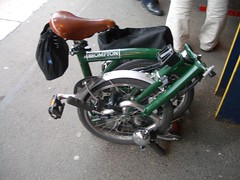
My fifth Brompton folder ~ one less car

Still the rain. News of three dying from heat in Corfu.

I've got 8000 words of this chapter done and now the hard part, getting it down to 5000. I'm cycling over to my friend and mentor Dr Lesley Prince this afternoon so that she can help me pull together a final version for a deadline on Tuesday.

I got this folding bicycle from Mike at Phoenix Cycles in Battersea Bridge Road, London in 2004. Walked in and bought it and he's looked after it since allowing me enjoyable visits across the Thames past the derelict grandeur of Battersea Power Station.

This valued artefact - a Brompton - is slightly longer than previous models, adding to its versatility - especially in allowing me to stand on the pedals which I found tricky on earlier versions. I've had several Bromptons over the eleven years since I bought my first. One was stolen in Lancieux in Brittany. One, through my negligence, fell under an intercity train in High Barnet and was broken into many pieces. One is in Ano Korakiana. One is in my mother's house in the Highlands - accompanying her recent move - and two, including this one, are in Handsworth. They are the design children of an inspired engineer who, with his team in London, works on them to this day and, within the small niche for folding bicycles, they are probably incomparable.

The bicycle in the picture is beside me as I wait for a train at New Street Station. It is ideal for what transport planners call multi-modal travel. Its low cross bar means walking is an easy choice, since it's so easy to hop on and off and stroll with it in places you might not be able to take a full size bicycle. It also carries lots of weight in a specially tailored pannier that slides on and off a sturdy bracket on the handlebar stem. I attached a large Dutch ding-dong bell for civility in announcing my presence. I carry an antique train whistle on a lanyard around my neck should I need to signal more urgently amid motorised traffic. Now get back to writing, Baddeley!
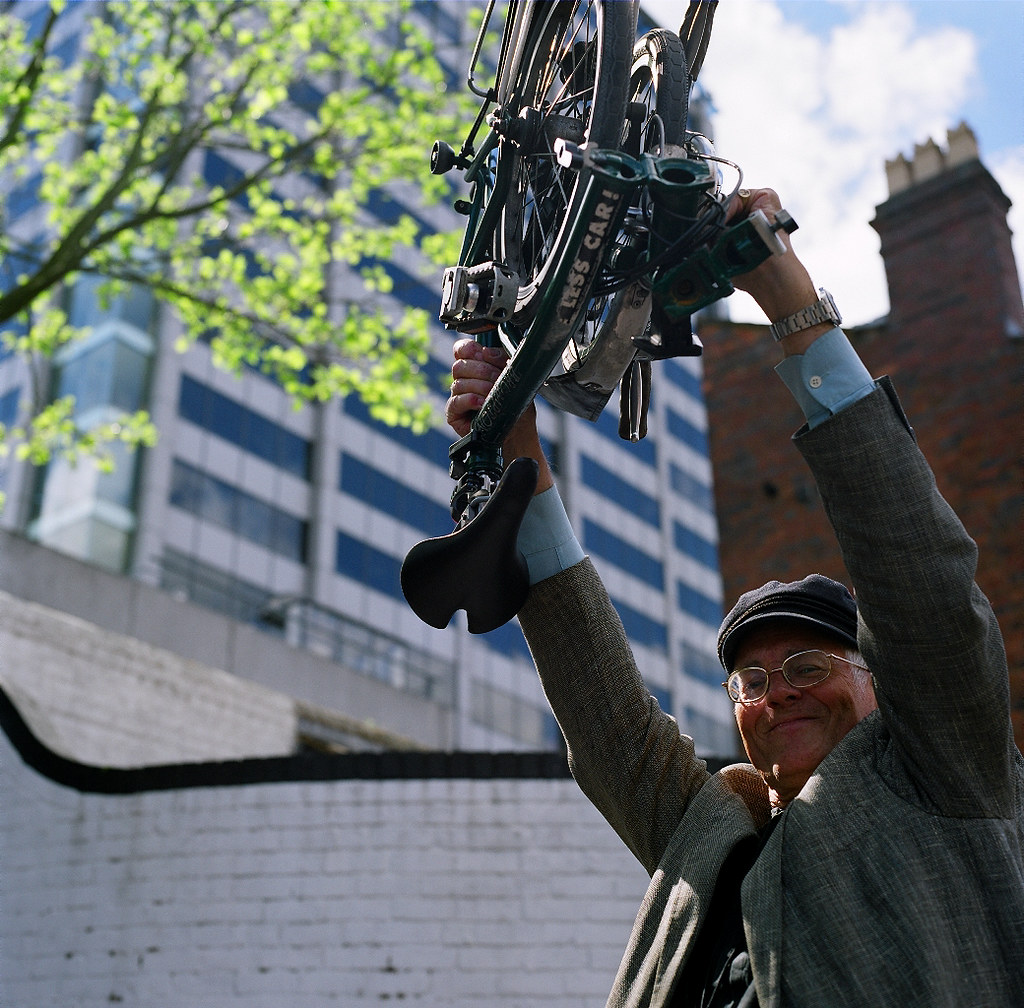
Me and my Brompton...one less car...portrait by Dan Burwood
At Gas Street Basin      Photo: Dan Burwood for Rescue Geography. 
* * *
Note from Bob McFetridge in Canada:
Simon. This article from today's Globe and Mail makes a bit more reference about the human impact on water patterns globally. I thought it might be of interest to you. "Human activity altering rainfall patterns": Sub-Saharan Africa is getting drier while more rain falls on North America in a global rainfall change that Environment Canada study shows is caused by humans. It has been quite extraordinary watching the news and hearing the interviews with those affected.
Today's study on Climate Change was released here in Canada (published in Nature). The potential impact will be a profound worsening of the human condition in the poorer regions and concomitant gains with more water in the wealthy regions of the world. Although I suspect the UK is not overjoyed about their new found wealth at the moment.
Our west coast has seen considerable rain this summer as well and records are breaking for temperature in the prairies - both consistent measures of CC modelling. Of course the challenge is to understand the difference between inclement weather patterns and actual climatalogical shift.
Some of what I am engaged in at the moment is trying to establish accessible data patterns in biodiversity that will allow monitoring of species changes in the ecosystem - particularly as they affect human health, food and economy.
There is a lot there in fact. The problem is that so much of it is in analog format and therefore hard to trap. Once again, however is the question of what we are actually seeing in a change. On the west coast, in my lifetime since I studied marine biology in the mid 60's, we have seen a number of species populations move as much as few hundred km north. Problem is they are mostly innocuous looking little invertebrates and so not particularly visible in the political landscape.
I watch all that water affecting urban and suburban populations and wonder how and when we will start to rethink our relationship with the landscape and how we plan our future development and protect that which we now have. All the best, Bob

Francis Zwiers is one of the lead authors of the complex study to which Bob has drawn my attention. Zwiers is based at the Canadian Centre for Climate Modelling and Analysis. The article in Nature - the equivalent for climatologists and other scientists as The Lancet for medical researchers - is being mentioned in newspapers around the world at the moment.

Tuesday, 24 July 2007

The banality of good - Η κοινοτοπια του καλου?

The picture of Barbati on the slopes of Pantokrator, taken by Lin from Corfu Fishing Port last November, has nothing to do with the discussion below. I just wanted a pin-up of the sea.
Από: Simon Baddeley
Προς: Nikos Dimou 20 Ιουλίου 2007 11:36 μμ
Θέμα: Re: Another bloody Philhellene*

I describe my blog as “waging peace” and I was thinking of adding the phrase “the banality of good” - both being about playing on the phrases “waging war” and “the banality of evil”. To complicate things I was hoping to have a Greek translation of these phrases that captured their meaning – but which was a good interpretation and not just a good translation. I am getting so much pleasure reading your articles. How I wish I could read them again in Greek to understand the extra nuance of the original. In fact so parental is Greek (and Latin) to English that much comes through but not all. Herete. Simon
From: Nikos Dimou (his third letter)
Date: Sat, 21 Jul 2007 08:49:39 +0300
To: Simon Baddeley
Subject: Re: Another bloody Philhellene

Well then it is: "i koinotopia tou kalou" - which is a bit Oscar Wildean ...

N. Nikos Dimou Athens
Greece www.ndimou.gr
doncat.blogspot.com
nikosdimou.blogspot.com
My tutors have been letting me know this isn't straightforward. From the office via my sister:
Dear Verena,
Thinking about the Greek version of “the banality of good” I must say that I cannot come up with a standard Greek phrase corresponding to it, not one that I know of anyway. I can attempt to “propose” something equivalent but in that case it would help me a lot to know the context in which the phrase will be used. There are words that could be suitable to create the Greek phrase. The choice depends on context.
Η πεζοτης του Συναιτου

Η κοινοτοπια του Σωστου


Το τετριμμενον του Αγαθου

Η απλοτης του Ορθου

Η απλοτης του Καλου

There could also be other good ways, involving more than two words, in which to express the concept satisfactorily, but knowledge of the context is necessary, Dimitris
And from Corfu
Από: Simon
Προς: Alex


Dear Alex
I need a philosopher. Is there a translation that captures the opposite of Hannah Arendt’s ‘banality of evil’?
Best wishes, Simon
Από: A 26 Ιουλίου 2007
Προς: Simon


Hello Simon. Finally, after a long and adventurous journey I am in Corfu, where I was greeted by an abnormal high temperature weather and scorching fires. I thought of what you sent me before and I asked a couple of friendly opinions here in Corfu, only to agree that we disagree with “kainotopia tou kalou” because it sounds bit like a prototype, an archetype or revolutionary. I think in the context of the firefighters it sounds better something like “aperantosini tou kalou” “to afilodokso kalo” “geneodoria tou kalou” mostly fit, meaning aperantosini – limitless, afilodokso – without the need for recognition, geneodoria – selfless giving.
In the concept of “waging war” or the idea of, if you use something like “evilness good” it would be an oxymoron. The solution might be the substitution of good with “areti” which is noble charisma and then can use it like “to proterima tis aretis” which is the advantage of having noble trait. I hope it helped a bit.
BTW, the Kapodistrias plan was not enforced properly across the country, therefore became a local and regional nightmare!
I also read the comments you wrote on the amazon website and I don’t think you went too far. I ordered the book because I want to see some of the actual writing and research. Hope you are flood-safe! Hopefully see you in Greece!
Cheers, Alex
[Note: Artemis Leontis in her brilliant book Topographies of Hellenism: Mapping the Homeland, Ithaca and London: Cornell UP 1995, which seeks - 'humbly' - to bridge 'the wide chasm between the dead and the living' (p.13) quotes Cedric H.Whitman on the difference between a classicist and a philhellene being 'chiefly this: . . . a philhellene likes the living Greeks, and a classicist likes the dead ones' The Vitality of the Greek Language and Its Importance Today, New York: The Greek Archdiocese Publication Dept. 1954]
* * *
21st century weather in UK from the Independent - 24 July:

Amidst all the news of communities being overwhelmed by water yesterday, one very significant announcement, from Gordon Brown and the Secretary of State for the Environment, Hilary Benn, was that the Government is setting up an independent inquiry to look at the flood events ... Its report ... may prove a milestone in terms of the British public's appreciation of the reality of climate change. It will doubtless focus on the key problem in terms of flood response ... but it may also take a view of the disaster in terms of global warming, and may well come to the conclusion that we are already witnessing the future. ... In April 1989 Margaret Thatcher ... gave her Cabinet a seminar on global warming at No 10 and one of the speakers was the scientist ... James Lovelock. A reporter asked him ... what would be the first signs of global warming. "Surprises." Asked to explain, he said: "The hurricane of October 1987 was a surprise, wasn't it? There'll be more." The floods of 2007 were a surprise as well ...

We got married - 31 Oct 1978

I just wanted another picture of the sea and me and Lin. The oil on the wall at 1 Daisy Road was my recreation of a strong north wind blowing across the Gulf of Corinth. If I get this in I've given myself an excuse for putting in more pictures of people. Gosh look at that knife. * * *
From: W*** Date: Tue, 24 Jul 2007 12:30:51 +0100 (BST) To: Simon Subject: Re: Permission to use 'The Gallery' image in my blog? I have been somewhat effected by this new tension between secular humanists and fundamentalist believers myself, I mean of all three monotheistic faith, not just of Islam. I am now a homeless wanderer (at the age of 53), trying to negotiate staying alive, with hiv, and trying to describe what is going on. I lost my home when Islamic fundamentalists sent me a sheep's head in London and the police had to move me out. I have been on the road since (for 2 years). I believe I am only one of the first of many who will be in this position soon. I love your reference to Goya, he has always been in the highest Pantheon of my heroes. I had forgotten about his 'exile', but of course remember now his Bordeaux washer-woman. I have just left Berlin and find myself in a completely new culture, where I know none of the language and not a single soul. This is very hard. I am still waiting to see what the outcome of this journey will be for me. I do not have Internet access at 'home' yet, but will be starting an artist residency (for 3 months) in this city on the 1st of August and will have access then. I would be very pleased to continue this sharing with you then. Sincerely, B*** Dear B***. Weber said ‘the relationship between democracy and bureaucracy creates one of the most profound sources of tension in the modern social order.’ Churchill said ‘the English never draw a line without blurring it.’ One enduring comedy - ‘Yes Minister’ - and two government enquiries – Hutton and Butler - attest its consequence (the relationship between politics and administration – the line of consequence and responsibility you present in The Gallery). Lord Hutton’s enquiry in January 2004 claimed that the scepticism of one set of managers about information presented to politicians by another set, had not reached the politicians. An important political decision – to make war - was based on the judgement of MI6, rather than the co-ordinated reservations of the Joint Intelligence Committee. Lord Butler, reporting in July 2004, included in his review of evidence for the existence of Weapons of Mass Destruction, a précis by a policy advisor of evidence collated by the JIC about the likelihood of such WMD in Iraq. That summary - the dossier - had ‘put a strain' he said 'on the JIC in seeking to maintain their normal standards of neutral and objective assessment’. Continuing, in the passive voice to avoid direct reference to the subject, Butler added, ‘more weight was placed on the intelligence than it would bear.’ The political decision that followed was catastrophic - its future consequences unfathomable. ... I imagine Thucydides being moved to tears of grief and anger at human stupidity and cruelty, yet determined not to lose the plot. He wrote what he did. You quoted him underneath an image. I found it while googling Thucydides. Now we write. Words written on a papyrus roll transferred to parchment codex to printed books and thence to cyberspace. Who could have known the old man had so much ink in him or doubted his pen was mightier than his sword.
Best, Simon

Monday, 23 July 2007

Leadership in government


My initial interest in political-management leadership began with an observation by John Stewart - government is a political-management system in which ‘the vote’ legitimates one of its two dimensions.

I've listened to many politicians and managers describing the nature of their working relationship. All have views on the relationship of politics and management. It is described as a bridge, a point of tension, a blend of political and administrative contributions, a trading space. What emerges most strongly is the tension between overlap and separation. If it could be covered by the codes of conduct that everywhere define member-officer relations, this might not be - but the fulcrum shifts. There's a fluid coalescence of politics and management. In the ideal relationship politician and manager know their jobs are separate - must be separate - but that they need to inhabit each other's worlds. They can be friendly but while they work together there must be no friendship.

This widely acknowledged contradiction between formally regulated separation and pragmatic overlap maintains the intensity of my interest. Weber wrote that the ‘the tension between democracy and bureaucracy creates one of the most profound sources of tension in the modern social order.’ Churchill said ‘the English never draw a line without blurring it.’

One enduring comedy and two government enquiries – Hutton and Butler - attest its consequence. Lord Hutton’s enquiry in January 2004 claimed that the scepticism of one set of managers about information presented to politicians by another set, had not reached the politicians. An important political decision – to make war - was based on the judgement of MI6, rather than the co-ordinated reservations of the Joint Intelligence Committee.

Lord Butler, reporting in July 2004, analysed a précis by a policy advisor of evidence collated by the JIC about the likelihood of WMD in Iraq. That summary - the dossier - had ‘put a strain' he said 'on the JIC in seeking to maintain their normal standards of neutral and objective assessment’. Continuing, in the passive voice to avoid direct reference to the subject, Butler added, ‘more weight was placed on the intelligence than it would bear.’ The political decision that followed was catastrophic - its future consequences unfathomable.

Any study of public sector leadership that does not recognise and endeavour to unwrap the intricate confusions and subtle tensions that arise from the overlap of political and managerial spheres of action and thought is pointing their torch in the wrong place - focusing on managerial or political leadership but not on their combined dynamic – especially the content and style of conversations in political-management space.

Despite the sense of humour that makes us laugh at 'Yes Minister' and the national disquiet that prompted those enquiries, none concludes there's ‘something rotten in the state’. No-one poured poison in anyone's ear. Briefings, précis’s, summations, even dossiers, that seek to capture large amounts of information from myriad sources and present them to politicians in a form that allows them to make informed choices are, inevitably, selective and so prone to the problem described by the enquiries.

Were the events that prompted Hutton and Butler not so grave, it is likely that the enduringly fuzzy line between politics and management would not have received such attention. Yet attention is just what is needed, if we are not to leave the study of leadership in government to historians, playwrights and novelists.

I got sent another copy of The Peloponnesian War yesterday with a note from an old bonesmen buddy in the flyleaf 'Ho Sibad. Wish I'd read ole' Ducididipops b4. Haven't got to the end yet so won't spoil it for yer!"

Sunday, 22 July 2007

"My fourth cat"


Mrs Kolcak, our neighbour, came to the door to say their big old cat had been scared up a tree after being set upon by the next neighbour's dogs. Specks of blood were on the rockery. Within minutes the West Midlands Fire Brigade arrived - five men in a big red fire engine. An extending ladder was raised. A young firefighter got the miaouing cat under one arm and carried him down through the awkward foliage. We clapped. "My fourth cat" he said. Cat, shivery but unhurt, went indoors to be fussed over.

* * *
This is from the 'north central' section of Stephan Jaskulowski's map of Corfu. It shows Ipsos Harbour to the east. Ano Korakiana to the west. The the winding roads to Sokraki and Spartillas to the north. It's 10 years old but still works for getting round by car, bicycle and foot - philhellenism at work! As good a map of the island and the city as any I've seen. Of course there's the detailed sections of the Corfu Trail and, no doubt, military maps* we can't see.

Stephan went all over Corfu with a GPS on this amazing project. How well he must know the ground. The section of his map I've posted is unpublished. Stephan, in Nottingham, sent it to me and it's helpful for guiding visitors over the five kilometres between Ipsos and Ano Korakiana. I've put a white cross on the map to show the whereabouts of 208 Democracy Street.
To obtain Stephan's published map of the whole island while supporting Agni Animal Welfare Fund visit www.agni-animal-welfare-fund.com/Maps.asp or e-mail Stephan at thecorfumap@ntlworld.com

*In the sixth chapter of Prospero's Cell Durrell mentions in his diary - 8/8/38 - that 'Bocklin has walked over the hills from Metsovo and arrived in the island' ... 'a tough looking specimen of the new Germany'. Bocklin, who Durrell knew in Paris as a 'seedy blond youth', unknowingly allows Durrell to discover, in a guest room at the White House, 'a bundle of accurate architectural drawings of the main harbour and fortress.'

Saturday, 21 July 2007

An e-mail to the Middle East
Dear Mr ** ** **, We are delighted to inform you that we wish to offer you a place on the Ph.D. programme, and official confirmation with full details of the offer is being posted to you today. We look forward to welcoming you to the University of Birmingham
An e-mail from the Middle East
My Dearest Friend and Teacher Simon. With pleasure and delight I forward the recent email I received on the status of my application ... The last battle I have to fight will be at the UK Embassy in ***** for Visas. I wonder how free I will be to mention you when the officials in the Embassy ask me of the people I know in the UK and where I will reside upon my arrival? Do you suggest that I give the address of a hotel or of your house in **** ? I thank you again and again and please pass my highest regards to the family. D** ** **
21 July 2007:
Dear D** ** **(my teacher!). Give my name and the address of our house and my name and address on campus (see attached). if you need further confirmation or reference let me know. Best wishes. Simon

Friday, 20 July 2007

Greece ranks at the bottom of EU tables

This is the kind of thing I dislike reading - from Kathemerini:
Remarks by EU Regional Policy Commissioner Danuta Hubner that Greece ranks at the bottom of EU tables regarding the absorption of community funds spent on road, railway and port projects say a lot about the incompetence of Greece’s political officials and the state apparatus in general. Her words shatter the impression cultivated by Greece’s idle politicians that progress on public works is stymied by a lack of money. The money is there, it’s just that the ministries have not hammered out any plans for how to use it.
I've spent my professional life studying and working with local government in the UK. Birmingham's transformation during the 1980s from a derelict late industrial wreck to a post-industrial European city was vitally dependent on the competence with which the City Council and its partners tapped into EU Regional Structural Funds. Of course that narrative's more complex. How do you rate a city's successful weathering of a 20th century crisis - the almost total loss to the East of its founding identity as the 'city of a 1000 trades' - the source of manufacturing wealth in a map that my school books covered pink to mark an empire?

I have watched our local councils go through compulsory competitive tendering, running intense annual evaluative audit - the Comprehensive Performance Assessment - the development of endless Performance Measurement, shifting from emphasis on inputs to outputs, submitting to efficiency reviews, continually meeting demands to deliver more for less. Now we see central government departments submitting themselves to Capability Reviews. There's still miles to go but that changes over the last 25 years have been dramatic.

The comments in Kathimerini would be supplemented by the curled lip contempt for Greek politicians and government that I encounter from my Greek family when trying to speak up for local democracy. In the flesh they are such fun to be with. They are all - over three generations - daunting in intelligence and talent. Phds, Firsts or nothing less than a 2:1 at Oxford, Cambridge or LSE; papers in journals so prestigious they are read only by a few people a year but last like oaks - Cambridge Journal of Economics; multi-lingual as toddlers; sisters as bright and successful as brothers.

So why am I reading about 'the incompetence of Greece’s political officials and the state apparatus in general'. The brightest star on the Greek side of my family is the son of a genius who started life in a Peloponnesian fishing village who worked as a deck hand.

The Greek students I encounter at my University work hard and are above average in intelligence. So why does someone unwire (if they did) the safety alarms on the gas-fired water boilers and why did police in Corfu accuse six individuals and one or more companies of negligence leading to manslaughter, negligence leading to serious bodily harm and negligence leading to endangering human lives in an apparently successful Corfu hotel (now re-opened) so that two kids died of carbon monoxide poisoning last October half-term holiday? Why do I get jokes like the one about the queue to get into Greek Hell where the devils are too lazy to bother tormenting sinners?

I've never met a lazy Greek, nor a stupid one. Where are they all? Why the jokes? What's with not only being unable to 'absorb' EU money for infrastructure, but 'ranking at the bottom of the table' for this capacity. You have to work to do so badly. Were the last Olympic Games secretly more of a mess than our Dome! Didn't look like it to me. What is this?

* * *

Of course I'm not being rational. How do you feel if someone's rude about someone you love. How dare they criticise Greece in their own bloody newspaper. I don't want to read this.

Yes yes I know. But you have to admit that Greek local government isn't as good as it could be. It is Greeks criticising Greeks.

Papsi papsi! I'm not listening!

* * *

Professor John Stewart - my colleague, Director for 17 years and original recruiter to Birmingham University in 1973 - told me when I bumped into him last Wednesday that one of his books - 'Modernising British Local Government' - had been translated into Greek. (details at www.epikentro.gr - and search for 'John Stewart; but on 16 nov 2007 I can see his name but not the book) John said he'd lend me his copy "I can't read Greek" he said, "Nor me" I said "but please, yes".


John STEWART
Επιμέλεια-εισαγωγή στην ελληνική έκδοση: Θεόδωρος Xατζηπαντελής

Η κεντρική θέση του βιβλίου είναι ότι τα προβλήματα του εκσυγχρονισμού της αυτοδιοίκησης δεν λύνονται μόνο με αλλαγές στις πολιτικές και οργανωτικές δομές. Η κύρια διαπίστωση είναι ότι πρέπει να ξεκαθαριστούν οι αρμοδιότητες μεταξύ των διακριτών επιπέδων και να αντιληφθεί η κυβέρνηση ότι πρέπει να προχωρήσει σε αναδιάρθρωση ολόκληρου του συστήματος διακυβέρνησης ξεκινώντας από το κεντρικό επίπεδο διοίκησης (δηλαδή τον εαυτό της) που πρέπει να αποκαταστήσει ένα χαρακτήρα συντονισμένης διοίκησης και όχι ένα άθροισμα υπουργείων που μερικές φορές γίνονται αυτονομημένα κέντρα αποφάσεων.
Το βιβλίο βασίζεται στην άποψη ότι μια αποτελεσματική τοπική αυτοδιοίκηση είναι απαραίτητη για την καλή διακυβέρνηση μιας κοινωνίας και αναλύει κατά πόσο το πρόγραμμα εκσυγχρονισμού στην εξέλιξή του μπορεί να διαμορφώσει αυτήν την αποτελεσματική τοπική αυτοδιοίκηση επικεντρώνοντας την ανάλυσή του στη δυναμική αλλά και τις αδυναμίες του προγράμματος εκσυγχρονισμού.
Όπως αναφέρει, μεταξύ άλλων, ο Θεόδωρος Χατζηπαντελής στην εισαγωγή του στην ελληνική έκδοση του βιβλίου «…Η διαπίστωση ότι στον πολιτικό ανταγωνισμό σχετικά με την Αυτοδιοίκηση συγκρούονται δύο διαφορετικές πολιτικές, η πολιτική που θέλει την Αυτοδιοίκηση εκτελεστικό όργανο των σχεδιασμών της κεντρικής κυβέρνησης και παροχέα δημόσιων υπηρεσιών σε τοπικό επίπεδο και η πολιτική που θέλει την Αυτοδιοίκηση θεσμό οργανικά ενταγμένο στο συνολικό σύστημα διακυβέρνησης της χώρας με διακριτές αρμοδιότητες σχεδιασμού και υλοποίησης πολιτικών για το σύνολο της περιοχής ευθύνης της, δεν είναι ούτε καινούρια, ούτε ισχύει μόνο στη Μεγάλη Βρετανία.…»
Πρόκειται για ένα βιβλίο εξαιρετικά επίκαιρο, που έρχεται να συμβάλει στη συζήτηση για το ρόλο και το μέλλον της τοπικής αυτοδιοίκησης όχι μόνο στη Μ. Βρετανία και στην υπόλοιπη Ευρώπη αλλά και στη χώρα μας.

Meanwhile:
Athens News Agency KAPODISTRIAS 2
Prime Minister Costas Karamanlis on Thursday had successive meetings with the leadership of Greece's main local authority unions, the Central Union of Municipalities and Communities of Greece (KEDKE) and the Union of Prefecture Authorities of Greece (ENAE), in order to discuss legislation for reforming the administrative structure of local government ... meeting was also attended by Interior Minister Prokopis Pavlopoulos, who afterwards stressed that the new framework would not be imposed on municipalities ... the new municipalities and communities code, would be tabled in Parliament in December this year. ... Also due for completion by the end of the year was a new code for prefectures, Pavlopoulos added ... the government's goal was to create stronger local government that would receive more funding, in line with the changes also taking place within the European Union. Under the plan, which has been dubbed 'Kapodistrias 2', local authorities are expected to join together and redraw their administrative boundaries - which will also increase the funds at their disposal - along the lines of the original and controversial 'Kapodistrias' plan passed by PASOK in 1998, which forced smaller municipalities and communities to merge with larger ones.
LETTER TO THE BIRMINGHAM POST Sir Having been involved, with many others, in long and successful campaigns to resist building on Handsworth Park and Black Patch Park in Smethwick, I’m vexed the government is pressurising Birmingham to surrender to housing, the parks, playing fields and allotments that should complement such homes, rather than being lost to them. If, under pressure from central government, we lose the plot on the stewardship of our urban green spaces, we will see our children living out their days in the cracks between the concrete we’ve laid over some of Birmingham’s most beautiful places. Yours etc., Simon Baddeley

More wet weather from the west

The sun was shining on Thursday morning. The house painter dropped in first thing. "I thought you were coming on Monday". "Have you seen the forecast? Better do it today."
We hadn't tidied where he needed to go. "I could kill you, Baddeley" said Lin. Showing Dannie the windows that needed repainting I said "My wife's angry with me for you seeing our mess" "Don't think about it" he said "We're Irish. We live like this." Such ingenious politeness almost placated Linda, while I felt complemented at being honorary Irish for not helping with housework.

By evening it was raining again. Then came an hour of thunder and lightning. I unhooked the WiFi until it passed. Rain continued through the night. This morning the surface of the ponds in the garden vibrate. The bird feeders are popular with a family of blue tits fledged from Amy's bird box - seldom fewer that five little birds at a time pecking away at the nuts, seeds and fat balls hanging outside our kitchen window, sheltered by the overhang of a Japanese quince, topped this time of year by the foliage of our venerable wisteria. Well aware that Oscar is across the road a baby rat comes out for the food dropped from the feeders.

Danica in Serbia tells of temperatures above 45 degrees in Belgrade. Our Met Office warns that Birmingham is the likely centre of the heaviest of today's severe weather. On Usenet Forums climate change deniers clamour with instances of past weather peaks to prove that out of the ordinary isn't, and all who disagree are 'commie freaks' and Al Gore supporters speculate on why 'these toads' have crept out from under their stones. I tell my students adversarial debate is part of democracy, quoting Churchill's maxim that 'jaw jaw is better than war war', but I dislike arguers who hurl abuse at each other from behind the hedge of cyberanonymity.
[Back to the future ~ 5 Nov 2008: see Keyboard Warriors on YouTube]

My class on politics includes pondering ways of using wit in the rough and tumble of public arguments, whether canvassing the public or in encounters outside the relative safety of a regulated debating chamber. A discussion last week, arrived at street escapology - getting out of sticky situations on buses, trains, sidewalks and other public places. J recalled how a man with a knife grabbed him from behind and whispered "I'm going take all your money and I'm going to slit your fucking throat". J replied "Why?" turning himself, for an instant, into a question mark. This, we surmised, for J was with us and I'd no cause to doubt his veracity, created a conundrum for his assailant. In the pause for reflection that followed J escaped.

These stories link wit to wisdom. Some last. "Tell us Lord, should we pay tribute money to Caesar?" How did the Naz get out of that one, in the glare of waiting reporters, not to mention those emissaries from the local theocracy seeking to have him arrested - if he said "no" - or discredited - if he said "yes"? 'And they could not take hold of his words before the people'. [Matt. 22:15-22; Mark 12:13-17; Luke 20:20-26] We spent twenty minutes unpacking the exchange and the escape phrase "render unto Caesar the things that are Caesar's and unto God the things that are God's" Theologians have raked this ever since, using it to define a disconnection between sacred and secular, though that'd been invented in Athens rather earlier. The actual crisis - trap set, sprung and evaded - lasted what? A hundred seconds? Wit is swift. It comes from the whole body not just the knowing bit. It is not - unlike joking - formulaic. It relies so much on the moment. If I'd said "Why?" to J's attacker it mightn't have worked at all. I've long wanted to be a fly on the wall when JC's questioners reported back to Caiaphas. "What did he say? Go on, what did he say" "Er well er um he said 'render... etc"" "What the heck's that supposed to mean? Look - let me think - right - yes - go and find a woman who's committed adultery, get the stoning ready, then ask him what's wrong with carrying out the Law of Moses. He'll never get out of that."

I just remembered I was talking, long ago, with a American Professor of English at Michigan - my son's late godfather James Gindin - about this particular street crisis. Confronted with the dilemma, a woman awaiting death, a crowd hefting stones and a pointed question about respect for the law, J bent down and began to write on the ground with his finger. Jim suggested Christ was letting them know he knew his scriptures too. I also needed to understand how deep in Judaism is respect for the law. Didn't it, he was implying, have some bearing on the precise conduct of a judicial stoning? His scribbling gained time to survey the crowd, to note the actual witness who must, in law, cast the first stone. As a communal act, any one stoner can evade the unpleasantness of being the one who started the killing. There was a click in my mind, as we chatted, about the three blanks rounds allotted at random to a firing squad, so each man with the vile task could hope his might be the rifle with the blank, and obey his orders and conscience easier. J looking up from his writing in the earth made hiding in the stoning party impossible. It was not the words "let he who is without sin cast the first stone" that, of themselves, saved the woman. How many times since has an equivalent plea fallen on stony ground? Jim said "He could have been writing anything - maybe just scratching". It was the gesture that mattered and the fact that what was spoken was to an individual not a crowd.

So what happened this time when the questioners went back to the High Priest? "What! Something about procedure? What on earth are you talking about? Who told you that?" "Well no-one as such but ..." "Fools, there's nothing but nothing about an actual witness having to throw first, you total idiots!"
[None watched with Christ. Though Peter tried, his courage failed him. None stepped to the mark when unesteemed, Christ faced his crucifiers.]
* * *
E-mail to staff: Electric Storms
Dear All. The inclement weather brings with it the risk of lightening strikes and as a result of this possible loss of service across campus. Last night the links between Edgbaston and Selly Oak campuses were lost due to hits on the Telewest exchanges and today the Conference Park was affected too. Both services are now active again with the problem last being rectified within a couple of hours.

Another e-mail:
For info – for those with a car there is a huge amount of water/fload on Egbaston Park Road at the level of the Vale and it is very difficult to pass though there to go to the City Centre
.
And another:
WEATHER CONDITIONS - FLOODING Importance: High
Dear Colleague. The University has been informed that the following roads are flooded: Bristol Road/Bournbrook Road Junction, Vincent Drive, and Edgbaston Park Road. I would be grateful if you could circulate this information to your staff in order that they can make alternative plans for their journeys home at the end of the day. Jonathan Nicholls

The Rector, Brian Hall, in the Parish Magazine of St.Mary, Handsworth for 7 July (delivered on Saturday) reports his return from a Greek Island holiday; his fifth visit to the same place:

What was unexpected (and for which I couldn't prepare) was the 'snowfall' of ash which, for three days, gently descended on us, carried on the wind from forest fires we could see driving across the mainland. At one stage there were 130 such fires raging out of control in the heat.

Thursday, 19 July 2007

Inventing Paradise

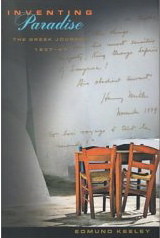
In the post this morning - the spells and potions of mid-20th century Philhellenes. I'll come to Byron later. This is an opportunity to become more familiar with the wonderfully crafted constructions that underlie the creation of Greece as an object of foreign admiration, passion, yearning and joy - not lust or possessiveness like some others - though some Greeks, one talented and very modern Greek polymath - Nikos Dimou - has written of this as a 'misery'. He's qualified that observation since. From the back cover of Professor Keeley's book:
In the looming shadow of an oppressive dictatorship and imminent world war, George Seferis and George Katsimbalis, along with other poets and writers from Greece's fabled Generation of the 1930s, welcomed Henry Miller and Lawrence Durrell to their homeland. Together, as they spent evenings in Athenian tavernas, explored the Peloponnese, swam off island beaches, and considered the meaning of Greek life, freedom and art, they seemed to be inventing paradise. In a lyrical blend of personal memoir, literary criticism, and interpretative storytelling, Edmund Keeley takes readers on a journey into the poetry, friendships and politics of this extraordinary time.
On Byron, British philhellenes get a taste of their own medicine. I saw a game of cricket last September while having coffee on the Liston. The grass was too long. There were too many cars parked round the pitch and I've never enjoyed cricket, but I felt quite proud. Byron sailed to Greece for the last time in 1823 and arrived at Kefalonia on the 4th August. I sailed to Greece from Messina with a friend in July 1962. The first morning of our two day crossing we were bouncing and swaying on a swift etesian reach. A sleek Greek frigate cut smoothly through the cresting waves heading west. In return to our salute she dipped her flag to us. I get a lump even now at that gesture - seeing that lovely ensign falling and rising again in the seconds of her passing as though official Greece was saying "yasus" just to us. Next morning we made Byron's landfall. Shapes - north and south - that appeared and disappeared and might have been no more than dawn shadows - though we knew otherwise - lay before us. All day, in zephyrs, we sailed towards them, passed between, and anchored off Killini where we rowed ashore to be sat at a table (my memory is flawed by many photos of Greek chairs - see Keeley's cover as typical), offered ouzikis and curiosity, before a polite policeman - reproached by our hosts - "po, po, po" - told us we were supposed to clear customs and immigration at Patras, but "please finish your conversation."
 * * *
Nikos Dimou 17 July 2007
"What a blog! A cornucopia! I know now I need no books for my vacation ..." Which cat feels like me on reading this?
[Squeak is grooming Bubble, and in the background - village sounds from Ano Korakiana]
** ** **
Back to the future - 25 July 2010: Henry Miller's Colossus of Maroussi reissued.

Wednesday, 18 July 2007

The Man in Seat 61

Message to Corfu Forums:
In the last 18 months we've travelled to Corfu four times, first by air, then by air, train and ferry and by train and ferry only. For train and ferry information visit the award winning website The Man in Seat 61
Contact me and I'll be happy to send examples of itineraries with prices for our recent journeys between Birmingham and Corfu and inexpensive places to stay in, for instance, Rome or Brindisi, if you're not sleeping on train or ferry. I'm used to flying but I'm interested in reducing my carbon footprint. In 2007 Trains and ferries seem expensive when compared to package air fares, but we anticipate cost differences between slow and fast travel getting less. Regards, Simon
* * *

E-mail:
Do you drive a car?

Reply:

I drive occasionally. Used to enjoy it, but got to dislike it more and more as the roads filled up and Jeremy Clarkson became popular. I don't like jams, want to avoid speeding and parking fines, hate speedophiles, but don't want to get enmeshed in the regulations that surround driving on the 21st century's closely monitored roads. I'm also aware of the damage our driving does to people and the land. I've come to detest urban sprawl - what's been called 'sloburbia'. Here's my review on Amazon of a book about relieving cities of car dependency.

As someone who doesn't like having their travel restricted I have largely freed myself from my own car and want to free myself from the consequences of other's dependence on cars. But my family drive, taking the test as soon as they could. I'm not religious about it but I prefer cycling or walking all year round and travelling by train and bus. I support Carfree Cities. Simon
Extract from my review in Local Government Studies, December 1999, of Sustainability and Cities: Overcoming Automobile Dependence by Peter Newman & Jeffrey Kenworthy (1999): The car, once it ceased to be an indulgence of the rich, always represented a balance between liberation and dependency. Today, the choices promised by cars are linked transparently to those they take away. Everyone knows about exhaust emissions and most drivers, outside advertisements, experience worsening road conditions. There is growing despondency among those who would like to use their cars less. They realise alternatives won't work unless people switch in large numbers to other ways of getting around. But the public space needed to take to the streets to walk or cycle and take trains and buses is unavailable. Many see public space as hazardous for themselves, and perilous for their children. Deprivations long imposed on people without cars apply, with increasing force, to people with them. New technology may reduce vehicle emissions. It cannot recover the enormous interaction space taken out of circulation by road traffic. Before that lost social space can become available for people outside cars, a legal and moral space has to be reclaimed.

In 2006 the global car industry put more cars on the road than ever, but more and more cities are pushing to decrease their dependence on cars, make better use of land and improving public transport.


Indulgence of the rich: my grandmother smoking a cheroot

Indulgence of the new rich: threading the jams

Monday, 16 July 2007

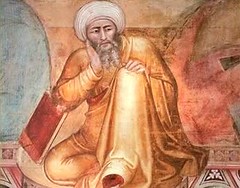
Averroes

Averroes Originally uploaded by Sibad.
I think of Averroes, and the Islamic thinkers who helped found modern medicine and who, centuries ago, strove to bring wise secularism to Europe's murderous theocracies. Thank goodness I have so many Muslim neighbours, so many teachers, friends and students who offer me and my family nothing but kindness and respect and who'd never be so ill-mannered as to insinuate their faith on me. Then I know the courageous conversation of Averroes and his contemporaries lives on Democracy Street. (see this analysis of Islam's modern dilemmas)
' ... doing little things with great love
E-mail from me to someone with a group on Flickr called 'hum drum town': I think your interest in the ordinary is extraordinary. I've been involved with local government all my career. It's focus is on the hum drum in people's lives - tho' of course there are dramas too. My blog is called 'waging peace'. It's about the ordinary things people and government's do - or don't do - to maintain civility and safety and peace. Among fire officers it's as much about preventing fires through monitoring and regulation as it is about bravely and efficiently putting them out. I'm interested in mundane tasks that keep the peace. When Hanna Arendt wrote in 1963 (I read her book Eichmann in Jerusalem in 1969) that Adolf Eichmann personified the 'banality of evil', it occurred to me that could be reversed. Best wishes Simon Reply: My father is involved in local government as well - so I guess from a young age I've been exposed to arguments from the Planning Commission regarding zoning, and building, etc. Waging peace makes a lot of sense to me. The small and the ordinary that comes into play here. Think of how much depends on people behaving in a civil manner. Big problems occur when we stop paying attention to small or ordinary things. Or maybe I'm just making excuses for myself. :-) I'm not really a 'big picture' kind of person. I just find that it makes more sense to 'think small' and to do little things with great love, if that makes any sense. Cheers & Best wishes, N

Manor Garden Allotments

PRESS RELEASE - IMMEDIATE - 16/7/2007 After Manor Garden Allotments won concessions from the LDA by threatening Judicial Review embarrassment, plotholders redouble their efforts to persuade the authorities of the value of incorporating the allotments as a showcase for sustainability principles. Media interest has increased again with ITV, BBC, Channel 4, Associated Press and France 2 TV continuing to broadcast features. NEXT FEATURED ON ITV “TONIGHT – OLYMPIC BACKLASH” 8pm Monday 16th July The public remain bewildered by the gap between the claims of sustainability and the reality of the total demolition taking place. The Olympic authorities and the Mayor refuse to acknowledge that their plan will destroy these 100 year old gardens and community, preferring words ‘save’ and ‘relocate’ – which for the plotholders means being bulldozed and forced to start from scratch in a contaminated field. Outside ITV studios at the recent ‘London Debate’, Mayor Ken Livingstone promised to visit Manor Gardens but has subsequently ignored further communications. Despite security and health and safety concerns having being used as reasons why the allotments could not be cultivated through to 2012, newly introduced access arrangements prove otherwise. Contact: info@lifeisland.org

Sunday, 15 July 2007

Third visit to Greece

Yiannis Moralis 1975 Originally uploaded by Sibad.
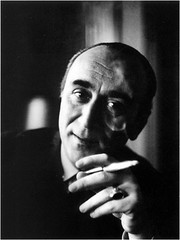
This is the look I recall. It's not my photo. I met him in Aegina in August 1968 with my stepmother, to whom he'd been married. Dad asked me to drive to Aegina, so we'd have a car for the family. I did the journey in four days - my third visit to Greece. I knew Yiannis Moralis'- Γιάννης Μόραλης - reputation. I've seen his portraits of Maria since - one on a card circulated to everyone at her funeral in 2005 at St.Sophia's in Moscow Road, Bayswater, her body laid with my Dad's ashes at Kensal Green Cemetery. Then, long ago, in Aegina, my memory is less of Moralis' work than the focus of his kind curiosity and quietness in the midst of much happy laughter, singing, eating, drinking and boisterous table talk in which, I, a polite political innocent so far as Greece was concerned, heard frequent reference to the name Markezinis. Outside the glow of a taverna, rather than squeeze through the crowd I strolled down the gravel road for a pee. The etesian northerly, which Maria detested and wouldn't call meltemi, was gusting as boisterously as our party, stirring the olives trees into a crackling roar that ebbed and flowed like breaking surf. Standing in the warm dark I was assailed by unfamiliar dread, more intense for the closeness of the bustling taverna. My anxieties are to do with enclosure, so this was odd. Maria said later, and matter-of-factly, that I'd had a bout of panic - sudden fear in a lonely or open place caused by Pan.
* * *
Dad and my brother George on a caique hired for the holiday. Dad was in the Foreign Office. His stay in Aegina was cut short because of events in Prague that broke on 21 August. I didn't visit Greece again for 27 years
In summer 1968 Georgios Papadopoulos, who'd led the previous year's coup d'état was claiming that if the 'Revolution' - as his Junta called it - stayed more than a certain time in power it would lose its dynamic and become a 'regime'. He was already trying to draw Spyros Markezinis into metapolitefsi - a word that only surfaces 5 years later to describe a return to democracy acceptable to those who'd taken it away and to a small number of old guard politicians - Markezinis being one - who might survive the risk of being close enough to the regime to achieve a recovery of parliamentary rule. On 13 August, as I enjoyed the beach, Alexandros Panagoulis tried to assassinate Papadopoulos as he was being driven to Athens from his summer residence.

My brother's address at Maria's funeral in November 2005:
Maria Baddeley: a tribute
Our mother, Maria Baddeley, was born Maria Roussen to Pericles and Lilly Roussen in Athens on 26th August 1916. Mum was the middle child of five daughters: her sisters being Janina, Emily, Dolly and Nora. Her father, Pericles, was Admiral of the Greek naval fleet. She adored her father who used to tease her affectionately: anticipating a boy, he nick-named her “Mario”. The five siblings, known as the “Roussen sisters” were a glamorous and much sought after part of the Athens social scene during the hectic interwar period. However, this picture of a happy family life was rudely interrupted when Pericles Roussen’s principled monarchist beliefs led to his imprisonment for refusing to jeopardize the Greek fleet. This caused his early death and the circumstances of the family changed dramatically. The young Maria was forced to abandon her education and take up a job working for an Athens power company. Our mother, who was always one of life’s natural bohemians, was greatly attracted to Athens’s literary and artistic community. In her early twenties, she became the model and inspirational subject of portraits by both her first husband, Yiannis Moralis, and other Greek painters including Yiannis Tsarouchis. Yiannis Moralis’s iconic portrait of Maria is now displayed in the National Gallery of Greece. She herself was also inspired to paint at this time and displayed an artistic talent that has been inherited by many of her grandchildren.During the German occupation and the ensuing Greek Civil War, along with all Greeks, she experienced great hardship and, in the prevailing chaos, she met and fell in love with John Halkett Baddeley, our father 'Johnnie.' She was introduced to Johnnie, who had been posted to the British Embassy in Athens, and soon after they married. Johnnie was captivated by Maria’s exoticism and beauty and Maria was equally captivated by his charm and English manners. They had a very happy, fruitful and loving marriage. After their marriage and, as the family started to grow, our mother embarked on life as a diplomat’s wife. Their combined charm and shared sense of humour and, especially Mum’s tremendous ability to empathise and make friends with people from all cultures and all walks of life, gave Dad vital support in his work. Together, they were a great gift to the diplomatic community of the time. Through the 1950’s and early 1960’s, our mother and the growing family accompanied our father on postings to Hong Kong, Singapore, Burma and Belgium. Mum had four children, Dorothy, Miranda, Oriana and me and she was a stepmother to Simon and Bay. In the early 1960s, Dad was posted permanently to the Foreign Office in London and the family moved to Sussex where Maria presided over a large house in Crawley where countless friends, relatives and diplomatic colleagues were welcomed, wined and dined in seemingly endless Sunday lunches. Once their children had left the family nest, Dad took up a new post at the British Embassy in Washington DC. Soon afterwards, Mum was left heartbroken as Dad became seriously ill and, several months later, died of cancer. After this terrible shock, Mum moved to Fulham where, while putting her life together again, she developed a passion for Fulham Football Club, now shared by many members of her family. From the mid eighties onwards, Mum divided her time between Greece, Switzerland and England. Despite her somewhat nomadic existence, she still created a home. This ‘home’ included, but went beyond, family and geographical boundaries. It was built from her personality, from her interest in us all, her intellectual curiosity and, most of all, her generous heart. This enabled her to see more of her extensive family, while also playing hostess to her wide circle of friends. In her later life, Mum flourished yet again as a loving and extremely popular grand mother, or rather “Granma.” Apart from all her grandchildren, she also had many great nieces, nephews and other young friends. It came naturally to her to show the same consideration to each one of them and she was loved dearly by all. They would often take turns to attend her renowned late night soirees. As all of us who are here today know, she was also a great friend to so many people who were very special to her: each person had their own unique relationship with her. She never forgot a birthday and she was renowned for her generosity. Mum had the discretion that was to be expected of a diplomat’s wife. She was someone in whom people could confide. They knew that they could speak to her at any time, although preferably after sunset! In recent years, Mum became increasingly frail (in body, not mind!). She had many people who helped and supported her. She made sure that they were all loved and cared for in return, as if they were a part of her own family.
Maria, Mum, Granma, was a devoted wife, a loving mother and aunt, a massively popular grandmother and a loyal friend. She was unique and irreplaceable. Over the years, she often spoke of her dream to be reunited with her beloved husband. Now, at last, they are together again.
Dad died in 1972 aged 52. His second marriage to Maria Roussen at the Church of Panaghia Kapnikarea in Hermou Street in Athens brought me three half-sisters and a half-brother[

Back numbers

Simon Baddeley