Total Pageviews

Showing posts with label map. Show all posts

Sunday, 22 July 2007

"My fourth cat"


Mrs Kolcak, our neighbour, came to the door to say their big old cat had been scared up a tree after being set upon by the next neighbour's dogs. Specks of blood were on the rockery. Within minutes the West Midlands Fire Brigade arrived - five men in a big red fire engine. An extending ladder was raised. A young firefighter got the miaouing cat under one arm and carried him down through the awkward foliage. We clapped. "My fourth cat" he said. Cat, shivery but unhurt, went indoors to be fussed over.

* * *
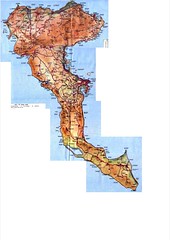
This is from the 'north central' section of Stephan Jaskulowski's map of Corfu. It shows Ipsos Harbour to the east. Ano Korakiana to the west. The the winding roads to Sokraki and Spartillas to the north. It's 10 years old but still works for getting round by car, bicycle and foot - philhellenism at work! As good a map of the island and the city as any I've seen. Of course there's the detailed sections of the Corfu Trail and, no doubt, military maps* we can't see.

Stephan went all over Corfu with a GPS on this amazing project. How well he must know the ground. The section of his map I've posted is unpublished. Stephan, in Nottingham, sent it to me and it's helpful for guiding visitors over the five kilometres between Ipsos and Ano Korakiana. I've put a white cross on the map to show the whereabouts of 208 Democracy Street.
To obtain Stephan's published map of the whole island while supporting Agni Animal Welfare Fund visit www.agni-animal-welfare-fund.com/Maps.asp or e-mail Stephan at thecorfumap@ntlworld.com

*In the sixth chapter of Prospero's Cell Durrell mentions in his diary - 8/8/38 - that 'Bocklin has walked over the hills from Metsovo and arrived in the island' ... 'a tough looking specimen of the new Germany'. Bocklin, who Durrell knew in Paris as a 'seedy blond youth', unknowingly allows Durrell to discover, in a guest room at the White House, 'a bundle of accurate architectural drawings of the main harbour and fortress.'

Friday, 27 April 2007

Stephan Jaskulowski's brilliant map


Stephan's map of Corfu
Originally uploaded by Sibad.
The more we roam Corfu - by cycle, car or on foot - the more I come to see the scale of the achievement of Stephan Jaskulowski in making this map of the island in 1996. Stephan was a working resident of Corfu in the 90s, found published maps of Corfu inadequate and in places hazardously innaccurate. Being a border state the authorities discouraged surveys. Over 3 years Stephan travelled over the island on foot, cycle, scooter and car with compass, altimeter and hand-held GPS checking roads, footpaths and tracks. This detailed map rich in additional information and inset plans of the city of Corfu is a unique labour of love. I wish Stephan would make a revised version that would pick up changes since he completed this project, but imagining the sheer scale of his original achievement I don't blame him hesitating. I still prefer this map to any other for exploring - and I don't want to know everything anyway and I can always ask for directions - though I'ver found that a gesture to take a right turn often means take a left and vice versa. The mainland stretched north to south in a tableau of varying greys in the damp air this morning. The shores are distinct and darker but beyond are the lighter and more distant peaks of the Grammos in Epirus - site of campaigns that 58 years ago concluded a catastrophe so terrible that even now it starts a lump in my throat to think of such happenings in a land we English have found so kind to us and of whose civility we hold such confident illusions. The vista is framed by the foreground of Vido Island and, even closer, Ipsos' breakwater and its cluster of masts including 'Summer Song's'. I caught the Korakiana bus into town to do some WiFi work and will catch it back to AK in an hour. Stephan e-mailed me on 8 May "Thank you very much once again for your very kind words and endorsement of the map." To get the map while supporting Agni Animal Welfare Fund visit www.agni-animal-welfare-fund.com/Maps.asp

Thursday, 5 April 2007

Ano Kato

Ano-kato means upper-lower. There's an Ano Korakiana - Άνω Κορακιάνα - and a Kato Korakiana. But through Ano Korakiana itself there run two roads - ano-kato. The higher road by the contours is Democracy Street. The views from both streets to the east and south east can be lovely. The village sits below the mists that can envelope Spartillas and Sokraki on the mountain above or the villages in the valley. [click on 'Ano Kato', in the title of this entry, to see a map of the village]

Here's a view I stole from Becky and Simon, restoring a house off the lower road described at anokato-acorfudream.blogspot.com/ - a dream so far unfulfilled (in early 2011 their house was still incomplete, rumoured for sale) and the blog ceases in 2007.

Tuesday, 3 April 2007

Democracy Street, Corfu, Greece


Democracy Street, Ano Korakiana Originally uploaded by Sibad.
DEMOCRACY STREET - the one we know - is in a village on Kerkyra or Corfu (Κέρκυρα), an island in the Ionian, close to the coast of Epirus, which includes Albania and the Greek mainland. The main town, which feels like a city, is also called Corfu. Ano (Upper) Korakiana - Ανω Κορακιανα - [Κόρακας means raven or crow] is in the widest part of the island on the slopes of the Troumpetta range - an hour's cycle ride, for me, from the port. Democracy Street runs through Ano Korakiana past the church of the Archangel Michael, past the Arestides Metallinos Museum, the school, a kafenion with views towards the mainland, the bandstand and the cluster of houses known as 'Little Venice' (for its architecture), turning north up a sinuous road past the small church of St.Isadoras, to Sokraki and over the mountains to the north coast. Westward, Democracy Street passes three general stores and surgery to a hairpin bend that leads to choices - one road running eastward again, almost parallel to Democracy Street (linked to it via steep footpaths between tightly clustered houses) to Ayios Markos and the sea at Pyrgi and Ipsos joining a north-south road along the east coast, another southwards via Kato (lower) Korakiana to the capital, and another westward to the sea via Skripero to Paleokastritsa on the west coast or Sidari in the north west. * * * Small facts gleaned from the web - which keep reappearing and need checking: Ano Korakiana - Άνω Κορακιάνα - is 18 kilometers from Corfu Town, about 3 from Ayios Markos. Its population in 1991 (last census) was a little more than in 1981 at 1400 - which is not the village trend. It has an orchestra founded in 1958 and a musical tradition going back to 1623 with the foundation of the Mantolinatas of the Pope (for which I will need an explanation). Ano Korakiana has 37 churches - the most interesting, to Byzantine scholars, are Saint Nicholas, the Archangel Michael (next to 208) and Saint Athanasios. The local school, a few metres east of 208, contains a small folklore collection. We heard from our friends in AK it was at risk of closing and being replaced by a psychiatric unit (What's new?). It's the birth village of the Greek actress Rena Vlahopoulou who died in 2004 at 81. She is quoted saying "I catch the boat from Patras and as I board I say to myself, now I’m at peace. I’m on my way home to Korakiana, I’m going to see my things, those who are close to me. I feel that Corfu embraces me every time I arrive." How true and I'm not even Greek, let alone Corfiot. Villages are being transformed all over the world. AK is probably no exception when it comes to a sustained communal core amid the foreign settlers and semi-settlers. It's not a 'tourist' village yet. The kafenion is open only at exclusive times. There's no restaurant or shop selling things other than provisions for residents. Notices are in Greek. Music practice can be heard at various times and chat in various registers - from outbursts of maternal invective, steady conversations, greetings, laughter, TV soap dialogue, monotonous sports commentary and chirruping domestic banter interspersed with the clinking of hardware in sinks, the acoustic of gossip shifting, as it comes outside, for washing to be hung or garden worked.

Back numbers

Simon Baddeley