Total Pageviews

Showing posts with label Dad. Show all posts

Sunday, 2 June 2013

'Out of Town'

From: Simon Winters
Hi Simon. Don't know if you are in UK and can make it, but there is a Kaleidoscope event on this saturday at Stourbridge. We are filming interviews for a major BFI documentary about missing tv. We will be filming David King about OoT. Can you make it and be interviewed? Cheers Simon
Stourbridge Station
Saturday morning I was on my way to the Talbot Hotel in Stourbridge. The middle aged man sitting opposite wore a floppy sun hat, travelling clothes that seemed to set off his bulk, peered at a satnav in one hand and a note book in the other.
"What kind of train is this" I asked. I had been on the vehicle once - December 2011 - before but spotting a true trainspotter I thought I'd see if I could find out more.
"It's called a Parry People Mover"
"I like it"
"It's the only one in the country"
No more was volunteered; the satnav getting full attention.
We trundled along a mile of bumpy single track surrounded by greenery arriving at the one platform terminus next to Stourbridge Town Bus Station. Via a lift and a tunnel I cycled down the High Street to where Kaleidoscope was holding one of its regular get-togethers, found Simon and after a cup of tea was sat with David King to be interviewed about the way we'd arrived at the 'Lost Episodes" of Out of Town.
Dave King, Out of Town DVDs and reels of archive film from the archive


Chris Perry asked questions. Rory was behind the camera. I extemporised about my stepfather and described Out of Town - not easy, as the tags 'country life' or 'rural pursuits' misses out on what was really a vehicle for my stepfather to enjoy chatting to a few million people about his favourite subjects - for instance rabbiting with nets - with brilliant illustrations from his camera-toting friend, of twenty five years, Stan Bréhaut...
Jack and his cameraman Stan


...and David told how he had discovered and saved the Out of Town episodes that Delta on the initiative of Charles Webster, put together and put on sale last year (Note: In Sept 2015 Delta became insolvent and the following month I terminated their licence on grounds of 'breach of contract', a condition that applies to any sold on copies of Delta's OOT DVDs). I spoke also of the 'unwieldy material' brought in April 2012 to a lock-up in Birmingham from South West Film and Television Archive - Stan Bréhaut's 16mm reverse negative location film with library sound effects...
...and a whole lot of - so far unmatched - ¼inch reel-to-reel tape of Jack speaking to these films and introducing each episode. I spoke briefly about technical challenges that I'd explained in more detail in the account included with the Out of Town 'Lost Episodes':
...I hadn’t only begun to grasp that the background sound on Jack’s programmes was added later – from sound effects in the library at Southern synched with events on Stan’s film. What was I to do with hours of such film? Jennie at SWFTA gave me a clue. She and her husband Roger, also working part-time at the archive, showed me a shelf of ¼” reel-to-reel sound tape in cardboard boxes. These for no obvious reason contained Jack’s voice as he talked in the studio from his set – a shed - and his commentary on Stan’s film for that week’s episode of Out of Town. It had taken hours to find the tape that went with the film. There was no order and no titles that allowed simple one-to-one matching. Roger, using a Steenbeck machine that could play separate film and sound tape simultaneously accurately splicing sound to vision. He then digitised the result and we had a 1975 episode of Out of Town as a gift for Richard Hill and his family. Well nearly. At the start and often at the end of each episode of Out of Town the viewer would see Jack  sat in his studio ‘shed’ from where he’d say “Hullo” before moving seamlessly into talking about Stan’s location film, run on a monitor in front of him in the studio. This all went out live. The location film would end. We’d see Jack again in his shed for a few remarks and a “cheerio” and the gentle signature tune Recuerdos de la Alhambra. So we had Jack’s commentary and location sound effects, but we had no picture of Jack in his shed. Richard’s film with which he was delighted came to him on a DVD courtesy of SWFTA with a stills of Jack inserted over the recording of his studio introduction. But what about the sound effects; of traffic, of cattle lowing, a fish splashing, wind in the trees, a bucket dropped? “People fill in the sound if you give them a clue” was Jack’s reasoning so I was told recently by one of Jack’s old colleagues, David Knowles. He’d certainly fooled me. I learned that my stepfather had made a point of asking expert sound people not to get “too clever”, inserting every possible event that might have had a sound. “Just make it sound like outside and synchronise doors banging and gun shots” I was slowly understanding why it was so tricky to trace whole episodes of Out of Town. “Jack loved to do high quality television on the cheap” added David who’d produced Jack’s successor programme - Old Country - for Channel 4 in the early eighties. My youthful memories of Jack musing about technical challenges were being jogged “I don’t want to go out in the countryside with a TV crew of half a dozen and a pile of kit. They frighten things away.” I learned after a bit that even Jack’s director George Egan stayed away, as Jack with Stan in essential tow went on location. “The finest outdoor cameraman in England” he called him, shooting silent, sound added later, and live continuity by Jack’s when broadcast. Jack knew that what made TV different from cinema and more than just lesser picture quality on a small screen was being live. He was stimulated by the risk of going out live but much more he relished the knowledge of talking there and then to his invisible audience. “We filmed nearly 1:1” explained Jack years later “The normal ratio of used to edited film is 10:I for the sort of thing I do. In commercials it can be 1000:1.” Jack and his team did minimal editing, had a minimal set and a minimal crew and it went out live with Stan’s silent location film plus library sound effects....
...and an episode about rabbiting from Old Country, successor to Out of Town, screened in the early 1980s on Channel 4 with Stan's successor, Steve Wagstaff, behind the camera..
Chris Perry, seeing the OoT film cans and sound tape I'd brought with me to Stourbridge said, to my delight, that he would introduce me to an ex-BBC expert who would know what needed to be done to wed sound and image from the archive. I've been looking for ways to get this done for two years now. I so hope this will lead somewhere.
In the early 1990s, When I was 50, I began searching for my dad, not the parent I'd come to know, but the individual who met and married my mum in 1940, whose DNA is mine...
He died in 1973, In the midst of war my mother and he, having made my sister Bay and I, were divorced. Living with my mother I would only get to know my dad after he'd been married over 10 years to Maria, who he'd met in Athens in 1949. Twenty years later, I'm learning more about Jack, the step-father with whom I enjoyed my childhood and youth from one Christmas in 1948. My dad's life is part impenetrable; hidden by his profession. He served in MI6 (Greece, Brussels, the Far East, London, Washington) until his early death at 52. My stepfather's life, including so much that was very public, is made puzzling by his versatile and invigorating self-invention. The novelist Graham Hurley,  who worked for Jack at Southern TV, wrote....
...It was this wonderful marriage of fact and fiction that made him such a great broadcaster (and inspiring boss). Like so many men from that generation including George Egan (Director of OoT), who flew SOE agents into France aboard tiny Lysanders), Jack had been through something infinitely bigger and more scary than any of us would ever find in television and it gave him a breadth and a perspective and a degree of creative mischief that was utterly beguiling. I put a number of the Out of Town programmes onto tape (Stan shot mute film; Jack's studio musings became the sound-track) and after a while I began to spot where fact strayed into fancy. Viewers, and gobsmacked youths like me, loved him. Like Stan, truly a buccaneer...
*** **** ***
Lin was entertaining Oliver most of the day after Amy.on her way to work, dropped him off. I got to see him later. He's not saying much tho' making lots of interesting sounds. We played on the sunny lawn after I got back from Stourbridge and later, for tea, sat Ollie in the same high chair used by my mum, by me and my sister, by our children Richard and Amy...
...Guy came round after work to collect his son.
I started working on removing woodwork and tiling holding our bath. It's got to come out so we can do something about growing damp in the room below coming, it seems, from under the bath. The bath was put in with great firmness in 1935. Getting underneath it, let alone extracting it,  is going to be a stinker given we want to save the long slate panel that runs beside it and seems immoveable. I removed the locker I built twenty plus years ago so that I could start trying to tease out the panel. Hopeless. I'm so tempted to take a sledge to the slate. But if I do I'll regret it. What a mess.

Friday, 8 April 2011

Ὄτι ἐγενήθην ως ἀσκος ἐν πάχυη

῏ο
My dad
Phone calls that come after midnight worry me but there's a line in the Greek Orthodox funeral service - a prayer of St John of Damascus - Ήχος α´ ποία τοῦ βίου τρυχφή διαμένει λύπης ἀμέτοχος´; Where is the pleasure of life that is unmixed with sorrow? I was in a log cabin on the outskirts of Ann Arbor when the phone rang in that different and distinctive American way. It was 1972 before tailored ring tones. It was at 1.35 in the morning when my half-sister, Dorothy, phoning round the world from his home in Dorset told me Dad had just died. Many years later she, the only one with him when he went,  said in passing (how she’s always said serious things) “Don’t ever get to thinking death is anything but very unpleasant.” In the same vein on another occasion (the only other time she referred to it) she muttered “Dad was so concerned not to give anything way,  he refused painkillers.” The two remarks made sense. The prolonged agony of death from stomach cancer, diagnosed a year earlier. The courage to ensure that drugged he imparted no intelligence, even to a beloved daughter. It was not until one mid-summer weekend in the 1980s, when visiting my stepfather who also lived in Dorset, hardly twenty miles away, that I dropped in on the farmhouse next to a small Saxon church; a village with a ‘worth’ in it’s name. I strolled up a short lane to the house. Someone in a floppy hat, gardening, greeted me. “I recognized you. You are so like your father.’ I hadn’t realised the new owner knew Dad. Though I’d arrived without warning, he invited me in for some tea. His family were out. Later he asked “Would you like to see the room where your father died?” He led me up a narrow winding staircase to a small bedroom that opened through a leaded mullion window overlooking a close cut irregular lawn fringed by banks of cottage flowers merging into a dappled meadow that became a shadowed orchard, with gaps for sunbeams in which butterflies sparred. “I did wonder if you were in the same line of work as your father.” “No I’m not.” He smiled. “No really” I said. Later in the churchyard I found a small commemorative stone, hardly larger than an upright brick, Dad’s name inscribed, almost hidden in the grass, where his ashes lay. Ὄτι ἐγενήθην ως ἀσκος ἐν πάχυη For I am become as a bottle in the frost."  In 2005 when my Greek stepmother, Maria died, these were brought to Kensal Green Cemetery to be buried beside her and we, my sisters and brother, with our children, had become the elders.
Maria, Simon and John Baddeley

Tuesday, 27 November 2007

Heading back to England

Athens Venezelos Transit: Flew out of Corfu at 0625. On the plane someone next me noticed I was reading Kazantzakis' Christ Recrucified. 'Do you like Kazantzakis?' No! I said I 'much more than "like'''. She said people either loved or hated Kazantzakis. 'You?' I asked. 'I like him very much'. I asked what she thought of his views on women. 'His second wife said he was impotent. That might explain much'. 'Oh' I was bemused. I would have to think about that. Wasn't Job impotent? Why should she say such a thing publicly? I am reminded of my ignorance. I was intrigued by Kazantzakis' views on religion. She said 'He is quite accurate about the church'. Wasn't Kazantzakis, like Tolstoy, driven by man's inability do anything about the misery of human life? In this aren't they in the tradition of the stoics, of men like Zeno, Epictetus, Marcus Aurelius and every creative endeavour in art or politics by men or women to better - I mean 'better' as 'overcome - the human condition? I guess this was not the impotence to which his second wife referred. But in the matter of eloquent shouts against the darkness Kazantzakis forked the lightning and sang the sun in flight. I was in confessional mood, because reading Kazantzakis at the same time as I was leaving dear Greece, I was ready to show more emotion than an Englishman should. D had already commented a few days earlier, after I'd told him the plot of Zorba the Greek, that I liked the tension between the Greek and the Englishman - especially as it was played in the film. 'So you see yourself as Alan Bates?' said D. I said to C, on the plane from Corfu to Athens, that I had reservations when first kissed on both cheeks and embraced by the Greek side of my family '...because we didn't do that. Not when I was young.' I said I'd changed over the years, as had England, reverting to a pre-19th century expressiveness - even in the north. 'I love Greece. However bad things might be, I could never not!' 'Why?' she mouthed. I didn't hear her as we were leaving the plane, standing, reaching for luggage. 'Why?' she asked again. 'I was infected by my father a long time ago. I have no wish to be cured' 'How' she asked 'did your father come to Greece and learn Greek?' I mentioned I thought he might have been in Epirus in 1949, involved somehow in what was happening then. She listened almost too intently - a habit of discretion breached by my curiosity. Lin would say 'Your big mouth!' In-flight to Athens: From the plane window I can see the mountains of northern Peloponnese under dawn mist and a few white clouds. I’ve found a transmission on 102.5 FM3 which I like. A mixture of Greek voices of all kinds and music. Last night, as I drove between Kato and Ano Korakiana, to collect an Indian take-away treat from Brynn for my last evening, there was a talk on sacred choral music. A thoughtful voice commented on extracts from Saint-Saëns, Handel, Mozart and Monteverdi. This morning as I drove south in the dark on empty wet roads to catch my plane home I heard, on the same channel, the news and, amid dawn chaff, some Mendelssohn. I understand a phrase here and there. It's how I understand – or don’t understand – music, but music and uncomprehended Greek were more than agreeable. I want to understand the church here. I'm qualified by ignorance, respect and faithlessness. The ancient tension between Protestantism and Catholicism was still around when I was at school. The Spanish Armada, Bloody Mary, the Inquisition were alive in our histories, quite separate, then, from the troubles in N. Ireland. There were bombs in our cities until ten years ago. Somewhere in all the economic and ethnic interpretation lay the old division that began with Henry VIII’s divorce from Katherine of Aragon. But on the great Schism between the Latin and Byzantine Churches, between the two popes, between Rome and Constantinople, I have no unharboured prejudices to moderate and come innocent to the filioque debate
[8/01/08: This subject scores 116,000 hits on Google and over a thousand revisions in Wikipedia since 2001 - and that's just the English version. When I was studying anthropology at Cambridge - long ago - one of our lecturers told a story about a people in West Africa visited by missionaries from different Christian traditions. The Chief, detecting competition between his guests for new souls, invited them to debate their positions in front of a formal meeting of the elders. Recognising how unfortunate, even ridiculous, would be a public argument of the kind that had divided European Christians for centuries, the missionaries, recovering mutual respect and love, succeeded in solving a problem that still occupies theologians. Both knew the local language well and agreed that the words that described the concepts that divided them were insusceptible to local translation. 'For words are wise men’s counters, they do but reckon by them; but they are the money of fools, that value them by the authority of an Aristotle, a Cicero, or a Thomas, or any other doctor whatsoever, if but a man.' Thomas Hobbes in Leviathan, ch. 4 (1651) I recognise the irony of my reliance on that quote. It was one I learned from my superb history teacher, Charles Keeley, at Westminster and it's been a good friend since, along with many other pearls he shared] [Filioque issue: The Churches were arguing about whether the Son played any part in the origin of the Spirit as one of the persons of the Trinity from the Father, who is the only ultimate source. The Latin word filioque, which means 'and from the son', was gradually inserted by Western churches into the Nicene Creed so that it stated that the Holy Spirit proceeds not from the God the Father alone, as the early Church Fathers believed, but from both God the Father and God the Son. The Eastern wing of the Church believed and believes that the Father alone had given rise to the Holy Spirit, and the idea that both Father and Son had done so was condemned as heretical.]
'When I said goodbye, with a small gift, to the Leftheris, I was invited into their dining room and treated to a skirto, and a tasty quince sweetmeat - kidoni gliko κιδονι - and some figs sweetened and mulled in ouzo. Ten of these were put in a jar, sealed with a ribbon and given me to take home with spiced bread from a name-day service at one of the Ano Korakiana's churches. Was there a church for every name? 'But of course, we have many churches in Korakiana. ' I thought Kiria L was saying this proudly, but checking herself to make it sound like a light apology, lest she create the risk of too many blessings. Or was it that so many churches means much labour? I didn't think it meant division. In Ano Korakiana there are 'many mansions'. As I sat making do with a mix of non-verbals, and sparse Greek and English, Leftheris smiled and said he'd seen his marrow on the internet. I was shown some photos of the grown-ups as children - Vassiliki, Themis (Themistocles) and Katherina. I said I was very happy they were our neighbours. We shook hands gravely and parted. On Saturday of my one week stay, I washed clothes and set out to cycle and walk to Spartillas on the slopes of Pantokrator. At the sixth hairpin bend on the narrow road to Sokraki above Ano Korakiana, there’s a narrower road running sharply off to the left by a house on the corner – the only one that far up the mountain. I cycled for a bit, but the inclines increased and the surfaces deteriorated - grooved by torrents. I went up and up. I passed the two masts with their generator motors rumbling. The vista grew and grew under a mildly cloudy sky, until the track levelled off, the road surface improved and I was cycling again through a plateau of small fenced allotments each with vines. I came, around mid-afternoon, into Spartillas and then enjoyed the longest of freewheels down to the sea through over twenty hairpin bends, stopping occasionally to gaze over the land to the south. After more work in the cyber cafe including sending a report home to Lin I cycled to From Ipsos, I cycled the twelve or so kilometres to Corfu town, gazing back at the distant heights I'd ascended and descended. In this picture there's a crack in the wall almost certainly caused by one of the earth tremors that occur here fairly regularly. Later I cycled back to Kontokali to meet D and T for a supper at George's - a delicious plate of pork off the grill with chips and a Greek salad, then onto the Navigator’s Bar where, to my quiet delight, the Saturday night karaoke equipment failed and a spatulate fingered bouzouki player, who happened to be there, entertained us instead. D drove me home, with the Brompton in the back.

Sunday, 15 July 2007

Third visit to Greece

Yiannis Moralis 1975 Originally uploaded by Sibad.
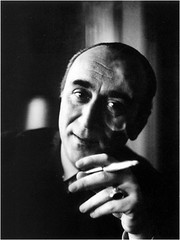
This is the look I recall. It's not my photo. I met him in Aegina in August 1968 with my stepmother, to whom he'd been married. Dad asked me to drive to Aegina, so we'd have a car for the family. I did the journey in four days - my third visit to Greece. I knew Yiannis Moralis'- Γιάννης Μόραλης - reputation. I've seen his portraits of Maria since - one on a card circulated to everyone at her funeral in 2005 at St.Sophia's in Moscow Road, Bayswater, her body laid with my Dad's ashes at Kensal Green Cemetery. Then, long ago, in Aegina, my memory is less of Moralis' work than the focus of his kind curiosity and quietness in the midst of much happy laughter, singing, eating, drinking and boisterous table talk in which, I, a polite political innocent so far as Greece was concerned, heard frequent reference to the name Markezinis. Outside the glow of a taverna, rather than squeeze through the crowd I strolled down the gravel road for a pee. The etesian northerly, which Maria detested and wouldn't call meltemi, was gusting as boisterously as our party, stirring the olives trees into a crackling roar that ebbed and flowed like breaking surf. Standing in the warm dark I was assailed by unfamiliar dread, more intense for the closeness of the bustling taverna. My anxieties are to do with enclosure, so this was odd. Maria said later, and matter-of-factly, that I'd had a bout of panic - sudden fear in a lonely or open place caused by Pan.
* * *
Dad and my brother George on a caique hired for the holiday. Dad was in the Foreign Office. His stay in Aegina was cut short because of events in Prague that broke on 21 August. I didn't visit Greece again for 27 years
In summer 1968 Georgios Papadopoulos, who'd led the previous year's coup d'état was claiming that if the 'Revolution' - as his Junta called it - stayed more than a certain time in power it would lose its dynamic and become a 'regime'. He was already trying to draw Spyros Markezinis into metapolitefsi - a word that only surfaces 5 years later to describe a return to democracy acceptable to those who'd taken it away and to a small number of old guard politicians - Markezinis being one - who might survive the risk of being close enough to the regime to achieve a recovery of parliamentary rule. On 13 August, as I enjoyed the beach, Alexandros Panagoulis tried to assassinate Papadopoulos as he was being driven to Athens from his summer residence.

My brother's address at Maria's funeral in November 2005:
Maria Baddeley: a tribute
Our mother, Maria Baddeley, was born Maria Roussen to Pericles and Lilly Roussen in Athens on 26th August 1916. Mum was the middle child of five daughters: her sisters being Janina, Emily, Dolly and Nora. Her father, Pericles, was Admiral of the Greek naval fleet. She adored her father who used to tease her affectionately: anticipating a boy, he nick-named her “Mario”. The five siblings, known as the “Roussen sisters” were a glamorous and much sought after part of the Athens social scene during the hectic interwar period. However, this picture of a happy family life was rudely interrupted when Pericles Roussen’s principled monarchist beliefs led to his imprisonment for refusing to jeopardize the Greek fleet. This caused his early death and the circumstances of the family changed dramatically. The young Maria was forced to abandon her education and take up a job working for an Athens power company. Our mother, who was always one of life’s natural bohemians, was greatly attracted to Athens’s literary and artistic community. In her early twenties, she became the model and inspirational subject of portraits by both her first husband, Yiannis Moralis, and other Greek painters including Yiannis Tsarouchis. Yiannis Moralis’s iconic portrait of Maria is now displayed in the National Gallery of Greece. She herself was also inspired to paint at this time and displayed an artistic talent that has been inherited by many of her grandchildren.During the German occupation and the ensuing Greek Civil War, along with all Greeks, she experienced great hardship and, in the prevailing chaos, she met and fell in love with John Halkett Baddeley, our father 'Johnnie.' She was introduced to Johnnie, who had been posted to the British Embassy in Athens, and soon after they married. Johnnie was captivated by Maria’s exoticism and beauty and Maria was equally captivated by his charm and English manners. They had a very happy, fruitful and loving marriage. After their marriage and, as the family started to grow, our mother embarked on life as a diplomat’s wife. Their combined charm and shared sense of humour and, especially Mum’s tremendous ability to empathise and make friends with people from all cultures and all walks of life, gave Dad vital support in his work. Together, they were a great gift to the diplomatic community of the time. Through the 1950’s and early 1960’s, our mother and the growing family accompanied our father on postings to Hong Kong, Singapore, Burma and Belgium. Mum had four children, Dorothy, Miranda, Oriana and me and she was a stepmother to Simon and Bay. In the early 1960s, Dad was posted permanently to the Foreign Office in London and the family moved to Sussex where Maria presided over a large house in Crawley where countless friends, relatives and diplomatic colleagues were welcomed, wined and dined in seemingly endless Sunday lunches. Once their children had left the family nest, Dad took up a new post at the British Embassy in Washington DC. Soon afterwards, Mum was left heartbroken as Dad became seriously ill and, several months later, died of cancer. After this terrible shock, Mum moved to Fulham where, while putting her life together again, she developed a passion for Fulham Football Club, now shared by many members of her family. From the mid eighties onwards, Mum divided her time between Greece, Switzerland and England. Despite her somewhat nomadic existence, she still created a home. This ‘home’ included, but went beyond, family and geographical boundaries. It was built from her personality, from her interest in us all, her intellectual curiosity and, most of all, her generous heart. This enabled her to see more of her extensive family, while also playing hostess to her wide circle of friends. In her later life, Mum flourished yet again as a loving and extremely popular grand mother, or rather “Granma.” Apart from all her grandchildren, she also had many great nieces, nephews and other young friends. It came naturally to her to show the same consideration to each one of them and she was loved dearly by all. They would often take turns to attend her renowned late night soirees. As all of us who are here today know, she was also a great friend to so many people who were very special to her: each person had their own unique relationship with her. She never forgot a birthday and she was renowned for her generosity. Mum had the discretion that was to be expected of a diplomat’s wife. She was someone in whom people could confide. They knew that they could speak to her at any time, although preferably after sunset! In recent years, Mum became increasingly frail (in body, not mind!). She had many people who helped and supported her. She made sure that they were all loved and cared for in return, as if they were a part of her own family.
Maria, Mum, Granma, was a devoted wife, a loving mother and aunt, a massively popular grandmother and a loyal friend. She was unique and irreplaceable. Over the years, she often spoke of her dream to be reunited with her beloved husband. Now, at last, they are together again.
Dad died in 1972 aged 52. His second marriage to Maria Roussen at the Church of Panaghia Kapnikarea in Hermou Street in Athens brought me three half-sisters and a half-brother[

Back numbers

Simon Baddeley