Total Pageviews

Showing posts with label Inventing Paradise. Show all posts

Monday, 28 April 2014

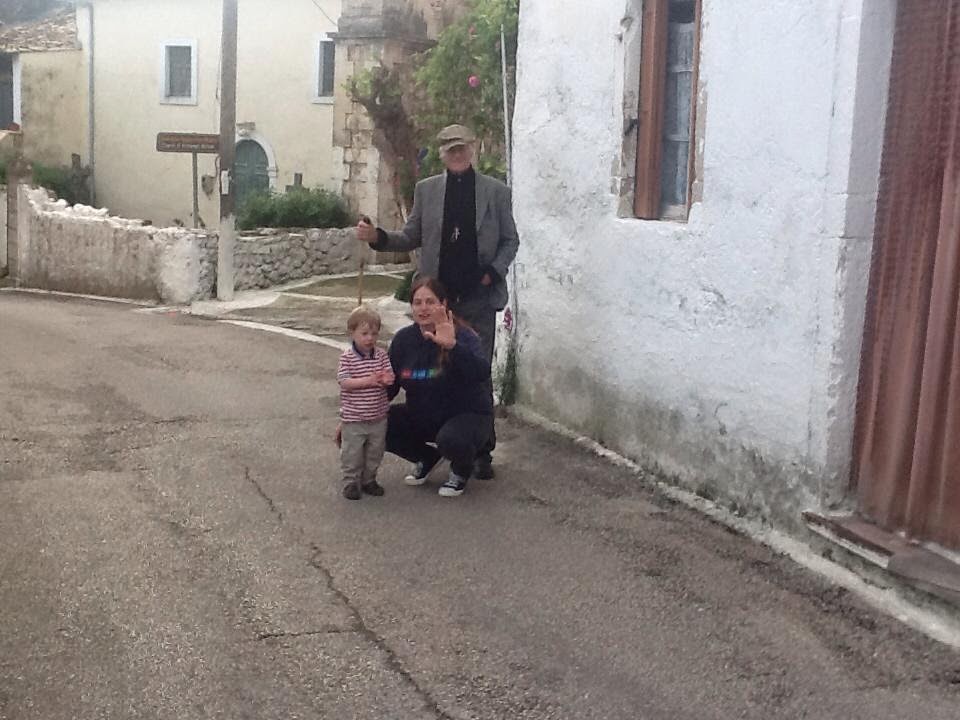
Our street

'Tourism serves everyone' by Aristedes Metallinos, village sculptor of Ano Korakiana 1981

See the wanton tourist led towards the olive groves on a priapic donkey by a handsome ragged-trousered peasant; Aristedes Metallinos' take on the arrival, in Corfu, of mass tourism. He'll pocket a negotiated charge in more than coin, and she an adventure to treasure. If I wanted the quaint ways of another country I’d enjoy them in our part of Birmingham where polyglottic heterogeneity is the norm; where we've many faiths whose celebrations are held in foreign voices displaying every colour under the sun of an imploded empire; where, to cite a depressing example, there are still parents who will kill their daughters for eloping with someone made unsuitable by faith or family. Many books by foreigners about life in Greece aim to entertain by parsing the exotic, describing with amusement and affection the folkways of 'our' village, presenting local caricatures - endearing postcards from abroad. Thus the sublime inventions that, apart from enhancing their authors' repute, created Greece as a post-war tourist destination by inventing a kind of paradise. 
All that’s changed. Edward Said's Orientalism has come home. In Greece, modernisation has made everything familiar and shared. The customers in Corfu Lidl – Greek and foreign – are almost entirely white, where in the same shop in Birmingham we find they're mostly black, with us a little different by skin and tongue. In the Ano Korakiana us un-Greeks are hardly the point of note we’d be if one of us were even slightly ‘mavro’. Our neighbours know more from their TV about the news in England then we. The marriage of Kate and William! They told of viewing the magnificent ceremony on their screen in the dining room; wondered what we thought. We’d seen nothing but folded headlines on passing news-stands bearing international newspapers. Ano Korakiana, even with us and plenty of other foreigners, has greater homogeneity than the road where we live in Handsworth. Does this mean I value arriving here, living here, any the less. Not one jot. But not because it's any more strange than our street in Birmingham, where I delight in most of our neighbours and they most of the time in us...so let us end any idea of Greece as an exotic country far from ours in place and culture. 
On our street in Birmingham


*** *** ***
The workable space in this house is reduced by rain. Wet weather loses us our small garden for drying laundry, the balconies for reading and eating and the veranda and path beside the house for other things we'd do out of doors.
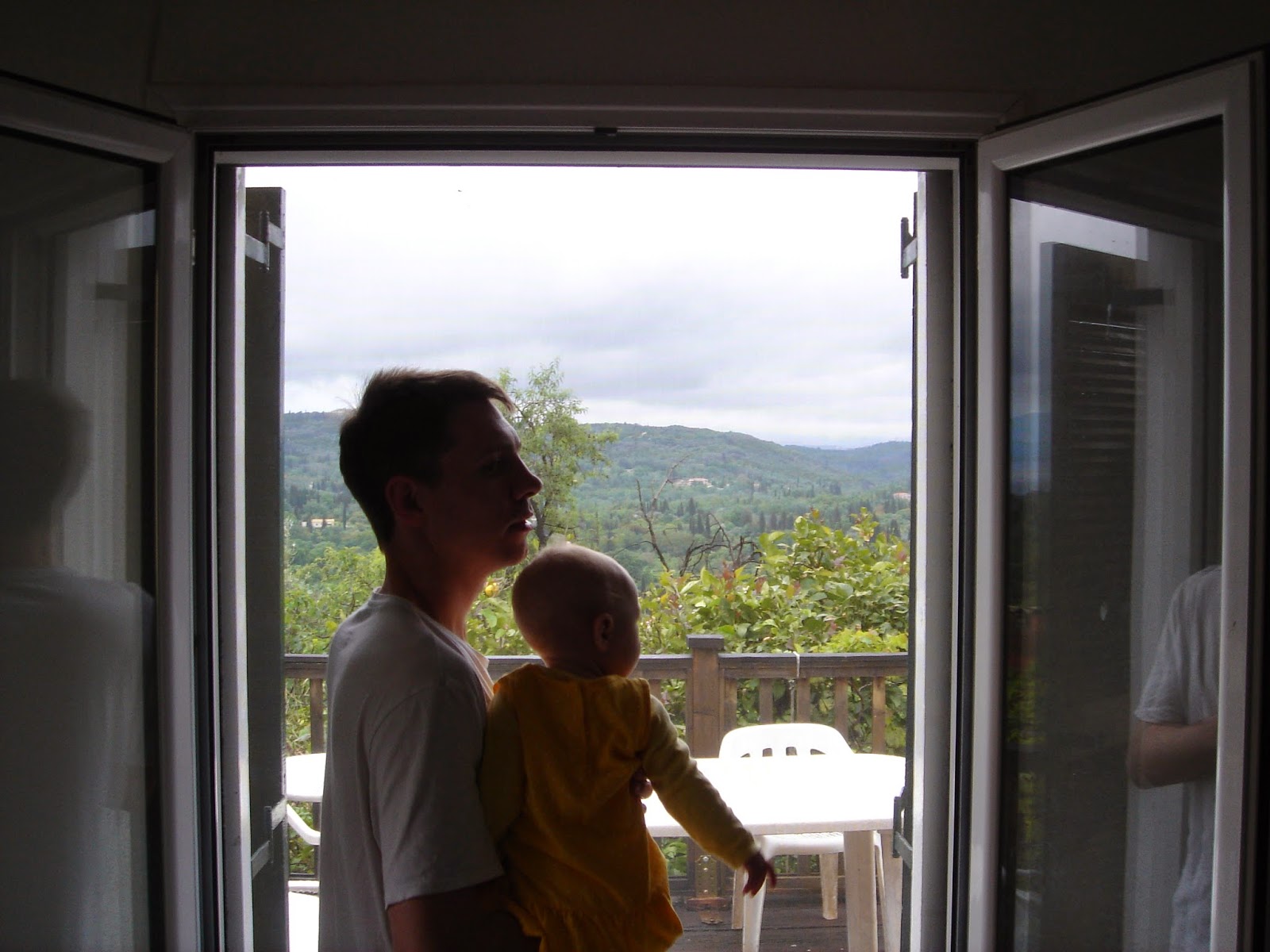
Matt and Sophia

Nonetheless it's a pleasure to inhabit - for a predicted while - a houseful of nappy talk, the collection and disposal of much extra rubbish, including feeding the cats food particles that fall from small hands and mouths untrained in table manners (note: Norbert Elias on the civilising process), wet-wipes, the discordant symphony of squeaks, wails and shouts of babes, and our shared and constant watch for risk. Oliver sleeps soundly in the room next to ours, though tiny sounds of slumber and waking penetrate the stud-wall separating our rooms. In the morning Lin and I hear clumping and knocks at the adjoining door; a sleepy child emerges to clamber into bed with nan and grandpa. Then in minutes it's 'pitch invasion' ....
Liz reads to Oliver under a quilt on our bed

...as Amy joins us from downstairs, and perhaps Liz while Matt attends to Sophia, and I'm up making tea and coffee, and, with everyone else, wiping surfaces.
Amid the grey wet weather - rare for this late in April - we've found intervals of sun and sea.
Paleocastritsa


Dassia before the clouds arrived


...and even in wet weather the city is a pleasant place to stroll, enjoy the children's playground at the Bosketto and look out to sea towards Vido, where the ferries pass, and on to the mountains of mainland Greece and Albania.
And on the way home there's Emeral for cakes and, especially, to choose ice cream cones, top them with sauces and sit eating them together as they dribble from tiny mouths...
Oliver at Emeral on the Paleo Road just north of Tzavros
..and this morning, Sally's at Ipsos - ethnically British with soccer on a big TV, all-day English breakfast and 60s and 70s hits on musak.


Sophia and 'Auntie Lin' (photo: Matt Basden)
Shopping in the rain
Oliver and grandpa at 208 Democracy Street
On Democracy Street ~ our neighbour Effie took an iPad snap and posted it to Facebook

Thursday, 19 July 2007

Inventing Paradise

In the post this morning - the spells and potions of mid-20th century Philhellenes. I'll come to Byron later. This is an opportunity to become more familiar with the wonderfully crafted constructions that underlie the creation of Greece as an object of foreign admiration, passion, yearning and joy - not lust or possessiveness like some others - though some Greeks, one talented and very modern Greek polymath - Nikos Dimou - has written of this as a 'misery'. He's qualified that observation since. From the back cover of Professor Keeley's book:
In the looming shadow of an oppressive dictatorship and imminent world war, George Seferis and George Katsimbalis, along with other poets and writers from Greece's fabled Generation of the 1930s, welcomed Henry Miller and Lawrence Durrell to their homeland. Together, as they spent evenings in Athenian tavernas, explored the Peloponnese, swam off island beaches, and considered the meaning of Greek life, freedom and art, they seemed to be inventing paradise. In a lyrical blend of personal memoir, literary criticism, and interpretative storytelling, Edmund Keeley takes readers on a journey into the poetry, friendships and politics of this extraordinary time.
On Byron, British philhellenes get a taste of their own medicine. I saw a game of cricket last September while having coffee on the Liston. The grass was too long. There were too many cars parked round the pitch and I've never enjoyed cricket, but I felt quite proud. Byron sailed to Greece for the last time in 1823 and arrived at Kefalonia on the 4th August. I sailed to Greece from Messina with a friend in July 1962. The first morning of our two day crossing we were bouncing and swaying on a swift etesian reach. A sleek Greek frigate cut smoothly through the cresting waves heading west. In return to our salute she dipped her flag to us. I get a lump even now at that gesture - seeing that lovely ensign falling and rising again in the seconds of her passing as though official Greece was saying "yasus" just to us. Next morning we made Byron's landfall. Shapes - north and south - that appeared and disappeared and might have been no more than dawn shadows - though we knew otherwise - lay before us. All day, in zephyrs, we sailed towards them, passed between, and anchored off Killini where we rowed ashore to be sat at a table (my memory is flawed by many photos of Greek chairs - see Keeley's cover as typical), offered ouzikis and curiosity, before a polite policeman - reproached by our hosts - "po, po, po" - told us we were supposed to clear customs and immigration at Patras, but "please finish your conversation."
 * * *
Nikos Dimou 17 July 2007
"What a blog! A cornucopia! I know now I need no books for my vacation ..." Which cat feels like me on reading this?
[Squeak is grooming Bubble, and in the background - village sounds from Ano Korakiana]
** ** **
Back to the future - 25 July 2010: Henry Miller's Colossus of Maroussi reissued.

Back numbers

Simon Baddeley