Total Pageviews

Showing posts with label Edmund Keeley. Show all posts

Saturday, 7 July 2012

What the Greeks went through

Dylan Thomas wrote to Lawrence Durrell in 1938 a letter from England which included the paragraph
...I think England is the very place for a fluent and fiery writer. The highest hymns of the sun are written in the dark. I like the grey country. A bucket of Greek sun would drown in one colour the crowds of colours I like trying to mix for myself out a grey flat insular mud. If I went to the sun I’d just sit in the sun; that would be very pleasant but I’m not doing it, and the only necessary things I do are the things I am doing. Unless by accidents, and my life is planned by them, I shall be nearer Bournemouth than Corfu this summer.
Jim Potts mentioned these observations on his blog recently, and in a note to me this morning, included the sentence:
It's extraordinary what the Corfiots (and the Greeks generally) went through in the 1920s and 1940s.
This made me think of suggestions that Corfu's beauty, tranquillity and wealth is enervating, not a place for an artist to be creative...
Dear Jim. Indeed. At the time Kostas Apergis identified those initials carved by a boy in 1957 he said Marcos was still living in Ano Korakiana...It’s knowing what the Greeks went through in the ‘20s and ‘40s that puts the lie to the idea of the ‘enervating.... bucket of Greek sun’ drowning the creative muse, as compared to colder climates...an error of Dylan Thomas and even Cretan Kazantzakis who described Corfu as 'fatal for a fighting soul'. A picnic on the Lazaretto?...
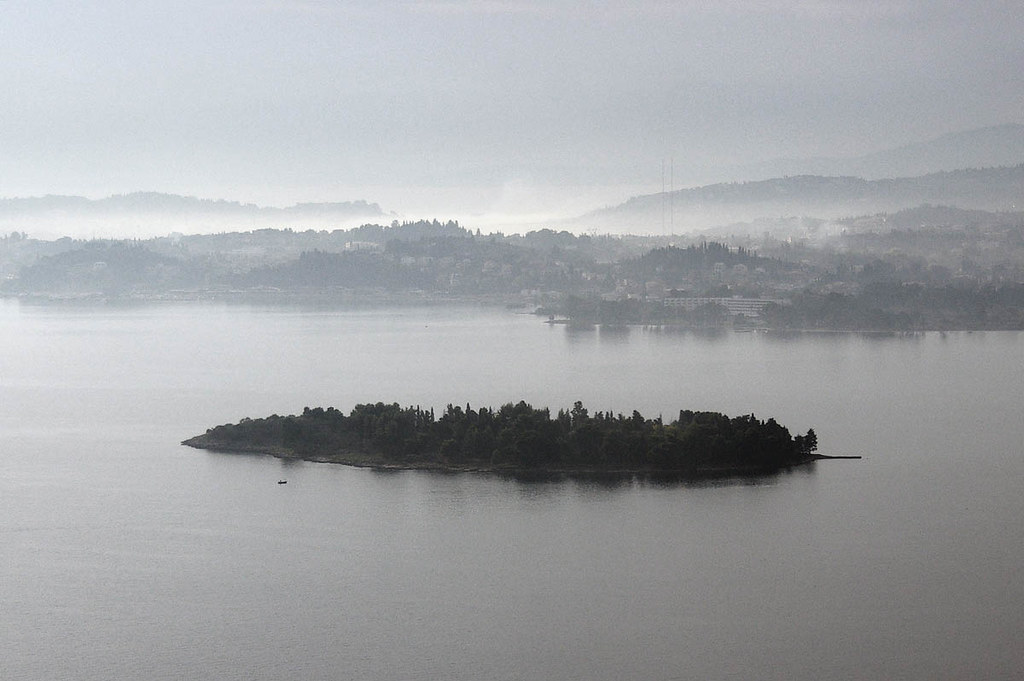
Lazaretto isle
The shame and cruelty of the young men and women being taken out under 'a bucket of sun' to that pretty green place; Theodoraki’s laments for his brother and others who died there; gentle Despina Bebedeli, Δέσποινα Μπεμπεδέλη, singing 'Sleep My Little Angel’...
Κοιμήσου αγγελούδι μου, παιδί μου νάνι - νάνι
Να μεγαλώσεις γρήγορα, σαν τ αψηλό πλατάνι
Να γίνεις άντρας στο κορμί και στο μυα - λό
Και να σαι πάντα μεσ το δρόμο τον καλό
You know this is not a lullaby to a baby, but a dirge, τα μοιρολόγι, for a youth in the ground of Execution Island. 
Greece, marketed as sun, sea and sand for fifty years, with ruins thrown in, is an image of the country that deceived even Dylan Thomas and no doubt other intellectuals (tho' I can compile a rebuttal inventory starting with Robert Graves and D H Lawrence, Camus, Hemingway and Leigh Fermor - it’s not just Greece but the decadent sun of the olive belt) who need, or feel their muse is further north, as though Greece is winterless. 
Lazaretto ~ each flower marks an executioner's bullet (photo: Jim Potts)
Corfu is full of ghosts; worse - spectres. She overlooks, as you well know, a peaked landscape of the imagination stretching from Saranda to beyond Levkada. Things were done on Corfu by the signorini that are lost to all but family history, even then reduced to small anecdotes that hide the larger oppression. 
What of the Jews, Greek citizens, taken from their city so near the end of the war, to join the thousands of others from Ioannina, Athens and Thessaloniki? It’s true that the skulls are not on the surface as they are in the Mani, but they lie in similar numbers beneath the beloved island’s green turf. The flaw in the 'ennervation thesis' is that so many northerners know almost nothing of modern Greek history. They know little even of the time before that - of the loss of Constantinople Κωνσταντινούπολις. 
I sent two birds to the red apple tree, of which the legends speak. One was killed, the other was hurt, and they never came back to me. Of the marble emperor - το Μαρμαρωμένο Βασιλιά - there is no word, no talk. But grandmothers sing about him to the children like a fairy tale. I sent two birds, two house martins, to the red apple tree. But there they stayed and became a dream.
There are refugees via Cyprus and Crete on Corfu, some in Ano Korakiana, who hold the memory of the marble emperor and the loss of Greece’s Byzantine capital. E.M. Forster met Constantine Cavafy in 1918 in Alexandria living off a narrow street in a flat above a brothel - 10 Rue Lepsius. Alexandria. Or was it in a letter Cavafy wrote to Forster? The poet told Forster that the Greeks and the English were almost exactly alike, but for one crucial difference: 
"We Greeks have lost our capital -- and the results are what you see. Pray, my dear Forster, oh pray, that you never lose your capital." 
Some suggest he referred to financial privation. Forster knew it was Constantinople. Northerners are confused by a hazardous semi-knowledge of what has happened here in the last 200 years. Greece's classical history - tho' in detail as exactingly complicated and messy as the modern one (see the actual alliances involved at Marathon, Salamis and Thermopylae for a start or the conditional liberties of Athenian democracy) - is so tremendous; fills such a vast part of educated people’s mental DNA, there’s hardly room for the utterly unfamiliar morally complicated Balkan mayhem of the Greek War of Independence.
“Wasn’t Byron involved?”
And what of the Souliotes betrayed by Pelios Gousis? ...πως ο Εφιάλτης θα φανεί στο τέλος. What of the women of Souli?
THe great schism? The big idea? The burning of Smyrna? The exchange of populations? What are they? Noble Kolokotronis at Dervenakia, Venizelos, Theotoki, Kapodistria, Mavromikali? Who are they? Klefts? The dance of Zalongo? Distomo? Kalavryta? Kommeno? The famine of Athens? Blokos?  The holocaust of Viannos? The dekemvria? The white terror, the red terror? Metaxa?
“Oh yes Metaxas, Very nice after a good meal”...
...and I haven’t got to the Stone Years, τα Πέτρινα Χρόνια. The Junta. (See Mazower's After the War was Over) And not only the 20th century but far further back. Thucydides: 
It was in Corcyra that most of these audacious acts were first committed and all the crimes that would be perpetrated in retaliation by men who had been governed tyrannically rather than with good sense and had the chance of revenge, or that would be unjustly designed by others who were longing to be relieved of their habitual poverty, and who above all were animated by a passionate desire for their neighbours' property; crimes too that men commit, not from greed, but when they assail their equals and are so often swept away by untutored rage into attacks of pitiless cruelty
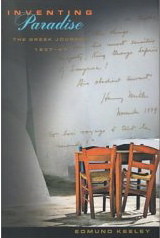
Another bolster for the enervation thesis is that for the Durrell’s, Corfu was a childhood paradise. They wrote with unsurpassed brilliance about happiness. Their joy may have aroused envious critical suspicion; an inclination to treat them as fantasists or, if telling the truth, describing a lotus eating haven that eats creativity. Edmund Keeley wrote Inventing Paradise. His word ‘invention’ captures the point.
I cannot subscribe to the enervation thesis on the grounds of landscape alone - a place with panoramas that elude the painter perhaps, but cannot fall short of the Netherlands or England for inspiration. Just because I’ve been so happy on the island doesn't make it enervating in my book, but then I have no book. I rest my case. Best, Simon
*** *** ***
Public or private dentistry?
I needed an extraction, some cleaning and some tidying. I went to a private dentist and met a nice and competent seeming surgeon. His estimate after an examination came to £5803. I went to an NHS dentist and talked to another nice and competent seeming surgeon. His estimate, after examinaton, was £208. The difference? The first dentist would replace my extracted tooth with an implant, and possibly another - the process completed by December. The second offered a small denture - the process completed in the time it'd take to make the denture - just over a week. I could afford to go private but I've got better things to do with £5959. I spoke to Lin and worried the matter for a week then went to the NHS where they made a mould in ten minutes. I came back in a week, had a local anaesthetic. The tooth was out so quick I hardly noticed. I was cycling home, my gadget in place, within half an hour. My three little false teeth are finely wrought and comfortable, and give my mouth a better appearance than it's had for years, but I'm not a toothy smiler anyway.
*** *** ***
Saturday afternoon Richard showed Amy around his flat in town and we went to the Bull Ring, to Jamie's Italian where I bought them a rather too expensive late lunch and Richard and I both managed to hold Oliver without dropping him or making him weep.
Later Amy inveigled me into Gap where there was a 45% off sale, except her choices of baby clothes were not in the sale. Next door Apple was packed but a figure waved to me from the crowd - Niko, our tutor. We embraced.
"When can we have our next lesson?"
"I've been very busy. Christina and I our getting married in September"
"Oh no! We'll be in Greece"
"I'll send dates for us to get together"
I introduced him to Amy and showed him my grandson, fast asleep in the odious hubbub of the shopping centre.
Strolling up crowded New Street Amy bumped into two of her police colleagues on duty.
We walked on.
"Just after I went on maternity leave" she said "Operation Paragon started belt tightening. My area will have changed when I go back. It's larger."
**** ****
Scholarship on two wheels! John Martin and Alistair Walker with Annie Guthrie filming as they go, continue their great shared cycle ride across Canada, studying sustainable communities; writing their thoughts as they go, every sentence is the tip of an iceberg, with a hundred elaborations and examples to be pursued on the way to explanation and insight on the habits that make for sustainability.
John, Annie, Alistair
The metaphor of a community on a journey becomes more powerful as the reader realises that their propositions are emerging from a transcontinental bicycle odyssey. Every working community is indeed unique yet governments and individuals seek the guidance and even the shock of admonition derived from general principles. Uniqueness is the watchword. Creativity is vital. They're explorers composing, as they travel, a sophisticated yet practical map of imaginative intellectual territory that for many currently in power has been illustrated by exotic beasts and blank spaces. Their new map will assist more and more people and communities to make more and more unique journey’s towards sustainability, helping more and more to join ‘the long conversation’, spurring more and more negotiation with the dominant economic paradigm. The final map won't be overwhelmingly burdened with data, with acronyms and endless statistics. They will know all this of course as they noticed and felt, in the seat of their pants, the rich detail of the endless surfaces over which they pedalled. They’ll have breathed it all in. Their exposition will be more like those ingenious ‘mud maps’...
...the aboriginals use, which in context reveals more truths than the precise measures of modern ordnance survey about a place and its inhabitants
Given the requisite variety of communities there is an infinite number of ways of achieving sustainable outcomes. Each journey is unique. Every community is concerned about its success and continuity. The way they achieve this is an individual journey, at a point in time influenced by both externalities and the capacity and commitment of the people who constitute each community to adopt new ways of working. We have seen many communities in our journey across Canada, some more closely than others. Some are doing well, some not so. The question we are often asked is: what makes for a sustainable community? ‘Institutionalising’ or incorporating sustainable living practices into the formal regimes of society is, I believe, an essential outcome for building sustainable communities.A key success factor in this continuity is the extent to which...
*** ***
It's clear that the onion fly has been causing harm across the VJA site. I've been getting advice from other plot-holders planning for future crops of onions and leaks on the use of nematodes. I've clearly got a world of understanding ahead of me with these. One snag is their cost. During a rare sunny patch I harvested more spring onions and broccoli from the plot.
***** *****
On Sunday afternoon, Linda and I completed Wednesday's Handsworth Helping Hand's work in the Church Vale Triangle, laying out plants donated via Freegle, including perennial Geraniums, Lilac, Hypericum, Big Leaf Periwinkle and Alpine Strawberries. Three of the seventy or so Pelargonia we planted on Wednesday have been pinched. We replaced them.
*** ***
Letter from a friend on holiday in Corfu. She had asked for advice on places to visit while there with her daughter. I cautioned her on a general truth about contemporary Corfu - in this case the despoliation of Paleocastritsa - while describing the possibility of exquisite places to be discovered close by - especially on foot or bicycle:
Simon. Greetings from beautiful Paleo. Your bespoke guide has been invaluable. I carry a printout in my beach bag. Thank you. We are here for another 3 of our 14 days. It  has been delightful. We have only had a problem with the weather - a heatwave! Really - can't believe I am complaining but sometimes too hot to move from our shaded cove. Everywhere a noticeable lack of people which is great for us but not for the locals. We didn't hire a car so have been walking everywhere. We recommended guests to your friend Sally's hacking tours and they loved the trek. Monastery great - after all the awful half empty coaches have left for he day. Glorious dusk. Restaurants good. London prices unfortunately. xxx Beach just perfect. We also like being able to find different spots to explore and enjoy the peace and cicadas. We are celebrating. My beautiful daughter, Genevieve has got a First in her Part 1 Tripos - English. She got the news here so I think Paleo will always hold precious memories for her. Greek Champagne is delicious! love Fiona
Genevieve in Corfu

Monday, 6 August 2007

I entered the home of a woman...

Mum with Ann Muir on the road to Coignafearn - one of our walks beyond Garbole, about 18 miles south of Inverness. When we were here in February, the hills were covered in light snow, the ground was frosted, the river was full of ice; a chill wind from the east; deer were feeding in numbers on the flat of the strath. This day was mild. The dogs, who never chase stock, scampered happily up and down the hills. The valley was full of the sound of the waters of the Findhorn. My mother - 90 this year - sighs at needing a pusher. She'd prefer to be clambering to the higher ground with the dogs, but her balance fails her. Ann is from South Africa, from a farming family, here to help care for my mum until September. Coignafearn is owned by Sigrid Rausing, daughter of the Tetrapak billionaire Hans Rausing inventor of ingenious cartons for milk and juice. His daughter is a noted ecologist keen to protect the golden eagle population. In Strathnairn just south of Inverness at my mother's house. The Highlands are as I like them - misty and damp with midges and occasional intervals of sun to enrich the matte landscape, brightening violet heather, great purple thistles - symbol of Scotland - and lichened granite with dazzling light which later reddens a lingering watery gloaming. The wind roisters the birches round Brin Croft, Mum’s new home at Inverarnie full of bready smells, and the furnishings and decorations of Mains of Faillie - two miles north, now chill and empty with furniture marks on the scuffed carpets and weeds encroaching the gravel that for 40 years has crunched with our arrivals and departures. Lin and I arrived at Brin Croft late Wednesday night, after she’d driven north all afternoon – through the Lake District, to the border at Carlisle – not even halfway – through the lowlands past Lockerbie and Dunblane to the edge of Glasgow, a long dog leg by Stirling to Perth and the last hundred miles by Pitlochry and Blair Atholl before, at last Drumochter Pass, by the Boar of Badenoch and the Sow of Atholl and Dalwhinnie – the Highlands begins and dusk is on us as we pass Aviemore, Carrbridge, Tomatin, Ruthven and Moy and come to the slope before the turn to Fort Augustus that brings us by the low road to Inverarnie, to drink tea, with, for me a sip of Speyside malt (present from my eldest Greek sister) before a wood fire burning in a stove surrounded by slate slabs. Oscar joined the biscuit terriers clustered to delight each other with greeting barks that turned to growls, squeaks, smellings and lickings. Next morning, by sleeper, Kalvin and Emma – my relatives slightly removed – arrived to stay the weekend. Emma’s expecting a child in October and they’ve decided not to know if it’s a boy or girl. Amy came on Saturday by plane and train, sleepless from working late at the pub and rising early to get to the airport by replacement bus (her train to the airport cancelled by a security alert, or possibly a local flood). We’re a group of six. With mum helped by Ann from South Africa; Lin and me sleeping in the wood cabin my mother’s put next to her house, which she’s painted blue and white outside after a Swedish house she saw in a photo, but which by happy chance is Aegean blue. What an achievement, at 90, to have moved and settled in a new house inside three months! In my picture - Linda, mum, Amy (at the head of the table), Kalvin, Emma and Ann. Kalvin’s a central heating engineer with polyvalent enthusiasms. We can talk about anything. Because he knows about installing boilers I can even discuss local government without a polite change of subject. K’s also a painter. He showed me an acrylic – on his camera – of Billingsgate Market, near his birthplace, with fresh fish on ice, redskinned mongers and customers including a bearded Asian face of antique profile in a hoodie gazing towards a wet salmon. A portrait of Emma captured her gentle questioning amused face in the manner of Lucian Freud. Later when we were walking on the hills high above Strath Nairn we reflected on the latter’s portraits - how they captured such likeness yet if a man with a face like that walked in you’d wonder if he needed a doctor. ‘We see so little of what’s there.’ With Kalvin's enthusiasm I repeated a walk up and down one of the highest hills in the Strath that I'd done with Amy ten years ago - a photo here of her half way up. On Saturday morning I dreamed I entered the home of a woman who I was researching. I arrived at her house, got no answer to my knock but found the front door ajar. I started looking through papers in her sitting room which I assumed she’d prepared for our meeting. I could hear small movements in the kitchen. I thought it was a cat or a dog. No-one arrived, so I left. As I walked out my eye was caught by a notice in the small window on the left of the porch being held against the glass by the woman I’d come to see. On it was written ‘I CA’ in felt-tip capitals. I thought she was signalling for help – about me – to anyone passing by. I went up to the window and offered her my mobile, signing she could use it to phone for reassurance. After hesitating she raised the window enough for me to slip her the phone. We waited; me in the porch, she shut in the kitchen. My step-niece, Emma, when I told her about this over porridge at breakfast, had another explanation. ‘She couldn’t talk to you about the things you wanted to know. She was writing something that began “I can’t”. She’d left her door ajar and papers waiting for you to see, but when it came to talking about them she suddenly felt she couldn’t and stayed in the kitchen. Hearing you leave she scribbled a note but had only time to write ‘I ca’ before you were out of the door and away.’ But what did she make of the phone I gave her? That she should ring me? That I would ring her later on it and she could choose to answer or ignore the call? I’d thought she was phoning the police. Now I’m not sure she was doing more than holding my phone in dismayed indecision. I’ve just finished Keeley’s Inventing Paradise. It’s about a world, seemingly invented over a mere ten years, starting, in Keeley’s book, in 1937, during which modern Greece becomes Paradise for Lawrence Durrell and Henry Miller as they roam the land and its literature, making their own wondrous realm out of what they see and read and learn from the table talk of their Greek hosts and their connections. Keeley gathers into this world the people who actually met and laughed, feasted and talked together over just a few years. The book was published in 1999 and Keeley mentions a Greece, more recent, with passing slaps at mass tourism, but insists on ending his book before he switches to the ‘first person singular’. Expulsion from this paradise came with the great European civil war; the Italian and German Occupation of Greece bringing miseries that gave added lustre to the memory of innumerable wonderful days and evenings of companionship with talents, present in flesh and in spirit, of Seferis, Katsimbalis, Palamos, Cavafey, Elytis, Ghika, Antoniou, Stephanides, Ioanna and Constantine Tsatsos (to name the main ones and not to claim for myself the familiarity with, or even knowledge, of their work this easy listing could imply).
There are two anecdotes among the many that I especially liked. First at the crowded public funeral of the national poet Kostis Palamos on 28 February 1943 when, among a great crowd of mourners, George Katsimbalis began at the open graveside to sing the banned national anthem – a whole verse on his own followed by silence – German soldiers looking on, his wife trying to shut him up, and Ioanna Tsatsos, George Seferis’ sister, tugging at his sleeve. He begins the second verse, feeling like a drowning man, then a fat Corfiot friend makes a duet, and then, ‘like throwing a switch’, thousands took up the hymn to freedom. And second when Ioanna Tsatsos writes on 12 October 1944, that the German flag on the Acropolis came down ‘as though swallowed by the Holy Rock, and in its place rose the flag with the beloved colour of our sky’. I am embarrassed at the thought that next to my own there’s no other flag I should so gladly see marking a moment of great happiness – even though I deprecate the waving of flags in triumph (except for my brother’s sacred football) and admire Dr.Johnson for saying ‘patriotism is the last refuge of a scoundrel.’ The deeper significance of Keeley’s work is its extended comment on a greater Fall - something not yet worked out; certainly not in my mind [See entry 10/12/08]. The invention of Paradise was a product not only of the intoxicating mix of singular personalities – foreign and Greek – who figure in Keeley’s book but of a pre-war Greek culture that was first stifled then blighted by cruelty beyond previous imagining, events so far outside the imagination of its culture, beyond the reach of the philosophies of irony, stoicism and cynicism. Totalitarianism far beyond the authoritarianism of Metaxas, or the bullying of a village thug or the seedy dishonesty of a corrupt provincial official. This was a system unknown to Greeks - and many others across Europe. Talking to the House of Commons on 18 June 1940 of what might happen were Hitler's army to take over the British Isles, Churchill warned that "all that we have known and cared for, will sink into the abyss of a new Dark Age made more sinister, and perhaps more protracted, by the lights of perverted science." For us it didn't happen. To the Greeks it did.
Every symbol of Greek culture became sullied. I know how uncomfortable I feel seeing old photos of red phone boxes and English bobbies next to a German uniform in the Channel Islands. Suddenly there were soldiers in Wehrmacht and SS uniforms posing in front of the Parthenon and these filthy people were praising it as a monument to culture, infiltrated into every part of the Greek state, including Corfu. Even the evzone uniform was compromised, worn by a minority of collaborators. A new dark age did descend on the wondrous land, making everything ugly, affecting all they knew and cared for. Atrocities at Komeno, Kalavryta, Ligiades, Kessariani, Distomo, and the hostages [the woodcut is from p.343 of Mazower's account of the Nazi Occupation, showing a blokko (round-up) at Kokkinia, Athens on 17 August 1944. A masked informer is pointing out suspects to Germans troops and Greek collaborators]
netted by blokkos and stored for reprisal murders at Chaidari, marked a far greater swathe of one-off murders designed on purpose to be random to amplify fear and spread despair. To supplement mass murder came humiliation, deprivation, separation, displacement, vulgarisation and the suffocating ugliness of defeat, invasion and occupation and then the remorseless destruction of the oldest Jewish communities [This in Corfu alone - 10 June 1944] in Europe and their abduction and murder - a dose of deadly efficiency. Language falters before the risk of creating a league table of comparative wickedness. Beside these we find - ridiculous and obscene - almost positive remarks being made about the other two plunderers - Italy and Bulgaria - nicer rapists than the Germans, who might never have invaded Greece had Mussolini not invaded first and then sought help from an ally after the Italians were routed by the Greek army in the mountains of Albania. To imagine the frightfulness inflicted on dear Greece I have to imagine the truth of Mazower's observation about the Civil War that flared with the departure of the invaders. The joy described by Ioanna Tsatsos on 12 October was fleeting. True the swastika came down, but brave young Greeks had been pulling down Nazi flags including the one on the Parthenon throughout the Occupation [On the night of 30 May 1941, Manolis Glezos and Apostolos Santas removed the swastika from the Acropolis. They were arrested on 24 March of the following year and sentenced to death. More on this seen on MGO and read on 13/03/08]. No, Mazower quotes a primary source for a series of formative events that were, in his scholarly view, ‘more traumatic’ for Greece than the Occupation – the British Civil Police Liaison log book in WO 170/4049 and the subsequent account of events in Syntagma Square on Sunday 3 December 1944 by 23rd Armoured Brigade in WO 204/8312 – ta dekemvriana. On that day an icon of our fight against the Nazis, the Spitfire, was strafing parts of Athens and Englishmen in English khaki were sniping at Greeks from the Acropolis and, something few knew about, ‘the percentages agreement’, informed the fate of the wondrous land. After the occupation came five years of Civil War already metastasizing inside occupied Greece, with the carcinogens of human weakness and constant fear brought on by starvation, brutalisation, grief and fear to add to the intensity of human division. And they have yet to endure the stone years and the armoured democracy that lasted until 1974. I haven't read Odysseas Elytis' Axion Esti, nor yet listened to Mikis Theodorakis oratorio on the epic poem, which I have on a CD sung and spoken in German, recorded by a Dresden orchestra and choir in Leipzig in 1982. I believe it may help prepare my understanding of how Greek artists have encompassed and transformed a great darkness and created the possibility of forgiveness and, if not reconciliation - for some differences of values should never be smoked in the same pipe or allowed a clinking of glasses - then a sombre unforgetting oblivion. Sacks and sacks of undestroyed primary sources remain to erode self-serving narratives and contradict polarised recollections. Thucydides would have been proud of the young scholars, mostly Greek, and all Greek speakers, leafing through them now.
* * *
I returned from America in 1973 and got a job at Birmingham University. I met Lin in 1974. My life began anew but we did not see Greece together until 1995.

Thursday, 19 July 2007

Inventing Paradise

In the post this morning - the spells and potions of mid-20th century Philhellenes. I'll come to Byron later. This is an opportunity to become more familiar with the wonderfully crafted constructions that underlie the creation of Greece as an object of foreign admiration, passion, yearning and joy - not lust or possessiveness like some others - though some Greeks, one talented and very modern Greek polymath - Nikos Dimou - has written of this as a 'misery'. He's qualified that observation since. From the back cover of Professor Keeley's book:
In the looming shadow of an oppressive dictatorship and imminent world war, George Seferis and George Katsimbalis, along with other poets and writers from Greece's fabled Generation of the 1930s, welcomed Henry Miller and Lawrence Durrell to their homeland. Together, as they spent evenings in Athenian tavernas, explored the Peloponnese, swam off island beaches, and considered the meaning of Greek life, freedom and art, they seemed to be inventing paradise. In a lyrical blend of personal memoir, literary criticism, and interpretative storytelling, Edmund Keeley takes readers on a journey into the poetry, friendships and politics of this extraordinary time.
On Byron, British philhellenes get a taste of their own medicine. I saw a game of cricket last September while having coffee on the Liston. The grass was too long. There were too many cars parked round the pitch and I've never enjoyed cricket, but I felt quite proud. Byron sailed to Greece for the last time in 1823 and arrived at Kefalonia on the 4th August. I sailed to Greece from Messina with a friend in July 1962. The first morning of our two day crossing we were bouncing and swaying on a swift etesian reach. A sleek Greek frigate cut smoothly through the cresting waves heading west. In return to our salute she dipped her flag to us. I get a lump even now at that gesture - seeing that lovely ensign falling and rising again in the seconds of her passing as though official Greece was saying "yasus" just to us. Next morning we made Byron's landfall. Shapes - north and south - that appeared and disappeared and might have been no more than dawn shadows - though we knew otherwise - lay before us. All day, in zephyrs, we sailed towards them, passed between, and anchored off Killini where we rowed ashore to be sat at a table (my memory is flawed by many photos of Greek chairs - see Keeley's cover as typical), offered ouzikis and curiosity, before a polite policeman - reproached by our hosts - "po, po, po" - told us we were supposed to clear customs and immigration at Patras, but "please finish your conversation."
 * * *
Nikos Dimou 17 July 2007
"What a blog! A cornucopia! I know now I need no books for my vacation ..." Which cat feels like me on reading this?
[Squeak is grooming Bubble, and in the background - village sounds from Ano Korakiana]
** ** **
Back to the future - 25 July 2010: Henry Miller's Colossus of Maroussi reissued.

Back numbers

Simon Baddeley