Telling the bees is a traditional European custom, in which bees would be told of important events in their keeper's lives, such as births, marriages, or departures and returns ... If the custom was omitted or forgotten and the bees were not 'put into mourning' then it was believed a penalty would be paid, such as the bees might leave their hive, stop producing honey, or die.
A message from a neighbour and friend in Greece:
Hello Simon, I see you are back home. What is going on with the referendum? Was the whole thing an accident? Though I cannot believe that the most instinctive 'school' is pulled in such uncomfortable situations. Do you see Cameron acting as Chamberlain did? In that case 1937-1939 period is being repeated? Sevastianos Metallinos (President of Ano Korakiana's Agricultural Co-operativeΑγροτικού μας Συνεταιρισμού
Home? We have two 'homes'! Dear S. Lovely to hear from you. No-one can know if history is repeating itself, but its shadow seems stronger, its echoes louder, than before 23rd June. Yes! You could say that the Referendum was an 'accident'. To resolve differences within his Party, Cameron, included a promise in the Conservative Manifesto for our May 2015 General Election - a pledge to hold a Referendum on the UK staying in or leaving the EU. He did not think the Conservatives would win last year’s election. When he became PM with a clear majority his new government was committed to a promise he had not expected to have to deliver. I guess that beloved Greece is too full of its own woes to care much about what we’ve done to ourselves in Britain as a result of this vote. I agree with the recent words of Yanis Varoufakis who had wanted the UK to remain in the EU. “OUT won because the EU establishment have made it impossible, through their anti-democratic reign (not to mention the asphyxiation of weaker countries like Greece), for the people of Britain to imagine a democratic EU.” My family voted to remain, except my daughter and son-in-law. We would never let politics divide our family, and although I do not think for a second that they voted from fear, there's no question that too many did; fear and anger. Too many jumped at the opportunity to give the ‘ruling elite’ a kick in the pants, and 'get their country back'…
…δεν έχει πλοίο για σε, δεν έχει οδό. Ετσι που τη ζωή σου ρήμαξες εδώ στην κώχη τούτη την μικρή, σ' όλην την γή την χάλασες.*
Their vote against ‘foreigners’ carried the day for the OUT vote. Our country is full of angry frightened people. Nor will Brexit shield us against many other angry people across Europe. There lies your comparison with the 1930s. The UK vote threatens the EU project as a whole - beset by right wing nationalist movements. I’m sure you know the famous Chinese curse “May you live in interesting times”. We are back in Ano Korakiana in late August. Meantime I am growing lots of fresh fruit and vegetables on my allotment, despite very wet weather and a plethora of slugs and snails. My bees are buzzing. I have much to occupy my life.
Με αγάπη και τις καλύτερες ευχές, Σαίμον και Λίντα XX
*...there is no ship for you, there is no road. As you have ruined your life here in this little corner, you have destroyed it in the whole world. (Constantine P. Cavafy 1910)
**...The Laestrygonians and the Cyclopes, the raging Poseidon do not fear: You'll never find the likes of them on your way, if lofty be your thoughts, if rare emotion touches your spirit and your body. Cavafy 1911
From Sevastianos: Thank you. My regards to Linda Me: I hope you do not now regard us as foreigners (:)) S: Of course you are foreigners. It is a matter of culture after all. We, proud Greeks, are fond of Sakis Rouvas, Alexis, NO and Olympiaco's morality. Kavafis, et al is for, nationwise, diversified orphans...At least lets enjoy it....THE IRISH coast guard has today issued a nationwide warning for the East Coast as hundreds of thousands of British refugees risk their lives to cross the Irish sea in an attempt to flee the impoverished and unstable nation.....
'An estimated 450,000 people have already fled the UK mainland to neighbouring EU countries.'
Owen Jones in The Guardian yesterday - an extract:
'...Many of the nearly half of the British people who voted remain now feel scared and angry, ready to lash out at their fellow citizens. But this will make things worse. Many of the leavers already felt marginalised, ignored and hated. The contempt – and sometimes snobbery – now being shown about leavers on social media was already felt by these communities, and contributed to this verdict. Millions of Britons feel that a metropolitan elite rules the roost which not only doesn’t understand their values and lives, but actively hates them. If Britain is to have a future, this escalating culture war has to be stopped. The people of Britain have spoken. That is democracy, and we now have to make the country’s verdict work.'
Comment from my friend Christopher Grossmith - living in Nepi, 50 kilometres north of Rome:
I tend to agree, we have to go for it now. The Great British Public may have put their foot in it 'Churchill with the Dardanelles' but we will now do something brilliant just to prove we were right. So far no one has spat at me in Italy..
*** ***
I've been taking part, via my membership of the 1000 Elders Group, volunteering to be guinea pigs, for the Queen Elizabeth Hospital's research into healthy ageing - on this occasion a study of 'the acute effects of sitting time on physiological and psychological function in older adults'
What is the purpose of the study? Although there is evidence supporting the longer term health problems of prolonged bouts of sedentary behaviour (sitting) in older people, we do not know very much about the effects of shorter ‘acute’ sitting bouts on our minds (mood, thinking and memory) and bodies (muscle power, mobility, joint pain). Interestingly the current UK physical activity guidelines state that “while there is sufficient evidence to support a recommendation to reduce sedentary behaviour in older adults, it is not currently possible to suggest a specific time limit”. The aims of this study therefore are to characterise sitting time in older people in terms of acute physiological and psychological effects, as well as identify the main effects that older people perceive as being important after periods of sitting....You have been chosen because you are 70 years of age or over and are able to walk either with or without the use of walking aids.
21st June. Dr. Emma Bostock, School of Sport Exercise and Rehabilitation Sciences:
Dear Simon. I hope you are well. This is just a reminder for your next visit this coming Friday at 11:30am. I will meet you in the reception of the NIHR Wellcome Trust Clinical Research Facility at the Old Queen Elizabeth Hospital (Heritage Building). Please remember to wear comfortable clothing and sensible shoes. Also remember to bring something warm and plenty of reading material to fill your sitting time. It will be your 2 hour sit this week so we should be finished by 5pm. Any problems or questions then please just let me know. Kind Regards, Emma
At the Wellcome Trust Clinical Research Facility, Birmingham University
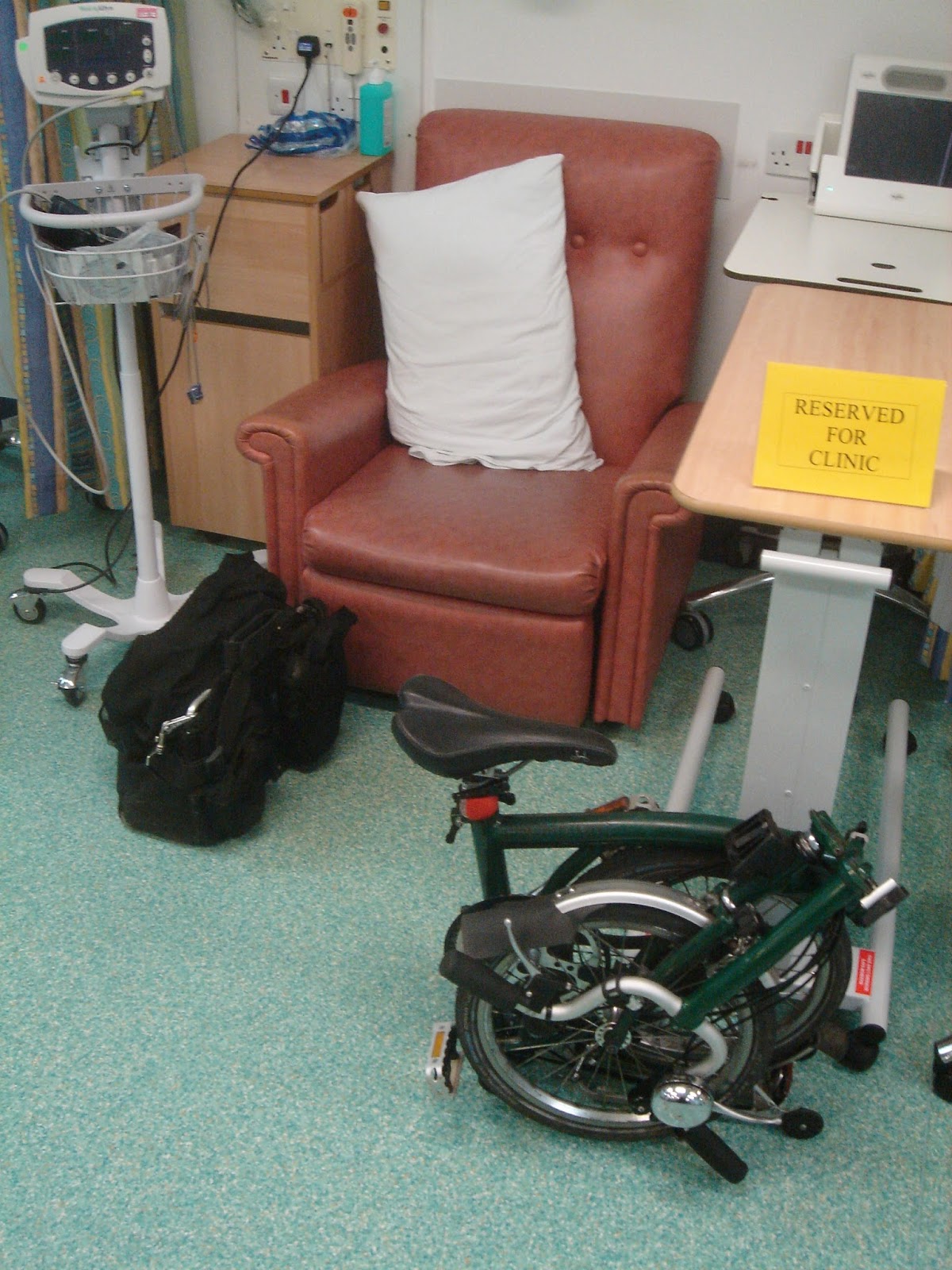
During the first phase of three sessions - following consent and familiarisation - I did psychological, cognitive and physical tests before and after sitting still for two hours. Next week I'll sit for four hours. I'm allowed to read and use the guest WiFi but not to receive or make phone calls. My main recollection later - I cycled home along the canal as usual - was the observation of the attending nurse, who took samples of my blood and saliva and measured my blood pressure.
"Your blood pressure's a little high"
"Seriously"
She showed me her readings; in the hypertension range.
"That's odd. That's never been a problem for me"
"Well I need to point it out. Check with your GP"
"Gosh Emma, do you think I'm stressed by the Referendum result?"
"Could be." she said "We'll see how your blood pressure looks on your next visit next week"
Talking to the bees, I recognise feelings that compare with previous personal ordeals - bereavement, and long long ago, divorce and separation. They are preambles to bracing myself for some major and, at the time, regretted change in circumstances.
Notice in the QE Hospital grounds (photo: Emma Bostock)
I'm well aware the rifts in the population of this country have long been there and worsening, but the EU referendum has given voice, expression to and significant legitimacy to stark differences. On the 16 bus into and out of the city I am often the only white man, the only old white man. In such frequent company I feel safe, at home, relaxed. I know a sample of such fellow passengers could include as much of a moral mix as on a bus in any other part of this country, but watching some of the good old boys interviewed in all white pubs and streets of another England I feel distanced, even prejudiced, god forgive me. So when, chatting to the long known and familiar owner of our local Asian corner shop, I was almost relieved to hear, from Ahmed's mouth, views about how 'immigration' had got 'out of hand' similar to those I was hearing on TV from rejoicing white Brexiteers in places where I would feel foreign in my own country.
The family came for roast lamb on Sunday. Potatoes from our allotment.
From a friend, and co-writer:
Yes lots of echoes with my thoughts
We have unleashed something repressed because we had a referendum we should never have had. The prosperity we both enjoy is not shared, inequality in the last 30 years has got worse, we have separate not integrated communities and so no wonder the dynamics of in/out groups, and the hatred of the other, mobilised voters. Many people left their homes to vote not knowing what they would do in the ballot box. They knew they were under-informed and were angry to have a responsibility that should have stayed in parliament. People were let down by politicians and yes I am angry with Boris and Gove but look how amazed people were when they found out how wonderful Jo Cox was - by contrast some politicians have spent a long time making fools of the electorate over expenses and politicking for personal gain. This fury and protest vote did not materialise in two months. I do worry that like the 1930s this fragility sends people right or left for certainty and our middle is lost - did the Lib Dems get any air time during this campaign? Who decided they were no longer relevant? So even the media had a role to play. They focused on personalities as good TV.
I envy future historians - in a hundred years time this whole process will be the subject of a thousand erudite papers. For now I see the issues we are already facing and feel in despair.
In the pre-checks for my last blood donation on Friday morning - my 99th - I thought I got a whiff of the impact of the crisis in Greece. The nurse, who knows me well, sees from my questionnaire, that I'm recently returned from Corfu. She looks in her 'book'.
"Hm. Yes. I think it's OK"
"Corfu isn't included in the West Nile Virus. It's just the mainland isn't it?"
"No longer"
Well maybe it's nothing to do with the malaria creeping back into Greece.
After a 40-year hiatus, malaria is returning to Greece. Some 70 cases have been reported there this year, and at least 12 people appear to have been infected in the country. (The others picked up the disease elsewhere.) That's a concern for health workers because it means malaria may now be endemic to Greece — and not just hitching a ride with travelers. Plus, the parasite is showing up in regions where it has never been reported, the U.S. Centers of Disease and Prevention said in a statement last week...
Celebrating my 75th donation - six years ago
I'm rather looking forward, in a Boy Scout way, to making my 100th donation next March. We'll have been back to Corfu before then. Might there be a problem?
*** *** ***
I'd heard that Patrick Leigh Fermor suffered from writer's block but only recently turned up what is probably the original reference to this condition. On 29 Sept'11 Colin Thubron wrote in the New York Review of Books:
Fifteen years ago, swimming in the Ionian Sea beneath his home, where nobody could overhear us, Paddy (as friends and fans called him) suddenly confessed to me the writer’s block that would plague the rest of his life. The expectations of a now-avid public, and his own obsessive perfectionism, were taking their toll, and he could not overleap this cruel impediment...
Forging his prose must have been an effort. I imagine him walking or travelling on sea and land, his broad intellect at work on sentences which would capture with precision an understanding - as rough stone takes form under the chisel and rasp – of the ancient divergence of Eastern and Western Christianity, something that's long intrigued and eluded my capacities for understanding history and theology. It was not perhaps accurately a writer's block; it was a thinker's block.
I have lots of facts. I understand almost nothing of why such differences divided whole populations for centuries. Why should the words 'and the Son' - filioque - matter so much?
Greek creed: Καὶ εἰς τὸ Πνεῦμα τὸ Ἅγιον, τὸ κύριον, τὸ ζῳοποιόν, τὸ ἐκ τοῦ Πατρὸς ἐκπορευόμενον And in the Holy Spirit, the Lord, the giver of life, from the Father proceeding.
Latin Creed: Et in Spiritum Sanctum, Dominum, et vivificantem: qui ex Patre Filioque procedit And in the Holy Spirit, the Lord, and giver of life, who from the Father and the Son proceeds.
And why should it matter as much to a secular student? That's my problem. Leigh Fermor has an agenda - a lover's search for the continuity of Hellenism. The things that happened in between.
Between when and when?
Well, say, the surrender of Athens in April 404 BC after the Battle of Aegospotami which ended the Peloponnesian War and Byron's death at Mesolongi 19 April 1824- about 2228 years - give or take a few weeks.
No, no, no....from the death of Alexander in 323 BC and the break-up of his empire.
No! Again no.
What of the Hellenistic Period and the Seleucid Empire that ended with the triumph of Rome at the battle of Actium in 31 BC, making that ridiculously vague interval just 1855 years? And why the date of the death of Byron?
I wasn't taught about these dates, these chronologies and sequences. It was more simply 'Ancient Greece'; wonderful pre-historic tales ill-placed in times - about Theseus, Jason and the Argonauts, Perseus, Andromeda, the Olympian Gods and, later, in my spotted learning, Homer, the Iliad and the Odyssey and even later the Aeneid which only then, in Latin not Greek, tells the appalling prevenient account - horresco referens - as Sinon opens the Wooden Horse and through the night the merciless sacking of Troy begins - no finer account was ever written of such a calamity.
I didn't hear of the Seleucid Empire until now and I looked upon the history of Byzantium as a different part of the curriculum; a mess of marble fragments.
As with ideas that express a convincing truth, there is so much missing evidence; so much rebuttal. If Leigh Fermor, deeply self-educated in Hellenistic and Byzantine history, claims a stark contrast between the iconography of the Orthodox and the Latin churches, there will be, especially for someone as well travelled as he, be much contrary evidence.
On the grey rainy windy days when I've wandered alone and with Lin and my mother in this chilly church, I've gazed up and not noticed it, but plenty of others have seen the tear that lies on the face of the Virgin Mary amid the gold mosaic of the central apse of the Cathedral of Santa Maria Assunta on Torcello.
My mother in Santa Maria Assunta
This is a Venetian-Byzantine Church; the image created in the 13th century, over two hundred years before the Fall of Constantinople. The tear seems an oddity, if Leigh Fermor's distinction between western and easter religious painting is correct. Recall that Islam and Judaism eschew imagery, deplore it, in some cases with fatal and murderous intensity...
...in the foredoomed task of indicating the unfathomable mystery of Godhead in visible terms, the Greek ikon painters chose the hardest way. They sought ingress to the spirit, not through the easy channels of passion, but through the intellect. Religion and philosophy were as inextricably plaited as they had been in pre-Christian times and this was due to the same philosophical temper which has saved Judaic Christianity(a brief and local thing) and made it Greek, then universal....Mani, c.15
Basilica di Santa Maria Assunta on the island of Torcello - where Venice was founded
I imagine phrases forming in Leigh Fermor's head which when he sat to write resisted the journey from mind to paper. It must have been made trickier by his knowledge of Greek words and grammatical forms that could capture ideas and emotions that cannot be expressed in English - ἀρετή, εἴδωλον, φιλότιμο, κέφι, μεράκι, απορία, θυμός, θάμβος...I'd like to see the original manuscript for chapter 15 of Mani.
I've read it over and over; at least, in part because it seems to help me; I say 'seems' to help me arrive at a real rather than a purely memorised mechanical grasp of the filioque difference. Leigh Fermor argues that the Orthodox theology of the Transfiguration - an astounding moment for which θάμβος is apt - καὶ μετεμορφώθη έμπροσθεν αυτών καὶ ἔλαμψεν τὸ πρόσωπον αὐτοῦ ὡς ὁ ἥλιος, τὰ δὲ ἱμάτια αὐτοῦ ἐγένετο λευκὰ ὡς τὸ φῶς (Κατά Ματθαίον 17.2) ...and He was transfigured before them. His face shone like the sun, and His clothes became as white as the light - is a more or less direct product of Greek Philosophy.
For extent and influence in the world the dual message of Greek philosophy and the Greek interpretation of the Christian revelation stand alone.
He lists pagan sages - Apollonius of Tyana, Solon, Plato, Aristotle, Plutarch, Thucydides, Sophocles - without haloes but in robes 'as honourable as those that adorn the Christian saints' painted with them on the walls of a small church on the edge of Layia in the Mani.
Where but in the ancient schools (these figures imply), were developed the intellectual thews which enabled the great Doctors to hammer the raw material of the Gospels into the intricate and indestructible apparatus of Christian dogma? Without the dialectical and philosophic skill of these rain-swept sages, who would have heard of the Three Hierarchs indoors...(he lists Basil of Caesarea, Gregory of Nazianzus and John Chrysostom)...who would have unravelled the perplexing skein of the Trinity or confuted the subtle-tongued heresiarchs or championed the Homoousion and the Double Nature? The Greeks do well to honour these ancient mentors...The evolution of Christianity into a logical system which could weather the shocks of millenia, was a Greek thing. The Christian Church was the last great creative achievement of classical Greek culture....
'...when two or three are gathered together in thy Name...'
For many generations, writes Stephen Greenblatt in chapter four of The Swerve, learned Christians remained steeped...in a culture whose values had been shaped by the pagan classics. Platonism contributed to Christianity its model of the soul; Aristotelianism its prime mover; Stoicism its model of providence...
Raphael: The School of Athens
This is Cavafy’s territory - eloquent, gnomic, exciting surmise and reflection on Hellenic continuity. It does not greatly surprise me - since our interests so often ran in parallel - to learn that the last - latest – book my mum ordered (and which Bay bought for her in New York) is Robin Lane Fox’s Pagans and Christians in the Mediterranean world from the second century to the conversion of Constantine (a hundred years before the murder of Hypatia in 415AD).
The transition from pagan to Christian is the point at which the ancient world still touches ours directly. We are heirs to its conclusion: on either side, participants shared an education which, until recently, we widely maintained. Like most transitions, it was a slow process, marked by unforeseen moments of sudden significance...
To me, whose school days were accompanied by rituals, bells, hymns, sermons and lessons from the King James Bible, whose parish church was Westminster Abbey, the customs, procedures and etiquettes of the Greek Church - whether observed in the quiet of an empty narthex or as a nervous but respecting participant, are more exotic, almost more foreign, than the services I've attended in Birmingham - in synagogues, gurdwaras and mosques. I delight in Greek Orthodox churches - sat alone, gazing around and upward, lighting candles, quietly praying...
"To?"
No preposition. Just praying.
Why 'to'?
Well just perhaps to a mystery; which is why I like Leigh Fermor's suggestion that the image of the Panayia is more mathematical than anthropomorphic, that in these ikons, he sees 'gilded and cube roots of the Logos' and, seeing the Virgin at the foot of the cross, he reads the message 'Do not worship me...but what I represent' - a reaction that contrasts with the feelings evoked by a Latin pieta - the seering image of a mother weeping over her betrayed, abused, tortured and murdered son.
Someone said the tear on the face of Mary in the church on Torcello is for mankind, not for her son. I remain puzzled and confused, but perhaps I'm also seeing that in the differences Leigh Fermor explores. Torcello is in the west, in the Veneto, and yet's it's cathedral is Byzantine, it's image of Mary - an in-between.
The two hour funeral service for my stepmother Maria at St Sophia's Cathedral in Bayswater was almost an ordeal. It wasn't until afterwards at the Makaria supper when a Greek opera singer with piano accompaniment sang Hadjidakis that I wept - not for grief but for joy at the pleasures of all Greece I'd enjoyed with her and my dad and their friends - and one of my my dry-eyed Greek half-sisters looked on concerned and slightly embarrassed.
On Mani see this from a blog about Leigh Fermor
*** *** ***
I'm not sure there could be a more beautiful and poignant or joyful train journey in all the world. The climax, whichever way I travel is Drumochter Pass, and the passage of the watershed into and from the Highlands, where one moment the river runs toward Dalwhinnie, and when descending from the Pass towards Blair Atholl the other way.
In the bright low light of Autumn the one track railway winds through valleys, through moorlands, by emerald pastures striped with long shadows of tall trees, and now and then sparkling streams with water so clear I see sunlight and shadows on the stones beneath the water. Hamlets and lone farm houses rush by and always the glimpses of water - sometimes lochs with such windless surfaces they turn the landscape upside down. In wet weather torrents jump and splash towards culverts beneath the line. Aviemore, Kingussie, Dalwhinnie...
Dalwhinnie
...Blair Atholl, Pitlochry, Dunkeld and Birnham where I lose my sense of place along a Lowland list of stations on the way to Edinburgh whose names I can't remember.
The Lowlands
And then suddenely here's the bright sea of the Firth of Forth with islands and in the distance, glimpsed before a long bend, the hazy outline of the Forth Bridge over which we'll pass in minutes.
The Firth of Forth
*** ***
We've had regular minor problems with battery drain on the Handsworth Helping Hands LGV. We've got over it by jumplead-starting. Allan Broad in the Handsworth Park compound has been especially helpful - hence our present to him and fellow workers of a supply of biscuits, coffee and tea last August. To get to the bottom of this I took the van down to - Cedric Fernandes - Ceds Car Alarms in Hockley and paid £20 for him to check for battery leakage.
"All you've got" he said "is standard drain from three systems"
"Explain"
"You've got the dashboard, the locking and the electric window and mirror controls - they all leak enough milliamps to drain your battery in a fortnight"
"If I take off one lead" which is what we've been doing recently after parking "will that stop that"
"Yes"
"What's the condition of the battery?"
"It's a bit stale and you could do with one that's more heavy duty"
Ced suggested Bannings - a company on the Lichfield Road. I phoned them. It'd be £95 plus VAT.
"I never knew all this about battery drain as just normal" I said
Ced pointed to a smart looking Mercedes in his workshop, bonnet and boot lids raised, wires sticking out all over like a patient in intensive care.
"He's got round 25 electrical systems in there. He hardly ever drives it. We found one system that was draining more than it should. Took a while to find it. You're diesel and need a heavier push. Why I'm saying get a stronger battery."
I drove back to the park compound, disconnected a battery lead and cycled home through the leaf strewn park.
"I guess learning that was worth £20"
Dylan Thomas wrote to Lawrence Durrell in 1938 a letter from England which included the paragraph
...I think England is the very place for a fluent and fiery writer. The highest hymns of the sun are written in the dark. I like the grey country. A bucket of Greek sun would drown in one colour the crowds of colours I like trying to mix for myself out a grey flat insular mud. If I went to the sun I’d just sit in the sun; that would be very pleasant but I’m not doing it, and the only necessary things I do are the things I am doing. Unless by accidents, and my life is planned by them, I shall be nearer Bournemouth than Corfu this summer.
Jim Potts mentioned these observations on his blog recently, and in a note to me this morning, included the sentence:
It's extraordinary what the Corfiots (and the Greeks generally) went through in the 1920s and 1940s.
This made me think of suggestions that Corfu's beauty, tranquillity and wealth is enervating, not a place for an artist to be creative...
Dear Jim. Indeed. At the time Kostas Apergis identified those initials carved by a boy in 1957 he said Marcos was still living in Ano Korakiana...It’s knowing what the Greeks went through in the ‘20s and ‘40s that puts the lie to the idea of the ‘enervating.... bucket of Greek sun’ drowning the creative muse, as compared to colder climates...an error of Dylan Thomas and even Cretan Kazantzakis who described Corfu as 'fatal for a fighting soul'. A picnic on the Lazaretto?...
The shame and cruelty of the young men and women being taken out under 'a bucket of sun' to that pretty green place; Theodoraki’s laments for his brother and others who died there; gentle Despina Bebedeli, Δέσποινα Μπεμπεδέλη, singing 'Sleep My Little Angel’...
Κοιμήσου αγγελούδι μου, παιδί μου νάνι - νάνι Να μεγαλώσεις γρήγορα, σαν τ αψηλό πλατάνι Να γίνεις άντρας στο κορμί και στο μυα - λό Και να σαι πάντα μεσ το δρόμο τον καλό
You know this is not a lullaby to a baby, but a dirge, τα μοιρολόγι, for a youth in the ground of Execution Island.
Greece, marketed as sun, sea and sand for fifty years, with ruins thrown in, is an image of the country that deceived even Dylan Thomas and no doubt other intellectuals (tho' I can compile a rebuttal inventory starting with Robert Graves and D H Lawrence, Camus, Hemingway and Leigh Fermor - it’s not just Greece but the decadent sun of the olive belt) who need, or feel their muse is further north, as though Greece is winterless.
Lazaretto ~ each flower marks an executioner's bullet (photo: Jim Potts)
Corfu is full of ghosts; worse - spectres. She overlooks, as you well know, a peaked landscape of the imagination stretching from Saranda to beyond Levkada. Things were done on Corfu by the signorini that are lost to all but family history, even then reduced to small anecdotes that hide the larger oppression.
What of the Jews, Greek citizens, taken from their city so near the end of the war, to join the thousands of others from Ioannina, Athens and Thessaloniki? It’s true that the skulls are not on the surface as they are in the Mani, but they lie in similar numbers beneath the beloved island’s green turf. The flaw in the 'ennervation thesis' is that so many northerners know almost nothing of modern Greek history. They know little even of the time before that - of the loss of Constantinople Κωνσταντινούπολις.
I sent two birds to the red apple tree, of which the legends speak. One was killed, the other was hurt, and they never came back to me. Of the marble emperor - το Μαρμαρωμένο Βασιλιά - there is no word, no talk. But grandmothers sing about him to the children like a fairy tale. I sent two birds, two house martins, to the red apple tree. But there they stayed and became a dream.
There are refugees via Cyprus and Crete on Corfu, some in Ano Korakiana, who hold the memory of the marble emperor and the loss of Greece’s Byzantine capital. E.M. Forster met Constantine Cavafy in 1918 in Alexandria living off a narrow street in a flat above a brothel - 10 Rue Lepsius. Alexandria. Or was it in a letter Cavafy wrote to Forster? The poet told Forster that the Greeks and the English were almost exactly alike, but for one crucial difference:
"We Greeks have lost our capital -- and the results are what you see. Pray, my dear Forster, oh pray, that you never lose your capital."
Some suggest he referred to financial privation. Forster knew it was Constantinople. Northerners are confused by a hazardous semi-knowledge of what has happened here in the last 200 years. Greece's classical history - tho' in detail as exactingly complicated and messy as the modern one (see the actual alliances involved at Marathon, Salamis and Thermopylae for a start or the conditional liberties of Athenian democracy) - is so tremendous; fills such a vast part of educated people’s mental DNA, there’s hardly room for the utterly unfamiliar morally complicated Balkan mayhem of the Greek War of Independence.
“Wasn’t Byron involved?”
And what of the Souliotes betrayed by Pelios Gousis? ...πως ο Εφιάλτης θα φανεί στο τέλος. What of the women of Souli?
THe great schism? The big idea? The burning of Smyrna? The exchange of populations? What are they? Noble Kolokotronis at Dervenakia, Venizelos, Theotoki, Kapodistria, Mavromikali? Who are they? Klefts? The dance of Zalongo? Distomo? Kalavryta? Kommeno? The famine of Athens? Blokos? The holocaust of Viannos? The dekemvria? The white terror, the red terror? Metaxa?
“Oh yes Metaxas, Very nice after a good meal”...
...and I haven’t got to the Stone Years, τα Πέτρινα Χρόνια. The Junta. (See Mazower's After the War was Over)And not only the 20th century but far further back. Thucydides:
It was in Corcyra that most of these audacious acts were first committed and all the crimes that would be perpetrated in retaliation by men who had been governed tyrannically rather than with good sense and had the chance of revenge, or that would be unjustly designed by others who were longing to be relieved of their habitual poverty, and who above all were animated by a passionate desire for their neighbours' property; crimes too that men commit, not from greed, but when they assail their equals and are so often swept away by untutored rage into attacks of pitiless cruelty
Another bolster for the enervation thesis is that for the Durrell’s, Corfu was a childhood paradise. They wrote with unsurpassed brilliance about happiness. Their joy may have aroused envious critical suspicion; an inclination to treat them as fantasists or, if telling the truth, describing a lotus eating haven that eats creativity. Edmund Keeley wrote Inventing Paradise. His word ‘invention’ captures the point.
I cannot subscribe to the enervation thesis on the grounds of landscape alone - a place with panoramas that elude the painter perhaps, but cannot fall short of the Netherlands or England for inspiration. Just because I’ve been so happy on the island doesn't make it enervating in my book, but then I have no book. I rest my case. Best, Simon
*** *** ***
Public or private dentistry?
I needed an extraction, some cleaning and some tidying. I went to a private dentist and met a nice and competent seeming surgeon. His estimate after an examination came to £5803. I went to an NHS dentist and talked to another nice and competent seeming surgeon. His estimate, after examinaton, was £208. The difference? The first dentist would replace my extracted tooth with an implant, and possibly another - the process completed by December. The second offered a small denture - the process completed in the time it'd take to make the denture - just over a week. I could afford to go private but I've got better things to do with £5959. I spoke to Lin and worried the matter for a week then went to the NHS where they made a mould in ten minutes. I came back in a week, had a local anaesthetic. The tooth was out so quick I hardly noticed. I was cycling home, my gadget in place, within half an hour. My three little false teeth are finely wrought and comfortable, and give my mouth a better appearance than it's had for years, but I'm not a toothy smiler anyway.
*** *** ***
Saturday afternoon Richard showed Amy around his flat in town and we went to the Bull Ring, to Jamie's Italian where I bought them a rather too expensive late lunch and Richard and I both managed to hold Oliver without dropping him or making him weep.
Later Amy inveigled me into Gap where there was a 45% off sale, except her choices of baby clothes were not in the sale. Next door Apple was packed but a figure waved to me from the crowd - Niko, our tutor. We embraced.
"When can we have our next lesson?"
"I've been very busy. Christina and I our getting married in September"
"Oh no! We'll be in Greece"
"I'll send dates for us to get together"
I introduced him to Amy and showed him my grandson, fast asleep in the odious hubbub of the shopping centre.
Strolling up crowded New Street Amy bumped into two of her police colleagues on duty.
We walked on.
"Just after I went on maternity leave" she said "Operation Paragon started belt tightening. My area will have changed when I go back. It's larger."
**** ****
Scholarship on two wheels! John Martin and Alistair Walker with Annie Guthrie filming as they go, continue their great shared cycle ride across Canada, studying sustainable communities; writing their thoughts as they go, every sentence is the tip of an iceberg, with a hundred elaborations and examples to be pursued on the way to explanation and insight on the habits that make for sustainability.
John, Annie, Alistair
The metaphor of a community on a journey becomes more powerful as the reader realises that their propositions are emerging from a transcontinental bicycle odyssey. Every working community is indeed unique yet governments and individuals seek the guidance and even the shock of admonition derived from general principles. Uniqueness is the watchword. Creativity is vital. They're explorers composing, as they travel, a sophisticated yet practical map of imaginative intellectual territory that for many currently in power has been illustrated by exotic beasts and blank spaces. Their new map will assist more and more people and communities to make more and more unique journey’s towards sustainability, helping more and more to join ‘the long conversation’, spurring more and more negotiation with the dominant economic paradigm. The final map won't be overwhelmingly burdened with data, with acronyms and endless statistics. They will know all this of course as they noticed and felt, in the seat of their pants, the rich detail of the endless surfaces over which they pedalled. They’ll have breathed it all in. Their exposition will be more like those ingenious ‘mud maps’...
...the aboriginals use, which in context reveals more truths than the precise measures of modern ordnance survey about a place and its inhabitants
Given the requisite variety of communities there is an infinite number of ways of achieving sustainable outcomes. Each journey is unique. Every community is concerned about its success and continuity. The way they achieve this is an individual journey, at a point in time influenced by both externalities and the capacity and commitment of the people who constitute each community to adopt new ways of working. We have seen many communities in our journey across Canada, some more closely than others. Some are doing well, some not so. The question we are often asked is: what makes for a sustainable community? ‘Institutionalising’ or incorporating sustainable living practices into the formal regimes of society is, I believe, an essential outcome for building sustainable communities.A key success factor in this continuity is the extent to which...
*** ***
It's clear that the onion fly has been causing harm across the VJA site. I've been getting advice from other plot-holders planning for future crops of onions and leaks on the use of nematodes. I've clearly got a world of understanding ahead of me with these. One snag is their cost. During a rare sunny patch I harvested more spring onions and broccoli from the plot.
***** *****
On Sunday afternoon, Linda and I completed Wednesday's Handsworth Helping Hand's work in the Church Vale Triangle, laying out plants donated via Freegle, including perennial Geraniums, Lilac, Hypericum, Big Leaf Periwinkle and Alpine Strawberries. Three of the seventy or so Pelargonia we planted on Wednesday have been pinched. We replaced them.
*** ***
Letter from a friend on holiday in Corfu. She had asked for advice on places to visit while there with her daughter. I cautioned her on a general truth about contemporary Corfu - in this case the despoliation of Paleocastritsa - while describing the possibility of exquisite places to be discovered close by - especially on foot or bicycle:
Simon. Greetings from beautiful Paleo. Your bespoke guide has been invaluable. I carry a printout in my beach bag. Thank you. We are here for another 3 of our 14 days. It has been delightful. We have only had a problem with the weather - a heatwave! Really - can't believe I am complaining but sometimes too hot to move from our shaded cove. Everywhere a noticeable lack of people which is great for us but not for the locals. We didn't hire a car so have been walking everywhere. We recommended guests to your friend Sally's hacking tours and they loved the trek. Monastery great - after all the awful half empty coaches have left for he day. Glorious dusk. Restaurants good. London prices unfortunately. xxx Beach just perfect. We also like being able to find different spots to explore and enjoy the peace and cicadas. We are celebrating. My beautiful daughter, Genevieve has got a First in her Part 1 Tripos - English. She got the news here so I think Paleo will always hold precious memories for her. Greek Champagne is delicious! love Fiona
Friday evening I cleaned the stove chimney, putting the pipes back in place and showered off the soot on myself, made myself supper and watched a film based on Lionel Shriver’s book We need to talk about Kevin. In the end it's about not getting answers to why someone does something very bad. The frightfulness of the ‘something’ intensifies the need for an answer. What might have been curiosity about a minor oddity “Why do you collect your nail clippings?" becomes "Why did you kill all those people?”
There are plenty of minor examples, though preveniently sinister, in the proleptic screenplay. Explanation of the larger horror becomes a desperate and collective need. Since the perpetrator, 16 year old Kevin, is in prison beginning, in the perception of his community, to become a co-victim, the remaining explanation, since her husband and daughter are among the murdered, is the mother. At the end of Lynne Ramsay’s film of the book we are left only with our own answers - or their absence.
“I want you to tell me - why” asks brilliant Tilda Swinton, Eva Khatchadourian, of brilliant Ezra Miller, Kevin. Long pause. I wait with her for an answer. Then with raptorish stare Eva's shaved prisoner son mutters almost inaudibly
“I used to think I knew. Now I’m not so sure”
The matter of what he ‘used to think’, which I doubt he’d have volunteered, is interrupted by a guard saying “Time’s up”. I half expected a notice with the credits "If you have been disturbed or affected by issues raised in this film you can phone our 24 hour hotline on...' What a brilliant film - again low budget like Attenberg.
If I were a psychopath or a sociopath I might say the film was tedious 'except for the stuff on bows and arrows.' As a child I was enchanted by the adventures of Robin Hood and later in life, with my children, enjoyed using the long-bow. The film's technical advice on archery is immaculate, tho’ I could swear that in the book, Kevin carries out his Gladstone High school massacre with a cross-bow...
...but more dramatic with the hunting bow, a gift from his father. He’d had to have been most accurate to cause such death and injury with the small tipped arrows he uses, but we know that’s one of his few gifts.
Labels for Kevin are an illusion. Film and book make that clear. The answers we invent; seeking consolation; calling Kevin ‘evil’ since birth, or Eva a ‘bad mother’ don’t work for anyone capable of remaining puzzled – inhuman, though, if your child were his victim.
Baddeley, S (1995) ‘Internal Polity’ Human Relations, 48 (9) pp.1073-1103
****
“Can you check my brakes?”
George puts my bicycle on a stand, clamp on the cross-bar.
“You need new pads. How much slack do you want in the levers?”
“A little as possible. I won’t forget not to stop too abruptly. And can you check my gears? I’ve slipped the chain a couple of times”
He turns the pedals, running quickly through the gears, pausing to take up a small driver to turn the Philip’s screws that adjust the chain tension
“Front or back did it slip?”
“Front. With the guard it’s fiddly getting it on again”
In seconds the job is done to his satisfaction. To mine too as I feel the difference cycling on into town. Apart from the cost compared to a motorcar, much satisfaction is to be gained from tuning a bicycle. Its mechanism so directly transmits the energy of human exertion to forward motion that small adjustments make satisfying improvements to the ride, especially on long ascents.
The snug fit of my new toe straps; saddle and handlebar height and angle are essential corrections. There are plenty of other things that I don’t know about. Racing cyclists shave their legs to reduce the time it takes for abrasions to heal if they fall on the road. This is outside my trousered Long John orbit. In the light rain yesterday I got back from a lesson and a game of croquet with Tony Blok, who I met after hearing from Cinty, who gave him my phone number, he’d bought Dave and Fran’s house at the bottom of the village. He wanted to know more about Ano Korakiana; his quid pro quo, a fish supper (octopus hors d’œuvres, fish stock soup, roast sea bream, pear pudding, coffee, brandy) at Pomo D’Oro in town and an offer to tutor me in croquet, his delight.
Tony’s set up a club, a website and maintains several well-tended well-equipped lawns inside the entrance to Gouvia Marina. On Sunday he and I played alone under grey skies; later drizzle. With a generous handicap and several discrete indulgences I was allowed to win by one hoop after a tie, despite wearing shoes that were tough on the grass and paining Tony by cutting a few divots from his immaculate surfaces. Two hours passed unnoticed so absorbed did I become in a game I’ve normally played on my mum’s unruly front lawn above Strathnairn when the children were young.
In the marina bar, where Tony and I sat over hot chocolates, I came across Pauline Sheriff with a friend, a tartan blanket over her lap. I’d heard only the day before that her husband had died before Christmas. He lies in the British Cemetery. Linda and I bought their boat Summersong six years ago, clicking ‘buy now’ on Norman’s eBay ad - ’27 foot yacht on permanent free mooring in Corfu’ - thus coming, by degrees, to Ano Korakiana and Democracy Street. In 1981 Norman, a Yorkshire man, made a redundancy deal with the railways, bought an already old boat in Spain and with minimal seafaring experience voyaged with Pauline towards Asia Minor, travelling as far as Turkey, settling at last in Corfu where for a while they lived on the boat, eventually, and with a wrench, selling her to us, to live in a small bungalow on the edge of Temploni – a Mediterranean Odyssey neither might have imagined when younger but by bold choice made true. That their place in Temploni was rented I put down not to finance but a dream of further travel.
Norman Sheriff sailing Summersong
****
I was 20 minutes late meeting Tony at Gouvia because I hadn’t got to bed until six the same morning. After visiting Carol at the Lighthouse sale on Saturday; putting out the word we were interested in child-gates, a baby-buggy and even a cot, I cycled home slowing my approach to Ano Korakiana...
...walking the steeper parts of the last mile, savouring the light and shadow passing unevenly over the mountains above the houses and the new flowers in the greenery beside the road.
“I disavow the sympathetic fallacy. I choose animism, personification, metonymy and synecdoche mixing place and heart, word and song…it’s not your fault Kerkyra that you’re so beautiful some ravage you while others like me look at you, gazing.”
From the Co-op came the sound of machinery. Anastasio took me round to see the stages of the one hour process; the same tour as Sebastianos' a few days back, though now a crop was going through. Rolando, a farmer from below the village, waiting with plastic tanks to collect his harvest.
I saw the black Corfu olives turning in water like pebbles in a shallow stream; leaves and twigs separated, the polished olives, ground six kilos at a time, their mush twice centrifuged – fast then faster - until the opaque yellow-green oil poured out in a steady stream.
Getting permission, Anastasio broke a piece off a loaf, held it a moment under the spout and handed it to me.
“Extra extra virgin!” I said, tasting Rolando’s oil on warm new bread next to the clatter of machinery. I’ll think of this delectable snack when I see an elaborately labelled bottle of costly olive oil in an up-market delicatessen.
[Back to the future: 31 March 2012 - Extra Virgin Olive Oil scams and corruption...Tom Mueller's article in New Yorker....In 1997 and 1998, olive oil was the most adulterated agricultural product in the European Union, prompting the E.U.’s anti-fraud office to establish an olive-oil task force. (“Profits were comparable to cocaine trafficking, with none of the risks,” one investigator told me.) The E.U. also began phasing out subsidies for olive-oil producers and bottlers, in an effort to reduce crime, and after a few years it disbanded the task force. Yet fraud remains a major international problem: olive oil is far more valuable than most other vegetable oils, but it is costly and time-consuming to produce—and surprisingly easy to doctor. ..this academic report and Mueller's book Extra Virginity: The Sublime and Scandalous World of Olive Oil... for all the things that are right about olive oil, there’s a whole lot that’s wrong. Again and again I’ve witnessed the same bizarre drama. Olive oil bottles labeled with fancy phrases – “cold pressed,” “made in Italy,” “first pressed,” “extra-light,” “pure,” and the ever-present “extra virgin” – that are meaningless, and often downright lies, false virgins selling at a fraction of the price of true extra virgin olive oil, which systematically undercut honest producers. Faced with this situation, governments do nothing, oil buyers turn a blind eye, big bottlers and oil-traders pocket the cash. Consumers everywhere are systematically defrauded, and honest growers go bankrupt. Over the last five years I’ve seen one of the world’s greatest foods reach a breaking point, where the future of quality oil is in question....]
At home again Paul and Lula arrived to check on the small but obstinate leak in the roof; not the part his people had built.
“We’ll sort it while you’re away. Let’s go and eat”
We tried Strapunto but we were an hour too early for the kitchen, so I guided them to Limeri at the Y-junction in Kato Korakiana. Lula got a call
“Lucinda’s been hit by a car”
There were calls back and forth between Lula’s family in Ag.Ioannis, Lula tearful while our dignified host waited in the wings. She organised a hunt for the stray dog they’d adopted which had been hit a glancing blow and run off.
“I suppose when you find her – which you will” said Paul resignedly asking for wine “you’re going to keep her now, after we’d planned to find her a new owner.”
Just into some delectable starters, as the main course spread aromas from the kitchen, came word Lucinda was found and fine. The Kato village square was packed, in the midst of a carnival drama, while we, for the two hours we were there, the taverna’s sole guests, treated with easy solicitude, as the radiators, on for us, warmed the whole room and I, normally unfriendly to background music, enjoyed some well selected folk songs whose singers Lula recognized for me. We spoke of history, of the crisis and things that interested us including why some farmers so liked genetic modification; whether ‘peasant’ was a term of abuse or something in which to take pride, how difficult it is for the bourgeois – like me -to grow things to eat; whether autism played some original part in the long process of human evolution.
“Hm?” said Lula
“Maybe?” said Paul humming and haaing as friends do in debate.
They dropped me at the Co-op where I’d been in the afternoon. The pre-carnival dance was in full swing, souvlaki roasting outside overseen by Forti. Effie and Natasha told me to pull up a chair to their table.
Someone handed me wine. The DJs were equipped with two laptops capable of making especially seamless transitions between genres – pop, rock, folk, song and dance - from Greece and the rest of the world. Dancers did likewise - alone, in pairs and in a circling group, longer with every bar, all without pause, the disco lights changing from dark to bright to frenetic staccato and back with a mirror ball throwing light about the working walls of the co-op now decorated with streamers, balloons and pictures.
Πραγματοποιήθηκε για μια ακόμη χρονιά, χθες το βράδυ, στην αίθουσα του Συνεταιρισμού του καθιερωθέν τα τελευταία χρόνια καρναβαλικό πάρτυ. Η αίθουσα που το πρωί εξυπηρετούσε τη λειτουργία του ελαιουργείου, μέχρι το βράδυ μεταμορφώθηκε κυριολεκτικά από τους καρναβαλιστές, προκειμένου να υποδεχτεί κοινό όλων των ηλικιών. Ο χορός και η μουσική κράτησαν μέχρι τις πρώτες πρωινές ώρες, στους ρυθμούς των Νίκου και Γιώργου Μεταλληνού σε ρόλους ντισκ-τζοκεϋ. Έξω, η ψησταριά που είχε στηθεί από το Φώτη Κάρμπουρη, ξεπούλησε γρήγορα όλα της τα αποθέματα, ενώ το μπαρ στο εσωτερικό της αίθουσας, προσέφερε ανάσες δροσιάς στους ακατάπαυστα χοροπηδούντες καρναβαλιστές….
All ages danced, from toddlers, through ten-year-olds to oldies like me with young men and women now and then crouching in a circle as skillful dances were done by individuals - that Greek thing where you bend over back or forwards and just as it looks as if you’re about to fall over, drop on flexed knees, hands in the air or slapping an ankle, and leap up again, torn paper standing in for smashed crockery and lots of clapping, syncopated and on the beat, with now and then a break to drop a key and start another rhythm.
“And what about the Greek deficit?” said Sebastianos at the bar offering me a cigarette, refilling my wine. On and off through the evening we talked - his English excellent - of history, local and wider. I was relieved my research on 19th century Corfu let me keep up with his references which - ahah - included unprompted the notorious alleged petitions from Ano Korakiana and Kinopiastes asking the British not to leave in 1864.
“The peasants did not know what they were signing. They were put up to it by interested parties, benefiting from trade with the British garrison”
We spoke of Storks, Gladstone, Young and other British Protectorate High Commissioners. Our conversation jumped between then and now; between here and there
“This roof in this building needs €20,000 to repair” He pointed out the details, and the temporary supports under some beams.
“That can surely be found”
“If there's the will. If!”
I didn’t actually decide to dance. I was gently tugged into the ones I could just about do, swung myself about and followed others, had more to drink and continued the conversation until drawn back to the party. The music was relentless yet not so loud you couldn’t chat and the wine so easy to drink I didn’t notice myself waxing hyperbolic until I recalled myself, sober, saying things like “Go tell it to the Lacedaemonians that here obedient to their laws we lie” and “Toὺs Laestrigonas kaὶ toὺs Kiklopas, tὸn thimomeno Poseedona mi foovᾶsee, tetia stὸn dromo sue pote soo thὲn thὰ vrees, ἂn men' i skepsis soo ipsili, ἄn ἐklekti singinisis tὸ pnefma kai to soma soo ἀngizei”* then wanting to cry, but I didn’t, and once dancing again became more clearheaded.
"I really like the way Greeks don't get drunk" I said
"Oh yes they do get drunk"
"No they don't!
"Yes they do!"
"No they do not. Not like some northerners - being sick and making silly noises and falling over"
"Oh yes they do"
"Did you go to a pantomime when you were in England?"
"Oh no I didn't!"
At this point I'm laughing - a lot.
I called Lin, holding the phone to the sound of the party, wholly insensitive to her mood in our kitchen in Birmingham
“You sound like you’re having a good time. Don’t get too drunk”
“Σ' αγαπώ, Λίντα γυναίκα μου”
“Yeah yeah”
"Now Sebastiano, tell me how I get to see the inside of the village Museum"
"Nothing to do with me. That's a different Metallinos"
"Yes but.."
"You will never get to see it"
"Oh yes I will"
"Oh no you won't. It was only called a museum to solve a legal problem of inheritance. Have another cigarette?"
By four there were fewer people around but the dancing and conversation continued with me drawn between both – struggling to understand, nearly but not stumbling, glad of the strength cycling’s given my legs.
Around 4.30 a friend said
"Come on to our house"
"Don’t we need to tidy up?” I said to Sebastionos.
“On Monday”.
There was a slow circular dance without background music, all singing in a monotone. Ten people from the last left, holding hands.
“This is Dionysus. They’re chanting lewd things. Next Sunday the old people sing this.”
So to Angeliki and Anthony’s house where ten people sat at a great wooden table and I was given meat and bread, wine and the usual courtesy of breaks in Greek to keep me informed and involved.
How this island indulges me! I’m not saying I’m a scrounger, but without Lin’s gift for reciprocity I may be overdrawn in that direction. I do bring small gifts - my interest, my company, love and friendship..hm…great curiosity, conversation (prolix? no! I can’t speak Greek), but in the last five weeks on Democracy Street, I’ve been given supper, over and over, in Mark and Sally’s home, shared bean soup, bread, sweetmeats and wine with Lefteris and Vasiliki and, as in the past, been handed - over our shared garden fence - bottles of their wine (in whose making last year I turned a wheel), been given tea and cakes and cooking advise by Cinty, who with Paul and Sally and Mark, give me their Wifi and phone for calls to the UK (bringing out tea and wine as I work), been taken to lunch and supper several times by Paul and Lula refusing to share the bill, as well as been lunched – similarly - by Jim and Maria, partaken of food provided at the end of the seed-share meeting in the Co-op, been treated to supper and dancing by Effie and Adoni, my close neighbours, plus Tsipero, bread and mezes in their garden as well as a plate of tasty cabbage dolmades brought over to my house, been served mezes and drinks at Aleko’s home in Nisaki with his mother and sister, taken out for a swell meal at Aristoteles Megoulas' Pomo D'Oro by Tony Blok - tutoring me at croquet - had a long Sunday lunch with Niko and Sophia at their home in the village, paid a small contribution for souvlaki at the grill in the street on Tsiknopemti, followed by generous portions of wine bread and spare ribs far beyond the one euro I'd been asked to put in the collection box, to late night meat and drink after the pre-carnival party at Antony’s and Angeliki’s, slices of New Year cake at the 2012 Vassilopita celebration at Luna D’Argento, warm bread sprinkled with Rolando’s olive oil direct from the press by Anastasio and an embarrassing number of cigarettes from Sebastianos Metallinos the other night and the brothers, Paul and Mark, may have found a suitable replacement engine for Summersong which with their skill and some good fortune they’ll put into her.
*** ***
21 Feb'12: Press reactions reported by the BBC on the second bail-out now agreed..."Many European news websites highlight the problems that still lie ahead for Greece after the second bailout agreed by eurozone finance ministers."
24 Feb'12: Corfu Blueslinks on the crisis: The FT today (24/2/12) carries an article on 38 specific 'State-Building' changes demanded urgently of Greece by creditors. They include centralising health insurance and completing an accurate land registry as well as reducing state spending on pharmaceuticals by Euro1.1bn; and the liberalising of professions such as tour guides. One risk-consultancy analyst considers the speed and scope of the targets almost impossible to achieve....What then?
25 Feb'12: Philhellene Richard Pine's increasingly grim op-eds written from Perithia in Corfu, published regularly in The Irish Times, takes one of his firmest positions - moving from a journalistic respect for description, he turns to prescription - 'Time for Greece to leave not just euro but EU itself':
...It’s not very honourable to renege on one’s debts, but the situation for every man, woman and child indentured to poverty is so intolerable that default and exit seem the only possibility. The problem is one of self-determination. With its sovereignty now completely suspended by its acceptance of the new bailout memorandum, Greece cannot look itself in the face. In order to regain self-esteem, it’s essential that Greece turns its back on those elements in Europe which are exacting this level of punishment. Like so many divorces, Greece’s exit from the EU would be messy and acrimonious, but it is in a place where it doesn’t belong.
Reading his whole article, talking to him over lunch in town in Chrysomalis the other day, I'm strongly persuaded. Not being involved in affairs of state, nor even a citizen of the Republic, I react from experience on a domestic scale, thus like my own divorce in 1973, even thinking of what Richard (and many others) advocate for a nation, surfaces feelings associated with a 'messy and acrimonious' personal crisis from long ago - τοὺς Λαιστρυγόνας καὶ τοὺς Κύκλωπας, τὸν θυμωμένο Ποσειδῶνα. Would we become foreigners of a divergent kind, in a place we don't belong, needing visas, changing pounds into drachmas, spectators of our neighbours' pain, feeling materially richer, psychologically more impoverished? How will the hi-politics of Hellas act upon the lo-politics of our daily life?
In Athens the other day
______________________________
*...The Lestrygonians and the Cyclops,
the angry Poseidon -- do not fear them:
You will never find such as these on your path,
if your thoughts remain lofty, if a fine
emotion touches your spirit and your body.