Telling the bees is a traditional European custom, in which bees would be told of important events in their keeper's lives, such as births, marriages, or departures and returns ... If the custom was omitted or forgotten and the bees were not 'put into mourning' then it was believed a penalty would be paid, such as the bees might leave their hive, stop producing honey, or die.
A message from a neighbour and friend in Greece:
Hello Simon, I see you are back home. What is going on with the referendum? Was the whole thing an accident? Though I cannot believe that the most instinctive 'school' is pulled in such uncomfortable situations. Do you see Cameron acting as Chamberlain did? In that case 1937-1939 period is being repeated? Sevastianos Metallinos (President of Ano Korakiana's Agricultural Co-operativeΑγροτικού μας Συνεταιρισμού
Home? We have two 'homes'! Dear S. Lovely to hear from you. No-one can know if history is repeating itself, but its shadow seems stronger, its echoes louder, than before 23rd June. Yes! You could say that the Referendum was an 'accident'. To resolve differences within his Party, Cameron, included a promise in the Conservative Manifesto for our May 2015 General Election - a pledge to hold a Referendum on the UK staying in or leaving the EU. He did not think the Conservatives would win last year’s election. When he became PM with a clear majority his new government was committed to a promise he had not expected to have to deliver. I guess that beloved Greece is too full of its own woes to care much about what we’ve done to ourselves in Britain as a result of this vote. I agree with the recent words of Yanis Varoufakis who had wanted the UK to remain in the EU. “OUT won because the EU establishment have made it impossible, through their anti-democratic reign (not to mention the asphyxiation of weaker countries like Greece), for the people of Britain to imagine a democratic EU.” My family voted to remain, except my daughter and son-in-law. We would never let politics divide our family, and although I do not think for a second that they voted from fear, there's no question that too many did; fear and anger. Too many jumped at the opportunity to give the ‘ruling elite’ a kick in the pants, and 'get their country back'…
…δεν έχει πλοίο για σε, δεν έχει οδό. Ετσι που τη ζωή σου ρήμαξες εδώ στην κώχη τούτη την μικρή, σ' όλην την γή την χάλασες.*
Their vote against ‘foreigners’ carried the day for the OUT vote. Our country is full of angry frightened people. Nor will Brexit shield us against many other angry people across Europe. There lies your comparison with the 1930s. The UK vote threatens the EU project as a whole - beset by right wing nationalist movements. I’m sure you know the famous Chinese curse “May you live in interesting times”. We are back in Ano Korakiana in late August. Meantime I am growing lots of fresh fruit and vegetables on my allotment, despite very wet weather and a plethora of slugs and snails. My bees are buzzing. I have much to occupy my life.
Με αγάπη και τις καλύτερες ευχές, Σαίμον και Λίντα XX
*...there is no ship for you, there is no road. As you have ruined your life here in this little corner, you have destroyed it in the whole world. (Constantine P. Cavafy 1910)
**...The Laestrygonians and the Cyclopes, the raging Poseidon do not fear: You'll never find the likes of them on your way, if lofty be your thoughts, if rare emotion touches your spirit and your body. Cavafy 1911
From Sevastianos: Thank you. My regards to Linda Me: I hope you do not now regard us as foreigners (:)) S: Of course you are foreigners. It is a matter of culture after all. We, proud Greeks, are fond of Sakis Rouvas, Alexis, NO and Olympiaco's morality. Kavafis, et al is for, nationwise, diversified orphans...At least lets enjoy it....THE IRISH coast guard has today issued a nationwide warning for the East Coast as hundreds of thousands of British refugees risk their lives to cross the Irish sea in an attempt to flee the impoverished and unstable nation.....
'An estimated 450,000 people have already fled the UK mainland to neighbouring EU countries.'
Owen Jones in The Guardian yesterday - an extract:
'...Many of the nearly half of the British people who voted remain now feel scared and angry, ready to lash out at their fellow citizens. But this will make things worse. Many of the leavers already felt marginalised, ignored and hated. The contempt – and sometimes snobbery – now being shown about leavers on social media was already felt by these communities, and contributed to this verdict. Millions of Britons feel that a metropolitan elite rules the roost which not only doesn’t understand their values and lives, but actively hates them. If Britain is to have a future, this escalating culture war has to be stopped. The people of Britain have spoken. That is democracy, and we now have to make the country’s verdict work.'
Comment from my friend Christopher Grossmith - living in Nepi, 50 kilometres north of Rome:
I tend to agree, we have to go for it now. The Great British Public may have put their foot in it 'Churchill with the Dardanelles' but we will now do something brilliant just to prove we were right. So far no one has spat at me in Italy..
*** ***
I've been taking part, via my membership of the 1000 Elders Group, volunteering to be guinea pigs, for the Queen Elizabeth Hospital's research into healthy ageing - on this occasion a study of 'the acute effects of sitting time on physiological and psychological function in older adults'
What is the purpose of the study? Although there is evidence supporting the longer term health problems of prolonged bouts of sedentary behaviour (sitting) in older people, we do not know very much about the effects of shorter ‘acute’ sitting bouts on our minds (mood, thinking and memory) and bodies (muscle power, mobility, joint pain). Interestingly the current UK physical activity guidelines state that “while there is sufficient evidence to support a recommendation to reduce sedentary behaviour in older adults, it is not currently possible to suggest a specific time limit”. The aims of this study therefore are to characterise sitting time in older people in terms of acute physiological and psychological effects, as well as identify the main effects that older people perceive as being important after periods of sitting....You have been chosen because you are 70 years of age or over and are able to walk either with or without the use of walking aids.
21st June. Dr. Emma Bostock, School of Sport Exercise and Rehabilitation Sciences:
Dear Simon. I hope you are well. This is just a reminder for your next visit this coming Friday at 11:30am. I will meet you in the reception of the NIHR Wellcome Trust Clinical Research Facility at the Old Queen Elizabeth Hospital (Heritage Building). Please remember to wear comfortable clothing and sensible shoes. Also remember to bring something warm and plenty of reading material to fill your sitting time. It will be your 2 hour sit this week so we should be finished by 5pm. Any problems or questions then please just let me know. Kind Regards, Emma
At the Wellcome Trust Clinical Research Facility, Birmingham University
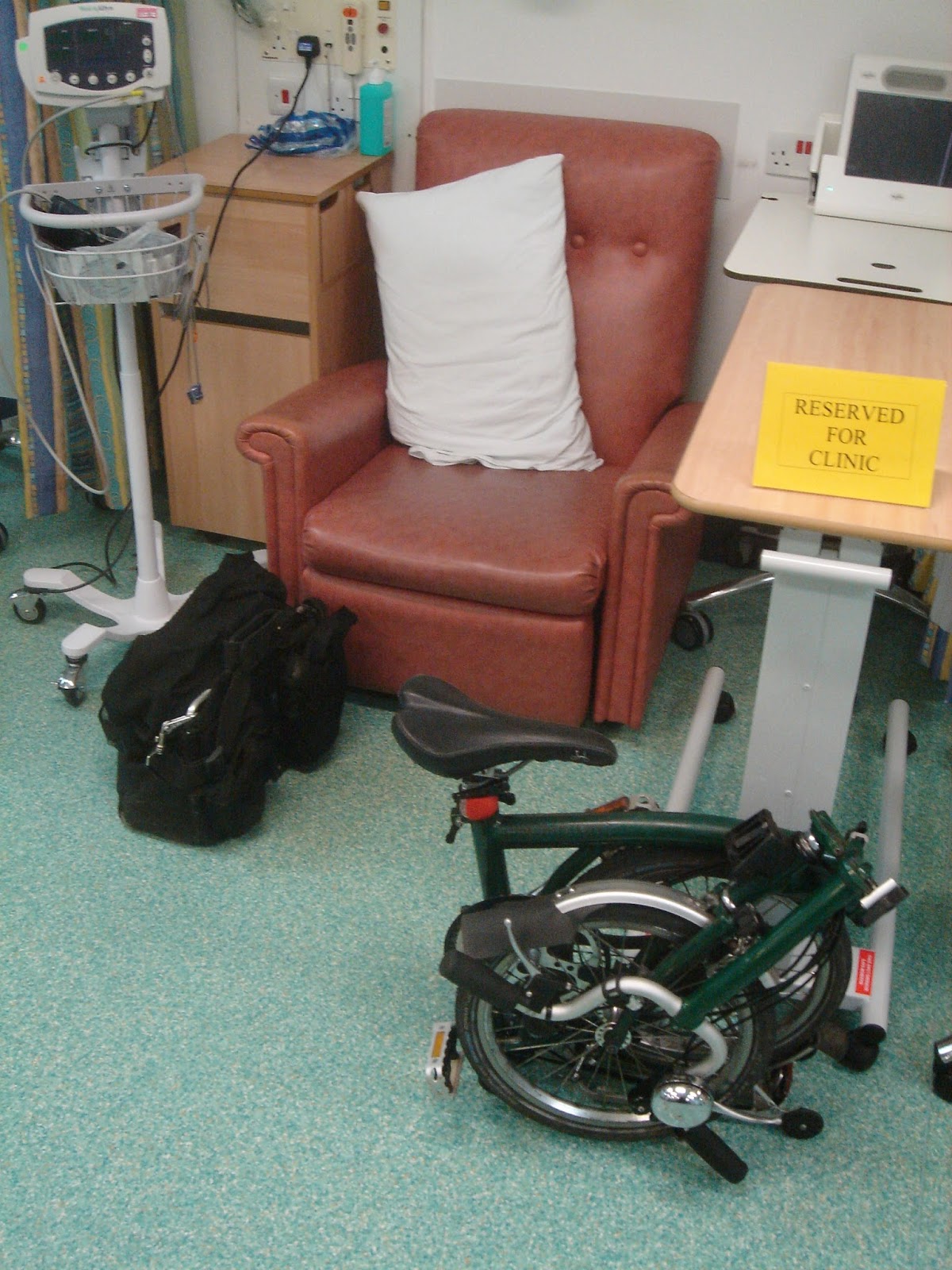
During the first phase of three sessions - following consent and familiarisation - I did psychological, cognitive and physical tests before and after sitting still for two hours. Next week I'll sit for four hours. I'm allowed to read and use the guest WiFi but not to receive or make phone calls. My main recollection later - I cycled home along the canal as usual - was the observation of the attending nurse, who took samples of my blood and saliva and measured my blood pressure.
"Your blood pressure's a little high"
"Seriously"
She showed me her readings; in the hypertension range.
"That's odd. That's never been a problem for me"
"Well I need to point it out. Check with your GP"
"Gosh Emma, do you think I'm stressed by the Referendum result?"
"Could be." she said "We'll see how your blood pressure looks on your next visit next week"
Talking to the bees, I recognise feelings that compare with previous personal ordeals - bereavement, and long long ago, divorce and separation. They are preambles to bracing myself for some major and, at the time, regretted change in circumstances.
Notice in the QE Hospital grounds (photo: Emma Bostock)
I'm well aware the rifts in the population of this country have long been there and worsening, but the EU referendum has given voice, expression to and significant legitimacy to stark differences. On the 16 bus into and out of the city I am often the only white man, the only old white man. In such frequent company I feel safe, at home, relaxed. I know a sample of such fellow passengers could include as much of a moral mix as on a bus in any other part of this country, but watching some of the good old boys interviewed in all white pubs and streets of another England I feel distanced, even prejudiced, god forgive me. So when, chatting to the long known and familiar owner of our local Asian corner shop, I was almost relieved to hear, from Ahmed's mouth, views about how 'immigration' had got 'out of hand' similar to those I was hearing on TV from rejoicing white Brexiteers in places where I would feel foreign in my own country.
The family came for roast lamb on Sunday. Potatoes from our allotment.
From a friend, and co-writer:
Yes lots of echoes with my thoughts
We have unleashed something repressed because we had a referendum we should never have had. The prosperity we both enjoy is not shared, inequality in the last 30 years has got worse, we have separate not integrated communities and so no wonder the dynamics of in/out groups, and the hatred of the other, mobilised voters. Many people left their homes to vote not knowing what they would do in the ballot box. They knew they were under-informed and were angry to have a responsibility that should have stayed in parliament. People were let down by politicians and yes I am angry with Boris and Gove but look how amazed people were when they found out how wonderful Jo Cox was - by contrast some politicians have spent a long time making fools of the electorate over expenses and politicking for personal gain. This fury and protest vote did not materialise in two months. I do worry that like the 1930s this fragility sends people right or left for certainty and our middle is lost - did the Lib Dems get any air time during this campaign? Who decided they were no longer relevant? So even the media had a role to play. They focused on personalities as good TV.
I envy future historians - in a hundred years time this whole process will be the subject of a thousand erudite papers. For now I see the issues we are already facing and feel in despair.
I am writing to you to express my deep concern about developments since the 20th February 2015 Eurogroup agreement, which was preceded two days earlier by a letter from our Minister of Finance* outlining a number of issues that the Eurogroup ought to resolve, issues which I consider to be important, including the need:
(a) To agree the mutually acceptable financial and administrative terms the implementation of which, in collaboration with the institutions, will stabilise Greece’s financial position, attain appropriate fiscal surpluses, guarantee debt stability and assist in the attainment of fiscal targets for 2015 that take into account the present economic situation.
(b) To allow the European Central Bank to re-introduce the waiver in accordance with its procedures and regulations.
(c) To commence work between technical teams on a possible new Contract for Recovery and Development that the Greek authorities envisage between Greece, Europe and the International Monetary Fund, to follow the current Agreement.
(d) To discuss means of enacting the November 2012 Eurogroup decision regarding possible further debt measures and assistance for implementation after the completion of the extended Agreement and as a part of the follow-up Contract.
Based on the in-principle acceptance of this letter and its content, the President of the Eurogroup convened the 20th February meeting which reached a unanimous decision expressed in a communiqué. The latter constitutes a new framework for the relationship between Greece, its partners, and its institutions.
More precisely, the 20th February Eurogroup agreement stipulated a number of points outlining this new framework and process, including:
(a) The Greek authorities will present a first list of reform measures, based on the current arrangement, by the end of Monday, February 23. The institutions will provide a first view whether this is sufficiently comprehensive to be a valid starting point for a successful conclusion of the review. This list will be further specified and then agreed with the institutions by the end of April.
(b) The Greek authorities have expressed their strong commitment to a broader and deeper structural reform process aimed at durably improving growth and employment prospects, ensuring stability and resilience of the financial sector and enhancing social fairness. The authorities commit to implementing long overdue reforms to tackle corruption and tax evasion, and improving the efficiency of the public sector. In this context, the Greek authorities undertake to make best use of the continued provision of technical assistance.
(c) We remain committed to provide adequate support to Greece until it has regained full market access as long as it honours its commitments within the legal framework.
Based on this common ground, the Minister of Finance sent to the President of the Eurogroup a letter, dated 23rd February 2015, with the aforementioned “first list of reforms” [see (a) above] proposed by the government. On 24th February 2015 the said “first list” was accepted by the institutions as “sufficiently comprehensible to be a valid starting point for a successfully conclusion of the review” by 20th April 2015.
In order to expedite the process, the Ministry of Finance sent a letter to the President of the Eurogroup on 5th March 2015 urging that the process of technical discussions on specifying further the “first list of reforms” begin immediately. In the same letter the Minister of Finance attached seven examples of how the reforms in the “first list” could be developed and specified further.
Following a positive reply by the President of the Eurogroup (dated 6th March 2015) and the subsequent Eurogroup meeting of 9th March 2015, the first round of discussions of the Brussels Group (comprising of the four institutions – EC-ECB-ESM-IMF – plus the technical team of the Greek government) took place, in Brussels, on Wednesday 11th March dealing with both political and technical issues. At that meeting it was also decided that technical teams of the institutions would travel to Athens on the following day for on-site fact-finding to assist the Brussels Group negotiations.In the context of the above, I feel it is critical to alert you to a number of developments which are either undermining the spirit of the agreement reached or making their fulfilment perilously difficult.
(a) On 4th February the European Central Bank lifted the waiver for minimum credit rating requirements for marketable instruments issued or guaranteed by the Hellenic Republic, while declaring that the waiver would be restored when an agreement was reached at the level of the Eurogroup. Moreover, even since the Greek banks were referred to the Bank of Greece’s ELA facility, the ECB has been raising the ELA’s ceiling at shorter intervals than normal and at rather small increments that incite speculation and spread uncertainty vis-à-vis Greece’s banking system. Additionally, the ECB determined that Greek banks cannot hold more T-bills than they did on 18th February 2015, thus restricting their participation to well below the T-bill cap. (Please note that, in the summer of 2012, when a new Athens government was in a similar situation to ours, ELA was being expanded generously, the T-bill issuance cap was lifted to allow the government to finance its debt repayments to our creditors, and banks were not restricted to any limit corresponding to a prior date’s holding. In that manner the government of the time and the Eurogroup were granted sufficient ‘space’ to reach an arrangement that allowed the Greek banks to move away from ELA and back to normal ECB financing methods.)
(b) Following past failures (of the previous government) to complete the scheduled reviews, disbursements under the loan agreements with the ESM-EFSF were discontinued (while those of the IMF were similarly delayed), yielding a substantial financial gap in 2014 and 2015. This includes the profits from the ECB’s SMP-sourced bond redemptions, which the ECB distributes to member states on the understanding that they be passed onto the Greek government.
Given that Greece has no access to money markets, and also in view of the ‘spikes’ in our debt repayment obligations during the Spring and Summer of 2015 (primarily to the IMF), it ought to be clear that the ECB’s special restrictions [see (a) above] when combined with the disbursement delays [see (b) above] would make it impossible for any government to service its debt obligations. Servicing these repayments through internal resources alone would, indeed, lead to a sharp deterioration in the already depressed Greek social economy – a prospect that I will not countenance.
Meanwhile, I also regret to report that little progress has been made in the negotiations between the technical teams in Brussels and Athens. The reason for the extremely slow progress is that the institutions’ technical teams, as well as some of the actors at a higher level, seem to show little regard for the 20th February Eurogroup agreement and are, instead, committed to proceeding along the lines of the Memorandum of Understanding that pre-dates both the 20th February agreement and 25th January 2015 – the date on which the Greek people elected a new government with a mandate to negotiating the new process established by the 20th February Eurogroup agreement. It is difficult to believe that our partners consider that a successful reform drive can be carried out under such restrictive and pressing constraints, including the financial squeeze that my government is currently labouring under.
The Greek government remains steadfast in its commitment to fulfil its obligations to its partners within the framework of the 18th February letter and 20th February Eurogroup decision. However, I am also obliged to make clear to you that, in order to continue to fulfil our obligations, as we have done up to now, progress has to be made on a number of fronts:
(a) After 20th February Eurogroup agreement and the approval of the extension of the MFAFA by member states, and given that the technical discussions with the institutions are under way, the ECB should return the terms of finance of the Greek banks to their pre-4th February 2015 state.
(b) The process by which the reforms proposed by the Greek government, and their evaluation, must be immediately clarified so as to make a successful conclusion of the review by the end of April 2015, as well as to specify the recommencement of disbursements with the progress of the negotiations.
(c) The process must be specified (as well as the participants and timetable) by which further arrangements (which my government would like to take the form of a ‘Contract for Greece’s Recovery and Development’ – including provisions on Greece’s public debt in the spirit of the November 2012 Eurogroup agreement) will be agreed to before the end of June 2015.
In conclusion, Greece is committed to fulfilling its obligations in good faith and close cooperation with its partners. To this purpose we are committed fully to the process specified in the 20th Eurogroup agreement so as to begin immediately the work of implementing reforms crucial to our economy’s prospects of long term development within an inclusive Europe. With this letter, I am urging you not to allow a small cash flow issue, and a certain ‘institutional inertia’, to not turn into a large problem for Greece and for Europe.
*Letter sent by Yanis Varoufakis, the Greek finance minister, on 18th Feb 2015, to Jeroen Dijsselbloem, the Dutch finance minister who chairs the eurogroup, formally requesting an extension of the existing bailout, something Tsipras had resisted since his government's election. See also Yanis Varoufakis' blog entry for 20th March in which he picks up on the matter of a subversive video circulating on social media.
Diplomacy in Berlin...
23rd March 2015: The German Chancellor and Prime Minister of Greece appear at 49.50 on this clip...