Total Pageviews

Showing posts sorted by relevance for query sacred rock. Sort by date Show all posts

Monday, 12 August 2013

Estate work

Lin holds the rope I've slung round the upper branches of the tree that overhangs Rock Cottage; ties it for safety round a tree trunk. Up a ladder leaning on the fork of the tree, I start sawing through a limb of the heavy soft ash, having sawn a wedge on the side we plan the branch to fall. Up a ladder I use a bowsaw.
Trollying kit on the path up Bell Hill to Rock Cottage
No garden tidying has been done since summer 2011, and then when I was on my own and avoided felling the larger limbs...

...As the branches start to chuckle I climb down the ladder and both of tug the rope, rocking away at the half-cut until it gives, cracks and slowly begins to fall while we keep pulling. So each of the five spreading branches drop where they should, missing the roof of the house.

On the ground the amputation is further de-limbed; cut into smaller lengths with a 12" chain saw. Other smaller trees - mainly birch behind the cottage - succumb. More will come down on our next visit when we'll need to scythe, sickle and mow grass. Meanwhile, Lin wields the hedge cutter clearing spreading brambles, cotoneaster, dog rose, ash saplings, hazel tips and ageing budleia, building up a stew of logs and foliage around the edge of the cottage.
"Next time we're here, we'll get some order in this chaos...cut logs and kindling and stack it below the lean-to. We'll have to get a professional to cut the ash trees along the path. They're already too tall and heavy for me. We'll get a good load of fire logs from them."
Now at least the repaired walls and roof of Rock Cottage are open to the sun needed to dry out the parts that had dampened from wind-driven leaks now sealed.
The garage by the road below us has been full of cast off objects for too long. Lin phoned G W Edwards, scrap dealers, in Cinderford who sent round a man with a small truck in half-an-hour and - for £5 - off went an old fridge, a doorless washing machine, along with a bicycle last used twenty years ago, the old wood stove now replaced, a couple of Calor gas stoves tattered by rust, a fireguard and length of stove pipe.
"How much will you get for that lot?" I asked
"Ooh, we'll be lucky to get £2.00"
"I think not" said Lin later

*** *** ***
Yesterday saw an annual celebration in Corfu in honour of the island's patron Saint Spyridon, our village Philharmonia taking part, and there's our neighbour Dimitra, far left in the first picture...

Λιτανεία τ' Αγιού 11.08.13
Λιτανεία του ιερού σκηνώματος του Αγίου Σπυρίδωνος στην πόλη της Κέρκυρας, σήμερα Κυριακή 11 Αυγούστου 2013, σε ανάμνηση της σωτηρίας του νησιού από τους Τούρκους, που  για 40 ημέρες πολιορκούσαν  την πόλη, το 1716. Μια ισχυρότατη βροχόπτωση, που αποδόθηκε σε θαύμα του πολιούχου Αγίου, έτρεψε τότε τους οθωμανούς σε άτακτη φυγή. Με ψήφισμα της, η Ενετική Γερουσία  καθιέρωσε λίγους μήνες αργότερα, την Λιτανεία της 11ης Αυγούστου.
11august2013b.jpg

Η πομπή με εκκίνηση από την εκκλησία του Πολιούχου, θα κάνει το γύρο της πλατείας (Σπιανάδας), με δύο στάσεις για ισάριθμες δεήσεις μπροστά από το Παλιό Φρούριο και το Παλάτι αντίστοιχα, συνοδευόμενη από 8 Φιλαρμονικές, μεταξύ των οποίων και αυτή του Χωριού μας. Το ιερό σκήνωμα του Αγίου θα συνοδεύουν 8 Μητροπολίτες, εκ των οποίων οι δύο από Ουκρανία και Λευκορωσία.
11august2013e.jpg

Έντονη η λιακάδα στο νησί, αλλά σαφώς λιγότερος ο κόσμος που παρακολούθησε τη Λιτανεία. «Λιγότεροι οι πιστοί, αρκετοί οι περιηγητές» θα σημειώσει μονολογώντας ο ιερέας δίπλα μας και ανάμεσά τους και αρκετοί χωριανοί μας.
11august2013f.jpg 11august2013d.jpg 

11august2013g1.jpg
Χθες, παραμονή της εορτής, στην μικρή εκκλησία της Πλάστιγγας, θα τελεστεί όπως κάθε χρόνο Λειτουργία, με τη γενική φροντίδα της οικογένειας Σαββανή… Οι «επιτελούντες» θα απολαύσουν στο τέλος καφέ και αναψυκτικό στη σκιά από τις δαφνιές της αυλής.
Υ.Γ. Ανέλπιστη η φετινή παραγωγή σπύρδας για το Γιάννη Κένταρχο... τόσο που χρειάστηκε φορτηγάκι για τη μεταφορά, αφού δεν χωρούσαν στο αυτοκίνητο του γιου του, Σπύρου...Πιο πάνω, στο στένεμα του δρόμου, η κυρά-Χαρίκλεια, απτόητη από τη ζέστη, τραγουδάει από το παραθύρι της «Δυο μαύρα μάτια», καλωσορίζοντας ταυτόχρονα τις δεσποινίδες Μαρία και Έλλη Βαρβαρίγου, άρτι αφιχθείσες στο χωριό.11august2013h1.jpg
(My rough translation) Litany of the holy relics of St. Spyridon in Corfu Town, took place today Sunday, August 11, 2013, in commemoration of the salvation of the island from the Turks, who in 1716 besieged the city for 40 days. A cloudburst, considered a miracle of the patron saint, distracted the Ottomans and forced their retreat. A few months later the Venetian Senate proclaimed the Litany of August 11. The procession, starting from the church of the patron saint, will tour the square (the Spianada) with two stops for as many prayers in front of the Old Fort and Palace respectively, accompanied by eight bands, including that of our village. The sacred relic of St.Spyridon is accompanied by eight bishops, including two from Ukraine and Belarus. The island lay under strong sunshine, but far fewer people attended the procession...Yesterday, on the eve of the feast, the small church of Plastingas, (after this my Greek fails me and I shall ask for help from Aleko D).
*** ***
An email circular just received:
Victoria Jubilee Allotments Association Committee
Minutes of extraordinary meeting held on July 6th 2013
Present  Apologies
Phil Rose
Sue Rose
Scylla Parkin None received
Robin Clarke
Gill Preston
Danny Webster
Jeevan Singh
Ralf Decambre
Some accusations have been made by a Victoria Jubilee plot holder about the committee, one of which is a very serious one directed at one member in particular. 
This particular accusation was made official when sent to the Big Lottery suggest misappropriation of funds.
This issue has been passed on to Clive Birch of BDAC and Adrian Stagg of Birmingham Council allotment department who will deal with the situation.
A personal libel case is also being sought which will be dealt with separately. 
It was suggested and agreed that we put in writing to the plot holder a request for an explanation and an apology to the committee and a retraction of the accusations in writing to the Big Lottery Fund.
The following were suggested and agreed as ways to improve communication -
We send a trial email to check our email contacts and update them. Gill will do this. 
Also that we publish our meeting dates a year in advance.. 
Committee members who have access to other members email address’s were reminded that they are only to be used via the vjallotment gmail site and strictly for allotment business. 
Sue Rose added – we should be grateful to committee members and other plot holders who give up their time to carry out all aspects of running the allotment. 
**** ****
Sunday supper at our daughter's - three happy hours with Amy, Guy and Oliver and, of course, the dogs.
Arriving at Amy's and Guy's home for supper
Mum's wooden owl which used to fly in Brin Croft
Ollie in the garden on Summer Lane


Simon, Amy, Lin, Cookie and Oscar on the sofa after supper
*** *** ***
A catch-up account as work proceeds on the JH archive:
It has been difficult to mine and refine the ore of the collection of old film and tape left me by my stepfather Jack Hargreaves! Others with more skill than I had been puzzled as to what to do with this collection of largely unmatched 16mm film and ¼" tapes. We still are! It took me longer than I like to think to grasp how Jack and his team at Southern had put OOT episodes together. I hadn't realised the film was in positive for a start; hadn't realised it had a magnetic strip down one side containing library sound effects added to an edited version at Southern TV's studio in Northam. It took a while to grasp that there were no recordings on film of Jack in the studio at start and finish and that the film didn't include title or credit sequences. I was puzzled as to the reel-to-reel tapes. Why had each programme been recorded in sound effectively rendering the sound effects on the film irrelevant in any reconstruction? Thank goodness tho' that these tapes were made at all! I recognised early as had others that the lack of 'shed' sequences with JH talking to camera would make commercial interest in the material improbable. We are now pondering in what medium to preserve reconstructed film - DVD, DV or Betacam. After hesitation I have selected Betacam (with DVDs for me to play around with) and found a skilled technician in Francis Niemczyk who has begun the long process of synching matched tapes (of Jack's musings) with Stan's location film. I forgot to mention how much of that vital tape-film matching process had been carried out and inventoried as a labour of love by Roger Charlesworth at the collection's second home in Plymouth (not even an OOT area) - the South West Film and Television Archive where it had been deposited by Jack's old friend Nick Wright after he moved to a house too small to house the unwieldy collection Jack had left him. The key issue of seeing off copyright claims on Out of Town despite Jack leaving them to me in his will was dealt with last year after I bought all distribution rights in OOT from Endemol who had been licensing the only collection of so-called Out of Town videos that was commercially available - all made by Jack to sell as VHS and later DVDs with the support of Endemol's predecessor Primetime, long after the demise of Southern Television in 1981 and never broadcast, tho' they use a selection - initially uncredited - of Stan Bréhaut's location film over a new commentary JH made at his home in Dorset in 1985-6. There remains one key challenge in bringing the JH archive back to life from its current location in a lock-up near my home in Birmingham. How do we (I say 'we' because I have had so much help on FB pages and from the informal JH committee) 'fill' the imageless gaps (no titles, no credits and no 'shed') when Jack is talking in his studio 'shed' before each episode dissolves to one of the myriad locations Jack and Stan had chosen for that week's episode of Out of Town....We are making progress! It's exciting to take on a challenge that has, so far, defeated other experts and amateurs - how to bring over 200 old episodes of Out of Town - some going back to the 1960s - back to life and suitable for a variety of media not available to JH (tho' he anticipated how the web might be used) in a way that is sufficiently inexpensive yet professional to have satisfied someone as expert as was Jack in the craft of television. This little essay may go some way to explaining why no institution or even keen individual is that interested in this invaluable archive in its unrestored form.. Jack Hargreaves - the invention of the camera from Simon Baddeley on Vimeo.
I am very aware that this account omits the story of how Kaleidoscope unearthed the only surviving 34 'lost episodes' of Out of Town that, so far as I currently know, exist - complete episodes rescued, as explained in the leaflet that accompanies the box set created and marketed by Delta in 2011 having been rescued almost literally from a skip by David King.

Friday, 13 July 2012

A good lesson

I've never hesitated getting lessons on things - scything, new legislation, cycle maintenance, cooking, using information technology. Over the last twenty years there have been so many free lessons available on how to get the best from new computer software, notably in social media. Regularly in Birmingham people get together as students and tutors to help each other understand the potential of citizen-journalism, film-making, blogging, podcasting, flickr, web-design, messaging, publicising, communicating, lobbying through such things as facebook, youtube and twitter. More recently Government has supported the idea of social media surgeries but the idea has been around far longer. One of its pioneers in the UK has been Nick Booth who surmised over a decade ago that broadcasting was withering, becoming more and more commodified, market driven.
He wanted to do journalism, had done a great local programme with me on the fight for the Victoria Jubilee Allotments on BBC West Midlands (as had Miles Blackley for BBC Community Programmes in 1999), but was seeing a new breed of small mammals evolving under the feet of increasingly ponderous broad-casting. In its simplest form broadcasting struggled to reach small audiences, the myriad small groups that make up that chimerical thing 'community', where 'two or three people are gathered together', where 'one's a nut but two's a movement'. Where a broadcast needs audiences in hundreds of thousands and preferably millions, narrow-casting can work with audiences of tens and twenties, and hundreds and as in the case of our campaign for Black Patch Park be taken up by broadcasters, here mentioned in a podcast by Nick in 2007. The conversation would bore the pants off anyone not directly involved in wanting to save this specific park. Broadcasting would cut it to thirty seconds. As it is an overview of a typically 'wicked' problem of local government becomes available for a small number of local activists. Nick switched - a risky career move; left the BBC and started his own grassroots organisation. I knew Nick through making 'Losing the Plot'. My allotment is very close to where's he's standing in the last seconds of this film - one I've streamed on Vimeo. I used him to run sessions at the university for local government managers and members telling them more about what was going amid the interstices of the more familiar information technologies used in larger institutions. Here he is, the initiator of Podnosh, chatting about what's involved running Social Media Surgeries.
Yesterday at a Social Media event at the Studio in Cannon Street I had another film-making lesson with Franziska Bährle. I convinced Franzi after a few vexed minutes that for my purposes Final Cut Pro was fiddly and tiresome compared to iMovie, but iMovie despite carrying the tag HD seemed fixed in 4:3 format instead of the 16:9 picture ratio that's now the norm. Franzi fiddled with 'preferences' but there was no relevant option there. She closed the application and reopened it in readiness 'to create project' and there where I'd never found it (why should I?) was a small box 'video format' on which I chose HDV1080i. Franzi found this, as she does regularly when tutoring, by accessing help forums on her smart phone.  We loaded a test clip I had on file but the image was stretched. "So near. So far". More fiddling. More help forum advice.
"When you get home reload the film from your camera"
She e-mailed me later:
Ok, try this, I think iMovie HD got some problems with the DV format: Take the clip we tried it with (Franzitest), put it into Mpeg Streamclip and convert it again to a quicktime-movie, H.264, but be sure to tick 1920 x 1080 (16:9). Then try it again with this clip that you get and put it in iMovie HD, setting it up like we did (new project and the little button below, ticking 16:9 or widescreen or whatever they show HD/16:9-wise there, can't remember the details). I hope this works. Let me know!
We also discussed how I could get my 30-50 minute research films of members and officers in conversation down to a manageable number of gigabytes - what will go on a DVD and stream on the web - without loss of quality. We fiddled about with compression variables and eventually came up with an arrangement that would reduce nearly 13 gigabytes to 1.5.
"Try that" said Franzi
Dear Franzi. I’ve re-edited the film in iMovie as none of the changes we made on Final Cut Pro seem to have saved. My re-edit on the iMovie you showed me how to adapt to 16:9 took me just thirty minutes. After that I transferred the edited film DV full quality to my desktop which took about 10 minutes. That gave me a file of 12.5gb which I put into MPEG Streamclip. That produced a final file of 1.50gb - with no appreciable loss of quality or distortion. I’ve burned this onto a DVD to mail to my client.
I chose H.264. Limited data rate to 5000, ticked 1920 x 1080 (16:9) and un-ticked interlaced scaling and stayed with 50% quality on the slide bar.
I'm just delighted and feel so much more confident about making local films - much shorter than this - as well as the longer films that are part of my work at the University.
Thank you so so much, Franzi, and please forgive me getting so fractious about Final Cut Pro, but it really is hopeless for me compared to iMovie - now you’ve shown me how I can get iMovieHD 6.0.3 (267.2) to handle 16:9 and how to get such excellent compression with such little loss of quality.
12.5gig to 1.5gig! Amazing. Up to now these 30-45 minute files have been so unmanageable. Hugs. Best wishes. Simon
31' video after compression to 1.5GB
When waxing on about social-meeja I'm well aware of the percentage of people across the world and in this country who have no access to the web; don't even have phones. Long ago - in the 1980s - Tom Stonier at prescient talks on campus was anticipating that if you don't exploit information technology, it will exploit you. I'm thinking of that village seminar in Newstead in November 2009 tho'...
Meanwhile in the small town of Newstead, in Victoria, I was taken to a community meeting in the main street coffee shop where there was a Sunday afternoon get together to discuss the implications of Social Networking with an invited academic, Barry Golding from Ballarat University, gently expressing his reservations about the difference between real face-to-face contact and that offered by, for instance Facebook or Twitter, and remindiing us just what en enormous part of the global population has never made a phone call let alone having access to the world wide web, while someone working for the State of Victoria, Ben Hart, suggested - with equal politeness - the potential of the medium. We had WiFi where we met and after the Q & A session I couldn't resist asking to have myself pictured 'in country' by a page of Democracy Street blog.
**** ****
I was collating some studio photos of Jack for Charles who wants them to accompany his marketing of the newly surfaced original episodes of Out of Towm and I came across loads of other pics going back years. There was one of Linda in December 1989
"It actually makes me look half decent" she said this evening...
...and another, record of a memorable day - the first time she came to Greece with me, so the first time to climb the sacred rock where I first strolled one rainy April day in 1957.
On the Acropolis: Linda at the The Sanctuary of Zeus Polieus ~ 1995
*** ***
 I was asked to write a short bio for a sailing club I've belonged to for years, one that encourages long diatance voyages in small boats. I had a go, adding, as requested some favourite quotes:
I don't deserve to be in the xxx, but pride in membership and reading the journal keeps me renewing my small subscription. I spent wonderful years between '61 and '66 sailing - first crossing was in a 17' gaff cutter from Pennington to Yarmouth. Next I sailed as crew in Danica, designed by Denys Rayner RCC, to Cherbourg from Lymington. Next skippered by a friend, Chris Jameson, I sailed Danica from Lymington to Athens. I was given my own 2.5 ton Hillyard - Two Pearls - for my 21st birthday. I sailed her from Lymington to Brittany between St Malo and Roscoff; my first cruise as an RCC cadet. Next year I helped make a TV programme about a new GRP boat called the Westerly 22, designed again by Denys Rayner. My stepfather Jack Hargreaves was fascinated by the idea of a boat that could be trailed, was inexpensive yet could cross oceans. With a friend we sailed Young Tiger across Biscay landfalling at Cape Ortegal, exploring the Ria's of Galiicia. In 1965 I sailed Young Tiger to Bordeaux helped by a Hasler self-steering gear. He'd encouraged me to go further as had Denys. After my stepfather and his wife had taken my boat via canal to Sète  making a TV documentary, I was joined by Sue Pulford. We sailed on to Gran Canaria and from there to Barbados - 29 days' crossing. We sailed via the islands up to Miami, where I gave up sailing my own boat for 41 years, and lived inland, working in Birmingham, a tourist in my own country. In 2006 my daughter Amy on her laptop at our kitchen table in Handsworth found a yacht on eBay advertised on a free mooring in Corfu. I looked at Linda who'd survived one windy wet summer with me in a borrowed W22 down the Bristol Channel. She nodded. I clicked on 'buy now'. We have a house in Ano Korakiana and Summersong - an old Snapdragon 27 - for day trips to coves and small islands on the Sea of Kerkyra.
"We are as near to heaven by sea as by land!" On the 9 September 1583 Sir Humphrey Gilbert called out these words from the stern of the frigate Squirrel. He was heard on Golden Hind, as both ships struggled with waves 'short and high, pyramid-wise' off the Azores. Hind's people, amid their own worries, watched for Squirrel as the weather separated them; her lights disappeared...and Thomas More 'He that hathe no grave is covered with the skye: and, the way to heaven out of all places is of like length and distance...'
***
In 1962 I sailed to Greece from England with a friend. In July we left Messina in Sicily. The first morning of our two day crossing, Danica bouncing and swaying on a swift etesian reach; came on our reverse, a sleek Greek frigate cutting smoothly through the cresting waves, heading west. In return to our salute she dipped her flag to us. My chest swells at the memory of seeing that lovely ensign falling and rising again in the seconds of her passing as though official Greece was saying "yasus" - just to us. Next morning we made Byron's landfall.
I value Gilbert's eloquence in the storm but I know too that this was a man who for England left places in Ireland 'the abode of wolves', Thomas More could be cruel and venomous against herecy. Of my ancient experience crossing the Ionian Sea, it's a blue-white picture outside time in the ceaseless kaleidoscope of my mind's eye.
5 January 1966 ~ another time, another place
*** ***
Citizen-journalist Craig Wherlock in Thessaloniki writes in his blog Teacherdude's Grill and BBQ on taking pictures in riots...'With clashes in Spain and especially in Madrid growing in intensity I thought I'd post a few pointers to those photographers who want to cover riots and other such turbulent events. Since 2005 I have recorded, dozens of violent confrontations here in Greece and I hope that these pointers will help keep you safe as well....'

Saturday, 16 April 2016

Green kryptonite

What a difference a day makes. Over 24 little hours I stayed up late. Early Tuesday Lin drove me to Digbeth Coach station from where the 777 service got me from Birmingham to Luton Airport by 4.30. After being searched with everyone else, I wandered the familiar concourse, had a coffee and read David Thomas’ Ostland. In rain at dawn I board a plane that flies an almost straight course south-east for 1800 kilometres. In the last minutes of an unturbulent flight I slid from the aisle over two empty seats to peer down on the dark Albanian mountains above Saranda...

...merging into Butrint and the gentler heights of mainland Greece, familiar contours, the blue below scratched by an island boat for Igoumenitsa.


Then a steep curve back on ourselves, for the run in to Kapodistria up the east coast of Corfu, a glimpse of the beautiful Manessi mansion and church, San Stephano...
... hidden by an outcrop of rock from sight of the multi-storied skeleton next door - an hotel offered to a friend years ago for a knock-down price. Meeting the hopeful vendor in different circumstances, my friend reminded him he’d offered to sell 'the unfinished' project at 'a bargain'.
“Not a bargain, my friend, I was trying to sell you a problem!”
In minutes I’m landed, luggage collected, in a hire car driving familiar roads north to the village. The humming seems continuous – coach, airport, plane, car. I stopped at Kaziani to shop for milk and butter and food for the next few days. Then the car’s parked on Democracy Street; my bags unloaded and carried down the 13 steps and into the house. The humming becomes the buzzing of innumerable bees; though I’m reassured the water’s turned on, as, too, the electricity. The fridge hums. Relaxing with the french windows open I read my book sipping a cup of tea. A pair of chattering swallows enter the room, perch for a minute on the chandelier above my head, noisily debating the definition of inside and outside before leaving for outside where two garden trees are weighted with lemons, our orange rich with blossom, and the landscape, olive groves over many gentle slopes, stippled with full blossoming Kokykias trees της κοκυκιάς, with a strip of the bluest sea between me and the hazy shores of mother Greece.

As ever I’m greeted in the street. I explain why I’m here on my own but the news of my father-in-law’s death on 5th April and why Lin has stayed in England is already known; or I hear it being explained to others.
“You must go. I’m looking forward to having the house to myself” said Lin “You’ve got to pay our property tax and submit our no-earnings return to the tax office.”
Next day I meet Eleni P. Parking by the old port I cycle through town to the office of our accountant, off Alexandros Street. Eleni does the paperwork on-line. I must come back to the office early on Thursday to sign at the Corfu Tax Office declaring she represents me.
I find a leather worker in the city centre who mends the metal catch on my Leatherman holster in 30 seconds for €1.50. I buy a needed button, needle, needle-threader and thread from a small shop off San Rocco Square.
In the meantime I’m getting news. Everyone’s getting older. Someone must have an operation; another is most unexpectedly in depression; another has dementia; the toddlers as it seemed when we first came to Ano Korakiana are growing into colts and fillies, quieter with all that’s going on inside, more serious. It's so good to have the Greek double kiss, with a pause between for a warm and unembarrassed hug.
Having ticked a good few ‘to do’ boxes by evening, I took my olive stick with the deer-foot handle, an early gift from Mark, and headed uphill through Venetia and on up the hairpin bends to St Isadoras, the small church on one bend of the zig-zag ascent to Sokraki, over the crags above Ano Korakiana.

I have the place to myself and am regretting I forgot to bring a candle for Dorothy, my mum-in-law, in the same Sandwell hospital where Arthur passed away and Lin and I arrived minutes after and saw his body and went to pass the news to Dot, a ward away, helped by a doctor called Jeremy.
It wasn’t until, instead of saying “Do you want to see him?' which we all did, I said, instead, ‘Would you like to see Arthur’s body?”
Then she wept. Arthur was 98. He and Dot have been married 70 years. St Isadoras is tiny. I can stand in there, in its dim cool interior but hardly turn in any of its three spaces. A wick burns in oil by a small window. The silence is palpable. It is a serene place, freighted with every kind of sweetness a building can hold; memories too of previous visits alone and with Lin and with the family. I went onto the broad terrace perched on the same rock as the church and gazed over the island’s centre towards the central mountains and the sea and the forts of the city and – a dot – the outline of Pontikonisi beyond Kanoni and the airport where I’d arrived six hours before. I thought I heard womens’ voices coming up the hill; Anna and Angeliki Metallinos – daughter-in-law and grand-daughter of the laic sculptor. I was so delighted to greet them and they me – and in this sacred place, still Tuesday.
I told my news and why I was here alone. Mother and daughter prayed a while and Anna, renewed the floating wick on the oil. So I didn’t need a candle. We walked back down to Ano Korakiana together, Anna collecting from the verges a plant with a light blue flower to make a tea that’s good for the stomach. Above Venetia their car was parked.
“Can we give you a lift?” asked `Angeliki who’d been translating our chat to her mum. She’d been asking me about Arthur and what I would say at his funeral on 5th May.
** **** **** **
On my second night in the house I awoke with a stomach ache and nausea. Going downstairs I was sick several times. I returned to bed and tried to sleep but after an hour I had to go downstairs again to be sick again. I have always been so healthy, it always surprises me to be weakened by a sudden illness. I suspect I ate too much of my own cooking the night before while watching Bridge of Spies. I’d promised to go into town to the tax office in the morning. Getting myself up, I thought of what happens to Superman when he comes into contact with that toxic mineral from his home planet. My folding bicycle suddenly weighed so much. Every step was draining. I was thirsty without wanting much to drink, just a sip to wet my lips and mouth. Dehydrated. Having parked and cycled into Alexandros I made the excuse to Eleni that I’d had too much to drink the night before. Her colleague Georgia walked me to the tax office, stopping now and then to make sure I was keeping up, as I would do, slightly frustrated with Arthur, in his last months. She found me a seat for the hour long wait in the grey beige corridor of Corfu bureaucracy, as like a vigorous West End comedy, people exited and entered left, right and centre, in and out and back and forth between different doors, some employees, some clients, with no sense of a queue or sequence, but all polite. Georgia chatted cheerfully to people she knew. I tried to snooze and over and over licked my lips; a fool, I’d not bought a small bottle of water to sip. At last the business was done, and I had a signed and stamped piece of paper. I coasted downhill on Theotoki stopping to enjoy a strawberry sorbet and sip more water.
In town - errands on my trusty Brompton

Back at Democracy Street where, like a lizard, instead of shifting clothes, I shuffled carefully between places to relax that were neither too cool nor too hot; the balcony under an umbrella, the sitting room near a window, our bedroom, getting into to bed at dusk, waking up and shifting to night clothes around midnight, and, no longer thirsty, sleeping through to five in the morning when I felt up to a mug of tea and two slices of buttered toast, sensing strength recovering. By morning proper I was having a shower, doing a load of washing that would dry swiftly in a warm breeze from the east, starting to tidy the garden, clipping back the bougainvillea and other spreading greenery, hanging a tarp beneath the balcony to protect the veranda from rain; phoning Dave to get Summersong craned from her berth so she can be scrubbed and anti-fouled and put back in the water for when the family come in a week – but without Lin I fear.  She’s caring for Dorothy, her bereaved mum.
Arthur Reynolds, miner, - Dorothy Bentley, munitions worker: their wedding at St James' Church, Norton Canes, 8th Sept 1945


Friday, 7 October 2011

October


Of Greece, Tony and Helen will now have seen, before they came to stay with us in Ano Korakiana, Delphi and the scenery on their route via Metsovo to Igoumenitsa and the ferry to Corfu. Since they left us, they’ll have visited the Vikos Gorge in Zagori, the great rock pillars of Meteora, the ruins at Nauplion and Mystras and now they’re in the Mani. Tomorrow Olympia…I yearn to hear their impressions as they visit the sublime places of ancient Greece. For four days until the 12 October they will be in great Athens; there to see the Parthenon – “approaching it” said Tony, architecturally trained, “indirectly, as the builders intended, via the Propylaia” - Προπύλαια.
During Fall 1961 and Spring ’62 Tony at Yale took Vincent Scully’s courses on Greek Art and Architecture and Modern Architecture.
‘Thereafter I was never the same’ he writes at the start of his gift book to us about their Connecticut home, placed in a rolling landscape like a nest in the crotch of a tree - a building he and Helen conceived and built in collaboration with the architect Judy Swanson.
Vincent Scully 'opened my eyes' writes Tony 'to the mystery of architecture from the Parthenon to Corbusier’s Ronchamp’ - a building Lin dislikes, which I saw while a student at Cambridge on a theatre tour of France and Switzerland in 1962, gazing at it bemused.
Notre Dame du Haut, by Le Corbusier, at Ronchamp
Tony and Helen will visit the Acropolis I first saw when I was 16; Easter 1957, long before the floor of the Parthenon was closed to the public. My first sighting was the morning of my arrival in Athens by train from London, peering through the loo window of my step-yiayia's upstairs flat in Koloniki. Years later Amy, Lin and I visited - in 1996. What joy, that hot afternoon, to be in that place again - this time with close family.
Amy and Linda on the Acropolis, behind them Mt Lycabettus
I can too easily put aside these wonders with my thoughts so much on modern Greece, the troubles of present Greece, and our dear home on one island, and, for most of the time, one street in one village. Tony and Helen gave us a greeting card in which he'd written:
Dear Simon and Linda. Our friendship traverses time from the first house we worked on together, my “Corbu” – after Corbusier – in Vermont, to our reconnection here at your “Democracy Street” on Corfu. We thought you might enjoy this which documents in architecture much of the journey. Tony and Helen 9/21/11. 
I first came to the Parthenon full of happy awe but, though I'd seen the Acropolis in books since I'd learned to read, lacking the education that could have made me sensible to the enveloping craft of Iktinus and Kallikrates. What matters is that I was given delight by genius to stir the heart of Everyman. My friendship with Tony has given me insight into how such things are achieved; how these seldom happen by talented chance. I become wiser in my appreciation of exceptional creation. In the book about their house - 36 Taconic Road - he says ‘architecture dramatises life'. It’s a stage, on which to tell a story, based on various principles – discovered, invented by humans long ago. One such is the diagonal eye, the indirect approach.
This concept is as old as the Parthenon. One ascends the steps to the Acropolis. On passing through the Propylaia, your eye strikes the corner of the Parthenon slightly to your right. The miniature Erectheum stands to your left. Before one extends open space. The Parthenon dominates. Your eye, split on the Parthenon’s nearest corner drives one’s vision along its apparent diagonal roof-line/pediment toward the geophysical object of veneration at the horizon: Mount Hymettos. The indirect off-center approach to the Parthenon makes the Acropolis come alive because one’s eye is driven beyond wherever one is – to try to determine why we are here at all…
So now instilled with such an understanding that began with Scully's lecture near 50 years ago, Tony with his stick will clamber up the sacred hill with Helen to see it together. What will they see and think? I saw it as a young man, untutored. Tony sees it as an old man, wise though with no less enthusiasm, perhaps more and with a beloved to share impressions.
We build in the face of incomprehensible random fate…incomprehensible even to the gods. Greek tragedy recognizes this. There are powers that even the gods cannot propitiate or direct to their ends. That is what makes Greek tragedy so profoundly moving and expressive of the human condition…In the face of this unseeable presence we build community among ourselves, and among the hills and stars…how unlike the dramatic eye-splitting Parthenon is the blunt, face-centered neo-classical New England bank! (Banker always miss the point!)
Don't they just!
** ** **
We were invited to supper by Mark and Sally the other night.  How I enjoy even the anticipation of such an event. Showered and tidied we set off.
“Where are you going?” asks Natasha (not "pou pigate?", but "pou parte?") sat with family below the steps we share to Democracy Street 
“To Mark and Sally. Their mum and dad are going back to England soon.”
After Natasha had helpfully corrected my “We are going” “Tha pas…” I made a passable go explaining in Greek our plan for the evening. Then,with our bag of ice and village wine, we stroll down the darkening street, past various place we would now know if blind, greeting the small gathering outside the opposing shops, until, on the hill past the band room, inhaling the jasmine climbing a corner two floors by one of the gently lit alleys that lead from the street, and, after the road narrows more, turning left down steps winding along a short path between walls until we arrive at a wooden gate opening into a low beamed foyer full of useful things - a wood pile, a reel of cable, boots, a washer, a dog bowl, a small table and chair, a chopping block - shaded in summer, cosy in winter, off which there’s a curtained door with a beaded hanger against insects.
Our arrival’s known. Black dog Teal comes out, growing old, still wagging his whole body, leading us into the familiar ground floor of pictures, shelves, books and fabrics, lit like an old painting, suffused with the tasting smell of slow cooked stiffado - hare and pheasant from England - and crisp crushed garlic roasting with small new potatoes.
“They’re upstairs” says Sally busy in the kitchen, a workroom inside the room we’ve entered, handing over wine and ice, putting my walking stick in the crowded stick stand, hanging my cap on its cloven hoof handle. The stairs are narrow, part triangular, open, built into one corner, marked by a string of white Christmas lights. As I ascend from the confines of the cosy sitting room, still rather too warm for a company to eat this time of year, I glimpse, through the curtains and part of the French window of an intervening room like a back-lit hint in the elaborate set of a drawing room play, silhouettes of people at a table spread with candles, set inside a balcony beneath a canopy of vines, whose two sinuous arm-width stems embrace, protect and frame a crow’s nest – the translation of Ano Korakiana, Άνω Κορακιάνα - overlooking the island’s central mountains 20 kilometres to the south, the bare outline of high peaked Epirus over the sea to the east, the twinkling lights of the mainland along a gently curving line that disappears behind the olive coated hills speckled with lights beside a straight stretch of the road to Kato, lower, Korakiana; while close by the small trees and climbers of neighbouring houses sharing our vantage, shadowed and lit by the last of the sunset, turning monochrome under a high gibbous moon. Towering behind us, three great crags meet the night sky showing the brighter stars and a planet. Wouldn’t an audience approve, even offer applause, for such a set, admiring the descent from narrow Democracy Street down an alley, into the confined arched space that leads via dim light and the enticing smells of cooking from an intimate interior to stairs that go up again to our small stage…
Later, to finish, there was a Pavlova, made by Cinty, and after the pudding, another of Mark's pâtés - "the best I've made"...
...along with cheeses, English and French and Italian - a delectable rough cylinder of white crumbly goat cheese.
** ** **
"Καλό μήνας" said Adoni a few mornings ago. I was puzzled. What was ‘minas’? Of course ‘month’, and this, being the start of October, Adonis my neighbour,  was wishing me not just ‘good morning’ ‘καλημέρα!’ but welcoming October. So - ‘year’ is χρονιά (καλή), ‘month’ is μήνας (καλό), ‘week’ is εβδομάδα (one I keep forgetting), ‘day’ is μέρα, ‘hour’ is ώρα, ‘minute’ is λεπτό and, I think, but ‘second’ is also λέπτο, so I., confused. Αμέσως means ‘in a tick’ but, wait a moment, how about για περίμενε for ‘just a second’?
Η οικογένεια του Νίκου Νικολούζου
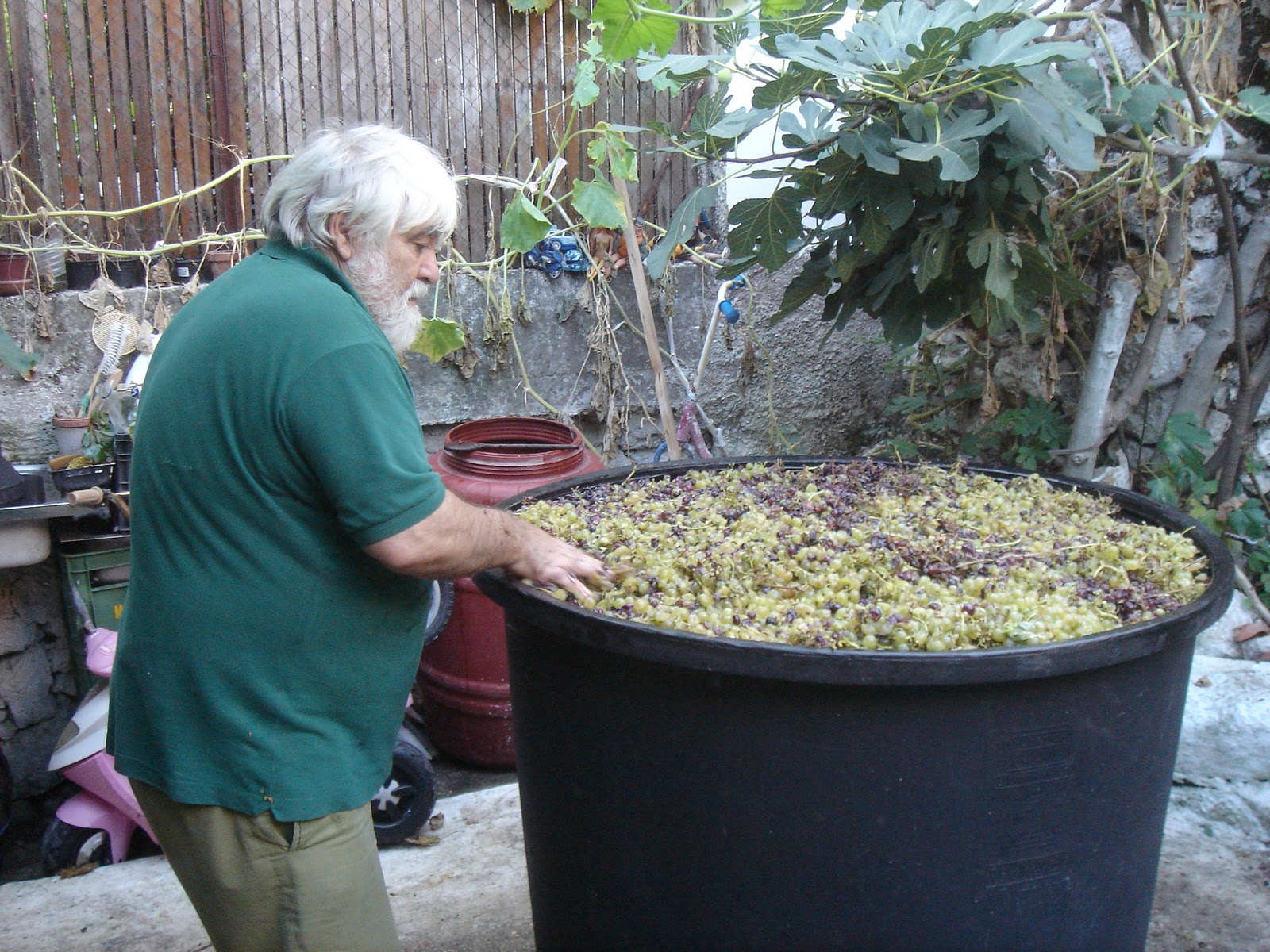
It’s a month for making wine - down alleyways, beside the road, biscuits of pomace left over from pressing. As we strolled by their house a few steps off Democracy Street, we saw Katerina and her husband pressing the grapes.
“Just a moment, Simon. I have a bottle of last year’s wine for you”. Katherine bought us out a two litre bottle of golden white. Their grapes both red and white had not become desiccated - wine from Ano Korakiana stock.
Lefteris and Fortis – yesterday afternoon – were still at the first stage, heaving 22 kilo plastic crates holding tight clusters of small black and larger white Zakinthos grapes, vine leaves, storks and twigs into a hopper, sat on a big chest-high plastic tub. Young Lefteris was having a go at the wheel.
“Simon” (their stress is always on the ό, rather than the ί in my name, which is properly spelled Σάïμον, which I like as much as the Greek respect in my more formal title ‘Mr Simon’).
“Simόn. Come.” I could see them by the tub from the balcony where Lin and I were working; an invitation to help turn the wheel that turned the cogged gear of spindled paddles above two shiny crushers at the bottom of the hopper. It was no less fun than as a child being asked to help with the mangle, squeezing out rinse water from jumbled clothes turned flat to have their creases shaken out; hung far from reach on the line. In one of the memory synapses so easily tapped I remembered, as I hurried downstairs to go next door, washing that hung in flat frozen slabs transfixed at a slight angle to the winter wind.  Lin’s mum Dorothy still does her washing by hand. Here the handle of the crusher was sticky with grape juice which, clearing hair from my brow, stuck there too. 700 kilos - about 30 crates – to be crushed, and during a break a cup of Greek coffee, skirto, with biscuit-cakes sprinkled with sesame seed and grapes steeped in honey on a small plate with a teaspoon and a glass of water made by Vasiliki. The tub exactly filled, Fortis measured the specific gravity of the juice sample – “12.5% good, 13% not good” said Lefteris. Now I know numbers in Greek, I could carry on an almost coherent statistical conversation. Three days the mass of solid grapes and twigs and leaves and perhaps spiders, a wasp and bits of grass, will stand; fermenting in the covered tub, before the young wine is run off from the tap at the bottom of the tub and sieved into bottles to continue working. Sticky and sweaty, grape smelling, I retraced my steps back to our house next door. From our balcony I could look down on the tub I’d help fill. “So when did you no longer do this with your feet?” I’d asked “Ten years ago.” Why would anyone resort to the pestled bones of a slaughtered tiger when they can make village wine?
*** ***
Linda has completed the preparing and painting of our shutters so that now on at least the street side of the house they are restored.
Shutters restored and painted
“Soon we should paint the house” she said “I think I’d like to use asvesti, whitewash, but I’m not sure the best way to apply it especially if we want to mix in colouring.”
She’s also been putting down more plaka under the balcony. First she arranges the pieces of plaka as though doing a jigsaw, then fixes three pieces at just the level she wants – at either end and centre. I chipped out the edge of the existing plaka so the join would be uneven with the new, not just a straight line.
*** ***
Yesterday afternoon Yianni returned the hire car, and this morning I drove to Tzavros to pick up needed materials from the ironmonger, and get some ciggies for Katerina. Coming home the clouds opened and I gave a lift to a soaked neighbour walking up the hill from his field below the village.
"I thought the rain was coming tomorrow?"
"So did I. Thanks for your kindness."

More quantitative easing

Monday, 6 August 2007

I entered the home of a woman...

Mum with Ann Muir on the road to Coignafearn - one of our walks beyond Garbole, about 18 miles south of Inverness. When we were here in February, the hills were covered in light snow, the ground was frosted, the river was full of ice; a chill wind from the east; deer were feeding in numbers on the flat of the strath. This day was mild. The dogs, who never chase stock, scampered happily up and down the hills. The valley was full of the sound of the waters of the Findhorn. My mother - 90 this year - sighs at needing a pusher. She'd prefer to be clambering to the higher ground with the dogs, but her balance fails her. Ann is from South Africa, from a farming family, here to help care for my mum until September. Coignafearn is owned by Sigrid Rausing, daughter of the Tetrapak billionaire Hans Rausing inventor of ingenious cartons for milk and juice. His daughter is a noted ecologist keen to protect the golden eagle population. In Strathnairn just south of Inverness at my mother's house. The Highlands are as I like them - misty and damp with midges and occasional intervals of sun to enrich the matte landscape, brightening violet heather, great purple thistles - symbol of Scotland - and lichened granite with dazzling light which later reddens a lingering watery gloaming. The wind roisters the birches round Brin Croft, Mum’s new home at Inverarnie full of bready smells, and the furnishings and decorations of Mains of Faillie - two miles north, now chill and empty with furniture marks on the scuffed carpets and weeds encroaching the gravel that for 40 years has crunched with our arrivals and departures. Lin and I arrived at Brin Croft late Wednesday night, after she’d driven north all afternoon – through the Lake District, to the border at Carlisle – not even halfway – through the lowlands past Lockerbie and Dunblane to the edge of Glasgow, a long dog leg by Stirling to Perth and the last hundred miles by Pitlochry and Blair Atholl before, at last Drumochter Pass, by the Boar of Badenoch and the Sow of Atholl and Dalwhinnie – the Highlands begins and dusk is on us as we pass Aviemore, Carrbridge, Tomatin, Ruthven and Moy and come to the slope before the turn to Fort Augustus that brings us by the low road to Inverarnie, to drink tea, with, for me a sip of Speyside malt (present from my eldest Greek sister) before a wood fire burning in a stove surrounded by slate slabs. Oscar joined the biscuit terriers clustered to delight each other with greeting barks that turned to growls, squeaks, smellings and lickings. Next morning, by sleeper, Kalvin and Emma – my relatives slightly removed – arrived to stay the weekend. Emma’s expecting a child in October and they’ve decided not to know if it’s a boy or girl. Amy came on Saturday by plane and train, sleepless from working late at the pub and rising early to get to the airport by replacement bus (her train to the airport cancelled by a security alert, or possibly a local flood). We’re a group of six. With mum helped by Ann from South Africa; Lin and me sleeping in the wood cabin my mother’s put next to her house, which she’s painted blue and white outside after a Swedish house she saw in a photo, but which by happy chance is Aegean blue. What an achievement, at 90, to have moved and settled in a new house inside three months! In my picture - Linda, mum, Amy (at the head of the table), Kalvin, Emma and Ann. Kalvin’s a central heating engineer with polyvalent enthusiasms. We can talk about anything. Because he knows about installing boilers I can even discuss local government without a polite change of subject. K’s also a painter. He showed me an acrylic – on his camera – of Billingsgate Market, near his birthplace, with fresh fish on ice, redskinned mongers and customers including a bearded Asian face of antique profile in a hoodie gazing towards a wet salmon. A portrait of Emma captured her gentle questioning amused face in the manner of Lucian Freud. Later when we were walking on the hills high above Strath Nairn we reflected on the latter’s portraits - how they captured such likeness yet if a man with a face like that walked in you’d wonder if he needed a doctor. ‘We see so little of what’s there.’ With Kalvin's enthusiasm I repeated a walk up and down one of the highest hills in the Strath that I'd done with Amy ten years ago - a photo here of her half way up. On Saturday morning I dreamed I entered the home of a woman who I was researching. I arrived at her house, got no answer to my knock but found the front door ajar. I started looking through papers in her sitting room which I assumed she’d prepared for our meeting. I could hear small movements in the kitchen. I thought it was a cat or a dog. No-one arrived, so I left. As I walked out my eye was caught by a notice in the small window on the left of the porch being held against the glass by the woman I’d come to see. On it was written ‘I CA’ in felt-tip capitals. I thought she was signalling for help – about me – to anyone passing by. I went up to the window and offered her my mobile, signing she could use it to phone for reassurance. After hesitating she raised the window enough for me to slip her the phone. We waited; me in the porch, she shut in the kitchen. My step-niece, Emma, when I told her about this over porridge at breakfast, had another explanation. ‘She couldn’t talk to you about the things you wanted to know. She was writing something that began “I can’t”. She’d left her door ajar and papers waiting for you to see, but when it came to talking about them she suddenly felt she couldn’t and stayed in the kitchen. Hearing you leave she scribbled a note but had only time to write ‘I ca’ before you were out of the door and away.’ But what did she make of the phone I gave her? That she should ring me? That I would ring her later on it and she could choose to answer or ignore the call? I’d thought she was phoning the police. Now I’m not sure she was doing more than holding my phone in dismayed indecision. I’ve just finished Keeley’s Inventing Paradise. It’s about a world, seemingly invented over a mere ten years, starting, in Keeley’s book, in 1937, during which modern Greece becomes Paradise for Lawrence Durrell and Henry Miller as they roam the land and its literature, making their own wondrous realm out of what they see and read and learn from the table talk of their Greek hosts and their connections. Keeley gathers into this world the people who actually met and laughed, feasted and talked together over just a few years. The book was published in 1999 and Keeley mentions a Greece, more recent, with passing slaps at mass tourism, but insists on ending his book before he switches to the ‘first person singular’. Expulsion from this paradise came with the great European civil war; the Italian and German Occupation of Greece bringing miseries that gave added lustre to the memory of innumerable wonderful days and evenings of companionship with talents, present in flesh and in spirit, of Seferis, Katsimbalis, Palamos, Cavafey, Elytis, Ghika, Antoniou, Stephanides, Ioanna and Constantine Tsatsos (to name the main ones and not to claim for myself the familiarity with, or even knowledge, of their work this easy listing could imply).
There are two anecdotes among the many that I especially liked. First at the crowded public funeral of the national poet Kostis Palamos on 28 February 1943 when, among a great crowd of mourners, George Katsimbalis began at the open graveside to sing the banned national anthem – a whole verse on his own followed by silence – German soldiers looking on, his wife trying to shut him up, and Ioanna Tsatsos, George Seferis’ sister, tugging at his sleeve. He begins the second verse, feeling like a drowning man, then a fat Corfiot friend makes a duet, and then, ‘like throwing a switch’, thousands took up the hymn to freedom. And second when Ioanna Tsatsos writes on 12 October 1944, that the German flag on the Acropolis came down ‘as though swallowed by the Holy Rock, and in its place rose the flag with the beloved colour of our sky’. I am embarrassed at the thought that next to my own there’s no other flag I should so gladly see marking a moment of great happiness – even though I deprecate the waving of flags in triumph (except for my brother’s sacred football) and admire Dr.Johnson for saying ‘patriotism is the last refuge of a scoundrel.’ The deeper significance of Keeley’s work is its extended comment on a greater Fall - something not yet worked out; certainly not in my mind [See entry 10/12/08]. The invention of Paradise was a product not only of the intoxicating mix of singular personalities – foreign and Greek – who figure in Keeley’s book but of a pre-war Greek culture that was first stifled then blighted by cruelty beyond previous imagining, events so far outside the imagination of its culture, beyond the reach of the philosophies of irony, stoicism and cynicism. Totalitarianism far beyond the authoritarianism of Metaxas, or the bullying of a village thug or the seedy dishonesty of a corrupt provincial official. This was a system unknown to Greeks - and many others across Europe. Talking to the House of Commons on 18 June 1940 of what might happen were Hitler's army to take over the British Isles, Churchill warned that "all that we have known and cared for, will sink into the abyss of a new Dark Age made more sinister, and perhaps more protracted, by the lights of perverted science." For us it didn't happen. To the Greeks it did.
Every symbol of Greek culture became sullied. I know how uncomfortable I feel seeing old photos of red phone boxes and English bobbies next to a German uniform in the Channel Islands. Suddenly there were soldiers in Wehrmacht and SS uniforms posing in front of the Parthenon and these filthy people were praising it as a monument to culture, infiltrated into every part of the Greek state, including Corfu. Even the evzone uniform was compromised, worn by a minority of collaborators. A new dark age did descend on the wondrous land, making everything ugly, affecting all they knew and cared for. Atrocities at Komeno, Kalavryta, LigiadesKessariani, Distomo, and the hostages [the woodcut is from p.343 of Mazower's account of the Nazi Occupation, showing a blokko (round-up) at Kokkinia, Athens on 17 August 1944. A masked informer is pointing out suspects to Germans troops and Greek collaborators]
netted by blokkos and stored for reprisal murders at Chaidari, marked a far greater swathe of one-off murders designed on purpose to be random to amplify fear and spread despair. To supplement mass murder came humiliation, deprivation, separation, displacement, vulgarisation and the suffocating ugliness of defeat, invasion and occupation and then the remorseless destruction of the oldest Jewish communities [This in Corfu alone - 10 June 1944] in Europe and their abduction and murder - a dose of deadly efficiency. Language falters before the risk of creating a league table of comparative wickedness. Beside these we find - ridiculous and obscene - almost positive remarks being made about the other two plunderers - Italy and Bulgaria - nicer rapists than the Germans, who might never have invaded Greece had Mussolini not invaded first and then sought help from an ally after the Italians were routed by the Greek army in the mountains of Albania. To imagine the frightfulness inflicted on dear Greece I have to imagine the truth of Mazower's observation about the Civil War that flared with the departure of the invaders. The joy described by Ioanna Tsatsos on 12 October was fleeting. True the swastika came down, but brave young Greeks had been pulling down Nazi flags including the one on the Parthenon throughout the Occupation [On the night of 30 May 1941, Manolis Glezos and Apostolos Santas removed the swastika from the Acropolis. They were arrested on 24 March of the following year and sentenced to death. More on this seen on MGO and read on 13/03/08]. No, Mazower quotes a primary source for a series of formative events that were, in his scholarly view, ‘more traumatic’ for Greece than the Occupation – the British Civil Police Liaison log book in WO 170/4049 and the subsequent account of events in Syntagma Square on Sunday 3 December 1944 by 23rd Armoured Brigade in WO 204/8312 – ta dekemvriana. On that day an icon of our fight against the Nazis, the Spitfire, was strafing parts of Athens and Englishmen in English khaki were sniping at Greeks from the Acropolis and, something few knew about, ‘the percentages agreement’, informed the fate of the wondrous land. After the occupation came five years of Civil War already metastasizing inside occupied Greece, with the carcinogens of human weakness and constant fear brought on by starvation, brutalisation, grief and fear to add to the intensity of human division. And they have yet to endure the stone years and the armoured democracy that lasted until 1974. I haven't read Odysseas Elytis' Axion Esti, nor yet listened to Mikis Theodorakis oratorio on the epic poem, which I have on a CD sung and spoken in German, recorded by a Dresden orchestra and choir in Leipzig in 1982. I believe it may help prepare my understanding of how Greek artists have encompassed and transformed a great darkness and created the possibility of forgiveness and, if not reconciliation - for some differences of values should never be smoked in the same pipe or allowed a clinking of glasses - then a sombre unforgetting oblivion. Sacks and sacks of undestroyed primary sources remain to erode self-serving narratives and contradict polarised recollections. Thucydides would have been proud of the young scholars, mostly Greek, and all Greek speakers, leafing through them now.
* * *
I returned from America in 1973 and got a job at Birmingham University. I met Lin in 1974. My life began anew but we did not see Greece together until 1995.

Back numbers

Simon Baddeley