Total Pageviews

Showing posts with label social media. Show all posts

Friday, 13 July 2012

A good lesson

I've never hesitated getting lessons on things - scything, new legislation, cycle maintenance, cooking, using information technology. Over the last twenty years there have been so many free lessons available on how to get the best from new computer software, notably in social media. Regularly in Birmingham people get together as students and tutors to help each other understand the potential of citizen-journalism, film-making, blogging, podcasting, flickr, web-design, messaging, publicising, communicating, lobbying through such things as facebook, youtube and twitter. More recently Government has supported the idea of social media surgeries but the idea has been around far longer. One of its pioneers in the UK has been Nick Booth who surmised over a decade ago that broadcasting was withering, becoming more and more commodified, market driven.
He wanted to do journalism, had done a great local programme with me on the fight for the Victoria Jubilee Allotments on BBC West Midlands (as had Miles Blackley for BBC Community Programmes in 1999), but was seeing a new breed of small mammals evolving under the feet of increasingly ponderous broad-casting. In its simplest form broadcasting struggled to reach small audiences, the myriad small groups that make up that chimerical thing 'community', where 'two or three people are gathered together', where 'one's a nut but two's a movement'. Where a broadcast needs audiences in hundreds of thousands and preferably millions, narrow-casting can work with audiences of tens and twenties, and hundreds and as in the case of our campaign for Black Patch Park be taken up by broadcasters, here mentioned in a podcast by Nick in 2007. The conversation would bore the pants off anyone not directly involved in wanting to save this specific park. Broadcasting would cut it to thirty seconds. As it is an overview of a typically 'wicked' problem of local government becomes available for a small number of local activists. Nick switched - a risky career move; left the BBC and started his own grassroots organisation. I knew Nick through making 'Losing the Plot'. My allotment is very close to where's he's standing in the last seconds of this film - one I've streamed on Vimeo. I used him to run sessions at the university for local government managers and members telling them more about what was going amid the interstices of the more familiar information technologies used in larger institutions. Here he is, the initiator of Podnosh, chatting about what's involved running Social Media Surgeries.
Yesterday at a Social Media event at the Studio in Cannon Street I had another film-making lesson with Franziska Bährle. I convinced Franzi after a few vexed minutes that for my purposes Final Cut Pro was fiddly and tiresome compared to iMovie, but iMovie despite carrying the tag HD seemed fixed in 4:3 format instead of the 16:9 picture ratio that's now the norm. Franzi fiddled with 'preferences' but there was no relevant option there. She closed the application and reopened it in readiness 'to create project' and there where I'd never found it (why should I?) was a small box 'video format' on which I chose HDV1080i. Franzi found this, as she does regularly when tutoring, by accessing help forums on her smart phone.  We loaded a test clip I had on file but the image was stretched. "So near. So far". More fiddling. More help forum advice.
"When you get home reload the film from your camera"
She e-mailed me later:
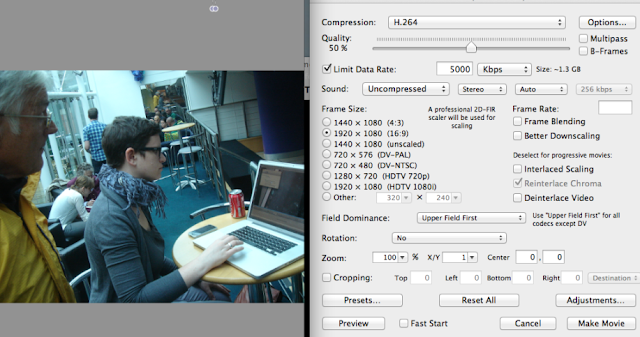
Ok, try this, I think iMovie HD got some problems with the DV format: Take the clip we tried it with (Franzitest), put it into Mpeg Streamclip and convert it again to a quicktime-movie, H.264, but be sure to tick 1920 x 1080 (16:9). Then try it again with this clip that you get and put it in iMovie HD, setting it up like we did (new project and the little button below, ticking 16:9 or widescreen or whatever they show HD/16:9-wise there, can't remember the details). I hope this works. Let me know!
We also discussed how I could get my 30-50 minute research films of members and officers in conversation down to a manageable number of gigabytes - what will go on a DVD and stream on the web - without loss of quality. We fiddled about with compression variables and eventually came up with an arrangement that would reduce nearly 13 gigabytes to 1.5.
"Try that" said Franzi
Dear Franzi. I’ve re-edited the film in iMovie as none of the changes we made on Final Cut Pro seem to have saved. My re-edit on the iMovie you showed me how to adapt to 16:9 took me just thirty minutes. After that I transferred the edited film DV full quality to my desktop which took about 10 minutes. That gave me a file of 12.5gb which I put into MPEG Streamclip. That produced a final file of 1.50gb - with no appreciable loss of quality or distortion. I’ve burned this onto a DVD to mail to my client.
I chose H.264. Limited data rate to 5000, ticked 1920 x 1080 (16:9) and un-ticked interlaced scaling and stayed with 50% quality on the slide bar.
I'm just delighted and feel so much more confident about making local films - much shorter than this - as well as the longer films that are part of my work at the University.
Thank you so so much, Franzi, and please forgive me getting so fractious about Final Cut Pro, but it really is hopeless for me compared to iMovie - now you’ve shown me how I can get iMovieHD 6.0.3 (267.2) to handle 16:9 and how to get such excellent compression with such little loss of quality.
12.5gig to 1.5gig! Amazing. Up to now these 30-45 minute files have been so unmanageable. Hugs. Best wishes. Simon
31' video after compression to 1.5GB
When waxing on about social-meeja I'm well aware of the percentage of people across the world and in this country who have no access to the web; don't even have phones. Long ago - in the 1980s - Tom Stonier at prescient talks on campus was anticipating that if you don't exploit information technology, it will exploit you. I'm thinking of that village seminar in Newstead in November 2009 tho'...
Meanwhile in the small town of Newstead, in Victoria, I was taken to a community meeting in the main street coffee shop where there was a Sunday afternoon get together to discuss the implications of Social Networking with an invited academic, Barry Golding from Ballarat University, gently expressing his reservations about the difference between real face-to-face contact and that offered by, for instance Facebook or Twitter, and remindiing us just what en enormous part of the global population has never made a phone call let alone having access to the world wide web, while someone working for the State of Victoria, Ben Hart, suggested - with equal politeness - the potential of the medium. We had WiFi where we met and after the Q & A session I couldn't resist asking to have myself pictured 'in country' by a page of Democracy Street blog.
**** ****
I was collating some studio photos of Jack for Charles who wants them to accompany his marketing of the newly surfaced original episodes of Out of Towm and I came across loads of other pics going back years. There was one of Linda in December 1989
"It actually makes me look half decent" she said this evening...
...and another, record of a memorable day - the first time she came to Greece with me, so the first time to climb the sacred rock where I first strolled one rainy April day in 1957.
On the Acropolis: Linda at the The Sanctuary of Zeus Polieus ~ 1995
*** ***
 I was asked to write a short bio for a sailing club I've belonged to for years, one that encourages long diatance voyages in small boats. I had a go, adding, as requested some favourite quotes:
I don't deserve to be in the xxx, but pride in membership and reading the journal keeps me renewing my small subscription. I spent wonderful years between '61 and '66 sailing - first crossing was in a 17' gaff cutter from Pennington to Yarmouth. Next I sailed as crew in Danica, designed by Denys Rayner RCC, to Cherbourg from Lymington. Next skippered by a friend, Chris Jameson, I sailed Danica from Lymington to Athens. I was given my own 2.5 ton Hillyard - Two Pearls - for my 21st birthday. I sailed her from Lymington to Brittany between St Malo and Roscoff; my first cruise as an RCC cadet. Next year I helped make a TV programme about a new GRP boat called the Westerly 22, designed again by Denys Rayner. My stepfather Jack Hargreaves was fascinated by the idea of a boat that could be trailed, was inexpensive yet could cross oceans. With a friend we sailed Young Tiger across Biscay landfalling at Cape Ortegal, exploring the Ria's of Galiicia. In 1965 I sailed Young Tiger to Bordeaux helped by a Hasler self-steering gear. He'd encouraged me to go further as had Denys. After my stepfather and his wife had taken my boat via canal to Sète  making a TV documentary, I was joined by Sue Pulford. We sailed on to Gran Canaria and from there to Barbados - 29 days' crossing. We sailed via the islands up to Miami, where I gave up sailing my own boat for 41 years, and lived inland, working in Birmingham, a tourist in my own country. In 2006 my daughter Amy on her laptop at our kitchen table in Handsworth found a yacht on eBay advertised on a free mooring in Corfu. I looked at Linda who'd survived one windy wet summer with me in a borrowed W22 down the Bristol Channel. She nodded. I clicked on 'buy now'. We have a house in Ano Korakiana and Summersong - an old Snapdragon 27 - for day trips to coves and small islands on the Sea of Kerkyra.
"We are as near to heaven by sea as by land!" On the 9 September 1583 Sir Humphrey Gilbert called out these words from the stern of the frigate Squirrel. He was heard on Golden Hind, as both ships struggled with waves 'short and high, pyramid-wise' off the Azores. Hind's people, amid their own worries, watched for Squirrel as the weather separated them; her lights disappeared...and Thomas More 'He that hathe no grave is covered with the skye: and, the way to heaven out of all places is of like length and distance...'
***
In 1962 I sailed to Greece from England with a friend. In July we left Messina in Sicily. The first morning of our two day crossing, Danica bouncing and swaying on a swift etesian reach; came on our reverse, a sleek Greek frigate cutting smoothly through the cresting waves, heading west. In return to our salute she dipped her flag to us. My chest swells at the memory of seeing that lovely ensign falling and rising again in the seconds of her passing as though official Greece was saying "yasus" - just to us. Next morning we made Byron's landfall.
I value Gilbert's eloquence in the storm but I know too that this was a man who for England left places in Ireland 'the abode of wolves', Thomas More could be cruel and venomous against herecy. Of my ancient experience crossing the Ionian Sea, it's a blue-white picture outside time in the ceaseless kaleidoscope of my mind's eye.
5 January 1966 ~ another time, another place
*** ***
Citizen-journalist Craig Wherlock in Thessaloniki writes in his blog Teacherdude's Grill and BBQ on taking pictures in riots...'With clashes in Spain and especially in Madrid growing in intensity I thought I'd post a few pointers to those photographers who want to cover riots and other such turbulent events. Since 2005 I have recorded, dozens of violent confrontations here in Greece and I hope that these pointers will help keep you safe as well....'

Wednesday, 20 May 2009

Nick Booth comes to supper

I met Nick Booth in 2000. He approached me about making a documentary for BBC West Midlands about the deliberate blighting of allotments, documenting the malign neglect that so reduced the numbers of tenants on a particular site that a calculative cabal of committee members could claim they had no option but to sell their shared land to a developer and pocket the profit of surrendering growing space for buildings. The case of the Victoria Jubilee Allotments was a central feature of an entertaining, and at times moving, half-hour investigation - Losing the Plot.
We've stayed in close touch as Nick has moved from broadcasting to narrowcasting - in a much richer sense of that term - developing a distinctive talent in the world of social media* evolving a novel grammar of communication as rich with unrecognised possibilities as when the role of steam was to rattle the lid of a boiling kettle. Developing a new technology is complicated. In testing it out, in draft form, on possible users you have to work out what needs to change - the techniques of the user or the design of the new tool; usually a mix of both. Coming to friends' homes; sitting with them as they tinker with what you're offering is as good a way of piloting something as any. With Nick it's fun.
In this case he's got something amazingly useful in mind - a site supporting, via social networking, the kind of investigation that has made Heather Brooke a local, and now, a national hero. It's early days. I find the idea exciting but tricky knowing the fickle attention span of those who try new sites. It needs to work from the moment of launch - in several weeks time. After that the web will spread the word. Richard cooked us supper.
*Wiki's list of social media: Social media can take many different forms, including Internet forums, weblogs, social blogs, wikis, podcasts, pictures and video. Technologies include: blogs, picture-sharing, vlogs, wall-postings, email, instant messaging, music-sharing, crowdsourcing, and voice over IP, to name a few. Examples of social media applications are Google Groups (reference, social networking), Wikipedia (reference), MySpace (social networking), Facebook (social networking),MouthShut.com yelp.com (product reviews), Youmeo (social network aggregation), Last.fm (personal music), YouTube (social networking and video sharing), Avatars United (social networking), Second Life (virtual reality), Flickr (photo sharing), Twitter (social networking and microblogging), Open Diary (blogging), and other microblogs such as Jaiku. Many of these social media services can be integrated via social network aggregation platforms like Mybloglog and Plaxo.
Nick is a most unnerdy enthusiast; as familiar as anyone I know with the technology but focused on its use for extending democracy - hence his Grassroots Channel and Podnosh blog. I'm hoping Jonathan and I can make use of his feel for the grassroots politics of Birmingham if our ESRC bid to explore the continuity of hegemony succeeds.
* * *
I skyped Honey in Corfu. As we'd left for the airport last week I realised we'd forgotten to switch off the electricity. "Don't worry" she said "All's done." then she started giggling because we were look so funny through signal distortion. "It's hot and sunny in Corfu!" "Well it isn't here." I took my laptop to the veranda so she could watch our rain 1340 miles away.
* * * I'm aware I face revelations about expenses I've submitted, so I feel that it is only right and proper that admit that on at least three occasions, perhaps a few more, I have, during the last four years, claimed for a cinnamon logo in the centre of the foam on top of several caffè lattes. I offer an unreserved apology for this breach of trust. I do not feel that I've done wrong. At no time was I motivated by anything other than the wish to serve...an administrative error for which I take total responsibility, my returns were approved by the expenses office, and...but...and...if...er...I wasn't the only one...everyone else was...I'm human...predictably irrational. * * * E-mail to an acquaintance in Corfu who asked for an opinion on Libertas.Greece as a player in the EU elections on 7 June '09:
There is a great need for the EU parliament to reform itself; little probability it will. Disillusionment with mainstream parties is bringing out many fringe groups - some with bizarre views. I have worries about the driving force behind Libertas, Declan Ganley (note his bids to revise his Wikipedia entry) and the lack of transparency about how Libertas is funded. Given the history of US involvement in the Republic, deeper investigation of Ganley's Rivada connection will harm the reputation of any Libertas.Greece candidate. Ganley is the populist entrepreneur who drove Ireland's 2008 'No' campaign against the Lisbon Treaty. He enjoys defamatory mud-slinging contests with rivals. Libertas can be found offering policies across Europe tailored to local electors fearful and angry about their local circumstances. On its own website it’s long on promises of freedom and liberty; short on the detail that would allow debate about what reforms it might be able to bring about if elected in sufficient numbers to be part of EU government. I respect your wish to get involved in politics in pursuit of solutions to the problems here, but I'm not convinced Libertas Greece or Libertas Europe or an of the Libertas local parties offer credible or practical answers to your concerns about them. Does Libertas, for instance, have a policy on sustainability that would help sort out the landfill problems at Lefkimi and Temploni? Could Libertas.Gr help revise the proportion of cash that goes to Athens rather than the local infrastructure? I doubt Declan Ganley (who speaks well) or those close to him, care about the problems of Greece, let alone those of Corfu. He wants power in Brussels and Strasbourg even as he complains about the influence of the EU. Without wanting to praise existing EU politicians, Libertas seems to have attracted too many candidates with undemocratic instincts, along with honest men and women who lack experience of government. Be careful before getting into bed with these people.
(context: see video)
Flea and magpie on our backlawn in Handsworth
Though we're close to neighbours, our back garden's just private enough to wander into in pyjamas or nighty, to feel the grass under bare feet, feed the fish and fill the bird feeders. From our balcony the view, especially in summer, is almost all sky and tree landmarked by the tower of St.Mary's Church and its six bells, much restored through six centuries of lapsed and recovered observances, holding the remains of James Watt, William Murdoch and Matthew Bolton, pioneers of the modern age.
Whenever someone opines Handsworth history or its current reputation I ponder the view. Urban pathologists, most famously John Rex, have studied our part of the city. It has been their laboratory; chemistry for the policy of successive national governments. With exceptions (e.g. Vanley Burke's superlative commentary ), this place is described by scholars striving to be objective, yet partial in quantifying injustice. We've benefitted from statistics, gained from theory. When we're in Ano Korakiana in beloved Greece I often think of here; our involvement. Given the choice we've no wish to live anywhere else in Birmingham than Handsworth - for the place and the people who are our neighbours, known and unknown.
A city is composed of different kinds of men; similar people cannot bring a city into existence. Aristotle, The Politics, Part 2

Sunday, 21 December 2008

"Violence cannot be fought with violence"


The dog Λουκάνικος, Bangers, successor to Κανέλλος, Cinnamon
Adam Schatz London Review 19 December 2008:
The police, curiously, have retreated from confrontation with the street-fighting anarchists, preferring to chase down protesters at the tense but mostly peaceful daytime rallies. Amnesty International has reported that two of its Greek members were beaten with batons, and accused the police of engaging in ‘punitive violence against peaceful demonstrators, rather than targeting those who were inciting violence and destroying property’. (Riot police emptied 4600 tear gas canisters, and had to make an emergency request to Germany and Israel to replenish their reserves.) But when the cities were burning at night, the cops were scarcer than firefighters during the great forest blaze: after midnight the cities belonged to anarchists, arsonists, looters – and, it seems, to hooded agents provocateurs with iron clubs. The stated objective behind this ‘defensive posture’ was to avoid further casualties, but many Greeks wonder whether the government had struck a tacit deal with the rioters. ‘We let you torch and plunder to your hearts’ content, and you let us continue pretending that we are in charge’ was the wording suggested by Michas Takis, a journalist at the liberal newspaper Eleftherotypia. [quote ~ Panagiotis Stathis, spokesman for the national police "Violence cannot be fought with violence."]
In one film, from a fixed camera above Syntagma Square, I viewed a road nearly empty of vehicles, campaigners standing in separate clusters on the broad pavements, and near the top of the square a pair of evzones in brown winter uniforms doing their traditional march at the Tomb of the Unknown Soldier in front of Parliament. On one forum a visitor to Athens leaving his hostel to visit the Acropolis writes that:
...we hit up the shopping area and people watched. then i saw a tv reporter setting up and asked if i could get a photo of her pretending to interview me. well, me and my big mouth, b/c she asked if she could interview for me, about the presence of police in large numbers around the christmas tree and pedestrian mall. so at least my photo is now genuine. look for me on the AP greek story regarding athens resembling a police state now. i didn't say that i had just come from israel and am used to it, but 'twas fun all the same. tomorrow will be ancient sites day, and at night olympiacos versus some team that will lose badly. fingers crossed for no rain. nap time now.
I was talking, this evening, to Amy who'd dropped in with Liz. She looked at some of the street action on the many videos of events in Athens, and referred me to current thinking in her work books on policing public disorder. I've started looking again at the way the Athens police are deploying, grouping and regrouping and begun to notice patterns in the fog. Having already had intuitions about symmetry in the dynamics of these dramatic scenes - not quite velvet, more like dralon. Amy's pointed me to a missing part of this puzzle. Of course it's been mentioned by others - the limited number of injuries among rioters and police, the minimal use of guns (none authorised) or even baton rounds, the shock aroused by the 'second shooting' - a spent bullet striking a young man's hand rendering it numb; the absence indeed of blood letting except that of Alexandros Grigoropoulos, whose death is unreservedly deplored by the government. These guys (and some women) have been on workshops and courses, taken notes from slide presentations, discussed scenarios introduced by senior officers who've attended international conferences on the management of urban riots. I know the police have training - of varying quality - but I hadn't realised how far practice had advanced informed by global experience. The Wikipedia entry on riot control is solely about weaponry - and daunting though that is - omits the volume of knowledge accumulated and diffused about crowd behaviour and its implications for policing. The arts of reaction and counter-reaction have been refined and must have spread - notwithstanding the low wages and lack of training that Greek police complain about - to the uniformed men I'm seeing in the gassy flaming streets of Athens. Riots judged as 'failures' by professionals, are those where violence is escalated or even provoked by police action; especially when police attack violent demonstrators - either because provoked, or because officers who enjoy violence are given rein, or because violent men have been planted in the crowd to provoke ill-trained and undisciplined police and/or because one or more politicians sees advantage in escalation. e.g. Berlusconi in Genoa. These acts of violence against violent mobs have either played into the hands of those who desire violence - on either side - and have diverted the police from directing their control measures against the violent, so that they end up playing into the hands of the violent, either by attacking peaceful elements in the crowd or killing or injuring aggressive demonstrators who's fate wins the sympathy of moderates, increasing animosity towards the police. I think Machiavelli would have at least reviewed some of his thoughts on the proper application of ruthlessness in the light of research on crowds since Le Bon's pioneering work in the 1890s. According to the text books on this subject, the worst thing the police can do is to return violence with commensurate violence. Blimey! For a testosterone charged male kitted up in riot gear that's counter-intuitive. The police have to avoid being drawn into violence without appearing to appease or permit violence. Those who seek confrontation among the rioters understand this, as do those who wish the same among the police, in collaboration with those in government or with aspirations to government, who seek confrontation to achieve their ambitions. The police have to be wise, as do those who give them orders - if peace is to be waged. So all those millions going into the Bloody Sunday Enquiry are, as well as being a search for truth, an investment in the competence of those handling mass disorder. The situation is complicated by the likelihood that many rioters, some with parental connections in government, including those who steer the police, are reading (a variety of social web links to virtual environments) the same manuals. Given that proportionality has been normal in cold war manoeuvring most of my life, how unsurprising that similar dynamics apply to conflict in civvy street - tailored to the circumstances of Greece. * * * *
Mixed reactions to the protests in Greece by Teacher Dude's BBQ. A man cries "shame"; a woman claps
[photo: Teacher Dude's Grill and BBQ, in some of the most intimate records of these weeks, captures mixed reactions]
Observations by the citizen-journalist Teacher Dude who's been posting images and comments from Greece on Flickr: There were times over the last two weeks when what I witnessed seemed taken from the script of an outlandish movie, the kind where everyone tuts and says, "That is just so Hollywood. That would never happen in real life". William Goldman, the writer of movies such as Butch Cassidy and the Sundance Kid once said that there were things taken from real life he couldn't put in his scripts as nobody would believe them. Here is a selection of the few I remember from the riots and protests that I covered over the last two weeks. The two guys wearing masks are ready to charge the bank, all set on smashing the security camera and disabling the ATM. However, there is a young woman there, oblivious to the mayhem around her who is taking out her money. The masked men wait, politely ask her if she has finished, then set about the cash machine with hammers. A march goes past a van, inside two tiny Shetland ponies stuck in a space not much bigger than they are. The protesters, enraged by this discuss what to do. In the end they take down the number plates as to....report the owners to the authorities. Just a few metres behind them riot police approach menacingly. 50 kids, one no more than 10 years old pelting the central police station with rocks as bewildered shoppers seemingly unable to grasp what is happening gawp while pieces of paving stone clatter around them. The quasi - military riot police up against tweenies Walking along Egnatia Boulevard lit up by at least a dozen fires, acrid smell of tear gas and burning plastic everywhere. Two middle aged bystanders argue over whether the anarchists about to firebomb a bank are doing the right thing. The older, white haired guy, says, "What do you care? It's not your money". An old woman buttoning holing a passing masked teen, scolding him about what has been happening. Others join in a passionately debate what has been happening over the last few days. A smartly dressed woman, shopping bags around her, waiting at the bus stop claps and cheers masked protesters marching by. The man next to her shouts out "Shame, shame on you" [Teacher Dude, citizen journalist, originally from England, living in Northern Greece, teaches English as a Foreign Language (EFL)...writes of loving photography...cpwefl2003@hotmail.com. His comment below - following a request from me for permission to use his words and this photo - refutes my remote observation but confirms some shared awareness of history among potential assailants 'As far as escalation of violence is concerned I think both sides realise that would quickly spiral out of control as there are literally millions of guns in circulation.'] [Big Fat Greek Summer - 13/12/08 - eye witnessing the ordinary and the dramatic were mingling in central Athens]
* * * * The Tango Team: Tango stands for Tactically Aggressive and Necessary Gambit of Options. This team goes forward and 'dances' with the crowd. The Tango Team can bring to bear the entire spectrum of use-of-force options-from command presence through deadly force-in a controlled, self-contained package. * * * * Last night - Saturday - Lin beckoned me round the other side of the kitchen table from where I was street watching Athens to see the last dance on BBC iPlayer of the Strictly Come Dancing final - between Tom and Camilla (see 32.50 on) - who she knew, though she'd missed the live show, had won. They were good - even I could see.

Wednesday, 10 December 2008

Parents of Greece could stop this

Parents of Greece could stops this educated disorder now, but part or all of them in part approve their children's public action against a rack of concerns about theirs and their country's future. The police are forbidden - since the "anomaly" of the Junta - to do what other European police forces could do to restore order. it is perhaps no wonder some individual officers in the fray of the street or the privacy of cells let loose the feral. The same goes for those they face. This is a dangerous but not entirely unintelligent game between government and some of Greece's best and brightest. It is tragic. It is so so sad to watch this ugly family row in a place so dear. I pray that the impulses of tame klephts remain restrained, but that's an oxymoron. I read the hatred and anger on the Greek web forums against those in the streets and sense the desire, leaping from their fingers to shoot, kill, torture and impound their countrymen, who they call scum and worse. These keyboard colonels, these virtual coupmongers, and those they may prompt to action make no contribution to resolving this long sowed crisis - except like me as part of the chorus. In Axion Esti Elytis describes this Greek struggle
...it cannot be they without you nor can it be you without them… and you must face them without fail…those who wear the black shirt...who speak the language of porcupines, raw-eaters, water-brutes, bread-fearers, the leadenfaced and the neocondors.
I do not refer only to the police. They clearly have their water-brutes, but to all those who lurk - leadenfaced - yearning to start hacking this Gordian Knot.
* * * *
The violence in Corfu in San Rocco reported by the BBC and from a participant via their mobile: * * * * Plato is called anti-democratic. What democrat isn’t, who knows himself and humans - perhaps Kazantzakis’ Zorba – but only after leaving the earth. Plato said ‘justice in life and the conduct of the state is possible only as first it resides in the hearts and souls of citizens’. My ancestor, Maine, warned idealists for democracy that 'democracy is just another form of government’. Its success depended, he argued so well in Popular Government, on the constant exercise of moral intelligence to prevent it falling into the same despotic excesses the idealists presumed exclusive to monarchy. Locked in the intimate company of family and neighbours for months in occupied Amsterdam, young Ann Frank wrote ‘I don't believe that the big men, the politicians and the capitalists alone are guilty of the war. Oh, no, the little man is just as keen...’
* * *
Just got this via a Corfu contact who writes: For non Greek speakers, the reporter is horrified by:
# The screams of children being thumped by the fuzz # Bystanders trying to stop them. # People being dragged along the ground. # Children fainting or being beaten 'til unconscious
BALLISTICS: I've been with a policier pal, no-nonsense type. He says the bullet's been examined and there was NO ricochet. All this chatter from the defence about a "mistake" is crap. Also, he says the 'special' policeman(meaning not at all specially trained) was in his car and fired from the vehicle which was never under attack. I can't vouch for that bit; just quoting an In with an in. Accident schmaccident: Gonna be trouble oop t'mill over this one. You tube description: O thanatos tou Alexi Grigoropoulou den einai memonomeno peristatiko. H elliniki astynomia ksylokopei anyperspistous mathites akoma kai stis eirinikes sygentrwseis gia ti mnimi tou. Dimosiografos zontana metadidei to peristatiko sto radiofwno
* * * *
Kat - American in Athens blog - records an interview with a MAT police officer who describes how he came to Athens from Thessaloniki, choosing the police to have a job where wages, though low, arrive on time. He speaks of a 'broken country'; of being in a force that is ill-trained and unsupported.
"The guy who shot the boy isn’t someone I know, but his nickname 'Rambo' explains it all. I don’t want to know a person like this, but policeman around the world probably all know a co-worker who is (what do you call it?) irresponsible and trigger happy. All professions everywhere have bad people. It is a tragedy, and I understand why people are mad. All the MAT are paying for him, whether he is guilty or not"..."I’m sorry for the boy who was killed, but I want people to understand that many police officers are good. People call us pigs and hicks, and yes there are a few. But we’re human and have the same problems as everyone else, and we care about this country. Thank you for the chance to speak." [Police officer Epaminondas Korkoneas was charged with murder and police officer Vassilios Saraliotis was charged as an accomplice to murder.]
* * * *
11 December: They're speaking of burning cities on Radio 4 with Melvyn Bragg - in this case the two great fires of London. A modern city can't be burned down by men without nuclear weaponry or a firestorm like Dresden's in February 1945. Despite the dramatic images of flame and smoke Athens' present damage will have disappeared by Easter if not earlier. Notwithstanding the misery of shop keepers, the import of these events is not written in material harm. It never is. For an account of what happens when a city is destroyed by fire I think of Virgil's evocation of the fall of Troy in Aeneid Book 2 (Andrew Wilson's 2003 translation). Aeneas, the future founder of Rome, tells Queen Dido and her court how the Greeks - the Danaans - appeared to depart leaving a great wooden horse packed with hoplites on the beach as a gift. The world knows what followed but seldom hears the details as imagined by the Roman genius telling the story, centuries later, of the founding of Rome. I listened to David West's translation read by Richard Pasco on Penguin Audio during a long drive to Scotland ten years ago. Though I'd grown up rooting for the Greeks, I wept at the pity of Troy's destruction, Virgil's account resonating with every other story of the dreadfulness of soldiery amok in the streets of a fallen city.
* * * *
Global Voices covering blogs, videos and podcasts across the world has finally registered riots in Greece and offers a wide range of reactions - including asteris on twitter from Thessaloniki, a Wikipedia entry (which will no doubt be revised especially regularly) and these 30 (at time of writing - noon GMT 11/12/08) films on YouTube via #griots. And here I learn that my respected cyberfriend Stavros has placed a lengthy comment of mine - which he's titled 'From a Philhellene' - on his eloquent blog My Greek Odyssey - my dream about entering the home of a woman [back to the future: 29/12/08 - the Montreal Gazette publishes a belatedly story] * * * * On Wednesday I tried out the web streamed videos on political-management that I've been gently feeding into the web in the classroom. I had my own laptop with its freight of videos to show unstreamed extracts off an external hard drive and for others I was able - using the classroom PC linked to the campus LAN to show some of the extracts I'd posted on my quicklist on YouTube. It was easy to switch between computers and I think the session went really well - with my students, all practitioners, finding it useful to know they could look over the videos again, after reading the paper I'd handed out on political-management leadership. The next challenge suggested and helped by the Cochrane's via Facebook is to do that three minute introductory film to accompany the clips. From Jane C:
I think the intro would need to cover something like: 1 - this is a short intro to a series of x number of YouTube vids on the subject of political sensitivity and leadership, 2 - the videos explore aspects of the complex relationship between politicians and CEOs of local authorities and ? other public sector organisations, 3 - For some people leadership, trust and political sensitivity are natural skills and competences ... but for the rest of us they have to be researched, nurtured and honed - I hope this series will provoke your thinking and point you towards further resource material... you could always put up bibliography for further reading too.
And from Peter C who also sent some useful URLs
1) Use very few words 2) Use a big bold font 3) Use simple, telegraphese, style 4) Let pictures get your core message across
* * *
Flickr photos of the events from Teacherdude and Πορείες για το νεκρό μαθητή

* * *
A Greek blogger - Tempel or rebel - comments on narrowcasting:
And finally and most important the blogging…After french riots in 2005, Greece verified the rule : Blogging and internet are established as alternative source of independent information. Not because bloggers are objective, the opposite!!! But they are now too many!! So someone could read a variety of opinions that usually gives the whole picture. In that sense information on internet exceeds the limits of traditional media. The whole political spectrum is expressed here, without limitations of time or political correctness. And that helps the political dialogue significantly. And here comes the videotapes. The current riots boost a distribution of images by cell phones, amateur videos, photos and information on incidents minute by minute. Greek bloggers were testing the limits and discover that is not such thing. There are not limits in our passion for open and accessible information
[Back to the future 29 December 2008: 'Social media and the Greek uprising'] [Back to the future 10/01/09 Teacher dude speaks - last November but just read - of the tension between broad and narrow casting, between mainstream and webstream, between those who wrote and those who type, and how this is evolving in Greece]

Back numbers

Simon Baddeley