Total Pageviews

Showing posts with label Acropolis. Show all posts

Friday, 13 July 2012

A good lesson

I've never hesitated getting lessons on things - scything, new legislation, cycle maintenance, cooking, using information technology. Over the last twenty years there have been so many free lessons available on how to get the best from new computer software, notably in social media. Regularly in Birmingham people get together as students and tutors to help each other understand the potential of citizen-journalism, film-making, blogging, podcasting, flickr, web-design, messaging, publicising, communicating, lobbying through such things as facebook, youtube and twitter. More recently Government has supported the idea of social media surgeries but the idea has been around far longer. One of its pioneers in the UK has been Nick Booth who surmised over a decade ago that broadcasting was withering, becoming more and more commodified, market driven.
He wanted to do journalism, had done a great local programme with me on the fight for the Victoria Jubilee Allotments on BBC West Midlands (as had Miles Blackley for BBC Community Programmes in 1999), but was seeing a new breed of small mammals evolving under the feet of increasingly ponderous broad-casting. In its simplest form broadcasting struggled to reach small audiences, the myriad small groups that make up that chimerical thing 'community', where 'two or three people are gathered together', where 'one's a nut but two's a movement'. Where a broadcast needs audiences in hundreds of thousands and preferably millions, narrow-casting can work with audiences of tens and twenties, and hundreds and as in the case of our campaign for Black Patch Park be taken up by broadcasters, here mentioned in a podcast by Nick in 2007. The conversation would bore the pants off anyone not directly involved in wanting to save this specific park. Broadcasting would cut it to thirty seconds. As it is an overview of a typically 'wicked' problem of local government becomes available for a small number of local activists. Nick switched - a risky career move; left the BBC and started his own grassroots organisation. I knew Nick through making 'Losing the Plot'. My allotment is very close to where's he's standing in the last seconds of this film - one I've streamed on Vimeo. I used him to run sessions at the university for local government managers and members telling them more about what was going amid the interstices of the more familiar information technologies used in larger institutions. Here he is, the initiator of Podnosh, chatting about what's involved running Social Media Surgeries.
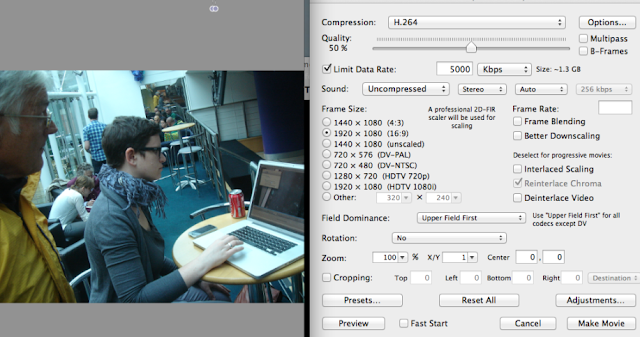
Yesterday at a Social Media event at the Studio in Cannon Street I had another film-making lesson with Franziska Bährle. I convinced Franzi after a few vexed minutes that for my purposes Final Cut Pro was fiddly and tiresome compared to iMovie, but iMovie despite carrying the tag HD seemed fixed in 4:3 format instead of the 16:9 picture ratio that's now the norm. Franzi fiddled with 'preferences' but there was no relevant option there. She closed the application and reopened it in readiness 'to create project' and there where I'd never found it (why should I?) was a small box 'video format' on which I chose HDV1080i. Franzi found this, as she does regularly when tutoring, by accessing help forums on her smart phone.  We loaded a test clip I had on file but the image was stretched. "So near. So far". More fiddling. More help forum advice.
"When you get home reload the film from your camera"
She e-mailed me later:
Ok, try this, I think iMovie HD got some problems with the DV format: Take the clip we tried it with (Franzitest), put it into Mpeg Streamclip and convert it again to a quicktime-movie, H.264, but be sure to tick 1920 x 1080 (16:9). Then try it again with this clip that you get and put it in iMovie HD, setting it up like we did (new project and the little button below, ticking 16:9 or widescreen or whatever they show HD/16:9-wise there, can't remember the details). I hope this works. Let me know!
We also discussed how I could get my 30-50 minute research films of members and officers in conversation down to a manageable number of gigabytes - what will go on a DVD and stream on the web - without loss of quality. We fiddled about with compression variables and eventually came up with an arrangement that would reduce nearly 13 gigabytes to 1.5.
"Try that" said Franzi
Dear Franzi. I’ve re-edited the film in iMovie as none of the changes we made on Final Cut Pro seem to have saved. My re-edit on the iMovie you showed me how to adapt to 16:9 took me just thirty minutes. After that I transferred the edited film DV full quality to my desktop which took about 10 minutes. That gave me a file of 12.5gb which I put into MPEG Streamclip. That produced a final file of 1.50gb - with no appreciable loss of quality or distortion. I’ve burned this onto a DVD to mail to my client.
I chose H.264. Limited data rate to 5000, ticked 1920 x 1080 (16:9) and un-ticked interlaced scaling and stayed with 50% quality on the slide bar.
I'm just delighted and feel so much more confident about making local films - much shorter than this - as well as the longer films that are part of my work at the University.
Thank you so so much, Franzi, and please forgive me getting so fractious about Final Cut Pro, but it really is hopeless for me compared to iMovie - now you’ve shown me how I can get iMovieHD 6.0.3 (267.2) to handle 16:9 and how to get such excellent compression with such little loss of quality.
12.5gig to 1.5gig! Amazing. Up to now these 30-45 minute files have been so unmanageable. Hugs. Best wishes. Simon
31' video after compression to 1.5GB
When waxing on about social-meeja I'm well aware of the percentage of people across the world and in this country who have no access to the web; don't even have phones. Long ago - in the 1980s - Tom Stonier at prescient talks on campus was anticipating that if you don't exploit information technology, it will exploit you. I'm thinking of that village seminar in Newstead in November 2009 tho'...
Meanwhile in the small town of Newstead, in Victoria, I was taken to a community meeting in the main street coffee shop where there was a Sunday afternoon get together to discuss the implications of Social Networking with an invited academic, Barry Golding from Ballarat University, gently expressing his reservations about the difference between real face-to-face contact and that offered by, for instance Facebook or Twitter, and remindiing us just what en enormous part of the global population has never made a phone call let alone having access to the world wide web, while someone working for the State of Victoria, Ben Hart, suggested - with equal politeness - the potential of the medium. We had WiFi where we met and after the Q & A session I couldn't resist asking to have myself pictured 'in country' by a page of Democracy Street blog.
**** ****
I was collating some studio photos of Jack for Charles who wants them to accompany his marketing of the newly surfaced original episodes of Out of Towm and I came across loads of other pics going back years. There was one of Linda in December 1989
"It actually makes me look half decent" she said this evening...
...and another, record of a memorable day - the first time she came to Greece with me, so the first time to climb the sacred rock where I first strolled one rainy April day in 1957.
On the Acropolis: Linda at the The Sanctuary of Zeus Polieus ~ 1995
*** ***
 I was asked to write a short bio for a sailing club I've belonged to for years, one that encourages long diatance voyages in small boats. I had a go, adding, as requested some favourite quotes:
I don't deserve to be in the xxx, but pride in membership and reading the journal keeps me renewing my small subscription. I spent wonderful years between '61 and '66 sailing - first crossing was in a 17' gaff cutter from Pennington to Yarmouth. Next I sailed as crew in Danica, designed by Denys Rayner RCC, to Cherbourg from Lymington. Next skippered by a friend, Chris Jameson, I sailed Danica from Lymington to Athens. I was given my own 2.5 ton Hillyard - Two Pearls - for my 21st birthday. I sailed her from Lymington to Brittany between St Malo and Roscoff; my first cruise as an RCC cadet. Next year I helped make a TV programme about a new GRP boat called the Westerly 22, designed again by Denys Rayner. My stepfather Jack Hargreaves was fascinated by the idea of a boat that could be trailed, was inexpensive yet could cross oceans. With a friend we sailed Young Tiger across Biscay landfalling at Cape Ortegal, exploring the Ria's of Galiicia. In 1965 I sailed Young Tiger to Bordeaux helped by a Hasler self-steering gear. He'd encouraged me to go further as had Denys. After my stepfather and his wife had taken my boat via canal to Sète  making a TV documentary, I was joined by Sue Pulford. We sailed on to Gran Canaria and from there to Barbados - 29 days' crossing. We sailed via the islands up to Miami, where I gave up sailing my own boat for 41 years, and lived inland, working in Birmingham, a tourist in my own country. In 2006 my daughter Amy on her laptop at our kitchen table in Handsworth found a yacht on eBay advertised on a free mooring in Corfu. I looked at Linda who'd survived one windy wet summer with me in a borrowed W22 down the Bristol Channel. She nodded. I clicked on 'buy now'. We have a house in Ano Korakiana and Summersong - an old Snapdragon 27 - for day trips to coves and small islands on the Sea of Kerkyra.
"We are as near to heaven by sea as by land!" On the 9 September 1583 Sir Humphrey Gilbert called out these words from the stern of the frigate Squirrel. He was heard on Golden Hind, as both ships struggled with waves 'short and high, pyramid-wise' off the Azores. Hind's people, amid their own worries, watched for Squirrel as the weather separated them; her lights disappeared...and Thomas More 'He that hathe no grave is covered with the skye: and, the way to heaven out of all places is of like length and distance...'
***
In 1962 I sailed to Greece from England with a friend. In July we left Messina in Sicily. The first morning of our two day crossing, Danica bouncing and swaying on a swift etesian reach; came on our reverse, a sleek Greek frigate cutting smoothly through the cresting waves, heading west. In return to our salute she dipped her flag to us. My chest swells at the memory of seeing that lovely ensign falling and rising again in the seconds of her passing as though official Greece was saying "yasus" - just to us. Next morning we made Byron's landfall.
I value Gilbert's eloquence in the storm but I know too that this was a man who for England left places in Ireland 'the abode of wolves', Thomas More could be cruel and venomous against herecy. Of my ancient experience crossing the Ionian Sea, it's a blue-white picture outside time in the ceaseless kaleidoscope of my mind's eye.
5 January 1966 ~ another time, another place
*** ***
Citizen-journalist Craig Wherlock in Thessaloniki writes in his blog Teacherdude's Grill and BBQ on taking pictures in riots...'With clashes in Spain and especially in Madrid growing in intensity I thought I'd post a few pointers to those photographers who want to cover riots and other such turbulent events. Since 2005 I have recorded, dozens of violent confrontations here in Greece and I hope that these pointers will help keep you safe as well....'
Friday, 7 October 2011

October


Of Greece, Tony and Helen will now have seen, before they came to stay with us in Ano Korakiana, Delphi and the scenery on their route via Metsovo to Igoumenitsa and the ferry to Corfu. Since they left us, they’ll have visited the Vikos Gorge in Zagori, the great rock pillars of Meteora, the ruins at Nauplion and Mystras and now they’re in the Mani. Tomorrow Olympia…I yearn to hear their impressions as they visit the sublime places of ancient Greece. For four days until the 12 October they will be in great Athens; there to see the Parthenon – “approaching it” said Tony, architecturally trained, “indirectly, as the builders intended, via the Propylaia” - Προπύλαια.
During Fall 1961 and Spring ’62 Tony at Yale took Vincent Scully’s courses on Greek Art and Architecture and Modern Architecture.
‘Thereafter I was never the same’ he writes at the start of his gift book to us about their Connecticut home, placed in a rolling landscape like a nest in the crotch of a tree - a building he and Helen conceived and built in collaboration with the architect Judy Swanson.
Vincent Scully 'opened my eyes' writes Tony 'to the mystery of architecture from the Parthenon to Corbusier’s Ronchamp’ - a building Lin dislikes, which I saw while a student at Cambridge on a theatre tour of France and Switzerland in 1962, gazing at it bemused.
Notre Dame du Haut, by Le Corbusier, at Ronchamp
Tony and Helen will visit the Acropolis I first saw when I was 16; Easter 1957, long before the floor of the Parthenon was closed to the public. My first sighting was the morning of my arrival in Athens by train from London, peering through the loo window of my step-yiayia's upstairs flat in Koloniki. Years later Amy, Lin and I visited - in 1996. What joy, that hot afternoon, to be in that place again - this time with close family.
Amy and Linda on the Acropolis, behind them Mt Lycabettus
I can too easily put aside these wonders with my thoughts so much on modern Greece, the troubles of present Greece, and our dear home on one island, and, for most of the time, one street in one village. Tony and Helen gave us a greeting card in which he'd written:
Dear Simon and Linda. Our friendship traverses time from the first house we worked on together, my “Corbu” – after Corbusier – in Vermont, to our reconnection here at your “Democracy Street” on Corfu. We thought you might enjoy this which documents in architecture much of the journey. Tony and Helen 9/21/11. 
I first came to the Parthenon full of happy awe but, though I'd seen the Acropolis in books since I'd learned to read, lacking the education that could have made me sensible to the enveloping craft of Iktinus and Kallikrates. What matters is that I was given delight by genius to stir the heart of Everyman. My friendship with Tony has given me insight into how such things are achieved; how these seldom happen by talented chance. I become wiser in my appreciation of exceptional creation. In the book about their house - 36 Taconic Road - he says ‘architecture dramatises life'. It’s a stage, on which to tell a story, based on various principles – discovered, invented by humans long ago. One such is the diagonal eye, the indirect approach.
This concept is as old as the Parthenon. One ascends the steps to the Acropolis. On passing through the Propylaia, your eye strikes the corner of the Parthenon slightly to your right. The miniature Erectheum stands to your left. Before one extends open space. The Parthenon dominates. Your eye, split on the Parthenon’s nearest corner drives one’s vision along its apparent diagonal roof-line/pediment toward the geophysical object of veneration at the horizon: Mount Hymettos. The indirect off-center approach to the Parthenon makes the Acropolis come alive because one’s eye is driven beyond wherever one is – to try to determine why we are here at all…
So now instilled with such an understanding that began with Scully's lecture near 50 years ago, Tony with his stick will clamber up the sacred hill with Helen to see it together. What will they see and think? I saw it as a young man, untutored. Tony sees it as an old man, wise though with no less enthusiasm, perhaps more and with a beloved to share impressions.
We build in the face of incomprehensible random fate…incomprehensible even to the gods. Greek tragedy recognizes this. There are powers that even the gods cannot propitiate or direct to their ends. That is what makes Greek tragedy so profoundly moving and expressive of the human condition…In the face of this unseeable presence we build community among ourselves, and among the hills and stars…how unlike the dramatic eye-splitting Parthenon is the blunt, face-centered neo-classical New England bank! (Banker always miss the point!)
Don't they just!
** ** **
We were invited to supper by Mark and Sally the other night.  How I enjoy even the anticipation of such an event. Showered and tidied we set off.
“Where are you going?” asks Natasha (not "pou pigate?", but "pou parte?") sat with family below the steps we share to Democracy Street 
“To Mark and Sally. Their mum and dad are going back to England soon.”
After Natasha had helpfully corrected my “We are going” “Tha pas…” I made a passable go explaining in Greek our plan for the evening. Then,with our bag of ice and village wine, we stroll down the darkening street, past various place we would now know if blind, greeting the small gathering outside the opposing shops, until, on the hill past the band room, inhaling the jasmine climbing a corner two floors by one of the gently lit alleys that lead from the street, and, after the road narrows more, turning left down steps winding along a short path between walls until we arrive at a wooden gate opening into a low beamed foyer full of useful things - a wood pile, a reel of cable, boots, a washer, a dog bowl, a small table and chair, a chopping block - shaded in summer, cosy in winter, off which there’s a curtained door with a beaded hanger against insects.
Our arrival’s known. Black dog Teal comes out, growing old, still wagging his whole body, leading us into the familiar ground floor of pictures, shelves, books and fabrics, lit like an old painting, suffused with the tasting smell of slow cooked stiffado - hare and pheasant from England - and crisp crushed garlic roasting with small new potatoes.
“They’re upstairs” says Sally busy in the kitchen, a workroom inside the room we’ve entered, handing over wine and ice, putting my walking stick in the crowded stick stand, hanging my cap on its cloven hoof handle. The stairs are narrow, part triangular, open, built into one corner, marked by a string of white Christmas lights. As I ascend from the confines of the cosy sitting room, still rather too warm for a company to eat this time of year, I glimpse, through the curtains and part of the French window of an intervening room like a back-lit hint in the elaborate set of a drawing room play, silhouettes of people at a table spread with candles, set inside a balcony beneath a canopy of vines, whose two sinuous arm-width stems embrace, protect and frame a crow’s nest – the translation of Ano Korakiana, Άνω Κορακιάνα - overlooking the island’s central mountains 20 kilometres to the south, the bare outline of high peaked Epirus over the sea to the east, the twinkling lights of the mainland along a gently curving line that disappears behind the olive coated hills speckled with lights beside a straight stretch of the road to Kato, lower, Korakiana; while close by the small trees and climbers of neighbouring houses sharing our vantage, shadowed and lit by the last of the sunset, turning monochrome under a high gibbous moon. Towering behind us, three great crags meet the night sky showing the brighter stars and a planet. Wouldn’t an audience approve, even offer applause, for such a set, admiring the descent from narrow Democracy Street down an alley, into the confined arched space that leads via dim light and the enticing smells of cooking from an intimate interior to stairs that go up again to our small stage…
Later, to finish, there was a Pavlova, made by Cinty, and after the pudding, another of Mark's pâtés - "the best I've made"...
...along with cheeses, English and French and Italian - a delectable rough cylinder of white crumbly goat cheese.
** ** **
"Καλό μήνας" said Adoni a few mornings ago. I was puzzled. What was ‘minas’? Of course ‘month’, and this, being the start of October, Adonis my neighbour,  was wishing me not just ‘good morning’ ‘καλημέρα!’ but welcoming October. So - ‘year’ is χρονιά (καλή), ‘month’ is μήνας (καλό), ‘week’ is εβδομάδα (one I keep forgetting), ‘day’ is μέρα, ‘hour’ is ώρα, ‘minute’ is λεπτό and, I think, but ‘second’ is also λέπτο, so I., confused. Αμέσως means ‘in a tick’ but, wait a moment, how about για περίμενε for ‘just a second’?
Η οικογένεια του Νίκου Νικολούζου
It’s a month for making wine - down alleyways, beside the road, biscuits of pomace left over from pressing. As we strolled by their house a few steps off Democracy Street, we saw Katerina and her husband pressing the grapes.
“Just a moment, Simon. I have a bottle of last year’s wine for you”. Katherine bought us out a two litre bottle of golden white. Their grapes both red and white had not become desiccated - wine from Ano Korakiana stock.
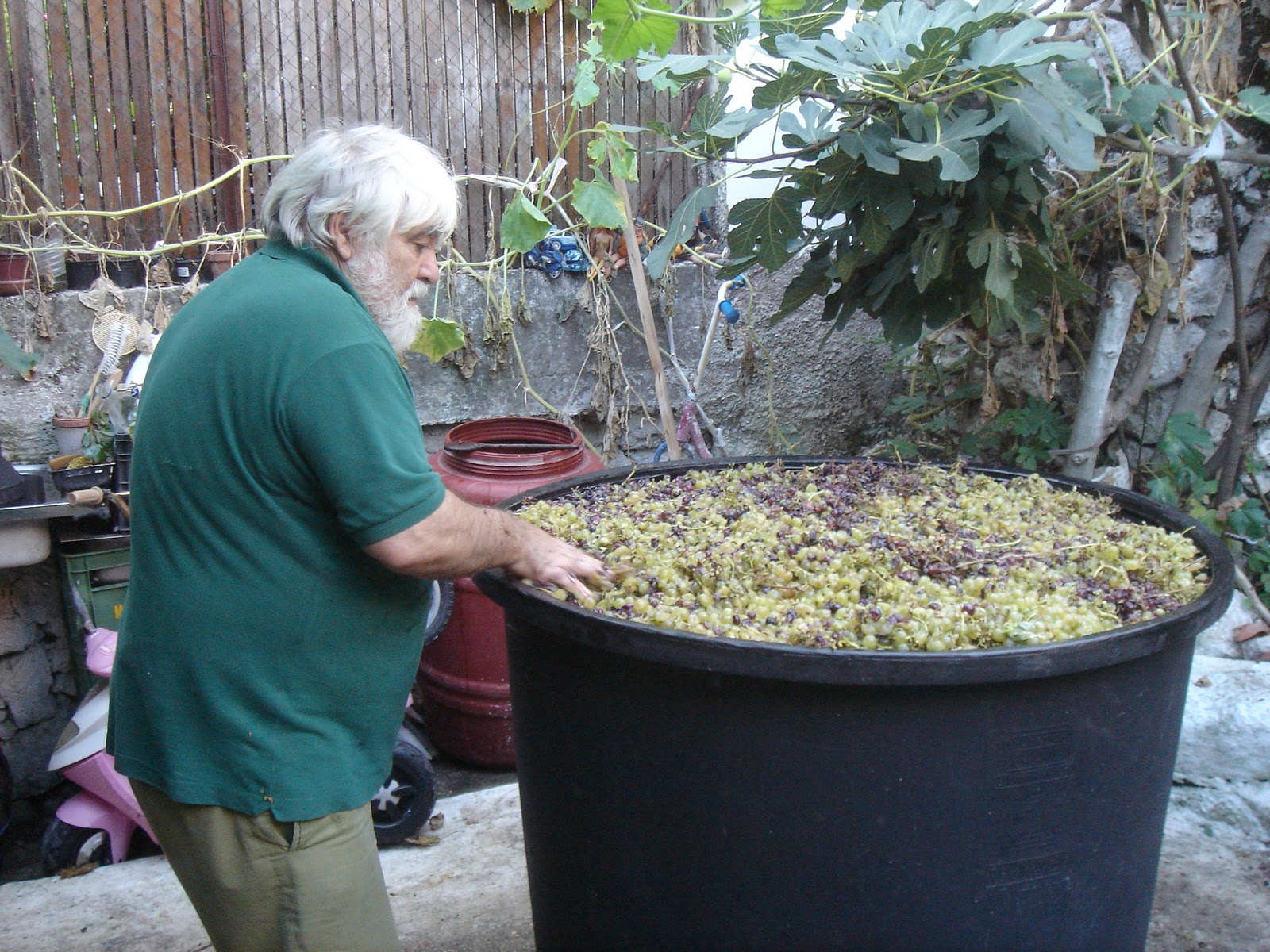
Lefteris and Fortis – yesterday afternoon – were still at the first stage, heaving 22 kilo plastic crates holding tight clusters of small black and larger white Zakinthos grapes, vine leaves, storks and twigs into a hopper, sat on a big chest-high plastic tub. Young Lefteris was having a go at the wheel.
“Simon” (their stress is always on the ό, rather than the ί in my name, which is properly spelled Σάïμον, which I like as much as the Greek respect in my more formal title ‘Mr Simon’).
“Simόn. Come.” I could see them by the tub from the balcony where Lin and I were working; an invitation to help turn the wheel that turned the cogged gear of spindled paddles above two shiny crushers at the bottom of the hopper. It was no less fun than as a child being asked to help with the mangle, squeezing out rinse water from jumbled clothes turned flat to have their creases shaken out; hung far from reach on the line. In one of the memory synapses so easily tapped I remembered, as I hurried downstairs to go next door, washing that hung in flat frozen slabs transfixed at a slight angle to the winter wind.  Lin’s mum Dorothy still does her washing by hand. Here the handle of the crusher was sticky with grape juice which, clearing hair from my brow, stuck there too. 700 kilos - about 30 crates – to be crushed, and during a break a cup of Greek coffee, skirto, with biscuit-cakes sprinkled with sesame seed and grapes steeped in honey on a small plate with a teaspoon and a glass of water made by Vasiliki. The tub exactly filled, Fortis measured the specific gravity of the juice sample – “12.5% good, 13% not good” said Lefteris. Now I know numbers in Greek, I could carry on an almost coherent statistical conversation. Three days the mass of solid grapes and twigs and leaves and perhaps spiders, a wasp and bits of grass, will stand; fermenting in the covered tub, before the young wine is run off from the tap at the bottom of the tub and sieved into bottles to continue working. Sticky and sweaty, grape smelling, I retraced my steps back to our house next door. From our balcony I could look down on the tub I’d help fill. “So when did you no longer do this with your feet?” I’d asked “Ten years ago.” Why would anyone resort to the pestled bones of a slaughtered tiger when they can make village wine?
*** ***
Linda has completed the preparing and painting of our shutters so that now on at least the street side of the house they are restored.
Shutters restored and painted
“Soon we should paint the house” she said “I think I’d like to use asvesti, whitewash, but I’m not sure the best way to apply it especially if we want to mix in colouring.”
She’s also been putting down more plaka under the balcony. First she arranges the pieces of plaka as though doing a jigsaw, then fixes three pieces at just the level she wants – at either end and centre. I chipped out the edge of the existing plaka so the join would be uneven with the new, not just a straight line.
*** ***
Yesterday afternoon Yianni returned the hire car, and this morning I drove to Tzavros to pick up needed materials from the ironmonger, and get some ciggies for Katerina. Coming home the clouds opened and I gave a lift to a soaked neighbour walking up the hill from his field below the village.
"I thought the rain was coming tomorrow?"
"So did I. Thanks for your kindness."

More quantitative easing

Monday, 14 July 2008

The family come to the village

On Thursday - in Athens - some of us left the hotel in a small coach with a guide to visit Poseidon’s temple at Sounion on the southernmost tip of the mainland, marking the entry to the Saronic Gulf, with safety for wind blown sailors both north or south of the Cape. I’d read, as a child, how King Aegeus had waited on this headland for his son’s return from challenging the Minotaur in the maze at Knossus. His ship stopped at Naxos where he abandoned Ariadne who'd helped him overcome the Minotaur, then on to neighbouring Delos where, amid celebrations for his victory, Theseus forgot to change his black sail to the prearranged white one to signal his safe return. From beside the temple, I gazed south and thought how, waiting for my son, I might have seen many vessels with white sails heading north and hoped, but then, at about the expected time for the annual return of the tribute vessel from Crete, glimpsed or pretended not to see, slowly rounding a hazy island headland from within the cyclades, a sail of undoubted blackness on course for Athens, and known the boy lost and a sheer drop close to hand. The temple occupies less land than nearby hotels – slender-scaled to the human physique - despite, as Anna, our guide, said, the craft being available to build on the scale of the pyramids. ‘Harmony between man and the earth - the thing we’ve lost … have always been losing and finding again,’ she said. While I toured, Lin read by the hotel pool, later taking the train with Richard and Amy to Monastiriki to stroll the Agora museum while Richard took his camera up to the Acropolis – his first visit. * * * On Friday afternoon we got back from the birthday party in Athens and were in Ano Korakiana – this time with Richard and Amy. Richard, especially, was fidgety “We’re stuck here in the middle of nowhere”. Hurt, I almost but didn’t reply that he’d said that as tho’ it was something bad. Later in the day Lin drove us by flowering oleander to our pebbly beach inside Cape Kephalopsos – entered via a small track through the growing rubble at the south edge of Ipsos harbour. In no time Richard was off to hire a scooter. Amy and I swam leisurely in the warm sea while Lin read in the shade of the myrtle, wavelets slapping the shore by her toes in this blighted Eden. Before she and Amy had arrived I’d filled a bin bag with rubbish washed up on our tiny strand alone, while reverberating across the grand vista stretching between the Albanian shore, Epirus’ haze and the villa'd slopes of Pantokrator the engine noise of cars, motor boats and aircraft. The serenity of this place, before we learned the art of capturing energy from exploding oil, can still be glimpsed at sunrise in winter. Slower economies make the poor picturesque, donkey-born poverty invisible. The sail strewn past is history. And still my jaded metropolitan eye notes the travel pimps' descriptions ‘unspoilt’ (over 2000000 hits on Google!) above italicised details on ‘how to get there’. Always, said JH, to avoid disappointment, go and live somewhere ‘already ruined’. In 1993, the year before he died, Jack wrote, for our reading: ‘Love of the Country - Ode to a book I never wrote’:
Did they think about the skylarks when they built Mayfair on the grazings that ran down to the Shepherd’s Market? Did they worry about the snipe when they drained the marshes behind St.James’s Palace to build Belgravia? Where did the kite go when they dug the London sewers? Do the piles they drove down through the beaver’s dam hold firm the supermarket in Newbury High Street? Who cooked the big trout that lay under the village bridge at Wandsworth? Who feasted on the last salmon that was netted at Tower Hamlets? Now they come to put central heating in the ploughman’s hovel. They claim the sun that used to bake the hay. And breathe the breeze in which the pointing dog caught a hundred scents. They walk out in trainers and T-shirts that say “Save the Rain Forest”. “Stand back!” they say. “We have a right to walk where we please!” But we look where they trod before and shudder for what follows in their footsteps. I said I must write a warning. But I was angry and - as the Japanese say - to be angry is only to make yourself ridiculous. So we will live out our days in the cracks between the concrete. And then they will pour cement on top of us.
I note the reproach, knowing ‘us’ excluded no-one. J wanted to write, I think, a final book about how to live without vexed dissimulation, arrogance or isolation. One element was a modern transhumance – the old pastoral seasonal journeys aimed at getting the best for their stock from different but familiar places, observing the migratory cues of flocks and herds. This included mental travel, moving at mind-speed across the patchwork eiderdown of his learning about the past and curiosity about the future. I wonder if J read The Songlines. It was published in 1987, hardly a year before Bruce Chatwin died in January 1989, when Chatwin must have known his future. I read it just now, after my short adventure in Australia. Chatwin wanted to learn ‘not from other men’s books, what a songline was – and how it worked’. His exploration, guided by a selection of unique and richly self-educated people, is deep referenced to insights from earlier travels…‘the more I read, the more convinced I became that nomads had been the crankhandle of history…’ (p.19). Chatwin followed my reading of a concise history of Australia, in particular a chapter about the catastrophic two century encounter of European and pre-neolithic peoples in Australia. History, to quote Durrell (in Prospero’s Cell 1945) ‘with her painful and unexpected changes cannot be made to pity or remember: that is our function’. This function Chatwin fulfils with engaging wit, finding just the tone for the mess strewn across the commonwealth by that collision – not ‘the fatal shore’, no ‘black armbands’, even an open-eyed optimism (given Chatwin’s closeness to death). Of another group of destitute outcasts in the Saharan Empty Quarter - the Nemadi - Chatwin told his chief Australian guide, Arkady Volchok (I don’t want to know where he is now, or not at once) a story of a greeting, ‘a few warbled notes’ and a three minute smile - over a chasm of separate experiences - from a woman of ‘more than a hundred’ called Lemina. That smile, C told A, was something he lived with:
‘...like a message from the Golden Age. It had taught me to reject out of hand all arguments for the nastiness of human nature. The idea of returning to an ‘original simplicity’ was not naïve or unscientific or out of touch with reality. “Renunciation”, I said, “even at this late date, can work.” “I’d agree with that,” said A. “The world, if it has a future, has an ascetic future.”’ (p.133)
* * * On Thursday evening the family and friends sat in a restaurant in Kifissia overlooking the vastly scattered lights of greater Athens. A breeze blew across Attica, ruffling hair – almost cool. My sister-in-law Kate was enjoying a barney across the white table cloth, beneath plentiful food, water, wine and Diet Pepsi, about the virtues of a hybrid car – she and G having bought one - the boon of supermarkets, railing at sentimentalist dreams among the prosperous about the mulish drudge of local shopping for sweated food, while arguing for global unions to regulate food prices. I’d started the evening by saying, jokingly, “hurray, we can talk about allotments”, a matter on which my assumptions are muddied, especially amid the joy of family table talk. I faltered and Lin entered the debate. Later I smiled quits to Kate as we headed back to our hotel. “Did you respect the way I deployed my relentless logic to demolish your case?”. “Yeah yeah. I love a good debate” she smiled her quits. * * * R, me, Lin and A went out for supper in Ipsos at the Bonita. Lots of scooters, strollers and boom boys passing pell mell – though word is that Ipsos is ‘dead’, lacking the spending numbers it needs to thrive. A & R stayed on to seek a nightclub, finding one place with the critical mass to make an evening. Lin and I were home by 11.00 and found the neighbour’s family and friends spread across the steps outside their house celebrating young Leftheri’s 7th birthday. Wending our way through the path to 208 we were beckoned to their table; served meat and cakes and wine from grandpa L’s garden. Young L’s sister, Dimitra and her friend Maria, - about 11 and 12 I think - spoke lots of English, taught by Katya S, wife of Thanassis. We shared favourites: school subjects, composers, musical instruments, football teams (we weren’t much good there. “Football – then katalaveno!” we grinned sheepishly), while everyone chatted to and fro and young L’s friends played in the alley and spilled onto Democracy Street, to be called back into the light around their table. * * * On out first evening back in the village – Friday late – we strolled, my family, up the gentle slope beyond the bandstand and towards the narrowing street that goes through little Venice. Some dogs barked, others sought stroking. A hedgehog scampered across our path. Another played dead to avoid confronting two waiting kittens. Cats chased grasshoppers skipping between light and shadow. We saw glow worms in the verges; a large cricket sat squat on a wall where Democracy Street narrowed; geckos hugged warm lintels scuttling away if any of us approached. Richard found a shed snake skin in a wall drain; hefted it gently out with Mark’s gift stick. In the house we saw and left cobwebs - a wasp trussed and husked in one. Later in Corfu in the afternoon we saw lizards, irridescent beetles, a cicada, a hornet, fishermen watching another preparing a fish he’d caught and in our garden the shed husk of a grasshopper.

Thursday, 8 November 2007

A missing commentary - the debate between sea and olives


Dora Bakoyannis, Greece's impressive Foreign Minister, and ex-Mayor of Athens, was doing things in London this week - like talking with David Miliband about Greek-Turkish relations and the FYROM issue. She brought a signed copy of Alexander the Great's birth certificate issued well south of the Slav upstart state claiming his history. No seriously, that's a squabble that has to be talked out by diplomacy - so it never gets fought out.
[Back to the future - 17 Dec '09: At the end of November 09, DB lost a fight with Antonis Samaras for the Leadership of New Democracy, in opposition since PASOK won a General Election in October '09. Op-Ed from Kathimerini]
DB is a politician who tends not to put a foot wrong. (Future PM?) Bakoyannis, in the Mercouri tradition, met the British Committee for the Restitution of the Parthenon Marbles. She thanked them for their campaigning, stressing that Athens' goal (diplomatic metonymy) was to "reunite" the Marbles being held at the British Museum in London with those in Greece - a shrewdly used word; a change of name.
'They do not only belong to Greece but the world has a right to see them united at the new Acropolis Museum'

Consider the blank space on the west pediment above our heads in this snap taken by another couple who we'd just snapped for their album. Whether you have the place to yourself - which can happen - or whether it teems with visitors, its genius loci is undeniable, yet in this world of 'signage' designed to teach visitors and remind locals about their history - the most finely crafted commentary on the Acropolis is missing. Blast away its roof and scar its pillars, it is the story told in marble on the pediments and friezes of the Parthenon that is as important to its integrity as Genesis is to the Bible or the statue of Romulus and Remus suckling a wolf is to Rome.
The theme of the western pediment is the rivalry between Athena and her uncle, Poseidon, as to who should be patron of their favourite city. Witnessed by Cecrops, the Goddess offers an olive branch; the God, a saltwater spring. What's that about? Ponder pethia! Think visitors! Or head to northern climes and check it while I have a skirto.
Olives are good food, good wood and their oil fuelled lamps. Both could be traded. Poseidon's gift was about sea power - important for defence and trading. Which is the best gift? What qualifies Cecrops to judge? Poseidon and Athena occupy the central, high point of the west pediment's triangle - or should. Also up there - or should be were he not in the British Museum - is Cecrops, half man and half serpent, born from the soil, ancestor of the Greeks, who, by preferring Athena's gift, founded Athens teaching her citizens to bury the dead, honour the contract of marriage, to read and write. A civiliser. The Parthenon was named Cecropia in his honour. It became home to Phidias' building-high ivory and gold statue of Athena. Can you see the problem here - a tension between peace and war; between the practicality of the olive, not to mention its beauty, and the fact of Piraeus and the security of the broad blue highway from whence came the trading economy of the Aegean basin and littorals beyond? Some lesson! Did the neat little recording gadget tell you that while you were gazing in wonder at the remains of the marble narrative - chipped and bowdlerised by ill advised cleaning - in the British Museum? [one of my students stands before the east pediment marbles a few weeks ago] Erichthonius, also on the west pediment, was the second king of Athens. I am confused about him. There seems to be speculation about his history and identity. He wasn't Athena's son but she brought him up. He taught his subjects to work silver, put horses to chariots, and to pull the plough. I don't think Poseidon liked him. I need to learn more. Then there are more water divinities - Iris and Hermes among them - joining in a debate which, for the moment, remains muted and remote since the chamber above our heads is sadly empty. When I was last there, I was looking at the miniature reconstructions of the pediments in the museum on the Acropolis. I got into conversation with a Greek visitor from Thessalonika. I said I'd very much like to see the marbles returned, since their absence made me ignorant, stopping me shifting my gaze in a helpful way from pediments to frieze - a four-fold lesson there - to the larger structure, to the city below and towards the sea to the south. He said 'Yes they must come back, but we are not ready for them. Because of the air pollution in Athens they will have to go from your museum to our museum.' Having first seen the incomparable Parthenon in the late 1950s I was indeed struck by the pollution damage since then; more harm in 30 years than in many previous decades. I saw his point. More pragmatic than moral. Athens' pollution problems are not helped by her magnificent topography. The great city is located in a basin surrounded by high mountains and the dear dark faced sea that has served her so well. Air dispersion despite the etesian winds of summer is minimal. It is the only city where I - a traveller - have suffered as much from the humid heat of August and which makes cooler suburbs like Kifissia so seductive. The main sources of air pollution - motorised traffic, industry, domestic heating and air-conditioning - is increased by solar radiation during spring and summer. Athenians know 'the nefos'. The fires on Parnitha and closer in Kifissia amplify the problem - driven by ill-chance and yearning for land. Traffic congestion seems as bad as ever. [19/01/08 Problem continues: Stavros Dimas to Parliament on CO2 emissions measurement “This issue can create a problem for the entire EU – imagine the ridicule for our country" ] In 1977 the pollution of Athens was so bad, that, according to then Greek Minister of Culture, Constantine Trypanis, the caryatids of the Erechtheum had seriously degenerated, while the face of the horseman still on the Parthenon's west side was all but obliterated. Strict measures during the 1990s improved air quality. Five of the caryatids were replaced with replicas - the orginals placed in the Acropolis Museum. Elgin had the sixth. [He's got a receipt. 'Hold on it was in my pocket just now. Wait. it's somewhere here, I promise.']. The nefos is rarer, but summer 2007 saw great palls of smoke blanketing the city. All the same, more Athenians are on bicycles. Many more rely on the superb rapid transit system that came with the Olympics. But people are people. They love their cars. They covet, they yearn and sometimes they burn. The National Law 1650/86 contains the main legal framework for the protection of the environment. Air is monitored in a highly detailed scientific way, but...so much depends on human beings, corporate responsibility and confident government. ['The pilfering lords have gone, but the hungry clouds of pollution do damage in Athens nearly as bad.' Richard Stoneman (ed) Land of Lost Gods: The Search for Classical Greece, London: Hutchinson, 1987, p.300] If the Parthenon marbles return to their pediments - not just to a superb air-conditioned humidity-controlled museum nearby (politically correct as that would be) - Greece will have achieved more than a just restoration, she will have tackled one of the great urban problems of the world. The statue of Romulus and Remus is in the Musei Capitolini not in the open on the Capitoline Hill, needing similar protection from air pollution. If the Parthenon marbles do not return to their original place, then can you reproach those with the means who also retreat to 'superb' air-conditioned humidity-controlled environments separated from their fellows, shielded from the effects of their way of life? The message on the west pediment - the debate between Poseidon and Athena, between sea and olives should be renewed and resolved. They may argue. They may quarrel. But if they cannot share the same space then nor can we. The next time I enjoy an olive from Kalamata or Halkidiki I will be more aware of its salty taste.
[Back to the future: For another juxtaposition of sea and tree or rather 'boat vs. tree' see this blog entry on how toy-sized boats are being replacing by trees in Greek Christmas celebrations. Christmas trees came to Greece rather as they came to Britain - in King Otto's Bavarian baggage to Greece and in Prince Albert's German baggage to Victorian England] [Who owns the Codex Sinaiticus, until the 19thC in the Monastery of St Catherine, Sinai - probably the earliest copy of the Holy Bible in Greek?]

* * *
What British things have been taken to another place? I can't think of any that are a bone of contention. US universities have bought quite a few original manuscripts, and now and again we hear of British Museums trying to save certain works 'for the nation' in competition with overseas private collectors. I'm failing to imagine what it must feel like to want the Parthenon Marbles back - because they are 'ours'. Cargo cults are driven by a shared feeling in a subject population that a powerful tribe has run off with their forefathers' wealth and magic powers, their technology and art. I wonder if growing Greek self-confidence will lessen demands for the return of the marbles so that when they come back, as I think they should and eventually will as part of the integrity of Pericles' Acropolis, the party will be ill-attended. Had Elgin not completed his mission for which he suffered famous abuse from Byron*, illness, impoverishment and gross disfigurement, the world might not have the marbles that now exist.
*Cold is the heart, fair Greece! that looks on thee,
Nor feels as lovers o'er the dust they lov'd ;
Dull is the eye that will not weep to see
Thy walls defac'd, thy mouldering shrines remov'd
By British hands, which it had best behov'd
To guard those relics ne'er to be restor'd.
Curst be the hour when from their isle they rov'd,
And once again thy hopeless bosom gor'd,
And snatch'd thy shrinking Gods to northern climes abhorr'd.
Childe Harold: Canto 2 (15) 1812
[Back to the future: 5 Aug 2009 - Since writing this I've learned of a sturdy intellectual thread in Modern Hellenic culture that has mixed feelings about widely venerated emblems of Classical Greece such as the Parthenon, including growing political sophistication about the way regimes exploit the supposedly objective work of archaeologists - preserving, rebuilding and destroying resonant symbols. As a discipline it's referred to as 'socio' - or 'social archaeology'. See for instance Liana Giannakopoulou 'Perceptions of the Parthenon in Modern Greek Poetry' Journal of Modern Greek Studies, 20 (2) Oct 2002, pp. 241-272
The Parthenon is not a popular source of inspiration for modern Greek poets. Only a few poems are devoted to it, expressing either the poet's grief for bygone ages of glory or his praise of the immortal Greek spirit. Against this background, three poets can be distinguished for being different and original. For Palamas, who fights for the cause of Demoticism, the attitudes of his contemporaries towards the Parthenon encapsulate what he takes to be a sterile veneration of the ancestors. He thus opposes the idea of the restoration of the Parthenon, promoting the Modern Greek language instead. For Sikelianos, the Parthenon is only one monument among many. This weighty symbol of ancient Greek tradition is not a source of awe or embarrassment, but the yardstick that indicates the importance of the modern poet's achievement. For Calas, finally, the Parthenon is associated with the declining values of a doomed bourgeoisie and should therefore be blown up and replaced by new standards in life and art.
And see also Yannis Hamilakis 'The Other "Parthenon": Antiquity and National Memory at Makronisos' Journal of Modern Greek Studies, vol 20 (2) Oct 2002, pp. 307-338
Makronisos, the small, uninhabited island off the Attica coast, was the location of the most notorious concentration camp set up by the Greek government during the Civil War (1946-1949). It was a place of brutality, torture, and death, but its distinctive feature was its role as an indoctrination centre for many thousands of political dissidents (mostly left-wing soldiers and citizens, but also ethnic and religious minorities) who, after they were "re-educated" in the national dogmas, were sent to fight against their ex-comrades. Classical antiquity was one of the main ideological foundations of this "experiment," the audience for which was the whole of Greece and the international community. In the island, still known as "The New Parthenon," the "redeemed" inmates were encouraged to build replicas of classical monuments, and the regime's discourse emphasized the perceived incompatibility of the inmates' "destiny" (as descendants of ancient Greeks) with left-wing ideologies....]
[Back to the future: a 21 August 2009 op-ed on the debate about the ownership of antiquities]
[Back to the future - 19 Dec 2009: 'The Parthenon frieze can now be digitally observed, piece by piece' - a website in Greek analysing the frieze with superb images...also see p.14 of 11 Dec 09 Athens Plus in which there's a piece about modern marble craftsmen working on the Acropolis]

Back numbers

Simon Baddeley