Total Pageviews

Showing posts with label cricket. Show all posts

Sunday, 4 September 2011

Cricket

Handsworth Park
Some humans feel diminished by discoveries which make reality more rather than less mysterious, as though magic and religion were never about mystery or faith or even consolation but only about propitiation and explanation. Last Sunday Amy, Guy, Richard and I strolled over with Oscar to watch the cricket, organised by Sted Wallen for the two day Sports and Cultural event in Handsworth Park. Sted, amid the bustle around the pavilion, invited us for food in the guest tent, and mentioned he'd had a word with our Lord Mayor, Councillor Anita Ward, about Persimmon Homes' extended delay providing playing fields, including changing rooms and children's playground next to the Victoria Jubilee Allotments under their S106A with Birmingham City Council. "We must hurry that up" she said. Fingers crossed. We bumped into Amy's Godmother, Sonia Hyman.
Lunch was curried goat, rice, salad. How pleasing that I could sit here in this park I care about so much among closest relatives, and, but for Sonia, be sat, hardly a fortnight earlier, with the same people, same dog, in the committee tent of the Highland Field Sports Fair at Moy.
Amy, Simon, Oscar, Sonia and Guy at Handsworth Sport and Culture Day
Tuesday morning, Lin and I coached to London, thence by train to Gatwick, for our flight to Corfu, arriving in humid warm darkness at 11pm, collecting the car from Yianni, getting into 208 Democracy Street after kisses and hugs with our neighbours sitting outside - Vasiliki, young Lefteri and his mother Natasha. We aired the house; began to unwind after the work of the last months.
When I woke before dawn, the sky clay, I could scarcely move. The muscles at the base of my spine had rebelled against digging our allotment - on Saturday spreading a big polythene sheet across one third of the plot weighed with slabs - tidying the flat - my contribution far less than Linda's - pre-departure chores with their hassle.
"You need to lie flat on a wooden floor" said Lin, disinclined to sympathy, but who had, after a chat with our neighbour Paul, obtained from him some locally available tablets called Arcoxia which, when taken after a meal, brought relief.
Even so I spent Wednesday indoors, philosophising about the impossibility of doing more housework, utterly engrossed in Zola's powerful demolition of the pastoral idyll - Earth - whose first English translation was banned in England and America.
A novel as heart gripping as The Bridge on The Drina. Later we swam, enjoying the blue,  stirred into cobalt by katabatic wind down the hot slopes of Trompetta, as light blue velvet is napped cobalt with the heel of a fist.
Nick and Nancy's pool yesterday evening
The writer intended, when he put arguments in their mouths, that Job’s helpers demonstrate the limits of common sense. All Job’s sufferings – real enough in the world - are invented to explain acceptance and faith in goodness amid the worst of suffering – loss of children, the death of beloved companions, and the least of it, a banged shin, a stubbed toe, my aching back. Common sense invents a commentary that suits the actuarial calculation of insurers; the narratives of litigants before a jury. How profoundly, unlike the Book of Job, it fails to explain why bad things happen to good people.
Cutting back the Bougainvillea and Wisteria at 208
While Lin read, I dropped round to see Mark and Sally, unwilling to wait to see them. Mark knowing my interest in the scythe, showed me an article written nearly 30 years ago - he collects such things for himself and for me - about billhooks and how they differed across the land. Imagine the variants across Europe and beyond.
Early Sunday morning a mosquito found us. I got up and addressed myself, lying headlong on a rubber mattress, to cleaning a large cerise stain spread across the bottom of one of the kitchen cupboards. I worked back to the white surface, reaching deep into the cupboard, twisting and turning in my efforts. After less than half-an-hour the space was pristine; my back no longer hurting, just the memory of its ache.
On Thursday we went to Foros, Ο Φόρος, at Palia Perithia for a long lunch of conversation with Richard Pine and his daughters, Emily and Vanessa, bringing back a bag of figs picked from one of his trees and the anticipation of a forthcoming book on Corfu created around his regular articles about Greece - and Ireland - for the Irish Times. 
Richard Pine at Palia Perithia

Thursday, 18 August 2011

Planting a vine

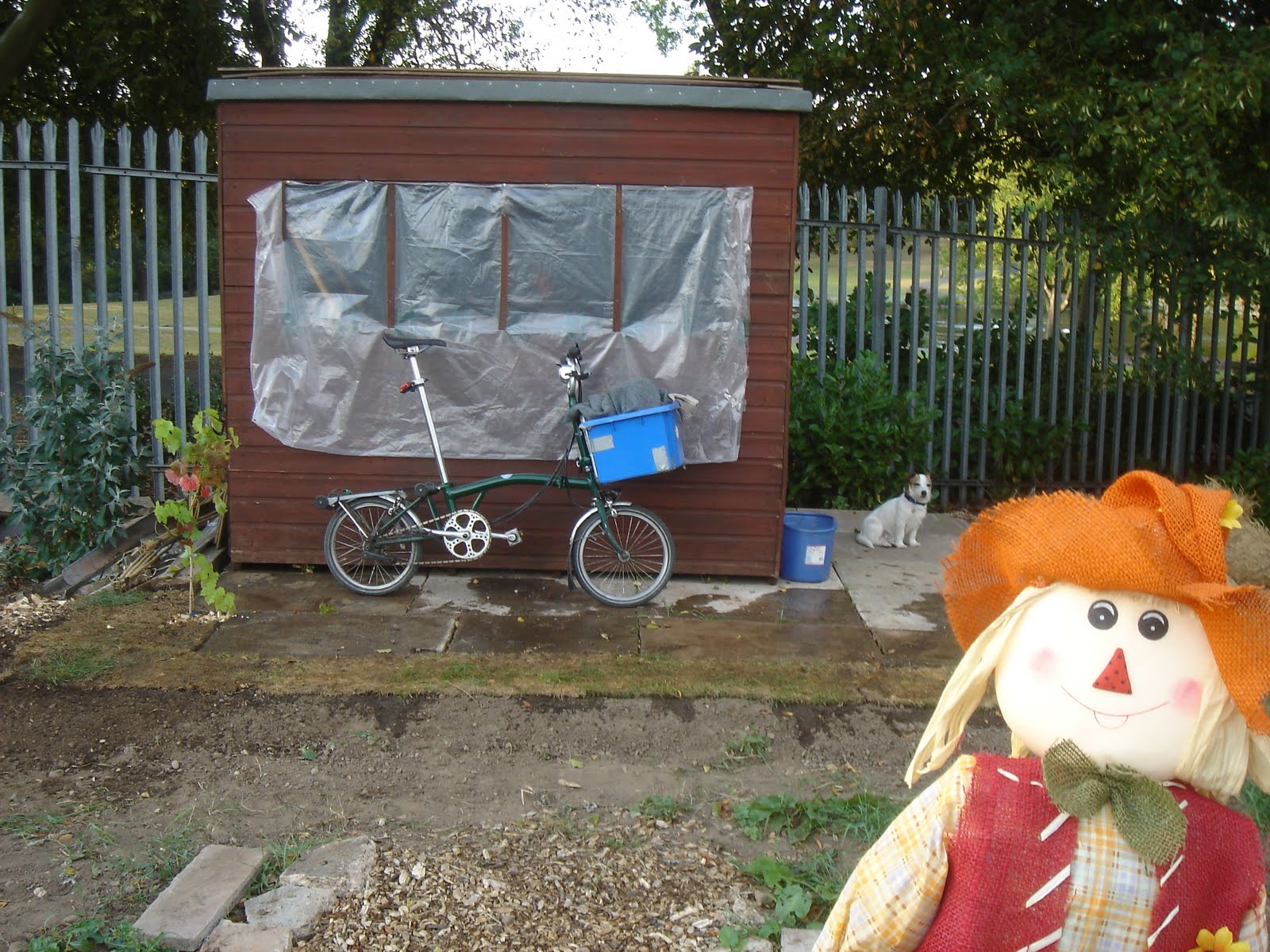
After a morning and afternoon's paperwork, I cycled with Oscar to Plot 14 to plant the vine - Vitis Boskoop Glory -  I'd bought Lin for her birthday.
"What's the best way to plant this?" I asked Vanley
"Dig deep and wide. Put some compost at the bottom."
Danny's on the plot next door to Vanley. She gave me a bucket of manure "Mix it with earth and water them together but leave earth between that and the vine roots or you'll burn them."
So I dug a good sized hole and planted the vine by the shed. I hope it'll grow around a trellis I'll raise on a veranda frame for our shed. I damped down the turf I've started to lay in front of the shed on a layer of riddled earth.
The scarecrow came from Scotland
*** ***
In Ano Korakiana the heat and humidity of August brings out family and friends - η μεγάλη οικογενειακή και φιλική παρέα της γειτονιάς - to sit in 'concentrations' - «συγκεντρώσεις» - chatting quietly - σε χαμηλούς τόνους - in the narrow streets.
Έξω από τα σπίτια της Νίνας Τσιριγώτη και της Θάλειας Μπαλατσινού
*** ***
I just came across my son Richard's posting - words and images - Violent Exposure
During this time, the flow of information/news from myriad sources has, at times, been overwhelming in content and volume.  Other data on the events has been distorted, exaggerated and imagined.  There have also been times when the flow of new information comes close to standstill. Scenes from television programmes on the night the Birmingham unrest quelled.  The TV schedule for that evening included the usual pulp-vision; films such as “I, Robot” and “Alien Vs. Predator,” and an ITV Police Drama starring Caroline Quentin. Popular mantras seeded and perpetuated by news media through such events are referenced with disarranged subtitles.
[Here his images of Handsworth Unrest posted 9 Aug'11]
*** ***
I got a call from the council planning department this morning, took notes and circulated what I'd learned:
CURRENT POSITION ON THE VICTORIA JUBILEE S106A
I’ve had a 20 minute chat with Stuart Morgans this morning. Stuart is the Principal Planning Officer for this part of the City now leading on overseeing the delays in implementing the S106 Agreement on the Victoria Jubilee site. It seems things had slowed down with the retirement of the long standing officer Alan Orr who was Stuart’s predecessor, plus other staff retirements. The Council's Landscape Development officer in Local Services (Andy Hogben) has also retired; his job now done by Bob Churn (useful always to have these names and I’ll seek emails). Stuart and Bob between them have had a recent meeting with Persimmon's Technical Director, Simon McDonald and Cliff Nixon to establish an agreed way forward. The City Council's Planning Solicitor has reminded them of their legal obligations and the Council's powers to pursue legal action if the matters cannot be resolved. Stuart said the meeting had achieved some effect and Persimmon have expressed their commitment to get things completed. Persimmon are keen to fulfil their obligations and get clear of the site. They are however pleading economic pressures and the fact they have already spent more than what was in their pot to fulfil this particular S106 Agreement. 
1. The allotments: There are a few minor ‘snagging’ problems to be sorted before the City Council can sign off the works. There’s nothing too serious needing doing now and problems, including one of rain run-off on a sloping area of the car park, should be dealt with in a couple of weeks.
2. The children's play area: The play area if built to current spec by a contractor on the Council's approved list would be far more than Persimmon state they can afford. They have suggested using one of their own contractors to do it for less. From the city’s point of view agreeing to a contractor who is not on the approved list could raise potential quality control issues and they don’t want to create a precedent developers could exploit in future agreements of this kind. However, the contractor has been working with officers to demonstrate that they can provide the required quality, and Stuart is awaiting confirmation from Bob as to whether they are agreeable to this compromise. Progress here is also complicated by the opposition of a number residents on the Parklands estate to having a playground near them on the grounds it could become a security risk.
3. The playing pitches (photo taken this morning from the allotments): On the subject of the playing pitches Stuart says the area in question is currently mowed. There are ‘technical issues’ relating to the cricket square that have been identified by the parks manager. It must be regraded and re-seeded, There must be a period of time for the land to settle and be ready as working playing pitches. Gillian Dovey is the officer in the City’s Education department with responsibility for overseeing the handover to the city of this facility. Her view is that it is pointless for the City to accept the playing fields unless the sports pavilion (with changing rooms for both sexes, plumbing, toilets and electricity) is ready. Persimmon cannot afford in the present economic climate to build any of the recently approved designs. It is also agreed that in the light of recent events, that whatever is built needs to be ‘robust’. Stuart says it will be a ‘basic’ building with the necessary changing facilities, but designed to be robust to vandalism. Gillian is ready to accept the situation and has submitted a suggested revised spec for the pavilion to Persimmon. They have appointed contractors to assess what's involved connecting it to power, water supply and sewer. Persimmon have agreed to prepare a new design and to get this costed with a view to having contractors on site this Autumn if possible. I asked Stuart for a judgement on when he thought the playing pitches would be available. Could they be ready by summer 2012? He said it might be safer to say by 2013.
I was grateful to Stuart for his detailed frankness. The delays and the reasons for them are by now familiar to me, They applied to the allotments which most of us are now happily working, even though officers would agree the land was not in the best condition at the time we started paying for our plots. At least that part of the site Is being worked as allotments. Indeed those of us who’d been lobbying for the allotments pressed officers to ensure that happened, saying, more or less, that we would be responsible for top-soil shortcomings, just to get on site and get gardening. Obviously circumstances are different when signing off playing pitches, We could have still worked plots without the communal shed valuable though it is. But using the playing fields with at least changing facilities is far less acceptable. So there you have it. Best wishes
A meeting at Parklands in 2008 about the Victoria Jubilee site
At that time I wrote: S106A = A section 106 Agreement, otherwise known as a 'Planning Gain Agreement' - by which a developer, in return for planning permission to build private homes on an area of green space, agrees to give a benefit back to the community equal to the opportunities lost by the removal of that space for leisure and recreation. It may just be that by August '08 we shall see work starting on the sports pavilion on the old Victoria Jubilee Allotments site off Hamstead Road. (The homes here have been built on part of the site. In return the developer - Westbury Homes and then Charles Church - will fulfil the contract of a planning gain agreement with Birmingham City Council). On Tuesday morning 20 May '08, this site-meeting on Parklands Avenue with - left to right in my photo - Cllr Mahmood Hussain, residents who I've not met yet, Cllr Kim Brom, Alan Orr our Constituency Planning Officer, my good friend Liz England from the Handsworth Park Association and Basil Hylton, Chairman of Handsworth Cricket Club and Frank James, Basil's representative on the park committee*. Alan said he'd met the representative of Charles Church, the developer of the housing on the site, and that he had agreed with Alan that the 'trigger' point for implementing the terms of the Section 106 Agreement on the VJA site had been arrived at. Sales of new homes on the site have been given impetus through affordable housing schemes overseen by Midland Heart, a locally prominent registered social landlord and Housing Association. (There is already a growing residents' group on Parklands - the name of the new housing). In other words we are now about to get the 80 new allotments, cricket pitch, two soccer pitches, sports pavilion and children's play areas. I will be sceptical up to the moment I see the work beginning but it was a good meeting.
Background.  Other images. Follow up correspondence.
*Since 2008 Liz has died, one councillor has resigned, the other de-selected, the planning officer has retired and Basil is no longer active with the local Cricket Club.

Monday, 14 July 2008

The family come to the village

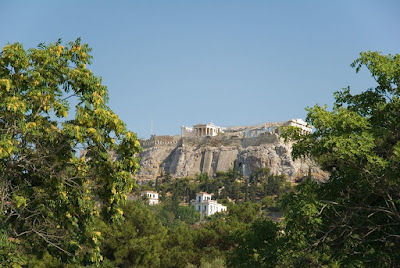
On Thursday - in Athens - some of us left the hotel in a small coach with a guide to visit Poseidon’s temple at Sounion on the southernmost tip of the mainland, marking the entry to the Saronic Gulf, with safety for wind blown sailors both north or south of the Cape. I’d read, as a child, how King Aegeus had waited on this headland for his son’s return from challenging the Minotaur in the maze at Knossus. His ship stopped at Naxos where he abandoned Ariadne who'd helped him overcome the Minotaur, then on to neighbouring Delos where, amid celebrations for his victory, Theseus forgot to change his black sail to the prearranged white one to signal his safe return. From beside the temple, I gazed south and thought how, waiting for my son, I might have seen many vessels with white sails heading north and hoped, but then, at about the expected time for the annual return of the tribute vessel from Crete, glimpsed or pretended not to see, slowly rounding a hazy island headland from within the cyclades, a sail of undoubted blackness on course for Athens, and known the boy lost and a sheer drop close to hand. The temple occupies less land than nearby hotels – slender-scaled to the human physique - despite, as Anna, our guide, said, the craft being available to build on the scale of the pyramids. ‘Harmony between man and the earth - the thing we’ve lost … have always been losing and finding again,’ she said. While I toured, Lin read by the hotel pool, later taking the train with Richard and Amy to Monastiriki to stroll the Agora museum while Richard took his camera up to the Acropolis – his first visit. * * * On Friday afternoon we got back from the birthday party in Athens and were in Ano Korakiana – this time with Richard and Amy. Richard, especially, was fidgety “We’re stuck here in the middle of nowhere”. Hurt, I almost but didn’t reply that he’d said that as tho’ it was something bad. Later in the day Lin drove us by flowering oleander to our pebbly beach inside Cape Kephalopsos – entered via a small track through the growing rubble at the south edge of Ipsos harbour. In no time Richard was off to hire a scooter. Amy and I swam leisurely in the warm sea while Lin read in the shade of the myrtle, wavelets slapping the shore by her toes in this blighted Eden. Before she and Amy had arrived I’d filled a bin bag with rubbish washed up on our tiny strand alone, while reverberating across the grand vista stretching between the Albanian shore, Epirus’ haze and the villa'd slopes of Pantokrator the engine noise of cars, motor boats and aircraft. The serenity of this place, before we learned the art of capturing energy from exploding oil, can still be glimpsed at sunrise in winter. Slower economies make the poor picturesque, donkey-born poverty invisible. The sail strewn past is history. And still my jaded metropolitan eye notes the travel pimps' descriptions ‘unspoilt’ (over 2000000 hits on Google!) above italicised details on ‘how to get there’. Always, said JH, to avoid disappointment, go and live somewhere ‘already ruined’. In 1993, the year before he died, Jack wrote, for our reading: ‘Love of the Country - Ode to a book I never wrote’:
Did they think about the skylarks when they built Mayfair on the grazings that ran down to the Shepherd’s Market? Did they worry about the snipe when they drained the marshes behind St.James’s Palace to build Belgravia? Where did the kite go when they dug the London sewers? Do the piles they drove down through the beaver’s dam hold firm the supermarket in Newbury High Street? Who cooked the big trout that lay under the village bridge at Wandsworth? Who feasted on the last salmon that was netted at Tower Hamlets? Now they come to put central heating in the ploughman’s hovel. They claim the sun that used to bake the hay. And breathe the breeze in which the pointing dog caught a hundred scents. They walk out in trainers and T-shirts that say “Save the Rain Forest”. “Stand back!” they say. “We have a right to walk where we please!” But we look where they trod before and shudder for what follows in their footsteps. I said I must write a warning. But I was angry and - as the Japanese say - to be angry is only to make yourself ridiculous. So we will live out our days in the cracks between the concrete. And then they will pour cement on top of us.
I note the reproach, knowing ‘us’ excluded no-one. J wanted to write, I think, a final book about how to live without vexed dissimulation, arrogance or isolation. One element was a modern transhumance – the old pastoral seasonal journeys aimed at getting the best for their stock from different but familiar places, observing the migratory cues of flocks and herds. This included mental travel, moving at mind-speed across the patchwork eiderdown of his learning about the past and curiosity about the future. I wonder if J read The Songlines. It was published in 1987, hardly a year before Bruce Chatwin died in January 1989, when Chatwin must have known his future. I read it just now, after my short adventure in Australia. Chatwin wanted to learn ‘not from other men’s books, what a songline was – and how it worked’. His exploration, guided by a selection of unique and richly self-educated people, is deep referenced to insights from earlier travels…‘the more I read, the more convinced I became that nomads had been the crankhandle of history…’ (p.19). Chatwin followed my reading of a concise history of Australia, in particular a chapter about the catastrophic two century encounter of European and pre-neolithic peoples in Australia. History, to quote Durrell (in Prospero’s Cell 1945) ‘with her painful and unexpected changes cannot be made to pity or remember: that is our function’. This function Chatwin fulfils with engaging wit, finding just the tone for the mess strewn across the commonwealth by that collision – not ‘the fatal shore’, no ‘black armbands’, even an open-eyed optimism (given Chatwin’s closeness to death). Of another group of destitute outcasts in the Saharan Empty Quarter - the Nemadi - Chatwin told his chief Australian guide, Arkady Volchok (I don’t want to know where he is now, or not at once) a story of a greeting, ‘a few warbled notes’ and a three minute smile - over a chasm of separate experiences - from a woman of ‘more than a hundred’ called Lemina. That smile, C told A, was something he lived with:
‘...like a message from the Golden Age. It had taught me to reject out of hand all arguments for the nastiness of human nature. The idea of returning to an ‘original simplicity’ was not naïve or unscientific or out of touch with reality. “Renunciation”, I said, “even at this late date, can work.” “I’d agree with that,” said A. “The world, if it has a future, has an ascetic future.”’ (p.133)
* * * On Thursday evening the family and friends sat in a restaurant in Kifissia overlooking the vastly scattered lights of greater Athens. A breeze blew across Attica, ruffling hair – almost cool. My sister-in-law Kate was enjoying a barney across the white table cloth, beneath plentiful food, water, wine and Diet Pepsi, about the virtues of a hybrid car – she and G having bought one - the boon of supermarkets, railing at sentimentalist dreams among the prosperous about the mulish drudge of local shopping for sweated food, while arguing for global unions to regulate food prices. I’d started the evening by saying, jokingly, “hurray, we can talk about allotments”, a matter on which my assumptions are muddied, especially amid the joy of family table talk. I faltered and Lin entered the debate. Later I smiled quits to Kate as we headed back to our hotel. “Did you respect the way I deployed my relentless logic to demolish your case?”. “Yeah yeah. I love a good debate” she smiled her quits. * * * R, me, Lin and A went out for supper in Ipsos at the Bonita. Lots of scooters, strollers and boom boys passing pell mell – though word is that Ipsos is ‘dead’, lacking the spending numbers it needs to thrive. A & R stayed on to seek a nightclub, finding one place with the critical mass to make an evening. Lin and I were home by 11.00 and found the neighbour’s family and friends spread across the steps outside their house celebrating young Leftheri’s 7th birthday. Wending our way through the path to 208 we were beckoned to their table; served meat and cakes and wine from grandpa L’s garden. Young L’s sister, Dimitra and her friend Maria, - about 11 and 12 I think - spoke lots of English, taught by Katya S, wife of Thanassis. We shared favourites: school subjects, composers, musical instruments, football teams (we weren’t much good there. “Football – then katalaveno!” we grinned sheepishly), while everyone chatted to and fro and young L’s friends played in the alley and spilled onto Democracy Street, to be called back into the light around their table. * * * On out first evening back in the village – Friday late – we strolled, my family, up the gentle slope beyond the bandstand and towards the narrowing street that goes through little Venice. Some dogs barked, others sought stroking. A hedgehog scampered across our path. Another played dead to avoid confronting two waiting kittens. Cats chased grasshoppers skipping between light and shadow. We saw glow worms in the verges; a large cricket sat squat on a wall where Democracy Street narrowed; geckos hugged warm lintels scuttling away if any of us approached. Richard found a shed snake skin in a wall drain; hefted it gently out with Mark’s gift stick. In the house we saw and left cobwebs - a wasp trussed and husked in one. Later in Corfu in the afternoon we saw lizards, irridescent beetles, a cicada, a hornet, fishermen watching another preparing a fish he’d caught and in our garden the shed husk of a grasshopper.

Back numbers

Simon Baddeley