Total Pageviews

Showing posts with label olives. Show all posts

Friday, 18 June 2010

Red sky in the morning

From Handsworth our son photographed a midsummer dawn
I'm miles apart in culture, experience and history from Tolstoy's character Levin but I was grateful to Google for recovering lines I remembered - vaguely - from the end of Anna Karenina, the part that has a happy ending for Levin and Kitty:
And Levin, a happy father and husband, in perfect health, was several times so near suicide that he hid the cord that he might not be tempted to hang himself, and was afraid to go out with his gun for fear of shooting himself.
It was those lines I recalled because as Tolstoy points out Levin has all that might be associated with content - a long loved woman as his wife, delightful children, material security, good health. Finding that memorable passage again I saw it was preceded by Tolstoy's speaking of himself.
All that spring he was not himself, and went through fearful moments of horror. "Without knowing what I am and why I am here, life's impossible....In infinite time, in infinite matter, in infinite space, is formed a bubble-organism, and that bubble lasts a while and bursts, and that bubble is Me." It was an agonizing error, but it was the sole logical result of ages of human thought in that direction...
War and Peace and Anna Karenina - Tolstoy's most majestic works; their indirect narrators Pierre Besuhov and Konstantin Levin - both embodiments of their author, sensitive to the charged implications of privileged status amid casual oppression, unrelenting servitude, the ebbing sea of faith, the improbability of God despite fervent attention to liturgy, holy text, observance of the rituals of penitence and devotion. Happiness harbours grim contemplation.
A damp day in Birmingham
The worst economic depression of our times is still not that obvious. History books compact the 'depression' into points on a time-line, an event with a beginning and an end; a word. I'm primed by distant reading to expect a contemporary re-enacting of sepia images; cloth capped queues, shuffling figures in ragged trousers on fluttery film glancing askance at a man with a camera, freeze-framed misery from the nation's family album. I'm a high latitude tourist cruising close to the sheer of a tidewater glacier from which chunks of ice crash into the sea, or, breaking away underwater, surge from the depths. Spectacular but not disastrous. All glaciers calve at the sea. Like peine forte et dure in which weights were gradually piled on the condemned there's no abrupt dislocation. Functionaries keep reminding semi-stupefied participants of the formidable seriousness of the situation...repeatedly...to a point where, like Giles Corey, we cry for "more weight!"
The process is unpredictable, probably inexorable, and because its woven into the present, nothing like the neatly composed narratives of past crises. Everything's mixed up; daily highs and lows obscuring a longer wave - mild until it steepens, curls, trips and breaks. We hear less about 'green shoots of recovery'; less about light at the end of the tunnel; more about changing our way of life, about hard times into the future.... and 'hard times' means? Our leaders avoid being drawn on detail. They can't surrender the appearance of being in control. Big projects are being abandoned, construction workers laid off as banks foreclose or governments cut. Middle class investment becomes negative equity. Nest eggs dissolve. Pensionable age advances. Pensions lose their value. Hospital waiting lists lengthen. There are fewer and lower benefits and concessions - like winter fuel payments; fewer government training schemes, fewer business start-up grants, more expensive care - for young and old. Less respite for carers. The mesh in the net grows wider, protecting fewer. Sovereign risk becomes normal. Failure the fault of the failed.
Latest from the Independent Treasury Economic Model - ITEM - interpreted by Ernst & Young - 'tightening of more than £48bn required to eradicate structural deficit...'
From the YouGov site these polls:

Consumer Confidence Trackers

Economy Perform Chart

Standard of Living Chart

Kathimerini 19/06/10 on the end of the Greek welfare state. See also 'Young Greeks' in LA Times 12/06/10 See Teacherdude's photostream from Thessaloniki - this for instance and the accompanying words...
Sometimes it's the little thing that show you how grim things are getting here in Thessaloniki, the long lines of taxis waiting at ranks for customers to turn up even in the middle of the day when up till recently getting a cab was next to impossible. Or perhaps its the accents of wandering street vendors who are now more likely to be people from the city than some recently arrived immigrants from West Africa or a member of Greece's Rom community. The city centre has become a near ghost town on week nights, a mere shadow of its former, vibrant self with cafes uncharacteristically quiet and empty streets, this in a place that prided itself on 4am traffic jams...
** ** **
As a PCSO Amy was a steward of public space - armed with her wits and connections via radio and CCTV to the police. Now, though still in training, she's becoming a centurion - with powers of arrest, doing intensive homework on the legal framework within which she must exercise those powers; armed in a literal sense, with a baton, handcuffs, pepper spray and a stab-proof tabard, techniques for interpersonal negotiation, self-defence and methods of 'taking down' someone resisting arrest - things I've learned about, not from my daughter who's discrete about her work, but from the internet and observation.
* * *
An informative overview of the Greek pension system and how it will be reformed.
Led by Prime Minister George Papandreou, lawmakers will begin passing legislation this month to overhaul the system, which the EU and IMF say contributed to the country’s debt crisis. Under terms of last month’s 110 billion-euro ($123 billion) (note: in UK a billion equals 100 million; in US it is 1,000 million) bailout agreement, Greece will increase the retirement age to 65 from as early as 58, curtail early retirement and calculate payments over a longer period of employment...The bill will be the first enacted by Papandreou’s government since the May 6 package that pledged 30 billion euros of wage and pension cuts and tax increases over the next three years.
* * * Aris & Katie on their blog are stirring greater curiosity about olives - in particular the suggestion that British understanding of olive oil is akin to our understanding of wine in the 1950s.
I said that, at heart, I'm not sure English people actually like olive oil. They like the idea of it, or the idea of liking it (like Kundera's "second tear"), but not the actual product. Hence the concept of extra-virgin olive oil- actually a very technical assessment of its acidity- is transmuted into a fetish for the wateriest, most pallid, flavourless liquid. Despite its fabled parthenogenic origin, any Corfiot farmer would rather a blowsy dockside strumpet of an oil than a timid virgin; though it would be a job to convince, say, Jamie Oliver, that cloudy green Greek oil is better than translucent bottled-in-Tuscany olive water...He said - I think astutely- that olive oil in the UK now is where wine was in the 1960s. We know it's a good idea, but we still think Blue Nun is the best the world has to offer. Corfu Olive Oil blog ~ 9 June 2010
Leftheris has educated me about some of the varieties. I'd like to learn more, that for instance the Corfu olive is called Lianolia Kerkyra. Perhaps we should visit the Triklino Vineyard, off the Pelekas Road out of Corfu Town, where a fire in 2000 destroyed a thousand of the family's olives, so that now they specialise in wine while showcasing olive cultivation. This table, among many, introduces the range of Greek olives - a first lesson, my heart full hearing a Greek friend reciting the names - an olive oil litany - Ποικιλίες ελιάς. In the centre our own rain loving Lianolia Kerkyra - Λιανολιά Κερκύρας - Souvlolia, Korfolia, Prevezana, Dafnofylli - Σουβλολιά, Κορφολιά, Πρεβεζάνα, Δαφνόφυλλη - from Corfu, Paxi, Cephalonia, Zakynthos and the dry shores of Epirus.
The Most Important Olive Varieties In Greece
Variety
Other Names
Main Regions
Table Olives
ConservoleaAmfissis, Artas, Violiotiki, Hondrolia HalkidikesCentral and W. Greece, Halkidike
KalamataKalamatiani, Aetonychia, KorakoliaPeloponnese, Crete, W. Greece
Oil-Producing Olives
KoroneikiLianolia, Psilolia, Ladolia, KritikiaPeloponnese, Crete, Lonian Islands
Lianolia Kerkyras(Corfu)Souvlolia, Korfolia, Prevezana, DafnofylliCorfu, Paxi, Cephalonia, Zakynthos, Epirus Coast
KoutsoureliaPatrini, Patrinia, Lianolia, LadoliaPeloponnese, Nafpaktos
MastoedesTsounati, Matsolia, MouratoliaPeloponnese, Crete
Double Use
MegareitikiPerachoritiki, Vovoditiki, Hondrolia AigiansAttica, Boeotia, Kynouria
KoloviMytilinia, ValanoliaLesbos, Chios
KothreikiManaki, Manakolia, KorinthiakiDelphi, Amfissa, Troezen, Kynouria
ThruboleaThasitiki, Hondrolia EvoiasAegean Islands, Attica, Euboea
Durrell in Prospero's Cell:
The entire Mediterranean seems to rise out of the sour, pungent taste of black olives between the teeth. A taste older than meat or wine, a taste as old as cold water. Only the sea itself seems as ancient a part of the region as the olive and its oil, that like no other products of nature, have shaped civilizations from remotest antiquity to the present..
Our little black island olives aren't the best to eat on their own, but Durrell's conflation of sea and olive reminds me of that commentary on the rivalry between Poseidon and Athena missing from the Parthenon pediment. No it doesn't, not really. It makes me long to be with Lin on Democracy Street gazing towards Prophet Elias on the hill and over the narrow sea to the Pindus mountains. That bright orange drawer - mouse-gnawed and wood-wormed - is now stripped, sanded, strengthened and polished and part of a cupboard we made from recovered wood.

Thursday, 8 November 2007

A missing commentary - the debate between sea and olives


Dora Bakoyannis, Greece's impressive Foreign Minister, and ex-Mayor of Athens, was doing things in London this week - like talking with David Miliband about Greek-Turkish relations and the FYROM issue. She brought a signed copy of Alexander the Great's birth certificate issued well south of the Slav upstart state claiming his history. No seriously, that's a squabble that has to be talked out by diplomacy - so it never gets fought out.
[Back to the future - 17 Dec '09: At the end of November 09, DB lost a fight with Antonis Samaras for the Leadership of New Democracy, in opposition since PASOK won a General Election in October '09. Op-Ed from Kathimerini]
DB is a politician who tends not to put a foot wrong. (Future PM?) Bakoyannis, in the Mercouri tradition, met the British Committee for the Restitution of the Parthenon Marbles. She thanked them for their campaigning, stressing that Athens' goal (diplomatic metonymy) was to "reunite" the Marbles being held at the British Museum in London with those in Greece - a shrewdly used word; a change of name.
'They do not only belong to Greece but the world has a right to see them united at the new Acropolis Museum'

Consider the blank space on the west pediment above our heads in this snap taken by another couple who we'd just snapped for their album. Whether you have the place to yourself - which can happen - or whether it teems with visitors, its genius loci is undeniable, yet in this world of 'signage' designed to teach visitors and remind locals about their history - the most finely crafted commentary on the Acropolis is missing. Blast away its roof and scar its pillars, it is the story told in marble on the pediments and friezes of the Parthenon that is as important to its integrity as Genesis is to the Bible or the statue of Romulus and Remus suckling a wolf is to Rome.
The theme of the western pediment is the rivalry between Athena and her uncle, Poseidon, as to who should be patron of their favourite city. Witnessed by Cecrops, the Goddess offers an olive branch; the God, a saltwater spring. What's that about? Ponder pethia! Think visitors! Or head to northern climes and check it while I have a skirto.
Olives are good food, good wood and their oil fuelled lamps. Both could be traded. Poseidon's gift was about sea power - important for defence and trading. Which is the best gift? What qualifies Cecrops to judge? Poseidon and Athena occupy the central, high point of the west pediment's triangle - or should. Also up there - or should be were he not in the British Museum - is Cecrops, half man and half serpent, born from the soil, ancestor of the Greeks, who, by preferring Athena's gift, founded Athens teaching her citizens to bury the dead, honour the contract of marriage, to read and write. A civiliser. The Parthenon was named Cecropia in his honour. It became home to Phidias' building-high ivory and gold statue of Athena. Can you see the problem here - a tension between peace and war; between the practicality of the olive, not to mention its beauty, and the fact of Piraeus and the security of the broad blue highway from whence came the trading economy of the Aegean basin and littorals beyond? Some lesson! Did the neat little recording gadget tell you that while you were gazing in wonder at the remains of the marble narrative - chipped and bowdlerised by ill advised cleaning - in the British Museum? [one of my students stands before the east pediment marbles a few weeks ago] Erichthonius, also on the west pediment, was the second king of Athens. I am confused about him. There seems to be speculation about his history and identity. He wasn't Athena's son but she brought him up. He taught his subjects to work silver, put horses to chariots, and to pull the plough. I don't think Poseidon liked him. I need to learn more. Then there are more water divinities - Iris and Hermes among them - joining in a debate which, for the moment, remains muted and remote since the chamber above our heads is sadly empty. When I was last there, I was looking at the miniature reconstructions of the pediments in the museum on the Acropolis. I got into conversation with a Greek visitor from Thessalonika. I said I'd very much like to see the marbles returned, since their absence made me ignorant, stopping me shifting my gaze in a helpful way from pediments to frieze - a four-fold lesson there - to the larger structure, to the city below and towards the sea to the south. He said 'Yes they must come back, but we are not ready for them. Because of the air pollution in Athens they will have to go from your museum to our museum.' Having first seen the incomparable Parthenon in the late 1950s I was indeed struck by the pollution damage since then; more harm in 30 years than in many previous decades. I saw his point. More pragmatic than moral. Athens' pollution problems are not helped by her magnificent topography. The great city is located in a basin surrounded by high mountains and the dear dark faced sea that has served her so well. Air dispersion despite the etesian winds of summer is minimal. It is the only city where I - a traveller - have suffered as much from the humid heat of August and which makes cooler suburbs like Kifissia so seductive. The main sources of air pollution - motorised traffic, industry, domestic heating and air-conditioning - is increased by solar radiation during spring and summer. Athenians know 'the nefos'. The fires on Parnitha and closer in Kifissia amplify the problem - driven by ill-chance and yearning for land. Traffic congestion seems as bad as ever. [19/01/08 Problem continues: Stavros Dimas to Parliament on CO2 emissions measurement “This issue can create a problem for the entire EU – imagine the ridicule for our country" ] In 1977 the pollution of Athens was so bad, that, according to then Greek Minister of Culture, Constantine Trypanis, the caryatids of the Erechtheum had seriously degenerated, while the face of the horseman still on the Parthenon's west side was all but obliterated. Strict measures during the 1990s improved air quality. Five of the caryatids were replaced with replicas - the orginals placed in the Acropolis Museum. Elgin had the sixth. [He's got a receipt. 'Hold on it was in my pocket just now. Wait. it's somewhere here, I promise.']. The nefos is rarer, but summer 2007 saw great palls of smoke blanketing the city. All the same, more Athenians are on bicycles. Many more rely on the superb rapid transit system that came with the Olympics. But people are people. They love their cars. They covet, they yearn and sometimes they burn. The National Law 1650/86 contains the main legal framework for the protection of the environment. Air is monitored in a highly detailed scientific way, but...so much depends on human beings, corporate responsibility and confident government. ['The pilfering lords have gone, but the hungry clouds of pollution do damage in Athens nearly as bad.' Richard Stoneman (ed) Land of Lost Gods: The Search for Classical Greece, London: Hutchinson, 1987, p.300] If the Parthenon marbles return to their pediments - not just to a superb air-conditioned humidity-controlled museum nearby (politically correct as that would be) - Greece will have achieved more than a just restoration, she will have tackled one of the great urban problems of the world. The statue of Romulus and Remus is in the Musei Capitolini not in the open on the Capitoline Hill, needing similar protection from air pollution. If the Parthenon marbles do not return to their original place, then can you reproach those with the means who also retreat to 'superb' air-conditioned humidity-controlled environments separated from their fellows, shielded from the effects of their way of life? The message on the west pediment - the debate between Poseidon and Athena, between sea and olives should be renewed and resolved. They may argue. They may quarrel. But if they cannot share the same space then nor can we. The next time I enjoy an olive from Kalamata or Halkidiki I will be more aware of its salty taste.
[Back to the future: For another juxtaposition of sea and tree or rather 'boat vs. tree' see this blog entry on how toy-sized boats are being replacing by trees in Greek Christmas celebrations. Christmas trees came to Greece rather as they came to Britain - in King Otto's Bavarian baggage to Greece and in Prince Albert's German baggage to Victorian England] [Who owns the Codex Sinaiticus, until the 19thC in the Monastery of St Catherine, Sinai - probably the earliest copy of the Holy Bible in Greek?]

* * *
What British things have been taken to another place? I can't think of any that are a bone of contention. US universities have bought quite a few original manuscripts, and now and again we hear of British Museums trying to save certain works 'for the nation' in competition with overseas private collectors. I'm failing to imagine what it must feel like to want the Parthenon Marbles back - because they are 'ours'. Cargo cults are driven by a shared feeling in a subject population that a powerful tribe has run off with their forefathers' wealth and magic powers, their technology and art. I wonder if growing Greek self-confidence will lessen demands for the return of the marbles so that when they come back, as I think they should and eventually will as part of the integrity of Pericles' Acropolis, the party will be ill-attended. Had Elgin not completed his mission for which he suffered famous abuse from Byron*, illness, impoverishment and gross disfigurement, the world might not have the marbles that now exist.
*Cold is the heart, fair Greece! that looks on thee,
Nor feels as lovers o'er the dust they lov'd ;
Dull is the eye that will not weep to see
Thy walls defac'd, thy mouldering shrines remov'd
By British hands, which it had best behov'd
To guard those relics ne'er to be restor'd.
Curst be the hour when from their isle they rov'd,
And once again thy hopeless bosom gor'd,
And snatch'd thy shrinking Gods to northern climes abhorr'd.
Childe Harold: Canto 2 (15) 1812
[Back to the future: 5 Aug 2009 - Since writing this I've learned of a sturdy intellectual thread in Modern Hellenic culture that has mixed feelings about widely venerated emblems of Classical Greece such as the Parthenon, including growing political sophistication about the way regimes exploit the supposedly objective work of archaeologists - preserving, rebuilding and destroying resonant symbols. As a discipline it's referred to as 'socio' - or 'social archaeology'. See for instance Liana Giannakopoulou 'Perceptions of the Parthenon in Modern Greek Poetry' Journal of Modern Greek Studies, 20 (2) Oct 2002, pp. 241-272
The Parthenon is not a popular source of inspiration for modern Greek poets. Only a few poems are devoted to it, expressing either the poet's grief for bygone ages of glory or his praise of the immortal Greek spirit. Against this background, three poets can be distinguished for being different and original. For Palamas, who fights for the cause of Demoticism, the attitudes of his contemporaries towards the Parthenon encapsulate what he takes to be a sterile veneration of the ancestors. He thus opposes the idea of the restoration of the Parthenon, promoting the Modern Greek language instead. For Sikelianos, the Parthenon is only one monument among many. This weighty symbol of ancient Greek tradition is not a source of awe or embarrassment, but the yardstick that indicates the importance of the modern poet's achievement. For Calas, finally, the Parthenon is associated with the declining values of a doomed bourgeoisie and should therefore be blown up and replaced by new standards in life and art.
And see also Yannis Hamilakis 'The Other "Parthenon": Antiquity and National Memory at Makronisos' Journal of Modern Greek Studies, vol 20 (2) Oct 2002, pp. 307-338
Makronisos, the small, uninhabited island off the Attica coast, was the location of the most notorious concentration camp set up by the Greek government during the Civil War (1946-1949). It was a place of brutality, torture, and death, but its distinctive feature was its role as an indoctrination centre for many thousands of political dissidents (mostly left-wing soldiers and citizens, but also ethnic and religious minorities) who, after they were "re-educated" in the national dogmas, were sent to fight against their ex-comrades. Classical antiquity was one of the main ideological foundations of this "experiment," the audience for which was the whole of Greece and the international community. In the island, still known as "The New Parthenon," the "redeemed" inmates were encouraged to build replicas of classical monuments, and the regime's discourse emphasized the perceived incompatibility of the inmates' "destiny" (as descendants of ancient Greeks) with left-wing ideologies....]
[Back to the future: a 21 August 2009 op-ed on the debate about the ownership of antiquities]
[Back to the future - 19 Dec 2009: 'The Parthenon frieze can now be digitally observed, piece by piece' - a website in Greek analysing the frieze with superb images...also see p.14 of 11 Dec 09 Athens Plus in which there's a piece about modern marble craftsmen working on the Acropolis]

Thursday, 27 September 2007

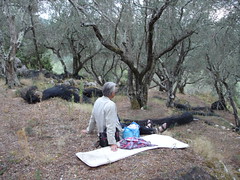
Picnic off the Trompetta Road


On Tuesday this was crisp and parched. We ate in silence gazing down on the terraces of fruitless trees towards the north coast of Corfu. Today it will be soaked and full of sprouting green. I thought later how Lin's photo looked rather like one of Edward Lear's wonderful landscapes made sometime between 1856-64 and now in the Victoria and Albert Museum. He was looking north from south of Corfu Town - from Ascension, which I don't know.

Tuesday, 11 September 2007

At 208 Democracy Street - elections on 16 Sept!

Monday 10 Sept. A hot day with a local morning breeze. My aches are moderating from all the messing about yesterday. My phone is still drying but we shifted my SIM to Lin’s so I got a call at noon as we tidied, that B. would be coming up to do our electrics and M. tomorrow to plaster. Lin in her nightie is spooning out rubble from around the electric wiring beneath the floorboards. The power’s off. I court martialled myself to her about the silly mistakes on the boat on Sunday. Our friends will be here from England in the afternoon.

The cat, Bubble, has found us again but not its companion Squeak. Bubble is older and has a cough and seems altogether in poor form. She pleads. Lin gives her food. One, a chop from supper yesterday is too hard for the cat. Lin chews it smaller and places the macerated meat on a plastic plate where they are welcomed.

How one becomes acquainted with dust when sweeping it up! How one notices the ground. Kostas spoke of the need to dig the earth and grow vegetables. We'd recalled the giant whom Heracles defeated by lifting him from the ground - the source of his strength. What was his name - Antaeus? Yes.

The use of association. Take these just now lathe-nail-crucifixion, dust-death – these are easy. Suitable for cryptic crosswords. They call on memory only. To dig deeper you have to jump on other things – which could be an assonance, a nonsence sound, an idea, an object, even a sound or smell. You don’t know whether what you’ve got is a wriggling thing or junk. The wriggling things have seen me first and I don’t know it. You have to fall asleep and then wake in a dream and think - stealthily.

Lin called while I was in the garden. ‘Come and look at this creature’. It was in her bucket wading on the surface tension of the water. A delicate slender striped multi-legged creature about an inch long with antennae fanned out ahead like something from the sea. She edged it gently into our garden. We are dusty but the house, though very incomplete, is looking much cleaner.

Sunday 9 Sept. A brief round of bells this morning. We wake just before 9.00am having not slept until 3.00. Eight miles away a northerly breeze dissects the sun’s reflection on the sea apportioning light to Epirus and Kerkyra. ‘Can we have some music?’ says Lin. I turn on music on the laptop, the Leipziger choir is singing Theodorakis’ folksong. ‘A solitary swallow’ - Ena to helidoni - from the Axion Esti.

One male singer:
Nur diese eine Schwalbe A solitary swallow
Der Früling macht sich rar and a costly spring
damit die Sonne heimkehrt for the sun to turn
Bringen wir Opfer dar’ it takes a job of work’

The choir echoes:
Nur diese eine Schwalbe…

Starting with parts, we’re getting, as we work, to know the Axion Este, set to the music of Theodorakis and parts of Elytis’ epic poem, which I have in English. I got to like the rebetica pieces, other parts grow as we get a sense of the whole – Genesis, Passion – in which the poet writes of a merciless struggle against the others – ‘it cannot be they without you nor can it be you without them… and you must face them without fail…those who wear the black shirt’ and others who ‘speak the language of porcupines’, raw-eaters, water-brutes, bread-fearers, the leadenfaced and the neocondors. The lead singer’s lines are repeated by him and the choir, the tune ratcheted up a key in a familiar heart churn even a musical idiot like me can grasp:


Tausende Tote braucht es it takes a thousand dead
wenn das Lichtrad ruht sweating at the wheels
lebende Leiber braucht es it takes the living also
wärmend verströmst ihr Blut giving up their blood

The same echoed, and then the chorus, back to the earlier key:

Als mein Gott die Erde schuf God my master builder
Baute er Berge um mich her you built me into the mountains

Als mein Gott die Erde schuf God my master builder
Schoß er mich ein im dunken Meer You enclosed me in the sea

A morning service for secularists enjoying peace. Here's A solitary swallow sung in 2001 by Mario Frangoulis and the same sung by Grigoris Bithikotsis with Theodorakis conducting in 1977. Keeley’s notes say the ‘master builder’ is not God but an architect from a folktale who built a bridge at Arta over the river Aracthos in Epirus - where Gianni Moralis was born incidentally. As is well known bridges, because they cross water, must have a sacrifice. He buries his wife alive inside its structure. Nowadays, in our disenchanted world, EU law would forbid this, but in some accident a beloved companion will slip on the wet marble of their new pool and be drinking through a straw for life – like the bold young motorcyclists in Corfu’s mental hospitals who did one wheelie too many or swerved into an olive trunk wearing no helmet.

* * *
Now mid-morning we wash before driving to the Sunday sale at Kontokali. Yesterday afternoon as we swept the path beside the house Kiria Leftheris brought a plate of sweetmeats made by her mother, telling us the name to make it right and I can’t remember – sweet crispy baked and tasty with honey.

* * *

The sale at Kontokali was not on so we drove west to Agios Ioannis. L and M sat with us over coffee for a couple of hours and added to the Sunday conversation in the square. While Lin looked at the stalls three of us with a combined age of 201 discussed the young – which is where I heard about the brain damaged in asylums, as we discussed the pros and cons of the rule of law at a table in the Platea at Agios Ioannis. We got on to Corfiot opinion about the UK and their indignation at our help for the Muslims in Yugoslavia, who they associated with the collaborationist Chetniks who had hounded Serbs for the Nazis. Durrell, years ago, wrote the British occupiers up to 1864 [Sir Frederick Adam, Lord High Commissioner of the Ionian Islands between 1824-32], when Corfu became part of independent mother Greece, regarded the locals as about 'as interesting as their stock' and the Corfiots regarded us - and other invaders - with contemptuous indifference. I doubt that all true. For the first commissioner, Maitland, yes - but a lot less for his successors. We brought good roads, ginger beer and cricket, and also there is a education and growth in trade. The Venetians brought the olives - a strategic incentive.
Olives, Corfu 1912, oil on canvas. John Singer Sargent

‘Oh yes and we contributed to the military band element of the island’s music’ said L ‘ except they regard it as slightly beneath them to tune their instruments’. ‘Wait’ I said, ‘maybe if you’re poised between East and West “out of tune” hasn’t the same meaning as it does for us?’ L. thought about that.

‘In the meantime, tell me some Corfiot jokes’ I said. These were mined from conversation with denizens who circulate Greek versions of English self-deprecation – both a product of confidence in one’s good fortune to be born under one or other flag. ‘How do you tell the difference between Corfiot electrician and a Corfiot joiner?’ ‘It’s written on the side of their van’. Two Corfiots meet in a bar. ‘Have you heard any gossip?’ ‘No’ ‘Have you heard any rumours?’ ‘No’ ‘Then tell me some lies.’ God offered to grant an Englishman, a Frenchman and a Corfiot, who had lived good lives, their dearest wish. The Englishman asked for a small castle and a few acres; the Frenchman asked for a vineyard that produced good wine; the Corfiot said ‘the man next door has a cow that produces 25 litres of milk every day’ – pause - ‘Yes?’ said God. ‘Can you stop it?’ asked the Corfiot. That last one is especially sweet. It makes Corfu sound like the Forest of Dean. I found M was a fan of Grand Prix - for me tedium in agate - but his joy in the success of the young Black – he called him ‘coloured’ - racing driver who’s brought Britain back into Formula 1, was infectious. I find this is always the case with enthusiasm – when modestly inserted into chat. We all get our turn.

* * *

We went back via Ipsos where I started putting on Summer Song’s sails and ran into a series of mishaps of my own making. The main went on fine, except that as I was folding it down a batten dropped out and disappeared. I started bending on the self-reefing foresail, but the afternoon wind had risen. The sail fought back, sticking in its groove. The foot clipped my face and my glasses fell into a fathom of hazy water. I leapt in after them. Futile of course. I called to B., on the boat nearby, and he dived for them, at first fruitlessly until I pointed out, through a myopic haze, something glinting. Phew! Then I remembered my mobile was in my pocket. I dunked it in fresh water and it’s still drying along with a few euro notes. The chip is OK in Lin’s phone. She wandered along the mole and gasped in admiring disdain as I relayed my foolishness. She tried to help me get the jib on but again it jammed. I persisted when I should have abandoned my efforts, and put the halliard on the mast winch. Another gust around Trompetta and I dropped the winch handle in the drink. ‘That’s it’ she said ‘how am I going to trust you in this boat?’ I wondered too. Such stupidities can, at sea, become swift disasters. I dived unsuccessfully for the handle in the warm salty harbour, and found the batten. ‘Wait until the morning clears the water’ said my neighbour on his taxi boat. I tidied up. Put the jib below and dug out dry clothes.

Lin drove us home ‘I was so angry with you’ she said. I don’t blame her. Another mistake. I hadn’t brought the combined tools gadget that should be on my belt, and was using a wholly inadequate spanner on shackles. ‘We could have been back tidying the house’ said Lin as we drove home. Meantime she’d found two shelves in kavalla marble lying on the beach.

What have I learned apart from ‘there’s no fool like an old fool’? Think what I’m doing. I should have left the sails until the morning or got help. It would have been unfair to ask Lin. Last time we sailed together in 1976 I was in the boat I’d sailed single handed in many weathers with sails far easier to bend. I’d done the sail work leaving her occasionally steering and cooking. She and I are a lot less lithe and I’ve not taken Summer Song more than a few miles up the coast so far. (note – have spare winch handle and attach a little white float, tether my specs, don’t bend on sails in a wind gusting 4 from astern, think!)_

Monday, 30 April 2007

Preparing to depart


Monday, April 30, 2007
0125. We packed up the boat, had a cheeseburger at CJs and drove up to Ano. The island dotted with lights and the sea sparkling below a waxing moon. We stepped over the threshold and made a cup of tea and coffee after unpacking and putting hotwater bottles in our bed. I had a shower and went upstairs. I can hear Lin tidying in the kitchen and far away muffled barking and what might be a nightjar. The roofers are back in the morning to finish up.
Sunday midday seeing our neighbour sat outside his front door doing a Sudoko puzzle I took him orange juice with ice. A friend said later “Next time try adding a little lemon to the orange. It adds something.” Our neighbours replied to the drink with a heaped plate of olives – small ones from Corfu for making oil and middle and large from a brother in Sparta for eating – as well as oil.
Discarded stones can be cast into the greenery edging our alley. He has a smallholding above the village growing oranges, lemons, garlic, onion, potatoes. Tracing the letters on his palm he said he was 65. “We are the same age. Which month?” “May” “Me March 29. I'm two months older”. This parity was enjoyed and shared with our closest, me to Lin and my neighbour to a daughter, mother, of the small siblings we’ve seen and heard playing in the garden.
* * *
I’ve had an uncomfortable exchange with the builder whose estimate for the roof work was too high. I phoned him because the bedroom sockets don’t work. He wouldn’t discuss it preferring to tell me that I’d made a bad mistake with my our chosen roofers. There was no gainsaying the man. Phones are bad for this kind of exchange. I suggested coming to see him directly but he was unenthusiastic. I found an extension cable so we could have bedside lights.


Saturday, April 28, 2007
Our first water bill was delivered by the shopkeeper yesterday. Work continues on the roof and we’ve accepted a tender to pave part of the garden and remove one of the upstairs walls. “It’ll be done when you’re back!” That seems ages away.
We’ll be going home Tuesday afternoon. Our roofer said “Your roof will done by then.” It was raining this morning, the work secured with a sheet of plastic. Extra tiles, mortar mix, insulation, wax paper were delivered and stacked this morning. We’re thinking we’ve now got a mix of people doing work we can afford and with whom we can keep in touch by e-mail, who trust us enough to cover cash flow delays, and who understand our wishes. After the electrics, the renewing of the kitchen, hall and downstairs bedroom ceilings and the roof comes making one space out of the two front upstairs bedrooms, with the wood stove and flue moved to its eastern wall, and the stairs widened. Then we could have the garden part tiled – over the flattened rubble.
Word of mouth led us to holiday flats in Pyrgi being refurnished. We salvaged a cane sitting room suite with cushions and a low table, drove it home, and lifted it upstairs with a rope over the balcony.

Thursday, 12 April 2007

The realm of wonder

Thursday, April 12, 2007
Yesterday we started clearing the small garden, to see what lay beneath. I opened the gate onto the path to the lower road. Neighbours brought a house gift. Our builders arrived to measure up the roof for an estimate of complete repairs as well as removing the concrete rubble blocks that the previous owners had set up beside the house to stack rubble and which have brought damp into the lower rooms. A young woman from the house behind when asked said “It was very nice” leaving unfinished her view that improvements had been unsuccessful. We agreed. An outside staircase to a balcony had been removed. I cycled back to Ipsos and Lin came down in the car. Shared a lager and an altercation with itinerant topers whose game is to ask questions, top the answer until someone remonstrates and then say ‘sorry’. We were part rescued by a friend who’d winked across the space at the bar into which this couple had barged.

Tuesday, April 10, 2007
Summer Song lies near the end of the seaward arm. of Ipsos Harbour. The owner of the little yacht moored next to ‘Summer Song’ until February, sailed for Italy while we were away, but Magnus, her skipper, is now in hospital there after he became ill while crossing the Straits of Otranto. The Italian Coastguard came alongside his drifting boat but in trying to lift him from his boat he dropped into the sea from which they only finely rescued him after two hours in the water.

We went into town and drew money from our bank behind the Liston, bought bedding, shower curtain and paint in the Evraiki [Back to the future reference: Look out for a forthcoming book by Marcia Haddad to which I was referred on 27/7/07 by Stan Boardman-Jacobs' 'The Day My Heart Broke']
We drove to Democracy Street - the back way, turning off the Sidari Road along roads lined by the pink blossoms of Judas trees, to gaze from our balcony at the sea and the woods and the village above and below and discuss plans for the house. I checked the shop nearby could receive our mail. “Yes, two or three times a week it comes.” I said the bread was good there. The owner said he used to have a bakery there. The wood meant the bread lasted 5-6 days, “but I don’t want to talk about that.”

Monday, 9 April 2007 Ano Korakiana, Easter Monday
We visited 208 Democracy Street and met the builders. It may be necessary to redo the whole roof rather than just repair parts of it. Ano Korakiana’s Easter Monday procession gathered round the bend by Little Venice. We had a coffee – skirto and nescafe – at the kafenion and gingerly wandered up Democracy Street to the ravine bridge where we waited. The drums started. The procession moved off. A troop of cub scouts, cross bearers and then the Ano Korakiana band. Woodwind – clarinets and flutes – to spice the grander sound of the swaying trombones, trumpets and the drums. They were playing San Tomasso. Solemn but not sad. Then three ranks of dignified women in suits with purple ties – part of the choir. Then passed – St.Peter and St.Spiridon and St Michael on banners, then priests. One saw us and nodded and said “Christos Anesti, Where from?” “From England.” I should have replied "Anethos Anesti".


We waited a little and than strolled on, wary to follow, but not join the procession as it played down Democracy Street. We visited some friends at the bottom of the village. Later on the low road past olive trees, Lin stopped the car and we could hear bees not yet recruited to the killing labour of monocultivation, doing voluntary work among the wildflowers.
Edward Lear, Corfu, 1871, w/c & gouache. Indianapolis Museum of Art, USA

Saturday, April 7, 2007


The big ferry from Bari sailed hardly a 100 metres by the corner of north east Corfu in the dark and on to Igoumenitsa where we landed and trollied our luggage a kilometre along the seafront to the Pantokrator. We remembered how when we'd come this way the previous November a south wind had blown with such strength off the shore our ship had been unable to dock for two hours - a wait that had given us a new friend in Hy from Ayios Markos who'd ridden home with us once we'd made it to Corfu.


She was very full, convivial chat drowning the noise of unwatched TVs in the familiar saloon. One family, at least, had brought a whole lamb for Easter. It lay wrapped beside them but as the crowd increased was stowed below their seat. 'One vast realm of wonder' (Canto 88 Byron's 'Travels of Childe Harold') - words of a lover, blind to flytipped refuse, strip mall development, bleached menus selling 'pise and ships', UK redtops and eurotrash porn, dumb t-shirts, fuming traffic, wall-to-wall football on TV and shaven lads with rosy bellies. But Greece makes me blind. I get a lump in my throat as I see it twinklng below from a late night plane or rising from the sea from the deck of a ferry.

The air was crisp as the ship headed north west over a flat sea. At the Port of Corfu by mid-morning Kostas' boy met us with a car. We left it outside his office with our luggage and strolled towards the Liston until we were standing tightly surrounded by people of all ages below fine balconies packed with onlookers, some preparing to drop terracotta pots on the marble streets below. As even larger pots appeared in the windows above we "ooh'd" and "aah'd" in anticipation. At noon the cascade began. 'Crash" "huraaaaaa" "crash" "huraaaaa". The water in the pots, as well as holding the sins of the preceding year, ensures shards don't explode among the onlookers. The sun shone bright. the crowd was civil and happy. A few minutes later with bands playing we strolled through pottery strewn streets, eating roast lamb, onion and tomato on pita bread.

Friday, April 6, 2007
All seats to Bari from Rome were reserved. At Termini by 8.30am we walked through the bustle and boarded a Eurostar for Bari hoping for the best. Another passenger, a young teacher, Valerian, helped translate, asking the guard if sitting on our luggage would be OK. He nodded. A young woman ran to catch the train as it started and the guard opened the door so she could hop aboard with a broad and slightly out-of-breath smile of gratitude. In a spacious lobby at the end of the last carriage we could gaze through glass at the receding lines as our train sped south.


The snack trolly was a door away. We enjoyed hot chocolate and espresso. Later Lin made a picnic – bread and wine. Cassino, Caserta, Foggia and then some seats came free. We ate, chatted and read. The train was clean and roomy; the passengers civil without needing words. No-one sought our tickets or made announcements.
At Bari we left our luggage at the station and soon found ourselves in a Good Friday procession through the high sided streets following or being followed by a brass band in grieving sonour swaying amid a procession of saints carried on biers behind Jesus - ecce homo - bearing a cross to Golgotha by crowded pavements, shops (few shuttered) bars (none closed) a nunnery and commuters in their cars queueing to get out of town.

Back numbers

Simon Baddeley