Total Pageviews

Showing posts with label Edward Lear. Show all posts

Sunday, 2 September 2012

This is how it happens...


This is how it happens. A space entirely green – private garden, allotment with trees and hedges, playing field - is taken over for building a new estate of private houses. Local people campaign against this for a decade helping to win planning gain concessions which, as anticipated by the developer, reduces the original footprint of hard surface by 50% or even more. The houses are built and occupied. The original application included two 1930s houses on the main road. One was demolished to create Victoriana Way – the road that leads into the estate – the other was converted into a temporary sales office, its front garden hard surfaced to allow would-be buyers to park. This house, after the new estate was mainly occupied, was sold privately, but only after a new property with detached garage had been built on half of the old house’s rich back garden, and a double garage built into its other half. Whittle away, whittle whittle, whittle. The new owner of the old house has submitted a planning application to build another two storey house on top of this double garage which he declares ‘surplus to requirements’ – hardly surprising given the parking now available on his frontage - extending into the small space left behind his house for a lawn. Is this worth making a fuss about? Isn’t the main damage already done? Lin and I, since our road’s residents’ opinion has been formally requested, submitted an objection.

From: planning.comments@birmingham.gov.uk
Subject: Comments on 2012/05776/PA have been received by the council.
Date: 30 August 2012 18:35:39 EEST
Comments made by Simon Baddeley of Beaudesert Road Residents
Thank you for informing us about this application to build a two storey house at the rear of 179 Hamstead Road, Handsworth, Birmingham, B20 2RL - 2012/05776/PA.
We believe that approving the proposed building will be detrimental to the area and therefore object to the application. Our objection is submitted in the context of policies to enhance the ‘liveability’ of our city, safety and security partnerships, the restoration of parks, street improvement schemes and measures to generate housing markets and the importance of not approving planning applications which set precedents contrary to these policies.For some, getting planning permission to dispose of part of their back garden for building is tantamount to finding oil there – especially if they are minded to take the profit and live elsewhere on the proceeds, bequeathing the in-filling to their abandoned neighbours. Parks and allotments and sometimes playing fields enjoy some statutory protection. Far fewer incentives or disincentives exist to protect private green space. 
Relentlessly we see the whittling away of city green space, diminishing the aesthetic of ‘leafy suburbs’, depleting the wildlife these spaces support, removing the Co2 processing capacity provided by trees and the absorbency that lessens flooding. Car ownership continues to rise. Everywhere we see householders and landlords slabbing over front and back gardens for yet more parking, building single, and in this case, even double garages on them. The Council, whilst constantly proclaiming its commitment to a cleaner, greener city, helps accelerate the hard-surfacing of Birmingham by approving applications of this kind. One reason for our objection to this application is that this development will destroy yet more green space, in an area that already has substantially less than the minimum recommended percentage of such space per head of population. The loss of even small green spaces in Handsworth, when aggregated, contributes to the continuing degradation of the urban environment, taking away yet more play areas, opportunities for cultivation and the capacity to absorb rainwater, subtracting from the local store of precipitated water and encouraging flash floods inside and, in the case of Handsworth, eastward into Perry Barr and the Tame River basin. 
This application involves the construction of a property extending over a recently built double garage in what was yet another mature garden next to Hampstead Road in an area that has already seen substantial and unpopular in-filling over recent decades. Between 2005-2008, no fewer than 84 new properties were constructed by Westbury Homes, now Persimmon Homes (ref: No. N/01514/03/FUL) on a large part of the Victoria Jubilee Allotments. Prior to that some 21 properties were constructed around a new road backing on to Bowling Green Lane and before that further houses were built around Crick Lane on another part of the Victoria Jubilee Allotments site.Another concern is that the applicant, whether intentionally or unintentionally, has created a back garden beside a new double garage, which consists of no more than a small lawn, as a precedent for circumventing advice on maintaining bio-diversity contained in the City’s 2008 Mature Suburbs Planning Guidance. It is through actions like these - equivalent of environmental ‘death by a thousand cuts’ - that our community experiences a relentless whittling away of its remaining green space; in this case a back garden made available for another house, in many other cases, gardens - front and back - stripped of lawns, flower beds, shrubs and trees to create yet more car-parking; homes with such tiny play-spaces for young children that they drop out of the family housing market, and become more liable for multi-occupation in an area already acknowledged as being blighted by an overabundance of such properties.  On this basis we withhold approval of any further hard surfaces being laid on our limited supply of green space, much of which has suffered from intense development over the years, not least the aforementioned estate accessed by Victoriana Way which from 2004 was built on private allotments.
As an additional reason for refusing this application we cite the planned development application N/04912/05/OUT in the rear of 173 Hamstead Road, Handsworth, B20 2RL rejected by the Planning Committee in 2005, for reasons which include those contained in our present objection to this application.
At first sight this application, with its required design and access statement, would appear  to conform to the City’s 2008 Mature Suburbs Planning Guidance on controlling residential intensification. The building shown in the application’s accompanying documents seeks to fit the style of other houses recently built on the new Victoriana Way and will be built over a recently constructed double garage, and extending into green space which, for the time being, is the applicant’s own back garden. 
But this application is far from an example of ‘preserving what is good and not making worse what is less good’ (first principle of Environmental Policy Advice 3.8 in the Birmingham Plan). However closely the proposed building matches the local vernacular with existing access to Victoriana Way, the fact remains that it is being built in a back garden. It represents yet another of many attempts at getting a windfall development past the planning rules and is clearly yet another opportunistic attempt at in-filling in one of Birmingham's best known ‘mature suburbs’.
*** ***
Jacqueline emailed me with an announcement. She’s archivist for Clavering in Essex, the village where I and my sister were born at Mill End Dairy Farm. Last year, I’d sent Jacqueline mementoes of my grandmother, Bar, and my mum, Barbara, for use in her book: ‘The story of the people of Clavering, at home and in service, during the Second World War’. 190 pages. 200+ illustrations. Fully indexed.

BOOK LAUNCH COFFEE MORNING

Clavering at War by Jacqueline Cooper
Saturday 29 September 11am - 1 pm
Clavering Christian Centre (former URC), Stortford Road

All welcome for coffee and cakes and the new book!

Enquiries  from author tel 01799 550462
Books from 24 Pelham Road, Clavering, Essex CB11 4PQ   £10 + pp postal copies
I guess it shows that I’m buccaneering the truth when on other occasions I say that all I learned of the countryside came from growing up with my stepfather, Jack. My grandmother, Bar Maine, bought an old cottage in Clavering in the 1930s and turned it into a farm – with Jersey cows, hens – full size as well as bantams – geese and some horses. 
Me on Gypsy, Bar on the hay wagon around 1945
She continued to live in and visit London, but the farm was her home, the place where she died in 1969. Jacqueline tells me it’s now a riding school and that its owner would be happy for me to arrange a visit. I shall certainly buy the book. I’m not sure it would be a good idea to revisit Mill End, despite its owner’s generous offer. Some things are meant to remain in another country, always present in imagination.
****
On Wednesday evening we drove down to the city to see the Edward Lear Exhibition - oil paintings, watercolours, drawings and engravings - brilliantly curated by Despina Zernioti -ζερνιώτη δέσποινα - displayed in a wonderfully made temporary structure, with gaps through which one glimpsed the grand décor of the palace...
... intended by Sir Thomas Maitland to impress the Ionians under our benign protection, by a talented team of helpers and supporters inside the Palace of St Michael and St George at the head of the Liston. We were entertained by one of the city bands in company with an assembly of visitors, here to say farewell to the exhibition which had run since May. 
Once I had read the journals of his almost solitary travels across Greece and Albania, and  a DVD series made a few years ago, that followed his routes comparing his landscapes with the same places now, I had to stop thinking of Lear as I, and most of his admirers still do, as a writer of enduring nonsense rhymes. Compared to Lear’s artistry in evoking a fascination with and love of place – especially Greece and most of all Corfu - his unique contribution to nonsense, long before Dadaism and Surrealism, seems a side line, possibly a sort of self-ridiculing compensation according to a psychological appreciation – one among five brilliantly illuminating essays in the exhibition catalogue – by Anthony Stevens. 
The Edward Lear Exhibition catalogue
An endearing and memorable clown becomes a troubled and courageous genius, explorer and remembrancer, his pen and brush connecting his eye and heart to the places through which he travels, touching things, even the sky and distant prospects – pre-photographic images as accurate and truthful as the most advanced cameras. One small sketch shows the Parthenon looming in isolated majesty beyond a grove of trees, surrounded by broad meadows. Amid the enthusiastic chat and pacings around the lovely exhibits I stared at these delicate tantalising landscapes, securely framed, protected by glass, neatly titled, I could hear their silence; grieve for the unreachable magic that Lear almost allows us to touch, and see and smell. We left morose, as I suspect did others.
Παλαιοκαστρίτσα - Paleocastritsa by Edward Lear

“When choosing somewhere to live” advised my stepfather, “settle somewhere where you can’t be disappointed. Go somewhere that has been comprehensively ruined” 
We’ve tried to do that and by and large succeeded. 
The Pimping of  Panorea by Maria Strani-Potts....Maria used this parable about Corfu where she was born, a citizen of the island.
...For years they had hated hard work and had come to resent the fact that they had to work in the fields and on the sea in order to survive. It is not known who had the idea first, but the notion that the time was ripe to exploit Panorea and to benefit from her eternal qualities sprang up suddenly and quickly spread widely amongst them. They decided that if they turned Panorea into a prostitute, they would benefit enormously. Panorea was so well known in the world, so popular, that they would have no problem in selling her charms at any price; so one morning members of the clan woke up, determined to take the lead in becoming her pimps. This would be beneficial to all, they proclaimed. It was such an easy thing to do. Panorea had been a muse to poets, painters, and writers. Kings, Emperors, and Empresses adored her and visited her often, and many scholars studied her history.  Pimping appealed to them; it was neither burdensome, demanding, nor did it need careful planning. They needed neither a substantial capital investment nor much in the way of hard work. In a very short space of time Panorea was turned into a commodity. In the beginning, fresh and wonderful as she was, she brought vast profits and satisfaction to her clients.....
Maria's writing always echoes in my mind, almost sounding aloud over my shoulder as I wandered by Lear's pictures of Corfu. I imagined a refutatory paragraph...
The woman is claiming rape. I detest and refute her ridiculous allegation. Even though it seems hardly necessary, I 've apologised - fulsomely and sincerely - for any hurt she may claim to have experienced as a  result of our very brief liaison. I've leaned over backwards to respect her temperament and sensitivities. Not only that, I have paid, through my lawyers, a generous sum to ensure that her exaggerated and embarrassing allegations are never brought to court. I am more than aware of the seriousness of the crime I'm so unfairly accused of, and in that light I have also given a very large donation to a local rape-crisis centre and indicated my readiness to fund the woman's visits. I will even pay for her to have long term psychiatric care, if she persists in succumbing to the mental problems she's managed to get her advisors to define as the result of 'a traumatic assault' bearing no relationship to actual events or the circumstances of our acquaintance - if that is what it was. If anyone has suffered with the level of hysteria and fuss surrounding what some might even view as a formative and even exciting experience, it is me. 

Friday, 17 July 2009

Putting cycling on the map

I'm getting so much pleasure from reading Edward Lear's Journals of a Landscape Painter in Greece and Albania (1851), especially as a recent previous reader has jotted in the current names of some of the places Lear visits so that I can skim over the spectacularly underfurnished terrain of Albania with Google maps, thus Himarë which Lear calls 'Khimára, anciently Chimæra' p.144 View Larger Map
Explore Vlorë, Albania, starting from Himarë

To the unlearnt tourist, indeed, Albania is a puzzle of the highest order. Whatever he may already know of ancient nomenclature - Epirus, Molossia, Thesprotia, etc. - is thwarted and confused by Turkish divisions and Pashaliks; beyond these, wheel within wheel, a third set of names distract him in shape of native tribes and districts - Tjamourià, Dibra, etc. And no sooner does he begin to understand the motley crowd which inhabits these provinces - Greeks, Slavonians, Albanians, Bulgarians, or Vlachi - than he is anew bewildered by a fresh list of distinctive sub-splitting, Liape, Mereditti, Khimáriotes, and Tóskidhes. Races, religions, and national denominations seem so ill defined, or so entangled ... (Lear's Introduction)
Thus Lear's Aryhyrokastro (shown on the map just before his Introduction) becomes Argyrokastro in my 1911 Britannica and that, sought on the web, carries me to today's Gjirokastër, and with that easy monkey-leaping of the web, I learn of the Protocol of Corfu which takes me to the Autonomous Republic of Northern Epirus proclaimed in Argyrokastro - Gjirokastër on February 28, 1914 and lasting until 1921, the site of the Northern Epirote issue, alive to this day, as well as the equally confusing way the Albanian population is spread outside Albania, across neighbouring states that include the cities of Skopje in the northern part of the Former Yugoslav Republic of Macedonia, Pristina in Kosovo, and Podgorica in the southern part of Montenegro.
* * * 
Staff circular about Rescue Geography research prompted by Dr Phil Jones:
Hi, I'm doing a project looking at how people cycle to the university and wondered if anyone wanted to take part. Essentially it involves wearing a microphone and a GPS-wristwatch while cycling home, describing thoughts and feelings as you ride along. The equipment is lightweight and fairly unobtrusive ... more information. Thanks, Phil, Lecturer in Human Geography [Phil's blog]
Dear Phil. I've been going to and fro between home in Handsworth, via the city centre or via Rotton Park for over 10 years, often on the canal towpath. I think I'd enjoy participating in your research. Best, Simon
Hi Simon, apologies for the delay in getting back to you, I was away doing the Three Peaks last week. Thanks for volunteering. D... Essentially I'll pop across to you just before you head home, show you how it all works and then you cycle home as normal. When you get home you turn the recorder off and then I'll collect the equipment from you the next day. thanks again, Phil
Dear Phil. Oh dear I hope I got the technology working last night. My concern is the tedium for you of having to listen to my commentary as I cycled. I guess turning my impressions into words doesn't work for me so I was reduced to commenting on where I was which you'll have on the SatNav anyway. I realise that what I like so much about my cycling is the changing experiences - heard, seen and smelled as I pedal my way home...more sensed than spoken. All the same thanks for asking me to take part in your interesting research. Best wishes, Simon
Hi Simon, please find attached transcripts from the recordings you've made as well as the Google Earth (part one, part two, part three) file of your route and heart rate. Everything seemed to record very well; thanks for your perseverance on the technological side. Your commentary was really great - as I think you'll see from the transcript. There's some really nice stuff in there which I can pull out. I absolutely get your point, however, about things being sensed rather than spoken - it's that embodied/experiential stuff which really fascinates me about cycling. If you want to have a look through the transcripts when you've got a moment, send me any corrections/things you would like removed. When you're happy, I'll match up the words to the GPS and post a spatial transcript up on the website. Thanks again for your participation. cheers, Phil

Dear Phil. Nothing I want to censor, so long as you ignore the SatNav evidence of how I walk on water and leap over high buildings. People aren't supposed to know (:)). I'm impressed with the speed at which you've completed the transcription. Best Simon
Hi Simon, excellent, your superhero status is safe with me! Have put your spatial transcripts up on the site as participant #06 …Thanks again for your help. cheers Phil
Phil is doing quite a few of these. It's an undramatic repeat of the panoptical world in Enemy of the State or Body of Lies with geostationary satellites about twelve and half thousand miles above me noting my every move give or take a few metres. Then Phil can link my route to the data from a heart rate monitor and a voice recorder, so that I can click on any of the route markers or the numbers in the map margin and see what my heart rate was at that point in my ride as well as anything I said. I would imagine that a talented poet, conversationalist, singer could make rather special representations of their journey - a cyclist's songline, linked to an idea that I'd first heard of via Bruce Chatwin's book about the Aboriginal Australians' ways of singing their way across the continent. One of my favourite intellectuals, Rebecca Solnit wrote she'd often wished her sentences
could be written out as a single line running into the distance so that it would be clear that a sentence is likewise a road and reading is travelling ... the songlines of Australia's aboriginal peoples are the most famous examples conflating landscape and narrative. The songlines are tools of navigation across the deep desert, while the landscape is a mnemonic device for remembering the stories: in other words the story is a map, the landscape a narrative. (2001) Wanderlust: A History of Walking
It brought to mind a journey long ago - my own navigation - traceable in memory.

'On the small-scale chart taped to the head of my bunk a slightly curved line seems to grow imperceptibly away from Africa and into the space of the ocean. As the days passed and merged, boredom was the least of our worries. We worked steadily through an extensive selection of books - Dante, Lawrence, Flaubert, Tolstoy and many lesser authors were read whilst one or the other of us lay sunbathing safety line attached, or down below propped in a bunk ... Every day now the tall clouds refreshed us with showers, but the wind blew more gently and we felt at home on the sea, carrying our horizons along with us...' A Voyage to America, 1966 Roving Commissions, London:RCC Press 1967 pp.19-20
Today I could be 'people tracked' all the way, unless I borrowed Gene Hackman's trick and put the gadget inside cooking foil...
* * *
I thought it only rained like this in Corfu
How it has rained this week - grey, wet and chilly. Usually I like such weather, but now it flavours the news; prompts moods.

An incident: black sedans, plainclothes, guns
Richard, in town with his camera, caught a glimpse of a man dragged from his car, pushed to the ground at the end of Waterloo Street, held at gun point, then released. Amy reassured me:
The photo wouldn't have been illegal even if it was not fuzzy. I don't know about the incident as we use a different radio channel to the firearms unit. Although the most likely reason is that someone reported seeing the driver with a weapon, so was stopped/searched and nothing found, meaning male was then released.
I often see herons by the canals these days but we've had a closer encounter - a visit to our back garden. Fish have been taken from our ponds. Lin put the plastic heron we've used to suggest to a real bird that the garden's taken. It was raining when I saw, through our kitchen window, side by side - the real and the dummy. Richard dashed out, The heron gracefully unfolded itself and was up and over the treetops in seconds.
* * *
I just read from June Samaras, with her superb website Kalamos Books, yet another vandalising of Jewish graves in beautiful Ioannina ... the latest in a long series of anti-semitic desecrations, this time on Sabbath 9 July 2009. This YouTube clip referred to vandalism in the same place a month earlier. The mainstream press seems to ignore these activities which are only reported in the Jewish press - my impression from web surfing the subject; most worrying is the inertia of the relevant governmental authorities in connection with:
...the widespread practice of the 'burning of Judas' with pictures from the events often taking place alongside the church 'Resurrection' or other religious services, explanations of its meaning, occasional mentions that it is also called 'burning of the Jew.'
If there’s a job, food on the table, good neighbours, good books and companionship, depravity loses its edge, hate becomes a grumble. My self-referential ego ensures that worries about the world are but a mirror of worries for myself, and when I’m content, surrounding dreadfulness sits like those meniscus'd raindrops perched, almost apologetically, on the perfectly waxed surface of important people’s black sedans.
* * *
Here's some background to British National Party Leader Nick Griffin's "Camp of the Saints scenario" mentioned in the interview with the BBC on 8 July. Griffin has cultivated quite clever ways of speaking to the mainstream. He will duck and weave, assuring his hard core that he can still be trusted to fly the BNP flag, while sounding amiably reasonable in talking to fellow Oxbridge graduates on assignment for the BBC. He cuffs the elephant with the occasional slips of an experienced performer, enticing and vexing his audience. The classic legerdemain is 'denied-refutation' - admitting some of what was said, even seconds ago, while trimming meaning to the popular conscience - an unpredictable quantity politicians with risky ideas are always testing.
In this case Griffin, having suggested he approved a European force with powers to sink ships carrying sub-Saharan Africans to Italy, emphasised he meant giving people time to abandon ship and be thrown a life raft so they can "go back to Libya" - an afterthought that avoids disappointing those who'd approved his drift.
The liberals think "phew! He's not nice but he didn't mean actually drowning those people" while his followers are relieved that he's not going back on the case for 'sinking ships' and ... complete the sentence.
Refining this method Griffin teaches his party to develop a public language that evades liberal proscription while reassuring core followers and those who say "I'm-not-racist=but..." that a vote for the BNP is a sound committment to solving problems made insoluble by the feebleness of mainstream politicians. If Griffin becomes too respectable he risks losing the party workers all successful politicians need - canvassers, poster-stickers, leafletters, doorsteppers. letter-writers, phone-in followers and room-bookers. At microphones outside government buildings he exudes reasoned arguments on matters of public anxiety. He's a holocaust-denier, yet I could swear I've heard him agreeing that many Jews had died during WW2. He's spoken admiringly of Louis Farrackan, and - a boxing blue himself - he's expressed admiration for Amir Khan. At regular intervals Griffin tosses a meaty sound-bite to his attack-dogs, then skitters away from another well oxygenated mêlée. It's not quite 'plausible deniability' but it comes close.
The stakes are high. Global population grows, sea levels rise, and in our connected cosmos the chasm between rich and poor cries from the rooftops (literally - given the placing of satellite dishes), and in this distinction, rich means what in the rich world feels like poor - living, for instance, for under €10,000 a year.
I read the book just after it came out in early 1970s. I was disappointed expecting a thriller or a murder mystery, rather than a tract, but it was intriguing and I love a good argument so long as there's no torture involved. Jean Raspail the 1970s author of Camp of the Saints, a master text for the BNP, better written than Mein Kampf, commented on his novel about the swamping of 'the white race' at the hands of its own white liberal elites in cahoots with swarms of refugees whose ships they lack the fibre to turn away from their shores, let alone sink:
So, what to do? I am a novelist. I have no theory, no system nor ideology to propose or defend. It just seems to me that we are facing a unique alternative either learn the resigned courage of being poor or find again the inflexible courage to be rich. In both cases, so-called Christian charity will prove itself powerless. The times will be cruel.
Anyone who opposes Griffin, his allies and followers and those who are sure 'he's got a point' needs a rejoinder to this bold observation. One of the best is a piece For Polite Reactionaries by Charles Sugnet in Transition, No. 69 (1996), pp. 14-34: Indiana University Press. I get to read it via my university but I can't make it accessible which is a shame but a reminder to refine my own reasoning.
This is hardly about preserving the 'white race', even if you believe - as I and 99.999% of physical anthropologists do not - that humans are made up of separate species. So refutation starts by eroding that firm subjectivity, not helped by the classifying bureaucracies that require us to name our ethnicity - something many mistake for race, which then gets conflated with identity, especially when linked to self-esteem. Secondly the rich (richer) world comprises a multiplicity of ethnicities. We are already - rich and poor inside the boundaries of the first world - hybrid, mongrel, polyglot, diverse in skin colour, hair, religion, language, culture, and just about any other category named and yet to be named. The gap between objectivity and subjectivity in the matter of our heterogeneity and homeogenity presents a deep well of confusion and fear.
The ship that turns away the ship - or sinks it - if Griffin's way were approved, is likely to be freighted with the same diversity as its target. The difference is wealth not race but Griffin has a dream of a pure English race, finding it irksome that David Harewood, a rather obvious Brit from Birmingham who happens to be black, plays Friar Tuck in Robin Hood. Raspail is right about the consequences of the differences between them and us when it comes to wealth, but we are a world away from Raspail when it comes to distributing those pronouns on racial criteria. - but then I live in Handsworth, Birmingham and he lives in Neuilly-sur-Seine.
It's not as if the Hellenic population isn't as susceptible to these arguments about purity which is why I like the views expressed to me over a year ago by Lliana when she said she though that even if no Greeks were left in Ano Korakiana it would remain Greek because it's new inhabitants would adopt Greek ways, thus Isocrates:
...καὶ τὸ τῶν Ἑλλήνων ὄνομα πεποίηκε μηκέτι τοῦ γένους ἀλλὰ τῆς διανοίας δοκεῖν εἶναι,
καὶ μᾶλλον Ἕλληνας καλεῖσθαι τοὺς τῆς παιδεύσεως τῆς ἡμετέρας
ἢ τοὺς τῆς κοινῆς φύσεως μετέχοντας
(Ἰσοκράτης. Πανηγυρικός. 50.)
...and it seems that the name of the Greeks is no longer denoting a race, but a mentality,
and one should call 'greeks' rather the ones who participate in our education,
than those who share our common nature.
(Isocrates. Panegyricus. 50.)
It's interesting to pick out a blog called Hellenic Antidote. It's author propounds a Griffinesque interpretation of racial Hellenism, which requires a denial of the meaning Katerina Sarri attaches to Isocrates' words. One of the comments following Hellenic Antidote's circuitous arguments mentions the blogger's 'Germanic' version of Hellenism, a side swipe at the Austrian Jakob Fallmerayer's slavophobic theory as developed in his 1827 History of the Empire of Trebizond which, ironically, argued that modern inhabitants of Greece have no genetic connection with the population of Classical Greece. As my half-brother George once said at a family get-together "Ugh! We're not proper Greeks we're all a bunch of dirty Slavs. Yuk!" a cue to roars of laughter from our mongrel family and friends.

No mean city: Soho Road in Handsworth

Saturday, 29 March 2008

Working on skills for good scrutiny

Over Friday the timeless sea rolled in from the south as a half gale shook the windows of the room where I was working on a series of workshops about scrutiny with a cross-section of interesting and interested councillors and officers:
Workshop 1: Scoping may involve only 10% of an enquiry, yet its significance in focusing an investigation is inestimable. While its theme is the process and selecting and filtering candidates for scrutiny, this two hour workshop is closely linked to accompanying workshops on questioning and weighing evidence. The tutor will assist participants as they explore face-to-face methods appropriate to scrutiny, with emphasis, in this workshop, on agreeing the purpose, range and outcome of a review and the skills and values required in the chair who leads the process.

Workshop 2: The aim of this interactive workshop is to identify and practice habits of intelligent conversation among all involved in scrutiny under the guidance of a skilled chair. The tutor will assist participants to explore face-to-face methods appropriate to scrutiny, with emphasis, in this workshop, on questioning skills that foster a spirit of enquiry, demonstrate curiosity and allow silences for shared thought. This material, drawn from research, with accompanying workshops on scoping and weighing evidence, offers an opportunity to fine-tune skills, share experiences and debate their importance for successful scrutiny. Open, closed, probing and reflective questions and their combination along with riskier ones - leading, challenging and multiple.

Workshop 3: This in-house skills training, accompanying workshops on scoping and questioning, focuses on ‘weighing evidence’. The demise of the committee system can be offset by the exercise of skilled scrutiny in collecting and analysing information relevant to local governance. By spreading understanding about the variety of ways of collecting and analysing information, scrutiny can widen and deepen members’ contributions to evidence-based government. Assessing evidence; distinguishing qualitative and quantitative, ‘hard’ & ‘soft’ data, witness accounts, evidence from visits and inspections; drawing conclusions and making recommendations on the basis of the evidence; reviewing, digesting and analysing evidence; political, managerial and professional data and the tensions between them; the politics of evidence; the intermediary role of the chair.
I got my usual pleasure from cycling through Brighton and Hove, taking the train, reading and gazing at the passing scenery, then cycling through the busy traffic of the capital. Looking at a film of someone else threading the city on their Brompton I'd like to try making a film like this. It is a special kind of pleasure - urban cycling. Part of me supports the idea of carfree 'eco-towns', but a subversive impulse says I'd miss mixing with cars, buses, vans, trucks, walkers and cyclists in the noisy metropolis - maybe that's why I like the vision of shared space.

The other day, Joel Crawford, who I’ve never met directly and for whom I’ve much admiration circulated what he called a ‘hateful post’ from a ‘Jeremy Clarkson wannabe’ – Jen Dunnaway’s peeved response to the announcement of ‘eco-towns’:
… this sounds like my idea of hell: a city populated entirely by self-righteous pedestrians and cyclists, with senseless 15-mph speed limits for cars on the roads leading into it, and a center from which cars are prohibited entirely. The UK is hoping to make this grim prison-camp world a reality, with the establishment ten ‘eco-towns’ throughout its countryside. While I think it'd be great to have some place to quarantine all the militant pedestrians, where they could hate on cars without marching out in front of them, ‘driver pressure groups’ (bless them) are predicting that the eco-town project will simply become a platform from which to bully the rest of the motoring public. UK Housing Minister Caroline Flint says, "These developments will be exemplars for the rest of the world, not just the rest of the country." Yeah, great. It's exactly this kind of pompous banner-waving that's gotten New York and other US cities considering a ‘congestion tax’ like the one so ‘successfully’ imposed in London. Now that we're approaching the saturation point for laws persecuting smokers, the lobbyists and other professional busybodies are clearly casting around for the next acceptable group to persecute. Guess what: we're up.
I thought I’d have a go at matching the rant - in a reply to Joel:
Take heart. Know that when reasoned argument, even that with which you disagree, turns to rants like this you have your opponents rattled. You'll never win them all, but the people who should be celebrating cars – the intellectuals, the creatives, the elites - whether of education, class or wealth - have withered away. The car defenders have lost the middle ground. More and more, those who proselytise against rebalancing relations between movement and interaction, in favour of the latter in cities, are being pressed into the outfield - not into the wilderness that breeds innovation, but into the isolating desert of autophilia. While city life improves, as access by proximity begins to replace access by mobility, they fume in the sprawling ex-urbs, where - deprived of stimulation - they enthuse about stretched limos, even longer food chains, and ever larger parking lots across the zombie world of placeless strip-malls, embracing increasingly grand guignol automobiles, excoriating invented monsters – ‘self-righteous cyclists’, ‘militant pedestrians’, ‘grim prison-camp world’? Plee-eese! Before such rants begin people remain reasonable – susceptible to debate and arguments of the kind that accompanied defences of slavery and the subordination of women e.g. Proslavery: A History of the Defense of Slavery in America, 1701-1840 (Georgia University Press, 1987), or see these and many other arguments against female suffrage, but as the abolitionists and the suffragettes (and their supporters) began - after prolonged struggles - to take the middle ground, their outfield values becoming common decency, so the language, and in some cases the actions, of those who saw themselves as losers, turn irrational and venomous or, like the antics of Jeremy Clarkson, increasingly comedic – helping, through boyish antics, and grumpy diatribes, to dissipate the frustrations of retreat along a broadening front. Best, Simon
* * *
We are busy with preparations for leaving on Monday for Venice, from where we'll take the train to Ancona, and from there the ferry to Igoumenitsa, thence to Corfu. For my birthday Lin has bought me a delightful and poignant Edward Lear reproduction, a tranquil landscape painted about 150 years ago, near the end of the British Protectorate in 1864
There was an Old Man of Corfu,
Who never knew what he should do;
So he rushed up and down, till the sun made him brown,
That bewildered Old Man of Corfu.

Thursday, 27 September 2007

Picnic off the Trompetta Road


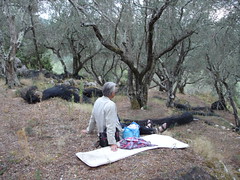
On Tuesday this was crisp and parched. We ate in silence gazing down on the terraces of fruitless trees towards the north coast of Corfu. Today it will be soaked and full of sprouting green. I thought later how Lin's photo looked rather like one of Edward Lear's wonderful landscapes made sometime between 1856-64 and now in the Victoria and Albert Museum. He was looking north from south of Corfu Town - from Ascension, which I don't know.

Thursday, 12 April 2007

The realm of wonder

Thursday, April 12, 2007
Yesterday we started clearing the small garden, to see what lay beneath. I opened the gate onto the path to the lower road. Neighbours brought a house gift. Our builders arrived to measure up the roof for an estimate of complete repairs as well as removing the concrete rubble blocks that the previous owners had set up beside the house to stack rubble and which have brought damp into the lower rooms. A young woman from the house behind when asked said “It was very nice” leaving unfinished her view that improvements had been unsuccessful. We agreed. An outside staircase to a balcony had been removed. I cycled back to Ipsos and Lin came down in the car. Shared a lager and an altercation with itinerant topers whose game is to ask questions, top the answer until someone remonstrates and then say ‘sorry’. We were part rescued by a friend who’d winked across the space at the bar into which this couple had barged.

Tuesday, April 10, 2007
Summer Song lies near the end of the seaward arm. of Ipsos Harbour. The owner of the little yacht moored next to ‘Summer Song’ until February, sailed for Italy while we were away, but Magnus, her skipper, is now in hospital there after he became ill while crossing the Straits of Otranto. The Italian Coastguard came alongside his drifting boat but in trying to lift him from his boat he dropped into the sea from which they only finely rescued him after two hours in the water.

We went into town and drew money from our bank behind the Liston, bought bedding, shower curtain and paint in the Evraiki [Back to the future reference: Look out for a forthcoming book by Marcia Haddad to which I was referred on 27/7/07 by Stan Boardman-Jacobs' 'The Day My Heart Broke']
We drove to Democracy Street - the back way, turning off the Sidari Road along roads lined by the pink blossoms of Judas trees, to gaze from our balcony at the sea and the woods and the village above and below and discuss plans for the house. I checked the shop nearby could receive our mail. “Yes, two or three times a week it comes.” I said the bread was good there. The owner said he used to have a bakery there. The wood meant the bread lasted 5-6 days, “but I don’t want to talk about that.”

Monday, 9 April 2007 Ano Korakiana, Easter Monday
We visited 208 Democracy Street and met the builders. It may be necessary to redo the whole roof rather than just repair parts of it. Ano Korakiana’s Easter Monday procession gathered round the bend by Little Venice. We had a coffee – skirto and nescafe – at the kafenion and gingerly wandered up Democracy Street to the ravine bridge where we waited. The drums started. The procession moved off. A troop of cub scouts, cross bearers and then the Ano Korakiana band. Woodwind – clarinets and flutes – to spice the grander sound of the swaying trombones, trumpets and the drums. They were playing San Tomasso. Solemn but not sad. Then three ranks of dignified women in suits with purple ties – part of the choir. Then passed – St.Peter and St.Spiridon and St Michael on banners, then priests. One saw us and nodded and said “Christos Anesti, Where from?” “From England.” I should have replied "Anethos Anesti".


We waited a little and than strolled on, wary to follow, but not join the procession as it played down Democracy Street. We visited some friends at the bottom of the village. Later on the low road past olive trees, Lin stopped the car and we could hear bees not yet recruited to the killing labour of monocultivation, doing voluntary work among the wildflowers.
Edward Lear, Corfu, 1871, w/c & gouache. Indianapolis Museum of Art, USA

Saturday, April 7, 2007


The big ferry from Bari sailed hardly a 100 metres by the corner of north east Corfu in the dark and on to Igoumenitsa where we landed and trollied our luggage a kilometre along the seafront to the Pantokrator. We remembered how when we'd come this way the previous November a south wind had blown with such strength off the shore our ship had been unable to dock for two hours - a wait that had given us a new friend in Hy from Ayios Markos who'd ridden home with us once we'd made it to Corfu.


She was very full, convivial chat drowning the noise of unwatched TVs in the familiar saloon. One family, at least, had brought a whole lamb for Easter. It lay wrapped beside them but as the crowd increased was stowed below their seat. 'One vast realm of wonder' (Canto 88 Byron's 'Travels of Childe Harold') - words of a lover, blind to flytipped refuse, strip mall development, bleached menus selling 'pise and ships', UK redtops and eurotrash porn, dumb t-shirts, fuming traffic, wall-to-wall football on TV and shaven lads with rosy bellies. But Greece makes me blind. I get a lump in my throat as I see it twinklng below from a late night plane or rising from the sea from the deck of a ferry.

The air was crisp as the ship headed north west over a flat sea. At the Port of Corfu by mid-morning Kostas' boy met us with a car. We left it outside his office with our luggage and strolled towards the Liston until we were standing tightly surrounded by people of all ages below fine balconies packed with onlookers, some preparing to drop terracotta pots on the marble streets below. As even larger pots appeared in the windows above we "ooh'd" and "aah'd" in anticipation. At noon the cascade began. 'Crash" "huraaaaaa" "crash" "huraaaaa". The water in the pots, as well as holding the sins of the preceding year, ensures shards don't explode among the onlookers. The sun shone bright. the crowd was civil and happy. A few minutes later with bands playing we strolled through pottery strewn streets, eating roast lamb, onion and tomato on pita bread.

Friday, April 6, 2007
All seats to Bari from Rome were reserved. At Termini by 8.30am we walked through the bustle and boarded a Eurostar for Bari hoping for the best. Another passenger, a young teacher, Valerian, helped translate, asking the guard if sitting on our luggage would be OK. He nodded. A young woman ran to catch the train as it started and the guard opened the door so she could hop aboard with a broad and slightly out-of-breath smile of gratitude. In a spacious lobby at the end of the last carriage we could gaze through glass at the receding lines as our train sped south.


The snack trolly was a door away. We enjoyed hot chocolate and espresso. Later Lin made a picnic – bread and wine. Cassino, Caserta, Foggia and then some seats came free. We ate, chatted and read. The train was clean and roomy; the passengers civil without needing words. No-one sought our tickets or made announcements.
At Bari we left our luggage at the station and soon found ourselves in a Good Friday procession through the high sided streets following or being followed by a brass band in grieving sonour swaying amid a procession of saints carried on biers behind Jesus - ecce homo - bearing a cross to Golgotha by crowded pavements, shops (few shuttered) bars (none closed) a nunnery and commuters in their cars queueing to get out of town.

Back numbers

Simon Baddeley