Total Pageviews

Showing posts with label Mill End. Show all posts

Thursday, 5 February 2015

My plot


'Above all remember; allotment gardening is fun, it's healthy and it's a great way to meet people. So the most important thing is to enjoy your allotment.'
Advice from the Allotments Section at Birmingham City Council suggests it takes 3 years to get a new allotment in order, but that's if you are already skilled and organised.

I and Lin and now my waged help, Winnie, have been digging over and over, weeding, weeding, weeding (dragging out those sinuous creeping white couch grass rhizomes especially)....
Winnie and Simon on Plot 14 (photo: Sue Hall, Winnie's mum)

....laying permanent paths, cutting out and pegging down porous weed control fabric, making temporary paths by moving around stacks of the industrial-grade carpet tiles I picked up for free during a garden clearance for Handsworth Helping Hands. Making separate beds accessible. The plot is just over 200 square meters, but with the shed and paths only half of that area is now working soil.
Potatoes planted in a bed dug over and over, weeded; new topsoil and compost raked in; all easily worked from surrounding paths

I love it. I do. I really do. But this is not a 'working man's' allotment from which i can proudly feed my family - the ideal of small holdings - urban green spaces whose legislative protection grows weaker by the year. Mine is a hobby plot - a word I dislike; a fact I accept, as a man seven generations from the land. My family have been townspeople, even when enjoying life in the country, since my ancestor Samuel Lees in Oldham became an iron master, then cotton mill owner, in the early years of the Industrial Revolution. True my stepfather could work the ground, handle stock, and grow vegetables in large numbers while my grandmother, Bar, abandoned metropolitan life to start the dairy farm where I was born in March 1942 and spent a lot of my childhood - an idyllic place I first heard described, when I was in my teens, as 'a hobby farm - by my stepfather.
Mill End: Simon on Gypsy, Bar on the haywain
I can't say I'd rather my allotment wasn't just a hobby. That's silly. I don't quite know what I was thinking. I suppose I think of it more as an experiment; a test even.
January 2007 - a picture in The Birmingham Evening Mail "When will the company who bought this green space in Birmingham and built on a third of it lay out the allotments that were part of planning gain deal agreed with Birmingham City Council?"
A hobby is 'a regular activity done for pleasure during one's leisure time'. Campaigning ten years to stop the Victoria Jubilee Allotments from being built over and, after that busy time - lobbying, writing, filming, speaking - getting the opportunity to work this plot, has hardly been a leisured activity. I've never been that keen about dividing activities into ones that are leisure, and one's that aren't. I've a distaste for how that distinction defines 'work'.
Starting on Plot 14 in 2010

I want Plot 14 - one Lin and I chose when the Victoria Jubilee Allotments opened in June 2010 - to prosper. I want it fecund, thriving - a source of pride and good food, I want to agree with the advice that an allotment should be enjoyable.
I've invested money on help, on topsoil, on compost, striving to get the ground closer to how I think it needs to be, and all the time I'm learning, with help from other plot-holders far better than me at growing their own - especially my friends Ziggi with her plot in north London and Vanley with his on the Victoria Jubilee, just a few yards away.
Winter sown broad beans with a sprinkle of potash to rake in
I'm going to make this work. But I'm reminded of Douglas Adam's remark "Flying is learning how to throw yourself at the ground and miss" or Winston Churchill saying 'success involves persevering from one failure to the next', The gardening guide books I read aren't helpful. They begin at a point I'm still striving to reach. They hardly mention soil filled with rubbish, as well as stones, nor do they seem to give much attention to the emotions aroused by the depredations of slugs, onion fly, pigeons, snails (with their exquisite shells I find impossible to crush), and human pilferers - the ones that stole my garlic last year! How I do not envy new plot holders as inexperienced as I, trying to get vegetables to grow on adjoining plots that are like mine was four and half years ago, perhaps worse.
Stones continue to come out of the soil at every dig....

....but they never appear in the books
...and this worthy tutor teaches me more or less nothing about how to dig my plot

I emailed Clive Birch, BDAC, for advice:
Dear Clive.  Happy New Year 2015.  I hope you're well. I've a favour to ask. Since 2010 I have struggled to get my allotment working. You’d not expect less when I’ve invested so much in getting it in the first place. My favour is also a question. We have by all accounts rather uneven topsoil on the VJA. I know that allotments officers on the council were hesitant about accepting the new plots from Persimmon under the S106A of 2004 because the land was not adequately prepared by the developer. Those of us pressing to get the allotments up and running pressed the council to let people start gardening. A minority of plot holders are doing pretty well but all I’ve spoken to admit they’ve had to do a lot of work getting the soil manageable and productive. It is full of stones, bricks, and other debris, as well as chunks of clay with - in some places - ground heavily compressed by building plant machinery. A lot of us have invested in manure, compost and extra topsoil. I would - now that I am beginning to feel more in control - be so grateful for someone coming to look at the soil on my plot to give me an assessment and tell me the best way to continue improving it. All the guide books speak of adding nutrients and getting a balance between acid and alkali, but I’m in the dark as to the starting point on soil composition. It would be great if someone with much more experience and knowledge than I could drop over and give my plot soil an assessment and diagnosis with suggestions as to the what would now be the best treatment to get healthy crops. Would this be possible? Best wishes Simon 
Simon. An experienced allotment holder visited your site and had a good look round, concentrating on the soil structure. Some plots were thriving, some were struggling and some were vacant and overgrown - the overgrown plots obviously were able to support plant life! You can test the acidity of soil [test kits available at DIY/ Nursery] - often the only balance used is lime for the brassicas. The answer to improving the plot - clear rough debris - stones etc [stones can be buried to provide drainage] Clay - working in compost - leaf mould is one of best ways - over wintering will help here. Adding as much rotted compost/manure is great. Leave on surface for a while then dig in [note some crops do not like fresh manure!] You could import topsoil but beware it could include weeds etc even Japanese knot weed! Perseverance is needed. Hope this helps. Best wishes, Clive
So really there's almost nothing in that I don't know, except for the hint about brassicas and the use of stones for drainage. Yet I'm grateful for the confirmation. The depth of my ignorance shared with Lin had me putting my seed potatoes under our bed to chit.
"They need the dark" Lin insisted, so under our bed they went.

I checked this up in books and on the internet
"No Linda! They need light not dark!"
Since the only chitting spuds we'd ever seen were the ones that start sprouting in the veg cupboard in the kitchen we'd assumed that darkness was needed. Out came the spuds from under the bed. Now I have them laid out in the conservatory.
A potato from the kitchen cupboard
Seven months ago the plot looked lovely - the greenery of mid-summer covering a multitude of sins. How will it look this summer? Much depends on what i do in the next few weeks.
June 2014


***** ***** *****
That other plot...
"We didn't reach an agreement. It was never on the cards that we would"
Yanis Varoufakis meets Wolfgang Schäuble in Berlin. The first 10 minutes of the clip has journalists and camera-folk preparing to see and hear statements. Then 'the curtain rises'. There they are, by god! Varoufakis has earned a concession before the conversation began. Greece is talking through Varoufakis to the Finance Minister of Germany - not to the Troika who Tsipras told his voters would not be the new Greek government's first port of call after the election. At 23.25 the German turns with courtesy to the Greek who with the journalists has been listening to the most sober and grave re-iteration from Schäuble for the European Project, an address not really to beloved and beleaguered Greece but to a far wider and more fragmented and unreliable audience across our continent.
Aristeidis Metallinos, Ano Korakiana's laic sculptor, depicts the EEC (EOK) as a broody chimaera
In my head there plays as background to this press statement I hear music - the 'Song for the Unification of Europe' composed by Zbigniew Preisner, sung in Greek by Elżbieta Towarnicka - an abridged version of 1 Corinthians:13, from the soundtrack of Krzysztof Kieślowski film 'Bleu'. Varoufakis is also in government but he speaks eloquently, poetically, to the people of Germany; pleads to them for their support in fighting the threat of fascism in Greece. I feel I am watching two statesmen at work; two men who know their trade.

I had an exchange with Richard Pine a few days ago. He wrote in The Irish Times
Tsipras appears to be naively idealistic, innocent, ingenuous and transparent, but he needs to be secretive, cunning and dishonest to succeed in the minefield he has created. As Maurice Manning once said of Garret FitzGerald, it is difficult to trust someone who pours a glass of wine without reading the label on the bottle. Tsipras wants to do the impossible, but if he is to succeed as a political leader he must learn the art of the possible and acquire the killer instinct.
So Richard suggests Tsipras must imitate the Greek hero Odysseus - famous for escaping terrible dangers more through cunning than face-to-face combat. My email:
Richard. I recall writing this in a paper published in the 90s about political skill in civil servants and politicians.....The constant negotiation of this moral minefield is part of life and certainly part of government. An additional layer of complexity is added to these circumstances by the fact that in families, as indeed in government, many people recognise the presence of these dynamics and may actually impart “in confidence”, something intended to be passed on. A process of negotiation is occurring where one person appears to be trusting another to risk being untrustworthy. The novelist Iain McEwan describes public figures who move around in this moral maze by navigating the complicated channels that run between truth and lying: 'with sure instincts while retaining a large measure of dignity. Only occasionally, as a consequence of tactical error, was it necessary to lie significantly, or tell an important truth. Mostly it was sure-footed scampering between the two extremes. Wasn’t the interior life much the same?’  (McEwan 1988:182)....McEwan captures the moral nimbleness that accompanies grown-up behaviour - public and private - where corruption and probity are proximate rather than polar and, where rules are at best casuitical; maintaining integrity requires wit.  What I struck me about Iain McEwan’s words is that self-query 'Wasn’t the interior life much the same?’  My tolerance of politicians about whom you are much more judgemental (I think) is that politics - certainly the politics of government - is that it’s so like my internal life and I suggest I’m not alone in that. Best, Simon 
Richard: You mean you lie to yourself and let not your right hand know....? 
Simon: That’s what Iain McEwan is suggesting. I care about the environment and do many things that harm it. I shop at supermarkets while praising the survival of small shops. I think lascivious thoughts about other women. The list of my moral inconsistencies is endless and I don’t let them worry me or lessen my expressions of concern about the sins of my fellows.
My interior life is a parliament of debate with every now and then a rare internal argument from which the whips are withdrawn and I have a vote in which I must truly interrogate my conscience - but most of the time I’m bladerunning ‘the complicated channels that run between truth and lying”.
I think you have so hit the spot when saying how Tspiras must be. The killer instinct etc. Do you think he has it? Could he grow into it? Is his partner going to help? Peristera Batziaka. ‘Tough cookie”? This is riveting. S 
R: I don't have that problem/advantage. I never argue or debate with myself. I am conscience-free when I wake, and the same when I go to sleep. Thanks for the Batziaka article - interesting that "peristera" means "pigeon" or "turtle-dove". R 
S: 'Behold, I send you forth as sheep in the midst of wolves: be ye therefore wise as serpents, and harmless as doves.' Matt 10:16 "I never argue or debate with myself. I am conscience-free when I wake, and the same when I go to sleep”. People will make pilgrimages to seek your advice - the sage of Perithia. You make me think of that other writer Nikos Kazantzakis “I hope nothing. I fear nothing. I am free. This is true happiness: to have no ambition and to work like a horse as if you had every ambition. To live far from men, not to need them and yet to love them. To have the stars above, the land to your left and the sea to your right and to realise of a sudden that in your heart, life has accomplished its final miracle: it has become a fairy tale.”  S
Draw me a picture....

In other words just 10.6% of the €254 billion funds 'state operating needs'


Thursday, 4 October 2012

Η γάτα είναι εφτάψυχη

Among the regularly shifting family of cats that live between our houses, using their claws to make effortless ascents of walls and trees, Linda had taken a liking to the ginger kitten which has been around since April. It was killed by a car on Democracy Street the other evening. Katerina, her sister Nectaria and Vangelis and a couple of other children, used to the same cats as us, were standing around in the dusk looking down at its small broken body lying in gouts of congealed blood close against the corner of Lefteris’ house. The children drew our attention to it as we came up the steps to the street the other evening on the way to supper with friends.
“Oh no” said Lin
We looked down in the gathering dark on the little corpse. I contemplated collecting it up.
“If it’s still there when we get back I will”
We walked on. The body had been removed when we came home.
“I could never get near that kitten, you know. It was so wary, yet it was hit by a car”
The cats – our cats – are of course not ours. They’re feral, uncollared, living among us, valuing us for the food we give them, alley cats κεραμιδόγατος.
When we come to the door they will sometimes gather looking up expectantly tails high, waving. If they are nowhere to be seen we will tap a plate against a wall and cry “Γάτα! γάτα!” or “Naps! Ναπς!” Drawing out the ‘a’ – “naa-aaps!” - so that they gather for our gift, imparting the suggestion that we have influence in their lives.
It is a duty to feed a dog that is of your household, as much as to feed a child. In the case of cats we are making offerings. The pet food marketing people figured this out years ago and wrote copy that repeated an ancient distinction in the contrasting ways humans viewed cat and dogs. Dogs whether treated well or abominably, as some are, belong to people. Cats invoke superstition in humans. They are household divinities, seen by some as familiars, “which is why” I read in some study long ago “humans when cherishing dogs will love them like their children and when cruel to dogs will abuse them as some humans abuse children; while humans when cherishing cats will come close to worshipping them or, when cruel, will torture them in inventively brutal ways.”
Cats are not parasites. The presence of these beautiful beasts around our cluster of houses is encouraged by gifts of food. They are never allowed inside houses.
“Έξω! exo!” we cry to the bolder kittens that haven’t learned about thresholds, crying out “cat in the house” and chasing them out. Most understand and obey this convention despite exhibiting intense curiosity about the interiors of our homes. Once I found the desiccated skeleton and pelt of a kitten that had hidden and got trapped in the house when we’d left for England for three months. An awful fate. Now we take more care to check rooms for cats on departure.
A queen and her kits in Venetia
Two adult cats presently allow themselves to be stroked, even purring and looking up ecstatically with half-closed eyes when gently scratched and caressed. I don’t understand why these particular cats decided to be trusting.
“There's a family I know” said a British friend the other day “who paid €500 to have a cat’s broken leg set, and to take her and her kittens to England. It’s a bit over the top when there are families trying to live on €30 a week”
“They have a way of dashing out in front of the car” added her husband “and as we miss them I mutter, ‘there goes one more of your nine lives’” In Greece the British saying is altered - they have just seven lives - Η γάτα είναι εφτάψυχη.
I don’t worship cats. I delight in the look of them. I’d be fascinated to learn more about their habits, especially how they determine each other’s rank and territories and how far different cats roam the village - their beat as it were - and where they live in the cold and wet of winter.
We see them growling at each other, slashing out at other cats to defend their space and we hear, and now and then see, them screeching during violent mating. I’m pleased they kill the occasional rats; less so that they leave their small savaged corpses near our front door as misguided gifts.
When we came home the ginger cat’s body was gone. In the morning young Katerina explained that she and Vangeli had wrapped it up and ‘taken it away’. Only a small map of dried blood remained in the gravel at the side of the road.
“I really liked that cat” said Lin.
*** ******
There came a local wind – in the heat of the midday – that lasted hardly a minute as though some great tree had fallen or rock had tumbled displacing air. It blows across the village, gusting through and around the houses slamming loose doors - close and far – momentarily raising our curtains like streamers, moaning through the roof, sending a plastic bottle poppity along the alley, lifting loose paper; gone as abruptly as it arrived. A portent from the north. Yesterday these great gusts were coming at regular intervals blowing up little dust storms along the mole at Ipsos.
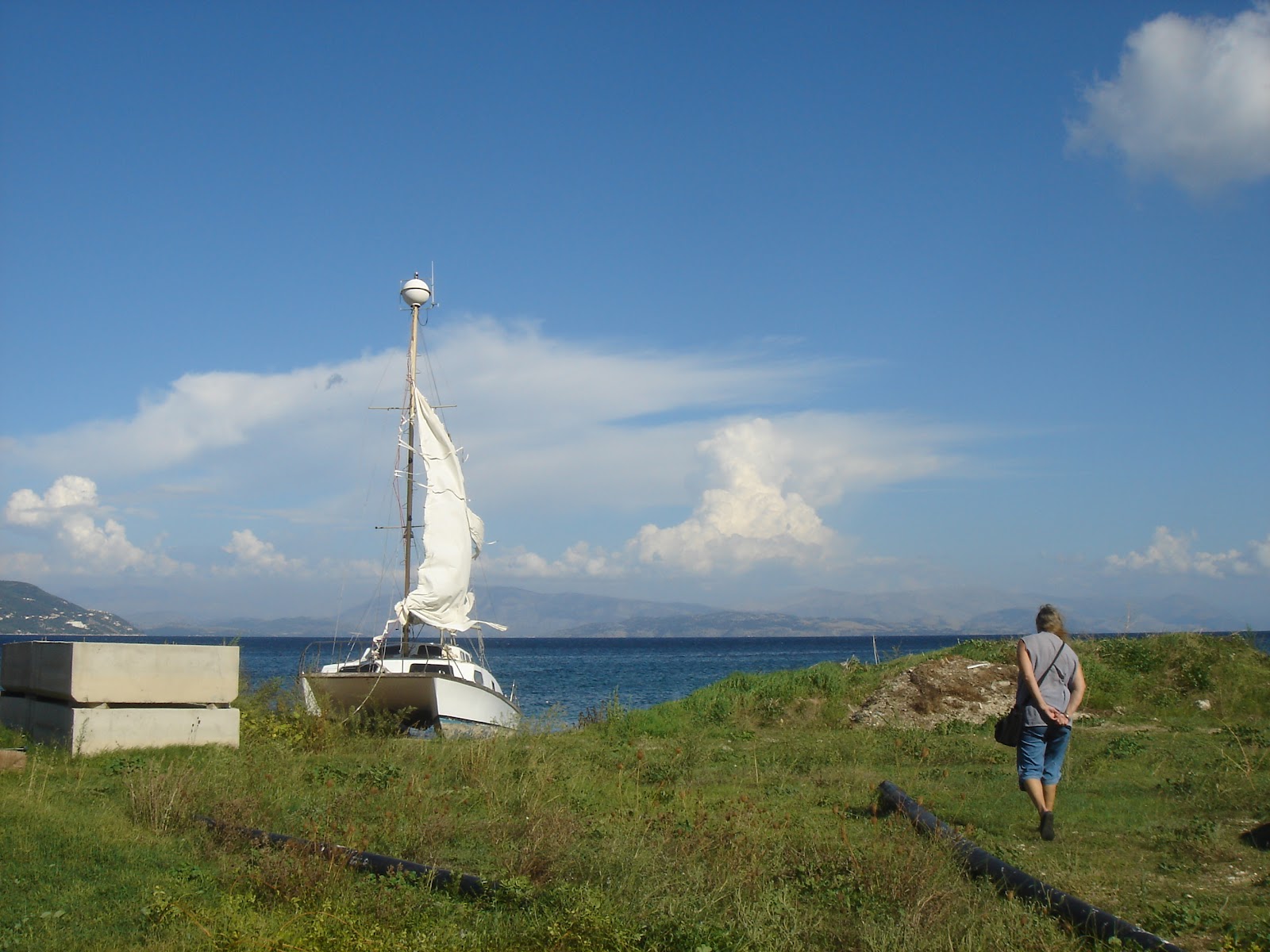
A catamaran we knew was in sound condition but whose owner died has been shifted from its original mooring in the harbour, where it had sat unattended for over five years. It's been beached on the shore where it lies forlorn - a desolate sight - halliards loose, its jib unfurled, slowly shredding, its dirty hull half in and out of the sea, at the mercy of waves from a southern storm.
I'd been down to inspect Summer Song, to check her moorings and cover. As Lin and I sat on a bench I noticed a new boat in the harbour, moored cosily among small fishing boats - of all things a Westerly 22, and not only that - with a gunter rig. I suspect these coincidences. This useful rig is so rare on anything but dinghies and I've not seen another boat of this kind all the time we've been in Corfu; yet here it was in Ipsos harbour only yards from our own boat. I made enquiries and by evening knew her owner and how she came to Corfu - sailed all the way from England.
I was entranced and filled with pleasant nostalgia, even a little envy, to see in such good condition a small boat of exactly the same type and rig as I and a friend had sailed across the Atlantic in 1965-66; a boat I'd know my way about in pitch darkness. Lin and I had been lent the same kind of boat in 1975. We'd sailed her from near Bristol to the Scilly Islands and back over a wet and stormy August. In the wiki piece I wrote about the man who taught me about the way to sail and attend to a small boat at sea, Denys Rayner - nickname 'Ben' his RNVR call sign during convoy duty - inventor of the Westerly 22:
...Ben Rayner's greatest peace time contribution lay in his approach to designing, building and selling such small craft. A fascination with making model destroyers at school evolved into the making of Robinetta in which for a few years he voyaged for pleasure - a pleasure which, after his long war service, he made available to thousands. Starting with Robinetta - based in 2006 on the River Orwell near Harwich and still sailing, and then the rebuilt Orchid to share with his youngest son, Rayner graduated via the one-off Corvette to the Westerly 22, to the Westerly 25, the Westerly 30, the Windrush (a re-worked W25), and the Nomad (a re-worked W22). Applying the husbandry, and inventiveness, that characterised his years as a professional sailor, Rayner applied design and techniques, including the crucial process of curing now recognised as so vital to enduring fibre glass construction, to products that sold themselves. In the recent words of one of his sons, "He was delighted when the butcher, the baker and candlestick maker arrived at the London Boat Show in the early 60s and put down deposits in cash. Boats at that time were produced by 12 men at 6 vessels per annum. With 12 men we built 50 a year. Their yachts cost £6,000. Ours were on a trailer for £1800." But if these small craft were swiftly made and so affordable, none left Rayner's factory unfit for the sea, of which he wrote "neither cruel nor kind ... Any apparent virtues it may have, and all its vices, are seen only in relation to the spirit of man who pits himself, in ships of his own building, against its insensate power."...
*** ***
The other evening, with Lefteris and his grandson and Adonis, I helped crush a 1000 kilos of red and white grapes for next years wine. Lin peeked at us over the garden fence as she cooked supper.
This evening after decanting the first fermentation the press will be applied to the crushed grapes, and the pomace composted.
*** ***
WiFi'd Amy who'd driven up to the Highlands with Oliver and Guy to be with her grandmother, and my sister Bay now at Brin Croft with mum after her flight from New York. I was showing Lin some pictures of Mum when she was a young woman and a girl. For all my pleasure in leafing through large books or drawers full of photos, it's good to have technology which so swiftly recovers a couple of pictures I had in mind - ones I scanned only a year or so ago.
My mother in the lower meadow at Mill End on her horse Oyster. The shadow of the photographer, my grandmother Bar. This must have been sometime in the mid-1930s. Another during a haymaking - mum and her sister with Gypsy, taking a mouthful from my mum's pitchfork.
Gypsy was still around when I was born at Mill End and old enough to be perched on his back in straw hat against the brightness of the sun. Yesterday afternoon I was skyping Amy and Guy, with my grandson Oliver sat between them, in the conservatory at Brin Croft.
There's a Greek philosopher whose name I can't remember. He was, I'm sure, one of the Stoics, a school of thinking - στωικισμός - that emerged, with other guides to life, after militaristic hubris had ended everything that made that brief brilliant era begun with the victory at Plataea, with the fragmentation of city states - the polis - entities which imparted identity, structure and meaning to their citizens; giving commonality to the Golden Age. The philosophy of stoicism is a richer vein of thought and feeling than the simplistic definition contained in our present notions of that word. As those organic societies withered, Greeks had to find an individuality separate from the body politic. It must have been dreadful - for all the liberties the loss of community may confer on people previously fixed in the amber of custom and tradition.
Human life, said this Stoic, could be compared to a great crowd toiling in a vast quarry from which, now and then at random intervals, a cutting out party would select an old man or woman, a mother, wife, father, husband, brother, sister, a suckling child, maiden or youth and take them away, never to be seen again. This image comes to me - one who delights in my surroundings in Greece, in England, in Scotland - with the words of Matthew Arnold
...for the world, which seems to lie before us like a land of dreams, so various, so beautiful, so new, hath really neither joy, nor love, nor light, nor certitude, nor peace, nor help for pain...
No place means anything without the people in it that you love, your dear neighbours and friends; the most sublime, most beautiful landscape on land or sea, whether the close-ups of exquisite detail or the distant prospect of mountains and plains at the rising of the sun or its going down, enchanted by moonlight as was the sea below the cliffs of Dover Beach, as Arnold strolled in the sweet night air with his new wife; none of this affords an iota of consolation when the cutting out party arrives in the quarry for someone you love. 

Sunday, 2 September 2012

This is how it happens...


This is how it happens. A space entirely green – private garden, allotment with trees and hedges, playing field - is taken over for building a new estate of private houses. Local people campaign against this for a decade helping to win planning gain concessions which, as anticipated by the developer, reduces the original footprint of hard surface by 50% or even more. The houses are built and occupied. The original application included two 1930s houses on the main road. One was demolished to create Victoriana Way – the road that leads into the estate – the other was converted into a temporary sales office, its front garden hard surfaced to allow would-be buyers to park. This house, after the new estate was mainly occupied, was sold privately, but only after a new property with detached garage had been built on half of the old house’s rich back garden, and a double garage built into its other half. Whittle away, whittle whittle, whittle. The new owner of the old house has submitted a planning application to build another two storey house on top of this double garage which he declares ‘surplus to requirements’ – hardly surprising given the parking now available on his frontage - extending into the small space left behind his house for a lawn. Is this worth making a fuss about? Isn’t the main damage already done? Lin and I, since our road’s residents’ opinion has been formally requested, submitted an objection.

From: planning.comments@birmingham.gov.uk
Subject: Comments on 2012/05776/PA have been received by the council.
Date: 30 August 2012 18:35:39 EEST
Comments made by Simon Baddeley of Beaudesert Road Residents
Thank you for informing us about this application to build a two storey house at the rear of 179 Hamstead Road, Handsworth, Birmingham, B20 2RL - 2012/05776/PA.
We believe that approving the proposed building will be detrimental to the area and therefore object to the application. Our objection is submitted in the context of policies to enhance the ‘liveability’ of our city, safety and security partnerships, the restoration of parks, street improvement schemes and measures to generate housing markets and the importance of not approving planning applications which set precedents contrary to these policies.For some, getting planning permission to dispose of part of their back garden for building is tantamount to finding oil there – especially if they are minded to take the profit and live elsewhere on the proceeds, bequeathing the in-filling to their abandoned neighbours. Parks and allotments and sometimes playing fields enjoy some statutory protection. Far fewer incentives or disincentives exist to protect private green space. 
Relentlessly we see the whittling away of city green space, diminishing the aesthetic of ‘leafy suburbs’, depleting the wildlife these spaces support, removing the Co2 processing capacity provided by trees and the absorbency that lessens flooding. Car ownership continues to rise. Everywhere we see householders and landlords slabbing over front and back gardens for yet more parking, building single, and in this case, even double garages on them. The Council, whilst constantly proclaiming its commitment to a cleaner, greener city, helps accelerate the hard-surfacing of Birmingham by approving applications of this kind. One reason for our objection to this application is that this development will destroy yet more green space, in an area that already has substantially less than the minimum recommended percentage of such space per head of population. The loss of even small green spaces in Handsworth, when aggregated, contributes to the continuing degradation of the urban environment, taking away yet more play areas, opportunities for cultivation and the capacity to absorb rainwater, subtracting from the local store of precipitated water and encouraging flash floods inside and, in the case of Handsworth, eastward into Perry Barr and the Tame River basin. 
This application involves the construction of a property extending over a recently built double garage in what was yet another mature garden next to Hampstead Road in an area that has already seen substantial and unpopular in-filling over recent decades. Between 2005-2008, no fewer than 84 new properties were constructed by Westbury Homes, now Persimmon Homes (ref: No. N/01514/03/FUL) on a large part of the Victoria Jubilee Allotments. Prior to that some 21 properties were constructed around a new road backing on to Bowling Green Lane and before that further houses were built around Crick Lane on another part of the Victoria Jubilee Allotments site.Another concern is that the applicant, whether intentionally or unintentionally, has created a back garden beside a new double garage, which consists of no more than a small lawn, as a precedent for circumventing advice on maintaining bio-diversity contained in the City’s 2008 Mature Suburbs Planning Guidance. It is through actions like these - equivalent of environmental ‘death by a thousand cuts’ - that our community experiences a relentless whittling away of its remaining green space; in this case a back garden made available for another house, in many other cases, gardens - front and back - stripped of lawns, flower beds, shrubs and trees to create yet more car-parking; homes with such tiny play-spaces for young children that they drop out of the family housing market, and become more liable for multi-occupation in an area already acknowledged as being blighted by an overabundance of such properties.  On this basis we withhold approval of any further hard surfaces being laid on our limited supply of green space, much of which has suffered from intense development over the years, not least the aforementioned estate accessed by Victoriana Way which from 2004 was built on private allotments.
As an additional reason for refusing this application we cite the planned development application N/04912/05/OUT in the rear of 173 Hamstead Road, Handsworth, B20 2RL rejected by the Planning Committee in 2005, for reasons which include those contained in our present objection to this application.
At first sight this application, with its required design and access statement, would appear  to conform to the City’s 2008 Mature Suburbs Planning Guidance on controlling residential intensification. The building shown in the application’s accompanying documents seeks to fit the style of other houses recently built on the new Victoriana Way and will be built over a recently constructed double garage, and extending into green space which, for the time being, is the applicant’s own back garden. 
But this application is far from an example of ‘preserving what is good and not making worse what is less good’ (first principle of Environmental Policy Advice 3.8 in the Birmingham Plan). However closely the proposed building matches the local vernacular with existing access to Victoriana Way, the fact remains that it is being built in a back garden. It represents yet another of many attempts at getting a windfall development past the planning rules and is clearly yet another opportunistic attempt at in-filling in one of Birmingham's best known ‘mature suburbs’.
*** ***
Jacqueline emailed me with an announcement. She’s archivist for Clavering in Essex, the village where I and my sister were born at Mill End Dairy Farm. Last year, I’d sent Jacqueline mementoes of my grandmother, Bar, and my mum, Barbara, for use in her book: ‘The story of the people of Clavering, at home and in service, during the Second World War’. 190 pages. 200+ illustrations. Fully indexed.

BOOK LAUNCH COFFEE MORNING

Clavering at War by Jacqueline Cooper
Saturday 29 September 11am - 1 pm
Clavering Christian Centre (former URC), Stortford Road

All welcome for coffee and cakes and the new book!

Enquiries  from author tel 01799 550462
Books from 24 Pelham Road, Clavering, Essex CB11 4PQ   £10 + pp postal copies
I guess it shows that I’m buccaneering the truth when on other occasions I say that all I learned of the countryside came from growing up with my stepfather, Jack. My grandmother, Bar Maine, bought an old cottage in Clavering in the 1930s and turned it into a farm – with Jersey cows, hens – full size as well as bantams – geese and some horses. 
Me on Gypsy, Bar on the hay wagon around 1945
She continued to live in and visit London, but the farm was her home, the place where she died in 1969. Jacqueline tells me it’s now a riding school and that its owner would be happy for me to arrange a visit. I shall certainly buy the book. I’m not sure it would be a good idea to revisit Mill End, despite its owner’s generous offer. Some things are meant to remain in another country, always present in imagination.
****
On Wednesday evening we drove down to the city to see the Edward Lear Exhibition - oil paintings, watercolours, drawings and engravings - brilliantly curated by Despina Zernioti -ζερνιώτη δέσποινα - displayed in a wonderfully made temporary structure, with gaps through which one glimpsed the grand décor of the palace...
... intended by Sir Thomas Maitland to impress the Ionians under our benign protection, by a talented team of helpers and supporters inside the Palace of St Michael and St George at the head of the Liston. We were entertained by one of the city bands in company with an assembly of visitors, here to say farewell to the exhibition which had run since May. 
Once I had read the journals of his almost solitary travels across Greece and Albania, and  a DVD series made a few years ago, that followed his routes comparing his landscapes with the same places now, I had to stop thinking of Lear as I, and most of his admirers still do, as a writer of enduring nonsense rhymes. Compared to Lear’s artistry in evoking a fascination with and love of place – especially Greece and most of all Corfu - his unique contribution to nonsense, long before Dadaism and Surrealism, seems a side line, possibly a sort of self-ridiculing compensation according to a psychological appreciation – one among five brilliantly illuminating essays in the exhibition catalogue – by Anthony Stevens. 
The Edward Lear Exhibition catalogue
An endearing and memorable clown becomes a troubled and courageous genius, explorer and remembrancer, his pen and brush connecting his eye and heart to the places through which he travels, touching things, even the sky and distant prospects – pre-photographic images as accurate and truthful as the most advanced cameras. One small sketch shows the Parthenon looming in isolated majesty beyond a grove of trees, surrounded by broad meadows. Amid the enthusiastic chat and pacings around the lovely exhibits I stared at these delicate tantalising landscapes, securely framed, protected by glass, neatly titled, I could hear their silence; grieve for the unreachable magic that Lear almost allows us to touch, and see and smell. We left morose, as I suspect did others.
Παλαιοκαστρίτσα - Paleocastritsa by Edward Lear

“When choosing somewhere to live” advised my stepfather, “settle somewhere where you can’t be disappointed. Go somewhere that has been comprehensively ruined” 
We’ve tried to do that and by and large succeeded. 
The Pimping of  Panorea by Maria Strani-Potts....Maria used this parable about Corfu where she was born, a citizen of the island.
...For years they had hated hard work and had come to resent the fact that they had to work in the fields and on the sea in order to survive. It is not known who had the idea first, but the notion that the time was ripe to exploit Panorea and to benefit from her eternal qualities sprang up suddenly and quickly spread widely amongst them. They decided that if they turned Panorea into a prostitute, they would benefit enormously. Panorea was so well known in the world, so popular, that they would have no problem in selling her charms at any price; so one morning members of the clan woke up, determined to take the lead in becoming her pimps. This would be beneficial to all, they proclaimed. It was such an easy thing to do. Panorea had been a muse to poets, painters, and writers. Kings, Emperors, and Empresses adored her and visited her often, and many scholars studied her history.  Pimping appealed to them; it was neither burdensome, demanding, nor did it need careful planning. They needed neither a substantial capital investment nor much in the way of hard work. In a very short space of time Panorea was turned into a commodity. In the beginning, fresh and wonderful as she was, she brought vast profits and satisfaction to her clients.....
Maria's writing always echoes in my mind, almost sounding aloud over my shoulder as I wandered by Lear's pictures of Corfu. I imagined a refutatory paragraph...
The woman is claiming rape. I detest and refute her ridiculous allegation. Even though it seems hardly necessary, I 've apologised - fulsomely and sincerely - for any hurt she may claim to have experienced as a  result of our very brief liaison. I've leaned over backwards to respect her temperament and sensitivities. Not only that, I have paid, through my lawyers, a generous sum to ensure that her exaggerated and embarrassing allegations are never brought to court. I am more than aware of the seriousness of the crime I'm so unfairly accused of, and in that light I have also given a very large donation to a local rape-crisis centre and indicated my readiness to fund the woman's visits. I will even pay for her to have long term psychiatric care, if she persists in succumbing to the mental problems she's managed to get her advisors to define as the result of 'a traumatic assault' bearing no relationship to actual events or the circumstances of our acquaintance - if that is what it was. If anyone has suffered with the level of hysteria and fuss surrounding what some might even view as a formative and even exciting experience, it is me. 

Monday, 18 July 2011

Our shed and all it contains

Yesterday Linda and I finally assembled the shed on our allotment - our Birmingham apothiki, την αποθήκη. Imram helped us lift the roof into place where it 'clicked' satisfyingly over the four walls. Then I loosened the hinges on the door and fitted that. It doesn't block our view of the park. It needs something transparent like perspex for windows, hooks and shelves inside, plus various small repairs where we cut it up to transport it after finding it in Walsall on freegle, but having a shed on plot 14 marks another stage in getting our allotment together, and of course we can share its use with Robin and Rachel. While on the plot today, Lin went on to rake and grade part of the ground I'd dug over last week making it look dark and fecund. Meantime potatoes are starting to flower and other plantings advance.
Our progress is slow compared to some plotholders but it's very satisfying to make comparisons with the state of our plot a year ago year, or the situation on 30 December 2008 when, as part of our continuing campaign to recover the Victoria Jubilee Allotments. I wrote to the Birmingham Post:
Dear Editor, In 2004, having fought for ten years to prevent losing more green space in Handsworth, campaigners were forced to accept the decision, by a small margin of the councillors on Birmingham’s Planning Committee, to negotiate a Section 106 Agreement to permit new homes to be built on the Victoria Jubilee Allotments (VJA) – a private site neglected by its owners. Can it be that having taken a profit from the houses they and their predecessors, Westbury Homes, have built and sold on the VJA, the current developer, Charles Church*, is seeking permission to renegotiate the agreement made with the Council and – implicitly – with a most active community (Jane Tyler, Birmingham Post, December 24, 2008)? We, with many others, anticipating trends now acknowledged by Government, (e.g. Baroness Andrews’ Introduction to ‘Growing in the Community’ 2nd ed.2008) argued convincingly that there was enough demand for allotments for the whole VJA site to be afforded the protection allotments are allowed by statute and Planning Guidance (PPG17). The city planner’s lower estimate of that demand was used to sway the Committee to approve the application to build houses on the allotments. In May 2007 we were assured by Alan Orr, Perry Barr Community Planning Officer, that new houses had been sold in sufficient numbers to trigger the next stage of the S106A – three playing fields, including a cricket pitch, and 80 allotments. How brash if now, having taken their profit, Charles Church claim themselves ‘burdened’ by the terms on which they made it. Yours, Simon Baddeley, Handsworth Allotments Information Group (HAIG)
*Since 2009 for Charles Church read Persimmon Homes
Thus have I moved in just over a year from the conclusion of a decade-long campaign for the idea of allotments to the real thing. Surprising myself.
Imram who helped us with our shed is also, following a successful bid to the Lottery Awards for All Fund, leading on creating a sensory garden on Plot 79 next to the gates into the VJA. A neighbouring plotholder, Jeevan Singh, sent me a picture of Imram and volunteers working on the early stages of a plot which will be open to all. The site will have other plots especially for particular groups and there is to be a council plot mainly for schoolchildren.
Volunteers preparing the sensory garden
*** ***
Oriana, my half sister, Professor at Chelsea, wrote with a letter attached:
Dear Simon. I thought you might be interested in this? Hope all is well. Xx oriana
The attached letter - on an academic matter - included this:
Dear Professor Baddeley....Upon initial arrival in London in September 1964, I found a magnificent one bedroom flat for let at 5 Bina Gardens, London SW 5. The interview for becoming a tenant took place somewhere in Mayfair with a very distinguished older woman by the name of Mrs. Maine. It became known to me, later on, while residing at 5 Bina Gardens, that she had grown children, one of whom had the last name of Baddeley. I remember chatting to her grandson, Simon, on several occasions. If memory serves me correctly, she had either a son or daughter who was well known in the British theatre. Seeing your name brings back those memories, and I am wondering if you have any relation to the Baddeley family? If this is not the case, please forgive my enquiring curiosity, but one never knows unless one asks...Musically yours from Chicago, Elisabeth Matesky (American Violinist/ Artist Teacher of Violin and Chamber Music/ Composer-Arranger for Solo Violin/ Musical Writer and Speaker) 
Me - back to my sister:
Dear Oriana. The longer we live the more likely it is that things will come round again. Thanks for this. I’d never actually forgotten Elisabeth. She’s a very special talent. ... About two years ago remembering one time long ago, I wrote a friend: 'We had a young American violinist upstairs - when I was a post-grad aimless in a big old place on the Earls Court-Kensington border a mile north of the Thames. I'd hear her practising through two floors and we'd nod in the hallway. One evening - just before she played a concert at QE Hall - I was giving a dinner party with tables pulled together for about twelve ex-uni friends (when food was cheap) she knocked on my door. "Come in come in, Elizabeth" (I knew her name. Lots of people did, and here was I looking as if she was an extra guest. Wow!) She said "Hi! I won't eat. I'll have a glass of wine. If that's OK?" So she joined our happy conversation. After about half-an-hour - can't remember - she said "Hold on" and dashed off. Well that's that, I thought. A minute later she's back - with that violin. Wood like fine porcelain, looking as if it was held together by polish. "Would you like me to play?" (No. Can't you see we're having a nice conversation?) "Yes yes yes" So she did. Standing just beside me. Except far off, from the stalls, I'd never seen a talent at work. When she hit the strings with her bow I swear bits and pieces flew off. She near looked to break the thing. I couldn't believe the volume she drew from it, fighting it, driving it like I've only seen in close-up shot on tele, but you know how with boxing even the close ups don't show the violence and the danger that excites some people. I saw. We saw and heard. So so beautiful. And she made it look easy. Heart stopping. I was weeping, shaking in a most un-English way - and do now - as I recount that 30 minutes of her generosity to me and my friends.'    ...  How are you all? We are as you know back and forth between Corfu and UK – two homes and two small worlds in each. It’d be lovely to see you and catch up on your perspectives. How are things for god-trodden St Catherine’s given current events in the Middle East? As for Murdoch...what schadenfreude, what quiet pleasure it is to see Ramasses becoming Ozymandias, meeting his due. XXXX Simon
** ** ** **
On Monday morning Lin, Denise and me had a meeting with Jo Burrill, Regeneration Project Officer for Midland Heart to brief her on how things are going with the Handsworth Practical Care Project. The project has a history of doing work for the housing association based in Birmingham with many properties in Handsworth.
And on Tuesday afternoon Lin and I met Sharon and Vicky at Birmingham Voluntary Service Council (BVSC) in Digbeth to learn about the assistance they give to projects like CHPC by way of handling wage packages, including tax and national insurance. They had a long association with the project that for been ended in June 2010.
******* *******
Clavering was the Essex village where I was born. For the last 6 months I've been exchanging emails and images with Jacqueline Cooper who emailed me in April (see also):
Dear Mr Baddeley. I have enjoyed looking at your various websites, which I found on a Clavering search. I was interested to see some photos of Barbara Maine when she lived in Clavering, and wondered if you would give permission for me to copy them for our archives? we are having a local history exhibition in September and I am particularly looking for WW2 material and photos. Many thanks, Jacqueline Cooper, Clavering Local History Recorder, Essex.
19 April '11: Dear Jacqueline. How nice to hear from you. My mother – Barbara – who if you have been looking at my website you may know lives in the Highlands. I’ve been capturing some of her recollections on video, a project we both enjoy. I’ll see her at the end of  May and perhaps we could do a short memoir (6-7 minutes) on video about Clavering, where of course she lived as a child and where she was married and where I was born, at Mill End Dairy Farm. Did you see the picture of me sat on the cart pony Gypsy with my aunt, and grandmother, Bar Maine. I’m pretty sure my mum took that snap. Of course you can use the pictures. I’m sure my mother will be pleased and not mind me giving you her permission. You’ll probably have come across the brief account of how Fl Lt Bobby Jeff (names on the Battle of Britain memorial  as one of ‘the few’), who was set to marry my aunt, Margot (holding the horse in the photo I’ve mentioned), was shot down and reported MIA only days before they were to be married. My grandmother recalls the postman cycling up the lane and thinking she ‘knew’ what news he brought. It was a telegram. All the wedding presents were laid out ready at Mill End. I also have memories of Caton’s Store on the ridge between the village and Mill End Farm. We see it on google now and then. I congratulate you on putting together a history exhibition, especially now when people are feeling gloomy about the economy, many with good reason. Best wishes, Simon 
In her reply Jacqueline mentioned 'Simon...I know Mill End Dairy Farm quite well, although of course it has long since ceased to be a farm. The family there now are Scottish as it happen s- the Inglis (or were when I was there). Some years ago, when my children were still at school, I used to do gardening for a few people including them, just one morning a week but it was a nice garden to work in, right beside Elm Street Lane. There is a huge tree, quite a rare one I thought might be a Black Poplar - maybe it was there in your childhood too. I think I recognise the painting of the outbuilding, which was still in use when I was there, I have the feeling it had been converted into something, but not sure. It would be good to see some more photos of when it was a farm. In a field near there now are some llamas or alpacas, not sure if they belong to the Inglis or someone else. Catons is not a store now, it has recently been bought by someone wealthy who has done a lot of rebuilding etc but at least the old windmill has been repaired.'
My birthplace
Jacqueline sent me a picture she took of Mill End in the last 20 years.  My mother sold the house after Bar, my grandmother, her mother, died in 1969. It seems hardly changed, though Jacqueline tells me there have been many changes since this picture was taken. I was born on Sunday 29 March 1942 in the room behind the far right window on the bottom floor.
A display Jacqueline's made for the Clavering history exhibition


Back to the future - 13 February 2014 
Matt McGinn sent me an email and a photo of one of the mills above Mill End beside Caton's Store - in the year before I was born. I am so grateful when people think of communicating with a stranger about something like this - especially for a placeless person like me it's wonderful to have these piquant dishes of local and personal history:
Dear Simon, I have just watched the wonderful clip of your Mother reminiscing about her time in Clavering. We purchased the Windmill where the shop used to be and it was fascinating to hear stories about the people and the places surrounding the Mill. Mill End is still an idyllic cottage and I'm sure your Mother would be pleased to have known that they still keep many Horses there. I am attaching a picture of the Mill as it was in 1941. Many thanks for your posting. Best regards Matt McGinn, Clavering Mill


Back numbers

Simon Baddeley