Total Pageviews

Showing posts with label compost. Show all posts

Sunday, 9 August 2015

'Born in debt'

'The compromise to save the nation' Greek cartoon 1893
My brother George Pericles B sent me this cartoon on Facebook. Nancy Katsalis and Aleko Damaskinos sent me translations of the old Greek. George thought the bemedalled beribboned figure on the right represented Germany.
"Nothing changes, eh?" Not quite so. I think it's Russia.
Aristeidis Metallinos, laic sculptor of Ano Korakiana, 'For faith and country' 1981 (Cat 118, marble relief 40 x 59)

I've been told this. I've read it, over and over; that Modern Greece, founded in 1828, was "born in debt". Yet most debates, interviews, editorials and op-eds I've read and heard and watched in recent years seem informed only by events of the 15 years since Greece joined the eurozone, rather than by those of the preceding 127 years.
Hellenic Parliament Monday 30 Oct 1893 Charilaos Trikoupis “Unfortunately, my dearest gentlemen, we went bankrupt.” 

In 1893 - date of the cartoon - the government of Charilaos Trikoupis declared bankruptcy. In return for debt relief, partial control was imposed by Greece's creditors - France, the Netherlands, Russia and Britain; all eschewing interference in the cat's cradle of Greece's internal finances. The government, over half of whose revenue, in 1893, went to service loans, was, as everyone knows, beset by clientelism - a complicated and deeply embedded part of Greek society....
Heinz Richter in The Globalist, June 2015: Unless one understands the history and the manifold ways in which the clientelistic system has metastasized, one has no chance of improving Greece’s prospects. Alas, most Europeans do not understand the phenomenon of clientelism and react in a peculiar way – such as the oft-made claim of 'lazy' Greeks.
Come to think of it, inside the EU, it is only the Austrians who – due to their past as a Balkan power – have some understanding of what’s really going on inside Greece’s structures. The other EU nations simply project European political ideas and ethical principles onto Greece and the other Balkan countries. They lack the understanding that these ideas and principles - noble and/or commonsensical as they sound - are alien to the society and the political culture of Greece.
After the national bankruptcy of 1893 - Greece's third - fruitless negotiations continued for years. In the cartoon the sack born by Hellas bears the words:
The compromise to save the nation - 99% with an eternal monopoly under foreign control of markets in tobacco, raisins, bread, wine, meat, olive oil.
and on the basket:
Loan 850.000.000 (drachma)
Those products listed are the pre-industrial exports upon which the Greek economy largely depended from the 1850s.
19th century Greek government had a weak financial system - persistent budget deficits; high debt to GDP ratio. Lenders - France, the Netherlands, Russia and Britain - demanded that Greece make, as a condition for loans, major institutional changes in her public finances - changes relating to the power, the credibility and the bureaucratic capacity to tax sufficiently to cover the government's expenditures and undertake budget reform. Plus ça change..in Greek <Όσο πιο πολύ αλλάζουν τα πράγματα, τόσο πιο πολύ μένουν ίδια>
Gerassimos Notaras, head archivist, historical archive, National Bank of Greece said...
From the beginning, our state had no other choice than to live on credit. We were born in debt.
A wise writer, Athina Rachel Tsangari, in the Greek film Attenberg – which Lin and I liked a lot, watching it twice in as many weeks – says, through the mouth of one of its main characters, the architect Spiro, as he gazes over an ekistical Doxiades settlement laid out in Euboea, muttering to his daughter...
“bourgeois arrogance…especially for a country that skipped the industrial age altogether…from shepherds to bulldozers…from bulldozers to mines, and from mines, straight to petit-bourgeois hysteria…we built an industrial colony on top of sheep pens and thought we were making a revolution.”
Tsipras as Sisyphus ~ David Simonds The Observer 1/2/15


Half the time Greece has been a nation it has been in default - five times since 1800 - in 1826 (prior to independent in 1829), in 1843, 1860, 1893, 1932 and now.
The first default was on the loans that financing the independence movement. Much of that money went into the pockets of middleman between Greece and London where the loan was floated. The 1843 default arose from spending an international loan raised in 1832. In 1860 British and French forces occupied Piraeus to enforce repayment of the 1843 loan, causing a default that went on being negotiated until 1878. In 1893 Greece was bailed out under strict conditions imposed by an International Financial Control Commission also called the International Committee for Greek Debt Management...
From April 1898 the International Financial Control Commission (IFCC) was established in Athens; ...initially termed International Control Commission, but despite the change of name it was known as 'Control'. The commission consisted of six members, representatives of the Great Powers (now including an expansionist Germany)...revenues from the monopoly of salt, oil, matches, decks (sic), cigarette paper, tobacco, paper stamps and the tariffs of the port of Piraeus passed under its control. These and other revenues, if the need arose, were disposed of to serve the country's loan obligations, while the Commission had the capacity to intervene in various sectors of the civil services in order to ensure the sufficient and, in time, payment of economic obligations to creditors...
It was during this period that Greece had both joined - in 1867 - and been expelled - in 1908 - from The Latin Monetary Union - an entity I've only just learned about. The Greek state has been in default for the following periods 1826–1842, 1843–1859, 1860–1878, 1894–1897, 1932–1964, and 2010 to now. It makes the present seem a small space tied in my impressions to the tiny duration of my association with Greece - since my first visit in 1957.
Χοινὸν τῶν Ἀχαιῶν 500 -146 BCE - a classical economic, monetary and political union

In trying to understand what's happening in Greece I have to know more history. The present is always confusing - the experience of an intelligent ant in the middle of a winding human footpath. Rise above the grass and gravel to make out the path - its scale and direction - thing become clearer. Grasping this picture of Greece - born in debt - and I'm clearer why Alexis Tsipras hasn't resigned, any more than did other Hellenic PM's, after declaring defeat, default and bankruptcy. I realise too that I've so little understanding of the different positions and trajectories of the EU leaders who stand together in opposing Greece and overwhelming SYRIZA, the 'big idea' of this quite new Coalition of the Radical Left, after its election victory in January - so few months ago. Prof Jan-Werner Müller, in the August London Review of Books, illuminates my understanding of the political leadership of the EU. Rule-Breaking:
Never before have the struggles among national elites been as visible to the public as they were in the early weeks of this summer, when Greece almost left – or was made to leave – the Eurozone. Never before has an assertion of national popular will, as expressed in the Greek referendum of 5 July, been flouted so thoroughly and so quickly by the enforcers of European economic orthodoxy. (There was an interval of two and a half years between the French and Dutch ‘No’ to the EU treaty in the spring of 2005 and the adoption of the Lisbon Treaty, which retained most of the constitution the French and Dutch had rejected, in December 2007.) Never before have the flaws of the Eurozone been so clearly exposed. We can expect more Greek drama before too long...
In August 2015, Greece is once again under strict foreign scrutiny, its government conceding authority over much of Greek policymaking to the eurozone, signing up to a 29 page Memorandum of Understanding (MoU) for a three-year ESM (Economic stability mechanism) programme to establish a system of quarterly reviews of the reforms by the troika of creditors – the European commission, the European Central Bank (ECB) and the International Monetary Fund (IMF).
Martin Rowson in The Guardian 20 Feb 2015

The government commits to consult and agree with the European commission, the European Central Bank and the International Monetary Fund on all actions relevant for the achievement of the objectives of the memorandum of understanding before these are finalised and legally adopted. (p.1 - 11/8/15)
Meanwhile the summer fires of Greece seem no longer in the news. Tsipras remains popular though once the third MoU starts to bite he will call a general election - before October tho' there doesn't have to be one until 2019. Refugees from Syria crowd Kos.


17th August 2015 - Varoufakis on the Third Memorandum of Understanding - the MoU annotated by Varoufakis....
Everybody knows that the dice are loaded 
Everybody rolls with their fingers crossed 
Everybody knows that the war is over 
Everybody knows the good guys lost Everybody knows the fight was fixed The poor stay poor, the rich get rich That's how it goes Everybody knows ...
*** *** ***
A lesson? An explanation...certainly worth watching - posted 31 Aug, an interview posted on Youtube 28th Aug.  [Words unclear at 15.23 - it goes "cut ELA (emergency liquidity assistance) to our banks" and the Netherland FinMin who's the Eurogroup chairman  named at 15.31. It's Dijsselbloem). Varoufakis says Wolfgang Schäuble wanted Greece out of the EU; that getting Greece out of the Eurozone would be good for Europe; good for Greece... I'm curious as to the membership of the FinMin's Plan B Working Group - source of 'shock horror' reactions in some quarters because it entailed a quite ingenious invention for issuing virtual scrip to enable the Greek government to continue cash transactions on the internet despite the European Central Bank being required by EU FinMins to cut the liquidity of Greek banks.
****
A case for Handsworth Helping Hands? Not really.

More like Handsworth people at their best. A man prone in the Food Bazaar carpark at the junction of Heathfield and Villa Road. No. He hadn't 'fallen among thieves' but in a short time (at least while I was there) there were three Samaritans - an Englishman an Irishman and a West Indian lady in different ways giving succour. One phoned an ambulance, one talked with him about the 'dangers of the drink', and another got his name and where he was from - citizen of a city of Eastern Europe - and we discussed if he was drunk or on medication or both, and then, in minutes, two Asian paramedics arrived and gently helped him into their ambulance...
"Come along my friend"
"Bye bye" we said "Good luck!" as our man disappeared into the friendly clinical interior of the ambulance.
We three introduced ourselves to one another; shook hands; went about our daily business. I've seen this kind of thing on many occasions in the forty years I've lived in Handsworth and Lozells.
*** *** ***
My parsnips give me pleasure - their germinating, growing, harvesting, preparing and eating...their weight, their feel, their taste and smell.
Lin made us a delectable parsnip soup "It tastes of Christmas"


I have been so delighted at growing things on my allotment. My confidence increases with my knowledge. I learn. In July and August I've planted aubergines from seedlings, turnips, beetroot and swedes from seed, raspberries, tayberries, gooseberries - fruit plants bought for a bargain from Aldi, tomatoes given by a neighbouring gardener. My vine thrives; next year I may assay a trellis for it. Winter cabbage seeds are in the ground.
Oliver helps plant Winter Cabbage seeds

Aubergines - at risk from slugs hence the pellets
Beetroots - variable success

Five summer Raspberries, two Tayberries, one autumn Raspberry, one Gooseberry - a fruit cage will follow

Swedes will have to be thinned

A neighbour gave me nine tomato plants
My hardy black grape planted in August 2011 now promises a rich crop, as well as shading the shed veranda

...and vital to all this, my friend Winnie who grafts on the plot and does more housekeeping inside its 200 square metres than I. Together we plan the plot...
Working - Winnie, Ollie and Dennis

...adding, to support the spreading black grape vine, a trellis in front of the shed...
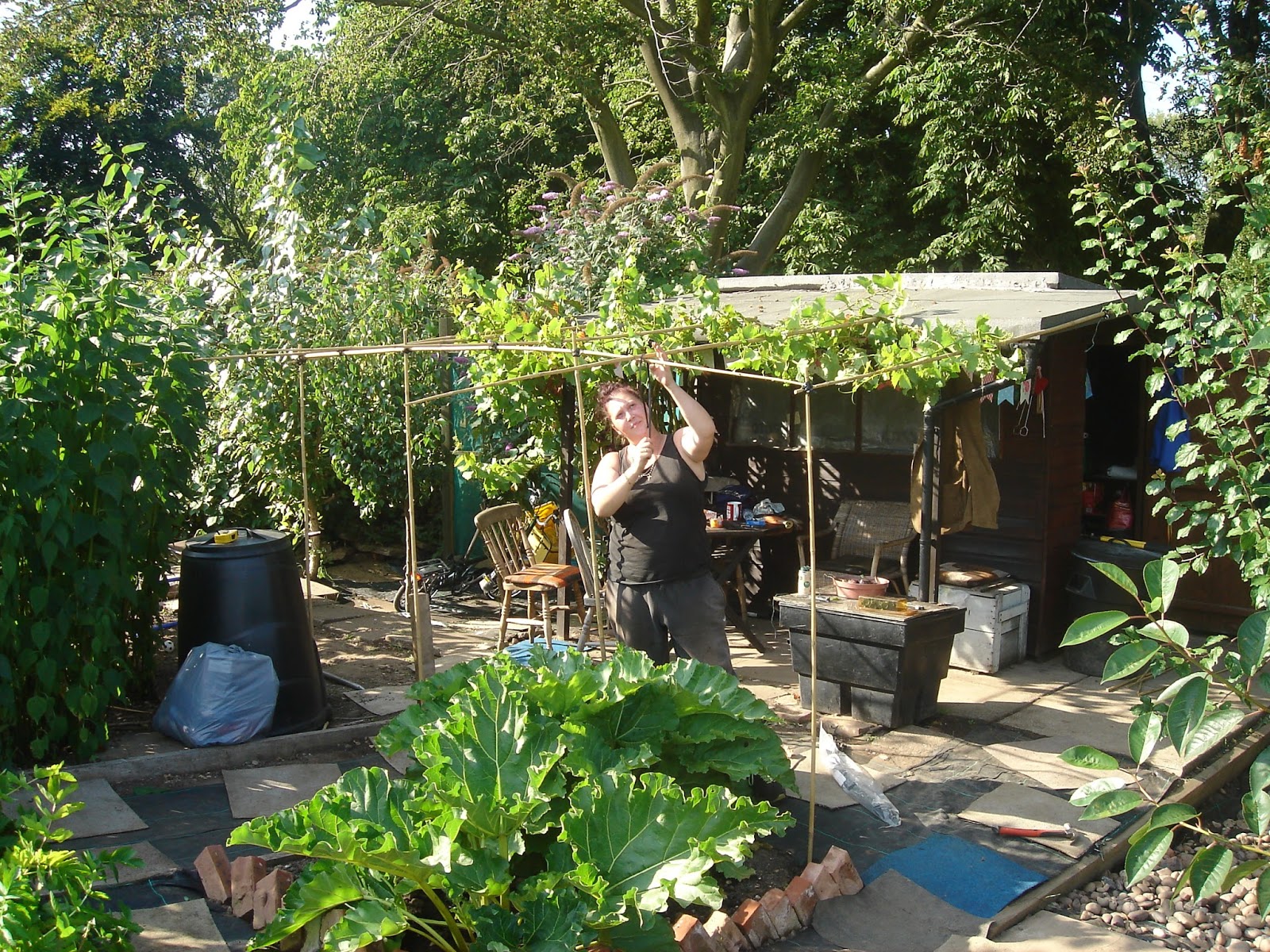


...and my preoccupation with understanding and trying make compost continues - vigorously. It's in fact wrong to say I'm 'making' compost. I embrace Stanley Whitehead's Gardener's Earth, but learning about the 17th century polymath John Evelyn, I've got a reprint of his essay A Philosophical Discourse of Earth, Relating to the Culture and Improvement of it for Vegetation, and the Propagation of Plants, &c. as it was presented to the Royal Society, April 29. 1675. London: John Martyn 1676.

Like thousands before me I'm inventing my own wheel. Type 'composting' into my search engine I get 14,800,000 hits in .44 seconds. Information about composting is overwhelming.
"Yeah" says Lin "but Google won't give you all those hits!"
They come from academia, through to the experience of single gardeners over the world in myriad languages; on film, scientific papers, text, images, tables... in Greek κοπρόχωμα. My understanding is that for all the interest and popularity of the subject no-one has yet been able to make compost. All they can do is attempt to speed up what has been done by nature since the arrival of organic life on this planet. I've now cracked the challenge of how to get perfect compost. I'll go back five years in a time machine (instruction on making and buying time machines on page 94) and stack up my garden waste; return to the present and my compost will ready and waiting, or perhaps everything has aged 50 years (or whatever), my allotment is a car park and everyone's speaking esperanto...
Compost bays A, B and C on Plot 14

Thursday, 5 February 2015

My plot


'Above all remember; allotment gardening is fun, it's healthy and it's a great way to meet people. So the most important thing is to enjoy your allotment.'
Advice from the Allotments Section at Birmingham City Council suggests it takes 3 years to get a new allotment in order, but that's if you are already skilled and organised.

I and Lin and now my waged help, Winnie, have been digging over and over, weeding, weeding, weeding (dragging out those sinuous creeping white couch grass rhizomes especially)....
Winnie and Simon on Plot 14 (photo: Sue Hall, Winnie's mum)

....laying permanent paths, cutting out and pegging down porous weed control fabric, making temporary paths by moving around stacks of the industrial-grade carpet tiles I picked up for free during a garden clearance for Handsworth Helping Hands. Making separate beds accessible. The plot is just over 200 square meters, but with the shed and paths only half of that area is now working soil.
Potatoes planted in a bed dug over and over, weeded; new topsoil and compost raked in; all easily worked from surrounding paths

I love it. I do. I really do. But this is not a 'working man's' allotment from which i can proudly feed my family - the ideal of small holdings - urban green spaces whose legislative protection grows weaker by the year. Mine is a hobby plot - a word I dislike; a fact I accept, as a man seven generations from the land. My family have been townspeople, even when enjoying life in the country, since my ancestor Samuel Lees in Oldham became an iron master, then cotton mill owner, in the early years of the Industrial Revolution. True my stepfather could work the ground, handle stock, and grow vegetables in large numbers while my grandmother, Bar, abandoned metropolitan life to start the dairy farm where I was born in March 1942 and spent a lot of my childhood - an idyllic place I first heard described, when I was in my teens, as 'a hobby farm - by my stepfather.
Mill End: Simon on Gypsy, Bar on the haywain
I can't say I'd rather my allotment wasn't just a hobby. That's silly. I don't quite know what I was thinking. I suppose I think of it more as an experiment; a test even.
January 2007 - a picture in The Birmingham Evening Mail "When will the company who bought this green space in Birmingham and built on a third of it lay out the allotments that were part of planning gain deal agreed with Birmingham City Council?"
A hobby is 'a regular activity done for pleasure during one's leisure time'. Campaigning ten years to stop the Victoria Jubilee Allotments from being built over and, after that busy time - lobbying, writing, filming, speaking - getting the opportunity to work this plot, has hardly been a leisured activity. I've never been that keen about dividing activities into ones that are leisure, and one's that aren't. I've a distaste for how that distinction defines 'work'.
Starting on Plot 14 in 2010

I want Plot 14 - one Lin and I chose when the Victoria Jubilee Allotments opened in June 2010 - to prosper. I want it fecund, thriving - a source of pride and good food, I want to agree with the advice that an allotment should be enjoyable.
I've invested money on help, on topsoil, on compost, striving to get the ground closer to how I think it needs to be, and all the time I'm learning, with help from other plot-holders far better than me at growing their own - especially my friends Ziggi with her plot in north London and Vanley with his on the Victoria Jubilee, just a few yards away.
Winter sown broad beans with a sprinkle of potash to rake in
I'm going to make this work. But I'm reminded of Douglas Adam's remark "Flying is learning how to throw yourself at the ground and miss" or Winston Churchill saying 'success involves persevering from one failure to the next', The gardening guide books I read aren't helpful. They begin at a point I'm still striving to reach. They hardly mention soil filled with rubbish, as well as stones, nor do they seem to give much attention to the emotions aroused by the depredations of slugs, onion fly, pigeons, snails (with their exquisite shells I find impossible to crush), and human pilferers - the ones that stole my garlic last year! How I do not envy new plot holders as inexperienced as I, trying to get vegetables to grow on adjoining plots that are like mine was four and half years ago, perhaps worse.
Stones continue to come out of the soil at every dig....

....but they never appear in the books
...and this worthy tutor teaches me more or less nothing about how to dig my plot

I emailed Clive Birch, BDAC, for advice:
Dear Clive.  Happy New Year 2015.  I hope you're well. I've a favour to ask. Since 2010 I have struggled to get my allotment working. You’d not expect less when I’ve invested so much in getting it in the first place. My favour is also a question. We have by all accounts rather uneven topsoil on the VJA. I know that allotments officers on the council were hesitant about accepting the new plots from Persimmon under the S106A of 2004 because the land was not adequately prepared by the developer. Those of us pressing to get the allotments up and running pressed the council to let people start gardening. A minority of plot holders are doing pretty well but all I’ve spoken to admit they’ve had to do a lot of work getting the soil manageable and productive. It is full of stones, bricks, and other debris, as well as chunks of clay with - in some places - ground heavily compressed by building plant machinery. A lot of us have invested in manure, compost and extra topsoil. I would - now that I am beginning to feel more in control - be so grateful for someone coming to look at the soil on my plot to give me an assessment and tell me the best way to continue improving it. All the guide books speak of adding nutrients and getting a balance between acid and alkali, but I’m in the dark as to the starting point on soil composition. It would be great if someone with much more experience and knowledge than I could drop over and give my plot soil an assessment and diagnosis with suggestions as to the what would now be the best treatment to get healthy crops. Would this be possible? Best wishes Simon 
Simon. An experienced allotment holder visited your site and had a good look round, concentrating on the soil structure. Some plots were thriving, some were struggling and some were vacant and overgrown - the overgrown plots obviously were able to support plant life! You can test the acidity of soil [test kits available at DIY/ Nursery] - often the only balance used is lime for the brassicas. The answer to improving the plot - clear rough debris - stones etc [stones can be buried to provide drainage] Clay - working in compost - leaf mould is one of best ways - over wintering will help here. Adding as much rotted compost/manure is great. Leave on surface for a while then dig in [note some crops do not like fresh manure!] You could import topsoil but beware it could include weeds etc even Japanese knot weed! Perseverance is needed. Hope this helps. Best wishes, Clive
So really there's almost nothing in that I don't know, except for the hint about brassicas and the use of stones for drainage. Yet I'm grateful for the confirmation. The depth of my ignorance shared with Lin had me putting my seed potatoes under our bed to chit.
"They need the dark" Lin insisted, so under our bed they went.

I checked this up in books and on the internet
"No Linda! They need light not dark!"
Since the only chitting spuds we'd ever seen were the ones that start sprouting in the veg cupboard in the kitchen we'd assumed that darkness was needed. Out came the spuds from under the bed. Now I have them laid out in the conservatory.
A potato from the kitchen cupboard
Seven months ago the plot looked lovely - the greenery of mid-summer covering a multitude of sins. How will it look this summer? Much depends on what i do in the next few weeks.
June 2014


***** ***** *****
That other plot...
"We didn't reach an agreement. It was never on the cards that we would"
Yanis Varoufakis meets Wolfgang Schäuble in Berlin. The first 10 minutes of the clip has journalists and camera-folk preparing to see and hear statements. Then 'the curtain rises'. There they are, by god! Varoufakis has earned a concession before the conversation began. Greece is talking through Varoufakis to the Finance Minister of Germany - not to the Troika who Tsipras told his voters would not be the new Greek government's first port of call after the election. At 23.25 the German turns with courtesy to the Greek who with the journalists has been listening to the most sober and grave re-iteration from Schäuble for the European Project, an address not really to beloved and beleaguered Greece but to a far wider and more fragmented and unreliable audience across our continent.
Aristeidis Metallinos, Ano Korakiana's laic sculptor, depicts the EEC (EOK) as a broody chimaera
In my head there plays as background to this press statement I hear music - the 'Song for the Unification of Europe' composed by Zbigniew Preisner, sung in Greek by Elżbieta Towarnicka - an abridged version of 1 Corinthians:13, from the soundtrack of Krzysztof Kieślowski film 'Bleu'. Varoufakis is also in government but he speaks eloquently, poetically, to the people of Germany; pleads to them for their support in fighting the threat of fascism in Greece. I feel I am watching two statesmen at work; two men who know their trade.

I had an exchange with Richard Pine a few days ago. He wrote in The Irish Times
Tsipras appears to be naively idealistic, innocent, ingenuous and transparent, but he needs to be secretive, cunning and dishonest to succeed in the minefield he has created. As Maurice Manning once said of Garret FitzGerald, it is difficult to trust someone who pours a glass of wine without reading the label on the bottle. Tsipras wants to do the impossible, but if he is to succeed as a political leader he must learn the art of the possible and acquire the killer instinct.
So Richard suggests Tsipras must imitate the Greek hero Odysseus - famous for escaping terrible dangers more through cunning than face-to-face combat. My email:
Richard. I recall writing this in a paper published in the 90s about political skill in civil servants and politicians.....The constant negotiation of this moral minefield is part of life and certainly part of government. An additional layer of complexity is added to these circumstances by the fact that in families, as indeed in government, many people recognise the presence of these dynamics and may actually impart “in confidence”, something intended to be passed on. A process of negotiation is occurring where one person appears to be trusting another to risk being untrustworthy. The novelist Iain McEwan describes public figures who move around in this moral maze by navigating the complicated channels that run between truth and lying: 'with sure instincts while retaining a large measure of dignity. Only occasionally, as a consequence of tactical error, was it necessary to lie significantly, or tell an important truth. Mostly it was sure-footed scampering between the two extremes. Wasn’t the interior life much the same?’  (McEwan 1988:182)....McEwan captures the moral nimbleness that accompanies grown-up behaviour - public and private - where corruption and probity are proximate rather than polar and, where rules are at best casuitical; maintaining integrity requires wit.  What I struck me about Iain McEwan’s words is that self-query 'Wasn’t the interior life much the same?’  My tolerance of politicians about whom you are much more judgemental (I think) is that politics - certainly the politics of government - is that it’s so like my internal life and I suggest I’m not alone in that. Best, Simon 
Richard: You mean you lie to yourself and let not your right hand know....? 
Simon: That’s what Iain McEwan is suggesting. I care about the environment and do many things that harm it. I shop at supermarkets while praising the survival of small shops. I think lascivious thoughts about other women. The list of my moral inconsistencies is endless and I don’t let them worry me or lessen my expressions of concern about the sins of my fellows.
My interior life is a parliament of debate with every now and then a rare internal argument from which the whips are withdrawn and I have a vote in which I must truly interrogate my conscience - but most of the time I’m bladerunning ‘the complicated channels that run between truth and lying”.
I think you have so hit the spot when saying how Tspiras must be. The killer instinct etc. Do you think he has it? Could he grow into it? Is his partner going to help? Peristera Batziaka. ‘Tough cookie”? This is riveting. S 
R: I don't have that problem/advantage. I never argue or debate with myself. I am conscience-free when I wake, and the same when I go to sleep. Thanks for the Batziaka article - interesting that "peristera" means "pigeon" or "turtle-dove". R 
S: 'Behold, I send you forth as sheep in the midst of wolves: be ye therefore wise as serpents, and harmless as doves.' Matt 10:16 "I never argue or debate with myself. I am conscience-free when I wake, and the same when I go to sleep”. People will make pilgrimages to seek your advice - the sage of Perithia. You make me think of that other writer Nikos Kazantzakis “I hope nothing. I fear nothing. I am free. This is true happiness: to have no ambition and to work like a horse as if you had every ambition. To live far from men, not to need them and yet to love them. To have the stars above, the land to your left and the sea to your right and to realise of a sudden that in your heart, life has accomplished its final miracle: it has become a fairy tale.”  S
Draw me a picture....

In other words just 10.6% of the €254 billion funds 'state operating needs'


Saturday, 21 December 2013

Compost

Worms at work: compost - το κοπρόχωμα για το κήπο - coming along nicely in our garden
Compost lunacy! I've learned from various sources in our local council that staff have been told to stop composting fallen leaves in city parks as a rich source of humus for suppressing weeds and enriching soil, with occasional surplus being brought to nearby allotments. In future all a park's potential compost will be taken to the local waste depot...
Denise and I take green waste we've collected in the streets of Handsworth to Holford Drive - but we'd hoped to take it to our local park in future
...often several miles away, where Birmingham City Council pays a private contractor to remove it. That company will compost the leaves that fall in the parks. Green waste previously generated and used as compost inside a specific park will now have to be removed from that park purchased back from the contractor. This probably means that the council will not pay for any compost at all. We shall live with the consequence of that interruption of a natural and local cycle; from green leaves on trees and shrubs and plants, and grass cuttings, to the rich fertiliser that helps them thrive the following year. I avow the verity of this daft logic. I learned about this accountant-driven erosion of the principles of sustainability, after, I, as a representative of the committee of Handsworth Helping Hands, was encouraged to explore our voluntary group's involvement in 'community composting'. We're anticipating more abandoned domestic green waste now that citizens must pay £35 per annum to continue a service previously covered by their council tax.
Green waste put out on a non-collection day - typical of what we can expect in greater abundance next year

*** *** ***
Love is powerful; so's hate. Both use the sleep of reason to create seamless narratives.
Love conquers all because it’s invulnerable to reasoned rebuttal; so's hate. Beware of the self-serving story that contains no doubt – take the film by Jim Bruce ‘Money for nothing – Inside the Federal Reserve’ which blames the sub-prime mortgage crisis on government, most specifically the US Federal Reserve system. Don’t I recall Hurricane Katrina and its aftermath, in failed government, as the catastrophe's precipitant?
An expert on the history of the Federal Reserve (a mechanism explained to me two years ago by my old friend and guest in Ano Korakiana, Tony Scoville - "oh that you had such a mechanism in Europe!") wrote a piece - 'They Hate the Fed'. Roger Lowenstein says the film espouses the grand villain theory of catastrophe, rather than a less gripping story of many causes (Once upon a time vs. once upon several occasions?), indicting Alan Greenspan and Ben Bernanke...
Ben Bernanke
 ...for the Fed’s policy of low interest rates which induced speculation. Don’t blame liar loans and reckless traders, argues the carefully edited documentary, they were merely responding rationally to Fed policy. The film adroitly rejigs a private market failure and presents it - seamlessly - as a failure of government. More likely, the disastrous rescue operations that followed Katrina were informed by a Darwinian retreat from duties of central government to intervene decisively on behalf of vulnerable citizens of New Orleans after the great tempest. Government action to ban risky mortgages might have averted the sub-prime mortgage crisis – ‘in other words’ writes Lowenstein ‘the problem wasn’t too much government, it was too little; regulation was woefully deficient’. I’d agree, but the real interest of this story is its demonstration of seamless narratives to propogate a ‘grand villain’ ideology. This would apply at any extreme of the political spectrum. In this case it’s a shrewd way to dismiss complexity, to dismiss the notion that the economic catastrophe we now experience and for whom I have to resist the temptation to seek one feckless clump of rogues had many causes including Lowenstein’s list:
‘faulty incentives that rewarded Wall Street traders for buying unsound loans…incompetence or corruption at rating agencies that endorsed mortgage securities as safe investments…abject failure to regulate new mortgages at various levels of government, including the Fed…reckless behaviour by Fannie Mae and Freddie Mac, the government sponsored housing agencies…low interest rates set by the Fed, that arguably motivated investors to seek the higher yields of mortgage products.’ (Roger Lowenstein 'They Hate the Fed' NYRB 21/11/13 pp.29-30)
*** *** ***
There are enough children in the village now for a decision to have a second kindergarten teacher.

Χριστούγεννα στο νηπιαγωγείο - Christmas at preschool in Ano Korakiana
Το μουσικό παραμύθι με τίτλο «Η αγέλαστη Πολιτεία» αναπαράστησαν απόψε οι μικροί μαθητές και μαθήτριες του Νηπιαγωγείου Κορακιάνας, με την καθοδήγηση της νηπιαγωγού τους.Η αίθουσα γέμισε από γονείς και συγγενείς (κυρίως παππούδες και γιαγιάδες) των μικρών παιδιών, που μεταμφιεσμένα σε καλικάντζαρους και παπαρούνες, σύμφωνα με τις απαιτήσεις του παραμυθιού τα «έδωσαν όλα». Στο τέλος της εκδήλωσης, ο Άγιος Βασίλης μοίρασε δώρα στα παιδιά, ενώ τον κόσμο ανέμενε ένας μικρός μπουφές που ετοιμάστηκε από τις μητέρες των μικρών μαθητών…
nipagogeio_christ2013a.jpg

Ο σχετικά μεγάλος αριθμός παιδιών και η αναβάθμιση του Νηπιαγωγείου σε ολοήμερο (από τις αρχές του νέου έτους αναμένεται να προστεθεί και δεύτερη νηπιαγωγός), σε συνδιασμό με την ποιότητα των εκπαιδευτών-νηπιαγωγών (σημερινών και προγενέστερων), πιστεύουμε ότι θα παγιώσει ένα καλό επίπεδο για το μέλλον…
(My translation) The small pupils of Kindergarten Korakiana enact the musical tale The unsmiling State* tonight - 20.12.13.. Our kindergarten room was filled with the parents and relatives (mostly grandparents) of the young children, who, disguised as goblins and poppies "gave all". At the end of the tale, Santa Claus distributed gifts to the children, while everyone looked forward to a small buffet prepared by the mothers of the young pupils...The relative numbers of children is bringing our village an upgrade to an all-day kindergarten (from the start of the new year we expect a second kindergarten teacher). This, combined with the quality of kindergarten teachers (current and past),, promises well, we believe, for the future.
*A story and play by Haris and Panos Katsimiha just republished...Χάρης και Πάνος Κατσιμίχας: Η Αγέλαστη Πολιτεία...


Kόβε πριονάκι μου, η Αγέλαστη Πολιτεία Κατσιμιχα.wmv


I wish I could tell this story to Oliver but he's more into touching and looking than following a narrative in any language. He and I play with books but I look forward to when we can read together.
Oliver with us for the afternoon: the high chair was my mum's. mine, our childrens' and now our grandson's
Days merge into days. It's mid-Winter. The longest night. Greece seems as far as I want it to be; as I want her to be always, as far as when, on my own, I first travelled there by train fifty five years ago; four days by train with three days in Venice on the way, then on through the Balkans via Belgrade in the middle of the night to Thessaloniki, Larisa and Athens in the morning - following the historical routes on the map I went on a standard train from London to Paris. I must have taken the métro from Gare du Nord to Gare de Lyon where, around midnight, I caught the Simplon-Orient Express. I'd still travel that way had not air travel ravaged the railway. In 1957 train travel was so normal, it seemed effortless, yet exciting. From Venice I took a standard train through what was still, and for a good long time yet, Yugoslavia, travelling via Belgrade to Athens - a two day journey. Such a travelling adventure is impossible today. Even were I able to buy tickets for the heritage version of a journey on the Simplon-Orient Express, it's the last thing I'd desire.

I freely roamed the centre of Athens returning to my family staying in Kolonaki, I living in a single bed flat loaned by a Greek cousin for a two week stay engraved in memory...
Ναός του Ολυμπίου Διός: I still have the 35mm Kodak camera I used to take this picture in April 1957

*** *** ***
Birmingham's canals are my favourite routes.
The Birmingham Mainline - σε όλη τη διαδρομή προς την Ελλάδα;

How wonderful if there were a waterway with a tow path, but for the channel at Dover, that stretches to the Black Forest to join the great Danube  - the Donau, Dunaj, Duna, Dunav, turning south somewhere before it becomes the Dunǎrea, and my route drives through Bulgaria southward to the Aegean. Our canals wind far and wide. I use a tiny section for my journey's in and out of the centre of Birmingham. Oscar and I enjoy them as, carried to the towpath in the basket on the front of my Brompton, he can run with me clear of traffic danger. The other evening after a visit to the Christmas market to enjoy a mulled cider and a lemon and sugar crêpe, I headed down to the Birmingham mainline that runs westward from the city beside the west coast railway and city trains to Wolverhampton. The wind was blowing wet and almost warm. Well clothed against the driven rain I sped through a succession of long puddles, the ruffled surface of the canal reflecting yellow lights from flats and street...
Vincent Street bridge on the Birmingham Mainline canal

...until under the Ladywood Middleway dual carriageway my way turns darker, Oscar, a dashing smudge in the gloom, now and then a lighted train rushing by in and out of the city. When I'm on one of those trains I peer down through my window watching for a version of myself pedalling below, getting dressed for cycling when I step onto the platform at New Street, ready to head home on the route I've been scanning from the train.
Earlier in the week I was again in London delivering Christmas presents for relatives in the middle of town gazing like a tourist at Katharina Fritsch's blue cockerel on the fourth plinth in Trafalgar Square...

...and on Pall Mall - sign of the times - two of the once cherished Gilbert Scott phone boxes - littered, damaged and disused; an optimistic ad for the services of a dominatrix; unrecognised by a generation unfamiliar with tart-cards or fixed phones.
Phone boxes on Pall Mall
*** *** ***
At home I'm making a present for Oliver, adapting a small bedside locker to make it into a cooker...
I got all the bits and pieces from a new ironmonger on Lozell's Road, most of the small items likes hinges, catches, nuts and bolts difficult to find outside a big-box suburban DIY store.

Lin at the kitchen table is surrounded by papers as she finishes our tax returns on-line as I feed her receipts for sundry paid activities in 2012-13.

Back numbers

Simon Baddeley