Total Pageviews

Showing posts with label parsnips. Show all posts

Sunday, 9 August 2015

'Born in debt'

'The compromise to save the nation' Greek cartoon 1893
My brother George Pericles B sent me this cartoon on Facebook. Nancy Katsalis and Aleko Damaskinos sent me translations of the old Greek. George thought the bemedalled beribboned figure on the right represented Germany.
"Nothing changes, eh?" Not quite so. I think it's Russia.
Aristeidis Metallinos, laic sculptor of Ano Korakiana, 'For faith and country' 1981 (Cat 118, marble relief 40 x 59)

I've been told this. I've read it, over and over; that Modern Greece, founded in 1828, was "born in debt". Yet most debates, interviews, editorials and op-eds I've read and heard and watched in recent years seem informed only by events of the 15 years since Greece joined the eurozone, rather than by those of the preceding 127 years.
Hellenic Parliament Monday 30 Oct 1893 Charilaos Trikoupis “Unfortunately, my dearest gentlemen, we went bankrupt.” 

In 1893 - date of the cartoon - the government of Charilaos Trikoupis declared bankruptcy. In return for debt relief, partial control was imposed by Greece's creditors - France, the Netherlands, Russia and Britain; all eschewing interference in the cat's cradle of Greece's internal finances. The government, over half of whose revenue, in 1893, went to service loans, was, as everyone knows, beset by clientelism - a complicated and deeply embedded part of Greek society....
Heinz Richter in The Globalist, June 2015: Unless one understands the history and the manifold ways in which the clientelistic system has metastasized, one has no chance of improving Greece’s prospects. Alas, most Europeans do not understand the phenomenon of clientelism and react in a peculiar way – such as the oft-made claim of 'lazy' Greeks.
Come to think of it, inside the EU, it is only the Austrians who – due to their past as a Balkan power – have some understanding of what’s really going on inside Greece’s structures. The other EU nations simply project European political ideas and ethical principles onto Greece and the other Balkan countries. They lack the understanding that these ideas and principles - noble and/or commonsensical as they sound - are alien to the society and the political culture of Greece.
After the national bankruptcy of 1893 - Greece's third - fruitless negotiations continued for years. In the cartoon the sack born by Hellas bears the words:
The compromise to save the nation - 99% with an eternal monopoly under foreign control of markets in tobacco, raisins, bread, wine, meat, olive oil.
and on the basket:
Loan 850.000.000 (drachma)
Those products listed are the pre-industrial exports upon which the Greek economy largely depended from the 1850s.
19th century Greek government had a weak financial system - persistent budget deficits; high debt to GDP ratio. Lenders - France, the Netherlands, Russia and Britain - demanded that Greece make, as a condition for loans, major institutional changes in her public finances - changes relating to the power, the credibility and the bureaucratic capacity to tax sufficiently to cover the government's expenditures and undertake budget reform. Plus ça change..in Greek <Όσο πιο πολύ αλλάζουν τα πράγματα, τόσο πιο πολύ μένουν ίδια>
Gerassimos Notaras, head archivist, historical archive, National Bank of Greece said...
From the beginning, our state had no other choice than to live on credit. We were born in debt.
A wise writer, Athina Rachel Tsangari, in the Greek film Attenberg – which Lin and I liked a lot, watching it twice in as many weeks – says, through the mouth of one of its main characters, the architect Spiro, as he gazes over an ekistical Doxiades settlement laid out in Euboea, muttering to his daughter...
“bourgeois arrogance…especially for a country that skipped the industrial age altogether…from shepherds to bulldozers…from bulldozers to mines, and from mines, straight to petit-bourgeois hysteria…we built an industrial colony on top of sheep pens and thought we were making a revolution.”
Tsipras as Sisyphus ~ David Simonds The Observer 1/2/15


Half the time Greece has been a nation it has been in default - five times since 1800 - in 1826 (prior to independent in 1829), in 1843, 1860, 1893, 1932 and now.
The first default was on the loans that financing the independence movement. Much of that money went into the pockets of middleman between Greece and London where the loan was floated. The 1843 default arose from spending an international loan raised in 1832. In 1860 British and French forces occupied Piraeus to enforce repayment of the 1843 loan, causing a default that went on being negotiated until 1878. In 1893 Greece was bailed out under strict conditions imposed by an International Financial Control Commission also called the International Committee for Greek Debt Management...
From April 1898 the International Financial Control Commission (IFCC) was established in Athens; ...initially termed International Control Commission, but despite the change of name it was known as 'Control'. The commission consisted of six members, representatives of the Great Powers (now including an expansionist Germany)...revenues from the monopoly of salt, oil, matches, decks (sic), cigarette paper, tobacco, paper stamps and the tariffs of the port of Piraeus passed under its control. These and other revenues, if the need arose, were disposed of to serve the country's loan obligations, while the Commission had the capacity to intervene in various sectors of the civil services in order to ensure the sufficient and, in time, payment of economic obligations to creditors...
It was during this period that Greece had both joined - in 1867 - and been expelled - in 1908 - from The Latin Monetary Union - an entity I've only just learned about. The Greek state has been in default for the following periods 1826–1842, 1843–1859, 1860–1878, 1894–1897, 1932–1964, and 2010 to now. It makes the present seem a small space tied in my impressions to the tiny duration of my association with Greece - since my first visit in 1957.
Χοινὸν τῶν Ἀχαιῶν 500 -146 BCE - a classical economic, monetary and political union

In trying to understand what's happening in Greece I have to know more history. The present is always confusing - the experience of an intelligent ant in the middle of a winding human footpath. Rise above the grass and gravel to make out the path - its scale and direction - thing become clearer. Grasping this picture of Greece - born in debt - and I'm clearer why Alexis Tsipras hasn't resigned, any more than did other Hellenic PM's, after declaring defeat, default and bankruptcy. I realise too that I've so little understanding of the different positions and trajectories of the EU leaders who stand together in opposing Greece and overwhelming SYRIZA, the 'big idea' of this quite new Coalition of the Radical Left, after its election victory in January - so few months ago. Prof Jan-Werner Müller, in the August London Review of Books, illuminates my understanding of the political leadership of the EU. Rule-Breaking:
Never before have the struggles among national elites been as visible to the public as they were in the early weeks of this summer, when Greece almost left – or was made to leave – the Eurozone. Never before has an assertion of national popular will, as expressed in the Greek referendum of 5 July, been flouted so thoroughly and so quickly by the enforcers of European economic orthodoxy. (There was an interval of two and a half years between the French and Dutch ‘No’ to the EU treaty in the spring of 2005 and the adoption of the Lisbon Treaty, which retained most of the constitution the French and Dutch had rejected, in December 2007.) Never before have the flaws of the Eurozone been so clearly exposed. We can expect more Greek drama before too long...
In August 2015, Greece is once again under strict foreign scrutiny, its government conceding authority over much of Greek policymaking to the eurozone, signing up to a 29 page Memorandum of Understanding (MoU) for a three-year ESM (Economic stability mechanism) programme to establish a system of quarterly reviews of the reforms by the troika of creditors – the European commission, the European Central Bank (ECB) and the International Monetary Fund (IMF).
Martin Rowson in The Guardian 20 Feb 2015

The government commits to consult and agree with the European commission, the European Central Bank and the International Monetary Fund on all actions relevant for the achievement of the objectives of the memorandum of understanding before these are finalised and legally adopted. (p.1 - 11/8/15)
Meanwhile the summer fires of Greece seem no longer in the news. Tsipras remains popular though once the third MoU starts to bite he will call a general election - before October tho' there doesn't have to be one until 2019. Refugees from Syria crowd Kos.


17th August 2015 - Varoufakis on the Third Memorandum of Understanding - the MoU annotated by Varoufakis....
Everybody knows that the dice are loaded 
Everybody rolls with their fingers crossed 
Everybody knows that the war is over 
Everybody knows the good guys lost Everybody knows the fight was fixed The poor stay poor, the rich get rich That's how it goes Everybody knows ...
*** *** ***
A lesson? An explanation...certainly worth watching - posted 31 Aug, an interview posted on Youtube 28th Aug.  [Words unclear at 15.23 - it goes "cut ELA (emergency liquidity assistance) to our banks" and the Netherland FinMin who's the Eurogroup chairman  named at 15.31. It's Dijsselbloem). Varoufakis says Wolfgang Schäuble wanted Greece out of the EU; that getting Greece out of the Eurozone would be good for Europe; good for Greece... I'm curious as to the membership of the FinMin's Plan B Working Group - source of 'shock horror' reactions in some quarters because it entailed a quite ingenious invention for issuing virtual scrip to enable the Greek government to continue cash transactions on the internet despite the European Central Bank being required by EU FinMins to cut the liquidity of Greek banks.
****
A case for Handsworth Helping Hands? Not really.

More like Handsworth people at their best. A man prone in the Food Bazaar carpark at the junction of Heathfield and Villa Road. No. He hadn't 'fallen among thieves' but in a short time (at least while I was there) there were three Samaritans - an Englishman an Irishman and a West Indian lady in different ways giving succour. One phoned an ambulance, one talked with him about the 'dangers of the drink', and another got his name and where he was from - citizen of a city of Eastern Europe - and we discussed if he was drunk or on medication or both, and then, in minutes, two Asian paramedics arrived and gently helped him into their ambulance...
"Come along my friend"
"Bye bye" we said "Good luck!" as our man disappeared into the friendly clinical interior of the ambulance.
We three introduced ourselves to one another; shook hands; went about our daily business. I've seen this kind of thing on many occasions in the forty years I've lived in Handsworth and Lozells.
*** *** ***
My parsnips give me pleasure - their germinating, growing, harvesting, preparing and eating...their weight, their feel, their taste and smell.
Lin made us a delectable parsnip soup "It tastes of Christmas"


I have been so delighted at growing things on my allotment. My confidence increases with my knowledge. I learn. In July and August I've planted aubergines from seedlings, turnips, beetroot and swedes from seed, raspberries, tayberries, gooseberries - fruit plants bought for a bargain from Aldi, tomatoes given by a neighbouring gardener. My vine thrives; next year I may assay a trellis for it. Winter cabbage seeds are in the ground.
Oliver helps plant Winter Cabbage seeds

Aubergines - at risk from slugs hence the pellets
Beetroots - variable success

Five summer Raspberries, two Tayberries, one autumn Raspberry, one Gooseberry - a fruit cage will follow

Swedes will have to be thinned

A neighbour gave me nine tomato plants
My hardy black grape planted in August 2011 now promises a rich crop, as well as shading the shed veranda

...and vital to all this, my friend Winnie who grafts on the plot and does more housekeeping inside its 200 square metres than I. Together we plan the plot...
Working - Winnie, Ollie and Dennis

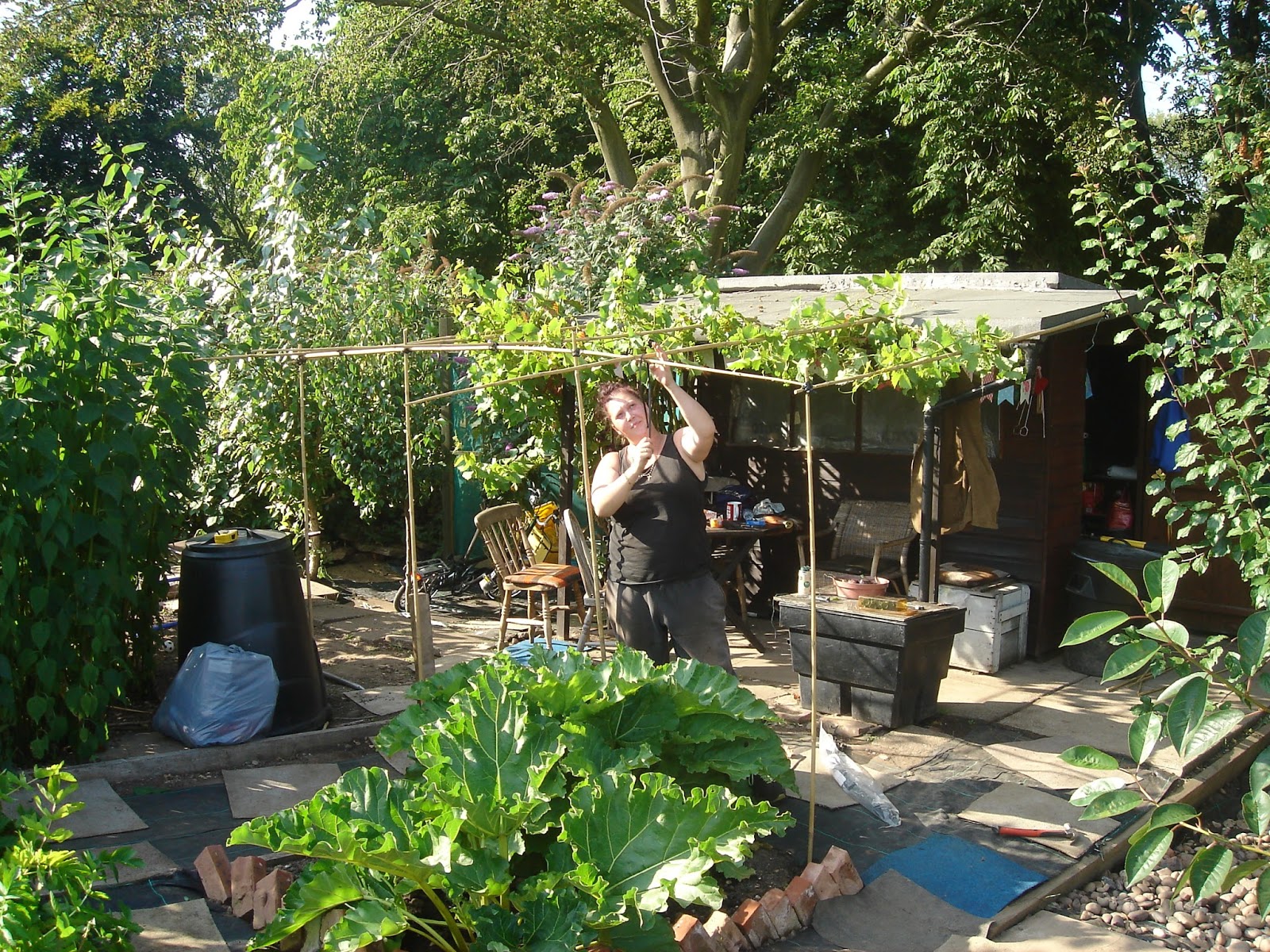
...adding, to support the spreading black grape vine, a trellis in front of the shed...


...and my preoccupation with understanding and trying make compost continues - vigorously. It's in fact wrong to say I'm 'making' compost. I embrace Stanley Whitehead's Gardener's Earth, but learning about the 17th century polymath John Evelyn, I've got a reprint of his essay A Philosophical Discourse of Earth, Relating to the Culture and Improvement of it for Vegetation, and the Propagation of Plants, &c. as it was presented to the Royal Society, April 29. 1675. London: John Martyn 1676.

Like thousands before me I'm inventing my own wheel. Type 'composting' into my search engine I get 14,800,000 hits in .44 seconds. Information about composting is overwhelming.
"Yeah" says Lin "but Google won't give you all those hits!"
They come from academia, through to the experience of single gardeners over the world in myriad languages; on film, scientific papers, text, images, tables... in Greek κοπρόχωμα. My understanding is that for all the interest and popularity of the subject no-one has yet been able to make compost. All they can do is attempt to speed up what has been done by nature since the arrival of organic life on this planet. I've now cracked the challenge of how to get perfect compost. I'll go back five years in a time machine (instruction on making and buying time machines on page 94) and stack up my garden waste; return to the present and my compost will ready and waiting, or perhaps everything has aged 50 years (or whatever), my allotment is a car park and everyone's speaking esperanto...
Compost bays A, B and C on Plot 14

Saturday, 27 June 2015

The Greek Crisis

A few days ago Oliver and Hannah were staying with their other grandmother, Christine. She introduced them to kite flying...
Oliver and Hannah (Photo: Amy Hollier)
...while yesterday Lin and I were entertaining them.
Hannah sits in the high chair that was my mother's, mine, and our childrens'


This morning I walked with Oscar and Oliver to the allotment and worked through the morning with Winnie, watering and weeding...
Oscar and Oliver ~ the flag was described recently as 'an ode' to a famous photograph taken 45 years ago


...cropping more broad beans and a first batch of peas, shelling them at home...


A sage item from the minutes of a recent VJA committee:
Flags. – Simon has a union jack flag on his allotment and it was questioned whether this was appropriate as it has negative connotations and could give the wrong impression of the allotment. The flag in question is an ode to a photograph taken close to the allotments that has cultural significance and is therefore an artistic and cultural expression.
Winford Fagan with flag, Handsworth Park by Vanley Burke 1970 - 1979 (c.)
Celebrating a rainy Diamond Jubilee on the Victoria Jubilee Allotments

Yesterday Amy brought Liz to the plot. She'd not seen it for two years.
"Wow!" she said "You've done good"
Liz can't walk anywhere for more than five minutes...complications with pregnancy means taking care moving about. Baby due in two months.
Liz visits the shed on Plot 14


** *** ***
Yannis Varoufakis, Greek Finance Minister, wrote recently, about a book he had just written 'talking to my daughter about the economy'...
Yanis Varoufakis, Finance Minister of Greece "Democracy did not have a good day in yesterday’s Eurogroup meeting"

...a book about 'how economic power has emerged from the shadows of political and military might before gradually taking over human societies. The narrative combines history, literature, science fiction films and down-to-earth economic analysis to impress upon teenagers, and various beginners, that economics is an epic drama. Rather than a technical science, it is a battleground on which armies of ideas clash mercilessly and where concepts with a capacity to move mountains emerge; and all that in a war for our own allegiances which are being fought over by powerful interests usually at odds with ours...That, looked at through a piercing eye, behind every economic notion, every theory, there lurks a fascinating debate about human anxieties that only poets, dramatists and musicians have managed to address with any degree of efficiency.'


As it happened – Yanis Varoufakis’ intervention during the 27th June 2015 Eurogroup Meeting
posted on 28th June 2015 The Eurogroup Meeting of 27th June 2015 will not go down as a proud moment in Europe’s history. Ministers turned down the Greek government’s request that the Greek people should be granted a single week during which to deliver a Yes or No answer to the institutions’ proposals – proposals crucial for Greece’s future in the Eurozone...

Greek Lawmakers Approve Decision to Hold Referendum
by Stelios Bouras, Wall Street Journal June 27, 2015 Greek lawmakers gave the green light early Sunday to a proposal by the coalition government to hold a referendum on whether austerity measures demanded by lenders in exchange for further aid should be accepted by the crisis-hit nation...

Greece Will Close Banks to Stem Flood of Withdrawals
by Landon Thomas Jr. and Niki Kitsantonis The New York Times 28 June 2015 ATHENS — Greece will keep its banks closed on Monday and place restrictions on the withdrawal and transfer of money, Prime Minister Alexis Tsipras said in a televised address on Sunday night, as Athens tries to avert a financial collapse....

Travel to Greece: Advice for those travelling to Greece
by Simon Calder, The Independent posted Tuesday 16 June, 2015 Many concerned prospective holidaymakers have got in touch this week as Greece’s financial crisis deepens. A worrying time for the Greeks – but should holidaymakers worry?...
by Viktoria Dendrinou & Gabriele Steinhauser Wall Street Journal June 27, 2015  The eurozone rejected a Greek request for a one-month extension to its bailout Saturday, plunging the country into a period of high uncertainty and raising concerns about wider financial fallout when markets open on Monday....
by Alex Barker Financial Times June 27, 2015 Greek banks are on the edge of failure. Deposit flight is accelerating and Greece’s funding options are running out. Every euro withdrawn from cash machines is backed by emergency funding from the European Central Bank. Without an extension to Greece’s bailout, these ECB emergency loans are in doubt. Alexis Tsipras, the Greek prime minister, has 
Reuters June 27, 2015 Greek Prime Minister Alexis Tsipras called a referendum on austerity demands from foreign creditors on Saturday, rejecting an "ultimatum" from lenders and putting a deal that could determine Greece's future in Europe to a risky popular vote...
Associated Press June 27, 2015 German Chancellor Angela Merkel has emerged undamaged from the global financial crisis, European bailouts, an astonishing U-turn on nuclear power and the crisis over Ukraine. Now, with the future of efforts to resolve Greece's fiscal woes up in the air, the long-serving leader looks well-placed to emerge strong even if they fail.
by Hugo Dixon Reuters June 27, 2015 Alexis Tsipras has taken a massive gamble on Greece’s future. By calling a referendum on whether to accept the creditors’ latest offer of cash in return for unpopular reforms, the Greek prime minister is offering the people a choice between the bad and the extremely bad. Meanwhile, the world may be about to face the biggest default in history... 
by Peter Spiegel Financial Times June 26, 2015 Alexis Tsipras, the Greek prime minister, has announced a national referendum on whether his country should agree to creditors’ demands that would release desperately-needed bailout aid to avoid national bankruptcy. In a televised address to the nation after a late-night meeting of his cabinet, Mr Tsipras announced that the plebiscite would be.... 

*** *** ***
'Ευρωπαϊκή Οικονομική Κοινότητα ~ The European Union' 1980 by Aristeidis Metallinos
In the week before we last left Ano Korakiana, Linda, I and Angeliki Metallinos, completed a list of nearly all her grandfather's sculptures and marble reliefs. After three and half hours we had a re-numbered list based on the year of the carving, with dimensions, brief description, and whether in local stone or in marble from Kozani...
Aristeidis Metallinos (1908-1987) catalogue draft
...giving us the raw material for a catalogue which, talking to several gallery curators recently, I believe should be created as a website. I'm not dismissing a hard copy. I'm recognising that having information about Aristeidis Metallinos on the web is a better goal. From such a site, easy to edit, different catalogues with varying emphases can be made into temporary hard texts. The web option, avoiding colour or even half-tone printing is also a deal less costly.  I am still exploring who should write about the laic sculptor. On 21st June, I was excited to receive a letter from the scholar - Dr. Eurydice Antzoulatou-Retsila, since 2009 professor at the School of Cultural Studies at the University of Peloponnese in Kalamata - who had first written about Metallinos in 1985, when he was still alive:
Dear Simon.
At last I can communicate with you, because I had terrible problems with my computer all this period, being afraid that I had lost all my archives, but finally all has been arranged well.
So, let me first thank you deeply for your interest in the work of Metallinos. I was feeling the same when in 1982 I had discovered him and I had faced all negative attitudes from all parts of communities in Corfu. But I insisted and I wrote my article then . My husband , now, says that nothing goes in vain and he is very glad with your initiative , because he, himself ( as artist, he is film director) had believed in this work.
Perhaps my interest those days was founded in my work as curator at the National Museum of Greek Folk Art (in Athens) and my interest in what is humble and simple. After all, this had been my first speciality (history archaeology, art focused on Greek folk art, my PhD dissertation was on the wedding crowns of modern Greece, those created in gold and silver and kept in local churches or in museums).
I will be very glad indeed to contribute in the volume you are preparing and actually I am planning to visit Corfu again in September to meet with my old friends there (I was professor of museum studies and cultural management at the Ionian University there from 1994 to 2009), to start a new research I am planning and of course I will enjoy seeing again the works of Metallinos.
This last period has been very hectic for me, because I am retiring  end of August and lots of things in the administration must be arranged (I am dean since 2011…).
I am planning also my new career  (my third one!!)  in music this time (piano and singing as soprano) and I am really very excited. My first career was as curator at the museum (and also creating lots of museums all over Greece), my second as university professor and now as musician. Not bad for a variety in life !!!
So, dear Simon, thank you again for these wonderful ideas you have, I am sharing your interest and I will be glad to contribute. But the greatest pleasure for me is your interest in Greek things, expressed in this very sensitive way, especially this period, where this country and this society is really in a very bad situation.
Be well, take good care, greetings to Linda and let us try to meet soon
Best,
Eurydice
Plaque on the front of the Aristeidis Metallinos Museum in Ano Korakiana - the year the builder became the sculptor
**** **** ****
The amount of greenery to be salvaged from crops, from neighbouring fallow allotments just scythed - in weeds, pods, tops and hay...all for long term composting...
Windrows raked from the scythings of fallow allotments either side of plot 14

...while the bays by the fence may have produced some humus by this time next year...with one bay providing almost usable soil though full of annual weed seeds.
This bay includes much of the couch grass weeded out over the last year
I've realised my friend Ziggi's point that it's not good just growing stuff, however successfully. You must grow it to eat and ensure that you bring it for cooking by agreement with the cook. Don't just turn up like the 'hunter-gatherer' with a bag of veg and expect Lin to be grateful. Check what's needed. Scarf what's to be cropped into her plans for meals. Allow also for the extra time involved in preparation compared to veg off the supermarket shelf.
Lin didn't ask for these but I needed to do some thinning of the parsnip bed


Once cropped every one of these sweet little parsnips needs to be topped, tailed and scrubbed.

That took me half an hour at the sink, slightly less time than it took me yesterday to shell fresh peas for two, or today, for Lin to shell a saucepan full of broad beans. The same goes for the many small new potatoes that were 'ordered' for a Sunday family supper..
From Amy who brought the cakes to finish the meal: Thanks mummy for cooking dinner for all of us was very yummy and much needed. Liz says thank you too smile emoticon
Et in Arcadia ego 

Friday, 20 March 2015

Work up Bell Hill, Lydbrook

The Rock Cottage restoration project hovered over us for several years. A favourite place reached by walking up a steep path from the middle of Lydbrook, Gloucestershire. The place has been neglected as the children grew older and my parents-in-law found it more and more difficult to climb the narrow path up Bell Hill from the car park below, and Linda and I met Ano Korakiana. Meanwhile, a nice man but, as it turned out, a wholly inadequate builder, subject to excuses about instructions 'lost in translation' made partial improvements which made the place worse. Its neglect hung over us. Then last July, our friends Martin and Sandra met us in Lydbrook. They inspected. Martin wrote later:
Hi both. Glad to hear you're feeling a little better about the task ahead...I must confess I was shocked to see the condition of the Cottage. I always visualise it as it was in May '92 when I did that veranda roof - and I used my motorbike, we lived in Gloucester. It was a glorious summer that year, Sandra would come over in the afternoons (after work) and sunbathe in the back garden. The ride there in the cool mornings, and the ride back with my jacket tied around my waist because it was so hot - ahhh!, happy days indeed. We'll have to see if we can recapture some of that. Martin X 
No builder or decorator could have been expected to achieve what our friends have, treating their work, mainly carried out by their son Adam and two other young men who work for Martin's company - work for which we paid - but also by Martin and Sandra who except for material have worked on the cottage for free. First, back in August of 2014, a pile of building rubbish and rubble left in the overgrown garden was barrowed or carried away. Phil from Lydbrook Stores gave permission for us to place a large skip where the path met the road. Adam and his mate Jack filled it over a weekend. Timber for logs was piled in the garden. Where, already cut, it was stacked under the lean to at the south end of the cottage. Foliage and other pieces of rotting wood were heaped for burning. Then work began on the interior - first the kitchen (transported from Amy's and Guy's home in Birmingham after new building there( and then the bathroom. The old bath was rescued from the garden, re-plumbed and combined with a shower.


Walls were plastered; stonework cleaned up and repointed, and two walls at the north end of the house were dry lined. Lin and I would go down now and then to see the place 'coming along'. Martin sent me conscientious costings for materials and the lad's labour. I'd send needed cash on-line. We downloaded Martin's photos of the work while we were in Greece in September and October.
Last year - Sandra at work in the hall
The hall being dry walled
The hall this Feb
New catches were fitted to the highly unsatisfactory windows installed by the previous builder which allowed them to open where previously they had merely cantilevered. Leaks around the window frames were made up. Martin would light the wood stove helping dry the place out.
"So much of the problem of damp is being caused by condensation" he said, dismissing prolonged discussion about water ingress via roof and walls that would have had us spending lots of unnecessary money with the previous builder.
Martin set the new windows on a trickle opening to make up for their lack of ventilation strips; set central heating to come on now and then when the house was empty. It began to dry out, helped via the tree clearance I'd paid Dave at Evolution Trees to carry out in January 2014. Lin and I had backed this up with substantial lopping and sawing of the garden trees and shrubs we could get to.
This February - just over half a year later, the body of the restoration was complete.
We went to look at carpets at a Birmingham showroom...
Our grandchildren, Oliver and Hannah play as Amy and Lin discuss carpets for Rock Cottage


Early February, Lin, ferrying her mum between hospital consultants, couldn't come with me. I got permission from the HHH committee to borrow the van in return for a full tank of fuel. With strict instructions from Lin, I took her selected carpets to Lydbrook and carried them up the hill where they were fitted in sitting room, and bedrooms, by Dave, locally recommended. He also laid new lino in the bathroom.
Our bedroom - carpeted and cosy 
Dave at work in Rock Cottage sitting room


Looking out across the Lydbrook valley


Of course there's more to be done; not least recovering the garden, especially the lawn where we lay in summers. For now Lin and I need to re-arrange the furniture stacked upstairs, so we have a couple of working bedrooms and furniture for the sitting room where we eat. The kitchen's fine, but needs a washing machine.
While Dave was fitting carpets Oscar and I set out on an old and familiar walk towards the top of Bell Hill. I wondered if the way had changed; a climb among tall beech trees. So, as we haven't for nearly 10 years, we set out - left turn, up a narrow steep track for 20 yards, then sharp right for a 50 yards and a short turn left and up the hill...

Up Bell Hill
Coming to the top of the first slope I could gaze down on the village...

...How this changes with the summer greenery, yet the beech trunks, once coppiced for chair making, are now so elongated, as they reach for the light, you can still see through them to feel the sense of being overhead, ascending towards the high ridge from where it's possible on a clear day to see the Brecon Beacons. A little further I saw the familiar car dump that reminds me Lydbrook is still its slightly scruffy old self rather than being a smart Cotswold Village.

I didn't rise so, but kept on the path round the village side of the hill...

...greeting Nigel Aston and shaking hands - "Not seen you a while" - descending to the Hangerberry Road just above its junction with Lydbrook's long central street. Dave had nearly completed his carpeting. The rooms felt warmer; the bedrooms cosier; the sitting room almost ready for family and friends. I paid Dave. Oscar and I headed happily back 75 miles to Birmingham.
*** *** ***
On our allotment, Gill, our friend, neighbour, and apiarist was inspecting the hive on Thursday to give the colony sugar feed and Apiguard against Varroa mites. A couple of years ago I persuaded her to keep one of her colonies on our plot. The first colony lasted five months but died during the first winter. The second died in February, a year later, after carrying damp into the hive after an early warm spell had brought the bees out foraging the winter bulb sprouts. The third colony Gill introduced was invaded in July 2014 by another colony which, after killing the tenant Queen, took over. These bees seems to have survived the worst of this winter and are, says Gill, the strongest colony yet. They should even give us honey, as well as pollinating across the allotment and beyond.

Oliver and I have continued to enjoy the plot, one day with Dennis and Winnie, who continues her work on the plot. Last week we cleared a mess of rotting wood, shrubs and other combustible rubbish, my first bonfire in years, good dry stuff, creating little smoke; buckets of water to hand ready to douse the flames in a hurry...


...Oliver is planting for the first time, watering and helping move earth...
I've moved the unsightly pile of weed-filled earth that's sat next to the shed for too long, and am making compost bays from pallets...
One more bay to come: compost from bay 2 will turned into the empty bay 3, so that bay 1 can be turned into bay 2.


I'm steadily planting things - winter peas, winter broad beans, onions, garlic, rhubarb, and I couldn't resist a scarlet rose - but the next few months will be critical if this year's growing is to be far better than previous years'. I've pruned the small trees; top-dressed them. Winnie's been creosoting the shed; continuing to place recovered bricks around beds and along paths. Where seeds are sprouting I've put up nets over hoops. The contest with couch grass continues with every visit to the plot.
I'm away soon to Greece - alone. Lin must care for her mother, who's fallen ill, and needs ferrying between different consultants at different Staffordshire hospitals - tests, diagnoses, treatments and more tests....
Hannah with her great grandmother at Staffordshire General
Linda and her mum wrapping presents last Christmas Eve

I've got lots to do in the next week. Winnie and I will stay in touch across the miles using photos to check progress. I really hope we've choked off the worst of the couch grass but it remains a presence for all the stripping out of those cursed winding white rhizomes. I'm hoping that I'll start a parsnip crop, growing them direct. but also to ensure germinated parsnip seeds grow straight and do not divide, I've sought advice and been told to plant them in tubes. I didn't have any round cardboard tubes to hand, so made cardboard triangle tubes, stapling the open edges. I filled them with damp compost, then Linda, to a background of 'Gardeners' Question Time' on the BBC, used tweezers to pick up the seeds that were showing little roots. I'd germinated the seeds on a damp kitchen towel over the last 10 days. She put two seedlings into a small indentation in the compost in each tube and put soil gently over them. If I get sprouting seedlings I'll thin them down to one per tube and then use a crowbar to make a hole in the bed I have ready for them on the allotment, and slide the tubes into the ground with no cardboard showing. If this works then I'll make up more tubes. Once in the ground I'll cover them with veggiemesh and over that, for a few weeks, lay a covering of fleece. Now all depends on Tyche Τύχη, the blind mistress of Fortune, protecting the young parsnips from Sod's Law, holding s sheaf with a sandalled foot on the shoulders of a suppliant farmer...
Τύχη είναι η υποτιθέμενη «δύναμη» που αποδίδεται σε έμψυχα ή άψυχα αντικείμενα και η οποία είναι σε θέση να επηρεάσει, πέρα από τον έλεγχο του ανθρώπου και τους φυσικούς νόμους του σύμπαντος, γεγονότα και καταστάσεις ώστε να έχουν θετική κατάληξη. Στην αρχαιότητα η τύχη ήταν θεά, κόρη του Ερμή και της Αφροδίτης, και λατρευόταν από τους αρχαίους έλληνες ως προστάτιδα των πόλεων. 
A gauge of my ignorance. I thought the little white tentacles emerging from the germinated seeds were growing upwards - stems rising with the seed earthward. I had to wait a few days and look closer to see these were stems rooting in the damp tissue carrying the seed skywards. Can it be that some of these tiny fragile things will become the delectable parsnips we may enjoy next Christmas?
Germinating parsnip seeds

*** *** ***
Birmingham's Lord Mayor Shafique Shah has to be outside party politics, but representing an inner city ward, he was well aware of the issues HHH volunteers discussed over biscuits, tea and coffee in the Council House last Tuesday morning. Thanks to our ward councillors for arranging this, especially to Cllr Waseem Zaffar MBE, with us for our hour with the Lord Mayor. A useful meeting and for all the civility and pleasant ritual (HHH got a certificate!) not idle chat.
Coffee, tea and biscuits in the Lord Mayor's Parlour


Cllr Waseem Zaffar MBE, Charles Bates, Jan Horn, Lord Mayor Shafique Shah, Mike Tye, Linda Baddeley, Simon B, Denise Forsyth, Nick Jolliffe
.
Working in Cornwall Road - another 'Skip-it Don't Tip-it' day - tea, courtesy of a resident

...and the next day Denise and I were working with a family to clear rubbish, including a collapsed rotting sofa, left by the previous tenant.


Kinopiastes - Κυνοπιάστες - is Ano Korakiana's sister village south of Corfu Town. Courtesy of John's Corfu World blog I've come across a film - 50 minutes - showing one of the best depictions I've seen of Corfiot rural life in 1970-71. Praise to Kinopiastes in Corfu and to the film-maker David Shaw-Smith, his family and Greek colleagues. This is the finest documentary I've ever seen of a pastoral economy still at work 45 years ago. At 36.21 I see a working threshing-floor (aloni, τ' αλώνι), horses used to loosen the chaff from the grain. My friend Jim Potts wrote a few years back...
"...an objective, physical structure and space, but also as a potent literary, cultural and folkloric symbol throughout Greek history, literature and folk-song, from ancient times, until the present day. It's sad to see many threshing floors abandoned nowadays, their surrounding walls crumbling, their beauty and function almost forgotten. As people start to go back to the land, maybe some, at least, will be restored. Will the circle be unbroken?" 
I enjoy the way the Greek commentary mingles with the children's English. Watching it, for all my realism about the back breaking labour of working the land, I ache for what's been lost by modernisation and its effect on the life of villages everywhere. 

This coming Sunday evening, at 19.00, there's a meeting in Kinopiastes Philharmonic Hall to consider rural revitalisation, including the revival of rural housing....
Η αναζωογόνηση της υπαίθρου
Μια εκδήλωση - συζήτηση με ευρύτερο ενδιαφέρον πραγματοποιείται την Κυριακή 22 Μαρτίου  και ώρα 7.00 το απόγευμα στους Κυνοπιάστες, σε συνεργασία με το Κέντρο UNESCO Ιονίου. Αφορά στο πρόβλημα της εγκατάλειψης της υπαίθρου και στην αναζωογόννηση των χωριών μας.
My translation: An event - exploring a matter of widest interest - will take place on Sunday, March 22 at 7.00 pm in Kinopiastes, in collaboration with the Centre for Ionian UNESCO. It concerns the problem of the rural exodus and the revitalisation of our villages.
The fast passing pastoral economy was fixed in a series of marble reliefs by Ano Korakiana's laic sculptor Aristeidis Metallinos who died in 1987.


Rapid changes in the countryside, in the rural economy,figured over and over in my stepfather's broadcasts.
"The past is passing away in the English countryside at a rapidly accelerating speed. The change is amazing"
In the mid 1980s Jack Hargreaves uses a visit to a farm sale, where a family that's lived in the same place for centuries is leaving their farm, selling their home to a market in which such places now change hands, on average, every seven years; selling off their agricultural equipment - old and new - to buyers who want them for museums, as garden and pub decoration...
 
Jack Hargreaves - farm sale 1 from Simon Baddeley on Vimeo.
Out of Town has preoccupied me these last few years. In spring 2012 I found the unruly archive of film and tape at South West Film and Television Archive; brought it back to a lock-up in Birmingham; struggled with the task of getting 16mm film and 1/4 reel-to-reel sound tape matched up. Charles Webster at one of our lunches at Seafresh sketched an outline.  'Jack loved Dickens' I said "Call the project 'restored to life'  - as in A Tale of Two Cities"
Charles Webster's note
A freelancer, Francis Neimczykand then late last year got the offer from Chris Perry to do a deal - letting the new local TV company, Big Centre TV, show existing episodes of Out of Town in return for having the post-production company Deluxe Soho digitise the archive material and Big Centre's editor, Sean Anthony Lee, synchronise and edit this material so that it too can be broadcast.
With Sean, 'my' Big Centre TV editor, at Walsall Studio School on 11th March

One other element of this risky quid pro quo is a 10 second commercial after each broadcast of 'Out of Town' for the Delta box-sets that my friend Charles Webster helped bring to the market..
My son came with me to interview Mike Prince at the formal opening of Big Centre TV on 6th Feb 2015

So now I sit at the kitchen table - 10.30-11.00 these last four Monday and Friday mornings monitoring my stepfather's broadcasts, transmission quality, on TV and on-line, aiming to ensure the commercials are shown, and that no more than 50% of the episodes in each box set will be broadcast (so no-one can download what others have bought). The event that I await is the first broadcast - so far unprecedented - of one of the reconstituted tape-film matches from the archive.
Oscar's got fleas and I'm watching 'Out of Town' on Big Centre TV
*** *** ***
"Cunning is, in fact, integral to Greek integrity, hence the disfavour it incurs from Anglo- and Teutonic mindsets" writes my friend Richard from Corfu. Greece is playing the game of her life, and how she plays the game despite holding a folding hand, will determine the history of the coming future. Being geographically small, Greece and Greeks value the classical merit of cunning - the talent of metis* referring in Greek to wisdom or craft or nous, and to the goddess of wisdom and prudence - η Μήτις. Cunning in Hellenic culture stands higher than it does in ours (tho' Greeks have seen perfidious Albion as a mirror). We are more wary of cunning. It can be ruefully respected, but also detested - no part of our understanding of integrity. Of necessity it's different in Greece. Richard Pine, in his latest op-ed for The Irish Times, written from Perithia, speaks of Yanis Varoufakis Γιάνης Βαρουφάκης.
Varoufakis plays consummate Cretan 
hand with EU ministers

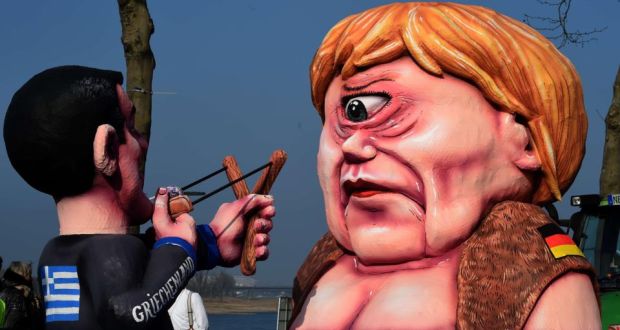
A caricature depicts Greek prime minister Alexis Tsipras  and German Chancellor Angela Merkel during the traditional rosemonday carnival parade in the western German city of Duesseldorf. Photogaraph. AFP/Getty Images
A caricature depicts Greek prime minister Alexis Tsipras and German Chancellor Angela Merkel during the traditional rosemonday carnival parade in the western German city of Duesseldorf. Photograph. AFP/Getty Images
I am very pleased that Germany’s chancellor, Angela Merkel, and Greece’s prime minister, Alexis Tsipras, took my advice about the need for compromise. The two most entrenched hardliners in Europe – on either end of whatever spectrum you choose – moved together as if orchestrated by newspaper columnists, with Nobel laureate Paul Krugman the chief puppeteer. 
Nevertheless, a kissy-kissy scenario and swapping family photos isn’t on the agenda yet. Behind whatever smiles they can manage for the photo opportunities, Merkel would dearly love to cut off Tsipras’s feet at the shoulders.
If it were not for a growing sense in southern Europe that the underdogs may still be able to snarl a bit, many in the north (and Ireland) would have no hesitation in killing Greece – or at least the Greece led by Syriza which, Charlie Hebdo says, is “the future of Europe”.
It seemed at one point that the palpable sympathy of most Europeans for the Greek plight would not translate into votes, with several around the euro table determined not to let heart rule head when it came to getting re-elected.
As Krugman has pointed out, austerity policies, which the International Monetary Fund admits were ill-founded, caused such a shrinkage in the Greek economy as to jeopardise any possibility of recovery. 
Tsipras knows his government is on sale or return. Crying “Wolf!” is no use, if his election promises (of a new vision of the Greek future) are outperformed and negated by the realpolitik of Brussels and Berlin, and his 20-20 vision is severely impaired. He may well accept by now that, as former governor of New York Mario Cuomo put it, you campaign in poetry but govern in prose. If Tsipras had capitulated to Brussels and Berlin he would be facing another election before the end of this year. And that is still on the cards.
Speaking of cards, Greece’s finance minister, Yanis Varoufakis, who taught game theory at Athens University, denies he has been bluffing. “Nothing is farther from the truth,” he said on the eve of the crucial meeting of EU finance ministers. But Varoufakis comes from a Cretan family, and it was a Cretan who famously said: “All Cretans are liars.” If he was speaking the truth he was lying, and if he was lying he was speaking the truth. 
Poker wasn’t around when this was first mooted in 600 BC, but when Varoufakis says “It would be pure folly to think of the negotiations as a bargaining game to be won or lost via bluffing”, he was in fact saying the opposite. And that is how he won the last round of talks. 
When he insisted there was “a red line beyond which logic and duty prevent us from going”, he wasn’t merely stating Syriza’s ideological bottom line: he was also admitting that although the cards in his hand couldn’t beat a royal flush they could force his euro zone colleagues to show their hand. This he achieved, and they respected him enough to let him into the next round of the game. 
Of course Varoufakis was playing the game of his life. Everything in his manner – dress code, body language, approach and withdrawal from the table – proved him the consummate Cretan. And he got what he wanted – what he knew he could achieve, without overplaying his hand. To sit as a neophyte at that table with the big boys (including a scornful Michael Noonan) was to play the Cincinnati Kid against Edward G Robinson, but this time he won. 
To change the analogy, if an Indian army officer couldn’t pay his mess bills, his fellow officers gave him a revolver and told him to do “the honourable thing”. Tsipras and Varoufakis walked out of their meetings with their fellow officers, holding the gun but with no intention of doing anything honourable other than abiding by as many of their election promises they knew they could afford to keep. 
Tsipras returned home cautiously claiming: “We won the battle, not the war. The difficulties lie ahead of us.” Influential figures such as the German finance minister Wolfgang Schäuble are not helping anyone by suggesting Greece won’t be able to deliver on the essential reforms. The simple fact, as Krugman repeatedly emphasises, is that if Greece cannot pay all its debts there’s no future in insisting it should do so. 
Noonan, too, doesn’t help when he so clearly relishes his rehabilitation on the good-boy side of the table, adopting an unseemly attitude to Varoufakis, comparing him to a “celebrity economist, good in theory but not very good in practice”. I think Varoufakis will prove to be a better player than Noonan. The next game could be Russian roulette. Smiles don’t cost anything but they don’t come cheap. Handshakes and hugs, as we know from Northern Ireland, take a little time.
* My footnote: Marcel Detienne and Jean-Pierre Vernant published a book in 1978 called Les ruses de l’intelligence: la mètis des Grecs, translated in 1991 as Cunning Intelligence in Greek Culture and Society.
...There is no doubt that mêtis is a type of intelligence and of thought, a way of knowing; it implies a complex but very coherent body of mental attitudes and intellectual behaviour which combine flair, wisdom, forethought, subtlety of mind, deception, resourcefulness, vigilance, opportunism, various skills, and experience acquired over the years. It is applied to situations which are transient, shifting, disconcerting and ambiguous, situations which do not lend themselves to precise measurement, exact calculation or rigorous logic.. 

Back numbers

Simon Baddeley