Total Pageviews

Showing posts with label cats. Show all posts

Thursday, 4 October 2012

Η γάτα είναι εφτάψυχη

Among the regularly shifting family of cats that live between our houses, using their claws to make effortless ascents of walls and trees, Linda had taken a liking to the ginger kitten which has been around since April. It was killed by a car on Democracy Street the other evening. Katerina, her sister Nectaria and Vangelis and a couple of other children, used to the same cats as us, were standing around in the dusk looking down at its small broken body lying in gouts of congealed blood close against the corner of Lefteris’ house. The children drew our attention to it as we came up the steps to the street the other evening on the way to supper with friends.
“Oh no” said Lin
We looked down in the gathering dark on the little corpse. I contemplated collecting it up.
“If it’s still there when we get back I will”
We walked on. The body had been removed when we came home.
“I could never get near that kitten, you know. It was so wary, yet it was hit by a car”
The cats – our cats – are of course not ours. They’re feral, uncollared, living among us, valuing us for the food we give them, alley cats κεραμιδόγατος.
When we come to the door they will sometimes gather looking up expectantly tails high, waving. If they are nowhere to be seen we will tap a plate against a wall and cry “Γάτα! γάτα!” or “Naps! Ναπς!” Drawing out the ‘a’ – “naa-aaps!” - so that they gather for our gift, imparting the suggestion that we have influence in their lives.
It is a duty to feed a dog that is of your household, as much as to feed a child. In the case of cats we are making offerings. The pet food marketing people figured this out years ago and wrote copy that repeated an ancient distinction in the contrasting ways humans viewed cat and dogs. Dogs whether treated well or abominably, as some are, belong to people. Cats invoke superstition in humans. They are household divinities, seen by some as familiars, “which is why” I read in some study long ago “humans when cherishing dogs will love them like their children and when cruel to dogs will abuse them as some humans abuse children; while humans when cherishing cats will come close to worshipping them or, when cruel, will torture them in inventively brutal ways.”
Cats are not parasites. The presence of these beautiful beasts around our cluster of houses is encouraged by gifts of food. They are never allowed inside houses.
“Έξω! exo!” we cry to the bolder kittens that haven’t learned about thresholds, crying out “cat in the house” and chasing them out. Most understand and obey this convention despite exhibiting intense curiosity about the interiors of our homes. Once I found the desiccated skeleton and pelt of a kitten that had hidden and got trapped in the house when we’d left for England for three months. An awful fate. Now we take more care to check rooms for cats on departure.
A queen and her kits in Venetia
Two adult cats presently allow themselves to be stroked, even purring and looking up ecstatically with half-closed eyes when gently scratched and caressed. I don’t understand why these particular cats decided to be trusting.
“There's a family I know” said a British friend the other day “who paid €500 to have a cat’s broken leg set, and to take her and her kittens to England. It’s a bit over the top when there are families trying to live on €30 a week”
“They have a way of dashing out in front of the car” added her husband “and as we miss them I mutter, ‘there goes one more of your nine lives’” In Greece the British saying is altered - they have just seven lives - Η γάτα είναι εφτάψυχη.
I don’t worship cats. I delight in the look of them. I’d be fascinated to learn more about their habits, especially how they determine each other’s rank and territories and how far different cats roam the village - their beat as it were - and where they live in the cold and wet of winter.
We see them growling at each other, slashing out at other cats to defend their space and we hear, and now and then see, them screeching during violent mating. I’m pleased they kill the occasional rats; less so that they leave their small savaged corpses near our front door as misguided gifts.
When we came home the ginger cat’s body was gone. In the morning young Katerina explained that she and Vangeli had wrapped it up and ‘taken it away’. Only a small map of dried blood remained in the gravel at the side of the road.
“I really liked that cat” said Lin.
*** ******
There came a local wind – in the heat of the midday – that lasted hardly a minute as though some great tree had fallen or rock had tumbled displacing air. It blows across the village, gusting through and around the houses slamming loose doors - close and far – momentarily raising our curtains like streamers, moaning through the roof, sending a plastic bottle poppity along the alley, lifting loose paper; gone as abruptly as it arrived. A portent from the north. Yesterday these great gusts were coming at regular intervals blowing up little dust storms along the mole at Ipsos.
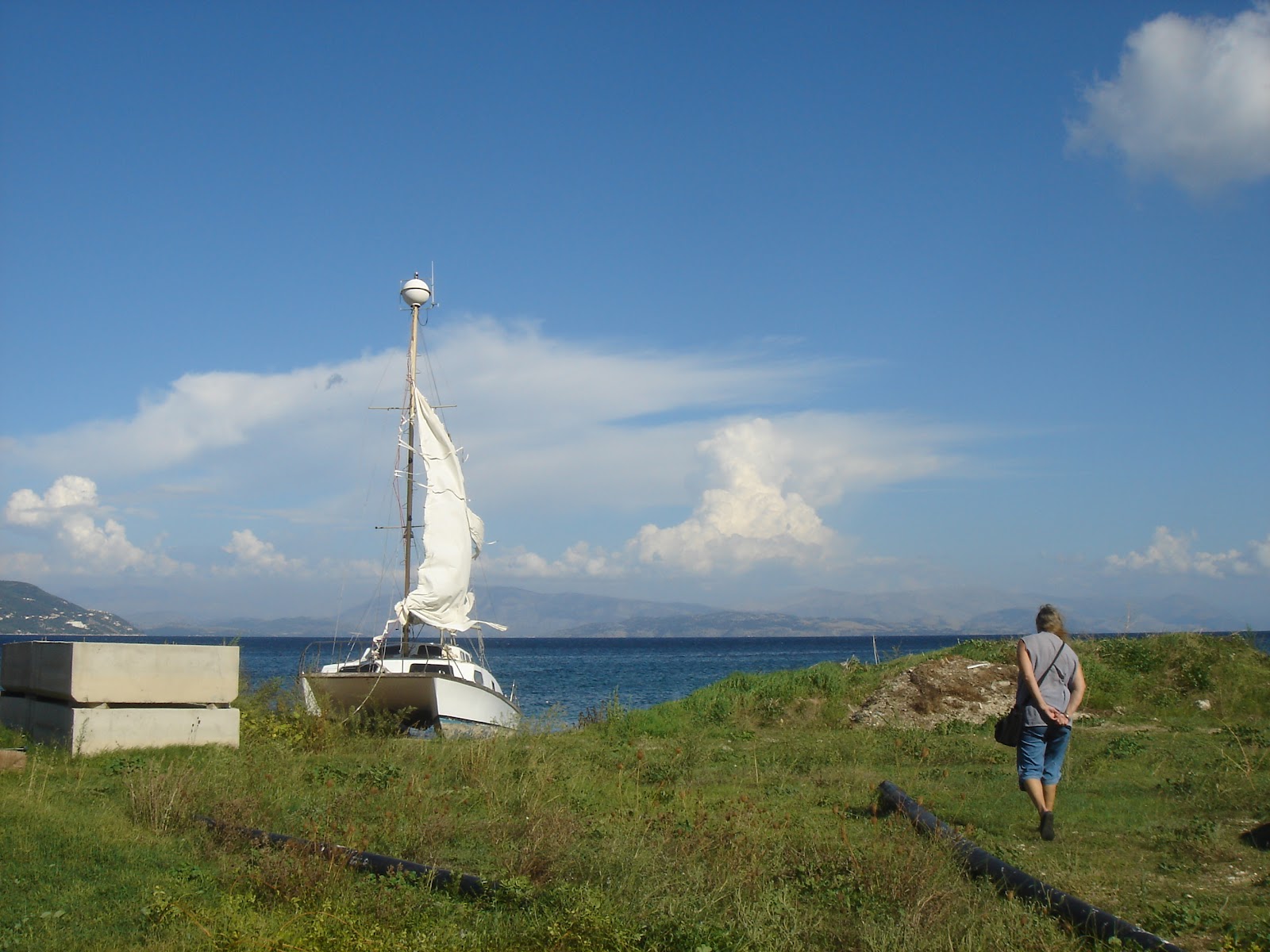
A catamaran we knew was in sound condition but whose owner died has been shifted from its original mooring in the harbour, where it had sat unattended for over five years. It's been beached on the shore where it lies forlorn - a desolate sight - halliards loose, its jib unfurled, slowly shredding, its dirty hull half in and out of the sea, at the mercy of waves from a southern storm.
I'd been down to inspect Summer Song, to check her moorings and cover. As Lin and I sat on a bench I noticed a new boat in the harbour, moored cosily among small fishing boats - of all things a Westerly 22, and not only that - with a gunter rig. I suspect these coincidences. This useful rig is so rare on anything but dinghies and I've not seen another boat of this kind all the time we've been in Corfu; yet here it was in Ipsos harbour only yards from our own boat. I made enquiries and by evening knew her owner and how she came to Corfu - sailed all the way from England.
I was entranced and filled with pleasant nostalgia, even a little envy, to see in such good condition a small boat of exactly the same type and rig as I and a friend had sailed across the Atlantic in 1965-66; a boat I'd know my way about in pitch darkness. Lin and I had been lent the same kind of boat in 1975. We'd sailed her from near Bristol to the Scilly Islands and back over a wet and stormy August. In the wiki piece I wrote about the man who taught me about the way to sail and attend to a small boat at sea, Denys Rayner - nickname 'Ben' his RNVR call sign during convoy duty - inventor of the Westerly 22:
...Ben Rayner's greatest peace time contribution lay in his approach to designing, building and selling such small craft. A fascination with making model destroyers at school evolved into the making of Robinetta in which for a few years he voyaged for pleasure - a pleasure which, after his long war service, he made available to thousands. Starting with Robinetta - based in 2006 on the River Orwell near Harwich and still sailing, and then the rebuilt Orchid to share with his youngest son, Rayner graduated via the one-off Corvette to the Westerly 22, to the Westerly 25, the Westerly 30, the Windrush (a re-worked W25), and the Nomad (a re-worked W22). Applying the husbandry, and inventiveness, that characterised his years as a professional sailor, Rayner applied design and techniques, including the crucial process of curing now recognised as so vital to enduring fibre glass construction, to products that sold themselves. In the recent words of one of his sons, "He was delighted when the butcher, the baker and candlestick maker arrived at the London Boat Show in the early 60s and put down deposits in cash. Boats at that time were produced by 12 men at 6 vessels per annum. With 12 men we built 50 a year. Their yachts cost £6,000. Ours were on a trailer for £1800." But if these small craft were swiftly made and so affordable, none left Rayner's factory unfit for the sea, of which he wrote "neither cruel nor kind ... Any apparent virtues it may have, and all its vices, are seen only in relation to the spirit of man who pits himself, in ships of his own building, against its insensate power."...
*** ***
The other evening, with Lefteris and his grandson and Adonis, I helped crush a 1000 kilos of red and white grapes for next years wine. Lin peeked at us over the garden fence as she cooked supper.
This evening after decanting the first fermentation the press will be applied to the crushed grapes, and the pomace composted.
*** ***
WiFi'd Amy who'd driven up to the Highlands with Oliver and Guy to be with her grandmother, and my sister Bay now at Brin Croft with mum after her flight from New York. I was showing Lin some pictures of Mum when she was a young woman and a girl. For all my pleasure in leafing through large books or drawers full of photos, it's good to have technology which so swiftly recovers a couple of pictures I had in mind - ones I scanned only a year or so ago.
My mother in the lower meadow at Mill End on her horse Oyster. The shadow of the photographer, my grandmother Bar. This must have been sometime in the mid-1930s. Another during a haymaking - mum and her sister with Gypsy, taking a mouthful from my mum's pitchfork.
Gypsy was still around when I was born at Mill End and old enough to be perched on his back in straw hat against the brightness of the sun. Yesterday afternoon I was skyping Amy and Guy, with my grandson Oliver sat between them, in the conservatory at Brin Croft.
There's a Greek philosopher whose name I can't remember. He was, I'm sure, one of the Stoics, a school of thinking - στωικισμός - that emerged, with other guides to life, after militaristic hubris had ended everything that made that brief brilliant era begun with the victory at Plataea, with the fragmentation of city states - the polis - entities which imparted identity, structure and meaning to their citizens; giving commonality to the Golden Age. The philosophy of stoicism is a richer vein of thought and feeling than the simplistic definition contained in our present notions of that word. As those organic societies withered, Greeks had to find an individuality separate from the body politic. It must have been dreadful - for all the liberties the loss of community may confer on people previously fixed in the amber of custom and tradition.
Human life, said this Stoic, could be compared to a great crowd toiling in a vast quarry from which, now and then at random intervals, a cutting out party would select an old man or woman, a mother, wife, father, husband, brother, sister, a suckling child, maiden or youth and take them away, never to be seen again. This image comes to me - one who delights in my surroundings in Greece, in England, in Scotland - with the words of Matthew Arnold
...for the world, which seems to lie before us like a land of dreams, so various, so beautiful, so new, hath really neither joy, nor love, nor light, nor certitude, nor peace, nor help for pain...
No place means anything without the people in it that you love, your dear neighbours and friends; the most sublime, most beautiful landscape on land or sea, whether the close-ups of exquisite detail or the distant prospect of mountains and plains at the rising of the sun or its going down, enchanted by moonlight as was the sea below the cliffs of Dover Beach, as Arnold strolled in the sweet night air with his new wife; none of this affords an iota of consolation when the cutting out party arrives in the quarry for someone you love. 

Tuesday, 15 September 2009

Cats and dogs and other beasts


Marmalade infuses the latest generation of male cats living off Katherina, us and the Leftheris. When I'm not taking them for granted, it will amaze me that humans can have creatures of such lively beauty living among them, along with the undemanding butterflies, the itinerant swallows that glue their nests to our eaves and help control the mosquitoes that leave us itching in the morning, the wasps and hornets which - getting too near - we drown in plastic traps of honied wine, the ants that annoy, the trampy dogs of no fixed abode, the lizards and geckos fixed to stones that catch our eye when they dart and, drawing our gaze with their cries, the eagles circling over the crags above the village.
* * *
Reading on through Calligas' thesis, I’m learning how the personality of different High Commissioners flavoured, what she calls, the Ionian politeia from 1815 to 1864. I need to be aware of the significance of events in the other islands within the British Protectorate – Santa Maura (now Levkas), Ithaca, Paxos, even distant Kithera beyond mainland Pylos, used as a place of exile for radicals, but especially Zakinthos and Cephalonia. I need to be aware of the deeply resented economic rule of the landowning signorini who as part of the office holding Camarilla, clung to offices held long before the British Protectorate, ever opposing liberal reforms introduced by successive commissioners to mend the harm done by Sir Thomas Maitland’s belief in the civilizing potential of authoritarianism when dealing with those he saw as culturally inferior. I need to be aware of different commissioner’s attempts to create a voting system across the Septinsula that, at least later, was meant to set the conditions for evolving autonomny – policies overseen by Colonial Ministers of varying political flavours in London, whose messages took 12 days to get to the islands – an interval that could separate a Commissioner from the rhythm of local events. I need to understand different commissioners’ reactions to the rebellions in Leucas and especially Cephalonia - notorious for Sir Henry’s Ward’s lethal over-reaction to the second peasant revolt there, with executions and unrecorded floggings, disproportionate - in numbers judicially killed - to the murders of landlords and their servants. I need to be aware of the tide of revolutionary thinking coming from Ionians educated in Italy and France and spread through local printing presses, private clubs, songs and celebrations in Cephalonia and Zakinthos, and of course the infusion of Hellenic nationalism from the mainland, with constant taunting of the British by the Rizospastai - Girolamo Pretenderi, from Cephalonia, ‘insolently’ naming his dog ‘Douglas’ after Lord High Commissioner Sir Hugh Douglas (Calligas p.89).
Calligas takes me through the short sojourn of the first High Commissioner, Sir James Cambell, who took over from the military governorship of Major Oswald in 1813, the rule of Maitland (1816-23) and his notoriously monarchical constitution – Ionians dubbed him ‘King Tom’ - giving him veto over the Senate and its Assembly, followed by Sir Frederick Adam (23-32), George Grenville, Lord Nugent (32-35), Sir Howard Douglas (35-40), James Alexander Stewart-Mackenzie (41-43), John Colborn, Lord Seaton (43-49), Sir Henry Ward (49-55), Sir John Young (55-59), the Extraordinary Commissionership over 12 weeks of William Ewart Gladstone (Nov 58-Feb 59), Sir Henry Storks (59-64) who at the end of the Protectorate on 21 May 1864 handed the office to the President of the Ionian Parliament, Count Dimitrios Nikolaou Karousos. This period is now generations past, in our timing ‘long long ago’ – yet history made in that period is engraved in Ionian architecture, and the more I learn of it, the more distinctly I taste its flavours in the present politeia of Corfu.
** ** **
Met another bright person, married to someone who’d lost his job – seven years before being eligible for a pension who said – with swift apologies in case we were affected – this thing’s good if it weans us off credit. The same as Kim and others have said even as they experience – on spouse, children, colleagues and friends the ill-effects of depression. Fran says it’s after the Greek General Election on 4th October “Things will start to hurt here.” Richard P told us of builders without work on land Britons were going to have homes. They’ve no longer the cash in £s against a € worth half as much again as when came. We see more houses semi-completed; lots for sale since we came here three years ago – leaf strewn with sun-dried notices, and homes bought to live in, being rented.

In Lidl we mutter, put things back, look for cheaper. More almost certainly are working in nero. In the stats unemployment levels are in single fingers until you go to women and the young:
Greek unemployment rose to 8.6% of the workforce in June, from 7.3% in June 2008 … among women 12.4%, sharply up compared to 5.8% among men. The 15-24 age group recorded 22.9%, up from 22.3% in June 2008 and 21.3% in June 2007 (12 Sep 2009 Athens News Agency)
Yet for some the year’s been OK. People who charter boats continue to, and have booked for 2010. The ingenious switch their pitch, relying on the cushioned, drawing on reserves. Meantime less concrete is laid, less land cleared, fewer trees chopped, but a rush to get footings laid against the bite of development control legislation and the Hellenic Cadastre

Thursday, 19 April 2007

Lists of things to do

Wednesday, April 18, 2007. The lady from across the street offered skilled helped cracking away one of the breeze blocks enclosing rubble in three concrete enclosures put up by the last builder against the side of the house. They’ve been collecting and storing damp that has been entering the house. They look ugly. Another neighbour was reassured I wasn’t dumping the emptied rubble off our property. She saw the first six barrow loads strewn in the garden as planned and said 'sorry'. On the car by the museum Lin found a a civil note in Greek and English pointing out she’d parked across a two car space. We had a picnic lunch about 5.30 under the veranda. Two young cats tried to climb on our table. Later on ‘Summer Song’ we discussed the re-roofing needed with a young man who can start work next week.
Lin thought we’d had an unproductive day. I’m not sure. Perhaps the test of a place is when it stops being an exotic and temporary escape and becomes another kind of home. We’ve being working through lots of lists in recent days, getting connected to water and electricity, securing addresses, paying dues, anticipating a Greek tax return next year and overseeing, and paying bills for, work on a boat and a house. This island was once a passing image that included mouse island – Pondikonisis – a white church, blue sea and dark cypresses. In the months since last July when I clicked the ‘buy now’ button and bought ‘Summer Song’ sight unseen on eBay, I remain astonished at the unexpectedness of this extraordinary turn of events.

Tuesday, April 17, 2007
Around 5.30 the sound of rain on the cabin roof and a wind from the east in the rigging. Light shows grey clouds. We’ve had waking dreams three mornings in a row. Something in the home made wine? I find the current reasoning about the way dreams work convincing – randomly firing synapses producing a stream of data that the mind assembles and reads like faces in clouds or interpretations of Rorschach blots. The detail is uncanny. I was forced at the end of one dream, to prevent it causing mayhem, to grill a boa constrictor in a shallow tray of hot coals. The image was painful because of the danger posed to me and then the pain caused the snake. I was glad to wake. This morning a reception in a public building composed of architecture from diverse but familiar places and guests including colleagues I thought I knew but with novel extramural professions – one a jockey in riding clothes who greeted me cheerily. Abruptly the time seemed to change and then after a pause – the brain processing a flood of waste data - the whirr of helicopter blades. We were invaded by Nazis, one disguised as a Guards Sergeant-Major. I saw him lining up infantrymen outside, barking at the ranks to get lined up. Then soldiers walked in and took over. There was no fighting, no remonstrations nor announcements. A pause for further processing and then I realised - invented the notion with the data to hand - that the place had been taken over as the venue for an opera. The situation remained fluid. Should we try to coordinate some response? I felt fearful about risks. I asked three staff officers with their wives – all immaculately dressed, the men in uniforms, the women in white diamonte evening gowns - sitting in a cluster of armchairs in blasé anticipation of the entertainment to come, why they needed to come here. “Isn’t your great Berlin Opera House fine enough? And what about Vienna?” I asked ingratiatingly but also resentfully, but they were entirely off hand. The opera was going to go ahead and there was nothing anyone could do.

We were taken by a Greek friend to get our electric bill and water rate sorted. Found there’s Wifi at the Arco Café on the Liston. Two estimates for repairing the roof and a visit to assess taking out an upstairs wall to make one large front room next the balcony. Lin continues painting white over various off-white shades with me holding a step ladder as she reaches up. The plaster board is up awaiting skimming. A late drink at CJs. The large screen over the bar played a football match in England. It is difficult to imagine a more intense assembly of enthusiasts, with the sound track and real time editing moving so adroitly between grand view and intimate inspection of players that took even me into the drama. I shared my admiration with the owner. He commented that the screen shots we were seeing can also be seen by the crowd, but not by the referee. This creates grand differences of opinion. Later I remembered I’d seen no-one spitting. Everyone involved knows how closely they are being watched on screens across the world, especially those whose brands are attached to the players shirts. Earlier when strolling to pick up the car in Ano K I noticed something missing – no litter on Democracy Street or its tributary paths.

Monday, April 16, 2007
Cloudy. In Corfu town after dropping Lin at the house to get electrics and water transferred but to get the phone requires the presence of both of us plus the line’s previous users. “I’m arranging it” said A. Asked after his baby daughter seeing him looking tired. Saw K. to get rubber on the clutch pedal. Got Lin’s phone working with a Greek number. Back at the house made lunch while Lin continued painting. Neighbour’s wine goes well with feta, raw onion and olives – different pungencies. More work on the garden. First estimate for redoing both roofs. Two more estimates tomorrow. Supper of chicken and pork from the spit at George’s, Kontokali, then home to the boat.

Thursday, 5 April 2007

Via Marghera, Rome


Via Marghera, Rome
Originally uploaded by Sibad.
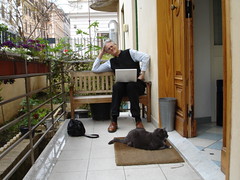
Linda and I are sitting in limbo outside the Beehive Hotel, Via Marghera. The sun's trying to come out. The traffic is grumbling round the Termini station and we are thinking all seats are taken on all trains and coaches to Bari tomorrow and we'll probably have to sit on our luggage for 8 hours, or could we play 'silly old foreigners' and hope someone will take pity on us like they do in England where everyone is so civil. Yeah, well. The cat is called Ingmar. The other one is called Lin's handbag

Back numbers

Simon Baddeley