Total Pageviews

Showing posts with label picnic. Show all posts

Sunday, 19 October 2014

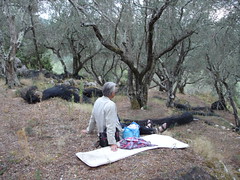
Picnic below Mount Pantokrator

Picnic below Pantokrator (photo: Liz Basden)

We got out of our cars into warm sunlight before the mist arrived to surround our small stroll around the summit of Mount Pantokrator, now and then parting to reveal the distant roofs of Old Sinies far below, and closer, the winding white road by which we'd arrived, ascending from Ano Korakiana via Sokraki, Zigos, Sgourades and Strinilas. Lin and I explored the cluster of commercial radio huts, slung with humming air conditioning units, a hamlet of aerials glued with concrete to the southern col of our small summit.

The monastery church was locked and barred.
"Why?" I asked Spiro in the shop
"The priest is ill. Normally it's always open"
Young cats, unlike most in the village, collected for cuddling - unwary of strangers
We descended a kilometer to a place in sight of the mountain top and spread a picnic on a grazing just off the road in the company of things that keep people away from such lovely places – two varieties of ant, a dung beetle, wasps, a lone mantis, a bumble bee, small butterflies and day moths.
"Why didn't you bring the picnic blankets?" asked Lin
"I forgot"
I'd spread a spare shirt, a couple of towels, even my jacket.
"We're fine!"

*** *** ***
Yesterday we went as usual when we have a car to the Lighthouse - ο Φόρος – table-top sale at Kontokali, then after the usual humming and haaing with arguments and indecision, to a pebbled beach near the ruin of the old Venetian Arsenal where the Corfu Rowing Club have made three wooden rafts into a jetty.
We’d bought souvlaki and giros from Spiridoula, working as ever over the turning spit at George’s.
“Did you get chips for Guy and Amy?” asked Lin
“No! I got what people ordered..I made the list as I thought agreed"
Lin shrugged to Amy “You didn’t tell your father to get chips as well”
“Shall I go back?”
“No don’t bother”
We sat in the sun on two picnic rugs I’d remembered to bring this time. I sat on the jetty, jeans rolled up, and dangled my feet in the mild sea. A slight breeze blew from the north. A few locals shared the shore.
Gouvia pier


Planes came high overhead now and then. After a while Guy and Amy took Hannah and Oliver further along the shore for shade. Lin lay to read. Sophia slept. Liz and I leapt off the jetty; drying and warming and swimming again. As the sun lost some of its strength Amy and Guy came back with the grandchildren. Oliver dislikes water at the moment and clung to Guy up to his waist. Liz dipped Sophia.
“There’s a pervert over there.” said Liz “He's watching the women. I don’t think it’s at the kids”
“He had his hand in his underpants feeling himself…Doing it” said Amy
I saw this gaunt elderly man, lean and bronzed, in the distance. I strolled over crunching gravel and for an hour stood between him and his glassy stare, standing by him in the water when he rose unsteadily and swam a few listless strokes; resting my shadow across him, as muttering soundlessly he tried to stare at women on the beach with the rusty focus of a spent torpedo. Peering at his watch he picked himself up and doddered from the beach.
Amy joined me jumping in again ...


..and so it was for the rest of the afternoon, before going into town; watching the sun set from the Faliraki corniche, a drive homewards for a long supper at pleasantly talkative Strapunto – delicious grilled meats (some boxed to take home for Sunday supper), breads, feta and salad, grilled mushrooms, chips and the children not embarrassing us too much with sudden complaints, as we sat across from a model family, father and uncle, mother, three small slim daughters and yiayia smiling benignly.
Home again in the cool of the evening
“Don’t bring the washing in now” said Lin “It’ll be fine in the morning”
The children disappeared into the soundest sleep.
“I’ll shower off this salt in the morning” I thought, heading for slumber, nearing the end of Jeffery EugenidesMiddlesex – a wonderful fictional biography about Greeks in America starting - almost - with the destruction of Smyrna; the massacres of 1922 - an event whose truth is debated still.

Wednesday, 18 June 2014

Black Patch Park

We had a good meeting - we reckoned who were there - about the Black Patch; with Nick at Sandwell Council.
Winding up the meeting: Friends of Black Patch Park at Sandwell Council house

"It's very chicken and egg. All about momentum!" said Nick twice, as we wound up a meeting that lasted a good hour. We'd explored and aired the continuing problems of lack of public money, the marginal location of the Black Patch on the Birmingham-Smethwick boundary; that there's not a single resident who opens a window on to the park. Nearly everyone who lives beside the place has been 'decanted' elsewhere. Black Patch has no obvious local constituency of users, but it is the focus of  significant communities of interest - rather than of place; urban explorers, industrial historians, Travellers, footballers. It has four schools nearby, connects to the Midland canal network and the SUSTRANS network; a wildlife haven amid industrial dereliction. It's haunted by Queen Henty...
A conversation with Bridget and Michelle on the Black Patch - June 2011


Nick, himself enthused by our separate presentations, will seek to widen interest in the Council. In the current situation we can hope for nothing better than that we, and all involved, should via a mix of luck and endeavour, arrive at a critical mass, a tipping point that brings serious attention to the meaning and significance of this neglected place.
Outside the Council House: "Are we agreed?" asks our Chairman Ron "It was a good meeting"
My message this morning to committee members of the Friends of Black Patch Park
Dear All 
BLACK PATCH PARK LINKS

Can we get these links to Nick ASAP - with brief explanations. 
- Draft history tour of the Black Patch mentioning it as the birthplace of Charlie Chaplin and the links to the Soho Foundry - key place-marker in the birth of the Industrial Revolution 
- The Wikipedia article on Black Patch Park 
Song on YouTube by Bryn Phillips about Queen Henty's curse 
Best, Simon
Soho Foundry today

Going home from the Council House in Oldbury Phil gave me directions for getting home off the roads, so I cycled past Sandwell and Dudley Rail station - where I'd arrived after a 20 minute journey from a morning appointment in New Street - and came to a sloping alleyway that led me to the Birmingham Mainline canal, whose narrow towpath widened after Galton Bridge, a greenway into the centre of Birmingham on which I saw a heron, dodging me by yards, unfrightened; also geese, duck, seagulls, coots and moorhen and a few walkers and one other cyclist and greenery galore.

Under and over on the Birmingham Mainline. Those are pillars for the M5 motorway
From the mainline I turned off at the Soho Loop to cycle home past Winson Green Prison, via New Handsworth Road, the Soho Road, Ivy, Lansdowne and Broughton Roads, dropping in on the Victoria Jubilee on the way. I am enjoying just seeing my allotment and in a while will set to scything my neighbours overgrown plot...
Dear Jeevan/Gill. Can I get my scythe to to the seeding weeds all over my neighbours' plots? Plot 13 and 15. Best wishes, Simon 
Hi Simon, Plot 13 can be trimmed as it is now empty but plot 15 has a new tenant, his name is Rxxx so please don't cut this one. all the best, Gill
*** ***
The walk we planned in  Handsworth Park started late. Amy and Liz arrived with their children. Oliver had turned poorly with a temperature, clingy and weepy. We headed for Summerfield drop-in centre - a projected two hour wait.
Liz, Sophia, Oliver and our pregnant Amy 
I bought some Kalpol so Amy could dose my slightly reluctant grandson. She used a squirter to get two teaspoons into his mouth. Fifty minutes waiting with me doing some babysitting for Sophia and Amy's name comes up on the clinic TV screen.
It was all simple.
"He's probably fine. Keep an eye"
So now we headed for Handsworth Park, Linda joining us along with Oscar. So now we have hardly three weeks before the entry into the world of a grand-daughter.
Handsworth Park

Our picnic at last. Lin made the sandwiches

*** ***
As a result of a two day course I helped lead the other day I've been sled to do a morning for officers in a northern council:

MANAGING WITH POLITICAL AWARENESS 
Training for officers in xxx Council  (date to be agreed)

A morning seminar focusing on skills and values for working in a politically led organisation. It will:

assist you to read and maintain your knowledge of the political scene,
explore the skills and values basic to political-management working,
develop and fine-tune your feel for the boundaries between political, managerial and professional work,
add to your vocabulary of political concepts, offering models of competence and integrity in politically sensitive situations.

PROGRAMME

Brief introduction - overview of the morning

Reading the Council’s political environment: facilitated exercise

Defining political awareness: skills and values; talk and discussion

Work on ‘critical incidents’: facilitated exercise

Summary and feedback: Q & A

Tutor: Simon Baddeley’s expertise lies in the study of working relations between politicians and managers in local government. As well as in the UK, he’s taught and researched in Australia, New Zealand, Sweden, Japan, and Canada. During the morning Simon will stimulate interest in the skills and craft involved in managing with political awareness, as well as facilitating discussion among participants of the local political environment and its implications for officers.

**** ****
Dear G. Can I get my scythe to to the seeding weeds all over my neighbours' plots - Plots 13 and 15?  Best wishes 
Hi Simon, Plot 13 can be trimmed as it is now empty but plot 15 has a new tenant, his name is xx so please don't cut this one. all the best, G 
Understood. But xx's grasses are growing as high as 13’s. Any chance you could get him to get in touch with you re the impact of his ‘weeds’ on me and everyone else. S
Hi Simon I sympathise as I have the same problem but xx has only just taken on the plot so perhaps we need to give him a bit of time. He has been down so he is keen but I will talk to his plot rep and ask them to keep an eye on things. All the best. G
I've started scything Plot 13


A strimmer or, even better, a power scythe would do this job faster, so why rely on a traditional  scythe? I enjoy the process; the judgement involved in selecting the right blade, setting its angle in two dimensions, and positioning the handles of the snath, tailored to my height and the length of my arms; the physical skill of getting and keeping up a scything rhythm; knowing how to sharpen the blade, keeping it razor sharp with a whetstone every few minutes of work; the pleasure of hearing the slice of the blade as it fells the grass, its fallen smell and the quietness of the work. The ability to deal with chips and dents as a result of striking stones in the undergrowth. That's the process of peening with hammer and jig, which also ensures a sharp edge as a blade gets older; the sheer pleasure of owning, looking at, and holding, so simple and so ancient a tool.
A friend told me of an old groundsman in Birmingham who could shave down to bowling green standard with a scythe. I tried it on our front lawn last year and realised how it could be done - a blend of blade set, sharpening and rhythm.
THE PERSONAL matter that absorbed Levin during his conversation with his brother was this. Once in a previous year he had gone to look at the mowing, and being made very angry by the bailiff he had recourse to his favourite means for regaining his temper,—he took a scythe from a peasant and began mowing.
  He liked the work so much that he had several times tried his hand at mowing since. He had cut the whole of the meadow in front of his house, and this year ever since the early spring he had cherished a plan for mowing for whole days together with the peasants. Ever since his brother’s arrival, he had been in doubt whether to mow or not. He was loth to leave his brother alone all day along, and he was afraid his brother would laugh at him about it. But as he drove into the meadow, and recalled the sensations of mowing, he came near deciding that he would go mowing. After the irritating discussion with his brother, he pondered over this intention again.
  ‘I must have physical exercise, or my temper’ll certainly be ruined,’ he thought, and he determined he would go mowing, however awkward he might feel about it with his brother or the peasants.
  Towards evening Konstantin Levin went to his counting house, gave directions as to the work to be done, and sent about the village to summon the mowers for the morrow, to cut the hay in Kalinov meadow, the largest and best of his grass lands. (Anna Karenina 3:4)

Thursday, 27 September 2007

Picnic off the Trompetta Road


On Tuesday this was crisp and parched. We ate in silence gazing down on the terraces of fruitless trees towards the north coast of Corfu. Today it will be soaked and full of sprouting green. I thought later how Lin's photo looked rather like one of Edward Lear's wonderful landscapes made sometime between 1856-64 and now in the Victoria and Albert Museum. He was looking north from south of Corfu Town - from Ascension, which I don't know.

Monday, 11 June 2007

At Kernovel, St Pol de Leon

Delighted to find a free and instantly working WiFi connection at the Hotel de France in the centre of St Pol de Leon and so sat with laptop and coffee, a friendly dog and aimiable proprietor while Lin and her parents provision us at Leclercs.

There was har in the Channel. The ferry sounded her fog horn at the start of the seven hour crossing from Plymouth to Roscoff. Visibility improved but the cool drove us inside, where we had expensive snacks to a background of competing muzak.
The gîte, just south of St Pol de Leon, is one of three attached to a farm of exemplary efficiency called Keronvel. Madame Moal accepted our €150 deposit ushering us into an attractive accommodation of surgical cleanliness approved by a category of consumer who’s taste for hygiene is formed by commercials for cleaners that eliminate dirt and hurt it in the process.


Gone are the forlorn roofs of a rural population driven by globalisation to the cities and its colleges. I’ve not noticed small bakeries and bars on their last legs. They’ve faded away. Shining cars are everywhere, their landing zones expansive aprons around supermarch hangers ringing marketless towns whose coiffured centrevilles have signs to direct the new harvest to places for the kids, for gazing and strolling in reach of parking. Old churches have a new liturgy- the guidebook. At Keronvel - power to their elbows - the farmers have outbuildings for the likes of us (stables, workshops, accommodation for long gone labourers, converted to gîtes for Sat-Sat hols) but they’ve also found ways, with state help, to up their yield to compete with the world, investing in spacey glasshouses, cultivating Stepford vegetables that meet the exactions of bigbox procurement aimed at meeting the demands of those same dirt fearing car born shoppers.

After driving to a couple of places we found a path to a brambled shrubby point east of Carentec where we could see islets, passing boats, birds and strollers on the edge of the Morlaix estuary. Here Arthur and Dorothy strolled gingerly down a slope to a small sitting place where we picnicked, chatted, and later read. I found a place to recline in the foggy sunlight of a humid afternoon, woken by the buzz of a jetski looping in the sea below – two young people filling the air with the noise of their fun, that silly stream of water shooting up from the back like boys competing to pee up a wall.
I’ve just finished Lawrence Durrell’s ‘Bitter Lemons’ between a more leisurely read of ‘Prospero’s Cell’. They make fascinating reading, but I’m glad I didn’t read Durrell on Corfu before we came. We weren’t guided there by his suite written before the second world war. Our Corfu was one we saw first in September 2006. One that we knew would have piled layers on earlier accounts. I was given Gerald Durrell’s ‘Corfu Trilogy’ by Amy for Christmas. A thoughtful gift, but I decided it was a unreadable as the diary of a parent’s old lover – engendering a mix of disdain and jealousy. This is not Gerald Durrell’s fault. He’s an admirable human. I just don’t want to look to closely at what his Corfu has become, preferring to enjoy our affair without reminders of her past lovers and their pleasures. His brother I can read - now. Corfu, like Cyprus later, separated from him as he became focused on universals, while Gerald stayed involved until he died, sharing apprehensions about the ecological blight attending the great spread of equality in travel. Lawrence Durrell is seductive. ‘Somewhere between Calabria and Corfu the blue really begins.’ His first line on Corfu and the last in that first paragraph ‘Other countries may offer you discoveries in manner or lore or landscape; Greece offers you something harder – the discovery of yourself.’

I am slightly less interested in his landscapes (the same difficulty I have with Gerald – mine not the author’s) than in his reflections on Greeks – heroic, cowardly, impulsive, generous, intrigue-prone – and their complicated feelings towards the English, especially where intimate local bonds – family, love, friendships - were drawn into larger pots stirred by bigger spoons. On such things Lawrence Durrell - who would be odd if he were not something more more difficult than his writing - brings grief close to the surface now, because experienced before but written after, and published even later, they are pregnant with unexpressed emotion – ‘not conscious of separation’ ‘regret so luxurious and so deep that it did not stir the emotions at all’, ‘we never speak of it …’ he wrote in from Alexandria in the final chapter of ‘Prospero’s Cell’. This I suspect is the source of the keening unleashed to my startled impression at Cambridge, as I absorbed his Quartets from cover to cover and enjoyed in happy innocence the ravaged country, to which my post-war father - part stranger - introduced me with attentive love. I was told years later that Dad, the very model of an Englishman, caused amusement because he spoke such fluent 'mountain Greek'.

This delicate ground is being carefully sieved by Mark Mazower and his contributors. One of the names to whom the essays are dedicated is Mando Dalianis. Inside the collection is a chapter co-authored – apparently – by Dalianis and Mazower, ‘Children in Turmoil during the Civil War: Today’s Adults’. An endnote (p.104) records this chapter written by Mazower ‘based entirely on the published and unpublished work of the late Mando Dalianis.’ In July 1996, very ill, she’d delivered a monograph at Sussex University. In August Mazower visited her in Stockholm. Over a week they agreed to him bringing her work to wider notice. Dalianis’ life as a scholar - I’m sure she did many other things - began when ‘At five p.m. on Wednesday April 13, 1949, the heavy iron door of Averoff Prison was opened to admit me, and my name was added to the register of prisoner’s awaiting trial’. It was completed with the delivery of her paper 47 years later.

It is the greatest mark of character that an individual who inherits every reason to recycle their anger becomes someone through whom the evil men do is not passed on. Dalianis, a child and adolescent psychiatrist, followed the children and parents she encountered in prison for the rest of her life. She could easily have darkened her interpretation of what happened to these children imprisoned with their parents, then, as punishment to their mothers, fostered or sent to children’s homes. Never glossing the cruel consequences of the civil war and its worse aftermath, she concludes that recovery from trauma for most of the children was made possible through the occasional kindness of strangers, the conscientious nursing of extended families, the love of surviving parents, and the unprecedented opportunity that arose from Greece’s economic growth and urbanisation.

It is salutary for me to digest the fact that the sprawling ugliness that now blights Durrell’s exquisite landscapes has also meant ‘that in less than four decades, the animosities of the civil war had receded much further from the forefront of people’s minds and lives than anyone might have predicted at the time.’ (Mazower, op. cit. 104).

Such is the scholar Dalianis, whose good work was not with her bones interred. I’m grateful to Mazower for finding her. I would have liked to have been a witness to the collaborative week in 1996 that brought about this hopeful chapter – a tribute to all who, having cause to make war, make peace. [A detail: Dalianis wrote that the gate of Averoff ‘opened to admit me.’ Prisoners usually speak of gates that ‘closed behind me’?]

Back numbers

Simon Baddeley