Total Pageviews

Showing posts with label Pantokrator. Show all posts

Wednesday, 1 December 2021

At 208 Democracy Street until winter

Looking over the Sea of Kerkyra towards Epirus in Mother Greece. The small island is Vido

Having been away – because of travel restrictions - since last December there have been more than a few gardening jobs to do. A spreading squash has climbed the fence into our garden from Vasilikki’s. Its broad palmate leaves and hairy stems, hanging by tendrils, spread to the ground. Most of its yellow flowers are male. 


On a whim I decide to have a go at doing work that’s better done by bees. I pull up a chair to get a closer view of the vine, looking to take the stamen of a male flower and touch it to the stigma of a female. I’d found find several squashes forming – kolokithakia Κολοκυθάκια – but could find no more female flowers on which to experiment. There’s a crack of thunder. The sky goes grey, rain descends, and the washing I’ve hung out gets a further rinse. As the days pass the lower squash has grown to a satisfied potentate, nestling among its decaying leaves, yellowing, a smaller satrap hanging six feet above. We on high ground only heard of the consequences of several days of rain in the south of the island.

Flooding in Moraitika

Our Bougainvillea, plant of a thousand hybrids even within a square mile, flourishes as it hasn’t for years, in some cases surging through the planks of the balcony. Work above and below with the loppers sorts that, with the help of a hammer and chisel where a stem has hardened, wedged itself between decking. 

The Wisteria, about 12 years old, had invaded our already enfeebled orange tree, the wooden balcony, the down pipe of the roof gutter, reaching into the upper branches of our neighbour's walnut tree. I tame it with an hour's discipline of shears, long reach loppers and secateurs, until it hangs meekly along the metal railings of our side balcony. One of Amy’s presents for her mum’s 70th birthday included a string of solar lights. Lin’s wound them along the railings amid the wisteria and with many hours of sunshine they shine out from dusk to dawn like a distant city street 

The trumpet vine leans nonchalantly over the front of the balcony, less invasive than last year but full of flowers. I’ve cut back the top growth of the lemon tree in front of the balcony. For its safety, I’ve applied more of the anti-scale insect spray used last October and earlier. These insects seem, at last, to have given up, after blighting our citrus trees. Can this infestation really be over? There are many lemons on the larger tree, but none on the smaller. Our blood orange tree, once so fecund, hasn’t fruited for five years. Though still leaved, its periphery branches end in dried and blackened twigs. In the lower garden Lin’s cut back ‘what needed it’, including Yucca tops. She’s combed out dead growth, potted up cuttings, moved many of our plant pots on the steps and swept up accumulations of fallen leaves and petals, and watered widely. Things are, and therefore life, is tidier. Dimitri, a neighbour, has strimmed the path that goes below our house from Democracy Street down to ‘our’ bus stop on National Opposition Street. 

Above us from before dawn well into the night the short holiday harvest planes grumble to and fro above the mountain ridge behind us, often half full, we’re told, of travellers in masks who, like us, have completed or booked Covid immunity tests, shown their vaccine certificate and other proofs of immunity, filed their PLFs and prepared for self-isolation on arrival. 

We are almost always without a car. Hirers may have none available, or they're too expensive. We rely on the daily bus at 7.45am and early afternoon back from the city. There’s my bicycles. But for the local bakery – OK for wine and bread – our grocery is 8 kilometres away.  A grocer in a truck visits us Tuesday and Saturday, crying his wares as he drives back and forth through ours and the lower roads.

I'm beginning to find the uphill pedal to the village, with kilos of shopping in the rear basket, and especially the ascent by the last four hairpin bends, more of an ordeal than an achievement, especially in the heat of August. On impulse I did what I had told myself I wouldn’t do.  I cycled on the bike I'd bought from them 10 years ago, to Rolando’s and Elena’s shop opposite the hospital in Kontokali, and bought an eBike with a Bosch crank-driven motor. 

Other electric bicycles have a battery drive on the hub of the wheel. My drive sits between the pedals - Active Line Plus offering increasing levels of power to support my pedalling with increments of back-up power that proceed from normal cycling without the battery rising to 40% (Eco) to 100% (Tour), to 180% (Sport) to 270% (Turbo) support - 


... all shown on a little screen beside an up-down button on the handlebars controlled by my left hand index finger. That's helped by seven derailleur gears on my rear chain drive controlled by a right hand twist grip - allowing me to decide how hard I want to work and how much I want to delegate to my battery, while still pedalling. Stop pedalling or reach a speed over 25kph and the edrive cuts out. Friends noting my occasional grumbles about the effort of cycling up the hills into Ano Korakiana had said “just get an e-bike, Simon”

“Spawn of the devil!” I retorted “They erode the moral compass of cycling – no pain no gain and vice versa.” 

Now my cavilling is dismissed. I love this machine. 

My e-bike on a hill looking south across the island of Corfu

Naturally disinclined to effort for its own sake, I rejoice in journeys back from Kaizani’s at Tzavros, with a good 10 kilos of shopping secured by bungies in a plastic crate cable-tied to my rear rack – a journey of over an hour now less than 40 minutes with a triumphant ascent into Democracy Street in lowest gear and ‘turbo’. There’s also a ‘walk’ function that, without having to be mounted and pedalling, helps me wheel the ebike up the 13 steps from home to the road. I’ve now cycled up the 29 hairpin ascent to Sokraki – the village on the watershed above us. I have done this twice on my ordinary bike but it’s a route that now tests my 79 years. I’ve been into the city – 22 miles return journey, made several journeys to Doukades using the main road, country roads and gravel tracks. I’ve cycled effortlessly home at night from eating with friends a mile below the village. For that I’ve strolled beside Lin on a gravel track, then, arriving at the metalled road, headed off by unlit hilly roads while Lin walks the stepped short-cut to Democracy Street. I’ve cycled from Sokraki to Trompeta in gentle drizzle then down through the woods to Doukades and home via Skripero – the dial shows I’ve already covered over 420 kilometres. In mid November I cycled to the top of Mount Pantokrator - a round journey of 54 kilometres nursing the battery by pedalling most of the ascent on 'eco'. 

Some years ago we had a family picnic close to the top of Mount Pantokrator

Route: Up the steep winding ascent to Sokraki; take the short bypass round the village centre down to meet the steep descent to the river valley, then up a hundred metres to Zygos, up up to Sgourades, on the Spartillas-Acharavi road, along a kilometer of level; then the turn up to Strinilas - the longest haul part of the ascent; from Strinilas, tavernas closed for winter and latest Covid restrictions, down briefly to the right turn up again to the gently rolling road to the foot of the steep mound that leads to the summit of the mountain, up which I walked, as, even on 'turbo', the kilometre of mostly concrete road is too steep for me and my ebike. I trudge - assisted by the bike's 'walk' function. Lingering on the roof of the island gazing round the compass - the peaks of Albania and Epirus across the Corfu Channel, the Adriatic stretching beyond the north coast settlements - Roda, Acharavi, and inland Old Perithia and south to two little peaks of the old fort and the city and much in between, I watch the cats and chat to Sotiris the gardener and a candle lit in the monastery church, much silence but for the wind in the aerials, then down down down down again to Sgourades and then return via a different road, to Spartilas with two clicks left on the five click battery. I stop at a taverna in Spartillas for a diplo skerto and cheese and ham toastie, my vaccination covid certificate sought. Can I make it home on what's left in the battery? I freewheel down the long descent, nearly to the sea at Pyrgi, then up again through Agios Markos and another mile into Democracy Street, Ano Korakiana. I did this journey first by traditional bicycle in 2012. 

I was back early afternoon, having the summit almost to myself via almost car less roads, proving to myself there are few places on the island I can't reach and return. Our friend Jenny, who has the same bike, says that relying on the lowest charge I should be able to cycle 60 kilometres. I've now satisfied myself of that, having power to spare on returning from Pantokrator. I’m almost back to the moral compass I’ve abandoned. 50 kilometres from Ano Korakiana can take me almost anywhere on this beautiful island. I could if concerned about remaining power ask a friendly taverna at the end of an outward journey to plug in my charger while I have a meal. 

A folding bicycle invented by Andrew Ritchie over 30 years ago called a Brompton is the best product in a niche market. It’s not just a bike that can be taken apart easily. It folds in less than 30 seconds into a 12 kilo portable machine that can be carried on cars and public transport.  I use the Brompton with public transport; best for negotiating traffic congested streets and the public spaces where I can mingle with walkers and other cyclists.

Awaiting the morning bus from the village into town at 07.45

I have owned several of these since the early 1990s. In February 2007 I was using a Brompton folding bike to travel by bike, rail and ferry with my friend John Richfield from the UK to Corfu via Paris and Venice to buy our home in Ano Korakiana. 

Just off the ferry from Venice in 2010

We returned the same route. 

On Via Garibaldi - the only filled-in canal in Venice, one of the few places anyone can cycle

A few years later I shipped the same bike – a deep green T6 – from Birmingham to Corfu with furniture. Bought in June 2001, it’s quite old. I rode it downhill to the sea at Ipsos this August. It scared me - clunking and clicking like a straining bulkhead. The original Sachs hub was telling me noisily that it was shot. I phoned Mike at Phoenix Cycles in Battersea. The cost of a replacement wheel with a Sturmey hub gear, new sprockets, chain and chain tensioner was over £400, before adding 50% post-Brexit customs charges . It says something for the resale value of used second hand Bromptons that I was prepared to even think of spending what would be needed – over half its cost in 2001. The carriage was made suddenly reasonable when a friend offered to put wheel and trappings in her hand baggage from London and drop them off to me in the village. I was anxious – cack-handed as I am – about the reassembling work. 
Guided by Youtube tutorials on several tasks I secured the new sprockets to the new hub with a holding circlip, threaded a new gear cable and handlebar controller, replaced the derailleur for the other two gears. Adjusting the chain guide that switches the chain from one sprocket to another was tricky - for me. A small washer on which the guide swivels kept slipping from my fingers and hiding on the veranda floor. With help from Lin and my cyclist friend Gerard (who’d never seen a Brompton), the work was done. 
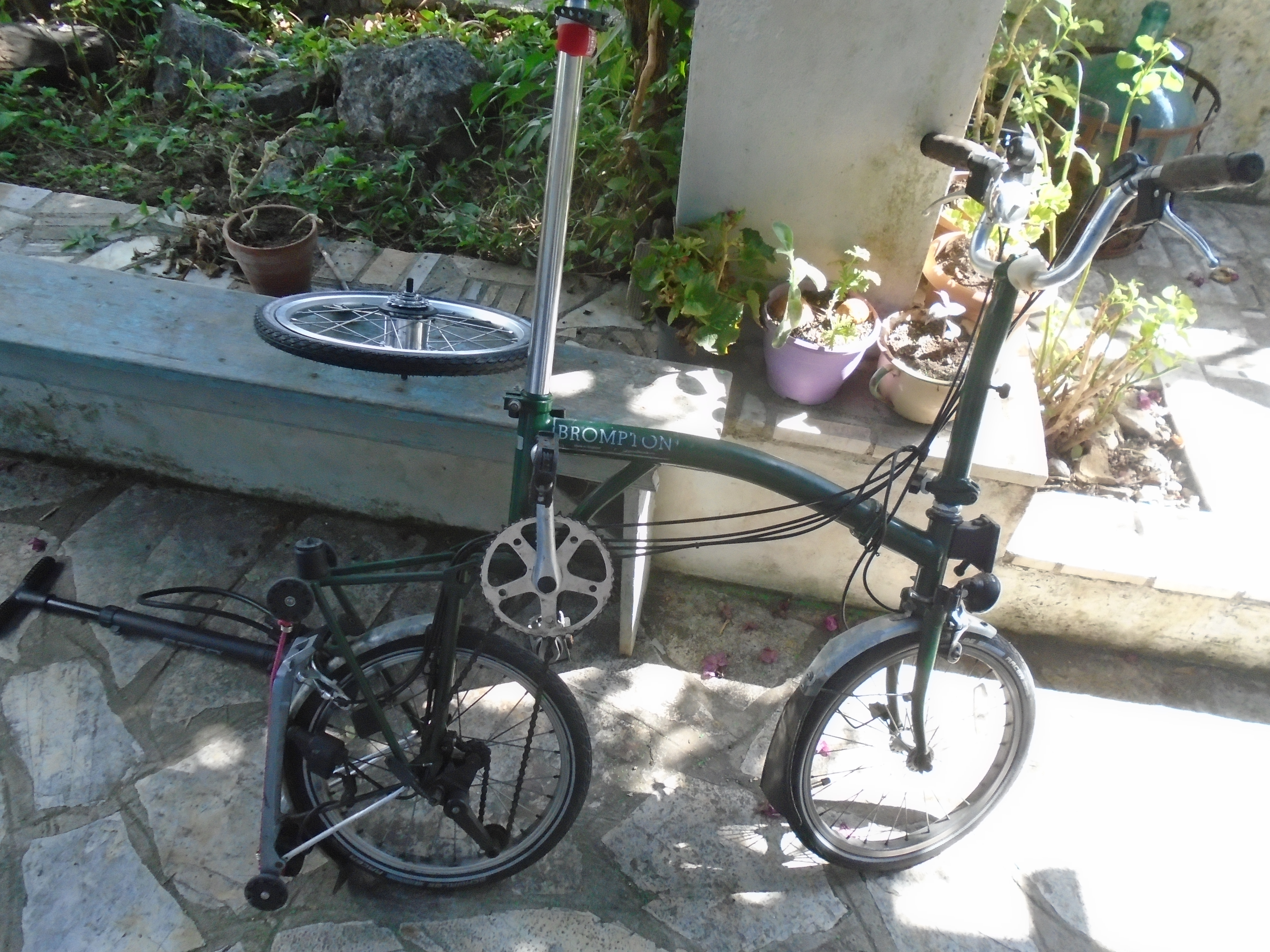
I reduced the new chain to 95 links using a chain breaker to force out the link rivet. I threaded it round the rear wheel sprockets, the chain tensioner jockeys and front chain-wheel, joining with a ‘quick link’ - an innovation that allows the chain to be joined and unjoined without the removal of a rivet. New to me. Repairs completed my folding bike performs better than new. 

New hub gears, rear wheel, and chain tensioner - my old folding bicycle better than new

The three Sturmey hub gears are superior to the Sachs they’ve replaced. Testing the restored Brompton I cycled slowly but steadily up to the small chapel of Agios Isadoras – five hairpin bends above the village. 

Agios Isodoros on the winding road between Sokraki and Ano Korakiana

So satisfying that the bottom of my 6 gears made that possible. I’ve since taken the folder into town to cycle happily through its maze of streets amid the walkers. I returned our hired car. Lifting the folded Brompton from its boot, I headed into the city centre for various errands - paperwork, especially for our Biometric Residency Cards interview with the Immigration department in the police station off Solari. Being Monday morning the town was near gridlocked, which made pedalling smoothly past a kilometre of fuming semi-stationary traffic queues, on Heptanisou and Lefkimmi Streets into Mitropoliti Methodiou and San Rocco Square, especially satisfying. To go home I caught the bus to Sokraki, Brompton in its luggage hold, and for €3 was driven, via Tzavros, Dassia, Ipsos and up the winding road to Spartillas, along to Sgourades – a wonderful bus route for seeing Corfu’s changes of scenery from city, seashores to forested mountains – then down to Zigos and up to Sokraki, 29 hair pin bends above Ano Korakiana. 

The road from Sokraki to Ano Korakiana - 29 hairpin bends

I sat outside Emily’s Taverna for snacks and conversation with their Polish waitress, Milena, and various customers, German and English. One couple from Manchester, arriving quietly in an electric car. They were living in Corfu - a man and his sister living in Karousades. As we chatted convivially about the comparative merits of marriage for men and women, the man – middle aged - told us he’d lost his wife to Covid. In the last two years I’ve known very few who’ve caught this much talked about condition – Lin suffering it for an uncomfortable fortnight in January 2020 before lay-people even had a name for SARS-CoV-2.  
On November 10th Lin and I decided depart from beloved Greece. We flew back to England - Corfu Kapodistria, Athens Venizelos, London Heathrow and National Express coach back to Birmingham and Handsworth.  Goodbye for a while. PLF and tests and 10 days self-isolation back in the UK except to buy food.


Monday, 23 May 2016

Hair cut

There's no question that my hair needed cutting. But it leaves me feeling uncomfortable. Lefteris told me about a barber - Tantis - in the Jewish Quarter.
'Very good!"
I dropped by this morning at 10.15 and was sat down by the window almost at once, my hair cut with finesse in hardly 10 minutes for €8. Mike, Welsh by birth, is at least bi-lingual, clearly respected by his Greek customers.
"Just leave your folding bike outside. No-one will touch it"
Of course not.

After, I went to the butchers on M.Theotoki, and bought one and a half oven chickens. I'm having friends to supper on Wednesday.
Thursday, Friday, Saturday were days of grey weather, wet and even chilly weather...
...but Saturday evening hinted at the forecast for Sunday, when I decided to set out to cycle up to the top of mount Pantokrator again having tidied and tuned my larger bicycle...

...doing a last minute check on our upper steps just before 9.00am, then pedalling slowly and steadily upwards...

...Leaving behind the village dogs barking and cock's crowing. Just before St.Isadoras I turned sharp right off the road and up the rough track that cuts across the sides of the mountain above the village heading for Spartillas...

Hardly half a kilometre up the path I heard footsteps behind me. Stephanie on her morning walk-jog with the dog.
 "Blimey Steph! I thought I had the mountain to myself this morning"
She continued, just ahead, to a small perch in the verge, made by Wes, to have a drink before turning home...

...and touching a tree, reciting the lines from the sweet wise* anchoress Julian of Norwich
"All shall be well, and all shall be well, and all manner of thing shall be well"
My path continued eastward, turning the corner towards different views from the slopes, my way roughened by rain-washed fissures in the path so that I'm wheeling over rubble...


...before the track smooths and leads over slopes, up and down, onto the metalled road that leads though vineyards to the road from Spartillas...
This is the track that Fokian, Mayor of Ano Korakiana, would like to see metalled all the way from Isadoras to Spartillas
...and so, to the turn upwards just south of Sgourades into the mountains where the landscape - north to the peaks of Albania and south towards Parga - grows panoramic.
The road that leads through vineyards and vegetable plots to the Spartillas Road


Just before one-o-clock I'm enjoying a diplo skirto and the views from the summit.
Albania from the grounds of the monastery on Pantokrator
It says in one of the recently unearthed Apocryphal books that ‘while life has no guarantee of ups to balance its downs, an elemental truth of cycling is that the discomfort of every ascent guarantees the free wheeling pleasure of an equal descent.

It took me just over four hours to get up to the top of the mountain - 900 or so metres - and less than two to dawdle back via Sgourades and Zygos. It took longer trudging up the hill to Sokraki where I had an early supper at Emily's, before descending on free wheels to Ano Korakiana.

I'm a little surprised and always delighted at the distances I can cover by walking, or, sometimes, when a slope is steep and I’m tired, by steady trudging. On the cycle journey to and from Pantokrator I walked three times: on the rough track from the church of St Isadoras up to the estancias beside the main road between Sgourades and Spartillas, about 3 kilometres; on the final ascent to the top of Pantokrator, an especially steep zig-zag kilometre; and 2 kilometres up the hill between Zygos and Sokraki, most of which I could have cycled earlier in the day, but now truly trudged.
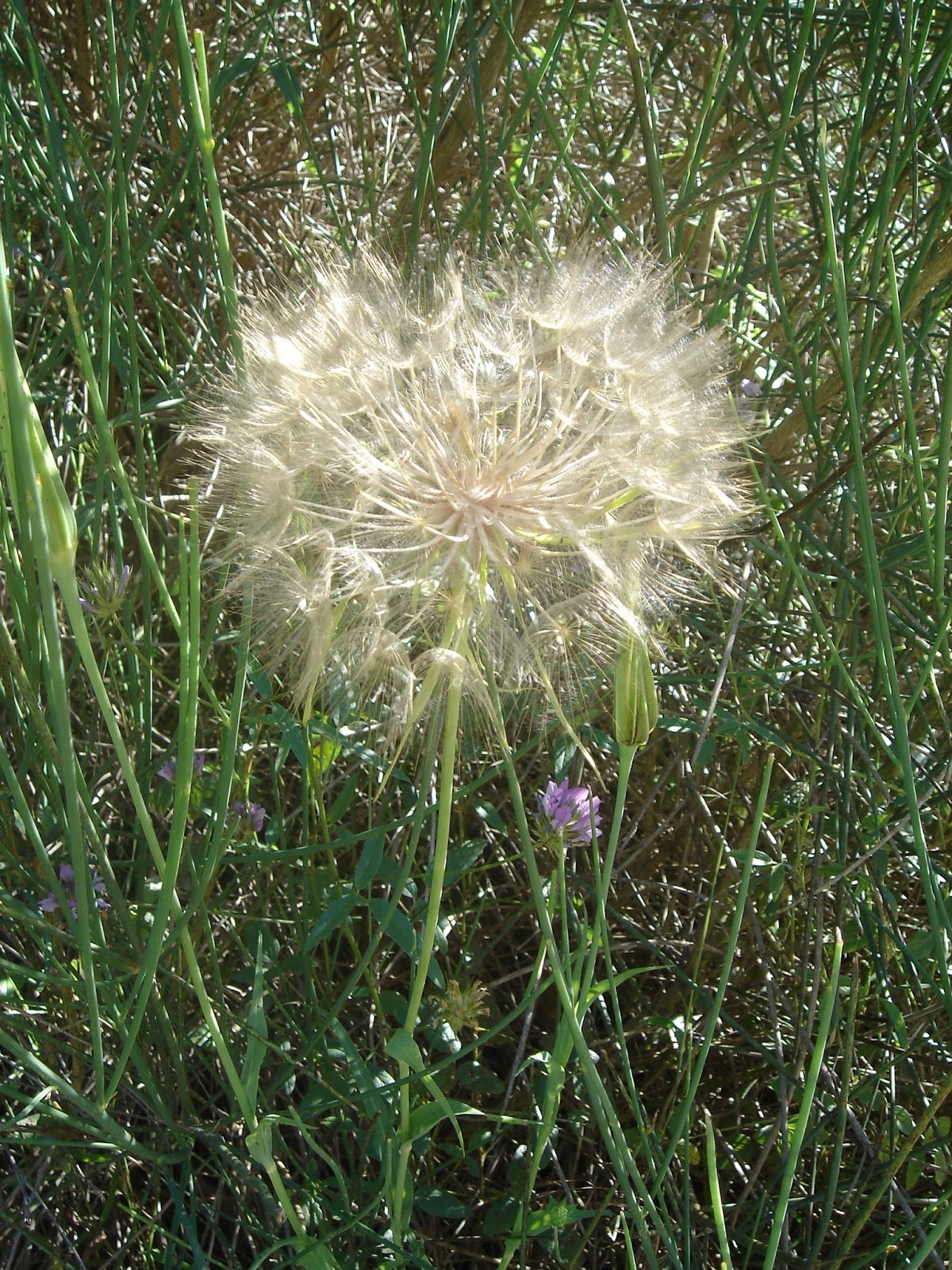
Sailing, without a motor long ago, taught me how slow passages get you places. If a steady breeze gives 4 knots for 24 hours, you’ve covered more than a 100 land miles; at even 3 knots you cover over 80. Walking and cycling up long hills, skeins of invisible spider web, tickling my face, glimpsed as sudden bright lines that flash in and out of sight; the whippy tails of road-basking lizards scuttling into the grassy verge; birds unseen in the scrolling frieze of greenery – olive, cypress, oak, hollyoak, fig, prickly pear, bramble, bracken, and a jungle of summer flowers, some seeded into time clocks much bigger than dandelions’...
...lichen on drystone walls and roadside boulders; and, the kaleidoscopic surface of things, especially the road – a nail, a bottle top, the shape of a twig impressed in the tarmac when it was rolled. Layers of repair; starting cracks, some already moss riven.  Even fecklessly cast litter is defeated by the green abundance of beloved Greece in late May. I peer down wells beside the road; cool, sinister, echoing with a ‘plump’ from my pebbles. Kandylakia, tended with flowers, a wick flame floating in oil...
This stretch - hardly a kilometre - up to this Kandylakia from the Spartillas-Sgourades road seems the longest peddle

...The bicycle - faster than walking but especially when nearly as slow, toiling up a long winding slope - affords even more quiet than walking. No footsteps or stick-tap. In the morning I heard a cuckoo – intermittent as is their wont -  for half-an-hour along the track towards Spartillas. Now and then a gentle breeze from the north rustled the scenery, bringing the tinkling of sheep bells. In the late afternoon, just above the little bridge at Zygos, there came the sound of rushing water. Peering from the edge of the road, over nettles and tree tops, I could make out the sparkle of a stream fed by two days’ rain. All along my route every colour of soundless butterfly; bees everywhere, but invisible, amid the greenery; louder, a lone bumble bee bumping into flowers; and when resting on the ascent to Strinnilas, the muted soundscape of the whole island, the occasional rumble of planes leaving the airport, heading north over the mountains; the buzz of a strimmer and the up-down sound of approaching and departing cars. Many went by, and back past me, after visiting the top of Pantokrator, stopping now and then for their passengers to capture a memory of the landscape on a tablet. I saw bicycles too, ridden by younger more accomplished cyclists, on much finer machines than mine, climbing - effortlessly it seemed - up slopes too steep for me to cycle.
Mount Mikhalakadhes – 852 metres, 2700 feet - on route for the top of Pantokrator "I was cycling up the side of that!"

Supper in Sokraki soon

*I write 'wise' for her discourses following the revelation that 'it was necessary that there should be sin'. I know of no lamp that I, sans faith, can hold to the darkness of what I've read of human depravity since I first studied the Shoah שואה in youth. Julian wrote only God can allow us to stare into the abyss, yet see light. I strive to make sense of Primo Levi's suicide. He is a Jew, yet an atheist, who, in his life-time, I believed had, having been forced to descend into a hell, returned from that man-made inferno, to speak and write to us, with optimism - my catechism.

Sunday, 19 October 2014

Picnic below Mount Pantokrator

Picnic below Pantokrator (photo: Liz Basden)

We got out of our cars into warm sunlight before the mist arrived to surround our small stroll around the summit of Mount Pantokrator, now and then parting to reveal the distant roofs of Old Sinies far below, and closer, the winding white road by which we'd arrived, ascending from Ano Korakiana via Sokraki, Zigos, Sgourades and Strinilas. Lin and I explored the cluster of commercial radio huts, slung with humming air conditioning units, a hamlet of aerials glued with concrete to the southern col of our small summit.

The monastery church was locked and barred.
"Why?" I asked Spiro in the shop
"The priest is ill. Normally it's always open"
Young cats, unlike most in the village, collected for cuddling - unwary of strangers
We descended a kilometer to a place in sight of the mountain top and spread a picnic on a grazing just off the road in the company of things that keep people away from such lovely places – two varieties of ant, a dung beetle, wasps, a lone mantis, a bumble bee, small butterflies and day moths.
"Why didn't you bring the picnic blankets?" asked Lin
"I forgot"
I'd spread a spare shirt, a couple of towels, even my jacket.
"We're fine!"

*** *** ***
Yesterday we went as usual when we have a car to the Lighthouse - ο Φόρος – table-top sale at Kontokali, then after the usual humming and haaing with arguments and indecision, to a pebbled beach near the ruin of the old Venetian Arsenal where the Corfu Rowing Club have made three wooden rafts into a jetty.
We’d bought souvlaki and giros from Spiridoula, working as ever over the turning spit at George’s.
“Did you get chips for Guy and Amy?” asked Lin
“No! I got what people ordered..I made the list as I thought agreed"
Lin shrugged to Amy “You didn’t tell your father to get chips as well”
“Shall I go back?”
“No don’t bother”
We sat in the sun on two picnic rugs I’d remembered to bring this time. I sat on the jetty, jeans rolled up, and dangled my feet in the mild sea. A slight breeze blew from the north. A few locals shared the shore.
Gouvia pier


Planes came high overhead now and then. After a while Guy and Amy took Hannah and Oliver further along the shore for shade. Lin lay to read. Sophia slept. Liz and I leapt off the jetty; drying and warming and swimming again. As the sun lost some of its strength Amy and Guy came back with the grandchildren. Oliver dislikes water at the moment and clung to Guy up to his waist. Liz dipped Sophia.
“There’s a pervert over there.” said Liz “He's watching the women. I don’t think it’s at the kids”
“He had his hand in his underpants feeling himself…Doing it” said Amy
I saw this gaunt elderly man, lean and bronzed, in the distance. I strolled over crunching gravel and for an hour stood between him and his glassy stare, standing by him in the water when he rose unsteadily and swam a few listless strokes; resting my shadow across him, as muttering soundlessly he tried to stare at women on the beach with the rusty focus of a spent torpedo. Peering at his watch he picked himself up and doddered from the beach.
Amy joined me jumping in again ...


..and so it was for the rest of the afternoon, before going into town; watching the sun set from the Faliraki corniche, a drive homewards for a long supper at pleasantly talkative Strapunto – delicious grilled meats (some boxed to take home for Sunday supper), breads, feta and salad, grilled mushrooms, chips and the children not embarrassing us too much with sudden complaints, as we sat across from a model family, father and uncle, mother, three small slim daughters and yiayia smiling benignly.
Home again in the cool of the evening
“Don’t bring the washing in now” said Lin “It’ll be fine in the morning”
The children disappeared into the soundest sleep.
“I’ll shower off this salt in the morning” I thought, heading for slumber, nearing the end of Jeffery Eugenides’ Middlesex – a wonderful fictional biography about Greeks in America starting - almost - with the destruction of Smyrna; the massacres of 1922 - an event whose truth is debated still.

Friday, 26 June 2009

Iason arrested in Iran

Iason Athanasiades a fine journalist of Anglo-Hellenic parentage, who's writing I've followed regularly, has been reported arrested in Iran. Though having a British parent and, according to the story linked here, a British name - Fowden - tagged on to his Greek one, I have always known him and thought of him as an Hellene, priding himself on his delight in and knowledge of Iranian culture and history. I hope he will not be mistreated and that his integrity as a scholar, writer, linguist, photographer and journalist will earn him a swift release. Athanasiadis grew up in Athens. He was read stories from The Thousand and One Nights (Alf Laylah wa Laylah) by his mother. In the summer of 2007 he wrote about 'intermediary Greeks' (scroll down the link to see):
...Being Greek makes me a quasi-insider: We have been present as a regional power from antiquity through to the Byzantine Empire. Later, as Christian subjects of the Muslim Ottoman Empire, the Greeks were its bankers, merchants and diplomats to the European West. The switch of allegiances to the West only came in the 19th century, after the Great Powers helped Greece win its War of Independence. There is still residual mistrust over the Crusaders' sacking of Constantinople on their way to Jerusalem and the lack of help sent by Genoa as the Turks scaled the capital of Byzantium. After World War II, Greece remained firmly within the Western orbit and became the first line of defense against the Soviet Union. In the post-9/11 world, Greek politicians have continued the tradition of the intermediary, most notably when former Greek foreign minister and Colin Powell confidante George Papandreou passed messages from the Bush administration to the Taliban prior to their overthrow. Greek construction companies were trusted by Arab leaders to construct much of the Gulf's infrastructure, build clandestine military bases in Libya, and erect palaces in Saudi Arabia complete with secret escape routes in case of an antimonarchical revolution. A fine example of the 'intermediary Greek' is that country's current ambassador to Baghdad. Panayiotis Makris was educated in Alexandria's Victoria College, speaks fluent Egyptian Arabic, packs a pistol in his leather briefcase, and lives resolutely outside the Green Zone. A 17th century tapestry depicting Alexander the Great's death in Babylon dominates his living room in the kidnapping-scarred diplomatic district of Mansour. His professional performance is likewise infused with an historical perspective. As he points out to visitors, Alexander died just 10 kilometers from Baghdad; "We're the only country that has the right to offer lessons in democracy around here," he quips in a barely concealed barb at the American mismanagement of their Iraq occupation. Greece's man in Tehran similarly draws heavily upon history in his dealings with Iranian officials. His enthusiastic and repeated claims that Greece and Iran share 5,000 years of shared civilization may owe more to Athens' dependence on Iranian oil imports and an innate proclivity to exaggerate than to historical fact. But the excellent ties between Greece and Iran reveal how important a shared cultural background is to a bilateral relationship (extract)
A Greek acquaintance here was almost amused at my concern for Iason. "He knows such things are part of his chosen profession. He will come out of this even more famous." Yes. well... maybe. My thoughts darted to the qualities another Iason shared with the most famous Odysseus - courage and cunning in sticky situations, so long as the right gods are in the right mood - metis referring in Greek to wisdom or craft or nous, and to the goddess of wisdom and prudence - η Μήτις - yet, in French, meaning of mixed race as in the Métis or mestizo. Cunning in Hellenic culture stands higher than it does in ours (tho' Greeks see Albion as a mirror). They do not link it so automatically to perfidy, and I've come, by happy chance, on the work of two Frenchmen, Marcel Detienne and Jean-Pierre Vernant, who, in 1978, published a book called Les ruses de l’intelligence: la mètis des Grecs, translated in 1991 as Cunning Intelligence in Greek Culture and Society.
...There is no doubt that mêtis is a type of intelligence and of thought, a way of knowing; it implies a complex but very coherent body of mental attitudes and intellectual behaviour which combine flair, wisdom, forethought, subtlety of mind, deception, resourcefulness, vigilance, opportunism, various skills, and experience acquired over the years. It is applied to situations which are transient, shifting, disconcerting and ambiguous, situations which do not lend themselves to precise measurement, exact calculation or rigorous logic...
* * *
Although there's plenty to do here and I love the places we inhabit we're missing Κέρκυρα. The prow points towards Vido. Beyond are the mountains of the Troumpetta leading eastwards to the summit of Pantokrator - the name of our ship.
I first saw Corfu across a crowded room - an island without insularity. Its aspect seduces visitors. Some passing through stay longer than intended, some keep returning, some never leave and one forced to go spoke of 'an amputation' for which 'all Epictetus' could offer no consolation.
But as the OSCE ministers talk at their conference at Gouvia Maria Strani-Potts writes:
The Potemkin principle is followed by our authorities. The Greek Government is spending vast sums to impress while we still have no decent hospital. The abuse of the environment continues. Corfu has become a Third World destination: luxury hotels for visitors, while the natives have to put up with abysmal public services and infrastructure. Last night we attended a public meeting of the Mandouki Association concerning the appalling state of the old olive oil factory opposite the New Port. It is a complete ruin even though it contains five listed buildings with preservation orders. It's a home to rats and illegal immigrants and constitutes a public health hazard... (see Maria's The Pimping of Panorea)
* * *
Yesterday I enjoyed strolling with Oscar in steady rain round Handsworth Park, the whole place to myself. There are problems in the park, no doubt created by general demand for economies showing up in disorganised ground care. Flower and shrub beds show signs of unskilled tending, invaded by rose bay willow, couch grass and thistle; drains, uncleared, have allowed large pools fringed by unpicked litter to gather by the cricket pitch while the broken walls and fence by Holly and Hamstead Roads remain unrepaired. What other problems may I have missed. Most will not notice even what I did as the place looks and feels so pleasant but I'm anxious about these signs of absent stewardship after our hopes in the aftermath of the restored re-opened park. I noted the arrival of a pile of topsoil for the allotments and concrete edging for the main lane through them, but can the Persimmon Homes really have them ready for selection in a month as suggested by the Allotments Team in the City Council?
Opposite the Hamstead Road park gate is the mess created by some householders colonising public grass verges with their cars even though Winston Drive off Churchill Road provides access to the rear of their homes. I passed this on to Transportation via FixMyStreet last week. We came home damp but content to dry out, chatting to our evening guest Karen while Richard and his friend Kirin cooked supper. Lin towled Oscar vigorously - a dog who's happy in the rain but, once home, detests being wet.
St.Mary's Churchyard next to Handsworth Park ~ between the fence and the gravestones are unmarked pauper's graves, waterlogged in wet weather
A card from my mother in London, She'd flown down from the Highlands to spend a week with hew new great grandchild, Raif, son of Anthony and Alesandra. 'Stunning weather & I'm so enjoying being wheeled about by Bay & going back through Memory Lane...Hyde Park, Kensington Gardens etc. The trees seem to have grown up and round otherwise London hasn't changed. I love it.'
Gillian Golding 'Noodles' 2006

Saturday, 19 July 2008

Up Mount Pantokrator

Last Tuesday, travelling pillion on his scooter, I went with Richard to the church on the summit of Mount Pantokrator. Ascending via dozens of hairpin bends to Spartillas, we rode on to Strinilas, after which the road, via sinous curves led to the rock that makes up the summit. On the final gradient our motor faltered. With Richard watching me carefully I walked the half-mile to the top. Far below blue acres of white caps and the wind humming through the clustered aerials around us. Through an archway into the grounds of the monastery we came to a church. A gale huffed and whistled through its eaves, yet candle flames burned steady inside the dim, scented, generously decorated interior. I lit one. Pantokrator gazed protectively from the curved ceiling. A tall priest peered through the door and went out again. The two wells outside, even in mid-Summer, over 900 metres high, had clear water in them. The man in the shop, which I might have guessed from his hale complexion, was a mariner. Seeing my Breton cap he asked if I was. I said "Only yachts". We compared judgements about the strength of the wind. I said high-6. He thought low-8. He explained that he had taken to working up here to give up smoking. Heading down my cap was blown off by a stronger gust. Richard spied it in the brush and climbed off the road to retrieve it. Further down we stopped to inspect a couple of large webs supporting plump spiders. It was exhilarating going up and down the highest mountain on Corfu on the back of Richard's scooter. He drove it confidently and sensibly and I enjoyed his solicitousness towards his father. * * * On Wednesday, with the wind reduced enough to remove the foresail, I tidied up 'Summer Song', and replaced her tattered Greek courtesy flag. We picnicked on a beach at Agni and later went riding at Sally's stables. On the way home Lin and Amy explored a pile of flytipped trash on a dirt track in the woods, recovering a chair, two Greek encyclopedias and an embroidered picture. Back at 208 we tidied and packed ready for flying to England.

Back numbers

Simon Baddeley