Total Pageviews

Showing posts with label Iran. Show all posts

Friday, 26 June 2009

Iason arrested in Iran

Iason Athanasiades a fine journalist of Anglo-Hellenic parentage, who's writing I've followed regularly, has been reported arrested in Iran. Though having a British parent and, according to the story linked here, a British name - Fowden - tagged on to his Greek one, I have always known him and thought of him as an Hellene, priding himself on his delight in and knowledge of Iranian culture and history. I hope he will not be mistreated and that his integrity as a scholar, writer, linguist, photographer and journalist will earn him a swift release. Athanasiadis grew up in Athens. He was read stories from The Thousand and One Nights (Alf Laylah wa Laylah) by his mother. In the summer of 2007 he wrote about 'intermediary Greeks' (scroll down the link to see):
...Being Greek makes me a quasi-insider: We have been present as a regional power from antiquity through to the Byzantine Empire. Later, as Christian subjects of the Muslim Ottoman Empire, the Greeks were its bankers, merchants and diplomats to the European West. The switch of allegiances to the West only came in the 19th century, after the Great Powers helped Greece win its War of Independence. There is still residual mistrust over the Crusaders' sacking of Constantinople on their way to Jerusalem and the lack of help sent by Genoa as the Turks scaled the capital of Byzantium. After World War II, Greece remained firmly within the Western orbit and became the first line of defense against the Soviet Union. In the post-9/11 world, Greek politicians have continued the tradition of the intermediary, most notably when former Greek foreign minister and Colin Powell confidante George Papandreou passed messages from the Bush administration to the Taliban prior to their overthrow. Greek construction companies were trusted by Arab leaders to construct much of the Gulf's infrastructure, build clandestine military bases in Libya, and erect palaces in Saudi Arabia complete with secret escape routes in case of an antimonarchical revolution. A fine example of the 'intermediary Greek' is that country's current ambassador to Baghdad. Panayiotis Makris was educated in Alexandria's Victoria College, speaks fluent Egyptian Arabic, packs a pistol in his leather briefcase, and lives resolutely outside the Green Zone. A 17th century tapestry depicting Alexander the Great's death in Babylon dominates his living room in the kidnapping-scarred diplomatic district of Mansour. His professional performance is likewise infused with an historical perspective. As he points out to visitors, Alexander died just 10 kilometers from Baghdad; "We're the only country that has the right to offer lessons in democracy around here," he quips in a barely concealed barb at the American mismanagement of their Iraq occupation. Greece's man in Tehran similarly draws heavily upon history in his dealings with Iranian officials. His enthusiastic and repeated claims that Greece and Iran share 5,000 years of shared civilization may owe more to Athens' dependence on Iranian oil imports and an innate proclivity to exaggerate than to historical fact. But the excellent ties between Greece and Iran reveal how important a shared cultural background is to a bilateral relationship (extract)
A Greek acquaintance here was almost amused at my concern for Iason. "He knows such things are part of his chosen profession. He will come out of this even more famous." Yes. well... maybe. My thoughts darted to the qualities another Iason shared with the most famous Odysseus - courage and cunning in sticky situations, so long as the right gods are in the right mood - metis referring in Greek to wisdom or craft or nous, and to the goddess of wisdom and prudence - η Μήτις - yet, in French, meaning of mixed race as in the Métis or mestizo. Cunning in Hellenic culture stands higher than it does in ours (tho' Greeks see Albion as a mirror). They do not link it so automatically to perfidy, and I've come, by happy chance, on the work of two Frenchmen, Marcel Detienne and Jean-Pierre Vernant, who, in 1978, published a book called Les ruses de l’intelligence: la mètis des Grecs, translated in 1991 as Cunning Intelligence in Greek Culture and Society.
...There is no doubt that mêtis is a type of intelligence and of thought, a way of knowing; it implies a complex but very coherent body of mental attitudes and intellectual behaviour which combine flair, wisdom, forethought, subtlety of mind, deception, resourcefulness, vigilance, opportunism, various skills, and experience acquired over the years. It is applied to situations which are transient, shifting, disconcerting and ambiguous, situations which do not lend themselves to precise measurement, exact calculation or rigorous logic...
* * *
Although there's plenty to do here and I love the places we inhabit we're missing Κέρκυρα. The prow points towards Vido. Beyond are the mountains of the Troumpetta leading eastwards to the summit of Pantokrator - the name of our ship.
I first saw Corfu across a crowded room - an island without insularity. Its aspect seduces visitors. Some passing through stay longer than intended, some keep returning, some never leave and one forced to go spoke of 'an amputation' for which 'all Epictetus' could offer no consolation.
But as the OSCE ministers talk at their conference at Gouvia Maria Strani-Potts writes:
The Potemkin principle is followed by our authorities. The Greek Government is spending vast sums to impress while we still have no decent hospital. The abuse of the environment continues. Corfu has become a Third World destination: luxury hotels for visitors, while the natives have to put up with abysmal public services and infrastructure. Last night we attended a public meeting of the Mandouki Association concerning the appalling state of the old olive oil factory opposite the New Port. It is a complete ruin even though it contains five listed buildings with preservation orders. It's a home to rats and illegal immigrants and constitutes a public health hazard... (see Maria's The Pimping of Panorea)
* * *
Yesterday I enjoyed strolling with Oscar in steady rain round Handsworth Park, the whole place to myself. There are problems in the park, no doubt created by general demand for economies showing up in disorganised ground care. Flower and shrub beds show signs of unskilled tending, invaded by rose bay willow, couch grass and thistle; drains, uncleared, have allowed large pools fringed by unpicked litter to gather by the cricket pitch while the broken walls and fence by Holly and Hamstead Roads remain unrepaired. What other problems may I have missed. Most will not notice even what I did as the place looks and feels so pleasant but I'm anxious about these signs of absent stewardship after our hopes in the aftermath of the restored re-opened park. I noted the arrival of a pile of topsoil for the allotments and concrete edging for the main lane through them, but can the Persimmon Homes really have them ready for selection in a month as suggested by the Allotments Team in the City Council?
Opposite the Hamstead Road park gate is the mess created by some householders colonising public grass verges with their cars even though Winston Drive off Churchill Road provides access to the rear of their homes. I passed this on to Transportation via FixMyStreet last week. We came home damp but content to dry out, chatting to our evening guest Karen while Richard and his friend Kirin cooked supper. Lin towled Oscar vigorously - a dog who's happy in the rain but, once home, detests being wet.
St.Mary's Churchyard next to Handsworth Park ~ between the fence and the gravestones are unmarked pauper's graves, waterlogged in wet weather
A card from my mother in London, She'd flown down from the Highlands to spend a week with hew new great grandchild, Raif, son of Anthony and Alesandra. 'Stunning weather & I'm so enjoying being wheeled about by Bay & going back through Memory Lane...Hyde Park, Kensington Gardens etc. The trees seem to have grown up and round otherwise London hasn't changed. I love it.'
Gillian Golding 'Noodles' 2006

Friday, 12 June 2009

Ένoσις - 'so perilous an experiment'


I'd been told by a British friend, some years ago, in one of those generalisations filed under 'conjecture - revisit', that Corfiots were fiercely proud to be Greek but sustained a certain sense of superiority over other Greeks. Our dear young Hellene friend Nancy, from Patras, did mention, when we were happily debating politics at table this January, that some Corfiots (and presumably some inhabitants of the rest of the Septinsular) felt that in abandoning the Protectorate in 1864, the British had delivered what could have been an independent Ionian Republic into the hands of the Greek Monarchy, embroiling them in the machinations of Athens.
I suspect that it will necessary first to understand the machinations of Britain and her agents. I expect this to bring uncomfortable revelations about what went on in the Ionian Islands under our 'amical protection' - notwithstanding roads, education, cricket and sin tsin birra (echoes of Life of Brian on "what have the Romans ever done for us?"). Original sources offer direct insight but, subliminally, they draw a student through time, so that one finds oneself wandering in another dimension. A reader invents the voices of fiction in their head. Film-makers pre-empt such imagining. I've travelled thus before when pursuing research. As ever it depends who writes the history and what interpretations most credibly explain the motives and actions of individuals.

From Warlike England as seen by herself (1915) by Ferdinand Tönnies - insight into British foreign rule from a great sociologist
I will ever revert to Anglo-Hellenic relations because my necessarily sober study of texts is driven by inchoate emotions. At times what I thought was Greece turns out to be my reflection in a foxed mirror. I'm neither detached nor disinterested. I'm mindful of Kevin Andrew's passion for Greece, in whose seas his life ended, undimmed by a rare fury at 'uncritical, unquestioning adherence to the revolting shame of lesser people’s stupidity, cynicism and cheapness' and Byron, his heart buried in the Hiera Polis, writing, in a burst of vexation, that 'there never was such an incapacity for veracity shown since Eve lived in Paradise.'

In the National Archives reading room at Kew: British Colonial Office records for the Protectorate of the Ionian Islands
On only my second visit to the National Archives, last Thursday, I focused on the months between November 1858 and late Spring 1859, getting the hang of ordering documents on-line, remembering to put pens in my bag in the downstairs locker chained by my folded bicycle, requesting a desk, swiping my reader's card at security, collecting documents - one file at a time - from the glass-doored locker with the same number as my computer allocated desk space, collecting the polystyrene forms to support thick heavy volumes, donning white cotton gloves to turn pages...

Sir Thomas Wyse, author of Impressions of Greece, was British Minister (or ambassador) to Greece, sending reports on local affairs back from Athens to the Foreign Office in London since his posting in 1849. On 2 December 1858, in a dispatch to the Earl of Malmesbury, Foreign Secretary in the government of Lord Derby, Wyse describes how, on the evening of 24 November, he'd just left a party given by Ozeroff, the Russian Minister to Greece, when a young employee from the Hellenic Foreign Office called Typaldos arrived with the news 'that the Ionian Islands had been ceded to Greece'.
..the dance ceased…groups were to be seen in every direction congratulating each other, especially amongst the younger portion of the company on so unexpected and auspicious an event.

This news may have come attached to reports of William Gladstone's extraordinary mission to the islands (journeying from England by train through Dresden, Prague and Vienna to Trieste where he took the paddle steamer HMS Terrible down the Adriatic, arriving in Corfu on 24 November [see p.367 in this ref] reporting the magnificent Albanian landfall we've several times enjoyed - the Karaburan Peninsular then called the Acroceraunian mountains). The day after news broke of unification, people in Athens had started ...
... to hesitate as to the advantages of the change. The more sedate and experienced did not see that either party could gain much by the proposed union. Others went so far as to express apprehension of immediate danger to the monarchy and dynasty, from annexing their turbulent neighbour little used to the restrictions of genuine Hellenic liberty...(The Ionians) couple with the hope of such annexation, the means of establishing by their audacity or preponderance, a new state of things in Greece, involving in some of the theories, a radical alteration, not in the constitution only, but in the dynasty and Monarchy of the State...The time is not yet ripe, it is added, for so perilous an experiment. It would be not so much an annexation of the Ionian Islands to Greece, as of Greece to the Ionian Islands...(FO32/263 ~ p.165)

Letter from Sir Thomas Wyse to the Earl of Malmesbury ~ 2 Dec 1858
Background: The news that broke at Ozeroff's party was of course a rumour, since union with Greece did not actually occur for another five and a half years on 21 May 1864. Gladstone, over three months in late '58, early 59 had sought to convey to Ionians - in ways and for motives I'm trying to understand - that union with Greece was, for the time being, unrealistic. Inclined towards self-rule, he became convinced that a catalogue of complaints against the Protectorate could be attributed, in part, to the style of the previous Commissioner Sir John Young who had recommended an Ionian partition converting Corfu and Paxos to British colonies, ceding the remaining islands to Greece, in part to inbuilt flaws in the Maitland Constitution of 1817 that corrupted prospects of evolution towards self-government, making the Ionian Protectorate, a Colony in all but name, and unready for the 'home-rule' he perhaps hoped to seed (echoes of Gladstone's later preoccupation with Ireland) or union with Greece which he came to doubt was really what local people or the Greek government really desired. Having ensured the departure of Sir John Young, Gladstone sailed away from the islands on HMS Terrible, leaving a reform package for approval by the Ionian Senators that would strengthen Ionian conservatives, weakening radical pressure for enosis. But his successor Sir Henry Storks was left to face almost immediate rejection by the Ionian Assembly of Gladstone's proposals as well as continued demands and petitions for union with Greece. Thus we enter the last five years of the Protectorate.
Gladstone, during his twelve week Ionian mission had visited Athens to sound the Greek government and court on the idea of union. On 13 December 1858 he wrote to Edward Bulwer-Lytton, Secretary of State for the Colonies under Lord Derby, noting ‘divided sentiment’ about union in the Greek Kingdom - something ‘feared as well as desired’. It is exciting to see the signature and writing of Gladstone dotted about the records, but although it’s referred to in Holland and Markides as being in CO136/165 I couldn’t find it. That file starts in January 1859 where I did find a letter marked 'most secret' from Sir Henry Storks to Bulwer-Lytton, a few months after Gladstone's departure for England on 19 February. Sir Henry matched Gladstone and Wyse in conveying Athenian ambivalence about extending the Hellenic Kingdom to the Ionian Islands:


Sir Henry Storks at the Palace, Corfu, to Sir Edward Bulwer-Lytton
Downing Street, London ~ 9 April 1859
'No doubt the King of Greece would find the inhabitants of these islands very difficult to rule, and in many respects superior in attainments, and less docile than his own subjects, but still territorial aggrandizement, and the commanding strategical and maritime position of these islands, are objects of ambition which the Court of Athens is not likely to underrate...'
...adding a full measure of jaundice towards King Otto, Queen Amalia and their court.
'It is my duty to acquaint you that I have heard from sources in which I have confidence that little reliance is to be placed in anything the King or Queen of Greece, or the Ministers may say on the subject of the annexation of these States to the Kingdom of Greece. I believe there is an undercurrent of intrigue fanning the flame here, and that the chief movers are Greek agents. (CO136/165 ~ p.645-646)
***
Dropping in on the Scrutiny offices at Southwark Council in mid-afternoon I mentioned my visit to the National Archives. As I left, Rachel one of Shelley's colleagues, explained how security at the NA had, through its focus on preventing documents being stolen, overlooked the possibility of them being introduced. Some rogue had sneaked in fake correspondence to prove that Himmler, rather than committing suicide, had been murdered by British agents. The fake letters intended as evidence (scroll down this URL to see) were printed on a 'high resolution laser printer', written by someone risibly incapable of imitating official circumspection, a bit like those ridiculous, but at least technically clever, Meegeren imitations of Vermeer. But then Trevor-Roper was initially deceived by The Hitler Diaries, to which Richard, knowing his le Carré, adds "unless it was double bluff."
* * *
  Email from Ayios Markos:
I forgot to comment on your learning Greek. It can be hard, or it can be fun, depending on the teacher and the teaching methods. I found it more fun and learned more when I taught myself. There are some advantages to having the teacher though, such as pronunciation and grammar. When I took classes I found it too frustrating. There were a couple of times I had to grab the teacher by the throat. She kept me sitting across the table so I wouldn't grab her. Ha! She is my very dear Greek friend here.
There was a rather comical incident up here in Agios Markos. They are working on the road, cutting a trench for water pipes. This, of course creates more problems for the already narrow street. Consequently, there was major frustration by the bus driver who was having a problem getting through. He called and complained to the mayor, who then called the police and they came up and wrote tickets on 30 cars! Each costing €80. Everyone was up in arms. They have been parking there for nearly 20 years without ever being told it wasn't legal. They all embarked on the police department in a rage. The mayor was red faced and admitted he might have made a mistake. Last I heard they were told not to worry about it, and today I noticed they were all, once again, back in their old parking places. Don't you love Corfu? The Greeks are as much fun as the italians. Love, X
* * *
Organization for Security and Co-operation in Europe (OSCE) meeting in Corfu under the auspices of Dora Bakoyannis near Gouvia.
Forwarded email: I see there’s a big summity event at the end of the month in Corfu. Everyone get ready to be hustled off the road by large cars with flags, and off the sidewalk by burly gentlemen with ear pieces. Here comes the cavalry...
Reply from H: Yes. I heard from the neighbor. Hillary Clinton is coming! [she cancelled] Actually, as much as I would love to see her, I would rather not be around with all the police lining the streets. I've experienced it before when a dignitary came to town. We've been amused at the things they've been doing to the main roads. You would not believe all the painted white lines! You will laugh when you see them. And also cats eyes, which are already popping off. Ha!
And a call via Indymedia to protest at the implication of Fortress Europe
 * * *
Back to the future ~ 16 June 2009 re the Iranian Election result: I think I and many others may, at last, take Twitter seriously seeing its use along with mobile phone photos to evade attempts to silence those challenging the poll. See this witty lass on YouTube where she speaks of things in Iran and of Twitter ' the so-called "death of attention span" medium (2.26).
See also Iran: Nation of Bloggers plus accompanying comments. It reminds me of the way the mobile phone circumvented attempts by leaders of the 1991 August Putsch in Russia to control the media and the telephone network.
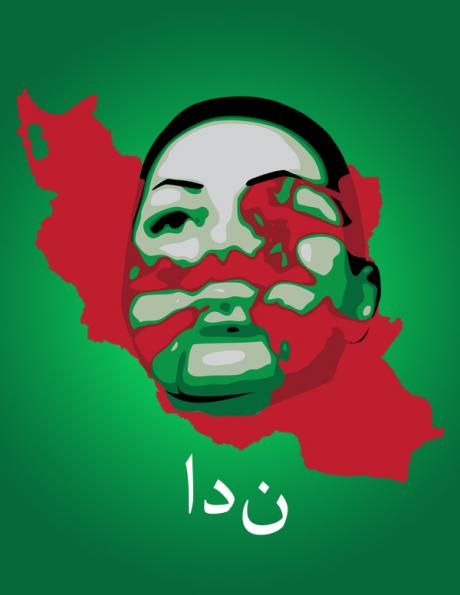
Back to the immediate future - 23 June 09: I was informed on Facebook across the globe by my student Takanori Ogasawara in Aomori Prefecture: 'The movie of the moment of Neda's (ندا آقا سلطان) death are so shocked. We receive the full benefit of peace here in Japan. On the other hand, on the another side of the Earth, a lot of people are dying.' The face of a woman, Neda Agha-Soltan, a philosophy student shot by a Basij militia sniper, on 20 November, dying in the street, was sent by an attending doctor's mobile to a contact in the Netherlands who put it on

the web from where it was picked up and relayed on live-blogs, flickr, facebook, mainstream media, wikipedia to be printed on placards in Iran. I'm just hearing a BBC R4 report in our kitchen at 13.26 23 June 09.
...and one of the most informed of commentators Iason Athanasiadis who spends a lot of time in Iran in The Spectator on 17 June 09 - cautious.
...and from Eric Margolis a sage warning about the higher-politics: 'In viewing the Muslim world, Westerners keep listening to those who tell them what they want to hear, rather than the facts. We are at it again in Iran...President Obama sincerely wants to enter into talks with Iran over its nuclear program and try to convince Tehran to give up enrichment. But hardliners in his cabinet and Congress are urging Obama to seize the opportunity to further destabilize Iran. Bad idea. A stable Iran is essential to a stable Mideast....US and British efforts to subvert Iran’s government could yet blow up in our faces.
...this on internet interception and this from Greek bloggers
[Back to the future -  22 June 2011: A More 4 programme For Neda]
[Back to the future - 14 November 2012: BBC News magazine 'Neda Soltani: 'The media mix-up that ruined my life'

Friday, 28 December 2007

Evaggalos Vallianatos joins up some dots

June Samaros at Kalamos books has referenced a blog by Evaggalos Vallianatos Through Greek eyes - views on hellenism and ecology. From Kephalonia, Vallianatos studied zoology, then mediaeval Greek history at Illinois and Modern Greek history at Wisconsin, going onto post-doctoral studies in the history of science and international development at Harvard. He's held US government jobs concerned with the environment and worked as an advisor on sustainable development at the United Nations Development Programme - chief interests Greek history, global environmental and agriculture. He's unleashed an informed polemic in the Hellenic News of America, linking the fires in the Peloponnese as shown on satellite images to the final route of the Ionian Highway:
The August 2007 photographs of the National Aeronautics and Space Administration of burning Greece brought to light not merely the monstrous size of the destruction, but the equally monstrous planning of those striving to convert the country into a playground for rich Greeks and foreigners.

Filling the dots between the hundreds of fires in Peloponnese puts many of them within reasonable distance and direction of the Ionian Road, a multibillion-dollar highway scheduled to open within four years and connecting the cities Corinth, Patras, Pyrgos and Kalamata. The arsonists did the dirty job for private and corporate criminals who plan to invest in the now burned land. The Ionian Road meanders along unspoiled coastline and Olympia, easily the most beautiful region of the heartland of Hellas. The highway then moves from Olympia in the west to the southern region of Peloponnese.


What is made of this outspoken diaspora Greek? Speaking as one who has fought for urban green space and against predict-provide road building policies for years, I find his writing on land-use and the ravages of agri-business convincing. His appreciation of flaws in the contemporary Greek polity revolve around views he drew together in a 2006 book The Passion of the Greeks: Christianity and the Rape of the Hellenes (Cape Cod: Clock and Rose Press) after a June 2005 op-ed 'Greece: A wounded country and civilization' in Hellenic News of America:

Greece is always hurting me. It’s a country full of tragedy. Its fantastic ancient civilization, which gave light to the West, stands alone because Greece remains outside the cultural borders of the West. Having never had a Renaissance, Greece is behaving more like an Oriental religious despotism, allowing its clergy a license for power and corruption reminiscent of the dark ages. The result of having a Christian theocracy in Greece is that the country is paying little attention to its Greek history and cultural treasures. Everything is made from a foreign model — and in a hurry. Its Christian population has yet to understand its pre-Christian Hellenic achievement. Rather, it strives to emulate its European neighbours and the United States, barely tolerating its antiquities.
[Reference back in the blog]
* * *1316 GMT 27/12/07: A bullet for the throat - source of debate and public utterance; another for the heart - source of courage and love. A bomb for the electorate - democracy stunned. Reason sleeps.
* * *

Intermediary Greeks
How I like this library on my kitchen table, though what a distraction it is from doing the washing up, getting dressed, marking papers, taking out the rubbish, sweeping the drive, packing away the Christmas decorations, preparing the talk I'm giving Thursday evening about Handsworth Park, completing a tax return, doing my share of the housework, and...and. I just found a piece written a while ago on the website of Iason Athanasiadis, a journalist based in Tehran which advances my understanding of Greece, but also of Iran - so pivotal in the landscape of international apprehensions. Athanasiadis grew up in Athens, read stories from 1001 Nights by his mother - mentioning in particular Sabah the Sailor (who I've long enjoyed by the name of Sinbad the Sailor):

...Being Greek makes me a quasi-insider: We have been present as a regional power from antiquity through to the Byzantine Empire. Later, as Christian subjects of the Muslim Ottoman Empire, the Greeks were its bankers, merchants and diplomats to the European West.

The switch of allegiances to the West only came in the 19th century, after the Great Powers helped Greece win its War of Independence. There is still residual mistrust over the Crusaders' sacking of Constantinople on their way to Jerusalem and the lack of help sent by Genoa as the Turks scaled the capital of Byzantium. After World War II, Greece remained firmly within the Western orbit and became the first line of defense against the Soviet Union. In the post-9/11 world, Greek politicians have continued the tradition of the intermediary, most notably when former Greek foreign minister and Colin Powell confidante George Papandreou passed messages from the Bush administration to the Taliban prior to their overthrow. Greek construction companies were trusted by Arab leaders to construct much of the Gulf's infrastructure, build clandestine military bases in Libya, and erect palaces in Saudi Arabia complete with secret escape routes in case of an antimonarchical revolution.

A fine example of the "intermediary Greek" is that country's current ambassador to Baghdad. Panayiotis Makris was educated in Alexandria's Victoria College, speaks fluent Egyptian Arabic, packs a pistol in his leather briefcase, and lives resolutely outside the Green Zone. A 17th century tapestry depicting Alexander the Great's death in Babylon dominates his living room in the kidnapping-scarred diplomatic district of Mansour. His professional performance is likewise infused with an historical perspective. As he points out to visitors, Alexander died just 10 kilometers from Baghdad; "We're the only country that has the right to offer lessons in democracy around here," he quips in a barely concealed barb at the American mismanagement of their Iraq occupation.

Greece's man in Tehran similarly draws heavily upon history in his dealings with Iranian officials. His enthusiastic and repeated claims that Greece and Iran share 5,000 years of shared civilization may owe more to Athens' dependence on Iranian oil imports and an innate proclivity to exaggerate than to historical fact. But the excellent ties between Greece and Iran reveal how important a shared cultural background is to a bilateral relationship (extract)
Odysseas Elytis, speaking of his work in 1972 said, in a longer talk:
... You always look somewhat puzzled, I notice, whenever I contrast Greeks with Westerners or Europeans. This is not a mistake on my part. We Greeks belong politically, of course, to the Occident. We are part of Europe, part of the Western world, but at the same time Greece was never only that. There was always the oriental side which occupied an important place in the Greek spirit. Throughout antiquity oriental values were assimilated. There exists an oriental side in the Greek which should not be neglected. It is for this reason that I make the distinction.
* * *
Read this for the sweetest funniest 'thing' - my waging peace award for 2007 'Η κοινοτοπια τοθ κάλοθ'

Back numbers

Simon Baddeley