Total Pageviews

Showing posts with label Robert Holland. Show all posts

Friday, 12 June 2009

Ένoσις - 'so perilous an experiment'


I'd been told by a British friend, some years ago, in one of those generalisations filed under 'conjecture - revisit', that Corfiots were fiercely proud to be Greek but sustained a certain sense of superiority over other Greeks. Our dear young Hellene friend Nancy, from Patras, did mention, when we were happily debating politics at table this January, that some Corfiots (and presumably some inhabitants of the rest of the Septinsular) felt that in abandoning the Protectorate in 1864, the British had delivered what could have been an independent Ionian Republic into the hands of the Greek Monarchy, embroiling them in the machinations of Athens.
I suspect that it will necessary first to understand the machinations of Britain and her agents. I expect this to bring uncomfortable revelations about what went on in the Ionian Islands under our 'amical protection' - notwithstanding roads, education, cricket and sin tsin birra (echoes of Life of Brian on "what have the Romans ever done for us?"). Original sources offer direct insight but, subliminally, they draw a student through time, so that one finds oneself wandering in another dimension. A reader invents the voices of fiction in their head. Film-makers pre-empt such imagining. I've travelled thus before when pursuing research. As ever it depends who writes the history and what interpretations most credibly explain the motives and actions of individuals.

From Warlike England as seen by herself (1915) by Ferdinand Tönnies - insight into British foreign rule from a great sociologist
I will ever revert to Anglo-Hellenic relations because my necessarily sober study of texts is driven by inchoate emotions. At times what I thought was Greece turns out to be my reflection in a foxed mirror. I'm neither detached nor disinterested. I'm mindful of Kevin Andrew's passion for Greece, in whose seas his life ended, undimmed by a rare fury at 'uncritical, unquestioning adherence to the revolting shame of lesser people’s stupidity, cynicism and cheapness' and Byron, his heart buried in the Hiera Polis, writing, in a burst of vexation, that 'there never was such an incapacity for veracity shown since Eve lived in Paradise.'

In the National Archives reading room at Kew: British Colonial Office records for the Protectorate of the Ionian Islands
On only my second visit to the National Archives, last Thursday, I focused on the months between November 1858 and late Spring 1859, getting the hang of ordering documents on-line, remembering to put pens in my bag in the downstairs locker chained by my folded bicycle, requesting a desk, swiping my reader's card at security, collecting documents - one file at a time - from the glass-doored locker with the same number as my computer allocated desk space, collecting the polystyrene forms to support thick heavy volumes, donning white cotton gloves to turn pages...

Sir Thomas Wyse, author of Impressions of Greece, was British Minister (or ambassador) to Greece, sending reports on local affairs back from Athens to the Foreign Office in London since his posting in 1849. On 2 December 1858, in a dispatch to the Earl of Malmesbury, Foreign Secretary in the government of Lord Derby, Wyse describes how, on the evening of 24 November, he'd just left a party given by Ozeroff, the Russian Minister to Greece, when a young employee from the Hellenic Foreign Office called Typaldos arrived with the news 'that the Ionian Islands had been ceded to Greece'.
..the dance ceased…groups were to be seen in every direction congratulating each other, especially amongst the younger portion of the company on so unexpected and auspicious an event.

This news may have come attached to reports of William Gladstone's extraordinary mission to the islands (journeying from England by train through Dresden, Prague and Vienna to Trieste where he took the paddle steamer HMS Terrible down the Adriatic, arriving in Corfu on 24 November [see p.367 in this ref] reporting the magnificent Albanian landfall we've several times enjoyed - the Karaburan Peninsular then called the Acroceraunian mountains). The day after news broke of unification, people in Athens had started ...
... to hesitate as to the advantages of the change. The more sedate and experienced did not see that either party could gain much by the proposed union. Others went so far as to express apprehension of immediate danger to the monarchy and dynasty, from annexing their turbulent neighbour little used to the restrictions of genuine Hellenic liberty...(The Ionians) couple with the hope of such annexation, the means of establishing by their audacity or preponderance, a new state of things in Greece, involving in some of the theories, a radical alteration, not in the constitution only, but in the dynasty and Monarchy of the State...The time is not yet ripe, it is added, for so perilous an experiment. It would be not so much an annexation of the Ionian Islands to Greece, as of Greece to the Ionian Islands...(FO32/263 ~ p.165)

Letter from Sir Thomas Wyse to the Earl of Malmesbury ~ 2 Dec 1858
Background: The news that broke at Ozeroff's party was of course a rumour, since union with Greece did not actually occur for another five and a half years on 21 May 1864. Gladstone, over three months in late '58, early 59 had sought to convey to Ionians - in ways and for motives I'm trying to understand - that union with Greece was, for the time being, unrealistic. Inclined towards self-rule, he became convinced that a catalogue of complaints against the Protectorate could be attributed, in part, to the style of the previous Commissioner Sir John Young who had recommended an Ionian partition converting Corfu and Paxos to British colonies, ceding the remaining islands to Greece, in part to inbuilt flaws in the Maitland Constitution of 1817 that corrupted prospects of evolution towards self-government, making the Ionian Protectorate, a Colony in all but name, and unready for the 'home-rule' he perhaps hoped to seed (echoes of Gladstone's later preoccupation with Ireland) or union with Greece which he came to doubt was really what local people or the Greek government really desired. Having ensured the departure of Sir John Young, Gladstone sailed away from the islands on HMS Terrible, leaving a reform package for approval by the Ionian Senators that would strengthen Ionian conservatives, weakening radical pressure for enosis. But his successor Sir Henry Storks was left to face almost immediate rejection by the Ionian Assembly of Gladstone's proposals as well as continued demands and petitions for union with Greece. Thus we enter the last five years of the Protectorate.
Gladstone, during his twelve week Ionian mission had visited Athens to sound the Greek government and court on the idea of union. On 13 December 1858 he wrote to Edward Bulwer-Lytton, Secretary of State for the Colonies under Lord Derby, noting ‘divided sentiment’ about union in the Greek Kingdom - something ‘feared as well as desired’. It is exciting to see the signature and writing of Gladstone dotted about the records, but although it’s referred to in Holland and Markides as being in CO136/165 I couldn’t find it. That file starts in January 1859 where I did find a letter marked 'most secret' from Sir Henry Storks to Bulwer-Lytton, a few months after Gladstone's departure for England on 19 February. Sir Henry matched Gladstone and Wyse in conveying Athenian ambivalence about extending the Hellenic Kingdom to the Ionian Islands:


Sir Henry Storks at the Palace, Corfu, to Sir Edward Bulwer-Lytton
Downing Street, London ~ 9 April 1859
'No doubt the King of Greece would find the inhabitants of these islands very difficult to rule, and in many respects superior in attainments, and less docile than his own subjects, but still territorial aggrandizement, and the commanding strategical and maritime position of these islands, are objects of ambition which the Court of Athens is not likely to underrate...'
...adding a full measure of jaundice towards King Otto, Queen Amalia and their court.
'It is my duty to acquaint you that I have heard from sources in which I have confidence that little reliance is to be placed in anything the King or Queen of Greece, or the Ministers may say on the subject of the annexation of these States to the Kingdom of Greece. I believe there is an undercurrent of intrigue fanning the flame here, and that the chief movers are Greek agents. (CO136/165 ~ p.645-646)
***
Dropping in on the Scrutiny offices at Southwark Council in mid-afternoon I mentioned my visit to the National Archives. As I left, Rachel one of Shelley's colleagues, explained how security at the NA had, through its focus on preventing documents being stolen, overlooked the possibility of them being introduced. Some rogue had sneaked in fake correspondence to prove that Himmler, rather than committing suicide, had been murdered by British agents. The fake letters intended as evidence (scroll down this URL to see) were printed on a 'high resolution laser printer', written by someone risibly incapable of imitating official circumspection, a bit like those ridiculous, but at least technically clever, Meegeren imitations of Vermeer. But then Trevor-Roper was initially deceived by The Hitler Diaries, to which Richard, knowing his le Carré, adds "unless it was double bluff."
* * *
  Email from Ayios Markos:
I forgot to comment on your learning Greek. It can be hard, or it can be fun, depending on the teacher and the teaching methods. I found it more fun and learned more when I taught myself. There are some advantages to having the teacher though, such as pronunciation and grammar. When I took classes I found it too frustrating. There were a couple of times I had to grab the teacher by the throat. She kept me sitting across the table so I wouldn't grab her. Ha! She is my very dear Greek friend here.
There was a rather comical incident up here in Agios Markos. They are working on the road, cutting a trench for water pipes. This, of course creates more problems for the already narrow street. Consequently, there was major frustration by the bus driver who was having a problem getting through. He called and complained to the mayor, who then called the police and they came up and wrote tickets on 30 cars! Each costing €80. Everyone was up in arms. They have been parking there for nearly 20 years without ever being told it wasn't legal. They all embarked on the police department in a rage. The mayor was red faced and admitted he might have made a mistake. Last I heard they were told not to worry about it, and today I noticed they were all, once again, back in their old parking places. Don't you love Corfu? The Greeks are as much fun as the italians. Love, X
* * *
Organization for Security and Co-operation in Europe (OSCE) meeting in Corfu under the auspices of Dora Bakoyannis near Gouvia.
Forwarded email: I see there’s a big summity event at the end of the month in Corfu. Everyone get ready to be hustled off the road by large cars with flags, and off the sidewalk by burly gentlemen with ear pieces. Here comes the cavalry...
Reply from H: Yes. I heard from the neighbor. Hillary Clinton is coming! [she cancelled] Actually, as much as I would love to see her, I would rather not be around with all the police lining the streets. I've experienced it before when a dignitary came to town. We've been amused at the things they've been doing to the main roads. You would not believe all the painted white lines! You will laugh when you see them. And also cats eyes, which are already popping off. Ha!
And a call via Indymedia to protest at the implication of Fortress Europe
 * * *
Back to the future ~ 16 June 2009 re the Iranian Election result: I think I and many others may, at last, take Twitter seriously seeing its use along with mobile phone photos to evade attempts to silence those challenging the poll. See this witty lass on YouTube where she speaks of things in Iran and of Twitter ' the so-called "death of attention span" medium (2.26).
See also Iran: Nation of Bloggers plus accompanying comments. It reminds me of the way the mobile phone circumvented attempts by leaders of the 1991 August Putsch in Russia to control the media and the telephone network.
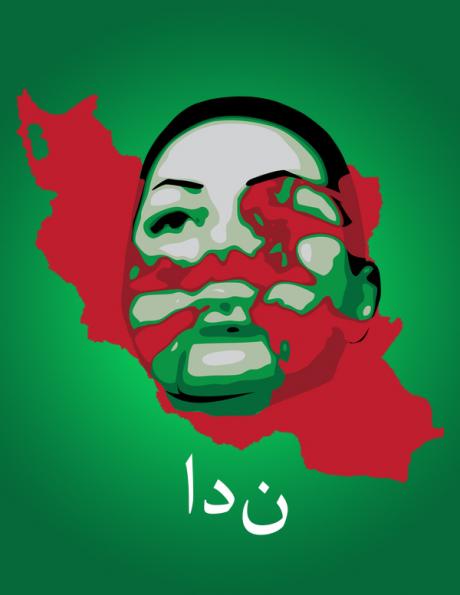
Back to the immediate future - 23 June 09: I was informed on Facebook across the globe by my student Takanori Ogasawara in Aomori Prefecture: 'The movie of the moment of Neda's (ندا آقا سلطان) death are so shocked. We receive the full benefit of peace here in Japan. On the other hand, on the another side of the Earth, a lot of people are dying.' The face of a woman, Neda Agha-Soltan, a philosophy student shot by a Basij militia sniper, on 20 November, dying in the street, was sent by an attending doctor's mobile to a contact in the Netherlands who put it on

the web from where it was picked up and relayed on live-blogs, flickr, facebook, mainstream media, wikipedia to be printed on placards in Iran. I'm just hearing a BBC R4 report in our kitchen at 13.26 23 June 09.
...and one of the most informed of commentators Iason Athanasiadis who spends a lot of time in Iran in The Spectator on 17 June 09 - cautious.
...and from Eric Margolis a sage warning about the higher-politics: 'In viewing the Muslim world, Westerners keep listening to those who tell them what they want to hear, rather than the facts. We are at it again in Iran...President Obama sincerely wants to enter into talks with Iran over its nuclear program and try to convince Tehran to give up enrichment. But hardliners in his cabinet and Congress are urging Obama to seize the opportunity to further destabilize Iran. Bad idea. A stable Iran is essential to a stable Mideast....US and British efforts to subvert Iran’s government could yet blow up in our faces.
...this on internet interception and this from Greek bloggers
[Back to the future -  22 June 2011: A More 4 programme For Neda]
[Back to the future - 14 November 2012: BBC News magazine 'Neda Soltani: 'The media mix-up that ruined my life'

Thursday, 11 June 2009

I'm on the train

At last Virgin have equipped their coaches with WiFi and I can stop reading books and get on the internet as I travel. Is this good?
I've decided to immerse myself further in Protectorate records at the National Archives so cycled from home to New Street this morning at five - Birmingham streets to myself and a few street cleaning and refuse trucks - with a return ticket to Kew Bridge Lin has got me off the internet for just over £25. So we've bought into yield-management after my initial dislike of the service. From Euston, surrounding bus stops crowded as a result of a Tube strike, I cycled over the Thames to Waterloo Station and caught a train to Kew Bridge arriving at the National Archives by 0830 when the coffee shop opened.
Instead of continuing to scan through the 1862-64 papers relating to the end of the Protectorate, where I've been hoping to find clues to the 'petition' from Ano Korakiana against enosis, I'm going to have a look at the 1858-59 Colonial Office records covering William Gladstone's mission to the Ionian Islands and Athens, following, for the time being, in the prominent footsteps of Holland and Markides. It's not always a good idea to leaf through material without a more specific goal, but I shall allow myself that for the moment and see what turns up.
In the afternoon I shall head over to Southwark Town Hall to discuss Scrutiny with Shelley Burke who we've invited to do the final session on our 5-day Post-grad module on Oversight & Scrutiny (see p.15 in the PDF from CfPS May 2008 Newsletter.
* * * Email from Ano Korakiana:
Yassou Simon and Linda. Just a quick note to let you know how the swallows are getting on...as you can see by the photo all 5 eggs hatched and all of the young are doing just fine. Both parents are as busy as busy can be fetching the young ones food. Managed to get mum feeding them on camera ( I know it's mum as she has a shorter tail than dad or was it the other way round?). Weather here has gotten hot as to be expected. Hope you are both well. Mark
The swallows over Mark and Sally's front door in Ano Korakiana

Wednesday, 5 March 2008

Searching for the petition from Ano Korakiana

This book- The British and the Hellenes: Struggles for Mastery in the Eastern Mediterranean 1850-1960 by Robert Holland and Diana Markides [see Richard Clogg's review in The TLS 20/6/07]- has taken ages to come, but I'm delighted it's at last arrived, having awaited with the same eagerness as once, as a child, I anticipated the insertion through our letter box in Hampstead, weekly comics inside a roll of newspapers for grown-ups. In those days - the 1950s - I could smell the newspaper and especially the print - some of which came off on my hands. This book from Oxford University Press is well made, so even though the modern paper is outside my olfactory range I get a faint smell of the binding glue, at least that's Lin's diagnosis, after I'd passed the pristine book across the kitchen table for her to sniff. First sentence:
Greece, Lord Palmerston once remarked, was an 'emotional word'.
The chapters that especially interest me are those linked to the cover image of a troop of British soldiers emerging from the Old Fortress of Corfu, a watercolour, circa 1850, by George Savage MD. Between pages 13 and 80 are Chapter 2 - Gladstone and the Greeks: The Extraordinary Mission to the Ionian Islands, 1858-1859, and Chapter 3 - The Abandonment of the Ionian Protectorate, 1849-1864. At last I get to learn that Gladstones' journey from England to Corfu lasted from just over a fortnight from 8-24 November 1858 via Vienna relying on train, and steamer down the Adriatic (pp.22-24) and he left Corfu on 19 February 1859 on HMS Terrible for Trieste having toured the Ionian Islands and had talks in Athens during his twelve week visit to Greece. I like these kind of details because although I do not expect a reference in the book to the actual document I seek for Thanasis and Kostas I feel closer to the level of detail that I will need to dig around among primary sources at the Public Record Office at Kew. I think I can get there on 12 March. I phoned this morning and chatted to a friendly librarian. Adrian, who did some swift searches through Colonial Office Records in the ranges suggested to me by Eleni Calligas in her e-mail of 14 January 08:
I would suggest that the best place to look is the High Commissioner's Correspondence at the Colonial Office archive of the Protection, housed in the Public Record Office, now re-named National Archives but still held at the Kew. I would look at the last couple of years, from 1862 onwards - probably starting from CO136/177 to /184. If such a petition does exist and is signed by inhabitants of the village, it would be interesting to identify the local figure of importance, as the initiative probably emanated from there.
He was finding the same things I'd found. The level was too high and I need papers from villages, as described by Thanasis and Kostas in their letter of 5 December '07.
Dear Simon, It is said that before the Union of the Ionian Islands with Greece (1864), inhabitants of Ano Korakiana signed a "paper" asking the British Government to keep the islands under Britain...We have been looking for this paper for years at the Greek archives without result. We wonder if you can help us by searching this paper in British archives (Parliament, Colonies archives, Foreign Office etc). We are sure that one of the names that signed the paper is Panos, Panayiotis or Panagiotis Metallinos (Μετταλινος). He was the 'leader'. A similar paper has been signed by inhabitants of Kinopiastes (another village in Corfu) and one village in Zakynthos island... [Note from the Ano Korakiana website: The oldest families still existing in Korakiana are ... Savvanis (since 1473), Vradis, Mandilas, Ionas, Markos, Metallinos, Laskaris, kaloudis, Linosporis, Reggis, Balatsinos, and finally, Kendarchos and Kefallonitis during the first half of the 16th century.]
I need to turn up with ID and proof of residence and then I can do some searching there and even order copies of documents. I'm not sanguine about finding any of these papers at once. They are reported, orally, as having been delivered to Sir Henry Storks, who, as a career administrator, took over from Gladstone's Extraordinary posting to the role of Lord High Commissioner of the Ionian Islands, and stayed in that post until the Protectorate ended in 1863. I don't know if the so-called 'papers' or petitions are in English or Greek or both; in print or writing. * * * I've been travelling, as usual, for work - London, Cardiff, Brighton, Stafford, Lowestoft, Norwich in the last few days. A glossy brochure (page 8) for my May workshop in Australia has arrived describing a session at the LGMA national conference at Gold Coast. I'm introducing a workshop called IT TAKES TWO TO TANGO: GETTING THE POLITICAL-MANAGEMENT LEADERSHIP ROLES RIGHT:
Executive leadership in local government requires a recognition of the ambiguity, confusion and tension that arises at the overlapping boundaries of political and managerial spheres of action. In this workshop designed for elected officials and senior managers, Simon will show video extracts from a small sample of chief executive and elected member conversations to explain how politicians and managers in the UK jointly create government - a perennial puzzle of increasing consequence for the sector.'
* * * Meantime several local concerns have arisen over Handsworth Park and Black Patch Park, at recent evening meetings of my neighbours. The community centre on the Black Patch has been closed down but ill-secured for over 18 months so that footballers have no changing room and there's no meeting space for local groups to meet. An e-mail from our secretary, Andrew:
Hi Simon. Sue contacted me this morning about the community centre and I've been down myself this afternoon to have a look. Someone has been inside and broken windows from the inside - also Sue reported evidence that someone has tried to set the building on fire. She has been in touch with Sandwell MBC and the Fire Service. I couldn't get in so the doors appear to be secure but entry via the roof might still be possible. Sue is wondering whether we ought to contact the press about this. Sandwell haven't made any attempt to repair the damage to the roof or taken adequate measures to secure the windows and doors. Our fears are that the damage to the building will become beyond repair! Best Wishes Andrew
While I've agreed, at a meeting of the Handsworth Park Association, last night, to try to get a local councillor to arrange a meeting with the developer and other interested parties over the extended delays in laying out seven acres of private green space to pass on to Birmingham City Council. Here's the basis for a draft letter to Cllr. Kim Brom:
Dear Cllr. Brom. I wonder if you can arrange, as a matter of urgency, a meeting with the developer of the housing on the Victoria Jubilee Allotment, our Community Planning Officer, the Chair of Handsworth Cricket Club, the member of the City's executive who has allotments and sport in their portfolio and the relevant Scrutiny Chair. Graham Winfield, current Chair of the Handsworth Park Association, phoned me in Corfu, saying how concerned he was at the delayed arrival of the very much needed extra sports facilities on the VJA site that were going to be handed over to the city on conclusion of the 106A. As it is a large area of valuable green space - grass seeded with some remaining hedgerows is just sitting there. I was well aware the implementation of the planning gain deal was delayed. The developer was claiming the agreement included a provision to delay laying out the allotments, playing fields and other elements of the agreed plan until they had disposed of 40 units of the 80 houses on the site. By last July they had sold 20 (their figures and these may not be accurate now). This provision was not confirmed by the Planning Department. The matter is complicated by the change of developer (under terms I don't know) from Westbury to Church Homes. I've raised this matter twice at Ward Area sub and other meetings. During 2007 we've had the continuing problem of the 'green pathway' that was agreed as being integral to the original plan but which cannot connect the site to the Park because there's a 'hostage strip' of private land between the fence and the park where that gate should be. It is the garden of one house garden designed in by the developer which effectively means we have a public gate to nowhere and therefore makes the path impossible - so that what we feared and spoke strongly against, is a separation between the Park and the VJA site's recreational resources, and indeed the link between the park and the new housing. I understand the city planning department is, for the moment, not budging on this and even Alan Orr is unhappy about it. What the committee make of it when it is presented to them I don't know and perhaps a 'fudge' has been privately agreed that we don't know about. There's problem brewing here. The worst case involves the developer goes broke or selling to another developer who then lobbies to have more of the site to build cheaper homes so they can make what they view as a workable profit from the site. Meantime the community loses not only the land already built on, but yet more green space, and the planning gain deal is rejigged to provide fewer allotments and sports space and the project to bring new allotments and sports space into the area as part of Handsworth Park, is delayed for years...
* * * Just before I left the house where we'd had our meeting I saw a dark hard-wood bust of an African woman, along with other items that Dlci told me came from an artist friend in Kenya. As I examined the bust, she showed me privately taken colour photographs of people lying dead in their church in pools of dried blood following one of the violent episodes spreading across Kenya. The art is a from a Kenyan friend. The photos were sent by her to raise money and to show what has happened to her neighbours and relatives. I thought, in my safety, of Kevin Andrews' reference to murder driven by :...uncritical, unquestioning adherence to the revolting shame of lesser people’s stupidity, cynicism and cheapness.' (p.185 The Flight of Ikaros) * * * One of my mentor texts came in useful the other day when I was arguing about what could and couldn't be taught about political awareness in government. I said I'd learned from the Meno about problems of teaching things no-one can satisfactorily define. "But" I said "you can demonstrate its existence" "I'll accept that" he said. "Conversation helps" I said "and knowledge". The Meno patently indicates Socrates' courage; the vexation amounting to rage his words induced in some, and the danger he faced for being so persistently awkward. With Meno, the young man in the eponymous dialogue about the impossibility of teaching virtue, is sometimes uncomfortable, but there's respect even amid Meno's bewildered consternation, but, near its conclusion, the Democrat Antyus is drawn into the dialogue. Socrates had been arguing that even Thucydides for all his qualities could not teach his children to be good:
SOCRATES: Now, can there be a doubt that Thucydides, whose children were taught things for which he had to spend money, would have taught them to be good men, which would have cost him nothing, if virtue could have been taught. Will you reply that he was a mean man, and had not many friends among the Athenians and allies? Nay, but he was of a great family, and a man of influence at Athens and in all Hellas, and, if virtue could have been taught, he would have found out some Athenian or foreigner who would have made good men of his sons, if he could not himself spare the time from cares of state. Once more, I suspect, friend Anytus, that virtue is not a thing which can be taught. ANYTUS: Socrates, I think that you are too ready to speak evil of men: and, if you will take my advice, I would recommend you to be careful. Perhaps there is no city in which it is not easier to do men harm than to do them good, and this is certainly the case at Athens, as I believe that you know. SOCRATES: O Meno, think that Anytus is in a rage. And he may well be in a rage, for he thinks, in the first place, that I am defaming these gentlemen; and in the second place, he is of the opinion that he is one of them himself. But some day he will know what is the meaning of defamation, and if he ever does, he will forgive me. Meanwhile I will return to you, Meno..
At no point in this conversation has Socrates spoken evil, though Antyus had already reiterated contempt for Sophists - paid teachers of wisdom. How I loath sentences that include "if you take my advice", let alone the barely veiled threat "I would recommend you to be careful. Perhaps there is no city in which it is not easier to do men harm..."
[The images illustrating 'conversation' and 'knowledge' are from my research on the 'construction of trust' between politicians and administrators in government. They are in the public domain with permission from participants]

Back numbers

Simon Baddeley