Total Pageviews

Showing posts with label Lawrence Durrell. Show all posts

Wednesday, 27 March 2013

'...a kipper in the fridge'

I was wandering down a long low neon lit shed where I’d been told she was working. A slaughter house. I came round a post – on the edge of a series of stalls - and there she stood with a cleaver in her right hand hanging beside her, looking workmanlike in the low light. Forty years gone by; I was meeting her again, dressed in abattoir gear way down a long low shed. In the gloom I came upon her standing astride in her working gear; gumboots, bloody apron. I went up to her - wan but kind smiles - feeling very glad to see her. She smiled at me. But all over her face…didn’t want me to embrace her (not because of being rejecting) but because...
“I’ve got this skin thing”
Lots of little bubbles (like Job’s boils) but not, to me, at all disfiguring, just a texture. I was very happy to see her - not love but a companionably strong feeling of reconciliation. She looked exactly as I remember her; older as I’d expected, but not aged. We felt, tho’ it was not said, that this meeting in this charnel of dirt, congealed blood and entrails, was highly amusing. There were no dead animals – just fleshy mess strewn about; lots of work going on. L glanced down. I followed her gaze. On the bloody straw at our feet a small baby, lusty and fine. I wanted to pick it up and hold it for a while. She was fine about that but …then I woke. It felt a good dream.
*** *** ***

And then the most marvellous thing as glorious us the most beautiful thing - as elusive as the end of a rainbow and as real - the wondrous land; 'a sophism to believe that there is any strict dividing line between the waking world and the world of dreams',,,
'You enter Greece as one might enter a dark crystal; the form of things becomes irregular, refracted. Mirages suddenly swallow islands, and wherever you look the trembling curtain of the atmosphere deceive. Other countries may offer you discoveries in manners or lore or landscape. Greece offers you something harder - the discovery of yourself...(We) for example, are confined by the sense of several contemporaneous lives being lived inside us; the sensation of being mere points of reference for space and time...' (Lawrence Durrell Prospero's Cell)

I came back from town after giving blood where Gracie, my nurse, and I chatted about the effect of the weather on trying to plant vegetables as well as her seventeen chickens. She asked me more about my folding bicycle, on which, well clothed, I'd cycled into town. Our driveway is icy and hazardous. I can't find the salt. Our gnome is snowed in.
On the kitchen table Lin has left me a note.


I boiled the kipper gently and served it to myself with a fried egg - mingling herring and yoke and ignoring its tiny bones. A friend wrote 'Your kipper note immediately put me in mind of one of my favourite poems by William Carlos Williams about iced plums. "This is just to say..."'
I have eaten
the plums
that were in
the icebox
and which
you were probably
saving
for breakfast
Forgive me
they were delicious
so sweet
and so cold
We're packing, checking lists of cargo. But the weather has stopped me planting what I need to get into the soil of Plot 14. The cold is forecast to go on for weeks as high pressure over that benighted Denmark Strait draws dirty weather with biting east winds across all Europe, even down to the Balkans.

Plot 14 on the Victoria Jubilee Allotments
In Corfu it's still raining daily but the temperature's running around 14 degrees. Lin has arranged with Paul to remove rubble from our apothiki
Hi Paul. Just a question....Will the flattened rubble left in the apothiki be 'compacted' in any way? Thanks. Love Lin x
Hello Lin. We would normally tamp it down and apply water, then tamp again. If you let us know fairly quickly I can get it done this week. Love, Paul xx
Hi Paul, i did say to go ahead with the clearing of baza and levelling, so it would be great if you could get that done this week. However, we don't want the concrete done at this point, as funds are low and we have a lot of outgoings coming up. I'm going to say that again, as we've just had a complete cock-up by a builder over here, who didn't hear what I told him and has put the wrong windows in  my house!!!...We WANT the baza cleared and the levelling and tamping down done. We DON'T WANT the concrete put down. My daughter Amy and family are coming out from 12th till 20th April. It would be nice if you and Lula could come for supper while they're with us. Have you got a spare evening during that time? See you soon and looking forward to seeing the apothiki minus the baza mountain. Love Lin x
Our apothiki
The Band of our village was parading through the city as part of the Celebrations of Greek Independence - 25 March. Εικοστή Πέμπτη Μαρτιου ~ Anniversary of the Greek War of Independence Ελληνική Επανάσταση in 1821
                  Η δόξα
Στων Ψαρών την ολόμαυρη ράχη
περπατώντας η δόξα μονάχη
μελετά τα λαμπρά παλικάρια
και στη κόμη στεφάνι φορεί,
γινωμένο από λίγα χορτάρια
που είχαν μείνει στην έρημη γη΄΄
               Διονύσιος Σολωμός, Κέρκυρα
Ano Korakiana's band on Theotoki in the city - our neighbour's daughter Dimitra in front on left

Εορταστικό διήμερο αυτό που μόλις πέρασε… Κυριακή της Ορθοδοξίας χθές, με Λιτανεία στην πόλη της Κέρκυρας, στην οποία συμμετείχε η Φιλαρμονική μας… Εθνική εορτή σήμερα, εορτασμός της απελευθέρωσης από τον οθωμανικό ζυγό και το πρόγραμμα της ημέρας περιελάμβανε: δοξολογία στον Άη-Γιώργη, κατάθεση στεφάνων στο Μνημείο της πλατείας, συμμετοχή της Φιλαρμονικής στην παρέλαση του χωριού από κοινού με το Νηπιαγωγείο και το Ειδικό Γυμνάσιο, όπως και στην παρέλαση της Κάτω Κορακιάνας και της πόλης… Παρά τα πολλά μποφόρ.

(My translation) Gala weekend has just passed...Sunday of Orthodoxy yesterday, with a procession in Corfu Town, attended by the Band...our National Day today, celebrating liberation from the Ottoman yoke with a programme that included: thanksgiving in Ag. Georgios, laying wreaths at Monument square, participation by the Philharmonic in the parade through the village together with children from the Kindergarten and Special School, to match parades in Kato Korakiana and the City ... all this amid gales.
**** **** ****
Notes from Jan D on what's happening to local democracy:
Osborne's Budget clearly demonstrates how economic policy drives ideologically inspired policy objectives, especially ‘rolling back’ local councils (in the government’s eyes probably the least desired part of the public sector; lowest of the low). To ensure that Total Managed Expenditure is kept as low as possible the so called ‘unprotected’ services have been squeezed disproportionately hard and of course local government expenditure is a large part of the overall unprotected total expenditure. To bring public finance back into balance, public expenditure has to fall from 45% of GDP to 38% - a massive drop. With no growth, or tax increases, the only option is further cuts and in a disproportionate way which hits LAs hard. Whitehall has done better than LAs. If Total Managed Expenditure overall had fallen at the rate of local councils then it would have dropped from £694 billion in 2010 to £632billion by 2014. In fact it will have increased to £720billion. If Whitehall had reduced its spending at the same rate as LAs then the public sector deficit would have been around £35billion. Instead the figure will be £120billion. This demonstrates the distorted relationship between Government and LAs and how our masters value, or not, the two so-called 'partners'. Given the near non-existent LA tax base it is difficult to find much to be cheery about when looking at Local Democracy and how it can be put on a firmer footing (when we are all skidding down the hill!). If you want further proof at the Government's contempt for local democracy look no further than their response to the Communities and Local Government Select Committee: ‘The Government is quite clear that councillors are and should be volunteers and does not wish to see any move towards professionalism through becoming full time’ Local councillors should ‘not qualify for extra allowances to make up for lost income’. Graham Sharp, the former housing minister and Tory party chairman likened calls for additional allowances to paying scout leaders for voluntary work. Councillors are also going to be banned from inclusion in LA Pension Schemes.
Thus do we blight and diminish the prospects of local leaders, so that when our councillors prove less than adequate, as now and then they do, it’s they who get the calumny and not the authors of the new feudalism – Ministers and MPs with salaries, expenses and perks and final salary pension schemes. This is hypocrisy of the highest order – a demonstration of how deeply undemocratic some MPs really are, not to say arrogant and offensive. This is the beast we are dealing with.
Unless some of these issues find their way into Political-Managerial relationships the future is bleak but how to do it require some reflection and finesse. To illustrate further the Parent-Child relationship, look at how the Heseltine recommendations are being implemented. First of all, the Sponsor will be a civil servant rather than a minister and then Local Economic Partnerships (LEPs) will be banned from contacting their Sponsor directly and can only do so through the local official of the Department of Business, Innovation and Skills. Perhaps capturing this absurdity in fiction or play format could better convey the reality of the current state of play than a more formal academic approach.
If there ever was a time for Heroes or Sleuths it must be now. The more I read of the literature and history of the Weimar Republic the more relevant and real it becomes. It wouldn't be that difficult for a ‘perfect storm’ to arise.

Friday, 4 November 2011

Ακόμα...

Christina Fernández, President of Argentina, at the G20 Summit*
Results of the Euro Summit agreed at the end of October...
1. An agreement that should secure the decline of the Greek debt to GDP ratio with an objective of reaching 120% by 2020. Euro area Member States will contribute to the PSI package up to €30 billion. The nominal discount will be 50% on notional Greek debt held by private investors. A new EU-IMF multiannual programme financing up to €100 billion will be put in place by the end of the year. It will be accompanied by a strengthening of the mechanisms for the monitoring of implementation of the reforms.
2. The significant optimisation of the resources of the EFSF, without extending the guarantees underpinning the facility. The options agreed will allow the EFSF resources to be leveraged. The leverage effect of both options will vary, depending on their specific features and market conditions, but could be up to 4 or 5, which is expected to yield around €1 trillion (around $1.4 trillion). We call on the Eurogroup to finalise the terms and conditions for the implementation of these modalities in November. In addition, further cooperation with the IMF will be sought to further enhance the EFSF resources.
3. A comprehensive set of measures to raise confidence in the banking sector by (i) facilitating access to term-funding through a coordinated approach at EU level and (ii) the increase in the capital position of banks to 9% of Core Tier 1 by the end of June 2012. National supervisors must ensure that banks' recapitalisation plans do not lead to excess deleveraging.
4. An unequivocal commitment to ensure fiscal discipline and accelerate structural reforms for growth and employment. Particular efforts are being deployed by Spain. New strong commitments on structural reforms have been made by Italy. Portugal and Ireland will continue their reform programmes with the support of our crisis mechanisms.
5. A significant strengthening of economic and fiscal coordination and surveillance. A set of very specific measures, going beyond and above the recently adopted package on economic governance, will be put in place.
6. Ten measures to improve the governance of the Euro area.
7. A mandate to the President of the European Council, in close collaboration with the President of the Commission and the President of the Eurogroup, to identify possible steps to strengthen the economic union, including exploring the possibility of limited Treaty changes. An interim report will be presented in December 2011. A report on how to implement the agreed measures will be finalised by March 2012.
*** ***
In the Palais des Festivals in Cannes the Group of 20 developing and industrialized nations is discussing 3 options for how the IMF can help euro-zone governments finance their debts...

Option 1:  IMF creates Special Drawing Rights - IMF reserve assets - to be handed over to euro-zone governments. Those governments could then exchange them for euros at central banks around the world.

Option 2: Nations would put money in a trust fund administered by the IMF to ensure financial stability around the world.

Option 3: A call for governments to stop $280 billion of IMF resources - meant to be a temporary boost to deal with the crisis - being returned to government shareholders.
*the photo of the President of Argentina and Silvio Berlusconi at the G20 Summit is on today's front page of The Telegraph and is titled 'return of the leerer'
***
Waiting on the vote - ψήφο εμπιστοσύνης έλαβε η κυβέρνηση 
...and I hear on the radio at 2300 GMT that Papandreou has won the confidence vote he sought from his colleagues and Parliament.
*** *** ***
Strathnairn, Inverness-shire
I've been strolling in Strathnairn with my mother's dog Lulu. I flew from Birmingham to Inverness yesterday morning, after a supper at Henry'sin the Jewellery Quarterthe evening before with my friends Kim and Tanya. The three of us have been treating ourselves to a shared supper for over ten years, catching up with our separate news, wondering about the world. We spoke of families, of my future grandson, the world, of bankers' salaries and bonuses - Tanya said "read Oliver James' Affluenza" - of the tent village in front of St.Pauls Cathedral and 'Occupy Wall Street'...
...of a neighbour sinking into dementia, of the news that close friends had been woken in the night by police to search their son's room with the news their boy was in custody facing a prison sentence awaiting trial accused of being culpably associated with someone who'd committed a knifing, of Jamie's Great Britain - a foodie celebration of British hybridity, of a dear friend's horse breaking a leg and having to be put down, of children's marriages and about becoming grandparents, of the cost of things, of the dwindling availability of credit and its complete disappearance in Greece, of Papandreou's referendum idea...
Martin Rowson ~ Guardian 4 Nov'11
 ...of Kim's decision to buy herself an e-book after coming across the latest Kindle, of looking forward to reading P.D.James' latest book Death Comes to Pemberley, of my reading - on paper - of Merchants of Doubt recommended by my American friend Tony Scoville (I spoke of the joy of taking up conversation with him again in Corfu after 45 years) of a friend who'd changed gender a few years ago - the full op - but said she was getting "tired of trying to be a woman" and has re-grown a beard "Such a relief to stop shaving"
"But is she still wearing skirts?"
"Oh yes"
"Do you call him-her 'he' or 'she'?"
"I don't know. But it's no problem. F's always been so interesting."
Lin was at home sorting through baby clothes, bought from storage, now and then holding up one of Amy's infant dresses; exclaiming
"Aah. Just look at that! Shame it's not going to be a girl."

**** ****
My email this morning to members of the Victoria Jubilee Allotments Association:
Hi. I’ve already run this idea past Peter (Hon Treasurer, VJA Assocxition) when he was walking in Handsworth Park a couple of days ago. We, Linda and I, and 5 others with voluntary work experience in the area have inherited unpaid responsibility for the Central Handsworth Practical Care Project (CHPCP). This is a handyman/woman project that uses a modern tipper truck carrying a variety of manual and power tools (chipper, chain saw, strummer, mower, drills, chainsaw, crowbars, posthole digger, etc) to carry out a wide range of tasks for vulnerable people in Handsworth. In August 2010 the project’s manager died unexpectedly leaving the care project without clear leadership and so without the means of seeking its regular funding - from grants and payments from larger social enterprises like Housing Associations - but needing to pay taxes, insurance etc. We were approached by a local councillor and others who had been involved in the project to see if we could help get the project back on its feet doing useful work in the area.  Over the past 6 months the voluntary group which includes Linda and myself have managed to ensure the project is solvent and able - we hope - by the New Year to recommence the local services (mending locks, doors, windows, clearing gardens, laying slabs, putting up fences, helping people move in and out of their homes, doing basic work on allotments and gardens, delivering and collecting heavy objects and other loads) for which it was set up over 15 years ago. Our immediate need is to find secure storage for ‘our’ tools and parking for the tipper truck - currently at a city depot courtesy of its manager. Chatting to Peter the other day I explored the possibility of being able to park the tipper on the VJA site and store the tools in the community shed with a view, if my suggestion is approved, of working in partnership with the VJA (with approval from Birmingham Allotments Section) to make the tools and tipper available to the association as part of a quid pro quo for secure parking and storage. We are confident it will be feasible to enable members of the VJA to use the project's tools - with proper training in the case of power tools (for which there is already a precedent on site) - and even to commission jobs that require the use of the tipper (carriage of compost, manure, building materials). The project already has a tradition of working in the area and with local agencies including the council and local housing associations. We suggest that a partnership with the VJA could represent a win-win arrangement, enabling work to be done on the VJA site while continuing the handyman/woman activities of the project across the area for which the project was already well reputed. I very much hope this proposal can be given consideration, and that we might be able to enter into a trial arrangement lasting - say - up until the end of the year to see if the mutual benefits I’m suggesting can be realised. I speak for the Voluntary Advisory Group (VAG) currently managing the CHPCP. One or more of us would be more than happy to present the above proposal in person and answer questions from members of the Victoria Jubilee Allotments Association, especially from members of the committee in the first instance. I very much hope you will give this matter your sympathetic consideration. We in the VAG believe that such a partnership is very much in line with current initiatives focused on community development in hard times. Yours sincerely, Simon and Lin
I suspect our greatest difficulty will be the rule maintained by the Council that motor vehicles may not be parked overnight on its allotment sites. I shall seek to press the view that in the current situation some of the old rules are subject to change. If the prohibition that used to exist on bees and chickens on allotments has been, or is being, reconsidered, then perhaps the idea of a charitable partnership with the Care Project might not be beyond the pale.
** ** ** **
I took the opportunity in the early hours when cyberspace seems less busy - or is it my imagination in this 24/7 world of the web - to stream another of my stepfather's TV films; an episode - or part episode - of Jack Hargreaves' series called 'Old Country' made for Channel 4 in the early 1980s. The cameraman is Steve Wagstaff. The starting title shows my stepfather leading his grey pony 'Ghost'. As usual much gratitude to the viewer who recorded it off-air at the time of broadcast and sent it to me on a CD.
"This is the bird, or rather it's a not entirely successful plastic Italian representation of the bird, which has been known to put up the price of Brussels Sprouts in England in a week - the Wood Pigeon."
*** ***
Jim Potts 1 Nov' entry on his Corfu Blues blog summarises and links a number of announcements of next year's celebration of the centenary of the birth of Lawrence Durrell (1912–1990), THE DURRELL SCHOOL OF CORFU will host a one-week seminar Wednesday 20 – Tuesday 27 June 2012, in the Durrell School premises at 11 Filellinon Street, in the historic centre of Corfu Town. The Moderator of this seminar will be Richard Pine, founder of the Durrell School (and now Director Emeritus), and author of Lawrence Durrell: The Mindscape
*** ***
Thanassis on the Ano Korakiana website, while announcing a blood donation session at 10.00 in the Co-op on Sunday 6 Nov «Ελάτε να δώσετε ζωή με το αίμα σας», points how heavy rain has washed away the cemented terrace supporting a car-park area, a problem which, with lack of funds, is likely to affect similar constructions. He uses the problem to take a swipe at the 'culture of cement' «πολιτισμός του τσιμέντου», suggesting dry stone walls or stones bound with mortar will last longer and better than substituted cement...
Δεν άντεξε τελικά το βαρύ φορτίο του τσιμέντου που εδώ και χρόνια κουβαλάει και η παλιά πέτρινη λιθιά στη στροφή του Μπή (κατασκευής Γιάννη και Μιλτιάδη Ιωνά πριν από πολλές δεκαετίες) έπεσε, με συνέπεια την «κούφωση» του οδοστρώματος, σε ένα σημείο που σταθμεύουν αυτοκίνητα. Εάν δε, δεν υπάρξει σύντομη αποκατάσταση, η ζημιά θα μεγαλώσει με τις βροχές του χειμώνα… Έτσι, για μια ακόμη φορά, ο «πολιτισμός του τσιμέντου» υποχωρεί, παρασέρνοντας μαζί του την παλιά μαστορική της πέτρας, που όταν μένει ανενόχλητη επιδεικνύει μεγάλες αντοχές στο χρόνο…

Wednesday, 13 June 2007

Rain in Brittany

From here to Perros-Guirec where we headed this morning to catch a sight of the famous pink granite the long showers drove in from the sea. If I can be outdoors in the right wear I like this weather as much as any, but Lin was a younger version of Giles’ gran in the rain – all in black, damp and pleasurably morose. We picnic’d in the car by a jetty at Grande isle, near Trébeurden, where we’d found a boulangerie open over lunch. I said small bakers were gone, but skeuomorphs survive as breadshops by having bread delivered each day from a regional bread oven, and selling patisserie, crêpes and chocolate and sometimes serving tea and coffee.

Dot and Arthur ever cheerful spoke now and then of ‘a break in the cloud’. It never came until we headed home and found roads beyond Morlaix quite dry. ‘I said we should have gone west’ grumbled Lin. By 5.00pm the sun’s shining brightly through the clouds. Dot’s well into on ‘Bleak House’. Lin’s nearly finished ‘Eleni’ and Arthur’s snoozing. I’m enjoying Robert Wilson’s ‘Hidden Assassins’ but I’ll go into Pol in a moment and use the WiFi and get some washing liquid. Durrell doesn’t go into details of the washing but the other humans in his households – not just select guests – are always in his plots, enjoined to conversation, questioned, listened to, teased, seduced, charmed; part of his enduring curiosity.

Yesterday was sunny. I suggested the dunes at Ker Emma – thirteen miles west. On the way I held to my opinion that there were no more ‘locals’ in the new Brittany. Lin, normally contrarian, agreed, then Dot said ‘There’s one’ and pointed to a silver haired dame on a sit-up-and-beg bicycle with a shopping basket on her handlebars peddling south in the traffic. ‘They have hundreds of these paid extras working for the tourist authority. There’ll be a priest along in a moment’ but the relaxed gendarme guiding traffic at the crossroads in St.Pol was dressed in a forage cap and light blue overalls – the new Brittany police working in partnership with the other Agences des Secours attending courses of the kind I run at home. A suitable extra would have come straight from ‘Maigret’ in dark blue with cape and kepi.

We found a spot on soft sand by two upturned dinghies where we could survey a crowdless beach, while enjoying Dot’s picnic. The horizon was hazed and bare; the traffic of the times rumbling above marking their passage with contrails that weft and warped into a diffuse weave of high cirrus.

Later, continental school time, brought a few parents with children and romping dogs to enjoy the strand. ‘It’s no good’ I said, playing to my misanthropy, ‘there are ten people within a mile of us!’. By the shore an oldish couple fished in the pale blue shallows, reeling in clumps of seaweed at intervals and chatting now and then. After she’d landed a reasonable flatfish they left.

We drove back to the old port at Roscoff, where crabs were being sold from a boat and dropped into plastic bags for a cluster of customers on the quay. At home I boiled an artichoke. ‘OK’ said Lin who’d melted my butter ‘but not special. It needs more cooking’. While the rest played cards I cycled to St.Pol de Leon, oriented this time by a bright setting sun and the Kreisker Tower. The WiFi at Hotel de France, where I had a coffee and cognac, revealed, via the BBC, a forecast of rain and cloud.

Perhaps, like the crowds, politics has gone somewhere else. ‘Youth bulge’, territorial injustice, global interpenetration of populations and their ideologies means war is diffusely retailed from conspicuous and distracting hotspots. Do atrocious things with bombs to most populations and instead of turning on each other as the theory of terrorism claims we should, something else happens. I’m not sure what, but it’s as if a heating pot just won’t boil over like unwatched milk. Some of ingredients for repeating history – only worse – seem present but it’s as though we’ve seen so far into the heart of our own darkness in the last hundred years, and taught so many of our children what’s there, that we are now enjoying the equivalent of vaccination against the pox of war. Academic research into the roots of war and the means of peace may even have had an effect. Perhaps the recipe needs a spice more charisma or a big dollop of unemployment and perhaps my words could sound like that sentence at the end of the confident 1911 Encyclopaedia Britannica entry on 'anti-semitism' which suggests that the worst of this pathological social phenomenon is now past.

What would happen if there was a collapse of our economy is another matter - immunisation thwarted by virulent strains of resistant virus. Violence, including self-harm, is rampant in the homes and streets of prosperous economies, but it’s difficult, for those who’d like this, to spread it beyond localised gangs into wider collective aggression. What spreads on the web doesn’t easily download to the street – notwithstanding the radio DJ-spread phone-in rumours that helped ignite the short burst of violence in Lozells in 2005. There seem to be forgivers around – among people with every cause to be unforgiving, as well as those ready to apologise for historical wrongs. People demonstrate for conciliation carrying billboards that say PACE, hanging rainbow flags from balconies. We are earnestly concerned about domestic violence. We try hard to stop bullying at school and work – striving to understand its causes. The penetration of the state is strong, - CCTV, ID, DNA - its intelligence improving, but this penetration is not unpopular.

Alertness to state incursion may be paranoia and may not be. Look at me. I’m a friend in court to a bookseller, Lindsay H., arrested for showing a poster in his window saying ‘Death to the Invader’ and I’m to be a friend at a disciplinary panel to an interpreter accused of unprofessional behaviour in a case involving the Serious Organised Crime Agency. I report local cases of possible criminality to an e-mail network that has effectively substituted for Neighbourhood Watch and my daughter hopes to join the Police. In my professional life I earn money aiding a culture of coordination between the police and the fire and rescue services – one of whose senior managers told me a couple of years ago, before the tube atrocities, that his agency was effectively on ‘war alert’. My friend Lindsay sees this co-ordination as the new face of emergent fascism. He says, in the kindest way, that I’m one of their useful idiots.

Monday, 11 June 2007

At Kernovel, St Pol de Leon

Delighted to find a free and instantly working WiFi connection at the Hotel de France in the centre of St Pol de Leon and so sat with laptop and coffee, a friendly dog and aimiable proprietor while Lin and her parents provision us at Leclercs.

There was har in the Channel. The ferry sounded her fog horn at the start of the seven hour crossing from Plymouth to Roscoff. Visibility improved but the cool drove us inside, where we had expensive snacks to a background of competing muzak.
The gîte, just south of St Pol de Leon, is one of three attached to a farm of exemplary efficiency called Keronvel. Madame Moal accepted our €150 deposit ushering us into an attractive accommodation of surgical cleanliness approved by a category of consumer who’s taste for hygiene is formed by commercials for cleaners that eliminate dirt and hurt it in the process.


Gone are the forlorn roofs of a rural population driven by globalisation to the cities and its colleges. I’ve not noticed small bakeries and bars on their last legs. They’ve faded away. Shining cars are everywhere, their landing zones expansive aprons around supermarch hangers ringing marketless towns whose coiffured centrevilles have signs to direct the new harvest to places for the kids, for gazing and strolling in reach of parking. Old churches have a new liturgy- the guidebook. At Keronvel - power to their elbows - the farmers have outbuildings for the likes of us (stables, workshops, accommodation for long gone labourers, converted to gîtes for Sat-Sat hols) but they’ve also found ways, with state help, to up their yield to compete with the world, investing in spacey glasshouses, cultivating Stepford vegetables that meet the exactions of bigbox procurement aimed at meeting the demands of those same dirt fearing car born shoppers.

After driving to a couple of places we found a path to a brambled shrubby point east of Carentec where we could see islets, passing boats, birds and strollers on the edge of the Morlaix estuary. Here Arthur and Dorothy strolled gingerly down a slope to a small sitting place where we picnicked, chatted, and later read. I found a place to recline in the foggy sunlight of a humid afternoon, woken by the buzz of a jetski looping in the sea below – two young people filling the air with the noise of their fun, that silly stream of water shooting up from the back like boys competing to pee up a wall.
I’ve just finished Lawrence Durrell’s ‘Bitter Lemons’ between a more leisurely read of ‘Prospero’s Cell’. They make fascinating reading, but I’m glad I didn’t read Durrell on Corfu before we came. We weren’t guided there by his suite written before the second world war. Our Corfu was one we saw first in September 2006. One that we knew would have piled layers on earlier accounts. I was given Gerald Durrell’s ‘Corfu Trilogy’ by Amy for Christmas. A thoughtful gift, but I decided it was a unreadable as the diary of a parent’s old lover – engendering a mix of disdain and jealousy. This is not Gerald Durrell’s fault. He’s an admirable human. I just don’t want to look to closely at what his Corfu has become, preferring to enjoy our affair without reminders of her past lovers and their pleasures. His brother I can read - now. Corfu, like Cyprus later, separated from him as he became focused on universals, while Gerald stayed involved until he died, sharing apprehensions about the ecological blight attending the great spread of equality in travel. Lawrence Durrell is seductive. ‘Somewhere between Calabria and Corfu the blue really begins.’ His first line on Corfu and the last in that first paragraph ‘Other countries may offer you discoveries in manner or lore or landscape; Greece offers you something harder – the discovery of yourself.’

I am slightly less interested in his landscapes (the same difficulty I have with Gerald – mine not the author’s) than in his reflections on Greeks – heroic, cowardly, impulsive, generous, intrigue-prone – and their complicated feelings towards the English, especially where intimate local bonds – family, love, friendships - were drawn into larger pots stirred by bigger spoons. On such things Lawrence Durrell - who would be odd if he were not something more more difficult than his writing - brings grief close to the surface now, because experienced before but written after, and published even later, they are pregnant with unexpressed emotion – ‘not conscious of separation’ ‘regret so luxurious and so deep that it did not stir the emotions at all’, ‘we never speak of it …’ he wrote in from Alexandria in the final chapter of ‘Prospero’s Cell’. This I suspect is the source of the keening unleashed to my startled impression at Cambridge, as I absorbed his Quartets from cover to cover and enjoyed in happy innocence the ravaged country, to which my post-war father - part stranger - introduced me with attentive love. I was told years later that Dad, the very model of an Englishman, caused amusement because he spoke such fluent 'mountain Greek'.

This delicate ground is being carefully sieved by Mark Mazower and his contributors. One of the names to whom the essays are dedicated is Mando Dalianis. Inside the collection is a chapter co-authored – apparently – by Dalianis and Mazower, ‘Children in Turmoil during the Civil War: Today’s Adults’. An endnote (p.104) records this chapter written by Mazower ‘based entirely on the published and unpublished work of the late Mando Dalianis.’ In July 1996, very ill, she’d delivered a monograph at Sussex University. In August Mazower visited her in Stockholm. Over a week they agreed to him bringing her work to wider notice. Dalianis’ life as a scholar - I’m sure she did many other things - began when ‘At five p.m. on Wednesday April 13, 1949, the heavy iron door of Averoff Prison was opened to admit me, and my name was added to the register of prisoner’s awaiting trial’. It was completed with the delivery of her paper 47 years later.

It is the greatest mark of character that an individual who inherits every reason to recycle their anger becomes someone through whom the evil men do is not passed on. Dalianis, a child and adolescent psychiatrist, followed the children and parents she encountered in prison for the rest of her life. She could easily have darkened her interpretation of what happened to these children imprisoned with their parents, then, as punishment to their mothers, fostered or sent to children’s homes. Never glossing the cruel consequences of the civil war and its worse aftermath, she concludes that recovery from trauma for most of the children was made possible through the occasional kindness of strangers, the conscientious nursing of extended families, the love of surviving parents, and the unprecedented opportunity that arose from Greece’s economic growth and urbanisation.

It is salutary for me to digest the fact that the sprawling ugliness that now blights Durrell’s exquisite landscapes has also meant ‘that in less than four decades, the animosities of the civil war had receded much further from the forefront of people’s minds and lives than anyone might have predicted at the time.’ (Mazower, op. cit. 104).

Such is the scholar Dalianis, whose good work was not with her bones interred. I’m grateful to Mazower for finding her. I would have liked to have been a witness to the collaborative week in 1996 that brought about this hopeful chapter – a tribute to all who, having cause to make war, make peace. [A detail: Dalianis wrote that the gate of Averoff ‘opened to admit me.’ Prisoners usually speak of gates that ‘closed behind me’?]

Saturday, 26 May 2007

The most pleasant place

From: Linda Baddeley Date: Sat, 26 May 2007 10:21:03 +0100 (BST) Hi George, Thanks for lending money till we get there. We owe you a drink or two! Thank Ben for sorting out the electrics. We owe him a drink too. Yes, we would like the window please. Good idea about the temporary plaka on the drain, but only if it's not going to cost much extra. Really can't afford to do things to be undone later. We're not rich like that lady you garden for! LOL Enjoyed seeing pics of arch jig. Shape looks good. It's looking so much better with that wall gone. I'll see if I can get any more info on sealing wood floors. Must admit that when we did one years ago in our previous house we just used normal satin finish polyurethane. Seemed to work OK, but don't know how long it lasted before it needed redoing. Could you give an estimate of how much we're going to owe you, so we can make sure we have enough to pay you when we come. You'd better add on the price of a saw blade! Thanks for keeping up the updates and pics. Regards to all. Lin
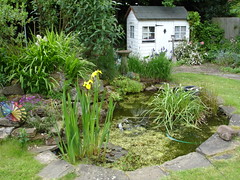
Big Pond Originally uploaded by lindabaddeley1.
As mid summer approaches and we are time richer the garden's looking good. Quite a lot of animals are living in or visiting. A young rat passes through on the scavenge driving the dog potty with its scent. Grey squirrels try to filch nuts from the birds. The occasional city cat passes along the gardens. The fish - orfe, koi, goldfish, tench - are stuck here, so we net their ponds against herons. The list of birds we've seen - Parakeets, Great Spotted Woodpeckers, (can't be bothered with more caps), jackdaws, rooks, magpies, great, blue and coal tits, hedge and city sparrows, an occasional thrush, a chattering jay, a wagtail, nuthatches, jenny wren, robins, starlings, blackbirds, fat wood pigeons, ring doves and - passing overhead now and then - Canada geese from the pond in the park. Our pond gives us dragonflies (but no frogs) and skaters and many other little beasts we don't see. The garden's full of insects, spiders and worms and snails and soon there'll be more butterflies to complement the bees. This weekend feels busy with a meeting later this morning of the Friends of St.Mary's Churchyard, followed by a wedding at Bethel United and one of my history tours around Handsworth Park - 'meet at the Park Lodge off Hamstead Road at 1300 on Sunday afternoon'. Yesterday I was doing a workshop for members of a Police Authority and some of its senior officers. Issues I suggested they consider: 1.Following the Police & Justice Act 2006 can Police Authorities develop a broader ‘conversation’ about service delivery with the public? 2.Central targets have created an Authority geared to delivering its performance figures to the centre. Can that process be about-faced? 3.By advancing their capacity for scrutiny, could Authority members have greater influence on the direction and nature of policing in the area? 4.How may Crime and Disorder overview, the spread of a habit of scrutiny among partners and ‘community calls for action’ influence relations between the Authority and the Service? 5.Can Authority members adopt techniques pioneered in Overview and Scrutiny, e.g. chairing, scoping, questioning and weighing evidence? Could scrutiny uncover the unknown unknowns? We noted a paragraph sent me by the person who'd invited me. It was in Mike Bichard's 2004 Inquiry into the murders of two children in an English village: '2.135 Nonetheless, the Police Authority appears at the time to have monitored police performance primarily by reacting to matters raised by the police themselves. Unless difficult or probing questions are asked about matters beyond those that the police choose to raise, no problem will be uncovered. There was, in my view, sufficient in the HMIC (Her Majesty's Inspectorate of Constabulary) reports to have caused the Police Authority to start asking more difficult questions. There is no indication that this happened.' These people - a mix of men and women between 30 and 60 (I'd say) were bright and conscientious sharing a wealth of experience. What a pleasure to work for such a group. I had a gentle row the evening before with a friend - a professor at Cranfield. She reflected perhaps no-one was to blame but the murderer; that Mike's remarks were perhaps untoward. I mentioned this on Friday morning. The most senior officer said "A difficult decision was made about what to do with information. What followed was consequent upon that judgement." As always I enjoyed cycling through London between rail stations on my way to this work. Being part brought up there I can't get lost in the capital. On my bicycle I travel almost as the crow flies, passing through static traffic like a butterfly, respecting those on foot, acknowledging the courtesy and skill of those who still drive in London, helped by the new cycle lanes. Lin's Mum just phoned to remind me to wake her for her Saturday visit to Cannock. The book I ordered has arrived. Lawrence Durrell's 'Prospero's Cell'. I've not read him since University ('The Alexandria Quartet' - spellbinding introduction to the same overlapping events told by different narrators; Justine, Balthazar, Mountolive, Clea). At the start of this 'Guide to the landscape and manners of the island of Corfu' written in 1945 Durrell quotes Anthony Sherley, His Persian Adventure 1601 'A Greekish isle, and the most pleasant place that ever our eyes beheld for the exercise of a solitary and contemplative life ... In our travels many times, falling into dangers and unpleasant places, this only island would be the place where we would wish ourselves to end our lives.' [Flickr news: 439 images and 117 members in the group I'm administering on 'International flytipping'.]

Back numbers

Simon Baddeley