Total Pageviews

Showing posts with label walking. Show all posts

Tuesday, 12 February 2013

Συζήτηση υια τις απόπειρες-διαρρήζεις

Alarm in the village about thievery, culminating in an attempt by two youths wearing hoods – according to those who chased them off - to break into the Agricultural Co-op. The masked miscreants fled into the woods above the village where they were pursued by hunters until two in the morning. Friday morning Cinty phoned to tell me there was a meeting to discuss attempted-burglary - Συζήτηση υια τις απόπειρες-διαρρήζεις - to be held in the upper room of the Co-op - Αγροτικού Συνεταιρισμού - at 7.00pm that evening.
“Are you going?” I asked
“Yes”
“I’ll go too and you can translate for me. Lin can stay and guard the house”
I was in the Co-op by seven. There were a good number present some of whom I knew. I chatted with the Chairman of the Co-op Sebastiano Metallinos who speaks excellent English.
“It’s a fuss that plays to the right wing elements” he said. “The chances are that most of the crime that’s causing the excitement is local, people from the village who know their way around. Why did those two bother with masks? It can be dealt with by having a word in the right place. This was how we handled a similar panic when I was a councillor a few years back. You find out whose up to mischief. You let it be known you know who it is. Perhaps pay a visit or two. Have a word in a few ears. It stops. The Right blame strangers and foreigners. We play into their hands.”
Cinty arrived at 7.30 knowing nothing would begin until around 8.00, when a panel - the President and members of the Local Council - Fokion Mandilis, Nikolouzos Charilaos and Spiro Tsirigoti, also the Deputy Mayor of Corfu, Fanny Tsimpouli, and Mr Papadopoulos, Mayor of Kato Korakiana’s Local Council - τον Πρόεδρο και τα μέλη του Τοπικού Συμβουλίου (Φωκίωνα Μάνδυλα, Χαρίλαο Νικολούζο και Σπύρο Τσιριγώτη), την Αντιδήμαρχο Κέρκυρας Φανή Τσιμπούλη και τον Πρόεδρο του Τοπικού Συμβουλίου Κάτω Κορακιάνας κ. Παπαδόπουλο.
The problem was acknowledged. The Mayor of Kato Korakiana spoke of the trauma of a break in that so scared his family his young lad wouldn’t go to the loo on his own for six months. The deputy mayor of Corfu – Fanny Tsimpouli – told the meeting that there would be two new police officers at a revived police post at Ipsos - επανα-ενεργοποίησης αστυνομικού στον Ύψο. €140K had been made available for this, so villagers wouldn’t have to rely on the police station – 15 kilometres away by road - at Paleocastritsa. Hardly had she sat down up stood a small succession of enragés – familiar at law’n’order meetings I’ve attended in Handsworth and Lozells.
“Why isn’t there a police officer at the meeting?” I whispered to Cinty
“He’d probably be lynched” she replied with a grin
The evident fact as in other places I know is that the police are very understaffed.
“..and that” declared Fanny Tsimpouli was “a political issue” which required the village to make a political response. She suggested a peaceful demonstration by villagers at the Tzavros T-junction on Monday. There was a call from the Chair for a show of hands. About a dozen arms were raised from among the 50 or so residents present. The enragés were swift to decry the futility of such an action, preferring to raise their voices and gesture at the panel for their failures.
“What are we supposed to do? If we catch someone in the act and hold him."
"Will the police even come?"
"And if they do, won't they make us let him go?”
These protests were received with murmurs of agreement around the room. Outside thunder came with a mighty clap. Rain leaked through the roof above the door, the main drips collected in a bucket. Much of the meeting served as a big safety valve for frustration and impotence. But as it proceeded, voices of reason became increasingly predominant...
...with astute questions about practical things like telephones, about neighbours keeping even more watch on behalf of their neighbours, and about the need to maintain dialogue with local government and the police; to have continued meetings to debate and share information on the village’s security in these hard times. The meeting ended with a good proportion of residents signing up to be part of a village watch, with no-one quite clear what that involved. I had really enjoyed being there, understanding far more than usual with Cinty's discrete translation and not relying on my reading of the colourful non-verbal dimension of such events.
Signing up for village watch

*** ***
Thursday 14 Feb: Cinty phoned me with the news passed on to her on Democracy Street by one of the residents at the Friday evening meeting that, partly as a result of the fuss that was made that evening, Corfu police have caught a gang of ten men made up of Greeks and Albanians who - allegedly - have been carrying out the burglaries and attempted burglaries, including the one on the Co-op, about which villagers were complaining.
*** ***
By and large villagers don’t go for ‘walks’ (βόλτα). My sister’s husband came to mum’s memorial service but seldom if ever came with her to the Highlands.
“There are wolves up there” he’d grumble
In answer to his question about what she actually did when in Scotland, she’d mentioned among other things “We go for walks”
“Where to?” he’d asked bemused, even a little disparaging. He’d made a similar remark about my liking for writing letters.
“Haven’t you got something better to do with your time?”
Long letters were one of the things I so enjoyed writing to mum. Now my paper lies with fountain pen and envelopes untouched. It may be an archaic thing I will one day explain to my grandson.
Lin and I have walked since our separate childhoods. In some UK census account ‘walking’ is listed as one of the favourite recreations of the British along with gardening and DIY. I don’t mean gardening to grow food anymore than walking, in the listed sense, is to go anywhere but back to where you started or that DIY is about saving money.
Walking down Democracy Street
We walk up and down and around Ano Korakiana, threading its maze of steep and winding allies where public and private space mingle between buildings fitted like jigsaw pieces to the spaces available; wood, tile, stone, plaster and concrete grown in a manner organic, and in beneficent contrast to the accursed ferro-concrete villas sprinkled suburban style across the Corfu countryside, raising their unsightly profiles above treelines, digging concrete footings into the roots of shattered olive groves. I know the street that runs through the centre of the village, its layered archipelago of different coloured asphalt like tundra glimpsed from a polar flight, manhole covers and those variations in breadth where experienced drivers know two cars can pass one another, perhaps folding a wing mirror for safety. But we have yet to discover all the tributaries that flow into Democracy Street, though we have become familiar with the twelve or so paths that climb up from almost parallel National Opposition Street Οδός Εθνικής Αντίστασης; several running to and from its four optional bus stops, with the longest – San Jacobo – running in paths and steps from the centre of Venetia down via a metalled section to the lower road, perfect for a long circuit of the village bounds. Others descend below National Opposition Street – normally referred to as 'the road to the sea at Pyrgi via Agios Marcos' – to another serpentine road that starts with a tight hairpin junction onto a steep hill at the eastern end of Ano Korakiana to a T-junction over a mile away on the road that connects the village to the main Corfu Town-Sidari Road. Along this road the other afternoon we took a hundred metre detour to Kiriaki Church...
Lefteri's plan for Kiriaki bell tower in 2010
... where our neighbour Lefteri first told us he was helping construct a bell tower. It’s done and the church repainted.
Nearby on a wooden telegraph pole we saw one of the regularly posted death notices - this one for Lefteris' brother who died in Athens only the other day.
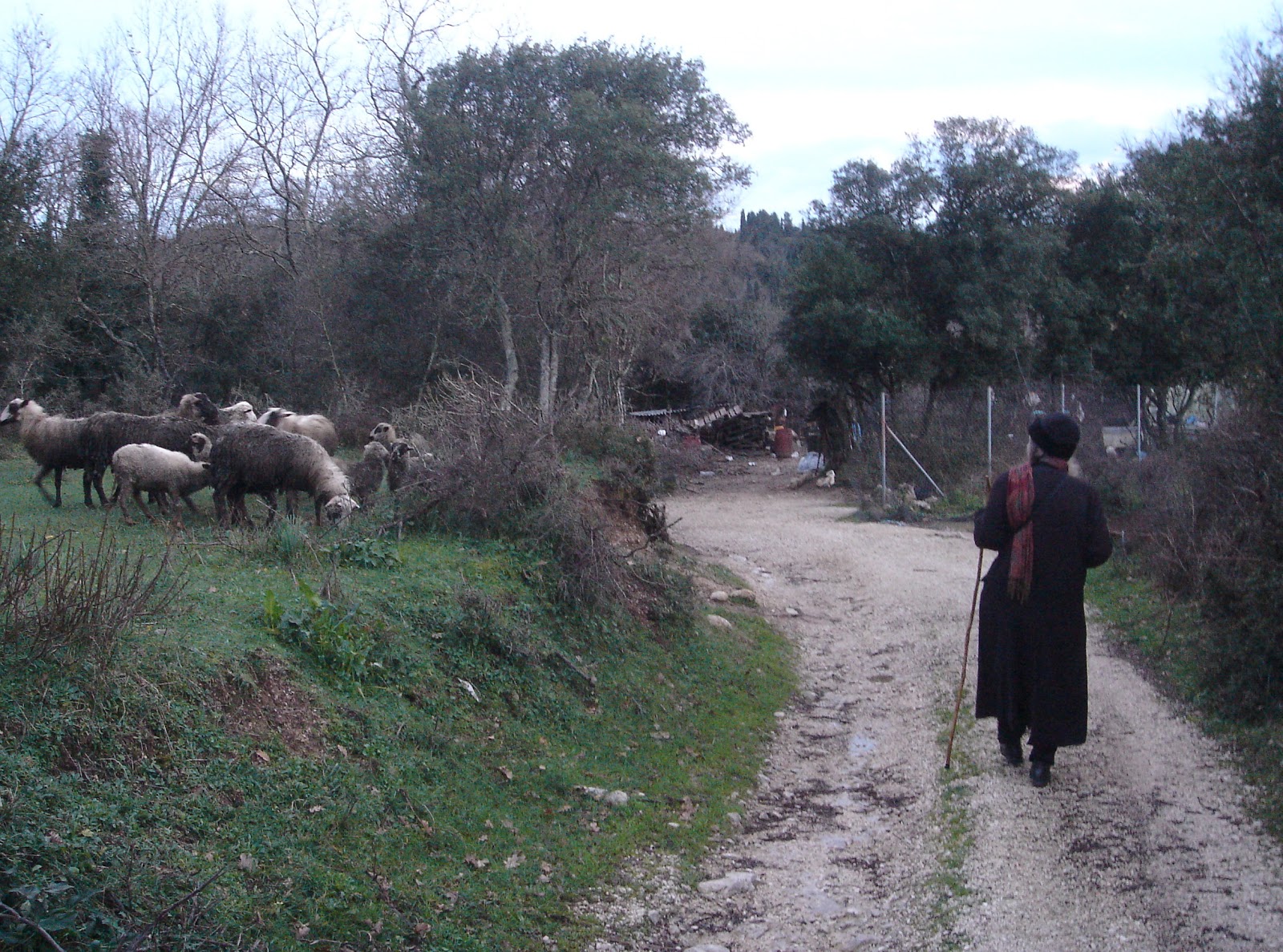
Walking further east into fields below we came across a scruffy flock of sheep who gathered at our passing.


On a turn at the western end of Democracy Street just beyond the shop there’s a narrow steep road surfaced with corrugated concrete that leads into Ano Korakiana’s west end, the area called Mougades. It has a traffic light to prevent impossible meetings of vehicles and leads through dense buildings to yet another road out of the village – one that passes through olive groves, high banked in places, descending about a mile and a half to join the Sidari road. I can hardly recall meeting a soul on this route out of the village. Advance a matter of yards left of the point where it meets the main road and there’s another road that goes a mile back into the village – ideal for a walk to where we started. A good thing about my attendance at the busy meeting last Friday is that more people recognise and greet us on our walks - including one of the angriest of those present who, as he worked in the garden in front of his house, smiled and waved in the friendliest way. 
"Γειά σου. Να 'σαι καλά"
*** ***
'Extremely urgent' notice on the village website
Εξαιρετικώς επείγον...| Εκτύπωση |
Γράφει ο/η Κβκ   
13.02.13
ΥΠΟΥΡΓΕΙΟΝ ΣΥΝΤΟΝΙΣΜΟΥ ΤΗΣ ΚΥΒΕΡΝΗΣΕΩΣ
karbav04022012b.jpg
Μετά τα αλλεπάλληλα χτυπήματα που δέχτηκε το χωριό μας από τις διαδοχικές παραιτήσεις του «Αρχηγού του Στρατού» και του Πάπα, ο Βασιλεύς, προ του προφανούς κινδύνου της αναρχίας, απεφάσισε να έλθη εις το χωριό μας εσπευσμένα.
Γι’ αυτό καλούνται όλοι οι μασκαράδες του χωριού να προσέλθουν στηναίθουσα του Συνεταιρισμού, την Παρασκευή 15 Φεβρουαρίου 2013και ώρα 8:00 μ.μ. για την οργάνωση των εκδηλώσεων, που θα πραγματοποιηθούν κατά το διάστημα της παραμονής Του στο χωριό μας.
Καθώς δε ευρισκόμεθα σε καθεστώς γενικής επιστρατεύσεως, καλούνται οι αρχηγοί των τριών όπλων να μεριμνήσουν σχετικά με τις χορηγήσεις αδειών προς τους καρναβαλιστάς.
Εκ του Γραφείου του Υπουργού

COORDINATING MINISTRY OF GOVERNMENT
After repeated blows received by our village from the successive resignations of "The Chief of the Army" and the Pope, the King, anticipating an obvious risk of anarchy, has decided to speed to our village. He therefore invites all villagers to attend at the Co-op from 8.00pm on Friday, 15 Feb 2013 and to help organise events that will take place during the period of these personages' stay in our village. In accord with 
traditional custom, the heads of the three armed forces will be invited to oversee the issuing of permits for Carnival. 


From the Office of the Minister

Sunday, 27 March 2011

Walking with Ghost

Jack walking with Ghost
From Mark Taylor: Hello Simon. Glad you got the DVD, hope you had a good trip home. No problem putting the clips on YouTube etc. Just arrived back from a work party in Hamsterley Forest and am about to collapse into a hot bath; brashing seems to get harder every year! All the best.
Dear Mark. Yes and I’ve been extracting films – some I’ve seen and some not. The first of these – for me – ‘new’ ones, has JH walking with his pony Ghost. I’ve streamed that with many thanks to you on YouTube. I take Jack’s point about not being able to learn much about the country from a motor car but all the same the tour you you took the trouble to give me after our lunch at Middleton One Row gave me, especially with your easy commentary, at least a sketch of a landscape I’ve only known, and at that briefly, through its famous towns. Do you know the proper name of that flower JH mentions at 05.00 -   “I’m always stymied when I come to tell you the name of it ...Q-W-I-N”? Part of his comment includes lines from Shakespeare – Oberon in Midsummer Night’s Dream in a wood near Athens: I know a bank where the wild thyme blows, Where oxlips and the nodding violet grows, Quite over-canopied with luscious woodbine, With sweet musk-roses and with eglantine... What I love about research - almost a vice - by the way, is that Jack says ‘grows'. That’s how I recall those lines. Looking them up in seconds on the memory-stealer Google I find it should be ‘blows’; 'grows' comes a line later. JH said that every programme he did harvested a proportion of viewers – some indignant - pointing out his ‘errors’. And here am I doing it it posthumously! Jack used to say that it was wonderful just how much knowledge there was out there. He was always learning from the people who wrote to him, sometimes ending up doing programmes with them. Having become pretty familiar with my collection – the DVDs I copied to you – it was a delight to see this one I’ve never seen before. I look forward to teasing out several more like that from your tape. I'll also be interested to see if Tony can extract a slightly higher quality picture. If not, never mind. It’s lovely to have these, and the search continues. Kindest regards and many thanks. I’ve put a picture of you and me by the Tees on my blog. (I’ve copied this email to other ‘members’ of our ‘JH Committee’) Best, Simon

"There's only one real way to get to know the country and that's on your flat feet." This is an episode from a broadcast of Old Country shown on Channel 4 in the 1980s. It was recorded at the time by Mark Taylor. Last week I travelled north to visit him in Yorkshire. He very kindly lent me a copy of the VHS tape he'd made of several of my stepfather's programmes over 20 years ago. I've sent his original video tape (this clip is uploaded from a DVD copy from a copied VHS tape) to Tony Herbert to be digitised optimally, just  to see if we can raise picture quality. I know however that we won't be able to achieve that until I can make wider use of the original 16mm film* in the archive in Plymouth, film which contains the outside sequences of Jack's programmes but not the sequences where he speaks to camera from his 'shed'. For these we do have sound - on 1/4 inch reel to reel tape - that must be married to the soundless 16mm film, made mainly by his long term cameraman Stan Bréhaut who's work for 'Out of Town' is to be recognised by the slight movement that shows, even when out a sea, since Stan worked with an old handheld Arri, which limited him to 100ft rolls of film - just over two minutes. This later film for 'Old Country' was the work of Steve Wagstaff. The sound tapes contain library sound effects and JH's commentary through whole episodes, but the only studio picture we have comes courtesy of viewers who recorded these programmes at the time they were broadcast.
In this episode Jack walks with his pony Ghost for pleasure in the countryside following downland routes used by the packers to move the wool staple, source of England's pre-industrial wealth, noticing things at walking pace. During the film he takes a few swipes at those who say they 'love the countryside' then stray no more than 25 yards from where they've parked their car. But privately Jack would confess to regarding that as no bad thing, what was much more distressing was the blighting of old green trails - the few that remain - by people having 'off-road fun' in recreational 4X4s.
*To see what can be done with the 16mm film here's an episode I've streamed on Vimeo of fishing off Littlehampton in the 1970s.  Even this is not the original, having been compressed to stream, but the promise of higher quality is there. The lack of studio sequences has been solved - in part - by using stills over my stepfather's commentary.
***
Lots of them there, but no friends or relatives arrested in London yesterday, nor gave cause. This was Politics for over a hundred thousand citizens not therapy for a few hundred idiots. (I do not include UK Uncut among the 'idiots'). Our friend Denise came round Sunday afternoon to chat about the Practical Care Project. She also told us about the TUC march in London on Saturday "There were thousands there - the postmen, the railmen, people from Wales, men in kilts. Our coaches parked in Edware Road. Long walk. Missed most of the speeches. They were played on the television in the coach on the way back." My nephews and nieces - Natasha, Anna, Eddie and Sam - were in Hyde Park and are posting prolifically on the web. One sent me this rap - some impressive rhyming, professionally done on NxtGenUK's channel....One comment: Anyone who rhymes "biggest beneficiaries" with "Lib-Dem Conservative policies" gets a thumbs up from me!


***
Sachiko Imai just posted photos on Facebook of her office after the earthquake. She'd written on 16 March: Simon...My prefecture Ibaraki is one of the worst disaster areas. In my case, water supply still cut off. Big quakes are continuing every one hour or so. And we have acute shortages of electricity, foods, and gasoline. In addition, my prefecture is bordered by the south of Fukushima prefecture where the nuclear explosion occurred. We must support them with great care. On the other hand, we are also taking care of our own nuclear facilities. The disaster scale is so huge. There is no end in sight. Of course, I would like to think the situation is getting better day by day. Now, as a member of the Ibaraki disaster countermeasures office, I am doing my best. I'd like to thank you for your concern again.  Sachiko
11 March 2011 ~ 1446 local time in Ibaraki
**** ****
Representatives of Ano Korakiana have expressed their strongest opposition to the proposed wind farm on Pantocrator, requesting the withdrawal of its planning permission. A resolution agreed on 19 March '11 has been addressed to the Ionian Regional Government and to Corfu Council arguing that the scheme will be damaging, not only to the environment of the village but of all Corfu (the translation links refers to Mount  Pantocrator literally as 'Almighty' - to lessen any confusion, and of course 'upper' refers to 'ano' in the name of the village. The translation also says villagers are opposed to renewable energy when what they actually say is that they approve it as an element of sustainable development. They do not regard the proposed wind farm as a contribution to sustainable development). The lower slopes of Mt Pantocrator begin above the village:
Τετάρτη, 23 Μαρτίου 2011
Ψήφισμα του ΤΣ Ανω Κορακιάνας ζητά την άμεση ανάκληση των αποφάσεων περιβαλλοντικής αδειοδότησης για το αιολικό πάρκο στον Παντοκράτορα
Το Συμβούλιο της Τοπικής Κοινότητας Άνω Κορακιάνας στην συνεδρίασή του στις 19-03-2011 αποφάσισε την έκδοση ψηφίσματος. 
Στη συνεδρίαση παραβρέθηκαν φορείς και κάτοικοι της περιοχής, οι οποίοι ενέκριναν ομόφωνα το ψήφισμα που έχει ως εξής: 
Λαμβάνοντας υπόψη:....
- Τις αδικαιολόγητα βεβιασμένες αποφάσεις που υπέγραψαν λίγο πριν από τη λήξη της θητείας τους ο πρώην Νομάρχης Κέρκυρας και ο πρώην Γ.Γ. της Περιφέρειας Ιόνιων Νησιών για την περιβαλλοντική αδειοδότηση του Αιολικού Πάρκου ανεμογεννητριών Παντοκράτορα, 
- Τις νέες υπό αδειοδότηση εγκαταστάσεις ανεμογεννητριών στην κορυφογραμμή του Κοράκιου Όρους, αλλά και του Παντοκράτορα, 
- Τις αρνητικές θέσεις που έλαβαν το περασμένο καλοκαίρι τόσο το Δημοτικό Συμβούλιο Φαιάκων, όσο και το Νομαρχιακό Συμβούλιο Κέρκυρας, 
- Το αρνητικό κλίμα που εκφράστηκε την περασμένη εβδομάδα στην κοινή σύσκεψη των εκπροσώπων των Τοπικών Συμβουλίων της ευρύτερης περιοχής που πραγματοποιήθηκε στον Ύψο, υπό την προεδρεία των δύο Αντιδημάρχων του Δήμου Κέρκυρας, 
- Το γεγονός ότι με κανέναν τρόπο ή διαδικασία δεν ενημερώθηκαν επίσημα οι κάτοικοι της ευρύτερης περιοχής για το θέμα, παρά μόνον «κατόπιν εορτής» 
- Το ότι όπως δείχνουν οι δημόσιες τοποθετήσεις όλων των τοπικών φορέων (συμπεριλαμβανομένου του Τ.Ε.Ε.), η αδειοδότηση χαρακτηρίζεται από σημαντικά κενά νομιμότητας και λειτουργικότητας και στην καλύτερη περίπτωση από εμφανή προχειρότητα και τέλος αφού κάνουμε σαφές ότι δεν είμαστε γενικά αντίθετοι με τη χρήση ανανεώσιμων πηγών ενέργειας στο πλαίσιο όμως μιας βιώσιμης ανάπτυξης, 
Δηλώνουμε τη σαφή αντίθεσή μας τόσο για το αδειοδοτηθέν έργο, όσο και για τα λοιπά προς αδειοδότηση αιολικά πάρκα, επειδή αυτά: 
1ον. Βλάπτουν τον οικισμό και την περιοχή μας, και υποβαθμίζουν την ποιότητα ζωής των κατοίκων, εγκυμονώντας ακόμη και κινδύνους για τη δημόσια υγεία, αφού μετατρέπουν την Άνω Κορακιάνα σε κόμβο διερχόμενων καλωδίων υψηλής τάσης και προσθέτουν στην ήδη επιβαρημένη ευρύτερη περιοχή νέους υποσταθμούς. 
2ον. Αποτελούν εγκαταστάσεις «Βιομηχανικής κλίμακας» και ιδιαίτερα μεγάλου όγκου και μεγέθους για τα γεωμορφολογικά και κοινωνικοοικονομικά δεδομένα όχι μόνο της περιοχής μας αλλά και ολόκληρης της Κέρκυρας, με συνέπεια να απειλείται εκτός από το περιβάλλον και το τοπίο και η ίδια η Τουριστική δραστηριότητα του νομού. 
3ον: Δεν δημιουργούν ορατά οφέλη για τον τόπο μας, παρά μόνο πολύ ορατές «βλάβες», ενώ το πιθανότερα είναι, μετά από μερικά χρόνια η περιοχή μας να παραμείνει γεμάτη με «άχρηστα κουφάρια» τσιμέντου και πυλώνων. 
Κατόπιν αυτών, ζητάμε από το Δημοτικό Συμβούλιο Κέρκυρας: 
- Να συνδράμει με κάθε τρόπο και να υποστηρίξει πολιτικά, νομικά και οικονομικά την αναπόφευκτη προσφυγή της Άνω Κορακιάνας και των λοιπών χωριών στο Συμβούλιο της Επικρατείας και 
- Να ζητήσει από το Γ.Γ. της Αποκεντρωμένης Διοίκησης την άμεση ανάκληση των αποφάσεων περιβαλλοντικής αδειοδότησης. 
*** *** ***
After my university friend Sue Pulford and I had sailed her across the Atlantic in 1965-66 I sold Young Tiger, to a pair of lawyers in Washington and started working - a harrowing transition from play to work that never suited me. My first job was at the Wharton School in Philadelphia processing data from consumer research into American beer drinking habits for Anheuser-Busch, open-plan desked beside a fellow assistant called Busch Maarbjerg (pronounced 'more beer'). It was just before the invention of electronic calculators. We worked - 9-5 (no more night watches) -
calculating standard deviations on large sample responses to forced choice questions using electric calculators. If you should be silly enough to try dividing a million by one on an electronic calculator the answer is immediate; on our state of the art electric calculators that would take about a day, wearing cogs. To be cruel, I'd leave mine rotating over lunch. The sea receded - down a tunnel becoming vignette picnics, promenades along beaches; wavelets viewed nine decks over the taffrails of rumbling ferries. I made myself forget Young Tiger, until 13 March 2007 - just before I began this blog -  when a Canadian yachtsman who'd found me on the internet confirmed he had traced the Westerly 22 designed by my mentor Denys Rayner in which two of us had sailed from Europe to Miami (Part 2). Lifted from the Chesapeake she was sat on a trailer in the Appalachian foothills of West Virginia, miles from the ocean. I felt sorry for her. By reports her owner was old, a little insensible, nursing a dream of unlikely voyages. Young Tiger was stuck in the woods. Bob, my kind Canadian friend who'd traced the boat, knew I'd thought of asking for the little plaque on her bulkhead mentioning the ocean voyage. This morning I got a kind email from him:
Hi Simon...Sean and Sara said they would get back in touch when they'd sorted out what they wanted to do. Apparently her father was a bit of a packrat and the boat itself is part of his stuff... I'll give Sean a call next week again. The last time we spoke they were in Hawaii. He was in Oahu but his accent was such that I didn't know what he was talking about at first. I think he thought me some sort of idiot not knowing where Hawaii was.  Hah! In any case I offered to assist them if they so wished. I also know of 2-3 people looking for a W22 who might be interested in the boat. Rest assured I will let you know any further news. All the best  Bob
Dear Bob. Lovely to hear from you and I sympathise with your gently expressed frustrations. Don’t worry about the plaque coming back to me. I have the most robust souvenirs in my head, not to mention the little Greek papier-mâché owl that hung happily inside Young Tiger’s cabin throughout our voyage to America. It would be so good if someone who appreciates her came to own her, but my business with Young Tiger is done, except for hoping to see a good succession. And of course I’d be delighted to correspond with any new owner who wants to take her to sea. Best Simon
Hi Simon. Oh, I made a career as a federal pubic servant and also spent quite a few of those years working with the UN for Canada. I am very resilient. I actually think things will sort out as they should- probably a left over perspective from working with indigenous peoples here and in Africa. My current work is once again with the Public Service coordinating 8 departments to cooperate with each other. I may write a book on this post retirement episode, "Zen and the Art of Herding Cats" Such is the democratic process at times. Bob
How I remember her
***
Sent off our Census form for 2011, completed on line.

Friday, 17 July 2009

Putting cycling on the map

I'm getting so much pleasure from reading Edward Lear's Journals of a Landscape Painter in Greece and Albania (1851), especially as a recent previous reader has jotted in the current names of some of the places Lear visits so that I can skim over the spectacularly underfurnished terrain of Albania with Google maps, thus Himarë which Lear calls 'Khimára, anciently Chimæra' p.144 View Larger Map
Explore Vlorë, Albania, starting from Himarë

To the unlearnt tourist, indeed, Albania is a puzzle of the highest order. Whatever he may already know of ancient nomenclature - Epirus, Molossia, Thesprotia, etc. - is thwarted and confused by Turkish divisions and Pashaliks; beyond these, wheel within wheel, a third set of names distract him in shape of native tribes and districts - Tjamourià, Dibra, etc. And no sooner does he begin to understand the motley crowd which inhabits these provinces - Greeks, Slavonians, Albanians, Bulgarians, or Vlachi - than he is anew bewildered by a fresh list of distinctive sub-splitting, Liape, Mereditti, Khimáriotes, and Tóskidhes. Races, religions, and national denominations seem so ill defined, or so entangled ... (Lear's Introduction)
Thus Lear's Aryhyrokastro (shown on the map just before his Introduction) becomes Argyrokastro in my 1911 Britannica and that, sought on the web, carries me to today's Gjirokastër, and with that easy monkey-leaping of the web, I learn of the Protocol of Corfu which takes me to the Autonomous Republic of Northern Epirus proclaimed in Argyrokastro - Gjirokastër on February 28, 1914 and lasting until 1921, the site of the Northern Epirote issue, alive to this day, as well as the equally confusing way the Albanian population is spread outside Albania, across neighbouring states that include the cities of Skopje in the northern part of the Former Yugoslav Republic of Macedonia, Pristina in Kosovo, and Podgorica in the southern part of Montenegro.
* * * 
Staff circular about Rescue Geography research prompted by Dr Phil Jones:
Hi, I'm doing a project looking at how people cycle to the university and wondered if anyone wanted to take part. Essentially it involves wearing a microphone and a GPS-wristwatch while cycling home, describing thoughts and feelings as you ride along. The equipment is lightweight and fairly unobtrusive ... more information. Thanks, Phil, Lecturer in Human Geography [Phil's blog]
Dear Phil. I've been going to and fro between home in Handsworth, via the city centre or via Rotton Park for over 10 years, often on the canal towpath. I think I'd enjoy participating in your research. Best, Simon
Hi Simon, apologies for the delay in getting back to you, I was away doing the Three Peaks last week. Thanks for volunteering. D... Essentially I'll pop across to you just before you head home, show you how it all works and then you cycle home as normal. When you get home you turn the recorder off and then I'll collect the equipment from you the next day. thanks again, Phil
Dear Phil. Oh dear I hope I got the technology working last night. My concern is the tedium for you of having to listen to my commentary as I cycled. I guess turning my impressions into words doesn't work for me so I was reduced to commenting on where I was which you'll have on the SatNav anyway. I realise that what I like so much about my cycling is the changing experiences - heard, seen and smelled as I pedal my way home...more sensed than spoken. All the same thanks for asking me to take part in your interesting research. Best wishes, Simon
Hi Simon, please find attached transcripts from the recordings you've made as well as the Google Earth (part one, part two, part three) file of your route and heart rate. Everything seemed to record very well; thanks for your perseverance on the technological side. Your commentary was really great - as I think you'll see from the transcript. There's some really nice stuff in there which I can pull out. I absolutely get your point, however, about things being sensed rather than spoken - it's that embodied/experiential stuff which really fascinates me about cycling. If you want to have a look through the transcripts when you've got a moment, send me any corrections/things you would like removed. When you're happy, I'll match up the words to the GPS and post a spatial transcript up on the website. Thanks again for your participation. cheers, Phil

Dear Phil. Nothing I want to censor, so long as you ignore the SatNav evidence of how I walk on water and leap over high buildings. People aren't supposed to know (:)). I'm impressed with the speed at which you've completed the transcription. Best Simon
Hi Simon, excellent, your superhero status is safe with me! Have put your spatial transcripts up on the site as participant #06 …Thanks again for your help. cheers Phil
Phil is doing quite a few of these. It's an undramatic repeat of the panoptical world in Enemy of the State or Body of Lies with geostationary satellites about twelve and half thousand miles above me noting my every move give or take a few metres. Then Phil can link my route to the data from a heart rate monitor and a voice recorder, so that I can click on any of the route markers or the numbers in the map margin and see what my heart rate was at that point in my ride as well as anything I said. I would imagine that a talented poet, conversationalist, singer could make rather special representations of their journey - a cyclist's songline, linked to an idea that I'd first heard of via Bruce Chatwin's book about the Aboriginal Australians' ways of singing their way across the continent. One of my favourite intellectuals, Rebecca Solnit wrote she'd often wished her sentences
could be written out as a single line running into the distance so that it would be clear that a sentence is likewise a road and reading is travelling ... the songlines of Australia's aboriginal peoples are the most famous examples conflating landscape and narrative. The songlines are tools of navigation across the deep desert, while the landscape is a mnemonic device for remembering the stories: in other words the story is a map, the landscape a narrative. (2001) Wanderlust: A History of Walking
It brought to mind a journey long ago - my own navigation - traceable in memory.

'On the small-scale chart taped to the head of my bunk a slightly curved line seems to grow imperceptibly away from Africa and into the space of the ocean. As the days passed and merged, boredom was the least of our worries. We worked steadily through an extensive selection of books - Dante, Lawrence, Flaubert, Tolstoy and many lesser authors were read whilst one or the other of us lay sunbathing safety line attached, or down below propped in a bunk ... Every day now the tall clouds refreshed us with showers, but the wind blew more gently and we felt at home on the sea, carrying our horizons along with us...' A Voyage to America, 1966 Roving Commissions, London:RCC Press 1967 pp.19-20
Today I could be 'people tracked' all the way, unless I borrowed Gene Hackman's trick and put the gadget inside cooking foil...
* * *
I thought it only rained like this in Corfu
How it has rained this week - grey, wet and chilly. Usually I like such weather, but now it flavours the news; prompts moods.

An incident: black sedans, plainclothes, guns
Richard, in town with his camera, caught a glimpse of a man dragged from his car, pushed to the ground at the end of Waterloo Street, held at gun point, then released. Amy reassured me:
The photo wouldn't have been illegal even if it was not fuzzy. I don't know about the incident as we use a different radio channel to the firearms unit. Although the most likely reason is that someone reported seeing the driver with a weapon, so was stopped/searched and nothing found, meaning male was then released.
I often see herons by the canals these days but we've had a closer encounter - a visit to our back garden. Fish have been taken from our ponds. Lin put the plastic heron we've used to suggest to a real bird that the garden's taken. It was raining when I saw, through our kitchen window, side by side - the real and the dummy. Richard dashed out, The heron gracefully unfolded itself and was up and over the treetops in seconds.
* * *
I just read from June Samaras, with her superb website Kalamos Books, yet another vandalising of Jewish graves in beautiful Ioannina ... the latest in a long series of anti-semitic desecrations, this time on Sabbath 9 July 2009. This YouTube clip referred to vandalism in the same place a month earlier. The mainstream press seems to ignore these activities which are only reported in the Jewish press - my impression from web surfing the subject; most worrying is the inertia of the relevant governmental authorities in connection with:
...the widespread practice of the 'burning of Judas' with pictures from the events often taking place alongside the church 'Resurrection' or other religious services, explanations of its meaning, occasional mentions that it is also called 'burning of the Jew.'
If there’s a job, food on the table, good neighbours, good books and companionship, depravity loses its edge, hate becomes a grumble. My self-referential ego ensures that worries about the world are but a mirror of worries for myself, and when I’m content, surrounding dreadfulness sits like those meniscus'd raindrops perched, almost apologetically, on the perfectly waxed surface of important people’s black sedans.
* * *
Here's some background to British National Party Leader Nick Griffin's "Camp of the Saints scenario" mentioned in the interview with the BBC on 8 July. Griffin has cultivated quite clever ways of speaking to the mainstream. He will duck and weave, assuring his hard core that he can still be trusted to fly the BNP flag, while sounding amiably reasonable in talking to fellow Oxbridge graduates on assignment for the BBC. He cuffs the elephant with the occasional slips of an experienced performer, enticing and vexing his audience. The classic legerdemain is 'denied-refutation' - admitting some of what was said, even seconds ago, while trimming meaning to the popular conscience - an unpredictable quantity politicians with risky ideas are always testing.
In this case Griffin, having suggested he approved a European force with powers to sink ships carrying sub-Saharan Africans to Italy, emphasised he meant giving people time to abandon ship and be thrown a life raft so they can "go back to Libya" - an afterthought that avoids disappointing those who'd approved his drift.
The liberals think "phew! He's not nice but he didn't mean actually drowning those people" while his followers are relieved that he's not going back on the case for 'sinking ships' and ... complete the sentence.
Refining this method Griffin teaches his party to develop a public language that evades liberal proscription while reassuring core followers and those who say "I'm-not-racist=but..." that a vote for the BNP is a sound committment to solving problems made insoluble by the feebleness of mainstream politicians. If Griffin becomes too respectable he risks losing the party workers all successful politicians need - canvassers, poster-stickers, leafletters, doorsteppers. letter-writers, phone-in followers and room-bookers. At microphones outside government buildings he exudes reasoned arguments on matters of public anxiety. He's a holocaust-denier, yet I could swear I've heard him agreeing that many Jews had died during WW2. He's spoken admiringly of Louis Farrackan, and - a boxing blue himself - he's expressed admiration for Amir Khan. At regular intervals Griffin tosses a meaty sound-bite to his attack-dogs, then skitters away from another well oxygenated mêlée. It's not quite 'plausible deniability' but it comes close.
The stakes are high. Global population grows, sea levels rise, and in our connected cosmos the chasm between rich and poor cries from the rooftops (literally - given the placing of satellite dishes), and in this distinction, rich means what in the rich world feels like poor - living, for instance, for under €10,000 a year.
I read the book just after it came out in early 1970s. I was disappointed expecting a thriller or a murder mystery, rather than a tract, but it was intriguing and I love a good argument so long as there's no torture involved. Jean Raspail the 1970s author of Camp of the Saints, a master text for the BNP, better written than Mein Kampf, commented on his novel about the swamping of 'the white race' at the hands of its own white liberal elites in cahoots with swarms of refugees whose ships they lack the fibre to turn away from their shores, let alone sink:
So, what to do? I am a novelist. I have no theory, no system nor ideology to propose or defend. It just seems to me that we are facing a unique alternative either learn the resigned courage of being poor or find again the inflexible courage to be rich. In both cases, so-called Christian charity will prove itself powerless. The times will be cruel.
Anyone who opposes Griffin, his allies and followers and those who are sure 'he's got a point' needs a rejoinder to this bold observation. One of the best is a piece For Polite Reactionaries by Charles Sugnet in Transition, No. 69 (1996), pp. 14-34: Indiana University Press. I get to read it via my university but I can't make it accessible which is a shame but a reminder to refine my own reasoning.
This is hardly about preserving the 'white race', even if you believe - as I and 99.999% of physical anthropologists do not - that humans are made up of separate species. So refutation starts by eroding that firm subjectivity, not helped by the classifying bureaucracies that require us to name our ethnicity - something many mistake for race, which then gets conflated with identity, especially when linked to self-esteem. Secondly the rich (richer) world comprises a multiplicity of ethnicities. We are already - rich and poor inside the boundaries of the first world - hybrid, mongrel, polyglot, diverse in skin colour, hair, religion, language, culture, and just about any other category named and yet to be named. The gap between objectivity and subjectivity in the matter of our heterogeneity and homeogenity presents a deep well of confusion and fear.
The ship that turns away the ship - or sinks it - if Griffin's way were approved, is likely to be freighted with the same diversity as its target. The difference is wealth not race but Griffin has a dream of a pure English race, finding it irksome that David Harewood, a rather obvious Brit from Birmingham who happens to be black, plays Friar Tuck in Robin Hood. Raspail is right about the consequences of the differences between them and us when it comes to wealth, but we are a world away from Raspail when it comes to distributing those pronouns on racial criteria. - but then I live in Handsworth, Birmingham and he lives in Neuilly-sur-Seine.
It's not as if the Hellenic population isn't as susceptible to these arguments about purity which is why I like the views expressed to me over a year ago by Lliana when she said she though that even if no Greeks were left in Ano Korakiana it would remain Greek because it's new inhabitants would adopt Greek ways, thus Isocrates:
...καὶ τὸ τῶν Ἑλλήνων ὄνομα πεποίηκε μηκέτι τοῦ γένους ἀλλὰ τῆς διανοίας δοκεῖν εἶναι,
καὶ μᾶλλον Ἕλληνας καλεῖσθαι τοὺς τῆς παιδεύσεως τῆς ἡμετέρας
ἢ τοὺς τῆς κοινῆς φύσεως μετέχοντας
(Ἰσοκράτης. Πανηγυρικός. 50.)
...and it seems that the name of the Greeks is no longer denoting a race, but a mentality,
and one should call 'greeks' rather the ones who participate in our education,
than those who share our common nature.
(Isocrates. Panegyricus. 50.)
It's interesting to pick out a blog called Hellenic Antidote. It's author propounds a Griffinesque interpretation of racial Hellenism, which requires a denial of the meaning Katerina Sarri attaches to Isocrates' words. One of the comments following Hellenic Antidote's circuitous arguments mentions the blogger's 'Germanic' version of Hellenism, a side swipe at the Austrian Jakob Fallmerayer's slavophobic theory as developed in his 1827 History of the Empire of Trebizond which, ironically, argued that modern inhabitants of Greece have no genetic connection with the population of Classical Greece. As my half-brother George once said at a family get-together "Ugh! We're not proper Greeks we're all a bunch of dirty Slavs. Yuk!" a cue to roars of laughter from our mongrel family and friends.

No mean city: Soho Road in Handsworth

Back numbers

Simon Baddeley