Total Pageviews

Showing posts with label dawn. Show all posts

Friday, 18 June 2010

Red sky in the morning

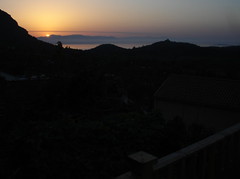
From Handsworth our son photographed a midsummer dawn
I'm miles apart in culture, experience and history from Tolstoy's character Levin but I was grateful to Google for recovering lines I remembered - vaguely - from the end of Anna Karenina, the part that has a happy ending for Levin and Kitty:
And Levin, a happy father and husband, in perfect health, was several times so near suicide that he hid the cord that he might not be tempted to hang himself, and was afraid to go out with his gun for fear of shooting himself.
It was those lines I recalled because as Tolstoy points out Levin has all that might be associated with content - a long loved woman as his wife, delightful children, material security, good health. Finding that memorable passage again I saw it was preceded by Tolstoy's speaking of himself.
All that spring he was not himself, and went through fearful moments of horror. "Without knowing what I am and why I am here, life's impossible....In infinite time, in infinite matter, in infinite space, is formed a bubble-organism, and that bubble lasts a while and bursts, and that bubble is Me." It was an agonizing error, but it was the sole logical result of ages of human thought in that direction...
War and Peace and Anna Karenina - Tolstoy's most majestic works; their indirect narrators Pierre Besuhov and Konstantin Levin - both embodiments of their author, sensitive to the charged implications of privileged status amid casual oppression, unrelenting servitude, the ebbing sea of faith, the improbability of God despite fervent attention to liturgy, holy text, observance of the rituals of penitence and devotion. Happiness harbours grim contemplation.
A damp day in Birmingham
The worst economic depression of our times is still not that obvious. History books compact the 'depression' into points on a time-line, an event with a beginning and an end; a word. I'm primed by distant reading to expect a contemporary re-enacting of sepia images; cloth capped queues, shuffling figures in ragged trousers on fluttery film glancing askance at a man with a camera, freeze-framed misery from the nation's family album. I'm a high latitude tourist cruising close to the sheer of a tidewater glacier from which chunks of ice crash into the sea, or, breaking away underwater, surge from the depths. Spectacular but not disastrous. All glaciers calve at the sea. Like peine forte et dure in which weights were gradually piled on the condemned there's no abrupt dislocation. Functionaries keep reminding semi-stupefied participants of the formidable seriousness of the situation...repeatedly...to a point where, like Giles Corey, we cry for "more weight!"
The process is unpredictable, probably inexorable, and because its woven into the present, nothing like the neatly composed narratives of past crises. Everything's mixed up; daily highs and lows obscuring a longer wave - mild until it steepens, curls, trips and breaks. We hear less about 'green shoots of recovery'; less about light at the end of the tunnel; more about changing our way of life, about hard times into the future.... and 'hard times' means? Our leaders avoid being drawn on detail. They can't surrender the appearance of being in control. Big projects are being abandoned, construction workers laid off as banks foreclose or governments cut. Middle class investment becomes negative equity. Nest eggs dissolve. Pensionable age advances. Pensions lose their value. Hospital waiting lists lengthen. There are fewer and lower benefits and concessions - like winter fuel payments; fewer government training schemes, fewer business start-up grants, more expensive care - for young and old. Less respite for carers. The mesh in the net grows wider, protecting fewer. Sovereign risk becomes normal. Failure the fault of the failed.
Latest from the Independent Treasury Economic Model - ITEM - interpreted by Ernst & Young - 'tightening of more than £48bn required to eradicate structural deficit...'
From the YouGov site these polls:

Consumer Confidence Trackers

Economy Perform Chart

Standard of Living Chart

Kathimerini 19/06/10 on the end of the Greek welfare state. See also 'Young Greeks' in LA Times 12/06/10 See Teacherdude's photostream from Thessaloniki - this for instance and the accompanying words...
Sometimes it's the little thing that show you how grim things are getting here in Thessaloniki, the long lines of taxis waiting at ranks for customers to turn up even in the middle of the day when up till recently getting a cab was next to impossible. Or perhaps its the accents of wandering street vendors who are now more likely to be people from the city than some recently arrived immigrants from West Africa or a member of Greece's Rom community. The city centre has become a near ghost town on week nights, a mere shadow of its former, vibrant self with cafes uncharacteristically quiet and empty streets, this in a place that prided itself on 4am traffic jams...
** ** **
As a PCSO Amy was a steward of public space - armed with her wits and connections via radio and CCTV to the police. Now, though still in training, she's becoming a centurion - with powers of arrest, doing intensive homework on the legal framework within which she must exercise those powers; armed in a literal sense, with a baton, handcuffs, pepper spray and a stab-proof tabard, techniques for interpersonal negotiation, self-defence and methods of 'taking down' someone resisting arrest - things I've learned about, not from my daughter who's discrete about her work, but from the internet and observation.
* * *
An informative overview of the Greek pension system and how it will be reformed.
Led by Prime Minister George Papandreou, lawmakers will begin passing legislation this month to overhaul the system, which the EU and IMF say contributed to the country’s debt crisis. Under terms of last month’s 110 billion-euro ($123 billion) (note: in UK a billion equals 100 million; in US it is 1,000 million) bailout agreement, Greece will increase the retirement age to 65 from as early as 58, curtail early retirement and calculate payments over a longer period of employment...The bill will be the first enacted by Papandreou’s government since the May 6 package that pledged 30 billion euros of wage and pension cuts and tax increases over the next three years.
* * * Aris & Katie on their blog are stirring greater curiosity about olives - in particular the suggestion that British understanding of olive oil is akin to our understanding of wine in the 1950s.
I said that, at heart, I'm not sure English people actually like olive oil. They like the idea of it, or the idea of liking it (like Kundera's "second tear"), but not the actual product. Hence the concept of extra-virgin olive oil- actually a very technical assessment of its acidity- is transmuted into a fetish for the wateriest, most pallid, flavourless liquid. Despite its fabled parthenogenic origin, any Corfiot farmer would rather a blowsy dockside strumpet of an oil than a timid virgin; though it would be a job to convince, say, Jamie Oliver, that cloudy green Greek oil is better than translucent bottled-in-Tuscany olive water...He said - I think astutely- that olive oil in the UK now is where wine was in the 1960s. We know it's a good idea, but we still think Blue Nun is the best the world has to offer. Corfu Olive Oil blog ~ 9 June 2010
Leftheris has educated me about some of the varieties. I'd like to learn more, that for instance the Corfu olive is called Lianolia Kerkyra. Perhaps we should visit the Triklino Vineyard, off the Pelekas Road out of Corfu Town, where a fire in 2000 destroyed a thousand of the family's olives, so that now they specialise in wine while showcasing olive cultivation. This table, among many, introduces the range of Greek olives - a first lesson, my heart full hearing a Greek friend reciting the names - an olive oil litany - Ποικιλίες ελιάς. In the centre our own rain loving Lianolia Kerkyra - Λιανολιά Κερκύρας - Souvlolia, Korfolia, Prevezana, Dafnofylli - Σουβλολιά, Κορφολιά, Πρεβεζάνα, Δαφνόφυλλη - from Corfu, Paxi, Cephalonia, Zakynthos and the dry shores of Epirus.
The Most Important Olive Varieties In Greece
Variety
Other Names
Main Regions
Table Olives
ConservoleaAmfissis, Artas, Violiotiki, Hondrolia HalkidikesCentral and W. Greece, Halkidike
KalamataKalamatiani, Aetonychia, KorakoliaPeloponnese, Crete, W. Greece
Oil-Producing Olives
KoroneikiLianolia, Psilolia, Ladolia, KritikiaPeloponnese, Crete, Lonian Islands
Lianolia Kerkyras(Corfu)Souvlolia, Korfolia, Prevezana, DafnofylliCorfu, Paxi, Cephalonia, Zakynthos, Epirus Coast
KoutsoureliaPatrini, Patrinia, Lianolia, LadoliaPeloponnese, Nafpaktos
MastoedesTsounati, Matsolia, MouratoliaPeloponnese, Crete
Double Use
MegareitikiPerachoritiki, Vovoditiki, Hondrolia AigiansAttica, Boeotia, Kynouria
KoloviMytilinia, ValanoliaLesbos, Chios
KothreikiManaki, Manakolia, KorinthiakiDelphi, Amfissa, Troezen, Kynouria
ThruboleaThasitiki, Hondrolia EvoiasAegean Islands, Attica, Euboea
Durrell in Prospero's Cell:
The entire Mediterranean seems to rise out of the sour, pungent taste of black olives between the teeth. A taste older than meat or wine, a taste as old as cold water. Only the sea itself seems as ancient a part of the region as the olive and its oil, that like no other products of nature, have shaped civilizations from remotest antiquity to the present..
Our little black island olives aren't the best to eat on their own, but Durrell's conflation of sea and olive reminds me of that commentary on the rivalry between Poseidon and Athena missing from the Parthenon pediment. No it doesn't, not really. It makes me long to be with Lin on Democracy Street gazing towards Prophet Elias on the hill and over the narrow sea to the Pindus mountains. That bright orange drawer - mouse-gnawed and wood-wormed - is now stripped, sanded, strengthened and polished and part of a cupboard we made from recovered wood.

Saturday, 6 February 2010

Rain

We are surrounded by mist, thunder, and the pleasant sound – for us who trust our roof – of rain pattering, occasionally drumming, on the tiles, flecking the windows, drops dribbling at random down the pane, water streaming from the gutters down the paths to the drains. I get up with a light heart to do easy routines – restarting the stove until it roars merrily, wearing my long raincoat to rescue a lineful of washing from the garden, spinning it and hanging it to dry on a frame by the stove, bringing in wood kept covered and dry and feeding the fire that is no longer smoking, cleaning a pan that had soaked overnight in the kitchen, making myself porridge topped with dark sugar and cream, and calling Lin to wake for a mug of coffee. There’s a Bal Masque for in the Agricultural Co-op tonight on the lower road. We’d seen chairs being delivered. Natasha showed us her costume as we chatted over the fence yesterday. Then on 14 February there will be Carnivali in the village.
Yesterday Lin and I started work filling in the staircase in preparation for closing it altogether from the room through which it passes which we are making into a bedroom. The room next to the kitchen is to be a downstairs dining room, conveniently next to the kitchen and cooler in hot weather.
* * *
Lee Southall at Handsworth Park has circulated a nice poster advertising one of my history tours of the Park on Sunday 21 March. I fear he and his colleagues are under terrific pressure to make and take big cuts in their budgets, and their own jobs. I've written to local councillors across Handsworth and Perry Barr:
Dear Councillors and friends
Handsworth Park under threat from new
proposals for re-organising Ranger Services
These proposed changes to the management of Birmingham’s treasured parks – in particular Handsworth Park - are very troubling, especially as they include reduction in the Ranger Services.
As someone involved in writing the history of Handsworth Park and, with many others, campaigning for its restoration since the 1980s, I learned a lot about the contribution of parks to city life – especially their indirect contribution to health and education and the resulting contribution to community safety. It did not take long for my researches to catch up with something that the public has long known, that you cannot realise the public good of parks without park keepers – now the Ranger Service. Crime, like fire, prevented is very difficult to measure, thus the peacekeeping role of the Rangers in all our parks cannot, in a time of desperate purse tightening, be accurately assessed against the cost to the city of their wages. That failure in accounting practice will bear very directly on all who have come to enjoy what for the last 10 years has seen a renaissance in public parks.
As an almost daily visitor to Handsworth park before and after the Rangers arrived about ten years ago I, and others in my position, can attest to the 1001 incidents that might have gone from petty to serious which have been nipped in the bud merely by the presence of a ranger patrolling, let alone their many direct interventions that have prevented crimes in the park. In addition, our Rangers, in liaison with teachers, local police and community support officers, have participated in a whole range of actions with schools designed to catch potential problems long before they become those that once allowed our public parks to deteriorate into spaces from which the larger public – young and old - were barred by crime and anti-social behaviour.
We hope very much that local councillors and our MPs will be able to come together to press for damage limitation, especially as it was understood as part of the Heritage Lottery Fund grant for the restoration of Handsworth Park that revenue for its continued maintenance and staffing was guaranteed for at least 10 years from the time of the grant. There are still still a few years to run, By cutting back on services especially the ranger service in Handsworth Park the Council may be acting contrary to its agreement with the Heritage Lottery Fund. Can councillors please make urgent enquiries this and make appropriate representations?
I would also appreciate knowing whether we must anticipate any collateral impact on the opening and managing of the new Victoria Jubilee Allotments next to Handsworth Park. Best wishes, Simon
* * *
My talk at the Durrell School about relations between the British and the Ionians in the 19th century went well mainly because an indulgent audience of friends put up with me struggling to cover more information than needed for a 20 minute talk about Lord High Commissioners and the British Protectorate. I managed to cover all but Gladstone, whose role was well filled in during questions by Richard Pine who'd invited me to do the talk. Despite my detours we had a good hour of discussion about character and motives of quite a few of the participants in that 48 year episode in which the Ionians hoped they'd got a Protectorate while the British, with notable exceptions (Nugent, Seaton, Gladstone) assumed they had a colonial possession, getting down to why the British were here in the first place and whether the British, when they left in 1864, were pushed or chose to jump, and the shrewd politics of the Ionian Radicals about whom I’ve learned so much from Eleni Calligas’ work
Slides for my talk - pause the film to read the small writing; click on the image to get full screen on YouTube
Paul came with Lula. There were at least two other Greeks in the audience, which was good, as well as Irish. I felt I’d traversed some mined ground unscathed with kind remarks from a full house on a chilly winter’s evening. The thing is the honour of being invited to give such a talk after being here only a few years. The subject gets richer as I learn more about it. On the way back to our car in the Spaniada we heard a Scops owl hooting right over our head in one of the trees that line the esplanade. Lin, to my relief, said “That wasn’t too bad. I could've kicked you when you went off on one of your diversions.”
Afterwards Richard took us for a meal. “Nothing special. Just basic” “Suits us” Lin sat in a corner by a shuttered window onto Theotoki Street. “That's where Lawrence Durrell used to sit” said Richard. A French tourist had once thrust a copy of Prospero's Cell through this window and asked the author to sign it. We had beef and potatoes, chicken and chips and the local red. “So what of the economy?” I asked.
“Papandreou, having consulted with Samaras, spoke to the country on TV last night. ‘We are in for very tough times. We must all work together otherwise – the abyss.’” We realized the biggest cuts must be in the Hellenic public sector. “KKE won’t buy this. They have significant seats in parliament.” “So?” With a left unwilling to back a one nation response to the problems of the economy there'll be demonstrations. The EU watches; the Greek diaspora too. I mentioned my concern at the news that Birmingham City Council is to make big cuts in its Park Ranger Service. “Well they’ve done that in California...and without rangers the state might close Yosemite National Park”.
* * *
DEMOCRACY STREET AS SHARED SPACE
On main roads people drive fast, tailgate, overtake on bends and hoot to hurry up dawdlers, yet when Lin stops the car on Democracy Street, in a spot even narrower than the rest of the road through the village , above the steps down to our house so we can unload before she goes on to a parking space, other drivers who happen to come along – in either direction - will invariably wait politely. All along Democracy Street, as it winds through the village, drivers have learned just where to give way (wider spots we now know), wave another car on or proceed themselves, making judgements about width, sometimes folding in their mirrors to clear a wall, yet very seldom inconveniencing those on foot. Democracy Street, along with the narrow sinuous main streets of other villages is a shared space – an idea about roads being laboriously recovered in settings where for decades politicians and professionals have favoured the view that roads are for cars and sidewalks or pavements for those on foot – building in traffic lights and occasional crossing spaces to allow pedestrians to enter, at least briefly, a space separated off for people in cars. Thus it is on Corfu’s main roads and indeed on their pavements where despite prohibitions drivers, who would noisily resent a similar encroachment by walkers on their space, will often park their cars. In the middle of many villages here there are often no pavements. Network of narrow streets are often plaka’d to remind visitors that the space between houses are to be shared by everyone on foot, cycle, scooter, car, truck and bus; that indeed walkers are also ‘traffic’ - a word that in the years of the combustion engine has defaulted to exclude cyclists, horses, donkeys and people on foot, moving, sitting or leaning on walls. Everyone can own the street and it generally works, with opportunities for regular acts of civility as people negotiate their way through. Civility that is the essence of this process is largely abandoned on main roads. The human-to-human negotiation of Democracy Street is replaced by automatic regulation of the highway. It was long ago discovered that you can’t use eyes to engage politely with another human once both of you are likely to be passing each other above a certain speed – about 15mph maximum. Thus is the shared space of the village abandoned to the individualised space of the open road. Human eye and the repertoire of non-verbal language that lubricated social interaction was replaced by traffic lights, warning signs, designated crossings, barriers and remote surveillance by camera. What was worse, though it hasn’t happened in many villages here, is that the so-called ‘open road’ instead of just running between communities, was often forced through them, and motorised traffic was encouraged to speed through newly widened and straightened roads between demolished homes, getting their drivers more swiftly from A to B but blighting those settlements that lie between (see: community severance and shared space). * * * * Lin, unable to sleep in the early hours, rose and watched the dawn. That very bright light on the Albanian shore had been out for several days but is there again now.

Friday, 5 October 2007

Dawn at Ano Korakiana

.
Sitting in our kitchen in Birmingham on an early October morning and thinking of the sun that would have risen some hours ago over Greece, over Corfu warming the houses of Ano Korokiana along Democracy Street. * * * In my mail on return from Greece was an A4 page of notes from Lindsay H from Bookbane who had borrowed my copy of Mark Mazower's, edited, After the war was over (Princeton 2000):
Simon. I pressed on, did my duty to read fourteen Princeton post-graduate essays written by students keen to advance their careers. 'Moral praxis', 'Anomie', 'Habitus', 'topos', and the 'clientelistic ladder' - I did it for you Simon! I read of 'the Stalinist regime' in Northern Epirus (Albania) and yet persisted when I could have been reading a William book. Useful facts (that could easily have fitted on one side of A5) gleaned: - the British took Communist prisoners to concentration camps in East Africa - Indians did most of the fighting - the plebiscite was rigged - the battle of Athens was between 'ELAS and the British' - EAM/ELAS brought justice and 'the benefits of civilisation and culture' to the mountains - 'Communist massacres' in the text turn out 'highly biased' or 'unnrecorded' in the notes - the British army at the end of 1944 was 'sent to crush the ELAS forces' and recruited fascists - compare that with 'parliamentary replies' to Gallagher's question. NOTE: When I was 19 I attended the demonstration outside the Greek Embassy against Queen Frederika. This became the famous NCCL 'half-brick' case when detective-inspector Challenor was found guilty of planting evidence on one arrestee. He was declared insane, confined for three months and released cured. Later C Georgion, General Secretary of the Greek Electrical Workers Union was hanged with Attlee's approval. Lindsey
So while criticising Mazower's and his colleagues' 'liberal' text as I anticipated he extracts 'useful facts'. Googling 'Challenor' I found Martin Short's book on Masonic influence in the police:
'...Det. Sgt Harry Challenor, a West End Central officer who planted knives, hatchets and iron bars on dozens of innocent citizens...His undoing came in 1963 when he framed a cluster of young men who had been demonstrating against a visit of Queen Frederika of Greece. He claimed that pieces of brick had been found in their pockets, presumably to throw at the Queen or at the policemen guarding her hotel. The accused were all cleared, eventually, because no brick dust could be traced in their pockets. Challenor himself was now put on trial for conspiring to pervert the course of justice... Challenor was found unfit to plead and detained in a mental hospital at Her Majesty's pleasure...'
And now I'm watching The Lives of Others - a riveting film about miserable East Germany stewarded by the Stazi, wondering how Lindsay can be so loyal to communism, even though he's often right about the vile behaviours of so-called anti-communists [a comment below reminded me that because every system has its rogues this needn't define communism or capitalism]. I've just read a text by Daniel Chomsky about bias in the New York Times implying that Nicholas Gage, in his understandable loathing for the communists who killed his mother Eleni outside her village of Lia in Epirus, became almost nostalgic for the anti-communism of the military regime of the Colonels, and as a result sought to influence the NYT's views against the PASOK government of the 1980s, as they restored the pensions of ELAS veterans who'd fought the Nazis, bringing them back from exile and restoring their citizenship (pp 587-590 in Daniel Chomsky, The mechanisms of management control at The New York Times, Media, Culture and Society, Vol 21 pp. 579-599, Sage 1999) * * * 7/10/07 Simon Baddeley wrote to Eleni Gage:
Sorry to bother you. Where is your father’s website? Excuse me if he is unwell or for some good personal reason has decided to go off the internet. Yours sincerely, Simon Baddeley
8/10/07 13:25 Eleni Gage replied:
I'm not sure what's happened to his website. I am ccing him so you two can communicate directly. Thanks, Eleni
13/10/07 Simon replied
Dear Eleni Thank you so much for your swift reply. You must have so many e-mails from strangers! I was, like so many others, deeply affected by the story of your grandmother. I came to Nicholas Gage's book after reading your book that celebrates, not reconciliation (there can be none for such evil) but a brave and happy recovery (as for all of Greece) from terrible times for 'the wondrous land' and its people. I wondered if your father had 'gone off air' because of feelings that some well-intended attempts at political reconciliation have led to a muting of the passionate anger that infuses your father's quest - so that he is unjustly accused of 'hate' and 'vengefulness'. The cruelty inflicted on his mother meant the more he learned the more he must have entertained those feelings (engendering them in me as one of his many readers) but he did the bravest of things, which was to resist acting on those feelings, when the opportunity arose. Your father conquered hate without sentimental forgiveness of the unforgivable. Forgiveness and reconciliation (healing tho' these things can be) were not options in this case. Regardless of the ideologies involved, the killing of his mother was a great evil, not to be morally diluted by the fact that so many others suffered similar fates. Because Nicholas Cage had the courage, tho' he does not see it that way, to draw back from personal retribution, part of him, according to his writing, felt continued anger and hatred as well as grief. He reproaches himself for not doing enough, when actually what he did was more than enough. He broke the cycle - surely was the truest 'revenge'. I respect the courage of his choice. I admire the honesty with which he describes his feelings. I feel compassion for his continued pain. Had your father tried to settle this account violently, he would have fulfilled the prediction of George Seferis, that 'blood brings blood and more blood'. and you would have found it very difficult - perhaps impossible - to create your unsentimental, happy, funny and generous book about Lia. 'Eleni' and 'North of Ithaca' are one piece of work. How pleased and proud your grandmother would surely have been. Yours sincerely, Simon
On 15/10/07 13:25, Eleni Gage replied
Thanks for such a thoughtful communication--I will save it. Your words mean a great deal to me and I will forward this to my father, too. I hope all is well with you, Eleni

Saturday, 14 April 2007

२०८

Friday, April 13, 2007 How satisfying to insert a new chip in my phone, enter a Personal Identification Number and find that it will work in Greece. For some this would be too easy to mention. Not for me. Whenever I’ve travelled my phone has been on ‘roaming’ for calling and being called anywhere. Yet call a number in Corfu, be it a few kilometres away, the person called pays for my call at international rates. Not a good way to treat friends in Corfu. Lin’s painting upstairs. I’ve gone on clearing the garden. We’ve asked another roofer to give us an estimate to compare with the one we expect on Monday from G. We’ve made up the bed that was left here, had a late light lunch and caught glimpses of neighbours and heard their children playing and seen distant ferries moving to and fro in the channel. Thursday, April 12, 2007 A calm fresh cloudless dawn. We are living on 'Summer Song'. Had breakfast on board and later in the morning drove up Ano Korakiana getting more used now to the road and its pinch points at Ayios Markos and the various potentially tricky passing points on the road up to the house. At the 208 Democracy Street Lin gardened, tidied and cleaned most of the day. I went to Corfu to work on the internet responding to enquiries from various councils. Back at the house late afternoon we checked the whereabouts of our cesspool and the best place in the small garden to transfer rubble from building work. Someone played a recorder next door. After dusk at CJs I chatted to an engineer about how Corfu’s water system struggled to cope with summer visitors. Not that well from what I’ve read and heard from Greeks and foreigners. There are problems with traffic, with waste, with land use, and - more subtly – with social fabric as tradition becomes commodity and harvesting begins with the start of the holiday season.
An old postcard of Ipsos
Enthusiastic from experience in Australia about what could be done here, Harry Tsoukalas in the April ‘Corfiot’ announces the first (Location: Kontokali – inland inner road close to Danilia junction info@petracon.biz 6947 269112 or Garnet at 6932 606332) of 3 recycling yards charging €50 to receive rubble, which at 20 cubic metres per truckload, would cost €500 to dump at Temploni.

Back numbers

Simon Baddeley