
Lin and Dot left the gîte flawless. Arthur did his magic loading the car. I did departure errands. We paid the Moals less than €20 for electricity. The transfer from abroad to home is so straightforward when you don't fly. A ticket and our passports get a 15 second glance then we're on the ferry and, after five hours, off it with similarly simple formalities and on the road. The boat seemed overfull of squealing children. Lin drove us flawlessly the 204 miles from Plymouth to Handsworth. We arrived just after midnight. Now Dorothy and Arthur are gone home to Cannock. Amy will be home from Glastonbury tomorrow. France which slipped behind us under a great sweep of cloud as we ferried north over a sunny breeze-blown sea seems far more than a day away. Here it's a question of unloading the car and tidying a house after a fortnight's rule by the feckless young. Black bags left uncollected and holed by foxes; objects left turning grass yellow on the back lawn; nuts and seeds to fill neglected bird feeders; a hose pipe to be coiled and hung up; a porch to be swept and tidied; a window broken by a piece of ice being broken to make a cocktail; a mix of wine, liqueur and spirit bottles to be carried to the neighbour's recycle bins just three doors away, paper to be collected and put in their recycling bins; surfaces to be sponged; a broken shower bracket to be replaced - all the while checking the mail that accrues in just 14 days. It's not that we are especially tidy but I do like to feel our version of chaos restored. Oscar came bounding over this morning and leapt on Lin asleep - licks all round and welcome squeaks and tail wags.
* * *
No more news from Corfu, but I have read and thought so much more about the island and about Greece in the past months. Awaiting me from Amazon comes
Stephen Dorril's 'MI6' whose chapters on the Balkans I have started to read to supplement what I've learned from Mazower about British policy in Greece between 1940 and 1949.
My slow brain is digesting Mazower's account of a country corrupted by occupation in which opposing conceptions of Greece's national identity enflamed bloody rivalries over ownership of the country's future. One revolved around the unique ethnic identity of those entitled to be citizens of Greece - a rumbling across the Balkans; another, the one most organised in resisting Axis occupation, sought to create a new Communist Greece; and another sought to create a liberal Western democracy. Such philosophies, debated among friends of opposing views, would have made for many an entertaining evening at the pub or kafenion. Instead they became imprinted on the banners of heavily armed and ignorant armies. Each group, even as it becomes distinct, turns out to have been riven by rival and distorting extremes. The justice of Greek nationalism fuelled racism and ethnic cleansing; the dream of a people's republic realised coldly planned pogroms against class enemies; while the idealised inclusiveness of 'liberal democracy' helped it to become a shelter for vengeful Rightists, many of whom had served under the Nazis, but now armed by Britain and, later, the USA, to prevent Greece 'falling to the
communists'. The deadly brawl was fuelled from below by ancient village vendettas; from above by high politicking among the great powers.
But see Peter Bien, professor emeritus of English and comparative literature at Dartmouth College, speaking about - inventing Greece: the emergence of Greek national identity. The Nicholas E. Christopher Memorial Lecture in November 1997, part of the G.P.Savidis Memorial Colloquium on 'Modern Greek Literature Today: Across Europe and Beyond'.
I feel impelled to say that I think the world has now had quite enough of nationalism. In its two hundred years of existence among Greeks and other Europeans it has accomplished much, to be sure, but I fear that its creative potential is exhausted and that it has become primarily a force for stagnation and evil. We need to develop a dream/myth/fantasy/idolatry beyond americanness, irishness, greekness, germanness (to be printed in Greek in plain small characters). Nationalism is not an inevitable human phenomenon. It did not exist before the modern era, and there is no reason why it should continue to exist in the postmodern era. Indeed, given the vast worldwide changes that have occurred recently there are ever-increasing indications that we may be headed toward a post-nationalistic time in which the earth as a whole, and mankind as a whole, become primary, replacing or displacing nationalism just as nationalism replaced or displaced Christianity as our primary source of meaning. But let's not forget Christianity entirely; let's remember St. Paul's 'there is neither Jew nor Greek, there is neither slave nor free, there is neither male nor female; for you are all one in ...'...in... - well, perhaps not in Jesus Christ, but in humanity. [back to the future - 26 Oct 07 - see this piece about Britain in Prospect Magazine - especially the para beginning ' Partly through immigration...']
The closer the focus the greater the fog. Especially poignant is the fact that civil war brought levels of violence to which the Greek population was largely unaccustomed. People innocent of the depths of human viciousness were - for 10 years - exposed to, and participated in, a brew of carefully planned and arbitrary cruelty from which no category of the population was protected. The confident reasoning of psychopaths ravaged the wondrous land.
We know now that such things happened across Europe, but in England there were those whose love for Greece included the view that what happened was somehow not Greek. I suspect that view is shared by many Greeks who, on the subject of the civil war, blame it on foreigners, preserving a silence based, consciously or unconsciously, on profound and ashamed disappointment.
* * * * * *
Incomprehension is part of this. It is not only that for many the horrors, being beyond imagination, become invisible, it is because people's motives for their actions are not only unclear to observers, they are unclear to those who act. Intricately interwoven threads of ethnicity, geography, religion, nationality, kin, village and domestic rivalries within the calculus of international alignments and tension is one of the defining characteristics of civil war - its intimacy. A young Muslim who would come as a guest lecturer to one of my courses told us that before he went to Bosnia - as an aid worker during the worst of the war there - he had not understood what was going on. "After I went there I understood even less."
Wars between nations - equally complex in reality - are made simpler because the authorities, as part of warcraft, impose and maintain official accounts of what is happening and what happened. In
After the War was Over, Mazower and his co-writers are digging through the collective narratives of winners and losers and the analyses of diplomats and political leaders, to sift hitherto unrecorded experiences of individuals, families, streets, villages and regions. It will not make things much clearer, certainly not more logical, but what I think it will do is what local history always aims to do, which is to raise the profile of the experiences (and therefore the responsibilities and agency) of individuals. Nicholas Gage did this to produce probably the most widely read histories of this kind - almost a lifetime's project to find out who killed his mother, Eleni, at the village of Lia in Epirus (its mountains in clear sight across the narrows from our house on Corfu); to name him and even to contemplate personal revenge against the man he judged most complicit in ordering her torture and murder. At the same time he does not omit the involvement of neighbours, her village, and even her relatives, in what happened, but the larger formal story - history - of the Greek Civil War is consigned to two or three pages inserted at intervals in bold print, giving formal context to the story of
Eleni Gatzoyiannis - and one whose intensity would be put in the strongest parentheses, if mentioned by any of Mazower's contributors. In the whole book it gets one passing reference. It's not that they necessarily disagree with Gage, it's that such emotions could leave them lost for words.
[Back to the future - see some thoughts about Nicholas Gage in Sept 07. Since it was written his story passed through many hands; been drawn into Republican arguments against liberals; received the fixative treatment of film. Emotions engendered by Gage's book, finished while waiting at Rome Fiumicino in April, have been diluted by later knowledge of how the book's been used, and therefore suspicion that I might have been. Nicholas Gage's website is inactive http://www.nickgage.com/au.html Perhaps he's withdrawn from the chatter, but there's a cheerful website by his daughter]
We cannot try to understand if we are blinded with tears, unable to speak through the lump that tightens the throat. I wonder what Thucydides did with his feelings. In Mazower I see researchers - sensitive to the most intense, tightly sprung, dormant feelings - padding delicately through crime scenes drenched with blood, clutching the delicate instruments of scholarship.
* * * *
To get a tiny flavour of the combustible feelings that fester I googled some current
group forums on the Balkans and
Cyprus. Botflies fattened on anger and hatred are buzzing in cyberspace. Here we see one of Mazower's categories - 'ethnic justice' as it relates to forms of legitimacy based on nationality and ethnicity, categories that really really matter to some people and, even when their meaning is understood at a cerebral level, have no resonance for me or thousands of others. All I hear is anger, hatred and the frightening fear that underlies those emotions. But just as I can name the phenomenon of
arachnophobia the experience of being frightened of spiders is beyond me. And yes I am aware that the
map of Greece I used at the start of this blog refers to the FYROM. For some I've already taken sides.
* * * * * *
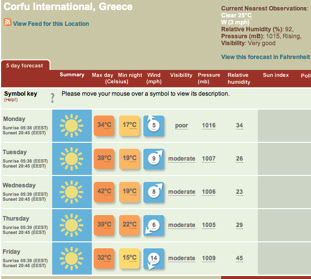
While here the weather is wet and cool there is a heat wave in the eastern Mediterranean.
* * *
If I were attempting to design a course on the things I'm trying to understand I'd start by recommending all my students get a copy of Thucydides'
The Peloponnesian War which between 431 and 404 BC ended the Golden Age. It's a book of suppressed intensity. Its only monsters are men.
Don't try to read it through yet - though it's not that long. For our purposes look over pages 109-119 (in my copy), chapters 69 to 87 in Book Three - Revolution at Corcyra, and read, especially, chapters 83 beginning 'Thus revolutions give birth to every form of wickedness in Hellas, and the simplicity which is so large an element in a noble nature was laughed to scorn and disappeared' and 84,  'It was in Corcyra that most of these audacious acts were first committed and all the crimes that would be perpetrated in retaliation ...' in fact I'll read you this paragraph now '... in retaliation by men who had been governed tyrannically rather than with good sense and had the chance of revenge, or that would be unjustly designed by others who were longing to be relieved of their habitual poverty, and who above all were animated by a passionate desire for their neighbors'...' I have an American edition - 'their neighbours' property; crimes too that men commit, not from greed, but when they assail their equals and are so often swept away by untutored rage...'
In this class any rage will be tutored. I'd like to know what actual Greek adjective or compound was translated here by Benjamin Jowett '...into attacks of pitiless cruelty' - the adjectives are for effect, the nearest you get to seeing this Thucydides' feelings - so don't quibble that cruelty
was by definition 'pitiless'. Thucydides lived through much of this war and took part in one of its failures before being exiled to his estate in northern Greece.

The society that separates its scholars from its warriors will have its thinking done by cowards and its fighting by fools. Θουκυδίδης. Private Lynndie England, who suffers from severe learning difficulties and was almost certainly acting under orders in Abu Ghraib Prison in Iraq in 2004, from Flickr 'The Gallery' - an image composed by doublevelvet while still on Flickr and here's another sent me 30/08/07.
 Somebody might read this entry and get dispirited, so how about this from Seferis' Banquet Speech in Stockholm in 1963 when receiving the Nobel Prize for literature?
In our gradually shrinking world, everyone is in need of all the others. We must look for man wherever we can find him. When on his way to Thebes Oedipus encountered the Sphinx, his answer to its riddle was: 'Man'. That simple word destroyed the monster. We have many monsters to destroy. Let us think of the answer of Oedipus.
 .


