Total Pageviews

Showing posts with label Thucydides. Show all posts

Saturday, 8 September 2007

At Democracy Street

Some pictures’ titles are obvious. ‘The arrival of The Emperor Cattobaz with his retinue at Telepontus’ and there’s a grand set piece oil painting, part souvenir, part measure of the artist’s talent, part landscape, part suitable decoration for a national museum. Then there’s a surrealist pictures with the same title and the subject will be consciously disconnected from an reference to any word in the title and the painting will comprise some striking collection of incomprehensibly juxtaposed objects mined from the terra incognita of the subconscious – yours and the artist’s. There will be perspective and colour to entice the curious and bewildered eye, hinting at the possibility of meaning and teasing the libido. Most perfect of these is ‘The Bride stripped bare by her bachelors’. Or there’s a title for the curator that you suspect the artist would rather omit, but since you insist, it’s called ‘Sequence 1’. If the painting depicts something I recognise then I can guess there will be a series and I can guess at a figurative sequence. If it’s abstract I have to lie back and think of colour, shade and shape. People think this sort of painting is easy, until they try painting a canvas that covers a church sized wall in shades of variegated cerise. Perhaps the artist or their patron will call it ‘chapel’ or ‘frieze’. It helps me even as I suspect I’m not supposed to need a hint. The picture is offered for me and others to make of it what we will. Some are made indignant by the freedom feeling taunted by a ballot box without papers offered on a day without election. Some see a box with a slot in the top into which one my slip an anonymous vote as a mark of respect for what ought to go on between humans. Dictators, unless tempted by the market value raised in the democracies they distrust, do not like paintings whose title’s are not agreeably and unarguably linked to their subject matter. Say nay pas oon peep. Are you taking the piss? Are you looking at me? Recruit a crowd by burning it in public. Throw their ballot papers on the same pyre. Ensure our court photographer is there. ‘The burning of decadent art in the interests of the people on (date) at (venue).’

* * *
No builders came on Friday. At dawn it rained for a good hour. The morning skies were grey, the land steaming. All day we worked on the house. Lin painted but also started on the rockery in the garden. I carried stones for her. We cleared weeds from the garden. Moved more odds and ends into the roof of the Apothiki. Lin did washing and hung it out. I brought it in at dusk. Lin painted on. I barrowed a pile of tiles left by our builders and piled them against the Apothiki wall, and manhandled 22 sacks of debris closer to the road so we could dispose of them properly next day. Earlier I bought some tools and more paint at Dassia and dropped in to Ipsos to check ‘Summer Song’. I put up the spray hood, ran the engine for a bit and raised flags to let D. who’s been keeping an eye on our boat, that we were around. We are more resigned to the slow pace of work on the house.

Friday 7 Sept: Long before light on Friday I dreamt I was very rude to a rather important imaginary superior and woke in dark silence, Lin stirring in deep sleep. I had just arrived at a new organisation, saw a staff circular inviting comment on some aspect of policy and so signed up to have a word with the boss whose signature was on it. A small dapper man entered the staff area and circulated, eventually to me. He’d noted my signature on his circular. ‘So, how can I help?’ he said. ‘It seemed like a good way of meeting you’ I said with a pleasant smile. ‘Well now you have’ he said and headed for the door. I chased after him and sprayed the remains of my tea on him saying in venomous sotto voce ‘You fucking little prat!’ and worse - every consonant precisely emphasised. He looked at me astounded and then walked off. I wondered why I had effectively abandoned my new job. I pondered swearing I’d never said such a thing, wanting insanely to justify my behaviour and grew cravenly apprehensive at how everyone else would view such choler. I woke with relief astonished – my first dream in this house. Speaking to the ghost of Norbert Elias, of whom it would be impossible to imagine such incivility let alone mine I’d interpret this dream as a recognition of barbarism within, a live volcano of which this was a mere tremor, but even waking I am certain that my opinion of my imaginary superior was correct. The problems of the world come down to bad manners.

* * *

At 7.30 on Thursday morning came a shower for ten minutes. The dawn landscape steamed and freshened. A church bell pealed in welcome. Swallows swooped overhead. A scooter puttered invisibly through the tree cover. I was glad the blackened area behind our house was being damped. Yesterday Katherina, the Leftheris and Lulu’s grandmother were tidying there, collecting wood. Kiria Leftheris said the land belongs to a man from Corfu city. Lulu’s grandmother indicated, a sleeping gesture, that the fire had broken out about 2.00 in the morning last week.
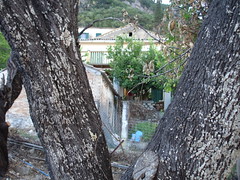
She thought the old twisted tree on the land would live, though badly scorched, its upper leaves and branches shrivelled. At its roots greenery is coming through the soil. I collected a plastic bag of plastic bottles and other litter and found four sealed bottles of wine half embedded in the ground. G said later ‘that one is vinegar, but try opening that one and let it stand. If it doesn’t fizz it should be drinkeable.’ I heard a man had put out flames on the mainland with wine. Maybe I should send these bottles to him.

Later while Lin painted I went with G to the wood yard he’d found at Kalafationi on the Viros road, an hour’s journey south involving threading Corfu town’s heavy traffic to a yard piled high with the cypress wanted for the floor. G’s Greek helped with the order but I was stuck by a demand for my tax number, not having it to hand. I phoned the property agent who said our file was now with the notary, we not being on their books any more. A. at the office would try and get it. A conversation on my phone between the wood yard manager and the agent and we were allowed on our way, the invoice incomplete. The authorities are rightly trying to track the movement of wood. I should have had the number to hand.

Later I continued with Lin tidying. We tidied some of the lathes and debris in the apothiki so that the doors opened and I could take stones to help make a rockery at the end of the garden. I cut back shoots from the lemon tree to help a few main ones grow better. Lin thought I’d cut away too many. We argued. From the upper floor the sea is darkened to the bluest of blues by the afternoon wind and in lucent air we can see the cumulus piles over the mainland on a view of the coast that stretches from the Albanian Cape Stilit, about 9 miles away across hardly 5 miles of water directly east until beyond Cape Gourouni south of Igoumenitsa it disappears towards Preveza behind the nearby higher ground at Anilipsi inland from Ipsos. From the balcony we can see Vidho Island between a gap in the local hills.

On Wednesday evening, over supper, we looked at Imray’s North Ionian Chart designed by Rod Heikell and linked to his Greek Waters Pilot, planning a short voyage in the Corfu Sea during our last fortnight here, sailing across from Ipsos to the hardly inhabited inlet of Ftelias in Greece but just under the Albanian border (p.56 in the Pilot Book), or perhaps Pagania with its promising shelter (p.56/57), then on to inhabited Sayiadha (p.57/58), where the strip of Greece that ribbons up the coast widens and the harbour can be entered if not too crowded. From there we could sail on about 15 miles towards Igoumenitsa but turn into Ormos Valtou, Igoumenitsa Creek, where the pilot shows a sheltered cove before the fish farm at the head of the creek (p.58). There is always a straightforward route back to Corfu but we could go on down to the harbour at Platarias (p.59) – popular with yachts but perhaps quiet enough for a berth in late September. From there we could go on, either to Mourtos among the Sivota Islands, to the harbour at Mourtos (p.60) (possibly incomplete) and the anchorage off Mourtos in Middle Bay (p.61), an adjacent cove. Then or earlier we could cross back to Corfu, possibly to the harbour at Levkimmi (p.50/51) (also called Kavos), or round Cape Levkimmis to Petriti (p.50), crowded but possible to anchor. Seven miles further north, past Boukari (we are now going against the prevailing wind) is the new marina at Benitses (p.49), after which comes Corfu Town (p.47/49) where we could try Mandraki under the old fort (p.48) if there’s room and we can pay, or we could try the old harbour, but be careful which end and will it be too crowded (I need to check this when in town). After that it’s home to Ipsos, though there’s an option of anchoring off Vido Island (what about Gouvinon island?). One question I have is whether it would be more interesting to make this round voyage in reverse, working south on Corfu and north on the mainland, crossing to Ipsos from Ftelias or nearby? I guess we can go south any route if the northerly wind prevails and, if going to windward I guess we’d prefer the calmer offshore version that we should get on the Corfu side. Clockwise makes sense but what about bolt-holes.
Thursday 5 Sept. 208 Democracy Street: While Lin painted and M. worked on the upstairs room I went to Corfu to pay for the car. Kostas beckoned me to a rare parking space outside his business by the old port and sent his son out for skirtos. A shared smoke and banter over these delectable little pots of bitterness softened the pain of parting with money. I embarrassed him first by conveying my regrets for the fire disaster, then we spoke of war, crime and human stupidity and the crazy badness of the world. ‘Things’ I assured him ‘ will only get worse!’ He delightedly agreed. ‘Yes indeed, everything will get worse’. ‘But’ I said ‘if you read your great historian Thucydides, things were always getting worse.’ I expanded my arms to demonstrate everlasting worseness. ‘Yes, Mr Simon, you say such good things! When you come next time you will come to meet my family. Is your wife with you? Here.’ He gave me a plastic bag of prickly pears, expertly flaying one and handing me a juicy core to sample.

Sunday, 24 June 2007

Untutored rage - many monsters to destroy

Lin and Dot left the gîte flawless. Arthur did his magic loading the car. I did departure errands. We paid the Moals less than €20 for electricity. The transfer from abroad to home is so straightforward when you don't fly. A ticket and our passports get a 15 second glance then we're on the ferry and, after five hours, off it with similarly simple formalities and on the road. The boat seemed overfull of squealing children. Lin drove us flawlessly the 204 miles from Plymouth to Handsworth. We arrived just after midnight. Now Dorothy and Arthur are gone home to Cannock. Amy will be home from Glastonbury tomorrow. France which slipped behind us under a great sweep of cloud as we ferried north over a sunny breeze-blown sea seems far more than a day away. Here it's a question of unloading the car and tidying a house after a fortnight's rule by the feckless young. Black bags left uncollected and holed by foxes; objects left turning grass yellow on the back lawn; nuts and seeds to fill neglected bird feeders; a hose pipe to be coiled and hung up; a porch to be swept and tidied; a window broken by a piece of ice being broken to make a cocktail; a mix of wine, liqueur and spirit bottles to be carried to the neighbour's recycle bins just three doors away, paper to be collected and put in their recycling bins; surfaces to be sponged; a broken shower bracket to be replaced - all the while checking the mail that accrues in just 14 days. It's not that we are especially tidy but I do like to feel our version of chaos restored. Oscar came bounding over this morning and leapt on Lin asleep - licks all round and welcome squeaks and tail wags.
 * * *
No more news from Corfu, but I have read and thought so much more about the island and about Greece in the past months. Awaiting me from Amazon comes Stephen Dorril's 'MI6' whose chapters on the Balkans I have started to read to supplement what I've learned from Mazower about British policy in Greece between 1940 and 1949. My slow brain is digesting Mazower's account of a country corrupted by occupation in which opposing conceptions of Greece's national identity enflamed bloody rivalries over ownership of the country's future. One revolved around the unique ethnic identity of those entitled to be citizens of Greece - a rumbling across the Balkans; another, the one most organised in resisting Axis occupation, sought to create a new Communist Greece; and another sought to create a liberal Western democracy. Such philosophies, debated among friends of opposing views, would have made for many an entertaining evening at the pub or kafenion. Instead they became imprinted on the banners of heavily armed and ignorant armies. Each group, even as it becomes distinct, turns out to have been riven by rival and distorting extremes. The justice of Greek nationalism fuelled racism and ethnic cleansing; the dream of a people's republic realised coldly planned pogroms against class enemies; while the idealised inclusiveness of 'liberal democracy' helped it to become a shelter for vengeful Rightists, many of whom had served under the Nazis, but now armed by Britain and, later, the USA, to prevent Greece 'falling to the communists'. The deadly brawl was fuelled from below by ancient village vendettas; from above by high politicking among the great powers. But see Peter Bien, professor emeritus of English and comparative literature at Dartmouth College, speaking about - inventing Greece: the emergence of Greek national identity. The Nicholas E. Christopher Memorial Lecture in November 1997, part of the G.P.Savidis Memorial Colloquium on 'Modern Greek Literature Today: Across Europe and Beyond'.
I feel impelled to say that I think the world has now had quite enough of nationalism. In its two hundred years of existence among Greeks and other Europeans it has accomplished much, to be sure, but I fear that its creative potential is exhausted and that it has become primarily a force for stagnation and evil. We need to develop a dream/myth/fantasy/idolatry beyond americanness, irishness, greekness, germanness (to be printed in Greek in plain small characters). Nationalism is not an inevitable human phenomenon. It did not exist before the modern era, and there is no reason why it should continue to exist in the postmodern era. Indeed, given the vast worldwide changes that have occurred recently there are ever-increasing indications that we may be headed toward a post-nationalistic time in which the earth as a whole, and mankind as a whole, become primary, replacing or displacing nationalism just as nationalism replaced or displaced Christianity as our primary source of meaning. But let's not forget Christianity entirely; let's remember St. Paul's 'there is neither Jew nor Greek, there is neither slave nor free, there is neither male nor female; for you are all one in ...'...in... - well, perhaps not in Jesus Christ, but in humanity. [back to the future - 26 Oct 07 - see this piece about Britain in Prospect Magazine - especially the para beginning ' Partly through immigration...']
The closer the focus the greater the fog. Especially poignant is the fact that civil war brought levels of violence to which the Greek population was largely unaccustomed. People innocent of the depths of human viciousness were - for 10 years - exposed to, and participated in, a brew of carefully planned and arbitrary cruelty from which no category of the population was protected. The confident reasoning of psychopaths ravaged the wondrous land. We know now that such things happened across Europe, but in England there were those whose love for Greece included the view that what happened was somehow not Greek. I suspect that view is shared by many Greeks who, on the subject of the civil war, blame it on foreigners, preserving a silence based, consciously or unconsciously, on profound and ashamed disappointment.
* * * * * *
Incomprehension is part of this. It is not only that for many the horrors, being beyond imagination, become invisible, it is because people's motives for their actions are not only unclear to observers, they are unclear to those who act. Intricately interwoven threads of ethnicity, geography, religion, nationality, kin, village and domestic rivalries within the calculus of international alignments and tension is one of the defining characteristics of civil war - its intimacy. A young Muslim who would come as a guest lecturer to one of my courses told us that before he went to Bosnia - as an aid worker during the worst of the war there - he had not understood what was going on. "After I went there I understood even less." Wars between nations - equally complex in reality - are made simpler because the authorities, as part of warcraft, impose and maintain official accounts of what is happening and what happened. In After the War was Over, Mazower and his co-writers are digging through the collective narratives of winners and losers and the analyses of diplomats and political leaders, to sift hitherto unrecorded experiences of individuals, families, streets, villages and regions. It will not make things much clearer, certainly not more logical, but what I think it will do is what local history always aims to do, which is to raise the profile of the experiences (and therefore the responsibilities and agency) of individuals. Nicholas Gage did this to produce probably the most widely read histories of this kind - almost a lifetime's project to find out who killed his mother, Eleni, at the village of Lia in Epirus (its mountains in clear sight across the narrows from our house on Corfu); to name him and even to contemplate personal revenge against the man he judged most complicit in ordering her torture and murder. At the same time he does not omit the involvement of neighbours, her village, and even her relatives, in what happened, but the larger formal story - history - of the Greek Civil War is consigned to two or three pages inserted at intervals in bold print, giving formal context to the story of Eleni Gatzoyiannis - and one whose intensity would be put in the strongest parentheses, if mentioned by any of Mazower's contributors. In the whole book it gets one passing reference. It's not that they necessarily disagree with Gage, it's that such emotions could leave them lost for words. [Back to the future - see some thoughts about Nicholas Gage in Sept 07. Since it was written his story passed through many hands; been drawn into Republican arguments against liberals; received the fixative treatment of film. Emotions engendered by Gage's book, finished while waiting at Rome Fiumicino in April, have been diluted by later knowledge of how the book's been used, and therefore suspicion that I might have been. Nicholas Gage's website is inactive http://www.nickgage.com/au.html Perhaps he's withdrawn from the chatter, but there's a cheerful website by his daughter] We cannot try to understand if we are blinded with tears, unable to speak through the lump that tightens the throat. I wonder what Thucydides did with his feelings. In Mazower I see researchers - sensitive to the most intense, tightly sprung, dormant feelings - padding delicately through crime scenes drenched with blood, clutching the delicate instruments of scholarship. 
* * * * 
To get a tiny flavour of the combustible feelings that fester I googled some current group forums on the Balkans and Cyprus. Botflies fattened on anger and hatred are buzzing in cyberspace. Here we see one of Mazower's categories - 'ethnic justice' as it relates to forms of legitimacy based on nationality and ethnicity, categories that really really matter to some people and, even when their meaning is understood at a cerebral level, have no resonance for me or thousands of others. All I hear is anger, hatred and the frightening fear that underlies those emotions. But just as I can name the phenomenon of arachnophobia the experience of being frightened of spiders is beyond me. And yes I am aware that the map of Greece I used at the start of this blog refers to the FYROM. For some I've already taken sides. 
 * * * * * *
While here the weather is wet and cool there is a heat wave in the eastern Mediterranean. * * *
If I were attempting to design a course on the things I'm trying to understand I'd start by recommending all my students get a copy of Thucydides' The Peloponnesian War which between 431 and 404 BC ended the Golden Age. It's a book of suppressed intensity. Its only monsters are men.
Don't try to read it through yet - though it's not that long. For our purposes look over pages 109-119 (in my copy), chapters 69 to 87 in Book Three - Revolution at Corcyra, and read, especially, chapters 83 beginning 'Thus revolutions give birth to every form of wickedness in Hellas, and the simplicity which is so large an element in a noble nature was laughed to scorn and disappeared' and 84, 'It was in Corcyra that most of these audacious acts were first committed and all the crimes that would be perpetrated in retaliation ...' in fact I'll read you this paragraph now '... in retaliation by men who had been governed tyrannically rather than with good sense and had the chance of revenge, or that would be unjustly designed by others who were longing to be relieved of their habitual poverty, and who above all were animated by a passionate desire for their neighbors'...' I have an American edition - 'their neighbours' property; crimes too that men commit, not from greed, but when they assail their equals and are so often swept away by untutored rage...'
In this class any rage will be tutored. I'd like to know what actual Greek adjective or compound was translated here by Benjamin Jowett '...into attacks of pitiless cruelty' - the adjectives are for effect, the nearest you get to seeing this Thucydides' feelings - so don't quibble that cruelty was by definition 'pitiless'. Thucydides lived through much of this war and took part in one of its failures before being exiled to his estate in northern Greece.
The society that separates its scholars from its warriors will have its thinking done by cowards and its fighting by fools. Θουκυδίδης. Private Lynndie England, who suffers from severe learning difficulties and was almost certainly acting under orders in Abu Ghraib Prison in Iraq in 2004, from Flickr 'The Gallery' - an image composed by doublevelvet while still on Flickr and here's another sent me 30/08/07. Somebody might read this entry and get dispirited, so how about this from Seferis' Banquet Speech in Stockholm in 1963 when receiving the Nobel Prize for literature?
In our gradually shrinking world, everyone is in need of all the others. We must look for man wherever we can find him. When on his way to Thebes Oedipus encountered the Sphinx, his answer to its riddle was: 'Man'. That simple word destroyed the monster. We have many monsters to destroy. Let us think of the answer of Oedipus.

Thursday, 7 June 2007

One fine day ...

There's a fine comparison from America on 'Open Source Blog" quoting passages from Thucydides' Peloponnesian War and how it marked the end of Athenian Civilisation.
'Thus every form of iniquity took root in the Hellenic countries by reason of the troubles.' Thucydides The Peloponnesian War Book 3, 69 - 85, The Civil War at Corcyra.
* * * levarsi un fil di fumo sull'estremo confin del mare. E poi la nave appare. Poi la nave bianca entra nel porto, romba il suo saluto. Vedi? È venuto! I love America in a generalised way and in a more specific way I respect the scholarship I was taught at the Universities of Pennsylvania and Michigan in the 1960s and 1970s. At 9/11, mine and the thoughts of hundreds of thousands were with America. In Bristol, where I was that day, there were English men and women crying in the streets as they spoke on their mobiles to friends in America. I shall continue to sympathise, respect and love the USA because nobody has been more eloquent than American's in criticising and campaigning in legitimate ways against this B.F Pinkerton who's conspired with our unwise Prime Minister in this feckless vicious illegal adventure in the Middle East and its consequences in collateral damage - psychological, spiritual and physical. My relatives who fought in WW2 were among the good guys. These squanderers of the instruments of peacemaking, who never served in war, have made us the bad guys, telling us - the irony of it - that strong leaders must make hard decisions. One day this will pass. One day US power, for which of course, its government must take responsibility, will exercise the statesmanship that sent its bold young men to be bloodied against the beaches of Normandy, who with their allies, saved Europe, produced the Marshall Plan, conducted the prolonged mental battle of the "cold war", who reached the moon, who nurtured democracy in Japan, forced through civil rights against murderous domestic resistance, whose lawyers studiously seek out past sins and aim at their redress (the lynchings of the south and other cruelties today.) One day things will get better for a country which, with all its teaming contradictions, was still a model of learning, culture and civility and hope for law and justice. One day...one fine day...America will come back to us. One fine day we will witness A smoke plume in the distance Far away on the blue horizon And then, a ship upon the ocean And the ship is painted white It sails into the harbour The salute booms, cannons roar He’s returned once more [The animated interpretation of Madame Butterfly by Pjotr Sapegin with its tiny background sounds amid the music of 'One Fine Day', sung by Natalie Choquette, portrays a smiling sexual predator who respects 'homeland' values but trespasses on elementals, wholly incapable of comprehending his complicity in the eviscerated wasteland he so cheerfully invades and abandons. Film plays through Safari but not Firefox on my laptop 20/07/07)]
From my friend in LA. Thank you for the kind meditation. You know, of course, that we here in the US are extremely frustrated over the high-handedness of the imperious baboons who have hijacked our government. Even the Great American Middle is beginning to realize that they have been robbed of their country. Unfortunately, as I once wrote the appeal of fascism is always strong, and we must constantly struggle against the inner coward who seeks a Strong Man's coattails to ride on. The current crew deserves the fate the Spanish government suffered in the last election. The Spanish were at least fortunate in not having a Republican operative controlling the voting machines. The cynicism and dishonesty of these thugs is disgusting, and I appreciate your words of support. They have largely turned the world against us, and turned Israel, once a true egalitarian democracy, into a goon-state puppet and a trial run for right-wing theocracy. They would turn the United States into a mirror of the Muslim theocracies they claim to fight. In truth, the Christian fascists here and the Muslim fascists there have much the same goal - only the labels differ. * * *

I was thinking about the film The Contender, screenplay by Rod Lurie, in which Senator Laine Hanson, nominated to run as Vice-President, is asked to testify in front of the confirmation committee, having been assailed by the information dredged up by Congressman Shelly Runyon. He asks about her religious belief:

Mr. Chairman -- ladies and gentlemen of the committeee. Remarkably enough, it seems that I have some explaining to do. So...let me be absolutely clear. (takes a drink from a glass of water) I stand for a woman's right to choose. I stand for the elimination of the death penalty. I stand for a strong and growing armed forces because we must stomp out genocide on this planet and I believe that that is a cause worth dying for. I stand for seeing every gun taken out of every home. Period. I stand for making the selling of cigarettes to our youth a federal offense. I stand for term limits and campaign reform. And, Mr. Chairman, I stand for the separation of church and state and the reason that I stand for that is the same reason that I believe our forefathers did. It is not there to protect religion from the grasp of government but to protect our government from the grasp of religious fanaticism. I may be an atheist but that does not mean I do not go to church; I do go to church. The church I go to is the one that emancipated the slaves, that gave women the right to vote. It gave us every freedom that we hold dear. My church is this very chapel of democracy that we sit in together and I do not need God to tell me what are my moral absolutes. I need my heart, my brain and this church. (takes another drink from the glass of water)
[Back to the future 13/01/09: I just read on Alternet, David Hilficker's post 'Now I Understand Why They Hate Us' posted January 12, 2009. 'How a middle-class white guy came to accept the evil embedded in American political and military might']

Back numbers

Simon Baddeley