Total Pageviews

Showing posts with label Syntagma. Show all posts

Monday, 4 July 2011

Worth a few onions and a turnip

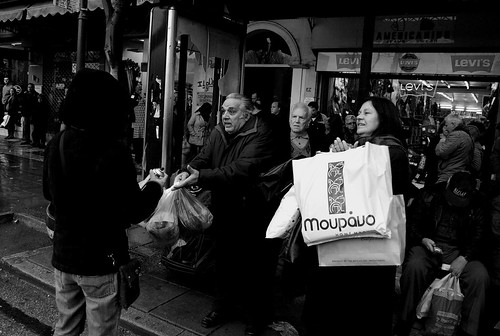
Urban gardener ~ a photo by Richard Baddeley
I was chatting to the gardeners on plot 34 on the Victoria Jubilee Allotments. They told me they worked four hours a day on their allotment - two in the morning and two in the late afternoon. They were concerned about weed seeds from the unworked plot next to theirs, so as a favour I mowed it for them and they gave me a turnip and some young onions.

Plot 33 was full of thick dry stalks - dock, thistle and couch grass in which it was impossible to get a proper circular swing or cutting rhythm. There were also bricks, stones and other debris hidden in the undergrowth - a familiar problem on the VJA whose topsoil was roughly spread by the developer only last spring. When I got home a I spent some time peening the scythe blade. This involves hammering out the bumps and small chips in the soft iron of the beautifully made Austrian forged blade - one that differs from the stamped and ground blades manufactured in England and the US. Austrian blades are wafer thin, delicately hand-forged to an elegant curve in three dimensions ideal for close cutting grass, so I was mindful of Simon Fairlie's observation that:
The only situation we have identified where the traditional English blades may possibly have the edge over the lighter Austrian blades is when dealing with heavy, tangled overgrown grass.
Forged
Stamped & ground
That describes most of the few unworked plots on the VJA. Unskilled sharpeners like me can make use of a peening jig which delivers the blow at the correct angle to a properly held blade - a blow that someone skilled could do on an anvil by eye and feel. I used a rough stone to work out any remaining bumps in the blade, finishing with a much smoother stone. I learn as I go, approaching the work with enthusiasm and humility. What I've learned so far is a mix of skills remembered from childhood, and subsequent experience following a grounding in the craft by Simon Fairlie, who by running workshops and importing scythes and scythe parts, has made a great contribution to a wider appreciation of the efficiency of a skillfully handled scythe, with the right choice of blade set at the right angle, properly and regularly sharpened, with the handle adjusted to the user. I used a blade on plot 33 which has a small tine on its tip which affords some protection if I hit something hard while mowing.

Our own plot is coming along nicely. I dropped over on Sunday with Oscar and worked on sifting out couch grass from the soil I've dug and rough hoed with the azada. This takes more time then the original digging - teasing out these slivers of root which spread netlike close to the soil surface gripping harder than nettle and thistle roots. Delith on a plot nearby said that the deep rooted dock didn't need pursuing so long as I cut them off at the surface. "Their roots force nutrients up the the soil surface" she said. I hadn't thought of that.
Jill and Lin came over to help complete the foundations for the shed. It's possible that we'll have it raised by the end of the week.
"One day people will unearth these mighty slabs. They'll wonder how they transported such weights from King's Heath to Handsworth? What were they like these allotment people? How did they think? What were their cares? Some questions may never be answered but we can still wonder..."
"Yeah, yeah. Can you just lift it so I can get some more gravel under it"
"How did they achieve such precision with such simple tools?"
"A bit higher. OK. OK not that high. That'll do. Now let it go. Let's go home"
I engage in urban pastoral, a middle class comfortable, cultivating city sylvan on a Δημοτικό περιβόλι, a few minutes cycle ride from home, where I see the world's gaze on Greece, read the latest round of social web comment, view images, the sights and sound of civil commotion, violence and shouting. One writes: 'Εμείς γεννήσαμε τη δημοκρατία, εμείς τη σκοτώσαμε!' 'We bore democracy; we killed it.' Ah! That believe that democracy was once perfect rather than just another system of government. We are saturated by Greece,  grown up in the society of the spectacle, as Debord put it in 1967 ‘a social relationship between people that is mediated by images’. His
followers carried his argument too far, but he was half right. The idea of the society of the spectacle endures. It is not only the media that are saturated. We are. Gil Scott-Heron, who died this May, sang in 1974 The Revolution Will Not be Televised, commenting powerfully on the relationship between the media and what we ...
 "sorry but who's 'we'?"
... take to be political activity; the famous for 15 minutes auditorium foreseen by Andy Warhol...
"Hold it a moment, I'm having a rant"
... Is there any connection, other than through images, between what’s happening in Egypt, Spain and Greece? Are the indignants the bellwethers?

I liked the article on the indignants in 1 July Kathimerini by Harry van Versendaal – spiced with conditionals - that went with the picture of the man in the Odos Dimokratias tent, pointing out the soupy ingredients of Syntagma's mêlée.  He’s sympathetic yet unconvinced “some see”, and other intransitives “it may be that...”. Mark Mazower a scholarly expert on 20th century Europe and the history of modern Greece writes in the New York Times on 29 June of Democracy's Cradle, Rocking the World...'it falls again to Greece to challenge the mandarins of the European Union and to ask what lies ahead for the continent.'
Is that possible? Can twitter, one of the agents of the saturation with the rest of the social web, do more than stir a contained pot lacking the astringency of practical ideas, practices or analyses to addresses the complex dynamics of modernity?  The fine tables around which the IMF ministers sit witness equal confusion and variety but they can carry on in suits debating in privacy, preserving their dignity in public. The dominant spirit is confused uncertainty (yes Yeats – not ‘anarchy’, but ‘mere anarchy’).
...How I've come to write in english sprinkled with hypertext wandering on the screen as once one used footnotes on paper...
 Can anybody really believe that direct democracy might represent a solution? Democracy, which I’ve cared about because it’s such an imperfect form of government, is marginally better than its alternatives, needing constant re-invention by people who understand the machinery of government - like how to collect taxes in a city where bright prosperous folk camouflage their swimming pools to evade tax. So it goes. The crowd in Syntagma reminds me of the ‘children’s crusade’ - that exercise in manipulated futility I learned of at school; how it ended with the enslavement of the few misguided children who survived, and might never have happened, or been no crusade but bands of wandering paupers. Meantime in other parts of the world other things are going on.

Sunday, 21 December 2008

"Violence cannot be fought with violence"


The dog Λουκάνικος, Bangers, successor to Κανέλλος, Cinnamon
Adam Schatz London Review 19 December 2008:
The police, curiously, have retreated from confrontation with the street-fighting anarchists, preferring to chase down protesters at the tense but mostly peaceful daytime rallies. Amnesty International has reported that two of its Greek members were beaten with batons, and accused the police of engaging in ‘punitive violence against peaceful demonstrators, rather than targeting those who were inciting violence and destroying property’. (Riot police emptied 4600 tear gas canisters, and had to make an emergency request to Germany and Israel to replenish their reserves.) But when the cities were burning at night, the cops were scarcer than firefighters during the great forest blaze: after midnight the cities belonged to anarchists, arsonists, looters – and, it seems, to hooded agents provocateurs with iron clubs. The stated objective behind this ‘defensive posture’ was to avoid further casualties, but many Greeks wonder whether the government had struck a tacit deal with the rioters. ‘We let you torch and plunder to your hearts’ content, and you let us continue pretending that we are in charge’ was the wording suggested by Michas Takis, a journalist at the liberal newspaper Eleftherotypia. [quote ~ Panagiotis Stathis, spokesman for the national police "Violence cannot be fought with violence."]
In one film, from a fixed camera above Syntagma Square, I viewed a road nearly empty of vehicles, campaigners standing in separate clusters on the broad pavements, and near the top of the square a pair of evzones in brown winter uniforms doing their traditional march at the Tomb of the Unknown Soldier in front of Parliament. On one forum a visitor to Athens leaving his hostel to visit the Acropolis writes that:
...we hit up the shopping area and people watched. then i saw a tv reporter setting up and asked if i could get a photo of her pretending to interview me. well, me and my big mouth, b/c she asked if she could interview for me, about the presence of police in large numbers around the christmas tree and pedestrian mall. so at least my photo is now genuine. look for me on the AP greek story regarding athens resembling a police state now. i didn't say that i had just come from israel and am used to it, but 'twas fun all the same. tomorrow will be ancient sites day, and at night olympiacos versus some team that will lose badly. fingers crossed for no rain. nap time now.
I was talking, this evening, to Amy who'd dropped in with Liz. She looked at some of the street action on the many videos of events in Athens, and referred me to current thinking in her work books on policing public disorder. I've started looking again at the way the Athens police are deploying, grouping and regrouping and begun to notice patterns in the fog. Having already had intuitions about symmetry in the dynamics of these dramatic scenes - not quite velvet, more like dralon. Amy's pointed me to a missing part of this puzzle. Of course it's been mentioned by others - the limited number of injuries among rioters and police, the minimal use of guns (none authorised) or even baton rounds, the shock aroused by the 'second shooting' - a spent bullet striking a young man's hand rendering it numb; the absence indeed of blood letting except that of Alexandros Grigoropoulos, whose death is unreservedly deplored by the government. These guys (and some women) have been on workshops and courses, taken notes from slide presentations, discussed scenarios introduced by senior officers who've attended international conferences on the management of urban riots. I know the police have training - of varying quality - but I hadn't realised how far practice had advanced informed by global experience. The Wikipedia entry on riot control is solely about weaponry - and daunting though that is - omits the volume of knowledge accumulated and diffused about crowd behaviour and its implications for policing. The arts of reaction and counter-reaction have been refined and must have spread - notwithstanding the low wages and lack of training that Greek police complain about - to the uniformed men I'm seeing in the gassy flaming streets of Athens. Riots judged as 'failures' by professionals, are those where violence is escalated or even provoked by police action; especially when police attack violent demonstrators - either because provoked, or because officers who enjoy violence are given rein, or because violent men have been planted in the crowd to provoke ill-trained and undisciplined police and/or because one or more politicians sees advantage in escalation. e.g. Berlusconi in Genoa. These acts of violence against violent mobs have either played into the hands of those who desire violence - on either side - and have diverted the police from directing their control measures against the violent, so that they end up playing into the hands of the violent, either by attacking peaceful elements in the crowd or killing or injuring aggressive demonstrators who's fate wins the sympathy of moderates, increasing animosity towards the police. I think Machiavelli would have at least reviewed some of his thoughts on the proper application of ruthlessness in the light of research on crowds since Le Bon's pioneering work in the 1890s. According to the text books on this subject, the worst thing the police can do is to return violence with commensurate violence. Blimey! For a testosterone charged male kitted up in riot gear that's counter-intuitive. The police have to avoid being drawn into violence without appearing to appease or permit violence. Those who seek confrontation among the rioters understand this, as do those who wish the same among the police, in collaboration with those in government or with aspirations to government, who seek confrontation to achieve their ambitions. The police have to be wise, as do those who give them orders - if peace is to be waged. So all those millions going into the Bloody Sunday Enquiry are, as well as being a search for truth, an investment in the competence of those handling mass disorder. The situation is complicated by the likelihood that many rioters, some with parental connections in government, including those who steer the police, are reading (a variety of social web links to virtual environments) the same manuals. Given that proportionality has been normal in cold war manoeuvring most of my life, how unsurprising that similar dynamics apply to conflict in civvy street - tailored to the circumstances of Greece. * * * *
Mixed reactions to the protests in Greece by Teacher Dude's BBQ. A man cries "shame"; a woman claps
[photo: Teacher Dude's Grill and BBQ, in some of the most intimate records of these weeks, captures mixed reactions]
Observations by the citizen-journalist Teacher Dude who's been posting images and comments from Greece on Flickr: There were times over the last two weeks when what I witnessed seemed taken from the script of an outlandish movie, the kind where everyone tuts and says, "That is just so Hollywood. That would never happen in real life". William Goldman, the writer of movies such as Butch Cassidy and the Sundance Kid once said that there were things taken from real life he couldn't put in his scripts as nobody would believe them. Here is a selection of the few I remember from the riots and protests that I covered over the last two weeks. The two guys wearing masks are ready to charge the bank, all set on smashing the security camera and disabling the ATM. However, there is a young woman there, oblivious to the mayhem around her who is taking out her money. The masked men wait, politely ask her if she has finished, then set about the cash machine with hammers. A march goes past a van, inside two tiny Shetland ponies stuck in a space not much bigger than they are. The protesters, enraged by this discuss what to do. In the end they take down the number plates as to....report the owners to the authorities. Just a few metres behind them riot police approach menacingly. 50 kids, one no more than 10 years old pelting the central police station with rocks as bewildered shoppers seemingly unable to grasp what is happening gawp while pieces of paving stone clatter around them. The quasi - military riot police up against tweenies Walking along Egnatia Boulevard lit up by at least a dozen fires, acrid smell of tear gas and burning plastic everywhere. Two middle aged bystanders argue over whether the anarchists about to firebomb a bank are doing the right thing. The older, white haired guy, says, "What do you care? It's not your money". An old woman buttoning holing a passing masked teen, scolding him about what has been happening. Others join in a passionately debate what has been happening over the last few days. A smartly dressed woman, shopping bags around her, waiting at the bus stop claps and cheers masked protesters marching by. The man next to her shouts out "Shame, shame on you" [Teacher Dude, citizen journalist, originally from England, living in Northern Greece, teaches English as a Foreign Language (EFL)...writes of loving photography...cpwefl2003@hotmail.com. His comment below - following a request from me for permission to use his words and this photo - refutes my remote observation but confirms some shared awareness of history among potential assailants 'As far as escalation of violence is concerned I think both sides realise that would quickly spiral out of control as there are literally millions of guns in circulation.'] [Big Fat Greek Summer - 13/12/08 - eye witnessing the ordinary and the dramatic were mingling in central Athens]
* * * * The Tango Team: Tango stands for Tactically Aggressive and Necessary Gambit of Options. This team goes forward and 'dances' with the crowd. The Tango Team can bring to bear the entire spectrum of use-of-force options-from command presence through deadly force-in a controlled, self-contained package. * * * * Last night - Saturday - Lin beckoned me round the other side of the kitchen table from where I was street watching Athens to see the last dance on BBC iPlayer of the Strictly Come Dancing final - between Tom and Camilla (see 32.50 on) - who she knew, though she'd missed the live show, had won. They were good - even I could see.

Back numbers

Simon Baddeley