Total Pageviews

Showing posts with label Angeliki. Show all posts

Tuesday, 23 January 2018

A paper on Aristeidis Metallinos

Aristeidis Metallinos, laic sculptor of Ano Korakiana (1908-1987)
Aristeidis Metallinos - Αριστείδης Μεταλληνός - is known to few. Villagers of Ano Korakiana older than 30 remember talking to him as children.  Aristeidis' son, Andrea, died in 2016. We attended his crowded funeral at Agios Athanasios, the cathedral of Ano Korakiana. We're honoured to be friends of Maria,  Andrea's sister, daughter of Aristeidis, also her son, Tassos; also of Angeliki, the sculptor's grand-daughter and her mother, Anna, Andrea's widow.
Aristeidis Metallinos was a craftsman of many skills, who became, in the last part of his long life, a sculptor - one of the island's talents. He died 20 years before we came to have a home in his village. Six years after our arrival, we were invited to visit the museum in which Andrea and Anna lived and in which the sculptor's work is currently displayed. Few others, Greeks or foreigners, have been inside.  It was once described as a 'museum', but last year that name was removed by workman in 2017, leaving Andrea's plaque on the front of the house, attesting it as his father's place of work.
To make his work known, a project in which we have faith, I submitted a Wikipedia entry in English and Greek. Two years ago, Angeliki, Lin and I, with Andrea's approval, made a draft catalogue of every work in the 'museum'.

With Andreas Metallinos' approval, Angeliki and Linda cataloguing his father's work 

Richard Pine was permitted to use one of the sculptor's marble friezes - The Saint of Preveza - in his book Greece Through Irish Eyes. In 2016 our son Richard made and administers a website owned and paid for by the family.
I have shown photos of many of the works to interested Corfiot artists and writers, Greek and British - Maria Strani-Potts, Jim Potts, Richard Pine, Katherine Wise. Also Corfiot historian John Petsalis author of Corfu Museum on-line, and his colleague photographer, Effie Stathia; the cultural anthropologist, Dr Alexandra Moschovi at the University of Sunderland. Irini Savanni, art historian and curator at the University of Athens, who I met in Ano Korakiana, her village. Aristeidis Metallinos is mentioned on Ano Korakiana's website and blog authored by Thanassis Spingos.
The first noting of the sculptor outside his village was by Giannis M. Maris - welcome, but brief, in a collection of artists' biographies published in 1978. The catalogue Angeliki, Linda and I made of the works in the museum in Ano Korakiana shows just 25 sculptures completed by that year.
Giannis M. Maris (1978) "Βιογραφικό - Αριστείδης Ζαχ. Μεταλληνός", in Απάνθισμα Γραμμάτων και Τεχνών, Athens, pp. 611–617


A much fuller paper of 23 pages illustrated with black and white photos of the artist's work was written by Professor Eurydice Antzoulatou-Retsila (she told me, in a letter, she preferred 'Eurydice' to the Greeklish 'Evridiki') published in Myriovivlos, vol. 7, Athens, pp. 37-47 - two years before the artist's death. 'Corfiot themes in the craft of the laic sculptor Aristeidi Metallinou'.
Ευρυδίκη Αντζουλάτου-Ρετσίλα (1985) “Θέματα Κερκυραϊκής λαoγραφίας στo έργo τoυ λαϊκoύ λιθoγλύπτη Αριστείδη Μεταλληνoύ” στο Μυριόβιβλoς, τεύχ. 7, Αθήνα, σελ. 37-47
Maria and Jim Potts have generously donated a 'free translation' of this paper's abstract:
The laic sculptor (sculptor of the people) Aristeidis Metallinos (1908-1987), from the Corfu village of Ano Korakiana, provides us with a common example of a folk artist or craftsman, for whom the need to earn a living pushes him/her in the direction of an occupation involving a variety of forms of traditional artisanal handicraft-work, until reaching the final stage of free and unconstrained expression of artistic inspiration through, e.g. sculpture in stone (in the case of Metallinos).
In the course of his difficult life, he practised as a wood-carver, a professional shoe-maker. He built fireplaces and ovens, carved and chiselled olive press mill-stones and hand grinding-mills.
At the advanced age of 67, he occupied himself as a sculptor carving in stone, declaring that he was self-taught. He thus realised a long-standing ambition to create and depict different forms of life which were slowly disappearing, as he had understood from his own experience of life.  His works of art demonstrate the true meaning of laic folk-art and provide visual testimony and evidence of aspects of Corfu’s culture and way of life, particularly in the north west of Corfu.
The inspiration for Metallinos’ sculptures was the folklore of the island. They are presented here for the first time. They were created in the period between 1975 and 1983. Two types are distinguishable: bas-relief sculptures, and statues, carved from white Kozani marble or Corfu stone.
They depict agricultural occupations* (milking a goat, a village woman carrying a load, the village olive press), traditional crafts and professions (the shoemaker/cobbler, the milkman, the village baker, the blacksmith), domestic activities (grinding with a hand-mill, a village woman kneading dough, a peasant woman carrying water), traditional handicrafts (a peasant woman with a distaff, another with a shepherd), villagers wearing traditional costumes (‘My mother’, an elderly man from Korakiana, a peasant woman in formal costume, a Corfiot).
NB If the word peasant’ is not felt appropriate now, substitute ‘villager’.
*I've recorded several of these. See 'Ano Korakiana in relief'

I am looking for ways of getting a translation of the whole paper – but without paying.
One of Metallinos' latest works - self-portrait of him at work 1984  (stone S 74 x 69 Cat 190) Photo: Richard Baddeley)

Saturday, 16 April 2016

Green kryptonite

What a difference a day makes. Over 24 little hours I stayed up late. Early Tuesday Lin drove me to Digbeth Coach station from where the 777 service got me from Birmingham to Luton Airport by 4.30. After being searched with everyone else, I wandered the familiar concourse, had a coffee and read David Thomas’ Ostland. In rain at dawn I board a plane that flies an almost straight course south-east for 1800 kilometres. In the last minutes of an unturbulent flight I slid from the aisle over two empty seats to peer down on the dark Albanian mountains above Saranda...

...merging into Butrint and the gentler heights of mainland Greece, familiar contours, the blue below scratched by an island boat for Igoumenitsa.


Then a steep curve back on ourselves, for the run in to Kapodistria up the east coast of Corfu, a glimpse of the beautiful Manessi mansion and church, San Stephano...
... hidden by an outcrop of rock from sight of the multi-storied skeleton next door - an hotel offered to a friend years ago for a knock-down price. Meeting the hopeful vendor in different circumstances, my friend reminded him he’d offered to sell 'the unfinished' project at 'a bargain'.
“Not a bargain, my friend, I was trying to sell you a problem!”
In minutes I’m landed, luggage collected, in a hire car driving familiar roads north to the village. The humming seems continuous – coach, airport, plane, car. I stopped at Kaziani to shop for milk and butter and food for the next few days. Then the car’s parked on Democracy Street; my bags unloaded and carried down the 13 steps and into the house. The humming becomes the buzzing of innumerable bees; though I’m reassured the water’s turned on, as, too, the electricity. The fridge hums. Relaxing with the french windows open I read my book sipping a cup of tea. A pair of chattering swallows enter the room, perch for a minute on the chandelier above my head, noisily debating the definition of inside and outside before leaving for outside where two garden trees are weighted with lemons, our orange rich with blossom, and the landscape, olive groves over many gentle slopes, stippled with full blossoming Kokykias trees της κοκυκιάς, with a strip of the bluest sea between me and the hazy shores of mother Greece.

As ever I’m greeted in the street. I explain why I’m here on my own but the news of my father-in-law’s death on 5th April and why Lin has stayed in England is already known; or I hear it being explained to others.
“You must go. I’m looking forward to having the house to myself” said Lin “You’ve got to pay our property tax and submit our no-earnings return to the tax office.”
Next day I meet Eleni P. Parking by the old port I cycle through town to the office of our accountant, off Alexandros Street. Eleni does the paperwork on-line. I must come back to the office early on Thursday to sign at the Corfu Tax Office declaring she represents me.
I find a leather worker in the city centre who mends the metal catch on my Leatherman holster in 30 seconds for €1.50. I buy a needed button, needle, needle-threader and thread from a small shop off San Rocco Square.
In the meantime I’m getting news. Everyone’s getting older. Someone must have an operation; another is most unexpectedly in depression; another has dementia; the toddlers as it seemed when we first came to Ano Korakiana are growing into colts and fillies, quieter with all that’s going on inside, more serious. It's so good to have the Greek double kiss, with a pause between for a warm and unembarrassed hug.
Having ticked a good few ‘to do’ boxes by evening, I took my olive stick with the deer-foot handle, an early gift from Mark, and headed uphill through Venetia and on up the hairpin bends to St Isadoras, the small church on one bend of the zig-zag ascent to Sokraki, over the crags above Ano Korakiana.

I have the place to myself and am regretting I forgot to bring a candle for Dorothy, my mum-in-law, in the same Sandwell hospital where Arthur passed away and Lin and I arrived minutes after and saw his body and went to pass the news to Dot, a ward away, helped by a doctor called Jeremy.
It wasn’t until, instead of saying “Do you want to see him?' which we all did, I said, instead, ‘Would you like to see Arthur’s body?”
Then she wept. Arthur was 98. He and Dot have been married 70 years. St Isadoras is tiny. I can stand in there, in its dim cool interior but hardly turn in any of its three spaces. A wick burns in oil by a small window. The silence is palpable. It is a serene place, freighted with every kind of sweetness a building can hold; memories too of previous visits alone and with Lin and with the family. I went onto the broad terrace perched on the same rock as the church and gazed over the island’s centre towards the central mountains and the sea and the forts of the city and – a dot – the outline of Pontikonisi beyond Kanoni and the airport where I’d arrived six hours before. I thought I heard womens’ voices coming up the hill; Anna and Angeliki Metallinos – daughter-in-law and grand-daughter of the laic sculptor. I was so delighted to greet them and they me – and in this sacred place, still Tuesday.
I told my news and why I was here alone. Mother and daughter prayed a while and Anna, renewed the floating wick on the oil. So I didn’t need a candle. We walked back down to Ano Korakiana together, Anna collecting from the verges a plant with a light blue flower to make a tea that’s good for the stomach. Above Venetia their car was parked.
“Can we give you a lift?” asked `Angeliki who’d been translating our chat to her mum. She’d been asking me about Arthur and what I would say at his funeral on 5th May.
** **** **** **
On my second night in the house I awoke with a stomach ache and nausea. Going downstairs I was sick several times. I returned to bed and tried to sleep but after an hour I had to go downstairs again to be sick again. I have always been so healthy, it always surprises me to be weakened by a sudden illness. I suspect I ate too much of my own cooking the night before while watching Bridge of Spies. I’d promised to go into town to the tax office in the morning. Getting myself up, I thought of what happens to Superman when he comes into contact with that toxic mineral from his home planet. My folding bicycle suddenly weighed so much. Every step was draining. I was thirsty without wanting much to drink, just a sip to wet my lips and mouth. Dehydrated. Having parked and cycled into Alexandros I made the excuse to Eleni that I’d had too much to drink the night before. Her colleague Georgia walked me to the tax office, stopping now and then to make sure I was keeping up, as I would do, slightly frustrated with Arthur, in his last months. She found me a seat for the hour long wait in the grey beige corridor of Corfu bureaucracy, as like a vigorous West End comedy, people exited and entered left, right and centre, in and out and back and forth between different doors, some employees, some clients, with no sense of a queue or sequence, but all polite. Georgia chatted cheerfully to people she knew. I tried to snooze and over and over licked my lips; a fool, I’d not bought a small bottle of water to sip. At last the business was done, and I had a signed and stamped piece of paper. I coasted downhill on Theotoki stopping to enjoy a strawberry sorbet and sip more water.
In town - errands on my trusty Brompton

Back at Democracy Street where, like a lizard, instead of shifting clothes, I shuffled carefully between places to relax that were neither too cool nor too hot; the balcony under an umbrella, the sitting room near a window, our bedroom, getting into to bed at dusk, waking up and shifting to night clothes around midnight, and, no longer thirsty, sleeping through to five in the morning when I felt up to a mug of tea and two slices of buttered toast, sensing strength recovering. By morning proper I was having a shower, doing a load of washing that would dry swiftly in a warm breeze from the east, starting to tidy the garden, clipping back the bougainvillea and other spreading greenery, hanging a tarp beneath the balcony to protect the veranda from rain; phoning Dave to get Summersong craned from her berth so she can be scrubbed and anti-fouled and put back in the water for when the family come in a week – but without Lin I fear.  She’s caring for Dorothy, her bereaved mum.
Arthur Reynolds, miner, - Dorothy Bentley, munitions worker: their wedding at St James' Church, Norton Canes, 8th Sept 1945


Thursday, 23 April 2015

A stone shoe

The light behind the curtains suggests another sunny day, with reservations. Enough to do laundry. Once the machine is rumbling reassuringly, the soaked mix tossing in the froth, I’ve emptied the waste into a plastic sack for walking to the wheelie bins, I boil the kettle for tea and coffee, slice two pieces of bread to toast, and take from the fridge my usual Christmas gift from Amy, anchovy paste – Partum Peperium –  ‘There’s only one shop in Birmingham I can get it, Dad’.

The balcony, where I take my tray, affords a view that spreads from Albania, across the border, along the high mountains of Epirus as far as the hazy space of Igoumenitsa over the shining sea between island and mainland. From the crags behind us...
...the island mountains disappear around to an inland cape covered in trees and shrubs from which stone cliffs jut now and then, over which, in winter, the sun will suddenly appear having risen red over the mainland peaks.

In April our sun rises further south, lighting three green hills a couple of miles away, clothed in olive trees that reach into the village, hiding the long shore between Pyrgi, an hour’s walk, and Dassia in the centre of the bay 10 kilometres wide between ugly Barbati, invisible from Ano Korakiana, and Corfu Town. Between the hills I can see, less than a mile from the Old Port of the city, Vido island. Due south the gentle undulations continue, completing the middle distance, dotted now and then with pink-violet blossomed Kokukyias, which some foreigners, including Lawrence Durrell, call Judas Trees.

Above them, usually in haze, sometimes invisible, more mountains – south of the city the saddle back around Agia Deka, 20 kilometres away, astride the island’s narrow tail, and to the west the mountains behind Cape Plaka forming precipices over the resorts of Ermones, Gliffada and Pelekas, facing the Ionian Sea – on their lower slopes, speckles amid the greenery, of villages. I call the time to Lin and prepare her coffee though she’ll lie abed another hour at least, muttering ‘Yes, maybe’. If only the swallows soaring across the distant haze of mountains gave people pensions; jocund weather converted to salaries; my joy in this place into its economy, but for all that we live here our contribution is paltry set against our detachment from the crisis whose slow and relentless development is being described on televisions behind shutters and doors, making the internet unreliably busy. The coach is turning back into a pumpkin, the footmen into mice. One delicate glass dancing shoe is turning to stone.
I had awoken from one of the loveliest of dreams about my mum; awoken happy too, rather than sad at realising I’d been asleep all along. Mum had been walking with me in the English countryside, stood at the lip of a long escarpment, surveying together a green landscape that stretched to a hazy horizon lit by a summer sun, then in the middle of Rome she’d sung from a balcony after breakfast ‘Mum’ I said ‘you’ve got crumbs on your tongue!’
She laughed and we were shopping in a fashionable arcade and she’d bought a dress in which she looked as beautiful as I’d ever remembered her. We hardly needed to speak; just comfortable and happy and at peace in one another’s company and all the time it seemed we both knew very well she was no longer here. It didn’t matter a jot.
'You know why we dream so much when we're here' said Lin 'Both of us! It's because our mattress is so hard we never get beyond REM sleep.'
That, not cheese?
*** *** ***
I was on the bus back to the village sat behind K.
‘Things are bad’
‘I know’ I said
It’s the first time I’ve heard her suggest we may return to the drachma.
Richard P had said that without money from Europe the first thing will be that the government can no longer pay its workers – civil servants, nurses, police, local government officers, refuse collectors, bus drivers, electricity and water workers.
‘They will strike' he said
Things will close down.
‘What do people in in England say?’ asked K
‘My brother-in-law, with many others, say it’s Greece’s fault. Get out of the Euro and let them make their own way out of the mess they created for themselves. Stop taking our money...I say I don’t want to hear such opinions.’
A friend for supper here has a similar refrain
‘Greeks have got to grow up.’
I get flustered at glib imperatives. I rehearse the counter-arguments that much of the time seem to make sense – of deliberately created national debt, the impossibility of trying to get water from a stone (or any more money that goes only to cover interest payments on a debt that is wholly unrepayable by people being turned into paupers), ‘fiscal waterboarding’; of the fact that Greece’s crisis is Europe’s, an amplified problem of advanced capitalism...my words are assailed by the worthy logic of economics.
But how is it across the nation? People must be watching TV as we don’t. What do they say in the streets of Ioannina, in Metsovo and Kalamata, on the islands of the Aegean, on Crete, let alone Larissa, Thessaloniki and Athens? I detect a resigned numbness with flashes of hope. People get by. Perhaps.
‘If everyone in Greece paid their taxes, the problem would be solved. If Greek institutions scoured themselves of corrupt practices...’
‘Who said that? It’s not so simple...’ I say...lamely
 On the bus I said how impressed I was by Yannis Varoufakis, and Alexis Tsipras ‘playing an impossible game with the weakest of hands.’
‘Yes, indeed’
‘Flying on empty’
‘Yes, indeed, Simon’
There is no conspicuous consumption in Ano Korakiana. People work. People nurse frappés and soft drinks as they chat in Piatsa. One family in our part of the village roasted a lamb for Easter. Vasiliki gave us plates of her delectable cakes on Easter Monday. The washing flies in the wind. People garden, as we do. Katerina gave us horta and pastichio. The people we meet are ever polite, generous and cheerful. It made the conversation on the bus the more worrying because the expression of such apprehensions. at least to us, is so rare.
Lin and I have pondered options.
I ask Mark, over a beer in Piatsa.
‘Quite simply, Simon, I don’t know anything anymore. So many people have so many opinions.’
******
We’ve been building a buttress to support the garden wall. Lin doing the skilled work with trowel and cement...


I carting heavy stones. We’ve made a workbench in the apothiki using recovered wood from the rebuilt balcony. These chores are pleasantly endless and simple; sawing logs, putting out washing to be dried in the wind; making a rough table, also from the old balcony. The days pass as they do in England, though here we collect firewood from the beaches and store it, sawed and chopped, in the apothiki.
Sun dried sheets


How many miles has this log floated...
...before we bring it home to saw and split for the stove?
This step we made eases the climb up the path at the back of the house
Winnie’s sent me photos of how my allotment’s coming along. Peas are rising, parsnips sprouting but where are my potatoes?
** ** ** ** **
We’ve now listed more or less every one of Aristeidis Metallinos’ works. From Tuesday to Friday for a couple of hours each midday Angeliki and I and Linda have worked through the collection, ensuring every item is numbered and measured. Serious with clipboards. We’ve added a small section for carvings of uncertain date, as well as the weathered works on the roof - stone boys astride the roof gables, a peacock at the apex, a tall woman in skirt and prim jacket and bare breasts. As work on the catalogue progresses Anna has brought us coffee, cakes and orange juice.


Andreas has helped improve our listings with recollections of his father. I am cautious with questions, learning more – but slowly. Aristeidis relied on his son to obtain his marble and stone and, since the sculptor’s death, Andreas has striven to be ‘the steward of his legacy’. The phrase is mine. After his father died in 1987 the museum that Aristeidis Metallinos wanted sustained as a gift to the village was, as far as I know, opened to visitors. I’m unclear for how many hours or days, or indeed for how many years before the place became the closed building we encountered when we arrived in Ano Korakiana in 2007. I suspect my initial difficulty gaining entry (K trying to get inside the Castle?) and even an introduction was because, after for whatever reasons the museum closed – and I speculate on these, Andreas has had quite a few individuals asking to be shown around. What happened? They had a look. They satisfied their curiosity. They went away. Did they remember anything? Were they even that impressed? Could they or did they have time for that contemplation essential to determine, in more than the most quotidian way, whether what they saw provided more than passing sensations. ‘Fascinating’ ‘Wonderful’ ‘Amazing’ ‘So interesting...where shall we have lunch?’ Where did that leave Andreas? Growing austerity in Greece must have made maintenance even trickier.
Before the sculptor died there had been promising academic articles about the ‘laic stone mason’, ‘the village sculptor’. Aristeidis seems to have had no interest in his own promotion. His interest was in the art, his trips to the open air cinema in town and views of what he watched on television, and a wish to give a gift to the village where he’d spent his life. He encountered - unknowing until near his death - the indifference of the world; hardly a problem for him, engaged with his chisels and mallets and the fascination of making things out of stolid stone and marble. At some point as he worked away in his open house he seems to have come upon disapproval. I don’t know enough about this. Just clues including the reference on his gravestone by Paraskevi Church to ‘slight bitterness’.  I suspect it may have been a problem for Andreas. Aristeidis countered with inscriptions – rebukes in marble that last, leaving a sensitive puzzle that calls for more understanding. I venture – tentatively – to explore something else missed by the academics who wrote about the laic sculptor while he was alive; Yianni M Mari in 1978 and Efrithikis Antzοulatοu-Retsila in 1985. They were intrigued by Aristeidis Metallinos as a carrier of folk-lore, of village tradition, history and culture.
The family in the fields - 195, 1986 40 x 64cms (Photo: Rob Groove)

The photos selected by Antzοulatοu-Retsila say as much. They show sculptures of villagers in traditional dress, of Greek dancing in Corfiot costume, of local individuals respected in the village and in some cases Greece – the statue of Makarios. The reliefs of the almost forgotten pastoral economy disappearing in Metallinos' final years are wonderful - a poignant lesson in another way of life. What these commentaries miss is the drubbing that Aristeidis Metallinos metes out to authority; his ridiculing of priests, of the police and the army, and the ever-present figure with cigar and top hat fondling a naked mistress, shopping for human flesh at the butchers ‘as a cure for piles’, roasting a native on a spit, ribald personifications of money men, ridicule and contempt for government – Greek, European and global. This was a man carving a permanency of anger at things he saw wrong in the world, depravity and exploitation; with this was his fascination with carnal pleasure...
"I am waiting for you. Naked" Extract 189, 1982 marble relief 40 x 59cms (Photo: Rob Groove)
 – sometimes celebrating the beauty and excitement of women, their lusciousness under the male gaze, his lust surely, yet also his interest and respect for women as strong, surging above their traditional roles as part of the farm-stock inventory, becoming  triumphant, even appropriating the traditional and oppressive weaponry of men, riding their phallic missiles, harnessing their grandiose and rather ridiculous penises. Now this must have been a handful for the family, even for parts of Ano Korakiana to which Aristeidis wished to dedicate his work.
‘So what next?’ asked Mark.
‘Well we’ve got the sculptor’s name in Greek and English wiki. One of his works will be mentioned in Richard Pine’s next book – about Greece from an Irish perspective – to be published in October. Angeliki and I speak of 'step-by-step', a year at a time to fathom the work of her grandfather. This catalogue is a logical next step – to have an inventory and an order that is more organised than the present list.’
I paused. This was insufficient.
‘And what then?’
‘Visiting the museum when we want is a privilege. The other day Andreas let me hold that first piece Aristeidis carved in stone when he was hardly 20, that women’s shoe which would have given a candidate for art school serious consideration...but how many people know about it being the only thing he carved for another fifty years? How many know about it at all? Few seeing unknown original art feel confident about its qualities – good or bad. So much art we know has been via introductions, references; from parents, teachers, books, friends, public esteem. Aristeidis’ work hasn’t been prepared for exposure or accreditation, hasn’t begun to run the familiar gauntlet of indifference, ridicule, or slight praise. People don’t know the man. His works are crowded on shelves and walls in four small rooms without commentary; a cluttered stockroom of souvenirs. His story, clearer and clearer to us, is vague, confusing, even uninviting.’
I knew I was going on too much.
The sculptor carves himself carving a ram in stone (Photo: Rob Groove)
‘Sorry’ I said ‘More has to be done to cultivate the eye of the beholder. A catalogue of the works; a selection of the most representative; themes clarified; commentaries by Greek critics – two I have in mind – a biography, perhaps by Angeliki, Andreas and I, building on my wikipedia article. Creating provenance. Our Richard could design the catalogue cover, using Jan Bowman’s sketch of the sculptor. Start with the shoe.’
‘Another pint?’
Andreas, the sculptor's son, allowed me to hold this precious shoe his father made in 1927 


Wednesday, 13 August 2014

On the allotment

The skies opened on us yesterday afternoon. Oscar and I sheltered under the shed veranda. Oliver decided to stand in the rain amid thunder and lightning and a shower of hail.
'Come here, Oliver!"

He refuses shelter. Thunder cracks; trees swirl.
"Oliver!"
I suppose he presents a smaller area to the weather. That's a rough speculation. This is about the pleasure of instant mud, puddles and dripping greenery. I must put up guttering on at least two edges of the shed to harvest rain like this. I had the wicked idea when sipping tea...

...a nicer version of that frightful father in Yorgos Lanthimos' brilliantly horrid film Dogtooth Κυνόδοντας imprinting his isolated children with toxic inaccuracies about the names of common objects.

Oliver and I will plant some random seeds on Plot 14. A few days later, after I've prepared the ground in his absence, we'll harvest small toys. Maybe not. I like that he sees and helps collect potatoes to eat emerging under my fork from the earth, and sees beans in their pods cut from their stalks to be on his plate in the evening.
*** *** ***
To our delight there arrived, a few days ago, a letter from Angeliki, with sweet greetings to the family from Ano Korakiana, including a card congratulating Amy on the birth of Hannah...
...and expressing happiness that her grandfather now has a Greek and English Wikipedia entry. "On the 30th June my sister also gave birth to a healthy boy, my first nephew, so I understand your feelings" Of the continued search for Aristeidis Metallinos she writes:
When you'll be back in Ano Korakiana you can continue your work as you have planned STEP BY STEP. The doors of the 'μουσείο' are and will be always open to you, Linda and whoever you want. My mother respects both of you. You know that!!! You are also free to write on your blog whatever you think it can help my grandfather's recognition.
Such joy to read these words; also that Angeliki and her family, after Andreas met them on Democracy Street, had been able to welcome Thannasis Spingos and Kostas Apergis - scribes and historians of Ano Korakiana - to the Museum.
...Πάντα στον νου σου νάχεις την Ιθάκη.
Το φθάσιμον εκεί είν’ ο προορισμός σου.
Aλλά μη βιάζεις το ταξείδι διόλου.
Καλλίτερα χρόνια πολλά να διαρκέσει·
και γέρος πια ν’ αράξεις στο νησί,
πλούσιος με όσα κέρδισες στον δρόμο,
μη προσδοκώντας πλούτη να σε δώσει η Ιθάκη...
In pursuit of those 'steps' I took the train on the three hour journey north to meet Dr Alexandra Moschovi. I'd contacted her back in May to ask if she could share thoughts on the laic sculptor. I'm digesting our discussion, working through Alexandra's many insights on Aristeidis.
Meeting Alexandra Moschovi in Newcastle to explore the world of Aristeidis Metallinos


8th August from Birmingham:
Dear Alexandra. What a fascinating visit for me, with lots of new ideas and encouragement on the subject of our - now I dare hope - shared interest in the laic sculptor of Ano Korakiana. I have this morning posted you two DVDs containing images from my visits to the Aristeidis Metallinos ‘Museum’ - some are my photos or Linda’s, but mainly they are by Angeliki Metallinos of the works of her grandfather, which she does not claim as adequate representations. ...As we agree the images are in no special order and so represent rather ‘raw’ data. Yes! A catalogue is vital.
 You have encouraged me in the important task of giving a context to AM’s work (I just noticed the coincidence of initials!) by checking the historical time-line that accompanies the sculptor's working, especially the significance of the year 1981.
I am also alerted to his likely exposure to a number of popular Greek films...more alert to the impact of some of AM’s themes within a village, especially if there are even more sensitive issues of his relationships with others in the village...Given that AM said he took up hammer and chisel 'to bear witness to human nature and its weaknesses' «να παρουσιάσω τον άνθρωπο και τα ελαττώματά του» I am unsure whether he himself is involved in these adventures ... or whether AM's work is observational - which could also bring animosity, even spite upon him....  As we discussed, many more things will emerge.
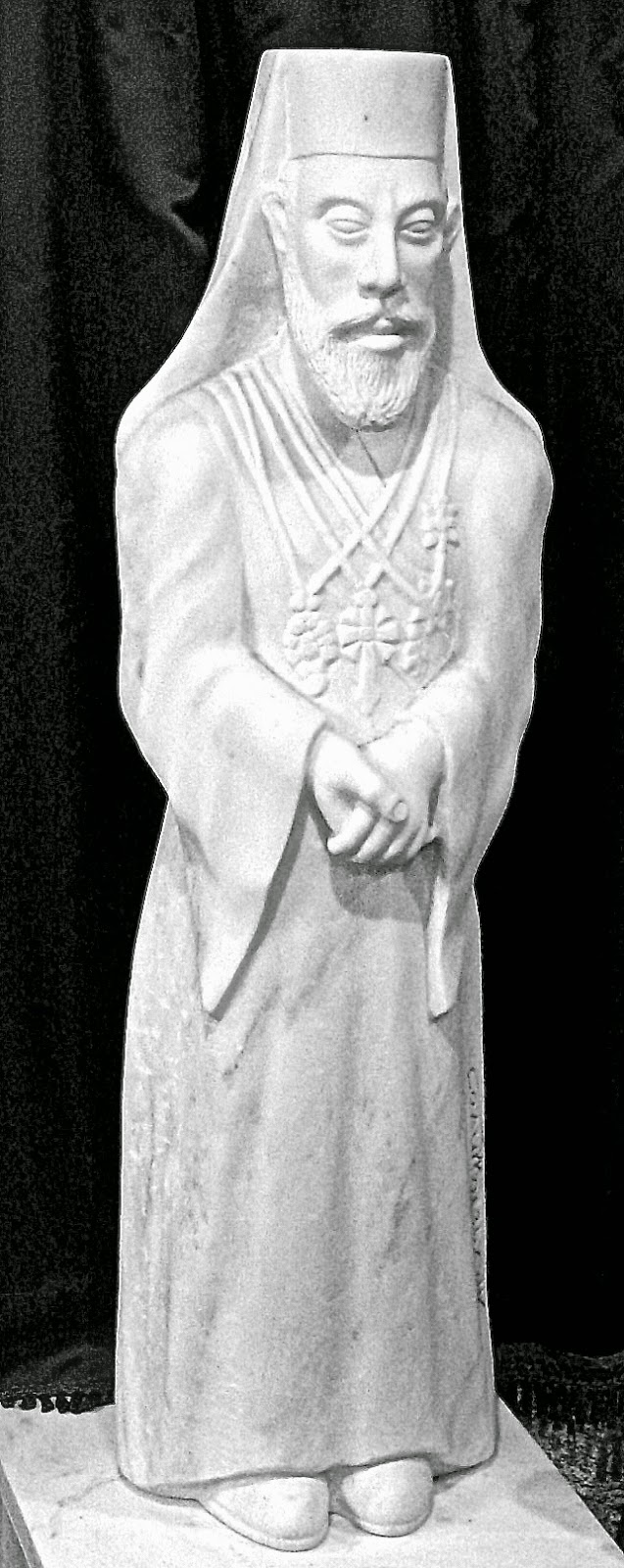
Archbishop Makarios carved in 1974 by Aristeidis Metallinos
I was told by Angeliki that her grandfather sketched his planned works on unfolded cigarette boxes. I hope to see his actual tools and more personal possessions. I hope I may be trusted to see and handle these - with kid gloves.
 Meanwhile I'm delighted you are curious and interested in the same subject. For me it is about the struggle to improve my Greek, but also about my relationship with Ano Korakiana.
I am pleased that you do not see AM's work as pornographic or sexist. I think there are others who may be repelled by some of it; who would wish to censor some of the more ‘grotesque’ or ‘horrifying’ pieces. But is AM a feminist? What novel view of women emerges from this Greek man in his seventies brought up more or less all his life in a pastoral economy.
What did he learn in Albania in the war? What mix of fascination, admiration and excitement, anxiety and even anger and contempt informs Metallinos' experience of the changes in the condition of women during his life - and especially in the 70s and 80s with the great tourist invasion of Greece?

There are aspects of AM’s depiction of sexuality and gendered work that my own maleness may disqualify me from understanding. This is why I am interested in Lin’s views. I know Angeliki is as close to her as she is to me - the English couple!
Your gaze and critical view as a woman is an addition to your academic perspective on Aristeidis Metallinos.

There is also the matter of how his relations with his children and family, and especially Eleni, influenced him. I have the believe that he was passionately and sensually in love with her. Or was he, like some artists, more and more egotistical and preoccupied with his marble. His work seems to be a burden on his son Andrea.
Perhaps I fix on some of these matters because I’m an old man.
There’s also the matter of many other sculptures and the lovely reliefs depicting a world that has all but been forgotten, and was passing away with immense rapidity in the last decades of the sculptor’s life.
 In a recent Greek film Lin and enjoyed - Attenberg - the young woman’s father, an architect, observes “We never had an industrial revolution. We built an industrial colony on sheep pens”. All over the world the Greek diaspora partakes and leads in projects of modernisation but in Ano Korakiana there are still remnants of pre-industrial enchantment (about which I am not sentimental any more than I am about ‘democracy').
Thanks again for your interest, your advice and your company in Newcastle. I’m glad the rain held off. 'Σὰ βγεῖς στὸν πηγαιμὸ γιὰ τὴν 'Ιθάκη, νὰ εὔχεσαι νἆναι μακρὺς ὀ δρόμος, γεμάτος περιπέτειες, γεμάτος γνώσεις….'
Kindest regards and my best wishes to your dear family Simon
Αριστείδης Μεταλληνός (1908-1987) ~ his gaze? Are these stone women 'passive'?
In July I asked Jim Potts for his reflections. Jim has seen only photos of AM's but I've greatly valued his and Maria Pott's opinion of the sculptor's work...Jim also said he might try to seek his daughter's reaction. Ditto I, the women in my family:
13th July from Zagori (an extract): Re Metallinos, I feel I need to see his work in situ to really understand his take or stance on women. From the images I have seen, there are works that seem to explore quite different aspects of human relations, and the nature of men and women. I don't feel able to judge which is the dominant strand of his thinking, but he was certainly pushing back the boundaries, and that makes his work unusual and interesting.
At the moment I am struggling with a chapter on Tourism for an American book. Corfu is one of my case studies. I have been gathering information, statistics and anecdotes dealing with the development of tourism since the early 1950s. Like everything else, there are a lot of ambiguities and contradictions, making generalisations very difficult. I have found a theoretical sociological book The Tourist Gaze 3.0 by John Urry and Jonas Larsen very helpful, athough it doesn't deal with Corfu.
What was the nature of the Metallinos "Gaze"?
Did AM's work change and evolve over a period of years, are there various "periods" when he depicts women in one way or another?
His 'gaze'? I need images of Metallinos looking. Not the 'women' but him.
'Αυτός είμαι εγώ ~ That's me' (1980)
*** *** ***
Earlier this month Lin and I went to a BBQ organised by Aftab Rahman - 'quintessential Englishman' - of Legacy WM, in the secret spaces behind terrace houses on the Hamstead Road.
Colin Simms tells how he came to be involved in the re-creation of these handsome terrace houses...

The evening was going to be a little expensive.
"I'd love too come, Aftab. It's a bit dear for us"
"Come anyway and give a talk about Handsworth Park"
So I came with Lin with a brief to sing for my supper.
Photo: David Ash

David Ash was taking pictures. We explored - in and out - a small group of attached gardens behind Colin's houses. The court where we ate was warm from the sun that had followed rain in the early afternoon while Lin and were still 75 miles south working at Rock Cottage. I'd showered, changed, cooled a bottle of wine; still aching from the climbs up Bell Hill, nursing an appetite. Around eight I spoke for about twenty five minutes about the Founding of Handsworth Park.
Photo: David Ash

"You were fine at first" said Lin after "but you read too much from your history"
"I know, it was when I was going over the script of the public meeting where the decision  was made to proceed with Handsworth Park"
I find the past in the present so fascinating. I get carried away. But it was just alright. I rehearsed my account of the political work required to create a park - one that was not a philanthropic gift; which had to be paid for with taxes. I earned us supper.
Photo: David Ash


*** *** ***
While they seem busy, often anything but carefree, with alway more to do than there are hours in the day, we shall recall these weeks, while Amy and Guy stay here with their children, our grandson and new born granddaughter, plus the two dogs, Oscar and Cookie (with her irritating bark), as the happiest of times.
Hannah with her great grand parents
Oliver and his new sister

*** *** ***
Greece's economy - worst since the worst depressions 'in recent memory'.
Greece’s GDP shrank by a mere 0.2% in the second quarter. While still a decline, it’s the smallest drop since the third quarter of 2008—which means that after 24 consecutive quarters of economic contraction, the Greek recession’s end might finally be at a hand. Don’t expect any wild celebrations in the streets of Athens anytime soon, though. The Greek economy has been through hell over the last few years. Unemployment is an atrocious 27%. And roughly 25% of the economy has been destroyed since the peak in late 2007. That collapse in economic output puts the Greek recession right up there with the worst depressions in recent memory.
In Ano Korakiana, in the courtyard of Saint Athanasios; Anastasia Metallinou and Sakis Karanikolas gave villagers a recital of beautiful melodies from the repertoire of Manos Hadjidakis.


anastasia_m082014.jpg
Υπό το αδιάκοπο θρόισμα της παλιάς νεσπολιάς, στον αύλειο χώρο του Άη-Θανάση, η Αναστασία Μεταλληνού και ο Σάκης Καρανικόλας μας χάρισαν χθες το βράδυ υπέροχες μελωδίες από το ρεπερτόριο του Μάνου Χατζιδάκι.
Inside the church on another evening there poetry was read
«Η τέχνη είναι ένα μέσο να συγκινεί κανείς το μεγαλύτερο αριθμό ανθρώπων, με το να τους προσφέρει μια προνομιακή εικόνα των κοινών πόνων και ευχαριστίσεων» (Albert Camus – «Ο Λογοτέχνης και η εποχή του»).
Έτσι λοιπόν, απόψε, στην εκκλησία του Αγίου Αθανασίου, σε μιαν ατμοσφαιρική αύρα, οι εκλεκτοί προσκεκλημένοι Δημοσθένης Δαββέτας, Δημήτρης Κονιδάρης, Μαρία Πρεντουλή, Σωτήρης Τριβιζάς, Νάσος Μαρτίνος και ιερ. Βαλέριος, μας μίλησαν για «ποίηση», αποδίδοντας το διπλό της χαρακτήρα, του «εμπνευσμένου» και του «σοφού». Η αιώνια και δραστήρια φιλοσοφία της σκέψης, αντιθετικές σχέσεις με την υποκειμενική φύση, μια εξαιρετική δύναμη αφαίρεσης και ανάλυσης. Η βραδυά «έκλεισε» με την ανάγνωση ποιήματος του Δημοσθένη Δαββέτα και με την υπόσχεση της συνέχειας…
poems06082014.jpg
Poetry evening in St Athanasios, Ano Korakiana

(My hopeless translation)...So, an atmospheric night in the church of St. Athanasius, the distinguished guests Demosthenes Davvetas, Dimitris Konidaris, Maria Prentouli, Sotiris Trivizas, Nasos Martin and rep. Valerios, we talked about 'poetry', debating the dual character of the 'inspirational' and the 'wise'; the eternal and dynamic philosophy of thought, contrasting relationships with subjective nature, a fine celebration of strength and resolution.  The evening 'closed' with the reading of a poem by Demosthenes Davvetas and the promise of a return in the future...

On 11th August Ano Korakiana's orchestra marched in the annual procession celebrating Saint Spyridon  Ἅγιος Σπυρίδων - Corfu's patron saint.
11august2014a.jpg
11 Aυγούστου σήμερα και η πόλη της  Κέρκυρας θα φορέσει τα γιορτινά της για τη λιτάνευση του Ιερού σκηνώματος του Αγίου Σ πυρίδωνα, σε ανάμνηση της σωτηρίας του νησιού απο τους Τούρκους το 1716. Ο κόσμος, αρκετός, κερκυραίοι και μη, θα κατακλύσει απο νωρίς τους κεντρικούς δρόμους της πόλης απ'όπου θα περάσει η πομπή. Ξεχωριστό χρώμα όπως πάντα θα δώσουν οι φιλαρμονικές, 8 στο σύνολο, αναμεσα τους και η δική μας αποτελούμενηη απο 60 μουσικούς, οι οποίες θα συνοδεύσουν το σκήνωμα με αρχή και τέλος της διαδρομής, την εκκλησία του Αγίου...
*** *** ****

Francis Niemczyk has at last completed the second exercise in synchronising one of the hundreds of episodes of Out of Town from my archive. It arrived a few days ago - as a Digibeta tape, a DVD of sound, a DVD of film, and the one I could view and hear, a DVD of sound and image synchronised. Of course the film of Jack in the studio, as we know, is missing. The challenge is finding ways of having more than a dark space over his introduction. Ever helpful, Ian Wegg has suggested this, adding the theme tune and introductory titles. He moves from a fuzzy image of my stepfather in his shed at Raven Cottage in Dorset. This fades into black and white with greater clarity -  a picture of Jack with recovered film boxes on shelves, that dissolves into colour ribbon titles dissolving into Stan's location film...

Ian has edited out some of the talk that referred to an unidentified object. I like what he's done. Being able to sustain chat about this project among several hundred people on Facebook is encouraging and useful.
**** ****
Συγχωριανού μας Σάïμον Μπάντλεϊ  2012 (Αυτός είμαι εγώ με το μπαστούνι)

Back numbers

Simon Baddeley