Familiar dreams of inadequacy – unprepared notes just before a lecture, no papers to explain myself to an arresting authority, a journey started but vital luggage gone missing...They are born on wasted efforts to strengthen arguments that differ from common understanding, on giving up on something within my capacity, but requiring effort I’m too lazy to exercise, finding other things to do; displacement activity. The crisis in Greece. I’ve surrendered to common explanation; resigned myself to the given options. Greece must pay the debts she’s accrued or leave the Euro, pay in cash or kind.
‘And how is leaving the Euro going to make anything any better?’ asks Lin.
‘Well they don’t have to pay back all that debt.’
‘Yes and exports – tourism to Greece being her main export – will, in theory, get cheaper, attracting more visitors...’
‘...except tourists, even if they are not on all-in holidays where they've paid for their holidays and all extras outside Greece, don’t just need waiters and accommodation. They need food, fuel, perhaps healthcare. Since most of those involve imports they’ll cost even more in drachmas, especially when devalued against the Euro, the pound and the dollar’
‘What a mess!’
The pound of flesh is due. Shylock – ill done by - awaits in the north for the bloody payment. Sensible voters of northern Europe say ‘if you prick us do we not bleed?’
I see no Portia in the wings with clever pleas and saving arguments.
I am slightly ashamed; one of those faltering disciples for whom the apostles – especially Paul – wrote their encouraging and loving letters.
‘Hold fast’ ‘Be of good faith’.
Yannis Varoufakis, shortly before he became Greece's beleaguered Minister of Finance published a book in which he described economics to his daughter...
*** *** ***
On Saturday morning we tried to catch the bus from the village. We waited at the bus stop below our house for half-an-hour. No bus came.
‘Shall we walk to the Sidari Road for another there? Two kilometers’
We set out. Dawdling to enjoy the views, chatting. Two familiar big old dogs attached themselves to us and stayed with us a kilometre, sniffing the verges and stopping to scratch.
At the Ano Korakiana T-junction we waited twenty minutes by the bus stop. Mark drove by heading into the village.
‘Is there a strike?’
‘No I’ve seen public buses on the road to Acharavi’
Reassured we waited as cars and trucks charged by. There at last came our bus. We hailed it, pointing south; the driver grumbling that we’d not waited on the right side of the road, where the southward stop without kerb stood in brambles swayed by passing traffic.
‘To Gouvia’ Lin paid our fares ‘I scratched my hand on brambles getting aboard’ she said rubbing her arm.
Catching a bus after lots of waits is such a pleasure. At last we’re on our way; tucked in seats with other passengers, hurrying down the main road’s long hill, past Sgombou and Emeral, past the Tzavros junction where the road flattens and becomes a dual carriageway. There was none of the chat that goes up and down the aisle on the Korakiana bus.
‘Gouvia’ said the driver slowing near Technomart.
‘One more stop’ said Lin
We were dropped within yards of The Lighthouse where we could go to the Saturday tabletop sale, and, upstairs, enjoy a coffee, greet Pastor Miltiades, and use the WiFi, skyping Amy who we glimpsed via the camera opposite her bed sleepily speechless tending Hannah and Oliver bouncing exhaustingly to and fro across the picture, ignoring us.
‘Bye-bye! Bye bye Oliver. Bye bye Hannah’ we cried ignored, switching them off with a distinctive Skype ‘cloomf’’
‘Amy needs a drop-in child-minder to take Oliver off her hands now and then’ I muttered ‘The energy! Ollie’s like a two year old colt. He should carry weight.’

We strolled a few hundred metres up to AB supermarket and with our shopping crossed the road to a Green Bus stop, buying ice creams to eat while awaiting the Sidari bus, which dropped us at the Ano Korakiana turn. We walked up to the village carrying our shopping, resting now and then in occasional shade.

All along the Easter-strimmed verge flowers had grown since, swaying in the slight breeze. A day earlier we’d walked a circle from Democracy Street, down towards the main road, turning west on a grassy track between smallholdings and vineyards which wound back towards the village before dissolving in meadows.


We followed where someone had walked already, slightly disturbing the uncropped grass, wild thyme, daisies, thistle, vetch and Honesty, until, beyond a ruined apothiki, past a well cultivated smallholding...

...we were following the familiar back road into Mougades and the rest of the village.
*** *** ***
Angeliki phoned on Monday to approve my musings on her grandfather, and tell me the news that her father is now ready to write about his memories of his father.
‘It will take time’ she said
‘Of course. But that’s wonderful’
I prepared an email to Dr Alexandra Moschovi, Senior Lecturer in Photographic Theory, University of Sunderland:

‘And how is leaving the Euro going to make anything any better?’ asks Lin.
‘Well they don’t have to pay back all that debt.’
‘Yes and exports – tourism to Greece being her main export – will, in theory, get cheaper, attracting more visitors...’
‘...except tourists, even if they are not on all-in holidays where they've paid for their holidays and all extras outside Greece, don’t just need waiters and accommodation. They need food, fuel, perhaps healthcare. Since most of those involve imports they’ll cost even more in drachmas, especially when devalued against the Euro, the pound and the dollar’
‘What a mess!’
The pound of flesh is due. Shylock – ill done by - awaits in the north for the bloody payment. Sensible voters of northern Europe say ‘if you prick us do we not bleed?’
I see no Portia in the wings with clever pleas and saving arguments.
I am slightly ashamed; one of those faltering disciples for whom the apostles – especially Paul – wrote their encouraging and loving letters.
‘Hold fast’ ‘Be of good faith’.
Yannis Varoufakis, shortly before he became Greece's beleaguered Minister of Finance published a book in which he described economics to his daughter...
Varoufakis' introduction to the German edition of the book...An inability to explain to a teenager the fundamental issues of economics reflects badly on one’s own grasp of them. And the failure to inspire youngsters to care about wealth, poverty, power (and their distribution in society), reveals the instructor’s, or author’s, own lack of appreciation of what makes our social world tick. This book strives to inspire teenagers (and other readers normally disassociated from economic narratives) to care about economic ideas and economic processes by revealing their power over our imagination, beliefs and passions. It does this by means of a narrative of how economic power has emerged from the shadows of political and military might before gradually taking over human societies. The narrative combines history, literature, science fiction films and down-to-earth economic analysis to impress upon teenagers, and various beginners, that economics is an epic drama. Rather than a technical science, it is a battleground on which armies of ideas clash mercilessly and where concepts with a capacity to move mountains emerge; and all that in a war for our own allegiances which are being fought over by powerful interests usually at odds with ours. In addition to its drammatic style and content, this book answers two fundamental questions: How was the modern world formed? And why are the economists’ theories part of the problems that this world is constantly producing, rather of the solutions. In the process, it poses and answers challenging questions, such as: • Why did British colonists invade Australia instead of the Aborigines invading England? • When and how did the primacy of profit come about? • Why could wealth never exist without debt? • From where do bankers derive their exorbitant power? • What is hiding behind economic crises? • Is there hope that humanity will stop functioning like a stupid virus killing the “organism” in which it resides? • What is money and why does it "need" democracy?

One of the enduring memories from my early childhood is the crackling sound of Deutsche Welle radio transmissions. Those were the bleak years of our dictatorship (1967-1974) when Deutsche Welle was the Greeks’ most precious ally against the crushing power of state propaganda. Mum and dad would huddle together next to the wireless, sometimes covered by a blanket to make sure that nosey neighbours would not get a chance to call the secret police. Night after night these ‘forbidden’ radio programs brought into our home a breath of fresh air from a country, Germany, that was standing firm on the side of Greek democrats. While I was too young to understand what the radio was telling my mesmerised parents, my child’s imagination identified Germany as a source of hope.Terror. Yes. That's the core of it. I'm not sure how, other than in appearance, clothing and panache, Euclid Tsakalotos, differs in theory and explanations of the world from the man he is replacing as negotiator with the EU.
As I am writing this preface to the German edition of a book aimed at another child, my daughter, I feel the urgent need to recount that memory. To turn it into a small homage to the idea of Europe as a realm of shared democratic ideals. A small gesture of defiance against the recent tendency for European peoples, who were hitherto coming closer and closer together, to be set apart by a… common currency.
Our European Union began life under the presumption that to achieve political and social union we must first bind together our economic interests; that economics would lead the way to a united European polity. It was a good idea except that, as the years and the decades went by, a problem emerged: our collective understanding of ‘economics’ became increasingly crude. We slipped into a simplistic mindset according to which the sphere of the economy began decoupling, separating itself from that of politics, of philosophy, of culture. As it did so, the economic sphere acquired massive discursive and social power for itself, thus causing democracy, politics and culture to fade out, to become shadows of their former selves.
We economists were, I confess, responsible for this steady erosion of our collective understanding of the economic sphere. Before we knew it, markets were no longer means to be placed in the service of social ends but emerged surreptitiously as ends in themselves. Under the influence of, on the one hand, financialisation and, on the other, economic theory, we began to resemble Oscar Wilde’s definition of the cynic: one who knows everything about prices and nothing about values. Naturally, our European Union’s institutions also tended towards the conviction that the large decisions should be taken by technocratic committees that constitute ‘politics-free zones’. In an ironic twist the language of economists helped usher in a mindset that jettisoned from the corridors of power and the halls of decision making not only politics and culture but also …economics.
But enough of this now! This book is not intended as a diatribe on Europe, on Germany, on Greece or indeed on anything that would bore… my daughter. It was written in order to test the author’s ability to convince a recalcitrant teenager that economics is too important to be left to the economists. That it can also be too much fun to be ignored by those interested in things other than money and finance. That, looked at through a piercing eye, behind every economic notion, every theory, there lurks a fascinating debate about human anxieties that only poets, dramatists and musicians have managed to address with any degree of efficiency.
Did I truly write this book for my daughter’s sake? Not really. I wrote it mainly to test the limits of my own understanding. For if I failed to explain to a teenager the fundamental issues of economics, my failure would reflect badly on my own grasp of them. Indeed, the failure to inspire youngsters to care about the nature of wealth, poverty, of economic power (and its distribution in society), reveals one’s own lack of appreciation of what makes our social world tick. As for my daughter, it is true to say that she played a major role. Being my worst critic, every time I completed a section or chapter I wondered whether she would look at me with disgust upon reading it. Nothing motivates an author better than such terror!....
*** *** ***
On Saturday morning we tried to catch the bus from the village. We waited at the bus stop below our house for half-an-hour. No bus came.
‘Shall we walk to the Sidari Road for another there? Two kilometers’
We set out. Dawdling to enjoy the views, chatting. Two familiar big old dogs attached themselves to us and stayed with us a kilometre, sniffing the verges and stopping to scratch.
 |
| Road from the village. Our companion dogs finally head home |
‘Is there a strike?’
‘No I’ve seen public buses on the road to Acharavi’
Reassured we waited as cars and trucks charged by. There at last came our bus. We hailed it, pointing south; the driver grumbling that we’d not waited on the right side of the road, where the southward stop without kerb stood in brambles swayed by passing traffic.
‘To Gouvia’ Lin paid our fares ‘I scratched my hand on brambles getting aboard’ she said rubbing her arm.
Catching a bus after lots of waits is such a pleasure. At last we’re on our way; tucked in seats with other passengers, hurrying down the main road’s long hill, past Sgombou and Emeral, past the Tzavros junction where the road flattens and becomes a dual carriageway. There was none of the chat that goes up and down the aisle on the Korakiana bus.
‘Gouvia’ said the driver slowing near Technomart.
‘One more stop’ said Lin
We were dropped within yards of The Lighthouse where we could go to the Saturday tabletop sale, and, upstairs, enjoy a coffee, greet Pastor Miltiades, and use the WiFi, skyping Amy who we glimpsed via the camera opposite her bed sleepily speechless tending Hannah and Oliver bouncing exhaustingly to and fro across the picture, ignoring us.
‘Bye-bye! Bye bye Oliver. Bye bye Hannah’ we cried ignored, switching them off with a distinctive Skype ‘cloomf’’
‘Amy needs a drop-in child-minder to take Oliver off her hands now and then’ I muttered ‘The energy! Ollie’s like a two year old colt. He should carry weight.’
We strolled a few hundred metres up to AB supermarket and with our shopping crossed the road to a Green Bus stop, buying ice creams to eat while awaiting the Sidari bus, which dropped us at the Ano Korakiana turn. We walked up to the village carrying our shopping, resting now and then in occasional shade.
All along the Easter-strimmed verge flowers had grown since, swaying in the slight breeze. A day earlier we’d walked a circle from Democracy Street, down towards the main road, turning west on a grassy track between smallholdings and vineyards which wound back towards the village before dissolving in meadows.
We followed where someone had walked already, slightly disturbing the uncropped grass, wild thyme, daisies, thistle, vetch and Honesty, until, beyond a ruined apothiki, past a well cultivated smallholding...
...we were following the familiar back road into Mougades and the rest of the village.
 |
| Ειδικά της κοκυκιάς που σε κάθε κήπο, σε κάθε φράχτη κάνει την εμφάνισή της! Walking below Ano Korakiana on St George's Day |
*** *** ***
Angeliki phoned on Monday to approve my musings on her grandfather, and tell me the news that her father is now ready to write about his memories of his father.
‘It will take time’ she said
‘Of course. But that’s wonderful’
I prepared an email to Dr Alexandra Moschovi, Senior Lecturer in Photographic Theory, University of Sunderland:
Dear Alexandra
I hope you’ve not given up on me and that you are well and that you will receive this email.
I am afraid my pace on our shared Aristeidis Metallinos project is slower than yours might be, were you in my shoes.
Nonetheless we do proceed! I attune to the family’s pace - and perhaps my own. The tortoise rather than the hare.
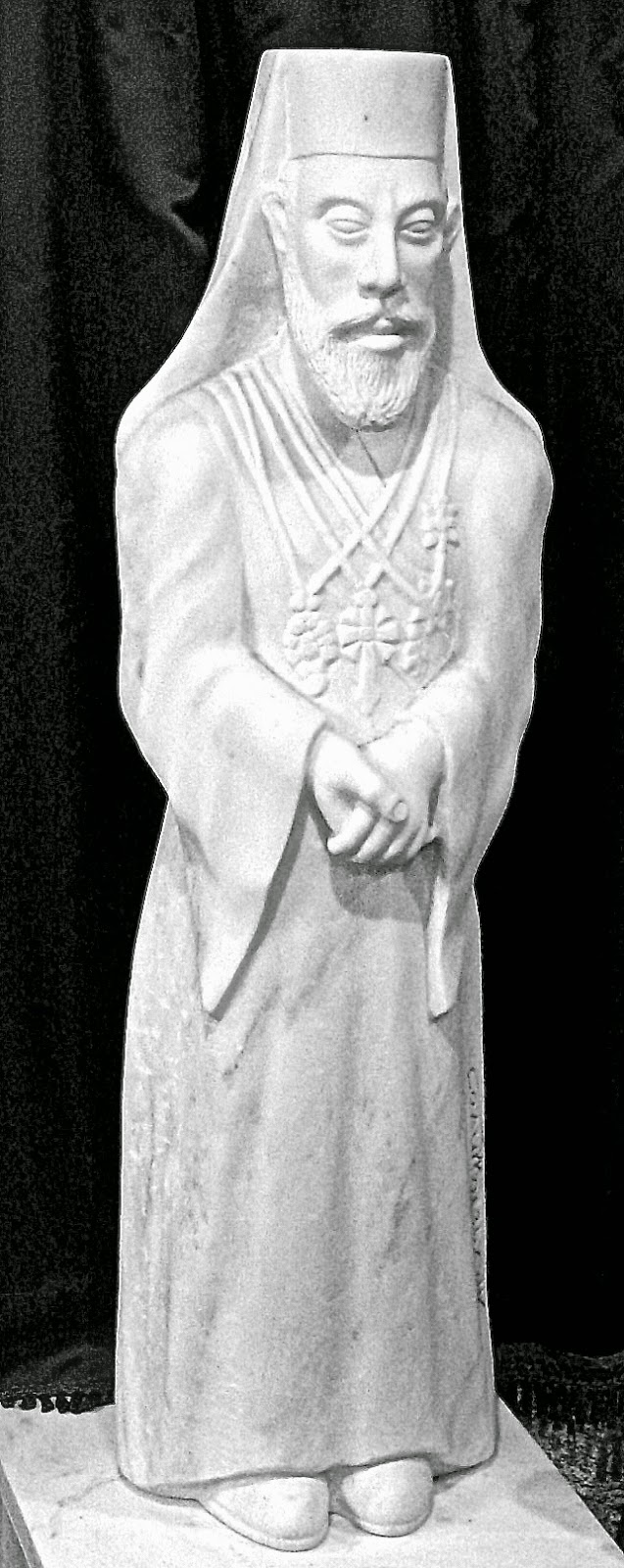
I am as enthusiastic as ever. Linda and I have now, with Angeliki, made a list of every item in the museum as well as a few weathered pieces on the roof.
In the week after Easter we created a temporary numbering of each item; whether it’s stone or marble; its metric dimensions. In about two weeks we will add to this information the inscriptions by the artist - his signature and date and where he’s written something - his words. We will then use our own words to describe those pieces where there’s little or no information from the artist. These notes will be in Greek and English (other languages could be added). We will then renumber the collection - chronologically (by year as there’s no way of finding a month unless Andreas who sometimes remembers his father’s work can date them more precisely).
I have ideas for the form of a published catalogue. Covers can have perhaps the sketch I had done by a Birmingham artist - Jan Bowman - which she made from Andreas' black and white photo of the sculptor at work.
I have also started with the help of a friend - Rob Groove - to get some high quality photos. He has already made a couple, one of which will be featured in a book by the scholar Richard Pine who’s next book will be about Greece from an Irish perspective - to be published this October.
We would pick - say - about twenty representative works to illustrate the catalogue.
I would like then to have three brief articles at the start of the catalogue
- One by Angeliki, Andreas and I describing Aristeidis - enlarging the Wikipedia piece I did last year, or if we are fortunate, one by Andreas alone remembering his father.These would be in Greek and English.
- One by you (if you’d be prepared) discussing the imagery from your perspective as a Greek scholar and referring to a timeline of events accompanying the sculptor’s works, your sense of his subversive risk taking etc.
- One by Prof Efrithikis Antzοulatοu-Retsila expanding on the piece she published in 1985 (I’ve now heard from her and she is interested in a second sight, from her base at Kalamata, University of the Peloponnese
These are tentative ideas. There is of course no money but I see it as unnecessary at this point (if at all) to spend money. Time! Yes. My son is skilled at self-publishing and graphics so he could mock up a model catalogue. Rob Groove is interested in establishing a reputation as a professional photographer and for the moment speaks of leaving out being paid in favour of the pleasure of taking part in an interesting project. It is one of his photos that will be credited in Richard Pine’s book. There are no problems with copyright as the family of the sculptor - in particular Angeliki and Andreas are involved and enthusiastic about seeing Aristeidis Metallinos better known.
My judgement is that a draft but publishable catalogue is a logical next step, essential for any wider recognition. About twenty pages, it could be presented in any initiative that might be taken to promote the laic sculpture in Greece and elsewhere.
In case you wonder why I would most especially like you to write something…your standing as a scholar is significant of course. More so your part in this project. You replied to me last year when I wrote to you about the laic sculptor. All original art has to be discovered; discovered by the individual who strives to see the artist's work directly, unmediated by reference, comparison or repute. I could see from the moment we sat down over coffee in Newcastle that day of my visit last August that you’d been ‘discovering’ Aristeidis. You’d read the papers I attached, looked at pictures, made notes. You had not awaited my arrival with questions, but had prepared thoughts of your own – especially about the timeline of contemporary events in Greece that offer context to this jumbled collection. I believe that few people have yet discovered the laic sculptor. Efrithikis Antzοulatοu-Retsila did in 1935. Yianni M Mari in 1978. I discovered him too as has Linda, through the kindness of the artist’s family and after five year’s wait. You have. So has Richard Pine and the writers Jim Potts and Maria Strani-Potts, to whom I sent all the photos. Aristeidis’ son is the most complex and ambiguous of these discoverers – the one who’s lived longest with the artist. This is why I’m pleased that Angeliki has just told me he’s come round to the idea of writing (or speaking) an account of his memories of his father. There must have been others - some of whom found the work boring, possibly ugly and second-rate, who were rather shocked by some of the pieces. Their reactions are also a discovery. I feel disturbed, even repelled by some art, as the artist may have expected and even intended.
My sense is that we can do our best to intervene in a process of discovery; by mediation and presentation enable more people to see and imagine Aristeidis Metallinos at work, to be able to place what they see and touch in a context and gain a sense of the range of his work - work he began in his 70s (but for the stone shoe he carved in 1927), through the last decade of his life, after most of a lifetime as an artisan, stone-mason and builder - a worker from Ano Korakiana becoming a self-taught sculptor of Kozani marble and unforgiving local stone.
I hope you are well and will forgive me the long interval between communications. We are back from Corfu in early June. It would be good to meet up again. Best wishes, Simon