Total Pageviews

Showing posts sorted by date for query "harm in world politics". Sort by relevance Show all posts

Saturday, 26 October 2019

Context


Before first light the parched island is soaked by a drenching downpour, a timely damping down of hectares of tinder. We lie in bed surrounded by unaccustomed gloom, lightning flashing through the curtains, crashes of thunder, constant rumbling. Mountains and sea are obscured; our forested foreground, now grey-green under a drifting overcast. The trees beside the house are wrung by the wind. Pouring rain spatters our windows, its fall muffled on the roof tiles, echoing in the downpipes. Water spills over the gutters splashing on the common path. Where I left a small gap in the kitchen windows, the counter’s wet. Water glosses the plaka under the veranda, the decking and concrete of our balconies, dribbling from the  yellowing leaves of the wisteria, soaking the green and red of the bougainvillea, bowing its branches. Abruptly a quilt is welcome on the bed and I switch to shirts with long sleeves and socks. I wear underpants again; even a jumper in the evening.
From this day of rain a fortnight follows of clear blue skies. The mountains in the east – rising in Epirus and the southern tip of Albania – return, during these unexpected days of early autumn , to their Wedgwood blue haze. The strip of sea between Corfu and the mainland could be mistaken for a placid lake, our green hills along its western shore, barer land over the strait.  
After weeks of washing clothes by hand – no great problem - we’ve bought a washer to replace the old one Lin couldn’t mend. Mark took it away for scrap after I’d unbolted its concrete steadying weights. I've carried them down to the garden where they stand as modernist shapes. From the same store on the road to Lefkimmi we’ve also bought a new wood stove – exact match of the one that came with the house 12 years ago. Age and misuse had warped the old stove's lid; its body leaked smoke from cracks at each corner. I manhandled three hundred weight of cast iron down the balcony steps, through the apothiki, to the garden where, filled with soil from the compost heap, the old stove sprouts a young bougainvillea we’ve bought.   
In search of context I’ve been reading a school text describing British economic and  social history from 1700. It ends in 1975 when I was 33 - just starting to live in a grown up way so it seemed; helping me to try understanding the next 44 years – my small life's window that included marrying Linda, her having our two children, getting our own house, the job I’ve had until I left the university a few years ago; my bicycles and my travels on them, the advent of Mrs Thatcher, the routing of the public sector, privatisation, the ending of the narratives and ideologies of modernism with its vision in many dimensions of 'one society'. About ten years ago I was strolling, with my folding bicycle, along the slab pavement of the Thames South Bank in London. Under my feet I found a commemorative plaque celebrating the Festival of Britain - marking its centre. For a millisecond I caught a full-body memory of a 9 year-old holding mum's hand in just that spot pausing amid many people - an enthusiastic crowded space - in 1951. "I have no wish to return to that time. I'd rather be in the now and the future" I thought. But I liked the thought of having been there long ago. 

So...the changing fabric, population and demography of our city, Birmingham, and other cities, the implosion of empire, the blatantly diverging fortunes of rich and poor, automation, artificial intelligence and the spreading role of decisions by algorithms indecipherable by their authors, the vast harvesting of personal data, the end - almost - of posting letters in mailboxes, the ubiquity of screens and roving phones, the hours spent dealing - over the phone - with energy service companies, the world wide web which I entered only in 1995, personal data harvesting, the dilution of place as a product of vast increases in the ease of transience "I'm both somewhere and anywhere",  identity politics "I'm a type on a bureaucratic check list which is useful to know, and I'm not at all which is also a lesson"; the tsunami of superficial distraction, but also my allotment, my continuing work with family, on getting the work of my stepfather  - Jack Hargreaves - restored and published, and also our project with his descendant family ("such a privilege") to give a a wider profile to the laic sculptor of Ano Korakiana, Aristeidis Metallinos (1908-1987), my involvement with local campaigns especially Handsworth Park, the Victoria Jubilee Allotments...
With our grandson, Oliver, on Plot 14 of the Victoria Jubilee Allotments (photo: Tim Hamilton)


... Black Patch Park and our small charity Handsworth Helping Hands,
Handsworth Helping Hands committee meeting

...our encounters with the law, my membership of 1000Elders and participation, as a subject, in research into healthy ageing, the growing up of our children, the arrival of our grandchildren, our homes in Handsworth, the Forest of Dean and Corfu, the boat Summersong, and, the long association with the Highlands from a childhood Christmas at Fasnakyle through the time my mother married again and went to live near Inverness for forty years, to go back to the 35 years before 1977, my childhood, my abrupt encounter aged 12, on a desk in the study of a schoolfriend's father of black and white photo's, in a hard backed book, of thin bodies bodies piled on trucks and being pushed by a bulldozer into a pit, and youth, my old travels on land and sea, sailing the Channel...
Sailing to France in Two Pearls in 1963 (photo: Barbara Hargreaves)
... the coast of Brittany, the Mediterranean from France to Greece, across the Atlantic in Young Tiger from the Canaries to the Caribbean, my time in America, the faces of those who loved me and taught me, long dead but ever in my mind, the panoply of art, literature, poetry, film, music, sculpture, design, architecture that educates me, and enriches my understanding, my ever-present confusions, vexations and perplexities…
I’m also re-reading – much more closely than in earlier years - Out of Town: A Life Relived on Television by Jack Hargreaves. Published in 1987
‘...this book, like my programmes – is concerned with those times, with the feeling of the old, small-farming life and the know-how of it’. The story my stepfather tells is of the time when his mother and father met in 1889 to 1929 when Jack would have been 18 - ‘until I left the farm to go to London University and read Veterinary Science’  
*** *** ***
There can hardly be a citrus tree on the whole island of Corfu that is not now infested and blighted by citrus scale insects, which over the last two years have settled in numberless scores on the underside of every young leaf, sucking its sap to access its sugar, bringing black mould to the leaves' upper surfaces. We are almost entirely bereft of once plentiful oranges and lemons. We see no end in sight for this grievous blight.
Our orange tree struggling against citrus scale insect infestation, beside three more similarly affected lemon trees

Some cut down their citrus trees. Others pollard them severely. Many paint the tree trunks with asvesti (white wash) but these insects do not travel up the trees from the ground. They move through the air on broad vectors across large areas. The insects, sometimes in a symbiotic relationship with ants, return as soon as new leaf shoots appear. Some spray with insecticide, which works temporarily but is not good for the fruit. We try regular spraying of non-toxic olive oil soap solution under the leaves. It works a little. So far we have avoided the blackened waste that has afflicted some trees we see in passing. We've heard that Bayer have a systemic insecticide applied to the soil around the roots which kills to insects leaving the fruit 'safe' after 3 weeks, and lasting a year. We are considering this option. Meantime we maintain the soap solution spraying with a pump action garden spray. Naturalist friends say there may be a chance of the trees learning to resist the harm caused to the vital photo-synthesis of leaves by insects and mould. They also say that a predator on scale insects may emerge. This is a low visibility catastrophe affecting tens of thousands of lemon and orange trees on Corfu and surely elsewhere. I'm always pleased when travelling on the island I see, now and then, a citrus tree bearing fruit, it's leaves unaffected and healthy. I saw a tree full of oranges in a garden on high ground in a village west of Agros a few days ago. Is it are resistant species? Have the pest insects not yet arrived? Waiting like a evil character in the wings is the olive tree plague Xylella Fastidiosa.


Wednesday, 21 December 2011

In the wet

I keep making up a cup of coffee with my cup of tea. I  do this a few times when Lin's away - with her mum and dad who she's taken for a biopsy in Sheffield. I've been cycling in the rain, giving Oscar his walk along the canal, taking in some Pantone swatches for Richard to use for computer graphics. We had lunch in town - a steaming soup of wontons, noodles, mushrooms and pak choi, delectable spring rolls, salt squid and rice, and china tea, regularly refilled. Oscar lies quietly in his basket under the awning outside Cafe Soya.
On the street I stay dry and warm. Oscar's got a soft, dense undercoat beneath his wiry surface fur keeping him warm and dry in the wet. This afternoon I raised a veranda of sorts on the shed on our allotment. The site's all mine in this weather, but I'm not alone as people pass along the path through the park, sometimes stopping to chat. I shall cover the plywood of the veranda with roof felt off cuts. It'll be good to have a bit of shelter outside to sit and watch the plot.
In the evening when Lin had still not returned I cycled into town with the box of Pantone Swatches Richard uses for making pictures on screen, Oscar running beside me along the puddled towpath. In the German Market we had bratwurst with crispy bread rolls. I had a mug of mulled cider before heading home the way i'd come.

Lin was back. We'll know the results of her father's biopsy after Christmas. The appointment for 1230 yesterday was delayed until half past six, and then as Lin was preparing to head south this morning the hospital called to ask Lin to bring her dad in to take some photos they needed. "They were all very nice" said Lin "but different people gave us different reasons for the delays." 
*** ***
I streamed another of Jack's Old Country films from the 1980s.
"Now here's a piece with a conservation message of a sort. Nothing to do with birds or frogs or wildflowers but a beautiful creature, important in the history of Britain which recently has been very seriously reduced in numbers. Now all the tourists who come from overseas to see the sights of London, a lot of them go to see a statue which is called the Quadriga. It's a statue of Queen Boadicea in her chariot. They buy postcards of it. But Queen Boadicea or Boudicca, as I believe it's now fashionable to pronounce it, never had horses like that. There are four horses in this chariot. It's a - that's why it's called a quadriga - and they're great big roaring giant horses of the sort which were quite unknown in Boudicaa's day. In the days of that queen the horses in England were very small, very tough and very ancient. They'd been here as long as anybody had ever been here. Perhaps they were here before the people."
*** ***
In Ano Korakiana we enjoy a wood burning stove which, after getting through one truckload of purchased olive logs, we've fuelled with wood recovered from the side of village paths, the gardens and interiors of long empty houses and driftwood from Corfu's litter-strewn beaches.
On the beach ~ plenty of firewood amid the trash
It entails getting permission, sometimes receiving generous offers as when our neighbours, Effie and Adoni rebuilt their apothiki offering us all its old roof wood - decaying but still excellent for heating.
Wood for me to saw from Effie's and Adoni's garden
With the cost of gas and oil increasing it's clear that wood burning stoves are returning in popularity and with this poaching of wood from Greek forests. Kathimerini reports:
Illegal logging has taken on epidemic proportions since the beginning of December, according to reports on Wednesday from forestry services across the country and the Environment Ministry’s Special Secretariat for Forests. The record-high cost of heating oil coupled with shrinking household budgets and a drop in temperatures have compelled thousands across Greece to switch off their radiators and turn to wood-burning stoves instead, creating a profitable market for wood sellers and importers, as well as illegal loggers who pass off their merchandise as being licensed. Reports suggest that thousands of hectares of forest have suffered serious depletion in Pilio, Xanthi, Kavala and Halkidiki, with illegal logging also taking a chunk, albeit a smaller one, out of the woodlands of Foloi in the prefecture of Ileia and Aghios Christoforos near Agrinio, while forest rangers in Strofilia in Achaia claim to have been attacked by a group of illegal loggers when they tried to stop them. The problem is also acute at the Kotychi-Strofylia Reserve in the western Peloponnese -- whose lagoon and forest are protected under the Ramsar Convention -- where there have also been reports of widespread poaching. Forestry authorities, however, admit to being overwhelmed by the magnitude of the phenomenon,
***
In Thessaloniki English citizen journalist Teacher Dude sees Greeks hanging electricity bills containing the new property tax on a public Christmas tree:
Richard Pine's morose grim letter from Greece for The Irish Times 23 Dec'11:
Politics is in complete disarray as people brace themselves for at least a decade of hardship and misery arising from a much-needed bailout. Two inescapable facts emerge from the new political scenario in Greece. First, that Greece was, is and will remain bankrupt – socially and morally as well as financially. The figures don’t add up. They add down. Few people in the street believe that the new “government of national unity” can do anything about it. Second, the structure of politics has fallen apart, with a massive question mark over the future of the two major parties, Pasok and New Democracy (ND) – Pasok because, under former prime minister George Papandreou, it failed to solve the crisis; ND because it caused it. It’s being widely bruited that austerity, even with a 50% 'haircut 's Greek debt, will not cure the long-term ills of Greece, and will do severe harm to individuals and business in the meantime. This is a fact of life which bewilders Greeks because they can see no way out of the impasse....
Richard ends his piece with a quote from Michael Lewis who is referring to southern European nations and Ireland as a new 'third world': “The Irish have a greater talent for suffering. If you imposed on the Greeks what the Irish have imposed on the Irish population, people would be getting shot.”

Monday, 8 November 2010

Aotearoa

South Island, New Zealand
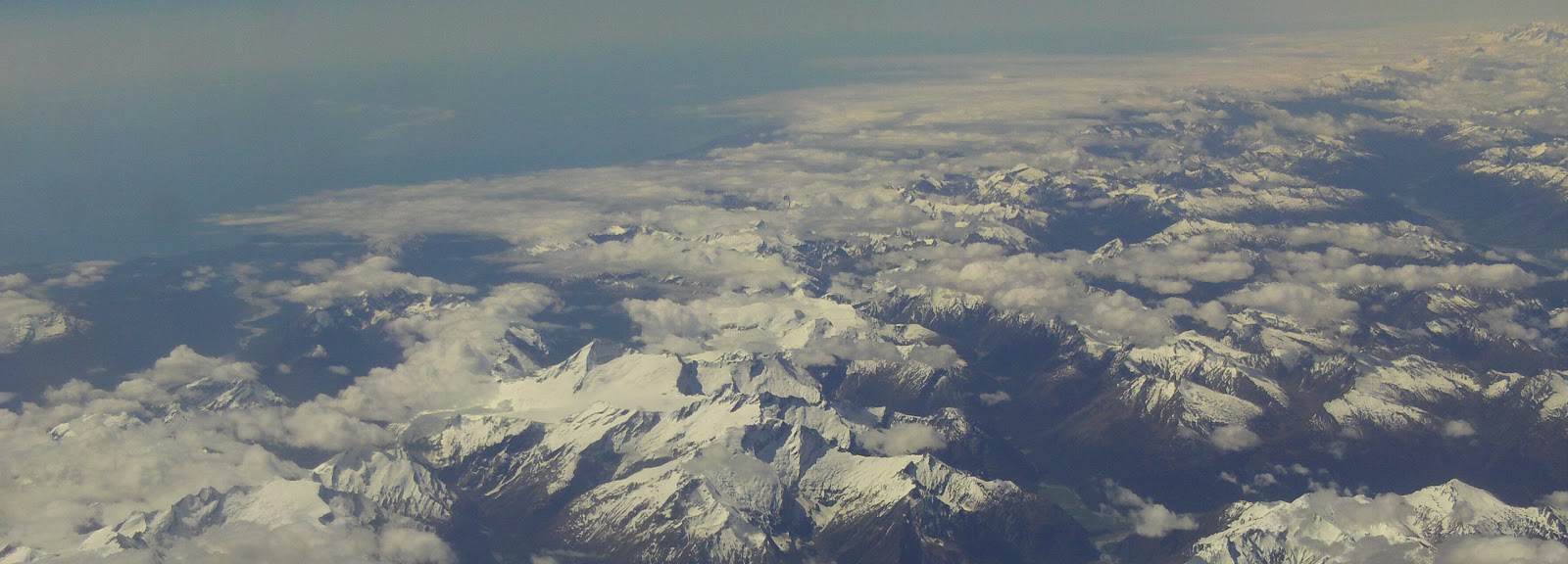
Sunday: From Base Brisbane - a backpackers' hotel opposite Central Station in Brisbane costing A$70 for a double with baths (note: hot water is a problem on the second floor) and WC down the corridor and a steak and beer supper the night before for A$10 each, we caught the efficient Airtrain to the International Airport - under A$30 each return, and without fuss were on a flight over the Tasman Sea - what locals call 'the Ditch' - over South Island, New Zealand, to Dunedin, Les at the Pacific Blue check-in kindly getting us seats by an exit for the extra legroom we cherish. The flight was easy, no frills, pay for your snacks - then after three and a bit hours we were over the mountains of Otago descending to Dunedin, where Val awaited us under a grey sky.
It was chilly, as though we'd flown into the Highlands in June, with similar landscape. So here we were in New Zealand - a place I'd never thought I'd actually see, let alone where I'd find myself - 11000 miles from England - invited to lead a one day seminar in a few days. Once home in Dunedin - 23 kilometres from the airport - Val took us into her warm home at the end of a cul de sac above the city. A log stove was burning merrily. She'd given us her bedroom. We'd enough light to stroll around a garden that mixed familiar British plants with more exotic. Amid the colour and greenery, even the weeds were familiar - couch grass, the tenacious invader and the beautiful nomad dandelion - envy of respectable flowers for its irredeemable wildness.
Some British gardeners struggle to achieve this ambience of timeless relaxed inattention and I've never seen it on a TV gardening programme. Cobwebs are allowed, moss approved, lichen welcome. In the back was a dry stone wall, random bluebells, small fragrant roses, a mossy edged lawn sprinkled with daisies, a little pond, a big old garden shed, a greenhouse with untidy shelves and a kitchen garden needing a few more vegetables, a hedge with an archway leading to a small jumbled patch for compost with a wooden gate that might or might not open onto another tree lined street - a rich patch of England on the other side of the world, and our washing hung out in the sun. Across the horizon, above the low buildings of Dunedin, lay the hazy South Pacific and, to the north west, steep green pastures edged by the bright yellow of gorse in spring, topped by a roll of white cloud beneath the blue. We could hear Blackbirds, "but" said Val "if you hear snuffling late at night that's Possums." In the same house is Val's son Laurence, who helped get my laptop working on the WiFi and on our first morning was coaxing the garden. Steak and sauté potatoes and Greek salad for supper, then early to bed with "no hurry in the morning," so read myself to drowsiness with The Bridge over the Drina - a book about a real bridge in Bosnia Herzgovina that I don't want to end I'm enjoying it so much. In his introduction William McNeill writes
no better introduction to the study of Balkan and Ottoman history exists...with humour and compassion Andrić chronicles the lives of Catholics, Moslems and Orthodox Christians unable to reconcile their disparate loyalties.
Monday morning the wind was still chill but the sky clear but for the long white cloud on the high ground above. The house sits in a slight dip, shielded from the chilly breeze so we could enjoy the warmth of Val's front garden.
"The Maori call this place Aotearoa - The Land of the Long White Cloud" said Val. Later she said with a wry smile "Some call it the land of Wrong White Crowd." I suspect that's an old one - but important for me to strive to understand.
** ** **
From Chris on the plot next to ours on the Victoria Jubilee Allotments:
Hi Simon. Sounds like you need to be heading nearer to the equator! I will try and have a look at lifting a couple of your plants and give you a report on how they have grown. I got some very small "salad" potatoes (very expensive in supermarkets) but the bigger ones seemed to have started to rot; of course my crop was not from seed potatoes but just left overs, so was a bonus realy. I have very much slowed down with the work on trees and hedge pruning before spring; and finally putting the roof properly on the shed. All this and a general tidy up and putting weed control sheets in the strawberry beds will have to be done in the next few weeks as I will be off for my 3 mouth winter escape in Jan. The weather here has been good but turning to rain and colder this week Hopefully arrange a get together for a morning or afternoon tidy and sorting out world politics after your return in Dec. Happy traveling till then. Yours Chris
From Scylla Parkyn, our Hon.Sec.:
Hello Simon, thank-you for your email. I have spoken to one of the park rangers and he said that we are still in line for some leaves, although we haven't quite established where the Allotments they could drop them off ( I did suggest that maybe they could put them on their own plot in the corner for the time being, which they agreed might be an idea, as nothing is being done on it at present, and that they would look into it. The next Allotment meeting will be on 20th November at 11.00am in the Meeting Room. If you can make it perhaps you would like to raise the issue about the bee keeping, especially as you are also allergic to bee stings yet would not object to a beehive on the allotment. I'm sure your offer of giving a talk on how to use a scythe would be welcomed  (in any case,  there's been no sign of a communal rotavator or strimmer appearing). Delith at no 10 had a little 'shed warming' tea party the other day (a few pictures were taken, if you would like one to add to your documentation), while we have managed to find a rather palatial recycled summerhouse/shed affair which is also now up opposite. With best wishes, Scylla 
Dear Scylla. Thanks for your reply. I won't be home until 6 December, but if you think it appropriate do mention this email exchange and say that I fully appreciate the apprehensions of anyone who has a fear that something as apparently minor as a bee-sting (they don't hurt even a quarter as much as a stubbed toe!) could end up causing an allergic reaction so severe as to be fatal. When younger I was stung by both bees and wasps - no where near a hive in the case of the bees, though I was by a nest in the case of the wasps. I had a strong and quite alarming reaction that was cured - luckily - at a nearby medical centre (of which we have several in Handsworth). The nurse saw me about half an hour after the stings and gave me an adrenaline jab for anaphylactic shock and said "It's lucky you got to us when you did." Since then I carry the kit that at the time only a nurse or doctor could provide. These remedies are easily obtainable and for the last thirty years I've had no worries. I was stung by a wasp a month ago. Quite painful but actually no need for treatment because I had no reaction beyond the smart of the sting. I regard my allergy as my responsibility and have equipped myself accordingly (check with local GP!). Bees are essential for the pollination and reproduction of the things we grow on our allotments and gardens and I would be very keen to see beehives in the hands of qualified apiarists on the Victoria Jubilee Allotments - if need be on a plot next to ours or anywhere fellow plotholders consider them welcome. Bees are having a hard time at the moment from various diseases and we need to encourage their husbandry, apart from valuing their role in helping us with growing things. There's an immense amount of advice on the web about beekeeping on urban allotments which includes guidance on how to avoid causing harm to other plotholders or their families. Avoiding apprehension is another thing requiring education, reassurance and respect for safety measures recommended by professional beekeepers. I hope very much that common-sense will prevail on this matter, or we'll end up cutting off our noses to spite our faces, which is a bit silly. Bees and wasps can sting you anywhere and at any time whether on allotment, or at home, in your garden or indoors even or in a car - supposedly safe from all insects. (Some advice on stings including allergic reactions). Part of our problem on the VJA is that shortly after our site was opened in June this year, one of the allotment liaison officers seems to have settled an issue between a beekeeper and another plot-holder, fearful of allergic reaction to stings, in favour of the latter. This has set a local precedent that needs to be debated and I very much hope reconsidered. (My abject apologies to the parties involved if I've over-simplified this incident or just got the wrong end of the stick.) BTW I look forward very much to following Delith's example and having a 'shed-warming' party later in the year or New Year. But first we must get the shed put up. Best  Simon
** **
George Papandreou feels sufficiently pleased with the support shown for his party PASOK in the Hellenic regional and local elections held on Sunday to delay calling a General Election to test support for his government's economic policies. It's typical that a central government uses local elections as a litmus test of its own popularity - especially now - but of course what we're c,urious about are the actual local results of elections to the new councils created by the Kallicrates Plan for the re-organisation of local and regional government across Greece, especially those for the new Municipality of Corfu - Δήμος Κερκυραίων - an amalgamation of the island's thirteen previous local councils. (see my earlier note on local government re-organisation in Corfu in a May 2010 blog). A more pessimistic take on the local polls comes from Costas Douzinas and Petros Papaconstantinou:
...In a country where the turnout is usually up to 80%, some 45% of the electorate abstained and another 10% spoilt their ballots. Pasok received approximately 34% of the vote, the opposition New Democracy 32% and the Communists 11%. The three radical left parties that had not managed to field common candidates polled about 12%. If the wider left had created a united front against the measures, it would have emerged as the hegemonic bloc confronting the neoliberal logic of the ruling elites. In view of these results, Papandreou, looking gaunt and exhausted, announced that he will not call an election but continue with the implementation of these measures...
** ***
Our dear friend Danica in Belgrade who I last saw in Oxford in the northern hemisphere summer has just lost everything from her hard drive - 'tabula rasa' as she writes on Facebook and on her blog - Digital Seredipities.
simon, i am in huge shock and grief.
i lost application im preparing for Harvard to send in 4 days
i have to write mission statement agaain
and research proposal
and to translate one of my works from Serbian to English
all in 4 days.
im installing programs now.
money doesn't matter
i paid for new hard disc
what matters is data
i will write now post on digital serendipities about this experience
and even more about support of humans and friendships
this seems good test to know who are really my friends and who not.
thank you for being my friend.
much love to lin and you
x
I know the feeling. These 'little' crises are sent to test us - remember Newton's thesis, eaten by a dog or did the maid use it to light a fire or was that someone else who lost all their work in the same grievous way? (What actually may have happened) I keep three external hard drives, one left at home, and two which travel in separate cases, plus I've a flash drive for ID stuff hung round my neck, and documents, images, film and sound left in the 'cloud' - e.g. Google-docs, Flickr, Soundcloud,Vimeo and Youtube - with links via this blog. Loss of a hard disk is still vexing but think of the 24/7 work we ask of these things! In a vain attempt at consolation I sent D this page from Dog with the Blog
** ** **
In a connected world I'm interested in any perspective on the incomprehensible world of economics. This piece in the Otago Daily Times (8 Nov '10) by Peter Lyons, an economist at St.Peter's College in Epsom, NZ I found quite helpful - if for nothing else than that he admits there are no easy answers:
...The United States, Japan and the United Kingdom are abandoning monetarist orthodoxy. Their central banks are pumping money into their economies with the aim of stimulating demand and driving down their exchange rates. This aims to increase the competitiveness of their exports. As the New Zealand dollar increases in value against these currencies it makes our exports less competitive on world markets.  Export-led growth was meant to be our saviour but this may be denied to us by the beggar-thy-neighbour polices of other countries. Further decrease in effective demand in New Zealand will lead to rising unemployment which could spill over into the housing market. If significant declines in house prices occur, this could create a negative wealth effect. As people feel less wealthy they cut back spending, leading to a nasty deflationary spiral. This is what other countries are desperately trying to avoid. There are no easy answers but we need to look seriously at our use of monetarist policy through the Reserve Bank. It is a debate that is long overdue. Our economy is not out of the woods by a long shot. These are strange times as countries seek to extricate themselves from the debt quagmire left by decades of monetarism....
*** ***
Andrew Coulson shared some thoughts by email about our Prime Minister's vision of the Big Society from which I extracted this::
...The idea of the Big Society is to recreate civil society, to turn back the clock to a life when we lived a few miles from the rest of our families, worked in the same place, shopped in the same place, went to pub or church in the same place, etc – i.e. a pre-motor car society. But it is also presented as a way of having a reduced state – i.e. civil society structures take over from what the welfare state does now. Politically this is very clever, as it means it can appeal to the right (smaller state) and to the left (mutualism and communitarianism), not only within the Conservative Party but more widely. But as a piece of political ideology the BS is in danger of complete meltdown. Cameron could not get a cheer for it at the Conservative Party Conference. I think that is because most Conservatives know that if the voluntary sector bodies they are involved in are to prosper they need constructive relationships, and often resources, from the state. They also know that they will be unequal – easy in villages and among retired people, much harder in cities and 30-somethings with young families trying to hold down jobs. So they neither believe that a top-down initiative can add much to what they are already doing, nor that it can replace the state in (say) crime fighting or care for the elderly...
My reply (extract):
As one involved in local community activity most of my adult life the impulse comes from advice given me ages and ages ago by my step-father who said two things of especial importance about political involvement and engagement to me when I was about 16. They must have been important or I wouldn’t recall them so clearly. The first was “You can get almost anything done if you don’t mind not taking credit for it.” (My Dad added to this also with a remark about how rewarding it was to have planted an idea and see other’s claiming ownership of it and pursuing it with enthusiasm.) I am sure JDS has ever approached the world in this spirit. The second observation was that trying to make anything happen in a democracy is like wading through thick treacle. ‘There are so many others trying to influence the same decision-making bodies that you will only achieve your goals by wading faster and more persistently and occasionly joining up with others who’s hopes and desires you share. The result of this is that I've never had any doubts about the role of perseverance and the patient courage demanded by political engagement. Few of the projects that have mattered to me (parks, allotments, green spaces in cities, transport transformation) have involved under 20 years and many of these continue messy and fragile and incomplete (e.g. The ending of autodependency (:)))  I have always consoled myself without using it as an excuse to be less resolved that none of my political heroes ever lived to see their dreams realised. Wilberforce never saw the ending of slavery, only our declaration of its illegality. Many of the most stalwart campaigners for women’s suffrage never themselves lived to gain the vote. Martin Luther King’s dream...and so on. I’m sure this applies to those who campaign against the predatory lobbying of big pharma that you mention. David and Goliath has always been an appealing image learned in childhood classes. The summarising maxim for me is not ‘don’t let the bastards grind you down’ (tho’ I like that phrase) but ‘you are always losing until you win.’ Until people can be persuaded to take on games that they seem to be losing over most of their adult lives I don’t see how government can hope to rely on dreams of ‘civic engagement’. Being poor is just such a losing game, so asking such people whose achievements revolve around daily and weekly survival to do yet more is bizarre. Best, Simon (in Dunedin, NZ) (See Stuart Weir on 'sham' localism)
Linda looks over the Pacific 

Tuesday, 24 November 2009

Melbourne


John's old friend Jeff Floyd lent me his fine bicycle which I collected this morning from a floor high over central Melbourne, heading south along the Yarra to the shore at St Kilda, still far from the swells of real ocean but sandy and blue and built-up, just kilometers from the vertiginous architecture of this great city. The great interior and the vast uninhabited ocean shores remain remote, but for glimpses through a plane window and the genius of the indigenous genii who’s art seen this afternoon, when I cycled back to the city, has imparted something of what I’ve yet to learn; something which D.H.Lawrence in his genius seem to miss - 'this speechless country'. No longer and I don't mean just the Mabo Case or Paul Keating's Redfern Address, or Kevin Rudd's magnificent speech on 13 February 2008, or the Aboriginal Tent Embassy which I saw when John cycled me around central Canberra, but an epic - known and yet to be known - that will flow into future understanding of Australia and the world.

The recovery of Terra Nullius
I've been gazing entranced at the work of H.J.Wedge, Samantha Hobson, Julie Dowling, Gordon Hoskey, Treahna Hamme and, respect to Geoffrey Bardon, at the great mural Napperby Death Spirit Dreaming by Tim Leura Tjapaltjarri and Clifford Possum Tjapaltjarri.
But why turn my experience of a few weeks in Australia into painting by numbers? What might be fun would be to see how my judgements shift; what changes these swift weeks have made in my character.
There's the sense of understanding more about the negotiated space between politics and management, through the thinking of John Martin, now friend and colleague, studying the relationship in Australia; from John’s and Annie’s film – especially – of the conversation between the Mayor and CEO of Marion. This demonstrated the way a role-determined tension between political aspiration and managerially stewarded limits - legal, technical, financial - is resolved – over and over, by unique individuals who get better and better at it.
That demonstration of the personal workings of government also shone a light on the position and role of professionals in that mix whose grammar we’re striving to make more intelligible. Here there’s a professional who cares so much about the difference between almonds and jacarandas as part of the landscape of a street - a place - fretting about root-falls on understreet services – invisible to most. We’re still parsing this conversation. John’s used it on his own with one set of managers and councillors. I will use it in England – an exploration of how managers broker the relationship between the professionals and the politicians in government – made real In animated conversation between leaders - politicians and managers - at the apex, negotiating overlapping spheres of activity and interest.
As my train on Monday morning hurried south to Melbourne, through Castlemain, Malmesbury, Kyneton, Macedon, I drank up the landscape washed by a weekend of steady rain, still insufficient to fill the creeks and lakes so thirsty is the land itself, our speed at moments blending iron bark, grass, corrugated iron, yellow red stone, and clouds that reach beyond horizons I've glimpsed over a wing.
From my comfortable and inexpensive seat on the train I see stretches of the road on which I’ve been driven several times to Melbourne Airport to catch airplanes to the edges of the continent – Perth, Darwin (via Alice Springs), Brisbane, Canberra, Sydney, Adelaide and Launceston. We calculated, John and I, that by the time I’m home I’ll have travelled 47000 kilometres, over 29000 miles. I asked an environmental campaigner about this at the conference at Bendigo on Energy Futures, after he’d shown us a clever clip of flight movements across the world. He had no imperative. He mentioned George Monbiot pondering the same. Could you give up friends made across the world through the benefits of flight? “He calls them love miles"
*** *** *** I sent Paul in Agios Ioannis some pieces from the blog that might interest him for the December Newsletter, having failed so far to put together thoughts on the reciprocity between Ionians and successive Lords High Commissioners during the Protectorate - the theme of my chat this February at the Durrell School. 'Paul, would any of these do?':
Some of the most beautiful in Northern Greece - Koliopoulos on 'plundered loyalties' in Macedonia
Yearning Burning Earning and again - the commodification of Greek land, the 2009 fires in Athens and the Hellenic Cadastre
The missing commentary - The Parthenon Marbles
"Which side then has committed more crimes - right or left?" - ο Eμφύλιος.
Bad building on Corfu
Long ago in Aegina - Yannis Moralis and my Greek stepmother, Maria Roussen
Shades of grey. Corfu in winter
Consumerism - upon which most of us depend...
* * * *
Greece and Melbourne mingle in my current reading - Christos Tsiolkas' Loaded - an excellent introduction to the city - East, North, South and West - for the average tourist with guidance on places to visit. I'm jesting. This is a Melbourne Sorrows of Young Werthe written in 1995, made into the film Head on, driven by the manic confusions of voluntary transportation to Australia, Greek parents with peasant roots who require land to feel secure, who 'migrated to escape the chaos of history' who 'know fundamentally, property is war' that:
Possession of land, of more and more land, is the means by which an uneducated, diasporic community enables itself to rise in the New World and kick their brothers and sisters in the face, in the balls, in the cunt. p.143
This Australian sturm und drang is unremittingly ugly - sexual and substance self-harm dancing to music that hurts and endless arguments of the kind that makes troubled youth so bloody irritating to the forgetful old - who've got their own problems. Wimpishly, I felt like hiding the book's well-lit pages from neighbours on the plane lest they think I'm reading porn, albeit funded by the Australian Council for the Arts. Ari, Tsiolkas' loaded antihero, loathes cars and suburbs and a lot of other things including the 'weakness' of his Greek parents. He was already 30 when Loaded was published. The book's unconsoling vigour brought to mind E.M.Forster in Passage to India, which I mined for A-Level 40 years ago:
Most of life is so dull that there is nothing to be said about it, and the books and talks that would describe it as interesting are obliged to exaggerate, in the hope of justifying their own existence. Inside its cocoon of work or social obligation, the human spirit slumbers for the most part, registering the distinction between pleasure and pain, but not nearly as alert as we pretend. There are periods in the most thrilling day during which nothing happens, and though we continue to exclaim, “I do enjoy myself,, or , “I am horrified,” we are insincere.
As an Englishman with mainly Scots roots, linked through my dad to a Greek stepmother and half Greek family set of sisters and half-bro, and parents who divorced in 1949, brought up by my mother and stepfather now living in inner-city Birmingham and the most congenially beautiful village in Corfu and re-visiting Australia, Tsiolkas' rich writing speaks of a misery in being young that I only half recall if at all, being largely distracted from self-harm by the ocean and all the possibilities of a life privileged by the imagination and talent of those closest to me, and located by English private boarding schools from the age of six - an indoctrination so robust I didn't start to peel it away until I was into my 30s, largely impervious until then that a peel even existed, and wasn't something that I could being to write about until I was well into my 50s, when I'd assembled some experience. I'll read more of Tsiolkas, as also Tim Winton, and thank the Brisbane bookshop owner who pitched me at just two consummate artists to be going on with, narrating the history of Australia as surely as its great physical explorers, matching the new cartography of its emerging indigenous artists.
[Back to the future 17 December 09: A finely written diatribe by the Sydney columnist Elizabeth Farralley, against suburbs and MacMansions and Australia's love affair with ugliness - see the comments too]
*A very different take on the Greek diaspora, comes from Stavros, author of My Greek Odyssey:
* * *
The image that will remain in my head is the Tjapaltjarris' night sky inside Napperby Death Spirit Dreaming and Lorenzo's words in The Merchant of Venice

Look how the floor of heaven Is thick inlaid with patines of bright gold: There's not the smallest orb which thou behold'st But in his motion like an angel sings, Still quiring to the young-eyed cherubins; Such harmony is in immortal souls; But whilst this muddy vesture of decay Doth grossly close it in, we cannot hear it.
It reminded me of Richard's picture last year when he stayed with us in Ano Korakiana.
and...
HR 5171 (back to the future March 2014)

Saturday, 1 August 2009

To the Highlands

Waiting at Glasgow Queen Street Station for a train to Inverness
Slipped the surly bonds of New Street with my book to read - High Albania - and my DVDs to watch - An Exile in Paradise - a picnic of goodies around two baguettes of smoked salmon and cream cheese made up for me by Lin, and Oscar of course, on his lead and in and out of his igloo, used by now to long train journeys. All day we head north, almost a routine; getting at mid-afternoon to handsome Glasgow Central Station; then a walk - sunny and warm, drawing my bag across dry pavements at last - to Glasgow Queen Street, then three and a half hours more via the magic ladder - Stirling, Dunblane, Gleneagles, Perth, Dunkeld & Birnham, Pitlochry, Blair Atholl - then beside the road and the rivers through steep Drumochter Pass - on to Dalwhinnie, Newtonmore, Kingussie, Aviemore, Carrbridge, from where I phone my mother's house to announce that I'll arrive at 7.34 in Inverness. "What! You said 31 July. Get a taxi." Minutes later as the train scurries downhill in a great wide circle over the viaduct above the Clava Stones, she relents and we're met by Sharon at the station and so up the A9 to Strathnairn and with Oscar squeaking with excitement up the dirt track to Brin Croft and the greeting terriers.
** ** **
In the Town Hall, Liverpool
Over the last few days Charlie and I have been helping run meetings in Liverpool. The idea is to help managers and politicians and other community representatives in the city’s five official, and relatively newly defined neighbourhoods, to work better; promoting clearer understanding of roles and responsibilities among members and officers, assisting officers to apply their professional expertise to politically led agendas, helping councillors get the best from their officers, identifying barriers and challenges being experienced, and thinking together about ways to improve communication and relationships. Each programme, over a couple of hours, has involved:
Welcome and introductions; objectives and ground rules (Chatham House), the reasons people are here; a look at the Liverpool context – councillors and officers initially at separate tables seeing how much they know about the governance arrangements in the city; how well people think they know one another – a mapping exercise (example from elsewhere) putting faces to places and roles with flip charts, photos of members and a plan of the city. "What don’t you know?" "Does it matter?"What do you need to know?” I give a talk on managing at the political interface, sharing my research across local government, with emphasis on working at the point where politics, management and professionalism converge – or fail to.
Then politicians and managers worked together on typical problems – critical incidents – talking around solutions but also around vision, values and skills. How do we make neighbourhood government work?
Charlie and I took notes for a summary to be circulated to everyone involved and in a morning off - successive workshops were afternoon and evening - I was a tourist, travelling by underground from Lime Street, surfacing beyond Birkenhead's seafront, crossing the top of the Wirral to West Kirby where I sought the street where Denys Rayner had lived when he got married. Under a turgid sky I cycled along the front - a brisk north westerly encouraging the wind surfers and dingy sailors on the marine lake where Rayner had taught his eldest son, Martin, to sail before WW2. Back on the train I got off at Hamilton Square and took the Royal Iris from Woodside a few minutes across the Mersey to its pier below the Liver Building.

* * *
I like it when names and actions mix. I've recently given high marks to a thesis by one of our students, Susanna Farmer, Town Clerk of Wisbech Town Council, here, with her father Reginald Phillips, on Graduation Day 14 July 2009. She's written a Master's thesis about ways councils like hers can pursue their duty under the 1908 Small Holdings and Allotments Act to protect and encourage local food growing. What delighted me was her analysis of the astute way the council, with its limited powers and even fewer resources, has found inventive ways to get local land brought back into cultivation as allotments and how as the officer of the council she's been able to help its elected members pursue that policy.
* * * Iason Athanasiades released from Iranian detention after being arrested, beaten and interrogated has written down a list of the books he'd like to have had in prison along with the hand annotated Holy Quran he was allowed and the copy of his mother Polymnia's PhD thesis on Julian the Apostate brought to his cell by the Greek Ambassador in Teheran and swiftly confiscated by his guards.
18 July 2009 ATHENS — Jail cells — alongside yoga studios — are the last bastions of true inner peace. When I became the first foreign journalist in decades to be thrown into Iran's notorious Evin Prison I was exposed to a mixture of intense interrogations amid long stretches of nothingness. Stripped of my laptop, cell phone and all human contact, I was forced to confront my ego and get used to spending time with me, myself and I.
The only printed matter in my jail cell was a copy of the Holy Quran. It was a previous inmate’s well thumbed edition that had come loose from its hardback spine. A neat hand had written several religious aphorisms in Arabic on its pages. Imagining I was resting against the thick pillar of one of the beautifully-carpeted Ottoman mosques of Istanbul, my adopted city, I spent hours reading the handwritten calligraphy.
On the second week the Greek ambassador was finally granted a 10-minute meeting. Leaving, he presented me with a copy of my mother’s Oxford Ph.D. thesis whose Greek edition he had happened to be reading. My guards confiscated it for “inspection” and I never saw it again. Perhaps they thought the perfidious Greeks had gone to the trouble of printing a book for their man containing disguised instructions within its unfamiliar alphabet.
Those were the only two books I saw. For the son of two academics who grew up in a house with floor to ceiling bookcases and whose only indulgence is haunting the aisles of secondhand bookstores in Boston, London and Istanbul, denying me reading matter was more painful than torture. Every day, I called the jailers and requested my mother’s book. Some of them visibly struggled with the concept that a woman could have written a book and looked at me as if I were trying to trick them. Others promised to convey the message but promptly forgot about me.
So I made reading lists in my head (see the list with hyperlinks to the books)
Several are recommendations by my Ministry of Intelligence interrogators. Others are themed on incarceration and were suggested by my friends.....
How I can relate to the 'torture' of being bereft of books, yet I have been in homes of people who's company I enjoy where there are none. These things vary greatly. For some to be deprived of TV might be 'torture' while, for me, such deprivation could be a small compensation for losing my freedom.
Perhaps the most telling book on Iason's list is: Ervand Abrahamian's Tortured Confessions: Prisons and Public Recantations in Iran. Written in 1999 Athanasiades described this as 'the definitive book on torture both in the Islamic Republic and under the Shah. The book lays out in fascinating detail and with extensive documentation how torture in Iran differs from elsewhere: victims are brutalised until something other than information is obtained — a public confession and ideological recantation. For the victim whose honour, reputation and self-respect are destroyed, the act is a form of suicide. Recent examples of confessions include: Iranian-Canadian sociologist Ramin Jahanbegloo’s interview to a state-run news agency following his release(see this re the 'confession' and see also); Haaleh Esfandiari’s televised confession in a hotel room presented in documentary format on state-run television; and Roxana Saberi’s signed confession in prison.' And see this, with the 'before' and 'after' images from Global Voices about the trial of the moderate reformist Mohammed ali Abtahi
* * * I'm engrossed in Kadaré's Broken April. Stark writing of a stark landscape, full of the intensity and detail of a world where one tiny action can change everything. There are moments in the book where I hear the weather among the mountains and see the words of its characters punctuated by powerful music.
... "at once terrible, absurd and fatal, like all the important things." "Like all the really important things," she repeated ... "Yes" Bessian said "because to an Albanian a guest is a demi-god."(p.77).
Like all great writing, unlike film, the artist has not purloined the reader's imagination. Kadaré sets it galloping. I have an intimation that my thoughts have turned with enthusiastic curiosity towards Albania because there is a key to understanding a queue of confusions I've entertained about Greece and her neighbours.** ** ** On 26 July I commented on a blog by the Corfu author Maria Strani-Potts containing her parable The Pimping of Panorea
I do not regard the pimping of panorea as only the fault of the locals. There are national and vaster forces - international traffic in the abuse of Panorea
Sunday 2 Aug:
Dear Simon. You are right, but honestly when I see what the Corfiots and the international operators/exploiters do on a daily basis, what else can I think? I live here, I am a Corfiot, I love my birthplace, and I appreciate its unique values; I want my compatriots to have good health care, good mains water to drink, better means of transport. If they have to own a car it would be nice to have a place to park it. I would like to see the Corfiots use the land in an appropriate manner, and getting rid of the rubbish in a sensible way. My book Panorea was about Corfu. I have lived in many more countries than an average person and I do know the strengths and weaknesses of different countries' policies and strategies, but I do care passionately about this island, and everyday I am shocked by the shortsightedness and incompetence of our local politicians. I work in the hospital as a volunteer and I am dreading the day that I might end up there. I think am correct in comparing many of my compatriots to pimps, because this is what they are vis-a-vis the unscrupulous exploitation of the island. They are greedy and insensitive and we all have to suffer the consequences. My heart bleeds to see what has happened to this island. Kind regards Maria
Reply by return:
Dear Maria. Thanks for taking this newcomer seriously. Like a chicken who’s egg is hatched by a duck then tries one day to swim – to the dismay of both species - I was hopelessly imprinted on Greece by my father John, who married an Athenian, Maria, at a little church in Hermou Street long ago. (The Greek Orthodox Church accords you a second chance which, since they had both been divorced, was much appreciated in 1949). Both he and Maria are gone. They left me almost incapable of faulting Greece. I'm aware of the burden imposed on Greeks by Philhellenes like me, and so, thank goodness, have been willing to study the flaws of a beloved land, especially in Corfu, now Linda and I spend so much time there. Your writing on this turned out to be a beautifully crafted account (and that’s only the English version) of a tragedy affecting the whole world. Yet without humans landscapes and soundscapes are pitiless nature. With them they can be loved and, as you know too well, destroyed - the aboriginal story of the Fall, in modern terms, the Tragedy of the Commons. I would never forgo the apple (tho’ cowardly as Adam, I might blame it on ‘the woman’ - as men do) but what a Pandora’s Box* was released (blaming it on the woman again!) when men first doted on Kerkyra. If we can sort ‘our’ (the pronoun is intended – ‘our’ not ‘your’) problem on Corfu - a race between our nature and our intelligence - we might just be able to sort it out in other places. There are good brave people everywhere ...When your heart bleeds for your home, you are weeping in Corfu over the harm our flawed species is doing to the whole world. Best wishes. Simon
*It never was a box. it was a jar. Pandora's πιθος. But I read this tale as a child - probably before I read Genesis. I remember Arthur Rackam's picture of Pandora.After Prometheus stole the secret of fire, Zeus ordered Hephaestus to create Pandora as just part of his punishment for men. Pandora, among other gifts, such as curiosity, had been given a large jar. She was told by Zeus to keep it closed. She opened it. I would. All of the evils mankind had not known escaped from the jar. It seems obvious now that Zeus knew Pandora would take the lid off the jar. Why leave Hope at the bottom?

Back numbers

Simon Baddeley