Total Pageviews

Showing posts with label Denys Rayner. Show all posts

Wednesday, 8 March 2017

'A friend in a field'

Six years ago I posted some sad pictures I'd been sent of an old boat I'd once sailed - her untidy cabin filled with dirty water, her cockpit invaded by greenery. This was Young Tiger, a 22 foot Westerly built in England 53 years ago, sat in a field in an eastern state of the USA, 40 miles from the nearest sea at Baltimore on the Chesapeake.

On 27th August last year - I got a message from a stranger on my blog via Disqus
Hi, Simon. Did you ever find out what became of Young Tiger after this post? (28 July 2011) Sue is a dear friend, and I'm a young American sailor myself (though in Wales at the moment)... If no one is looking after the boat, I'd love to beg someone to let me buy her. Very best, Whitney
28 Aug 20i6: Dear Whitney...I send you details of the family of the man - John Coyle - who had put Young Tiger on that flatbed trailer hoping - though it sounds an old man’s dream - to sail her off the New England coast. This email address may well be out of date by now. The old man in my record is down as:
John Coyle (son-in-law Sean, daughter Sara) ** Roland Place, N.W.,
Washington, D.C., 20008 USA. Phone:  001 (202) *** ****  owner of Young Tiger, Frederick Maryland. Source of this info: Gordon Gemeny PO Box ***, Dowell, Maryland, 20629, US    It’s all gone a little historical now, but I’d be fascinated to know more, as I am sure would Sue.  Best wishes and good luck, Simon
28 Aug: Dear Simon. I was delighted to hear from you. I’ve sent an email to Sean and Sarah straightaway. I’m in Wales at the moment, but back to the US in early October and quite serious about finding YT if I can. I’m based in South Carolina, but I work in the DC area regularly and expect I might be up that way again in the autumn. I won’t get my hopes up too high, but buying a soggy 1960s boat that would need huge amounts of restoration has really caught my imagination, I confess. I’m a builder of sorts by trade (very good dry-stone waller, sort of rubbishy carpenter, etc), so I hope I could do a bit of it myself.
I was with Sue just last week, and she mentioned you and that very Merry Wives reunion as we drove along the A470 together!
Miriam, Sue and I in London at a 50 year reunion of another adventure ~ 14 Nov 2015
She is an extraordinary woman - one of my very favorites. She and Phil were the first to take me sailing some years ago...
Sue, Phil and Whitney aboard Vicki at Aberaeron
 ...and I’m so grateful to them for it. I’ve gone on to do a few RYA courses since then (currently sitting comfortably at Day Skipper level after a week in St Lucia last February), and I’ve sailed newer, bigger French boats as well as older, creakier wooden boats like a Bristol Channel Pilot Cutter, but it’s the little Westerly I love best. They’re so approachable. Sometime a few years ago Sue and I were sitting on her front lawn having a gin and catching up after I’d returned from my first big sail when suddenly she disappeared into the house for a few minutes with no explanation … She returned holding one of the charts from your voyage. “I found this the other day while I was clearing up,” she said. I can’t recall if it was Barbados or the Grenadines she had in her hands, but we talked for a long time about the sea that afternoon. It was a lovely moment. Wish me luck, and thanks again for the quick response! I’ll let you know if I hear anything back. Very best, Whitney

28th Aug 2016:  Dear Sean and Sarah. Please forgive this email out of the blue. I’m trying to find the whereabouts of a little Westerly 22 called Young Tiger. I think you know Simon Baddeley - at least electronically. His companion on Young Tiger's big Atlantic crossing, Sue Pulford (now Best), is a very dear friend of mine and the reason I began sailing just a few years ago.
Sue Pulford 1966
I linked up with Simon via his blog just a few days ago, and he’s very kindly pointed me to you. I’m sorry to bother, but I thought it might be worth a shot to email you. I hope you don’t mind.
I’m in Wales at the moment, which is where Sue lives and where I’ve trained and still work sometimes as a dry-stone waller, but I’m American. I’m from South Carolina (don’t hold that against me!), but I spend much of the year on the road for work, leaving a trail of beautiful stone wherever I go. I even built on the National Mall earlier this summer as part of the Smithsonian Folklife Festival, though the bulk of my work is down in the mountains of southwestern Virginia and here in the wild hills of mid-Wales. Here I am, if you’re curious: www.whitneybrownstone.com    Anyway, I’d love to know what’s happened to the boat these last few years. The last photos I saw showed her in quite a sad state. I don’t want to be too forward here since we don’t know each other at all, but I’d be so eager to rescue her if she needed it. I’m 33 and perhaps a bit foolish, but I think she’s quite a special little boat - not to mention quite special to someone I love - and I’m not afraid of a project. Even if she’s found a good home by now, I’d love to know how’s she’s faring out in the world if you have a few minutes to write.
Sue still sails a Westerly 22 after all these years. Vickie, moored in Aberaeron in Cardigan Bay, was the first boat I ever sailed on, and I fell quickly in love. I’ve gone on to sail bigger, newer boats here in Wales and down in St Lucia, gradually working my way up to skipper, but none have ever been as charming as the little Westerly.
Thanks very much for your time. Best wishes, Whitney Brown
Email to Whitney 29 Aug: Hello, This is Sean, the son in law of the John P. Coyle. JPC is the gentleman who owned the Young Tiger before it came to be where it is at now. She is still in the same spot in a field in Adamstown Maryland. It is most likely that she could be had for free to someone willing to take on such a project in ernest. If you are interested, I would be happy to inquire/make arrangements. Let me know .... would love to see her sail and crew with her.  Call or write us, Sean and Sarah 
29th Aug: Simon, can you believe it? More soon. Pleasantly in shock at the moment! Very best, and THANK YOU, Whitney. Sent from my iPhone
29 Aug to Whitney, copied to Susanna Best (Sue Pulford): No I do NOT believe it (:)) After hardly half a week’s checking - that’s almost disappointing - except it’s not! I too am in shock at the continuity in emails in these times of transient addresses. And so good to feel goodwill from Sean. I wonder how YT's fared on her flatbed through those Maryland seasons. I can only imagine YT wanted to be found, old timer that she is. Here are tales to tell of adventure and perhaps more to come. Best, Simon
A friend in a field
23 Jan 2017: Hi Simon. I hope this finds you happy and well. I’m sorry to be out of touch so long. The autumn just seemed to slip away with one thing and another ... And a very nasty election. (I was marching in Washington on Saturday, rest assured)

I’ve just finished an email to Sue updating her on my morning’s adventure, so I thought I’d better check in with you as well. Finally, in horrendous weather, I went to see Young Tiger in her field in rural Maryland. She is just as Sean described her to me in his email: in a bit of a sad state, but not beyond repair. I was disappointed to see that her spars are all rotted, but I do think the hull will be just fine with some TLC. Then there’s the matter of, oh, ALL of the equipment: sails, radio, battery, engine, loo, cooker, lights, etc! It will take me a bit to get sorted so that I can begin the restoration process, but I am keen to do so. I want her to be beautiful again, and while I probably won’t sail her across an ocean, I’d love to get her down to Admiralty Bay in Bequia once more ... Best,
Whitney
Young Tiger in Admiralty Bay, Bequia 1966


23 Jan 2017: Dear Whitney. We are well and I’m the happier for seeing that striking image of you and Young Tiger. It was easier to see you in the crowd on Independence Avenue, because it was so small compared to the previous day’s inauguration where the crowd was many times larger than at the 'nasty women’s' march. I have access to 'alternative facts’, as will we all for the next few years.
What a really lovely picture. So you traced Young Tiger to a field under autumn trees in Maryland; Denys Rayner’s small boat that looked after us along the coasts of Spain and Africa, the Canaries, the Caribbean Islands, the Bahamas and on the deep ocean between those magic shores.
The woods are lovely, dark, and deep,
But I have promises to keep,
And miles to go before I sleep,
And miles to go before I sleep.
Sue phoned me, seconds before I opened your email. You have stirred dream memories of an adventure long ago.  Your journey to a field in Maryland seems destined, and you are to windward of us in age, energy and enthusiasm.  I’m not surprised those spruce spas have rotted - through neglect rather than use.  I am excited at your plans for restoration and am sure, as is Sue, that you can make ‘our' little ship whole again. Make her yours. She’s not been properly owned for decades. If you want a rough ground plan of the boat from the original brochure that came with each model including YT, just ask. I have it in my files and can easily get it copied.  All the very best, Simon
So she's 3570 miles away as the crow flies, far further by other means, and - so it feels - in time. Last Wednesday, Whitney and I met in London, and over a long lunch at the Lighterman in Granary Square, ran through what I remembered about the boat she is taking under her capable wings. I gave her a copy of the plans - inside and out of the W22, and ran through the gunter rig, the reasoning behind bilge ballast keels, the evolution of YT's design in the mind of Ben Rayner and the boat's aesthetic, the reason Denys preferred outboard motors, 'Blondie' Hasler's self-steering gear as its inventor had explained it to me, the simplicity of Mary Blewitt's guide to taking noon sights - whch I reckoned W had begun to learn on her Day Skipper course and would hardly need in the days of SatNav. I am inspired by this continuity; not a revisit, a relay. Whitney Brown is a true grafter. I cannot imagine anyone more qualified in character, knowledge and craft to take on the challenge of taking Young Tiger back to the sea where she should be.
Landfall on Barbados - 5 Jan 1966 "Clouds collected during the night, obscuring the bright moon, and at dawn it was blowing hard with rain everywhere and haze ahead. We stared ahead until our eyes ached. Suddenly a break in the cloud let through a sunbeam which shone on the land about 10 miles off - green and incredibly exciting."*(painting: SB)

A message on 8th March from me to WB on Facebook:
I am told this was the original Rosie. It's clear you have all the skills and craft and strength to remake YT. My concern is the interaction, over many years, of saltwater, iron, and fibre glass as this may affect the integrity of the keel bolts. Ben Rayner built to Lloyds spec, as you know, which means that he would have wanted heart and soul that no manufacturing blemish would endanger your safety at sea in any boat that came from him. His character gave me cause to sleep sound on stormy nights. The other area (there may be many others you will find) that would concern me, would be the pulpit fixings, but much more important is strength, after 50+ years, of the mast bracket. Rayner intended that the curve of deck and hull provide the strongest resistance to the forces on the rig exerted through that, but recall that the gunter rig has no back-stay, which means either aft shroud will take the unsupported force of the boom in the event of a hard gybe. Oh and while I'm thinking on this, few things are more undignifying for you and your boat than that she become waterlogged or worse because the heads outlet or inlet fail.
With Whitney in London


*Baddeley, S., A Voyage to America, 1966 Roving Commissions (7) pp. 9–30, London:RCC Press 1967

Sunday, 29 September 2013

Summer Song sails

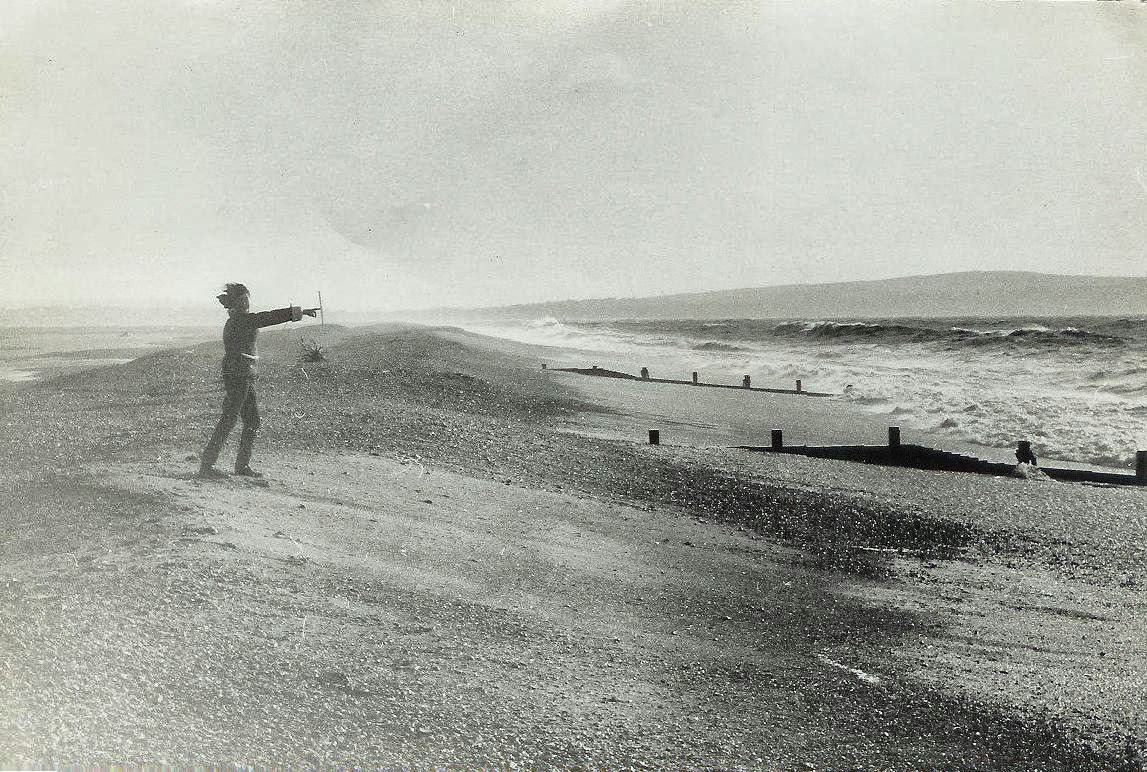
My sister Bay in a south westerly gale on Hurst Spit
Smell is so seductive; evoking, momentarily, a recollection of sight and touch, before capricious memory amends and revises. Daffodils have no perfume like a rose or hyacinth but for me one sniff brings an embracing feel of infancy, when my nose was closer to the ground. I know the place; who was there somewhere in the background; everything that could be known without words or anything so tangible as a sequence of thought. ‘Intimations’ of course free of my editing ego. Anyone who’s been around horses as a child and left them behind can be struck by the pleasing reek of staled straw and dung mingling with leather and the exhalations of shifting beasts that click on the yard. In infancy I was taken on a pleasure boat trip round Southampton harbour. It included passing the docked Queen Mary, sun reflected from a dizzying precipice of black riveted plates. There were jelly fish hanging in the black water. That besides I knew no more of the sea than holidays with bucket and spade. But for the pages on which I enjoyed vivid illustrations of ships, the sea was not something I knew by smell. The first boat I was to sail on saltwater was built well inland. I associated, what existed in my imagination, with the whiff of epoxy resin, marine ply, varnish and new synthetic paint.
Denys Rayner DSC*
It was at our family friend Denys Rayner’s boat building yard at Donnington, near Newbury 60 miles from where Danica, a 5 ton sailing sloop, would be slipped one enormously exciting autumn afternoon into the grey water of Gosport Harbour. 
Danica launched from Hardway Gosport in 1961

I was 18, being mentored in seafaring by a man who, though he never mentioned it, had commanded warships in the Battle of the Atlantic...
Denys - far right - at war in the Atlantic, from his biography Escort
...been torpedoed, survived and returned to his Ithaca, a Berkshire farm, where in the peace he made a living designing and building small sailing yachts for people’s dreams. My stepfather Jack Hargreaves was taken with the idea of making yachting, hitherto exclusive, more available. He made TV programmes about Denys’ successful endeavours to make a small affordable sailing boat that could potter tidal estuaries at weekends yet hold steady in the deep. Rayner knew and respected the dangers. He was assiduous on seamanship and its responsibilities. He was also a romantic with several novels written by the time we knew him. Denys wanted his designs to go far. Five months after Danica, built of plywood, was launched I’d found myself – with my stepfather’s blessing and a small ad in The Times - a skipper, almost my age, Chris Jameson, who’d worked Thames barges off the east coast.
“I want to sail to Greece” I’d said
“So long as you know who’s in charge” he’d replied
”Agreed”
We sailed Danica to Athens and back – a journey lasting from April to October.  We crossed from Lymington ahead of a gale in a grey channel swell to Le Havre, journeyed up the Seine to Paris, through the springtime countryside of France by canal to Séte and the Mediterranean, on to Marseilles, San Tropez, Monaco, Corsica, Naples, Messina, Patras, Corinth and Athens, then back around the Peloponnese to Zakinthos thence to Malta, Bizerta in Tunisia, and north to Séte again, this time via the Canal du Midi into the Garonne and the Bay of Biscay where, south east of Finisterre, Danica, as Chris was confident she would, weathered her first tempest – an equinoctial gale gusting to Beaufort 10. 
I was fledged. I made single handed crossings in another boat to France exploring north Brittany between Granville and Morlaix, then in another – Denys’ first fibre glass design - to Spain across Biscay to the rias around Coruna. 
In 1965 Denys encouraged me in a dream of sailing his Westerly 22 to America. I’d just finished university.
“It’ll be your national service” said Jack, whose service like Denys’ had been in a war.
Years later my mum said of that Atlantic Caribbean adventure “I never ever worried about you” I guess the truth of this is that I could not have improved on my parents, their faith in me grew mine in myself, along with their choice of those who taught me seafaring.


Young Tiger  (in 2012) in Bequia with my shipmate Sue (in 2014) in 1966
A year later, in a class at the University of Pennsylvania, where I took up my first paid occupation, I tried to learn and do research and follow my stepfather’s admonition “You have had your dream. Now you must earn a living”.
I came to work in London and later in Birmingham, putting aside all interest in sailing and boats (I wasn't going to be a weekend sailor packing up Sunday night for work on Monday when I’d been used to being out on the water again on Monday morning), until, in my late 60s, my daughter Amy, sat at our kitchen table in Handsworth, found notice on ebay of a boat on a mooring in Corfu.
“Come and look at this, Simon” said Lin, who knew my inclinations. I, knowing that a mooring is almost more important these days than the boat, made some phone calls, and clicked ‘Buy now’.
So Linda and I, in 2006, bought Summersong, attached to a rickety jetty in Ipsos.
This is where the smells come in. Salt water filmed in diesel and fishiness and the embracing smell, not of timber or old rope, but, for me, the evocative scent of fibre glass and terylene, foam rubber squabs, varnished plywood and synthetic paint.
Summersong was in poor condition when we bought her; so disappointingly messy, shorter than described and not in the condition shown in the ad photo. I sat in her shabby interior with Lin that first day of our arrival on the island.
“What have we done?”
“I thought you knew about boats” said Lin.
“I did, I do. I’ve sailed to many places” 
My excuses were feeble. In later years when speaking of Summersong, a 27 foot Snapdragon built on the Thames Estuary in the early 1970s, I’ve been wont to say when Lin speaks of a rip-off or at best a ‘sorry deal’, “Summersong brought us to Corfu”.
We live in Ano Korakiana in a house we love beside good neighbours in a village at the foot of a mountain with a panoramic view over the sea and mainland Greece, “because of Summersong".
"...because of Summer Song"

We’ve made small expeditions in her, a few miles up the coast to a cove at Agni, down to picnic at Execution Island and over to the mainland at Sayader, but our boat’s engine was unreliable, her overall condition poor and I was now an elderly man with forgotten instincts; lacking essential reflexes and youthful confidence. Lin does not trust me as a skipper, nor does she take to the pace of sailing and the feeling of hazard when katabatic winds gust down from Trompetta, leaning us abruptly over with straining sheets and odd noises. Through all this we’ve worked on our house, improved and maintained it but neglected Summersong. I decided two years ago we must have a better engine. I must spend money on our boat; not money I expected to get back but an investment in recovering the pleasures of sailing that I’d taken up again and then almost abandoned. 
Vital to this restoration - our friends Dave and Trish. In 2007, as we sat inspecting our ill-advised purchase over the internet, it was Dave who said “Your boat’s OK. Just needs some work. We’ll make a list.” 
He did things on Summersong for us, but only this last 12 months have we begun to turn the old boat round – a different and more powerful engine, new and more reliable electrics, new rigging, new mast head fittings, new cockpit slides and hatches and a restored interior, recovered squabs, fenders, repaired cabin lining, new curtains, a major paint job on hull and deck, mended teak strakes, new anchor chain, new propeller and sacrificial plate, a grand tidy up of accumulated odds sand ends in bilges and lockers, and the shaking jetty made firm, moorings made more secure to the harbour bed, a replacement roller for the jib.
Moored at Ipsos in Corfu

“She’s retro” says Dave “She’ll never be swift but she’ll be a new old boat” 
“Easier to sell I suppose” mutters Lin. 
Last week Dave and I took her out of the harbour and I got my first sail, jib only, in three years. It’s a start.  
Two days ago we went out again, this time with Trish too and dog Skinny and raised jib and main. 
Sailing Summer Song with Trish, Dave and Skinny

*** ***
Our friend Chris Holmes has sent me this article, via Jim Potts - a piece by the fine writer Nick Malkoutzis in MacroPolis called Nightmare on Democracy Street
...When a group of Golden Dawn supporters recently attacked Communist Party (KKE) members who were putting up posters in the working class neighbourhood of Perama, western Athens, the socio-political dimension of the Greek crisis entered a new, uncertain and dangerous phase. After years of mounting attacks on migrants, homosexuals and leftists, Golden Dawn made it clear that it wants to fight a pitched battle for control of districts like Perama. The symbolism of the September 12 incident did not end there. The attack took place on a road named after democracy – the very same democracy that has been pushed and pulled like a rag doll over the last few years ...Philosopher Stelios Ramfos captures the essence of the sometimes myopic Greek mentality by saying that when Greeks go to bed they do so for the purpose of sleeping or dying but never with the intention of getting up the next morning. Recent events underline that this short-sightedness in the face of a clear political and social threat is perilous. If we close our eyes, it must only be with the purpose of awakening from this nightmare when we open them again.

Saturday, 1 August 2009

To the Highlands

Waiting at Glasgow Queen Street Station for a train to Inverness
Slipped the surly bonds of New Street with my book to read - High Albania - and my DVDs to watch - An Exile in Paradise - a picnic of goodies around two baguettes of smoked salmon and cream cheese made up for me by Lin, and Oscar of course, on his lead and in and out of his igloo, used by now to long train journeys. All day we head north, almost a routine; getting at mid-afternoon to handsome Glasgow Central Station; then a walk - sunny and warm, drawing my bag across dry pavements at last - to Glasgow Queen Street, then three and a half hours more via the magic ladder - Stirling, Dunblane, Gleneagles, Perth, Dunkeld & Birnham, Pitlochry, Blair Atholl - then beside the road and the rivers through steep Drumochter Pass - on to Dalwhinnie, Newtonmore, Kingussie, Aviemore, Carrbridge, from where I phone my mother's house to announce that I'll arrive at 7.34 in Inverness. "What! You said 31 July. Get a taxi." Minutes later as the train scurries downhill in a great wide circle over the viaduct above the Clava Stones, she relents and we're met by Sharon at the station and so up the A9 to Strathnairn and with Oscar squeaking with excitement up the dirt track to Brin Croft and the greeting terriers.
** ** **
In the Town Hall, Liverpool
Over the last few days Charlie and I have been helping run meetings in Liverpool. The idea is to help managers and politicians and other community representatives in the city’s five official, and relatively newly defined neighbourhoods, to work better; promoting clearer understanding of roles and responsibilities among members and officers, assisting officers to apply their professional expertise to politically led agendas, helping councillors get the best from their officers, identifying barriers and challenges being experienced, and thinking together about ways to improve communication and relationships. Each programme, over a couple of hours, has involved:
Welcome and introductions; objectives and ground rules (Chatham House), the reasons people are here; a look at the Liverpool context – councillors and officers initially at separate tables seeing how much they know about the governance arrangements in the city; how well people think they know one another – a mapping exercise (example from elsewhere) putting faces to places and roles with flip charts, photos of members and a plan of the city. "What don’t you know?" "Does it matter?"What do you need to know?” I give a talk on managing at the political interface, sharing my research across local government, with emphasis on working at the point where politics, management and professionalism converge – or fail to.
Then politicians and managers worked together on typical problems – critical incidents – talking around solutions but also around vision, values and skills. How do we make neighbourhood government work?
Charlie and I took notes for a summary to be circulated to everyone involved and in a morning off - successive workshops were afternoon and evening - I was a tourist, travelling by underground from Lime Street, surfacing beyond Birkenhead's seafront, crossing the top of the Wirral to West Kirby where I sought the street where Denys Rayner had lived when he got married. Under a turgid sky I cycled along the front - a brisk north westerly encouraging the wind surfers and dingy sailors on the marine lake where Rayner had taught his eldest son, Martin, to sail before WW2. Back on the train I got off at Hamilton Square and took the Royal Iris from Woodside a few minutes across the Mersey to its pier below the Liver Building.

* * *
I like it when names and actions mix. I've recently given high marks to a thesis by one of our students, Susanna Farmer, Town Clerk of Wisbech Town Council, here, with her father Reginald Phillips, on Graduation Day 14 July 2009. She's written a Master's thesis about ways councils like hers can pursue their duty under the 1908 Small Holdings and Allotments Act to protect and encourage local food growing. What delighted me was her analysis of the astute way the council, with its limited powers and even fewer resources, has found inventive ways to get local land brought back into cultivation as allotments and how as the officer of the council she's been able to help its elected members pursue that policy.
* * * Iason Athanasiades released from Iranian detention after being arrested, beaten and interrogated has written down a list of the books he'd like to have had in prison along with the hand annotated Holy Quran he was allowed and the copy of his mother Polymnia's PhD thesis on Julian the Apostate brought to his cell by the Greek Ambassador in Teheran and swiftly confiscated by his guards.
18 July 2009 ATHENS — Jail cells — alongside yoga studios — are the last bastions of true inner peace. When I became the first foreign journalist in decades to be thrown into Iran's notorious Evin Prison I was exposed to a mixture of intense interrogations amid long stretches of nothingness. Stripped of my laptop, cell phone and all human contact, I was forced to confront my ego and get used to spending time with me, myself and I.
The only printed matter in my jail cell was a copy of the Holy Quran. It was a previous inmate’s well thumbed edition that had come loose from its hardback spine. A neat hand had written several religious aphorisms in Arabic on its pages. Imagining I was resting against the thick pillar of one of the beautifully-carpeted Ottoman mosques of Istanbul, my adopted city, I spent hours reading the handwritten calligraphy.
On the second week the Greek ambassador was finally granted a 10-minute meeting. Leaving, he presented me with a copy of my mother’s Oxford Ph.D. thesis whose Greek edition he had happened to be reading. My guards confiscated it for “inspection” and I never saw it again. Perhaps they thought the perfidious Greeks had gone to the trouble of printing a book for their man containing disguised instructions within its unfamiliar alphabet.
Those were the only two books I saw. For the son of two academics who grew up in a house with floor to ceiling bookcases and whose only indulgence is haunting the aisles of secondhand bookstores in Boston, London and Istanbul, denying me reading matter was more painful than torture. Every day, I called the jailers and requested my mother’s book. Some of them visibly struggled with the concept that a woman could have written a book and looked at me as if I were trying to trick them. Others promised to convey the message but promptly forgot about me.
So I made reading lists in my head (see the list with hyperlinks to the books)
Several are recommendations by my Ministry of Intelligence interrogators. Others are themed on incarceration and were suggested by my friends.....
How I can relate to the 'torture' of being bereft of books, yet I have been in homes of people who's company I enjoy where there are none. These things vary greatly. For some to be deprived of TV might be 'torture' while, for me, such deprivation could be a small compensation for losing my freedom.
Perhaps the most telling book on Iason's list is: Ervand Abrahamian's Tortured Confessions: Prisons and Public Recantations in Iran. Written in 1999 Athanasiades described this as 'the definitive book on torture both in the Islamic Republic and under the Shah. The book lays out in fascinating detail and with extensive documentation how torture in Iran differs from elsewhere: victims are brutalised until something other than information is obtained — a public confession and ideological recantation. For the victim whose honour, reputation and self-respect are destroyed, the act is a form of suicide. Recent examples of confessions include: Iranian-Canadian sociologist Ramin Jahanbegloo’s interview to a state-run news agency following his release(see this re the 'confession' and see also); Haaleh Esfandiari’s televised confession in a hotel room presented in documentary format on state-run television; and Roxana Saberi’s signed confession in prison.' And see this, with the 'before' and 'after' images from Global Voices about the trial of the moderate reformist Mohammed ali Abtahi
* * * I'm engrossed in Kadaré's Broken April. Stark writing of a stark landscape, full of the intensity and detail of a world where one tiny action can change everything. There are moments in the book where I hear the weather among the mountains and see the words of its characters punctuated by powerful music.
... "at once terrible, absurd and fatal, like all the important things." "Like all the really important things," she repeated ... "Yes" Bessian said "because to an Albanian a guest is a demi-god."(p.77).
Like all great writing, unlike film, the artist has not purloined the reader's imagination. Kadaré sets it galloping. I have an intimation that my thoughts have turned with enthusiastic curiosity towards Albania because there is a key to understanding a queue of confusions I've entertained about Greece and her neighbours.** ** ** On 26 July I commented on a blog by the Corfu author Maria Strani-Potts containing her parable The Pimping of Panorea
I do not regard the pimping of panorea as only the fault of the locals. There are national and vaster forces - international traffic in the abuse of Panorea
Sunday 2 Aug:
Dear Simon. You are right, but honestly when I see what the Corfiots and the international operators/exploiters do on a daily basis, what else can I think? I live here, I am a Corfiot, I love my birthplace, and I appreciate its unique values; I want my compatriots to have good health care, good mains water to drink, better means of transport. If they have to own a car it would be nice to have a place to park it. I would like to see the Corfiots use the land in an appropriate manner, and getting rid of the rubbish in a sensible way. My book Panorea was about Corfu. I have lived in many more countries than an average person and I do know the strengths and weaknesses of different countries' policies and strategies, but I do care passionately about this island, and everyday I am shocked by the shortsightedness and incompetence of our local politicians. I work in the hospital as a volunteer and I am dreading the day that I might end up there. I think am correct in comparing many of my compatriots to pimps, because this is what they are vis-a-vis the unscrupulous exploitation of the island. They are greedy and insensitive and we all have to suffer the consequences. My heart bleeds to see what has happened to this island. Kind regards Maria
Reply by return:
Dear Maria. Thanks for taking this newcomer seriously. Like a chicken who’s egg is hatched by a duck then tries one day to swim – to the dismay of both species - I was hopelessly imprinted on Greece by my father John, who married an Athenian, Maria, at a little church in Hermou Street long ago. (The Greek Orthodox Church accords you a second chance which, since they had both been divorced, was much appreciated in 1949). Both he and Maria are gone. They left me almost incapable of faulting Greece. I'm aware of the burden imposed on Greeks by Philhellenes like me, and so, thank goodness, have been willing to study the flaws of a beloved land, especially in Corfu, now Linda and I spend so much time there. Your writing on this turned out to be a beautifully crafted account (and that’s only the English version) of a tragedy affecting the whole world. Yet without humans landscapes and soundscapes are pitiless nature. With them they can be loved and, as you know too well, destroyed - the aboriginal story of the Fall, in modern terms, the Tragedy of the Commons. I would never forgo the apple (tho’ cowardly as Adam, I might blame it on ‘the woman’ - as men do) but what a Pandora’s Box* was released (blaming it on the woman again!) when men first doted on Kerkyra. If we can sort ‘our’ (the pronoun is intended – ‘our’ not ‘your’) problem on Corfu - a race between our nature and our intelligence - we might just be able to sort it out in other places. There are good brave people everywhere ...When your heart bleeds for your home, you are weeping in Corfu over the harm our flawed species is doing to the whole world. Best wishes. Simon
*It never was a box. it was a jar. Pandora's πιθος. But I read this tale as a child - probably before I read Genesis. I remember Arthur Rackam's picture of Pandora.After Prometheus stole the secret of fire, Zeus ordered Hephaestus to create Pandora as just part of his punishment for men. Pandora, among other gifts, such as curiosity, had been given a large jar. She was told by Zeus to keep it closed. She opened it. I would. All of the evils mankind had not known escaped from the jar. It seems obvious now that Zeus knew Pandora would take the lid off the jar. Why leave Hope at the bottom?

Saturday, 6 December 2008

Internal Polity ~ αγαπην δε μη εχωουδε ημη

My little ship - Young Tiger - makes landfall off Spain's Cape Ortegal Lord, my ship is so small and your sea is so big "We are as near to heaven by sea as by land!" (On the 9 September 1583 Sir Humphrey Gilbert called out these words from the stern of the frigate Squirrel. He was heard by listeners on Golden Hind, as both ships struggled with dangerous waves 'short and high, pyramid-wise' off the Azores. Hind's people, amid their own worries, watched for Squirrel as the weather separated them, but her lights disappeared and it was believed that she foundered in the night with all hands.)
At the start of the last century, Joseph Conrad wrote Heart of Darkness - a story of Africa about darkest Europe before the world wars, the camps, the gulags, Little Boy and Fat Man. Most men, wrote Conrad, are 'heartless phantoms'. They live not in themselves. They assume their individuality and autonomy, without grasping that what they believe to be their unfettered liberty is really conditional on 'the strength and allegiances of their police.' I wrote Internal Polity over ten years ago. It was an attempt, in times when individualism cannot be relied upon to nurture individuality nor identity, to explore the use of political language to describe the internal life - starting with the only one I can try to know. The personality can be understood as plural rather than unitary, viewed as a mosaic of many parts, a 'commonwealth of souls', 'a gang in the head' or 'a society of different minds'. Such miscellany may presage resourcefulness, superficiality or fragmentation. R.L.Stevenson in Dr Jekyll and Mr Hyde (1886)
"...that truth by whose partial discovery I have been doomed to such a dreadful shipwreck - that man is not truly one, but truly two. I say two because the state of my own knowledge does not pass beyond that point. Others will follow. Others will outstrip me on the same lines and I hazard a guess that man will be ultimately known for a mere polity of multifarious, incongruous and independent denizens.'
Repression has been the favoured guarantor of civility and self-definition in the internal polity, as dictatorship was in the Balkans. Some external polities are experimenting with alternative ideals of nationhood, seeking legislative frameworks which celebrate diversity and forms of citizenship not based on assimilation. What political skills and qualities, what values and principles, might be needed to govern an internal polity experiencing this freedom from older guarantees of public identity? My contention then and now is that without a well governed internal polity you cannot hope to make an external one. And only by entering the limitless space within can one grasp the labour of becoming a citizen of the species - homo sapiens. What of the infinite space inside? What's our constitution? A dictatorship? A democracy? .
If with the tongues of men I speak, and of angels, Love I do not have, I have become a gong resounding or cymbal clanging. And if I have the gift of prophecy, and know mysteries all, faith mountains move, Love I do not have, nothing I am. Love is generous, virtuous, Love does not envy, boast, not proud is. All she protects, all she trusts, all she hopes, all she perseveres. Love never she fails. Be it prophecies, they will cease, Be it tongues, they will be stilled, be it knowledge it will cease. So remain, Faith, Hope and Love, these three. But the greatest of these is love One Corinthians 13 Zbigniew Antoni Kowalski (also called Preisner) εαν ταις γλωσσαις των ανθρωπων λαλω και των αγγελωναγαπη δε μη εχω, γεγονα χαλκος ηχων κυμβαλον αλαλαζον. και εαν εχω προφητειαν και ιδω τα μυστηρια πανταωστε ορει μεθυστανην. αγαπην δε μη εχωουδε ημη. η αγαπη μακροθυμηη αγαπη ου ζηλει, η αγαπη ου περπερευεται, ου φυση ουτε. η αγαπη παντα στεγει, παντα πιστευει, παντα ελπιζει, παντα υπομενειη αγαπη ουδεποτε εκπιπτει ειτε δε προφητειαι καταργηθησονταιειτε γλωσσαι παυσονταιειτε γνωσεις καταργηθησετε Νυνη δε μενει, πιστις, ελπις, αγαπη, τα τρια ταυτα, μειζον δε τουτων η αγαπη. (Stavros or Lliana or Adamos - if you read this can you correct the Greek for me?) * * * *
How can I expect to see the person in the state if I cannot define the state in the person? How do external politics get inside us and vice versa? When I try to make sense of attempts to synthesise psychology and politics, in particular the works of Freud and Marx or those influenced by them, I am reminded of a point at the end of Portland Bill in Dorset where spectators gather to witness a spring tide on the ebb meeting a gale from the West. Separated, it is possible to cruise these mighty systems of thought in the family yacht. Combined, they produce an unnavigable maelstrom of overfalling concepts ... Yet to understand the interaction of internal and external politics these waters must be entered.
The economic structure of society - through many intermediary links such as the class association of the parents, the economic conditions of the family, its ideology, the parent's relationship to one another, etc., - enters into a reciprocal relation with the instincts, or ego, of the new born.
Jacoby attempts to explain this confusing meeting of internal-external exploration as a dialectic. Psychology, or what he decries as psychologism, considers the 'genesis and structure of the individual psyche' but not 'the power of society in and over the individual.' And sociology, which he calls sociologism, fails to recognise that subjectivity matters and that we both invent and are invented by the processes we observe. The journalist Neal Ascherson, writing about war in former Yugoslavia, said 'the New World Disorder is also, and above all, in our heads' (Independent on Sunday 31/01/93) . The devils cast out of Legion took up residence in a herd of swine that stampeded and drowned. This story quoted by Dostoyevsky at the start of The Possessed shows individuals fermenting anarchy (29/12/08 'anarchy' is used v.loosely ref) to create in the world, a mirror of the chaos inside.
Simon Baddeley (1966) 'A Voyage to America', 1966 Roving Commissions 7:9-30 Simon Baddeley (1995) ‘Internal Polity’ in Human Relations 1995 48:1073-1103 Brian Keenan (1992) An Evil Cradling Russell Jacoby (1975) Social Amnesia Julian Jaynes (1976) The Origin of Consciousness in the Breakdown of the Bicameral Mind Simon Baddeley (1997) “Governmentality” in Brian Loader (ed.) (1997) The Governance of Cyberspace (London:Routledge) (5) 64-96
My seacraft mentor Denys Rayner who fought in the Battle of the Atlantic, and designed boats for peace time sailors, would challenge attempts to personify the sea. ‘…neither cruel nor kind’ he wrote in his war autobiography Escort ‘Any apparent virtues it may have, and all its vices, are seen only in relation to the spirit of man who pits himself, in ships of his own building, against its insensate power.’

Wednesday, 9 May 2007

Winter gale North Atlantic


Winter gale North Atlantic 1943
Originally uploaded by Sibad.
An image, from his book 'Escort', of my friend and mentor Denys Rayner who, with his companions, fought long ago, far from home and family, so we could enjoy peace through our lives. I spent a good bit of my spare time last year learning more about him. The memory of his unembarrassed impulsiveness prompted me to press the 'buy it now' button on my screen when 'Summer Song' came up for sale on the web.
Not a day passes without a thought of the European century from which I, with most of my generation, escaped - unlike Denys, and my parents, grandparents and great grandparents. Unlike them I've lived in peace for 62 years. Wars have been waged in other places. The hideous exceptions (Birmingham 1972, 7/7 for example) have come nowhere near the carnage on our roads - killing more people I know than war, creating shrines beside the roads of peaceable Corfu and flowers tied to railings here. Tutored in happiness, the most I feared as a baby was the mewing of mating cats on the thatch of Mill End (where I was born in 1942) and thunder around Bignall's Cottage, my great grandmother's home near the Itchen.

Thunder made Grandpa Henry draw into himself. They remind me only of being carried downstairs and cuddled in a cosy sitting room, rain beating on the windows. My France has been green and pleasant, not mud and ruins like his. My Atlantic was not the Western Approaches in winter aboard a warship, but running before the tradewinds in deep blue swells in a boat - Young Tiger - that Denys had designed for enjoying peace. “In any reasonable weather" he wrote "it is the diminutive size of the yacht which makes long passages under sail such thrilling affairs, and one of the reasons why I, for one, find the smallest possible craft the most rewarding”.

In 1899 Conrad wrote, through a narrator moored with his companions under the darkening skies of the Thames Estuary, about the monstrous European Kurtz. Some thought Conrad wrote about something that arose in Africa - but his 'Heart of Darkness' was here. What happened in Greece in the 1940s, says Mazower, was part of something that happened across Europe - a continental civil war. The plotting of the mighty was linked to atrocities and counter atrocities across the continent, scarring collective memory. [Mark Mazower (1998) Dark Continent: Europe's Twentieth Century]
* * *
Had lunch and a meeting on campus to plan a series of training events on leadership for scrutiny. Passed out small gifts from Corfu to colleagues. Set up a meeting to plan a virtual lecture series in Australia via the campus video conferencing facility. Met up with my friend Nick to do a podcast with a Sandwell councillor discussing possible futures for Black Patch Park and went to a meeting of our group - The Friends of Black Patch Park - at the Soho Foundry Pub from 7-9.

Back numbers

Simon Baddeley