Total Pageviews

Showing posts with label civil war. Show all posts

Saturday, 24 July 2010

Working on the allotment

Starting on a shed on our plot on the Victoria Jubilee Allotments from Simon Baddeley on Vimeo.I got three planks, stored in the garage roof, left over from building an extra room in our Handsworth home twenty years ago, put them on the rack of Lin's car and took them out to the allotments using a spirit level to make a level rectangle that I must fill with earth and stones and detritus, tamping it well down to get a surface for flags. After that we'll look out for a shed. Oscar came to the plot with me, sat as usual in the blue plastic cycle box while I was on the road. He wandered around staying close, lay in the sun and watched, until another terrier on the park side started nosing around the fence. OscarOscar from Simon Baddeley on Vimeo. There's hardly a moment when I'm not thinking of the recession and since asymmetric war occurs everywhere involving all, Wikileaks helps even an intelligence deficit. Julian Assange on the failures of journalism "Too few Western journalists have died". This observation reminds me of a comment by my stepfather on war correspondents during the 1940s - several of whom he knew as friends in later years. He told me that ordinary soldiers often thought they were crazy. For their part, war journalists believing themselves less exposed than real soldiers, would - compensating for their non-combatant status - take undemanded risks in pursuit of a story. (Some examples of Wikileaks content re Afghanistan)
*** ***
I continued digging, working faster than before after Jill's advice; not worrying about picking out stones and weeds, just turning the soil with the fork. Later I can go over the ground and pick out roots and larger stones and other detritus that got mixed with the soil when the developer levelled the ground of the original allotments and pushed all the topsoil into an enormous mound near the backs of the houses on Holly Road, only re-spreading the resulting mélange in the early months of this year. Bits and pieces of plastic, glass, polythene, rusty iron, a chunk of lead, pieces of wood, ground up parts of sheds, greenhouses, fences and other things that were once on the old private plots of the Victoria Jubilee Allotments.
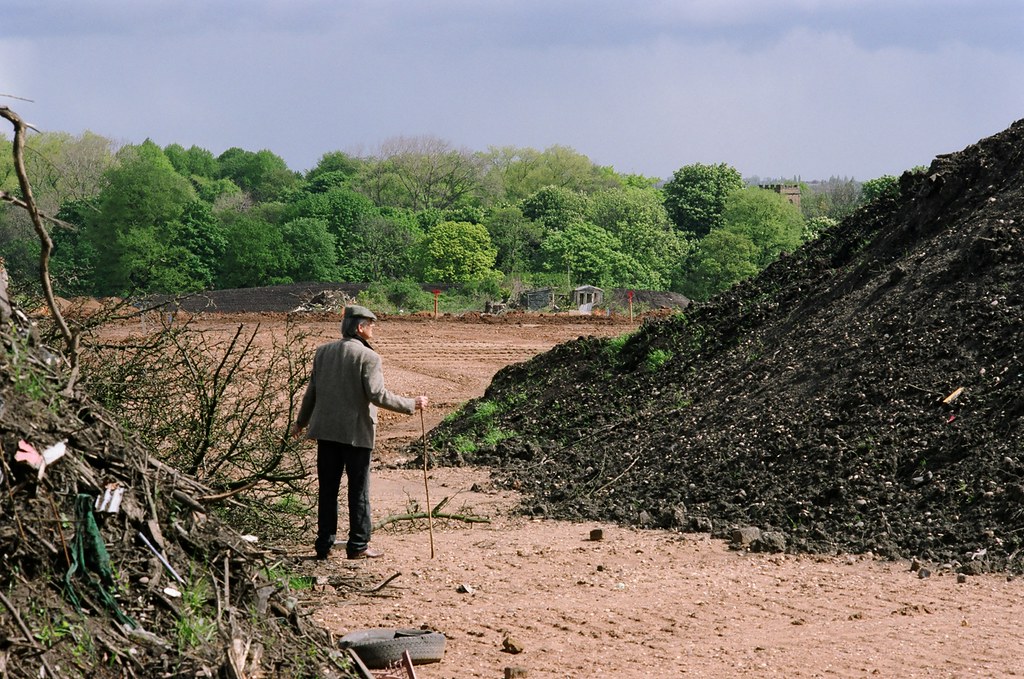
Victoria Jubilee Allotments stripped 2005
Topsoil from the VJA site in 2005. Photo: Luke Unsworth
There are whole bricks, old and new, chunks of gravel and tarmac, and innumerable smooth rounded stones and pebbles that were once under the surface of the twenty mile wide tropical prehistoric river estuary that someone on Uplands Allotments, up the road, told me flowed through this area millions of year ago.
fat-hen. It's food!
The weeds on our plot include fat hen, purple toadflax, redshanks and groundsel, dock, nettles and a sprinkling of couch grass. Fat hen - chenopodium album - like the other plants is a wild flower with so many different names in English alone - white goosefoot, lamb's quarters, nickel greens, pigweed or dungweed. In Hindi it's Bathua and can be used among other things to flavour paratha or make raita; cropped as food in India, and once regularly used as a vegetable here - like the steamed horta (χόρτα βραστά) we enjoy in Greece. Toadflax - linaria purpurea - provides pollen for bees; a laxative for people. Redshanks is one of the first weeds to appear on new topsoil. It can be used against diarrhoea and infections, its fresh leaves with their characteristic dark spot in the centre can staunch bleeding while its shoots and young leaves can be cooked as a vegetable. Groundsel - Old-man-in-the-spring, ragwort, grimsel, grinsel, grundsel, simson, birdseed, chickenweed, old-man-of-the-spring, squaw weed, Grundy swallow, ground glutton, common butterweed - is poisonous to many mammals, including humans but has also been described by herbalists as having many virtues.
Redshanks
Toadflax
groundsel
** ** ** ** Present reading: Just finished The Allotment by Colin Crouch and David Ward. Just started Ashes and Diamonds by Jerzy Andrzejewski. Though Katzanzaki's The Fratricides comes to mind I know of no Greek novel - and would be fascinated to find one - that so captures the mingling of personal and political at the moment a country was poised between retreating Nazism and the adversity that affected all of Eastern Europe, precipitating Greece's four year Civil War (ο Eμφύλιος).
****
There's been rumours and rumours of allotment rent increases for at least a year. I've just seen a note on the Birmingham & District Allotments Council website dated 9 July 2010:
Had a sneak preview of the new rent increases - not good news at all! Will post them on the website as soon as possible. All I can say that by 2013 there may be a lot of plots surrendered!

I ought to relax with shock horror but - pause - there's a longer argument. Allotments were once for the poor - a plot of land on which a working man could raise food for his family. Increasingly reasons for working an allotment have become more layered - in the words of an Oxford Brookes study, which produced a pie-diagram of plotholders' reasons for leasing:If I understand this, the 'cheap food' motive is one among many others, with 'health', 'quality food', 'environmental concerns' being of equal or higher importance. Allotments in many places have become gentrified. More are becoming so - worked by people who could afford to pay more, especially as 'cheap food' isn't a priority. Add-in an unprecedented cash squeeze on the public sector and there are more reasons why local government managers and councillors to plan rent increases for municipal allotments, increases that will have been preceded on private allotments (note the £150 annual rental option proposed by The New Allotment Company).
I was given a reminder of harder facts by Richard Wiltshire at least four years ago. He gently but firmly interrupted my flowing derogation of developers, victimisation of gardeners, the bias of community planning gain agreements, loss of urban growing space..."If people are so keen to grow their own food why don't they use and share domestic gardens that exist in abundance among the non-tower block residing middle classes."
Richard had just co-authored Growing in the Community - an LGA policy report which has government favour both before and, I suspect, even more so after the latest election. It emphasises the move away from a 19th century tradition of allotments as an antidote to pauperisation. Richard had stopped me to impart reservations about the allotments as opposed to city farms. "Why are city farms thriving and allotments under threat?" The word 'allotment' contains an implication of calculative philanthropy - "We'll allot you some land to grow food...until we need it to make money." Much allotment land is on prime urban development land with potential rental value vastly in excess of current allotment rents. He argues that the degree of protection accorded allotments would be more politically acceptable if a greater number of plot-holders were more ready to exercise the social responsibilities, locally and nationally, that should go with being so sheltered from market forces. Instead many view their plots as held by right, shouting too loudly against any move to increase rents - and in the process undermining their political position, especially the standing of their national body - NSALG. The way this argument goes is that - like parks with which I'm well familiar and have written - the existing case for allotments as a public good has become largely redundant. If allotments are to survive and thrive a new and more sophisticated case, like that now refined for public parks [see the Philadelphia Report] must be made to justify not replacing them with buildings. I'd go along with that. It's a case that we'll need to have in hand when Birmingham City Council presents us with its plot rent rise proposals. Present charges:

Plot Category

Full

Over 60 Rate

Small ( Cat A )

£22.00

£11.00

Standard ( Cats B/C )

£28.00

£14.00

Large ( Cats D/E )

£39.00

£19.50

Mini Plot (Cat A*)

£12.00

£6.00

Friday, 15 February 2008

Under Mount Korakiana

Another chilly blue dry day - perfect for our odd jobs. Aln came up in the late afternoon and fitted our flue. We sat enjoying the fire and the slight scent of the wood smoke drifting back through the rough hole that Lambros is coming up to finish tomorrow along with putting final touches to the roof, putting in a botched window properly, plastering and generally tidying the mess made of our upstairs last year. The weather promises to stay fine over the weekend and beyond.
* * *
E-mail makes arranging future work pleasantly easy - over a soup and bread in the Beer Bucket in Kontokali. I got a circular from the university yesterday on an agreed ‘sustainable cooling policy’. It aims to limit the use of ‘active cooling’ - air-conditioning:
With the expected increase in temperatures due to global warming the need to adapt buildings to prevent overheating and ensure acceptable working conditions will become increasingly important…The University will adopt a cooling strategy based on the ‘switch off, absorb, blow away and cool principles’ with active cooling being a last resort. (i) Switch off: Reduce internal and external heat gains by minimising gains from lighting, IT and heat producing equipment. This includes minimising the need for heat producing equipment, locating such equipment in dedicated areas, and the use of passive techniques such as solar shading. (ii) Absorb: Where practical use the thermal mass of the building to absorb heat and/or by the introduction of phase change materials (SB note: technology for collecting night cooling for use in the day) (iii) Blow away: Ensure an intelligent ventilation strategy. For example the use of night time air to cool buildings, limiting ventilation when external temperatures are greater than internal. (iv) Cool: Where cooling is unavoidable, ensure that the system used is well controlled and is designed to minimise energy use and the production of CO2
* * *
I finished Kevin Andrews' The Flight of Ikaros. I’m grateful for the web friend from Ikaria and the English north country, who is making a study of Andrews, who told me of him. Andrews' writing makes his book universal, but it could be read alongside Nicholas Gage’s Eleni – the latter first, partly for the summarised history inserted to give context to the story of his mother’s murder in the village of Lia in Epirus – by any non-Greek wanting to understand the Greek Civil War. Andrew's only meets communists very briefly, on their way to prison, but spends much time in the company of those who fought against the andartes.

The understanding that is emerging – very slowly as my stolid intelligence reaches for it - is the role, only recently teased out in a number of doctoral theses focusing on small areas of Greece in the period to which Professor Mark Mazower and fellow contributors refer in his sombre and scholarly collection After the war was over, is the way the civil war, so often viewed as the first surrogate hot war spawned by the Cold War, in which ignorant armies clashed under the aegis of greater powers, was also an occasion for escalating the violence of traditional feuding between villages, families and brothers. In Kevin Andrews’ encounters across Greece during that dire period people talked less of differences over the future government of Greece – the preoccupation of the Americans and the British and, to some extent the Russians, though Stalin had graciously agreed with Churchill to cede Greece to the West at Yalta – than about the settlement of scores, revenge and retribution. This is the story of all civil wars including ours - now entertainly re-enacted as a fancy dress picnic on Bank Holidays. Imagine that here. Thucycdides wrote of it with the start of the revolt in Corfu. Its ingredients include envy, jealousy, rage, the availability of weapons and the opportune moment. These fine grain interpretations are bound to be less welcome, even 50 years later, not just because they become so tortuously detailed, but because their currency is made up of villages, streets, families, the names of individuals and the messy subjectivity of personal accounts among people whose scores, even now, remain unsettled. No wonder some say ‘leave it be’.

Andrews, who’s sense of severance at leaving for New York at the end of his fellowship in the early 1950s perhaps surpasses Lawrence Durrell’s (‘The loss of Greece has been an amputation. All Epictetus could not console one against it’ Ch 8 Prospero’s Cell), recalled from the caique nosing past Cape Matapan towards Crete in April 1941, returned (unlike Durrell) to become a citizen of Greece, living there with his family until his end. Nicholas Gage, on the other hand, was born a Greek but, through his mother’s courage, escaped, as a child, to America to return as a man to research and tell her story.
‘History with her painful and unexpected changes cannot be made to pity or remember: that is our function’ Lawrence Durrell op cit 1945
* * *
I had a good dream last night about ordering wet work on the person who set me up over the credit card theft – only joking. Katerina came up from the bus stop yesterday afternoon with more horta for us with names like famous battles – moskalahánu, prikalíthá, zaxhouliá and zágouna. It’s chilly but sunny enough to dry washing and feel warm in the day. Katherina sighed and exclaimed ‘Krio!’ I made gesture of flexed arms ‘Stin Anglia einai zesto!’ She laughed. I might have made some doltish sense despite every tense wrong. God how I wish I could speak this lovely clever language – and a hundred others but that can wait.

An Athens News horoscope tells me ‘its getting creepy but getting moving as the week goes on’ and that I should ‘get good luck from low-class little men up the backstairs and avoid the great and the good…’

Last night I took my new stick for a walk up the village. Lin held my gloved hand in the chill. “Left or right?” she asked at the top of our steps. “Let’s go up the village”. We strolled against the wind funnelled between the houses until we came to the wider slope that leads to the car park and bandstand and the lights of Corfu and the mainland coast twinkled between the dark shapes of swaying cypresses harking the winter breeze. ‘How could you prove to a child those lights, which look just the same, are closer than those stars?’ We strolled over the performance area by the bandstand and traced out the words on the low iron-fenced memorial to those who’d died for their country. Lights shone behind the windows of a substantial overlooking house from which hung the national flag. We walked on to where the road narrowed between small houses, some occupied some clearly not for some time. A heavy dog chained on a terrace barked suddenly and loudly as we passed and went on being noisy out of boredom. We came to the derelict music school. An earth tremor had made a crack that ran from the lintel above its third floor to the street. We started back from the second of the hairpin bends as the road starts to climb to Sokraki and the street lights end. ‘It’s got the same magic as Lydbrook’ - the village where we’ve had a home for over twenty years. On the fringe of the forest between high steep slopes sprinkled at night with lights along its steep unlit footpaths and a night sky almost free of city glow, we’ve walked on similar windy evenings and enjoyed the long village to ourselves as people sit snug indoors. Coming home we passed quietly by the new music school where a piano was being practised and the kafenion where elders were playing cards and backgammon.

Wednesday, 9 May 2007

Winter gale North Atlantic


Winter gale North Atlantic 1943
Originally uploaded by Sibad.
An image, from his book 'Escort', of my friend and mentor Denys Rayner who, with his companions, fought long ago, far from home and family, so we could enjoy peace through our lives. I spent a good bit of my spare time last year learning more about him. The memory of his unembarrassed impulsiveness prompted me to press the 'buy it now' button on my screen when 'Summer Song' came up for sale on the web.
Not a day passes without a thought of the European century from which I, with most of my generation, escaped - unlike Denys, and my parents, grandparents and great grandparents. Unlike them I've lived in peace for 62 years. Wars have been waged in other places. The hideous exceptions (Birmingham 1972, 7/7 for example) have come nowhere near the carnage on our roads - killing more people I know than war, creating shrines beside the roads of peaceable Corfu and flowers tied to railings here. Tutored in happiness, the most I feared as a baby was the mewing of mating cats on the thatch of Mill End (where I was born in 1942) and thunder around Bignall's Cottage, my great grandmother's home near the Itchen.

Thunder made Grandpa Henry draw into himself. They remind me only of being carried downstairs and cuddled in a cosy sitting room, rain beating on the windows. My France has been green and pleasant, not mud and ruins like his. My Atlantic was not the Western Approaches in winter aboard a warship, but running before the tradewinds in deep blue swells in a boat - Young Tiger - that Denys had designed for enjoying peace. “In any reasonable weather" he wrote "it is the diminutive size of the yacht which makes long passages under sail such thrilling affairs, and one of the reasons why I, for one, find the smallest possible craft the most rewarding”.

In 1899 Conrad wrote, through a narrator moored with his companions under the darkening skies of the Thames Estuary, about the monstrous European Kurtz. Some thought Conrad wrote about something that arose in Africa - but his 'Heart of Darkness' was here. What happened in Greece in the 1940s, says Mazower, was part of something that happened across Europe - a continental civil war. The plotting of the mighty was linked to atrocities and counter atrocities across the continent, scarring collective memory. [Mark Mazower (1998) Dark Continent: Europe's Twentieth Century]
* * *
Had lunch and a meeting on campus to plan a series of training events on leadership for scrutiny. Passed out small gifts from Corfu to colleagues. Set up a meeting to plan a virtual lecture series in Australia via the campus video conferencing facility. Met up with my friend Nick to do a podcast with a Sandwell councillor discussing possible futures for Black Patch Park and went to a meeting of our group - The Friends of Black Patch Park - at the Soho Foundry Pub from 7-9.

Back numbers

Simon Baddeley