Total Pageviews

Showing posts with label horta. Show all posts

Wednesday, 9 January 2013

A New Year

So let's start new in 2013. The sun was bursting over the Victoria Jubilee. I tidied; removing old cabbage stems and slug ridden leaves, pulling weeds from the path, putting dead stalks on the compost. Janet caught me, and as she'd promised, gave me a bag of Jerusalem artichokes; a little note of hand written instructions.
"I slipped" she said "on some wet leaves the other day. My back still aches"
"Thank you so much, Janet. Just be careful"
"Put them in any time from now. Don't leave them in the bag or they'll get mildew"
Vanley was working on his plot - a model of a kitchen garden. I stopped to talk and grumbled about what a bad year it'd been.
"That was last year, Simon"
"I know I know. What can I plant now?"
"Try garlic"
I found a few cloves and planted them with the help of a dibber, but I'll get some fresher ones tomorrow.
My confidence has taken a step back. I'm ready to be surprised if anything springs from this rich damp earth - except weeds.
"None of your weeds are a problem" said Vanley "You got the deeper rooted one's out last year. Bother the others with your hoe. Dig them back in. Think of this as your food."
He makes it seem easy.
I found a clear patch; raked it and dibber planted the dry earthy tubers about six inches down.
"I saw you the other day picking up litter"
"Oh yes. Quarter of a ton of it. I get angry with the people who drop it, the council that doesn't pick it up and the manufacturers who produce so much packaging"
Vanley isn't much interested in mutual grumbling, so I didn't go on. Later when I was working on the plot he stopped by to have a look.
"Not too bad. Keep at it."
My friend Ziggi rang from London too ask how I was and we agreed to meet up in March. She has an allotment.
"Unlike bringing up a child"she said "you can make up in the next year for the mistakes you made the year before. There's always the prospect of renewal. I've come to enjoy the winter for the time spent in preparation; ordering my potatoes and other plants. I'm going to grow my onions from seeds this year. I'll be planting chard in March. In fact that's really when I'll start."
*** ***
Yesterday I was at the blood donor centre in Corporation Street.
"Well well well. It's your hundredth donation" said the nurse.
"Can you take my picture?"
"Yes" said the nurse
"What;s your name?"
"Lauren"
"You're good at this. I hardly felt the jab"
"When you've finished you can hold the blood"
She pulled out the needle, put a plaster over the little bruise in the crook of my arm, and handed me the pack with a pint of blood. I've never held that before. I didn't really feel anything very much but I sported a smile and I do feel quite proud like getting a Scout badge - not that I was in the Scouts.
*** ***
Richard Pine has written another 'Corfu Letter' in the Irish Times ~ 'Raw figures conceal richness of life behind Greek economic collapse':
A recent study, Understanding the Crisis in Greece, by two Greek economists, Michael Mitsopoulos and Theodore Pelagidis (both of whom have been advisers to the Greek government) tells us the Greek economy is dysfunctional.
We do not need an academic treatise to tell us that. Greece’s relations with the EU have made that clear over the past three years at least. The 114 bar charts, pie charts and graphs in the book are unnecessary: we can observe all of them by looking around us.
Anton Chekhov used to say that he got the ideas for his searing dramas by looking out of the window and seeing all human life going by. Brian Friel showed us much the same in his essay on his mother’s home town, A Fine Day at Glenties.
I sit on the esplanade of Corfu town, absorbing the last of the autumn sunshine, and I look across the straits at an Albania already going into winter: a country consisting almost entirely of unhelpful snow-clad mountains.
We live in a world of microclimates, each of which disobeys the laws of economics, meteorology and citizenship.
What I see in town (really a small city rather than a large town) or in the village where I live, is living proof of this book’s thesis: that the political parties are undemocratic in nature and “everyone participates, more or less willingly, in the shadow economy”.
I see poverty, tax evasion, ostentatious wealth, despair and joy. Hope and helplessness. I see widows collecting wild greens (horta) on which they live almost exclusively because they cannot afford meat (although they buy chicken carcases to make stock). But I am also told that one of the poorest-looking widows owns five houses and has thousands of euro stashed away. A microclimate indeed.
One of the strongest indicators of Greece as a divided society is the contrast between town and village: the mutual suspicion of the people. The townies look down on the peasants (not too strong a word for subsistence farmers), who in turn regard the townies as crooks – and have done so since at least the 18th century.
A new dimension to political life has been the rise of the neo-fascist Golden Dawn, which in Corfu polled much higher than its national average in the last elections, and which is suspected of having organised an arson attack on its last synagogue.
It’s a country where women use the genitive of their husband’s or father’s name (the singer Vicky Leandros is known as Vicky Leandrou - Βασιλική Παπαθανασίου - here) and still adopt an all-black wardrobe as widows.
It’s also a country of immense beauty: Corfu town has been declared a Unesco world heritage site because its arcaded streets, built mostly during the 400-year Venetian occupation, and the evident signs of building during the British administration (1815-1864), make it a city of appealing uniqueness.
Sitting on the esplanade, I look at the miracle of the two arcaded blocks that form a replica of Paris’s rue de Rivoli - they were built by the father of the man who constructed the Suez Canal. Miraculous because when the French were routed from Corfu the British finished the job. It’s the social centre of 'le tout Corfou'
But the simplicity of village life and architecture complements and adds to that beauty – even though the inhabitants of village and town are as different as chalk and cheese. How can I reconcile the beauty of the environment – and the added value that inheres in the tourist industry – when Mitsopoulos and Pelagidis document so thoroughly that Greece is so resistant to the sort of reforms demanded by the EU?
I see the kaleidoscope from the opposite end, simply because the economists cannot look at the everyday lives of ordinary people. It’s possible that they may never have seen villagers dunking their local bread into their own olive oil – or seen the sacks of olives going to the oilery where the growers pay 80 cent per litre for production, or spit-roasted lambs at the local panegiri (saint’s day).
It is the celebration of life at the most basic level, even if it does involve bribery and corruption, that the economists can’t see: they may hold the view that Greek people are inured to the grey economy and to dealing with the problem of balancing responsibility to the state with the demands of family, but in a country which last year lost 1,000 jobs a day, and where young people look to emigration as their only hope of survival, the claims of the individual are bound to trump those of the state.
And if, as is rumoured, the local taverna decides to open for only three days each week, due to declining spending power, we will all have to learn more than just dunking bread in oil.
Dear Richard. As I ‘struggle' with The Diviner having downgraded my reading and probably my intelligence this last decade I just saw your latest in the Irish Times. You’ve excelled. It was so good to see you pairing Chekhov and Friel - two artists who’ve managed so brilliantly and magically to blur the ancient and over-revered distinction between tragedy and comedy. See you soon we hope. We come via Naples to Corfu...it was another writer who while ‘looking out of the window’ also placed his feet in a bowl of water (not so much to warm or cool) but to remind himself of his subjectivity when describing what he saw between his curtains.  Best Simon

Jan Manessi in Corfu wrote...fine article, but don't assume that everyone out collecting wild vegetables does so because they cannot afford to buy them - horta gathering has been a popular task for years - at weekends hillsides round Athens were full of people out with plastic bags and a small knife. They are a delicacy, and those with knowledge of the many varieties are greatly respected. The eastern way of changing a name's end depending on sex is just the way things have been done from Greece to Russia- and few of the younger widows, both in town and village, wear black any longer, certainly not after the 40 days mourning has ended. In old times a widow would not even go to church, as this was considered enjoyment, her visits outside the house were only expected to be to and from the graveyard- thank goodness times have changed in some respects.
*** *** ***
One of my half-sisters - Miranda - tells me of a new grandchild. ....
Hi Lin and Simon. Here is Otis (born three weeks early on 14th December - a birth compadre of your Amy!)
Otis Oscar 
Meanwhile Oscar came round to visit with Amy and Guy, Richard and Emma...
*** *** ***
Dusk in Ano Korakiana...

Σερί από λιακάδες το τελευταίο διάστημα, που σε συνδυασμό με το άπλωμα της μέρας, προδιαθέτουν για το τέλος του χειμώνα, παρότι είμαστε λίγο μετά την αρχή του. Στα χωράφια, όπου το μάζεμα της ελιάς συνεχίζεται με τη βιασύνη να προλάβουμε μιαν αλλαγή του καιρού, ο χρόνος κυλάει γαντζωμένος στο άρμα του ήλιου. Με ξεχωριστούς ήχους και χρώματα. Από το μοναχικό κελάδημα του πουλιού, ως το μοναδικό χρώμα του δειλινού, που βάφει κόκκινα τα πρώτα σπίτια του χωριού, κατά την επιστροφή.

A final streak of sunshine, comes with the end of the day, suggesting winter is delayed even as it's begun. The olive harvest continues apace in expectation of a change in the weather. Time is linked to the sun's passage. There's the song of a lone bird as the sinking sun paints the houses red.
*** *** ***
A lovely and fascinating present from Alan Moir who knows my interest in Albania - a book -  Kanuni I Lekë DukagjiniThe Code of Leke Dukagjini, in Albanian and English.
Albanian text is by the priest Shtjefën Gjeçovi, translated by Leonard Fox, published by Gjonlekaj Publishing Company, New York  in 1989. Alan and his wife Christine were friends of my mother's. He worked for a period under an EU-UK Home Office scheme by which senior police officers were seconded to Albania to assist in the reform of their police following the end of the regime of Enver Hoxha. Alan maintained connection with the country and has many friends there. At mum's memorial service in December I met up again with him and he promised to send me a copy of the Leke Dukagjini code: 
The entire essence of the legal code of the Albanians is an unparalleled rigorous respect for this basic principle: non-violation of the dignity of a man- his honour, home and life.”
(Ismail Kadare) 
“The ‘Kanun' or Code of Lekë Dukagjini is an extraordinary monument of 

Albanian culture, essential for the understanding of all the northern Albanian lands. This magnificent edition, with its authoritative translation of the text, is an indispensable work for anyone who wishes to explore the history and traditions of the Albanian people”
(Noel Malcolm, author of Kosovo: A short History, 1998) 
“Certainly the Kanun is an unique document, a codification of practices amounting to law of great historical significance. In addition, it provides the bedrock for the rule of law in Albania even today.”  (Robert W. Sweet, United States District Judge)
For all their habits, law and customs, the people, as a rule, have but on explanation: ‘It is in the Canon of Lek…' as for the laws ascribed to him, the greater part are obviously far earlier than the 15 th century, when he is said to have lived. They probably were obeyed by the unknown warriors of the bronze weapons in the prehistoric graves.” (Edith Durham, High Albania (1909)

*** ***
As well as the Jerusalem artichokes, I planted more garlic on Thursday morning, and a double row of potatoes...

Saturday, 24 July 2010

Working on the allotment

Starting on a shed on our plot on the Victoria Jubilee Allotments from Simon Baddeley on Vimeo.I got three planks, stored in the garage roof, left over from building an extra room in our Handsworth home twenty years ago, put them on the rack of Lin's car and took them out to the allotments using a spirit level to make a level rectangle that I must fill with earth and stones and detritus, tamping it well down to get a surface for flags. After that we'll look out for a shed. Oscar came to the plot with me, sat as usual in the blue plastic cycle box while I was on the road. He wandered around staying close, lay in the sun and watched, until another terrier on the park side started nosing around the fence. OscarOscar from Simon Baddeley on Vimeo. There's hardly a moment when I'm not thinking of the recession and since asymmetric war occurs everywhere involving all, Wikileaks helps even an intelligence deficit. Julian Assange on the failures of journalism "Too few Western journalists have died". This observation reminds me of a comment by my stepfather on war correspondents during the 1940s - several of whom he knew as friends in later years. He told me that ordinary soldiers often thought they were crazy. For their part, war journalists believing themselves less exposed than real soldiers, would - compensating for their non-combatant status - take undemanded risks in pursuit of a story. (Some examples of Wikileaks content re Afghanistan)
*** ***
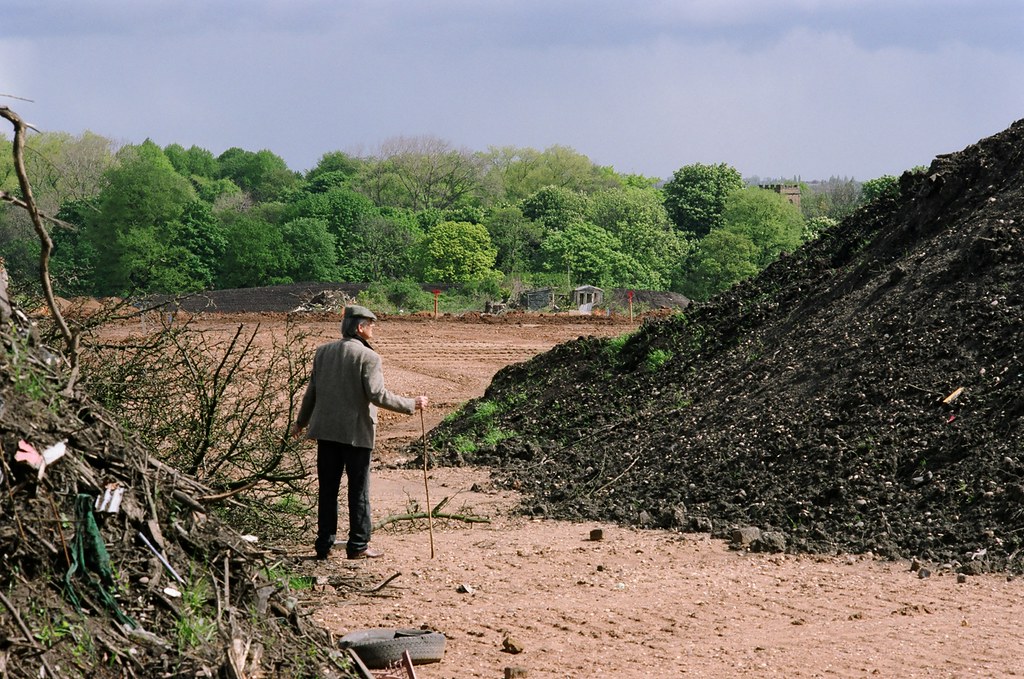
I continued digging, working faster than before after Jill's advice; not worrying about picking out stones and weeds, just turning the soil with the fork. Later I can go over the ground and pick out roots and larger stones and other detritus that got mixed with the soil when the developer levelled the ground of the original allotments and pushed all the topsoil into an enormous mound near the backs of the houses on Holly Road, only re-spreading the resulting mélange in the early months of this year. Bits and pieces of plastic, glass, polythene, rusty iron, a chunk of lead, pieces of wood, ground up parts of sheds, greenhouses, fences and other things that were once on the old private plots of the Victoria Jubilee Allotments.
Victoria Jubilee Allotments stripped 2005
Topsoil from the VJA site in 2005. Photo: Luke Unsworth
There are whole bricks, old and new, chunks of gravel and tarmac, and innumerable smooth rounded stones and pebbles that were once under the surface of the twenty mile wide tropical prehistoric river estuary that someone on Uplands Allotments, up the road, told me flowed through this area millions of year ago.
fat-hen. It's food!
The weeds on our plot include fat hen, purple toadflax, redshanks and groundsel, dock, nettles and a sprinkling of couch grass. Fat hen - chenopodium album - like the other plants is a wild flower with so many different names in English alone - white goosefoot, lamb's quarters, nickel greens, pigweed or dungweed. In Hindi it's Bathua and can be used among other things to flavour paratha or make raita; cropped as food in India, and once regularly used as a vegetable here - like the steamed horta (χόρτα βραστά) we enjoy in Greece. Toadflax - linaria purpurea - provides pollen for bees; a laxative for people. Redshanks is one of the first weeds to appear on new topsoil. It can be used against diarrhoea and infections, its fresh leaves with their characteristic dark spot in the centre can staunch bleeding while its shoots and young leaves can be cooked as a vegetable. Groundsel - Old-man-in-the-spring, ragwort, grimsel, grinsel, grundsel, simson, birdseed, chickenweed, old-man-of-the-spring, squaw weed, Grundy swallow, ground glutton, common butterweed - is poisonous to many mammals, including humans but has also been described by herbalists as having many virtues.
Redshanks
Toadflax
groundsel
** ** ** ** Present reading: Just finished The Allotment by Colin Crouch and David Ward. Just started Ashes and Diamonds by Jerzy Andrzejewski. Though Katzanzaki's The Fratricides comes to mind I know of no Greek novel - and would be fascinated to find one - that so captures the mingling of personal and political at the moment a country was poised between retreating Nazism and the adversity that affected all of Eastern Europe, precipitating Greece's four year Civil War (ο Eμφύλιος).
****
There's been rumours and rumours of allotment rent increases for at least a year. I've just seen a note on the Birmingham & District Allotments Council website dated 9 July 2010:
Had a sneak preview of the new rent increases - not good news at all! Will post them on the website as soon as possible. All I can say that by 2013 there may be a lot of plots surrendered!

I ought to relax with shock horror but - pause - there's a longer argument. Allotments were once for the poor - a plot of land on which a working man could raise food for his family. Increasingly reasons for working an allotment have become more layered - in the words of an Oxford Brookes study, which produced a pie-diagram of plotholders' reasons for leasing:If I understand this, the 'cheap food' motive is one among many others, with 'health', 'quality food', 'environmental concerns' being of equal or higher importance. Allotments in many places have become gentrified. More are becoming so - worked by people who could afford to pay more, especially as 'cheap food' isn't a priority. Add-in an unprecedented cash squeeze on the public sector and there are more reasons why local government managers and councillors to plan rent increases for municipal allotments, increases that will have been preceded on private allotments (note the £150 annual rental option proposed by The New Allotment Company).
I was given a reminder of harder facts by Richard Wiltshire at least four years ago. He gently but firmly interrupted my flowing derogation of developers, victimisation of gardeners, the bias of community planning gain agreements, loss of urban growing space..."If people are so keen to grow their own food why don't they use and share domestic gardens that exist in abundance among the non-tower block residing middle classes."
Richard had just co-authored Growing in the Community - an LGA policy report which has government favour both before and, I suspect, even more so after the latest election. It emphasises the move away from a 19th century tradition of allotments as an antidote to pauperisation. Richard had stopped me to impart reservations about the allotments as opposed to city farms. "Why are city farms thriving and allotments under threat?" The word 'allotment' contains an implication of calculative philanthropy - "We'll allot you some land to grow food...until we need it to make money." Much allotment land is on prime urban development land with potential rental value vastly in excess of current allotment rents. He argues that the degree of protection accorded allotments would be more politically acceptable if a greater number of plot-holders were more ready to exercise the social responsibilities, locally and nationally, that should go with being so sheltered from market forces. Instead many view their plots as held by right, shouting too loudly against any move to increase rents - and in the process undermining their political position, especially the standing of their national body - NSALG. The way this argument goes is that - like parks with which I'm well familiar and have written - the existing case for allotments as a public good has become largely redundant. If allotments are to survive and thrive a new and more sophisticated case, like that now refined for public parks [see the Philadelphia Report] must be made to justify not replacing them with buildings. I'd go along with that. It's a case that we'll need to have in hand when Birmingham City Council presents us with its plot rent rise proposals. Present charges:

Plot Category

Full

Over 60 Rate

Small ( Cat A )

£22.00

£11.00

Standard ( Cats B/C )

£28.00

£14.00

Large ( Cats D/E )

£39.00

£19.50

Mini Plot (Cat A*)

£12.00

£6.00

Friday, 15 February 2008

Under Mount Korakiana

Another chilly blue dry day - perfect for our odd jobs. Aln came up in the late afternoon and fitted our flue. We sat enjoying the fire and the slight scent of the wood smoke drifting back through the rough hole that Lambros is coming up to finish tomorrow along with putting final touches to the roof, putting in a botched window properly, plastering and generally tidying the mess made of our upstairs last year. The weather promises to stay fine over the weekend and beyond.
* * *
E-mail makes arranging future work pleasantly easy - over a soup and bread in the Beer Bucket in Kontokali. I got a circular from the university yesterday on an agreed ‘sustainable cooling policy’. It aims to limit the use of ‘active cooling’ - air-conditioning:
With the expected increase in temperatures due to global warming the need to adapt buildings to prevent overheating and ensure acceptable working conditions will become increasingly important…The University will adopt a cooling strategy based on the ‘switch off, absorb, blow away and cool principles’ with active cooling being a last resort. (i) Switch off: Reduce internal and external heat gains by minimising gains from lighting, IT and heat producing equipment. This includes minimising the need for heat producing equipment, locating such equipment in dedicated areas, and the use of passive techniques such as solar shading. (ii) Absorb: Where practical use the thermal mass of the building to absorb heat and/or by the introduction of phase change materials (SB note: technology for collecting night cooling for use in the day) (iii) Blow away: Ensure an intelligent ventilation strategy. For example the use of night time air to cool buildings, limiting ventilation when external temperatures are greater than internal. (iv) Cool: Where cooling is unavoidable, ensure that the system used is well controlled and is designed to minimise energy use and the production of CO2
* * *
I finished Kevin Andrews' The Flight of Ikaros. I’m grateful for the web friend from Ikaria and the English north country, who is making a study of Andrews, who told me of him. Andrews' writing makes his book universal, but it could be read alongside Nicholas Gage’s Eleni – the latter first, partly for the summarised history inserted to give context to the story of his mother’s murder in the village of Lia in Epirus – by any non-Greek wanting to understand the Greek Civil War. Andrew's only meets communists very briefly, on their way to prison, but spends much time in the company of those who fought against the andartes.

The understanding that is emerging – very slowly as my stolid intelligence reaches for it - is the role, only recently teased out in a number of doctoral theses focusing on small areas of Greece in the period to which Professor Mark Mazower and fellow contributors refer in his sombre and scholarly collection After the war was over, is the way the civil war, so often viewed as the first surrogate hot war spawned by the Cold War, in which ignorant armies clashed under the aegis of greater powers, was also an occasion for escalating the violence of traditional feuding between villages, families and brothers. In Kevin Andrews’ encounters across Greece during that dire period people talked less of differences over the future government of Greece – the preoccupation of the Americans and the British and, to some extent the Russians, though Stalin had graciously agreed with Churchill to cede Greece to the West at Yalta – than about the settlement of scores, revenge and retribution. This is the story of all civil wars including ours - now entertainly re-enacted as a fancy dress picnic on Bank Holidays. Imagine that here. Thucycdides wrote of it with the start of the revolt in Corfu. Its ingredients include envy, jealousy, rage, the availability of weapons and the opportune moment. These fine grain interpretations are bound to be less welcome, even 50 years later, not just because they become so tortuously detailed, but because their currency is made up of villages, streets, families, the names of individuals and the messy subjectivity of personal accounts among people whose scores, even now, remain unsettled. No wonder some say ‘leave it be’.

Andrews, who’s sense of severance at leaving for New York at the end of his fellowship in the early 1950s perhaps surpasses Lawrence Durrell’s (‘The loss of Greece has been an amputation. All Epictetus could not console one against it’ Ch 8 Prospero’s Cell), recalled from the caique nosing past Cape Matapan towards Crete in April 1941, returned (unlike Durrell) to become a citizen of Greece, living there with his family until his end. Nicholas Gage, on the other hand, was born a Greek but, through his mother’s courage, escaped, as a child, to America to return as a man to research and tell her story.
‘History with her painful and unexpected changes cannot be made to pity or remember: that is our function’ Lawrence Durrell op cit 1945
* * *
I had a good dream last night about ordering wet work on the person who set me up over the credit card theft – only joking. Katerina came up from the bus stop yesterday afternoon with more horta for us with names like famous battles – moskalahánu, prikalíthá, zaxhouliá and zágouna. It’s chilly but sunny enough to dry washing and feel warm in the day. Katherina sighed and exclaimed ‘Krio!’ I made gesture of flexed arms ‘Stin Anglia einai zesto!’ She laughed. I might have made some doltish sense despite every tense wrong. God how I wish I could speak this lovely clever language – and a hundred others but that can wait.

An Athens News horoscope tells me ‘its getting creepy but getting moving as the week goes on’ and that I should ‘get good luck from low-class little men up the backstairs and avoid the great and the good…’

Last night I took my new stick for a walk up the village. Lin held my gloved hand in the chill. “Left or right?” she asked at the top of our steps. “Let’s go up the village”. We strolled against the wind funnelled between the houses until we came to the wider slope that leads to the car park and bandstand and the lights of Corfu and the mainland coast twinkled between the dark shapes of swaying cypresses harking the winter breeze. ‘How could you prove to a child those lights, which look just the same, are closer than those stars?’ We strolled over the performance area by the bandstand and traced out the words on the low iron-fenced memorial to those who’d died for their country. Lights shone behind the windows of a substantial overlooking house from which hung the national flag. We walked on to where the road narrowed between small houses, some occupied some clearly not for some time. A heavy dog chained on a terrace barked suddenly and loudly as we passed and went on being noisy out of boredom. We came to the derelict music school. An earth tremor had made a crack that ran from the lintel above its third floor to the street. We started back from the second of the hairpin bends as the road starts to climb to Sokraki and the street lights end. ‘It’s got the same magic as Lydbrook’ - the village where we’ve had a home for over twenty years. On the fringe of the forest between high steep slopes sprinkled at night with lights along its steep unlit footpaths and a night sky almost free of city glow, we’ve walked on similar windy evenings and enjoyed the long village to ourselves as people sit snug indoors. Coming home we passed quietly by the new music school where a piano was being practised and the kafenion where elders were playing cards and backgammon.

Thursday, 14 February 2008

Nightmares of the contented

People in Corfu gather edible plants - horta - such as asparagus, dandelion, wild mustard, chicory, and borage, from favourite places. Katherina, with typical generosity, gave us horta - 'wildweed' - from a sack of plants she'd picked. I've had it in restaurants. This was delicious cooked like spinach - almost my favourite vegetable - but I'm half wondering if it makes me dream. Yesterday morning I was in a machine shop in an old building in Derbyshire. My companion, who I didn’t know very well, needed to buy a particular tool. It was the second place we’d visited on a journey to get something done further north. There was a shout. Everyone stopped working. I wondered what was going on. A foreman arrived in worn overalls. "There’s been a credit card stolen. Would all of you mind emptying out your pockets." I immediately pulled out my cards in their plastic container but with them was this red and white card and a piece of paper in a similar design that I didn’t recognise. Immediately someone pointed to it even as I was grasping what had happened, and I was left with a security guard The room emptied. I could think of no way out. Anyone can be a thief. Why not me? The security guard remained impassive, not unwilling to listen to futile protestations of innocence. This is the second dream I’ve had since arriving here, where I’ve woken just before being arrested. The previous one, obviously brought on by the juice of our blood oranges, had involved me cycling on the pavement on a lonely dark road in Birmingham near my university. A patrol car came by and parked at the next junction and, via a speaker in its roof, asked me to approach. I dismounted and tried to hurl my bike over the hedge with the intention of following it and escaping, but the bike fell back messily, compounding my offence and shame. I know these waking nightmares have nothing to do with their subject matter and are only prescient about the possibilities of my character. They are worse than one’s about physical disaster like plane crashes or shipwrecks. They refer to offenses treated as minor in our society – especially the cycling misdeed - but they are only slightly less dreadful than ones where two police, one a woman, come to the door with news. They are about the unreliability of shared opinion – in this morning’s case, of my honesty, which I foolishly take for granted as existing outside me and abruptly doesn’t. Conrad wrote in Almayer’s Folly, his first novel, ‘few men realise that their life, the very essence of their character, their capabilities and their audacities, are only the expression of their belief in the safety of their surroundings’ and ‘the reliability of their police’ (or similar words) adding that their ‘interior is still phantom and heartless.’ (see Internal Polity) My dream was about the bickering that went on between Lin and me as she drove us into town the other day about the whereabouts of our electric bill. "At the electric place where we must pay they won’t know who we are without it. I’m sure I left it with you!" "For god’s sake don’t be such an old woman"says L. "Don’t be sexist" I said grumpily. As it was our tax number, their computer system and a friendly employee at the company found our account in a minute. I don’t think it's about age. I've had such dreams since childhood. I think they occur when one is happy and enjoying peace - unlike so much of the world. To recover my cheer I played Ένα Το Χελιδόνι and Της Δικαιοσύνης Ήλιε Νοητέ from Axion Esti. Lin came down. I had a cup of tea. A few days ago our English neighbours, of long residence in Corfu, visited to see our house and to show us the house they are having remade a few doors up Democracy Street. M presented me with gifts – an olive walking stick he’d fashioned and to which there’s a history that made this gift special and two eggs for us from their geese – one of which I’ve enjoyed as an omelette. My step-father would have been so pleased to know that a stick he’d made on television of hazel from an English hedgerow, had been crafted for me from out of olive in Corfu. ‘Where did you get the roe deer’s hoof?’ ‘Off eBay’. This matter of balancing old and new is one that recurs – a way of inventing our future. Wednesday was blue again but with a chill breeze during all but the middle of the day. We’ve been doing more jobs so we can relax in April. Lin has begun preparing the rest of the garden for a layer of plaka between beds. I’ve barrowed concrete blocks stored under the veranda to her. Most of the apothike tiles are now on our roof, so we cleared the corrugated roof of mortar left by Lambros. We gently pruned the lemon trees. Lin put more plants in the garden and watered it. We’ve done more carpentry on a kitchen shelf and the guest bedroom door which Lin’s still stripping while I de-rusted and oiled the latch, before we reglazed the four panes using silicone instead of putty. From time to time neighbours strolled by, greeting us. We realised we were supposed to have renewed the car hire contract yesterday. When I rang him, Kostas said "Don’t worry. Come in when you can." Tuesday evening, over spaghetti, we watched Theo Angelopoulos’ Landscapes in the mist. A teenage girl, Voula, and her little brother, Alexandros, set out from somewhere in Greece on a journey by rail to find their father somewhere in Germany - a ‘somewhere’ that could be anywhere, as the idea that he’s in Germany is a tale of their mother’s, who we never see, to avoid telling them their father’s unknown – something we hear after a policeman takes them to their uncle in a vast power station after they’ve been put off the express to Germany. This was a Greece of grey skies, snow, wind and rain with people in winter clothes standing around a lot in towns of scruffy empty buildings or monstrous machinery at work in taupe landscapes crossed by trucks on featureless motorways. The children are brave, sadly innocent - distressingly so in the case of the girl - but increasingly ingenious at surviving. Memorable scenes include, policemen and women in the street gazing up at falling snow; a gigantic hand floating up from a muddy sea with a stump of an index finger pointing out of the screen and being carried by a helicopter past the apartments on the Thessaloniki corniche to disappear over the Turkish citadel; a line of clothes shaking macabrely in a stiff breeze like limp bodies – andarte and battalion uniforms and traditional klepht costumes strung up for sale by a penurious theatre troupe no longer able to draw an audience for their touring re-enactment of events between 1900 and 1949.
* * *
The Corfiot is an English language monthly magazine (subscriptions - most of the paper is not on the net) edited by Hilary Whitton-Paipeti. Its contributors are Greek and English and the editorial policy is diplomatically, but entertainingly, opinionated. We enjoy it for its small ads about forthcoming events and for articles on old Corfu, on current challenges facing the island economy - most especially how to develop policies for sustainable tourism. The latest issue – February’s - has heated responses to a letter from someone who’s recently come to live in Corfu, in Temploni, effectively complaining about Greek Corfiots and calling on readers to write to the local authorities and complain about their behaviour. C.M. Woodhouse in The Philhellenes wrote scathingly about a certain kind of Englishman who came to Greece and complained about Greeks – in the 19th century this included grumbling that the natives didn’t pronounce Greek as taught in English public schools. The hapless RS in this January’s letter pages of the Corfiot asks why all Greek civil servants aren't required to speak and write English and why road signs aren't in Greek and English. He complains about the lack of direct flights to Corfu out of season; about shooting small birds on the island, about some Corfiots poisoning stray cats and dogs; about the way these animals are allowed to run free on the island. His solution is regulation, dog licences, neutering, ‘keeping on leads’, criminalisation, and the ‘mobilisation’ of armed forces and the police to collect refuse during the recent strikes and a lot of letters to the local authority. What vexed me and Lin about this letter was amplified in responses to it in the February issue. Dr Lionel Mann, a good old man with a distinguished career, who we’ve had the honour of meeting in Ay.Ioannis, wrote, with uncharacteristic anger that the January letter 'was horrifying in its display of the monumental arrogance and abysmal ignorance that have made English-speaking nations so widely despised and hated.’
‘We do not want foreign “improvements” imposed here, as seen today in its ugliest forms in Afghanistan and Iraq.’ ‘Man has always been a hunter and always will be. I do not particularly like the shooting of little birds either, but these guns are not being used to slaughter indiscriminately innocent Iraqi and Afghan men, women and children, are they?’
There’s rebuttal of each complaint in the January letter. He finishes
‘Consider that for more than two thousand years until the British left in 1864 the Corfiots had always been ruled by occupying powers who made little if any effort to educate the residents. Corfiots have had only a relatively short time in which to learn to govern themselves and are not doing at all badly. Insensitive, ignorant criticism is at best unhelpful, at the worst flagrantly insolent and tarnishes even further the already suspect reputation of British immigrants. Anyway, life here is vastly superior to that in the over-regulated yet greed-driven, crime-stricken, violence-worshipping, drug-sodden, booze-swilling, pollution-plagued, barbaric UK. Accept beautiful tranquil Corfu for what it is – faults and all. I love Corfu.’
There are two more letters in the same vein reproaching Mr S with equal vehemence. I disagree on only one element of Lionel’s letter. My love for Greece is not deepened by any animosity towards England. Perhaps it’s my luck; possibly the result having two families – English and Greek – that allows me to love both lands – a feeling that is not for one moment compromised by awareness of their separate and shared problems. * * * There are about four bus stops along the lower road through Ano Korakiana. One is at the end of the short path that goes down from our house. Lin, who unlike me has been less keen on breaking up with her car, asked me about bus times. She's influenced by the daily cost of car hire - our largest regular expense at €22 a day (the best going rate fr a small saloon we know). On weekdays, a bus leaves that stop four times a day for Corfu Town at 0715, 0900, 1245 and 1630. The same bus leaves Corfu main bus station for the village at 0645, 0830, 1215 and 1600. Last year a single fare was €1.40. Using my bicycle - folded and stored on board - I can also use the Corfu to Sokraki bus that leaves Corfu on weekdays at 0500 and 1400 (then have an exciting cycle back down the zig zag hill to AK). I can also use the Corfu to Sidari bus, which will drop me off at the AK turn off the Sidari road, about 2 miles to the centre of AK. This leaves Corfu 0515, 0900, 1100, 1200, 1400, 1600 and 2000 during the week and on Saturdays at 0515, 0900, 1100, 1400 and 1830 and on Sunday at 0930. I don't know what time it takes for the bus to get from Sidari to the AK turn where I could wait for it, but it departs from Sidari on weekdays at 0700, 1100, 1200, 1345, 1600, 1700 and 2100 and on Saturdays at 0700,1100, 1200, 1600 and 1930 and on Sunday at 1615.

Back numbers

Simon Baddeley