Total Pageviews

Showing posts with label filioque. Show all posts

Sunday, 28 October 2012

A tear

In the pre-checks for my last blood donation on Friday morning - my 99th - I thought I got a whiff of the impact of the crisis in Greece. The nurse, who knows me well, sees from my questionnaire, that I'm recently returned from Corfu. She looks in her 'book'.
"Hm. Yes. I think it's OK"
"Corfu isn't included in the West Nile Virus. It's just the mainland isn't it?"
"No longer"
Well maybe it's nothing to do with the malaria creeping back into Greece.
After a 40-year hiatus, malaria is returning to Greece. Some 70 cases have been reported there this year, and at least 12 people appear to have been infected in the country. (The others picked up the disease elsewhere.) That's a concern for health workers because it means malaria may now be endemic to Greece — and not just hitching a ride with travelers. Plus, the parasite is showing up in regions where it has never been reported, the U.S. Centers of Disease and Prevention said in a statement last week...
Celebrating my 75th donation - six years ago
I'm rather looking forward, in a Boy Scout way, to making my 100th donation next March. We'll have been back to Corfu before then. Might there be a problem?
*** *** ***
I'd heard that Patrick Leigh Fermor suffered from writer's block but only recently turned up what is probably the original reference to this condition. On 29 Sept'11 Colin Thubron wrote in the New York Review of Books:
Fifteen years ago, swimming in the Ionian Sea beneath his home, where nobody could overhear us, Paddy (as friends and fans called him) suddenly confessed to me the writer’s block that would plague the rest of his life. The expectations of a now-avid public, and his own obsessive perfectionism, were taking their toll, and he could not overleap this cruel impediment...
Forging his prose must have been an effort. I imagine him walking or travelling on sea and land, his broad intellect at work on sentences which would capture with precision an understanding - as rough stone takes form under the chisel and rasp – of the ancient divergence of Eastern and Western Christianity, something that's long intrigued and eluded my capacities for understanding history and theology. It was not perhaps accurately a writer's block; it was a thinker's block.
I have lots of facts. I understand almost nothing of why such differences divided whole populations for centuries. Why should the words 'and the Son' - filioque - matter so much?
Greek creed: Καὶ εἰς τὸ Πνεῦμα τὸ Ἅγιον, τὸ κύριον, τὸ ζῳοποιόν, τὸ ἐκ τοῦ Πατρὸς ἐκπορευόμενον And in the Holy Spirit, the Lord, the giver of life, from the Father proceeding.
Latin Creed: Et in Spiritum Sanctum, Dominum, et vivificantem: qui ex Patre Filioque procedit And in the Holy Spirit, the Lord, and giver of life, who from the Father and the Son proceeds.
And why should it matter as much to a secular student? That's my problem. Leigh Fermor has an agenda - a lover's search for the continuity of Hellenism. The things that happened in between.
Between when and when?
Well, say, the surrender of Athens in April 404 BC after the Battle of Aegospotami which ended the Peloponnesian War and Byron's death at  Mesolongi 19 April 1824- about 2228 years - give or take a few weeks.
No, no, no....from the death of Alexander in 323 BC and the break-up of his empire.
No! Again no.
What of the Hellenistic Period and the Seleucid Empire that ended with the triumph of Rome at the battle of Actium in 31 BC, making that ridiculously vague interval just 1855 years? And why the date of the death of Byron?
I wasn't taught about these dates, these chronologies and sequences. It was more simply 'Ancient Greece';  wonderful pre-historic tales ill-placed in times - about Theseus, Jason and the Argonauts, Perseus, Andromeda, the Olympian Gods and, later, in my spotted learning, Homer, the Iliad and the Odyssey and even later the Aeneid which only then, in Latin not Greek, tells the appalling prevenient account - horresco referens - as Sinon opens the Wooden Horse and through the night the merciless sacking of Troy begins - no finer account was ever written of such a calamity.
I didn't hear of the Seleucid Empire until now and I looked upon the history of Byzantium as a different part of the curriculum; a mess of marble fragments.
As with ideas that express a convincing truth, there is so much missing evidence; so much rebuttal. If Leigh Fermor, deeply self-educated in Hellenistic and Byzantine history, claims a stark contrast between the iconography of the Orthodox and the Latin churches, there will be, especially for someone as well travelled as he, be much contrary evidence.
On the grey rainy windy days when I've wandered alone and with Lin and my mother in this chilly church, I've gazed up and not noticed it, but plenty of others have seen the tear that lies on the face of the Virgin Mary amid the gold mosaic of the central apse of the Cathedral of Santa Maria Assunta on Torcello.
My mother in Santa Maria Assunta 
This is a Venetian-Byzantine Church; the image created in the 13th century, over two hundred years before the Fall of Constantinople. The tear seems an oddity, if Leigh Fermor's distinction between western and easter religious painting is correct.  Recall that Islam and Judaism eschew imagery, deplore it, in some cases with fatal and murderous intensity...
...in the foredoomed task of indicating the unfathomable mystery of Godhead in visible terms, the Greek ikon painters chose the hardest way. They sought ingress to the spirit, not through the easy channels of passion, but through the intellect. Religion and philosophy were as inextricably plaited as they had been in pre-Christian times and this was due to the same philosophical temper which has saved Judaic Christianity(a brief and local thing) and made it Greek, then universal....Mani, c.15
Basilica di Santa Maria Assunta on the island of Torcello - where Venice was founded


I imagine phrases forming in Leigh Fermor's head which when he sat to write resisted the journey from mind to paper. It must have been made trickier by his knowledge of Greek words and grammatical forms that could capture ideas and emotions that cannot be expressed in English -   ἀρετή, εἴδωλον, φιλότιμο, κέφι, μεράκι, απορία, θυμός, θάμβος...I'd like to see the original manuscript for chapter 15 of Mani.
I've read it over and over; at least, in part because it seems to help me; I say 'seems' to help me arrive at a real rather than a purely memorised mechanical grasp of the filioque difference. Leigh Fermor argues that the Orthodox theology of the Transfiguration - an astounding moment for which θάμβος is apt -    καὶ μετεμορφώθη έμπροσθεν αυτών καὶ ἔλαμψεν τὸ πρόσωπον αὐτοῦ ὡς ὁ ἥλιος, τὰ δὲ ἱμάτια αὐτοῦ ἐγένετο λευκὰ ὡς τὸ φῶς (Κατά Ματθαίον 17.2) ...and He was transfigured before them. His face shone like the sun, and His clothes became as white as the light - is a more or less direct product of Greek Philosophy.
For extent and influence in the world the dual message of Greek philosophy and the Greek interpretation of the Christian revelation stand alone.
He lists pagan sages - Apollonius of Tyana, Solon, Plato, Aristotle, Plutarch, Thucydides, Sophocles - without haloes but in robes 'as honourable as those that adorn the Christian saints' painted with them on the walls of a small church on the edge of Layia in the Mani.
Where but in the ancient schools (these figures imply), were developed the intellectual thews which enabled the great Doctors to hammer the raw material of the Gospels into the intricate and indestructible apparatus of Christian dogma? Without the dialectical and philosophic skill of these rain-swept sages, who would have heard of the Three Hierarchs indoors...(he lists Basil of Caesarea, Gregory of Nazianzus and John Chrysostom)...who would have unravelled the perplexing skein of the Trinity or confuted the subtle-tongued heresiarchs or championed the Homoousion and the Double Nature? The Greeks do well to honour these ancient mentors...The evolution of Christianity into a logical system which could weather the shocks of millenia, was a Greek thing. The Christian Church was the last great creative achievement of classical Greek culture....
'...when two or three are gathered together in thy Name...'
For many generations, writes Stephen Greenblatt in chapter four of The Swerve, learned Christians remained steeped...in a culture whose values had been shaped by the pagan classics. Platonism contributed to Christianity its model of the soul; Aristotelianism its prime mover; Stoicism its model of providence...
Raphael: The School of Athens
This is Cavafy’s territory - eloquent, gnomic, exciting surmise and reflection on Hellenic continuity. It does not greatly surprise me - since our interests so often ran in parallel - to learn that the last - latest – book my mum ordered (and which Bay bought for her in New York) is Robin Lane Fox’s Pagans and Christians in the Mediterranean world from the second century to the conversion of Constantine (a hundred years before the murder of Hypatia in 415AD).
The transition from pagan to Christian is the point at which the ancient world still touches ours directly. We are heirs to its conclusion: on either side,  participants shared an education which, until recently, we widely maintained. Like most transitions, it was a slow process, marked by unforeseen moments of sudden significance...
To me, whose school days were accompanied by rituals, bells, hymns, sermons and lessons from the King James Bible, whose parish church was Westminster Abbey, the customs, procedures and etiquettes of the Greek Church - whether observed in the quiet of an empty narthex or as a nervous but respecting participant, are more exotic, almost more foreign, than the services I've attended in Birmingham - in synagogues, gurdwaras and mosques. I delight in Greek Orthodox churches - sat alone, gazing around and upward, lighting candles, quietly praying...
"To?"
No preposition. Just praying.
Why 'to'?
Well just perhaps to a mystery; which is why I like Leigh Fermor's suggestion that the image of the Panayia is more mathematical than anthropomorphic, that in these ikons, he sees 'gilded and cube roots of the Logos' and, seeing the Virgin at the foot of the cross, he reads the message 'Do not worship me...but what I represent' - a reaction that contrasts with the feelings evoked by a Latin pieta - the seering image of a mother weeping over her betrayed, abused, tortured and murdered son.
Someone said the tear on the face of Mary in the church on Torcello is for mankind, not for her son. I remain puzzled and confused, but perhaps I'm also seeing that in the differences Leigh Fermor explores. Torcello is in the west, in the Veneto, and yet's it's cathedral is Byzantine, it's image of Mary - an in-between.
The two hour funeral service for my stepmother Maria at St Sophia's Cathedral in Bayswater was almost an ordeal. It wasn't until afterwards at the Makaria supper when a Greek opera singer with piano accompaniment sang Hadjidakis that I wept - not for grief but for joy at the pleasures of all Greece I'd enjoyed with her and my dad and their friends - and one of my my dry-eyed Greek half-sisters looked on concerned and slightly embarrassed.
On Mani see this from a blog about Leigh Fermor
*** *** ***
I'm not sure there could be a more beautiful and poignant or joyful train journey in all the world. The climax, whichever way I travel is Drumochter Pass, and the passage of the watershed into and from the Highlands, where one moment the river runs toward Dalwhinnie, and when descending from the Pass towards Blair Atholl the other way.

In the bright low light of Autumn the one track railway winds through valleys, through moorlands,  by emerald pastures striped with long shadows of tall trees, and now and then sparkling streams with water so clear I see sunlight and shadows on the stones beneath the water. Hamlets and lone farm houses rush by and always the glimpses of water - sometimes lochs with such windless surfaces they turn the landscape upside down. In wet weather torrents jump and splash towards culverts beneath the line. Aviemore, Kingussie, Dalwhinnie...
Dalwhinnie
...Blair Atholl, Pitlochry, Dunkeld and Birnham where I lose my sense of place along a Lowland list of stations on the way to Edinburgh whose names I can't remember.
The Lowlands


And then suddenely here's the bright sea of the Firth of Forth with islands and in the distance, glimpsed before a long bend, the hazy outline of the Forth Bridge over which we'll pass in minutes.
The Firth of Forth

*** ***
We've had regular minor problems with battery drain on the Handsworth Helping Hands LGV. We've got over it by jumplead-starting. Allan Broad in the Handsworth Park compound has been especially helpful - hence our present to him and fellow workers of a supply of biscuits, coffee and tea last August. To get to the bottom of this I took the van down to - Cedric Fernandes - Ceds Car Alarms in Hockley and paid £20 for him to check for battery leakage.
"All you've got" he said "is standard drain from three systems"
"Explain"
"You've got the dashboard, the locking and the electric window and mirror controls - they all leak enough milliamps to drain your battery in a fortnight"
"If I take off one lead" which is what we've been doing recently after parking "will that stop that"
"Yes"
"What's the condition of the battery?"
"It's a bit stale and you could do with one that's more heavy duty"
Ced suggested Bannings - a company on the Lichfield Road. I phoned them. It'd be £95 plus VAT.
"I never knew all this about battery drain as just normal" I said
Ced pointed to a smart looking Mercedes in his workshop, bonnet and boot lids raised, wires sticking out all over like a patient in intensive care.
"He's got round 25 electrical systems in there. He hardly ever drives it. We found one system that was draining more than it should. Took a while to find it. You're diesel and need a heavier push. Why I'm saying get a stronger battery."
I drove back to the park compound, disconnected a battery lead and cycled home through the leaf strewn park.
"I guess learning that was worth £20" 

Saturday, 7 January 2012

Mothercare

Mum and I went to buy baby things for my daughter's and her grand-daughter's expected son. It's the first time this coming wonder became real. We had a lovely hour together looking at various useful and slightly indulgent products and bought some clothes for Amy and for the baby as well as a bouncer, which Amy can collect from her local Mothercare in Birmingham. Sandi looked after us as we shopped. She seems about 13 years old compared to us, and was fulsome with enthusiastic advice. Outside the shop we ran into Isla, shopping with her husband Bruce, held together - he said - by so many metal implants, he can't pass security to fly, who lives way down the eastern edge of Loch Duntelchaig.
"Will you take our picture, Isla?"
*** ***
My dear friend Dhiaa-al-Asadi spoke last year of a day when we might visit the site of the City of Ur of the Chaldees, near Nasiriyah, that I learned of at school, to stand together by the great Mesopotamian ziggurat raised in the 21st century BC, a place where some say our civilisation has its roots:
I replied with joy; affirmatively. I'm missing Dhiaa - the great gift that came to me from the ill-judged invasion of Iraq. He has taught me, faithless - and bereft for it - much about faith, though in matters go government he is secular. I have learned as much about Christianity from Dhiaa as about Islam. When after much complex work we were able to get Dhiaa over to  Birmingham for the start of a brilliant Phd several years ago, our first long conversation occurred as he, still I'm sure, tired from his journey from Iraq via Jordan and Heathrow, wandered at my invitation around the Barber Art Gallery on campus. We stood in shared pleasure before Jan de Beer's Nativity.
"I've not seen so much wonder - held in - in suspension. The angel on the right whose hair's blown back by unseen force is supposed to be Satan at birth of his undoing." We stopped opposite a painting The Adoration of the Child Jesus by Cosimo Rosselli.
"I have always been puzzled" I began
Dhiaa and I went closer to the picture, as you can at the Barber, a public place you can have almost to yourself. We gazed at the sky and the Virgin's dress of blue egg tempura painted 500 years ago
"Who are these?" I asked pointing at the lucent sky, my finger millimetres from the paint "God? The Father and - and - then The Holy Ghost. It's unclear to me."
Dhiaa without a trace of the didactic, pondered his own interest in one of the foundational ideas of another religion.
"Is it meant to be a mystery? Your puzzling. Is it  how it can be understood?" We talked more about the rest of the picture, as though it were on a wall in our homes. Later when we revisited the Barber we would explore - I the student - the enduring differences between Sunnis and Shi'a, and then we came to the filioque, the difference that men have debated, argued and quarrelled over since the First Council of Constantinople in 381...(blog ref, blog ref)
Orthodox Creed: Καὶ εἰς τὸ Πνεῦμα τὸ Ἅγιον, τὸ κύριον, τὸ ζωοποιόν, τὸ ἐκ τοῦ Πατρὸς ἐκπορευόμενον...And in the Holy Spirit, the Lord, the giver of life, from the Father proceeding. 
Latin Creed with the filioque "from the Father and the Son". Et in Spiritum Sanctum, Dominum, et vivificantem: qui ex Patre Filioque procedit...And in the Holy Spirit, the Lord, and giver of life, who from the Father and the Son proceeds.
....and another thing, the idea that as so many struggle to release ourselves from the bonds of religion we come to see how they may also be anchors. Religion both releases and controls actions based on instinctive desires. Secularism, especially atheism, tends to scorn repression, relying on good governance separate from church, temple or mosque. Yet it may be that the worst imaginable actions - and we have seen much of them this last 100 years - may require a degree of repression that is beyond secular regulation; suppression of our worst instincts that can only come from impulses that transcend the rule of law; from that which is sacred, rooted in myth; beyond the utilitarian in its understanding of evil, and what we can explore through evidence-based policies on crime and punishment. I shared with him the arguments I'd developed about substitutes for repression and guilt, the idea of an internal polity (the paper I wrote back in 1995)...
*** ***
The Farnack
I've again taken long walks about the Strath. The river's full. Rain and snow melt. I think I managed to tire at least one of the dogs but only because she indulged in a mile's fruitless circular chase of a red deer twenty times her size.
*** ***
I shall translate this - or try to - later; from Ano Korakiana, a celebration of Epiphany, when John Baptist dipped the Christ in the Jordan, came a beam of light with the words <Ούτος εστίν ο Υιός μου ο αγαπητός εν ω ευδόκισα> ~ "This is my beloved son, in whom I am well pleased".
theofaneia2012.jpg
Των Θεοφανίων, Άη-Γιώργη
Με πολλά μποφόρ και ψιλοβρόχι εορτάστηκε στο χωριό η Ημέρα των Θεοφανίων. Στην εκκλησία του Άη-Γιώργη, το Συμβούλιο των Επιτρόπων είχε επιμεληθεί τον εορταστικό διάκοσμο, με την αναπαράσταση του περιβάλλοντος της Βαπτίσεως. Όμως, με το «εν Ιορδάνη…», το περιστέρι (συμβολισμός Αγίου Πνεύματος) κτυπημένο από το δενδρολίβανο του ιερέως «πέταξε και πήγε στις βρυσούλες…». Οι πιστοί θα αναμείνουν στη σειρά για την προμήθεια αγιάσματος στα γυάλινα φιαλίδια τους, ενώ οι Επίτροποι θα τους προσφέρουν γλυκό και ένα μικρό ημερολόγιο με την εικόνα του ναού. Την ίδια ώρα, η Φιλαρμονική μας βρισκόταν στην εκκλησία του Ποταμού για την εκεί τελετή της Βαπτίσεως, ενώ μόλις που θα προλάβει την κατάδυση του Τιμίου Σταυρού στον Ύψο.

Amid strong winds and drizzle the village celebrated the Day of Epiphany. In the church of St. George, the Board of Commissioners had arranged the festive decorations, symbolising the sacred Baptism. But with ...
I shall have to give up and ask Aleko or Nikos for help with the rest, but I do know that a lot of the men are going to strip off down by the shore at Ypsos and dive into the chilly sea after a gold cross.

Letter from Aleko:

Dear Simon and Linda. First of all A VERY HAPPY NEW YEAR and may the drachma stay where it is!!! Your attempt with the language is excellent and please carry on. You are miles ahead of any English person living here! It is ΧΡΟΝΙΑ ΠΟΛΛΑ and not ΠΟΛΛΑ ΧΡΟΝΙΑ!! Although the meaning is the same you say this at every celebration except at funerals. Last week I put my foot in it at a funeral at the Nisaki church when I said Χρόνια Πολλά!!!! The other point is : ΘΕΟΦΑΝΕΙΑ (Theofania)-never in singular!!! (τα Θεοφάνεια και οχι το Θεοφανειο). Theofanio does not exist as a word!! Now - the translation of your entire text :
With high winds and drizzle we celebrated the day of Epiphany. At the church of St. George the council of churchwardens took care of festive decorations re-enacting the Baptism. However with the hymn "In Jordan the dove (symbolising Holy Trinity)" was reborn with the priest's rosemary and "flew away to the wellspring." The faithful queued with small bottles for their Holy water, while the churchwardens offered them home-made sweets and a little calendar with a picture of the church. At the same time our Philharmonic brass band was at the church at Potamos (12 kilometres away) for the ceremony of the Baptism, and if they make a great effort, will be in time for the 'cross-casting' ceremony at Ipsos.
I would suggest we need Friday 27th January at my kafeneion just before 1pm, when the bus gets there, and then after a beer we'll go down to my house for lunch and later you can catch the the bus back to Ipsos. We will speak nearer the time. With love, Aleko
***  ***
Wanting to see the sea I borrowed the car and drove to the shore and walked in the late afternoon and into the evening around Fort George, strolling with the dogs on rough salted turf, gravel laced with boulders, and sand, firm, smooth and wet, reflecting the sky...
...over the Moray Firth towards Inverness, the Black Isle on the northern shore of the firth across the horizon, Fort Rose hardly visible and the rampart stars of the garrison fort the English built to hold the Highlands after the '45.

Tuesday, 14 December 2010

The Localism Bill - power to the people?

Maria wrote 'δυνατά και ντύσου. Βάλε τα καλά σου. Δεν μπορείς να διαβάζεις αυτό το συγκεκριμένο ποίημα με τις πιτζάμες ' ... basically, 'don't recite this particular poem in pyjamas' to which she sweetly adds 'Ωραίος είσαι και έτσι'.
** ** **
I got up this morning from a restless sleep and started to try to make sense of the Coalition Government's Localism Bill which we'd discussed at Inlogov's departmental meeting yesterday morning. The official guide from CLG is the kind of thing I used to find so helpful when assembling a flatpack from a furniture superstore.

But here's the flensing - courtesy of posting on the LGiU site. Although the Minister, Eric Pickles, says no cuts will be greater than 8.9%, I suspect actual cuts are considerably deeper. Complaints will be treated as 'shroud-waving'. LGiU provide excellent useful information - as it emerges. Our take on the Bill will come with more narrative, though this is LGiU CEO Andy Sawford's take. (See also Ref: Professors George Jones' and John Stewart's oral evidence on localism to the Communities and Local Government Committee on November 15).
For the moment I'm reeling with the long term effects of the government's policies on Handsworth and the rest of our area; the implications for the breaking up of decades of messy incremental investment in our fragmented and fluid inner-city population...and this is from someone deeply involved in voluntarism and community activism since I arrived in Birmingham.
To make an inventory: ....starting, with Lin, The Reservoir Roads Residents' Association feistily engaged in resisting the renewal of the licence of the neighbouring Tower Ballroom to pay for an overflow car-park so late night revellers didn't invade our narrow streets; participating in the content of an S106A to get a local playground; succeeding via a survey of traffic in denying permission for a detour road that would have sent commuters in and out of the city centre past a local school and through residential streets;  acting as key witnesses in a case of racial discrimination in a local 'white's only' Working Men's Club and numerous local activities involving care of the elderly, street cleaning and a great street party to celebrate the Queen's Silver Jubilee in 1977
Street Party in Daisy Road for the 1977 Silver Jubilee
When we moved to Handsworth it wasn't long before we'd started a residents' association for new street, and become involved in challenging our rating valuations in front of the local rating tribunal. We had limited success but got to know more of our neighbours. The two main community activities that have taken up the last decades of mine and many other's time have been campaigns to save Handsworth Park
 and to recover and restore the Victoria Jubilee Allotments, resisting robust attempts to encroach on a limited pool of inner city urban green space. Our successes here were palpable; the stories lengthy and well documented in film and text, attracting interest way beyond our local focus.
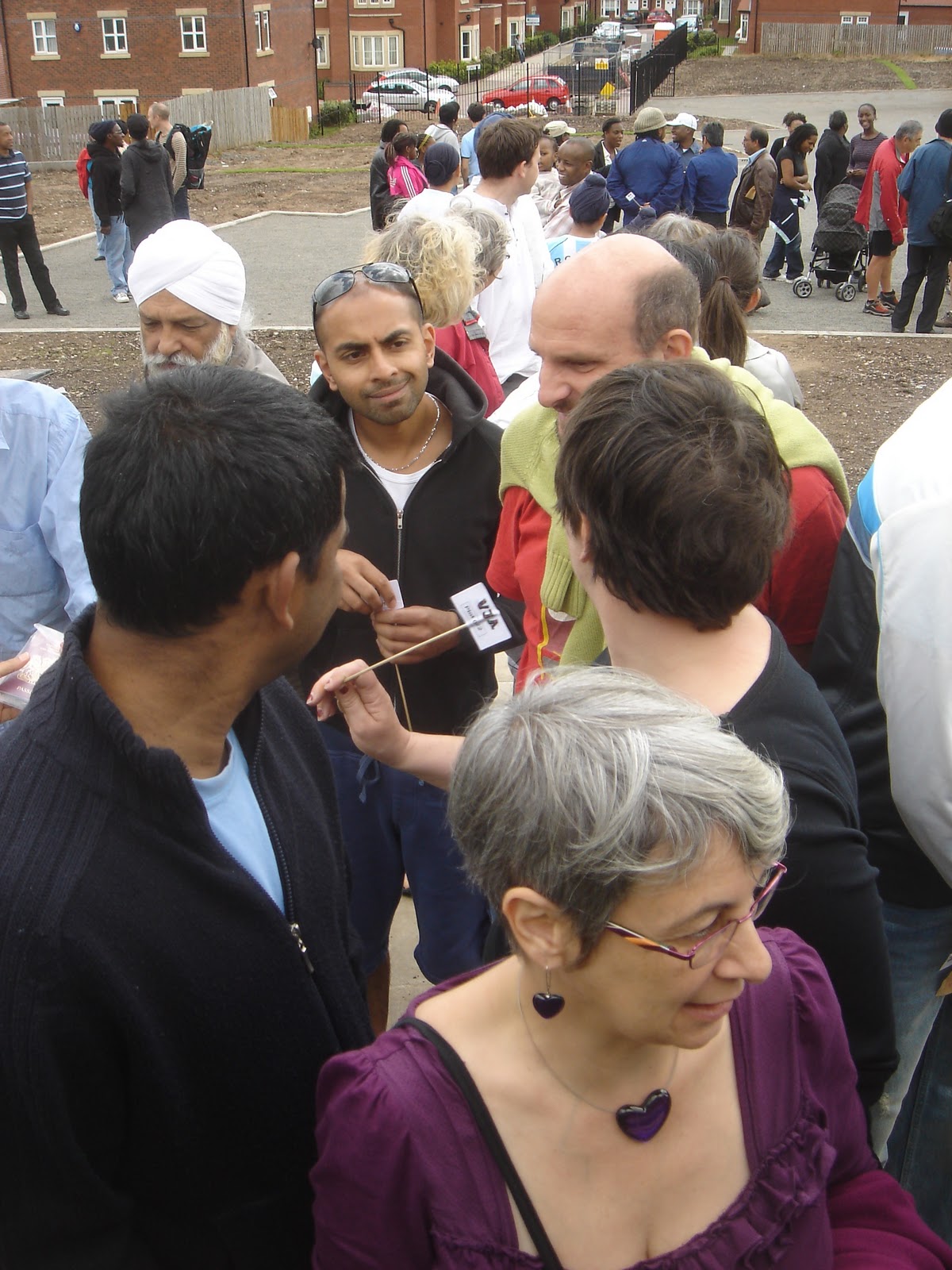
10 June 2010: queueing for plots on the restored VJA (ph: Richard Baddeley)
Other activity has involved work on restoring the churchyard of St Mary's Handsworth and the successful campaign to get Sandwell Council to alter the local plan for the area that includes Black Patch Park so that it is no longer available for industrial development. That's a continuing story amid as funds dry up for maintaining let alone restoring an urban park.

 What's been unique about this is the connection with the descendants of the Gypsies who were originally evicted from the Black Patch long ago. Some of them are shown in the YouTube of Bryn Phillips' song about Queen Henty's curse.
** * ** * **
 1400 Tuesday: Ah here's a reaction from Inlogov, from Philip Whiteman
....there remain a number of elephants in the room that Government has failed to fully answer.
Local authorities are being encouraged or subjected to the ideology of mergers and shared services are arguably good ideas in terms of economics but goes against the very concept of local control. In essence councils are becoming ever more distant from those they seek to serve. This is counter to the idea of connecting government to communities.
The move to de-ring fence funding is to be welcomed as it will allow greater local discretion over funding priority services. However, if Government is sincere in terms of allowing greater local autonomy in terms of funding, the balance of funding between central grants and local taxation needs to be addressed. Instead of central funding accounting for 75% to 25% local funding, this ratio should be reversed. Central government should only provide funding to ensure equalisation of funding between the richest and poorest communities.
The Big Society proposals could inevitably be depicted as little more than a mask for local authority spending reductions also announced yesterday. This means that funding community groups, the third sector and others to provide the Big Society capital will be difficult to achieve. The big hope comes from these groups being able to provide quick and cost effective alternative solutions.
The Localism Bill needs to ensure that principal councils can let go of services and hand them over to the parish and town level. Equally, local and parish councils need to build their own capacity and ensure that they are advocates for the Big Society. However, this tier of councils is very rural centric and greater thought will need to be given towards building the Big Society in urban conurbations.
The move towards increasing the number of mayors is journalistically and politically popular. However, government should not assume that all of the twelve cities will jump at the opportunity. Evidence in favour is patchy.
The role of councillors has largely been ignored. At a time of the Big Society, greater effort could be given towards the role in supporting and enhancing community influence and provision of local services.
INLOGOV will be researching, evaluating and monitoring how the Bill is enacted into reality. We will also be engaging our postgraduate students on the impact of Localism and the Big Society with their communities and employers. We welcome discussions with local authorities or any other organisation on how they seek to address the implications of new and current thinking within this arena. In the New Year, INLOGOV will publish a full and detail response to the Bill drawing upon expert opinion within the field.
** **
Καλά Χριστούγεννα και Ευτυχισμένος ο Νέος Χρόνος
I've posted quite a few Christmas cards this year including one to our neighbours - which might just make sense despite my Greek writing. We're always putting snow into our Christmas cards despite its rarity in English December. This year our local weather richly matches the theme. There was a prediction of snow in Ano Korakiana the other day - για έναρξη χιονόπτωσης στο χωριό. A celebration and vigil in the church of Savvani Arkoudena - εκκλησία των Σαββανήδων στην Αρκούδενα - ended early as a result. I see a photo of our neighbour - the Papas - Κωνσταντίνος Φαϊτάς - second from left - in Alice Stergiou-Savvani's dining room.
This year her family provides the traditional dinner of fish and wine for a vigil which, if I understand rightly, takes note of an ancient dispute that was to sever Eastern and Western christians. In the local church of Savvani Arkoudena there's a picture of St.Arius at the great Council of Nicea - first ecumenical council - Α’ Οικουμενική Σύνοδο - in the year 325AD. He is arguing his belief that Christ, though the most perfect of creations, is a creation of God the Father, in opposition to the belief of St.Alexander who held that Christ is of the same substance as the Father and co-eternal with him (my italics). This debate became so heated that Nicholas of Myra - one day to be known as 'Santa Claus' - slapped Bishop Arius for, as he saw it, belittling Christ.
The slap: 'Behold, how great a matter a little fire kindleth!' James 3:5-6
The insertion of Alexander's argument - the filioque (and from the soninto the Western creed 260 years after the arguments at Nicea (words on this in Democracy Street some years ago, and again in Feb 2008),
Aghios Panteleimonas attended by the President of Greece and the Archbishop of Athens - reported by Malcolm Brabant - to advance conciliation in the present...

** ** **
The other day I dropped into our local GP to get my flu jab - which covers swine flu - and have a routine blood test. I like this process of trying to stop people getting ill, rather than waiting until they do. That of course is the trouble with a lot of what government does - stops bad things happening via road safety, food and drug testing, with building regulations - inside and out - with child protection; all kinds of risk assessment - things that can make government look like party poopers, do-gooders and interferers - and with the additional problem that it's so tricky to measure performance in stopping things happening. You can measure how many people you've arrested. How do you measure how many crimes you've prevented; how many fires didn't have to be put out because of the work you've done to ensure they never started? As a recipient of the flu jab over six years I've no scientific proof it works just because I've not had flue more than once in that time.
Preventive medicine: old gits at the docs
** ** **
I'm flattered at seeing my face on the front page of the Ano Korakiana website - with a fair précis in Greek of what I wrote in 2007 about Ano Korakiana avoiding becoming a 'non-community'
I find my rough re-translation rather pleasing, so leave it as is, since the meaning's all there (go to the village website and click on my face to read it in Greek) - Ο  Simon Baddeley είναι λέκτορας στο Ινστιτούτο Τοπικής Διακυβέρνησης του Πανεπιστημίου του Birmingham στην Αγγλία, μα πάνω από όλα λάτρης της Ελλάδας. Εδώ και αρκετούς μήνες έχει αποκτήσει μαζί με τη σύζυγό του μια άμεση σχέση με το χωριό μας, αφού εδώ περνάει αρκετό διάστημα του χρόνου, στο σπίτι που αγόρασε  στην περιοχή που είναι το πηγάδι της «Γραμματινής», κοντά στην εκκλησία του Εσταυρωμένου. Μέσω δε της ιστοσελίδας μας προσπαθεί να έχει μιαν εικόνα για τη ζωή του χωριού μας και αρκετές φορές γράφει σχετικά στο δικό του χώρο στο διαδίκτυο, ανταλλάσσοντας μάλιστα απόψεις και με άλλους συμπατριώτες του που έχουν κάνει την ίδια επιλογή με τον ίδιο, να αποκτήσουν δηλαδή ένα «καταφύγιο», μια δεύτερη κατοικία στο χωριό μας...
Do not make Korakiana "non-community"
Written by Kvk
13.12.07
Simon Baddeley is a lecturer at the Institute for Local Government at the University of Birmingham in England, but above all a lover of Greece. He's acquired with his wife, a direct link to our village, after passing some time here last year, buying the house by the well of Grammatinis near the church of the Crucified. Through our website he strives to gain an idea about the life of our village and sometimes writes on his own site on the Internet, exchanging views with other compatriots who have chosen like him to have a second home in our village ... He indicates a developing problem in a recent memo to the village about our future, in response to some reports on our website, a small part of which has already been translated into English and French. 
"What I'm trying to figure out is why the village (Ano Korakiana) has such a great style of architecture. It resembles a village that might have benefited from one or two large public buildings gifted by a rich Greek Diaspora. It seems there are so many elegantly crafted buildings, lovingly prepared with the additions to the lintels and doors and arches and other decorative features, suggesting a prosperous time ...
Referring to comments on the site  - korakiana.gr - hat today, a reduction in the population of the village is evident, despite the installation of either temporary or permanent foreign families. Many years ago in my childhood, my parents bought and converted an old house in the village of Bagnor near Newbury in Berkshire. When we went there in 1949 we were re the first among some 20 houses in the village to install interior plumbing. Others went to a small stream - the Winterbourne - running at one point under the village street, bringing water home in buckets. When we left there in 1962, the village had changed a lot. The villagers had mostly moved to the municipal housing on the edge of Newbury, and more professionals from the city had moved into the village . Of course we now know this phenomenon well. It happens in villages throughout Europe - and no doubt elsewhere.
I remember my father said that although we loved the place we'd come to live we were also part of what some saw as the destruction of the rural economy. In the 90s I re-visited Bagnor. I could hardly recognize it. We were there to protest along with thousands of others against the highway that would pass through the meadows of my childhood. My father wrote in his old age, that the invasion against which we were protesting so vigorously (but peacefully), was part of a change that affected all of us and for which we were partly responsible.
Do you think that some of us are putting at risk what might be called the 'integrity' of Ano Korakiana? Can any of us (trying to avoid the term 'we' because you and I and our relatives are unique and I don't want to characterize us all together as 'foreigners') be criticized for our choices in life? Will Ano Korakiana become as much a non-community as Barbati, with newly built houses and wonderful views of the sea, but inhabited exclusively by seasonal visitors. I hope that young Greeks born in Ano Korakiana will be able to stay, or leave, and return to contribute to village life. There are villages in England which despite having been transformed have gained a new equilibrium, with significant involvement of relative newcomers, who've found harmony with the remaining former residents,  pressed for the building of 'affordable housing' so younger people can remain in the village.
It is truly a touching reflection of Simon Baddeley, thinking that might not have been experienced by many of us locals, a reflection of a 'foreigner' who seems to feel as 'native' as many of us. We believe that such examples are useful and beneficial for our region, now and for the future in an ever-changing world. Moreover, the history of Korakiana for centuries, has been largely written by family relocation ...
In a Greek nutshell I guess!
** ** **
At a suburban BBQ, a  man slaps a child who's not his own
My current reading. The Slap* by Christos Tsiolkas.  I read earlier work by him while in Australia. Tsiolkas' writes of the lives of successfully settled emigrants from the Balkans, especially Greeks, living in Australia. He reports the dire existences of a materially comfortable, social and psychological diaspora. This is the Balkans transferred to the suburbs of Melbourne; eastern Europeans escaped, or dislocated by globalisation, from the hold of blue-collar solidarity, faith and ritual, tight family, close neighbours, organic community. Tsiolkas is an enragé on the arid rewards of embourgeoisement. A third generation emigrant, he looks back at a prosperous dystopia in the way a young 'gentleman' sent to private school by his nouveau riche parents might be ashamed of them, looking upon talk of self-made success with ignorant disdain. I'm over 150 years away from that process worked out in the mills of Oldham and Bolton, distanced from its feelings and dynamic, but I've been lucky with my friends, relatives and reading.

*The link here is to The Omnivore, a website developed by my niece, Anna Baddeley
***
Oral evidence on Localism from John Stewart and George Jones, [George to the committee: "John and I are old men in a hurry. After all, we’ve been doing this for 40 years. We want to see it now."] taken before the Communities and Local Government Committee chaired by Clive Betts on 15 November 2010. Both have given a professional lifetime's academic attention to local government.

Q49 Chair : Good, we can make a start on our second evidence session of our inquiry into localism. Welcome, George and John; it almost seems like yesterday when you were before us on our previous inquiry into the balance of power, so welcome once again. Henry Peterson, welcome as well; it’s the first time you’ve come before the Committee. Somebody asked me the other day at a talk I was doing, after I’d finished, whether you could really prove that localism was going to make services more efficient, whether in the current climate it was actually going to be more cost effective and, if it wasn’t, whether there was any point in doing it. What would your response be if you were asked that question?
Professor George Jones: Yes, certainly localism will make services more effective, more efficient and more economical, because decisions will be taken close to the communities that are being dealt with. If we, for example, build on the work of the participatory budgeting experiments and exercises, we saw there, in an era of growth, that local citizens could take decisions sensibly and effectively about how to spend local money. Now we move into the era of cuts, and I’d have thought localism is even more significant, because, after all, it’s local people who will know where the cuts really bite, and they will know where to make sensible cuts far better than any central Government Department or regional office, and they will be able to be sensitive to any of the big problems that will arise-the social consequences, for instance, of cuts. Yes, it’ll be more economical, more efficient and more effective, because one hopes that they will be able to take an overview of all public service spending in the locality, building on the total budget experiments, so that it won’t just be local government expenditure that’s within their remit; it will be all public service expenditure. I’m a great champion of localism. You have yet to get me to define what I mean by that, but we’ll leave that to one side. My answer is wholeheartedly yes.
Professor John Stewart: I would also say wholeheartedly yes. You can fit expenditure more closely to two things: you can fit it more closely to local circumstances, which will vary from area to area; and you can also fit it more closely to what local people want. National Government tends inevitably to seek uniformity, because it hasn’t the machinery and the means to discriminate between the circumstances in one area and the circumstances in another, or to take full account of local wishes. That is why we actually have local councils; they can take account of local circumstances. The argument for localism is that maybe we are not giving the local councillors enough power.
In late November the Institute for Public Policy Research North - ippr north - sets out ‘five foundations’ upon which localism must be built:


  • A framework for decision-making which is efficient and effective – with powers being devolved down to the appropriate level of government.
  • Arrangements which give powers for much greater local financial autonomy. The target should be that local councils raise 50% of funds locally through a reformed local taxation system which combines local income and property taxes.
  • A set of national minimum outcomes which mean that every citizen is guaranteed a level of service within a system of greater de-centralization and local flexibility.
  • An increase in the transparency and accountability of local decision-making through more powerful and democratic local government.
  • A formal constitutional settlement between central and local government enshrining the key principles of central-local relations for years to come.

Tuesday, 12 February 2008

"And...?"

In cities, where more and more of us live, plots are elusive. Moments that might, in a village, have started a story, get washed away in the urban flux. “We ran to an incident yesterday” said Amy on the phone from Birmingham. “And?” I said “It was two gangs fighting. They’d run off by the time we got there – me, a car and a police cyclist.” “Go on” “Well there was this was dopey girl who said she’d only give us a statement if we let her ride a police bicycle”. “And?” “Oh, I had to check on that man you know in town who plays the saxophone. He lost his accommodation. He’s been sectioned a few times.” “Andre? And what happened?” “I just had to check on him.” “And?” “Nothing really. We see him around but he doesn’t listen to us. Just talks about other things.” Coronation Street and Eastenders, represent Britain as a horio, creating narratives that seem, ingeniously, to simulate the shared concerns of a teeming transient over-populated terrain of 60 million people. Their scripts are written by metropolitan talents mining ore from the glop of contemporary confusion and fashioning it into soap. On Corfu the ore lies closer to the ground.

We were in J’s place on Saturday night with a cast of most of those we'd got to know from arriving here in September 2006. Lin was getting a laugh from my latest mishap. I’d tried to enter the local supermarket via its automatic doors and walked into the glass. I told how last December I was cycling down the long hill from Spartillas and I'd been bitten – well, nipped - by a dog. “I know that one!" said D “Big black and white mix. Has a go at everyone passing.” “And I thought it was only me” I complained. In walked X, the man who’d not done a very good job on our roof last year; the reason I’m bagging his discarded mortar and broken tiles as our roof is redone. He greeted us cheerfully. I smiled and shook hands. Later I muttered to D “it galled me to do that” “Why?” “Because I looked as glad as when I greet you”.
This was a moment amid the conviviality for D to tell me some things. I was telling him about the filioque clause. Knowing D's aversion to any talk of religion I said “You won’t be interested in this. Did you know that the Latin and Orthodox Christian Churches have been split for over 1300 years over whether the son – Jesus – is ‘of’ or ‘from’ the Holy Ghost?" I couldn’t even get that right but he took my point.
“This is a small island. People know what happens. You’ve got someone else to do your roof. You told me that. I can handle that. I’m … (what was the word he used?) … I’m broad shouldered (it was better than that)… but (he mentioned Y who’d also been on our roof) thought we had an agreement with you, which we did and now you’ve got someone else. He’s not well pleased, in fact if you were younger, he’d have done what that door did and more.’ I could not speak. ‘You're surprised at two churches splitting straws for a thousand years. Things like that start with a word - one gesture, one action in a small world. Take your decision about your roof. It’s not a problem for me, but for Y it’s different. Now if you’d refused to shake X’s hand that could have caused the same problem.’ I kept silent, chastened. Our exchange was over swiftly, but its import wasn't diluted by another hour of friendly conversation. It ached as I went to my warm bed and was reading Kevin Andrews on the Greek Civil War while Lin went on varnishing our stairs.
'When the wood faileth, the fire shall go out: and when the talebearer is taken away, contentions shall cease. As coals are to burning coals, and wood to fire, so an angry man stirreth up strife.' Proverbs 26:20-21

'Even so the tongue is a little member, and boasteth great things. Behold, how great a matter a little fire kindleth!' James 3:5-6
* * *
Kevin Andrews' conversation with a Cretan gendarme in Molái, in the Peloponnese, in a coffee-shop full of war weary men:
‘What solution is there?' he's asked towards the end of an evening 'What way do you propose for us?"
He replies ‘There’s only one way for a civil war to be won.’
‘What way?’
‘The hardest of all.’
‘What way?’
‘Moderation.’
He (the gendarme) nearly screamed. ‘Can you speak such a word – and to us!’
‘I said it’s the hardest of all.’
‘Do you say that for comfort? Is that another one of your labels?’
Then he calmed down rather suddenly and said, “In this age there’s only one thing for men of moderation to do, and a lot of them have done it already.’
‘The only thing they can possibly do,’ I said, ‘which is to work at –’
‘No, no. Not work at anything. Just kill themselves.’
The Flight of Ikaros Ch.4 p.78
* * *
On Sunday afternoon Lambros and his mates finished the roof. On Monday we got the money from the bank in town. Aln was up again with H in the afternoon to collect this, start work on our upstairs electrics and prepare for the installation of our wood stove. But they arrived to a stench. I’d put my overcoat on the back of a chair in our dining room and turned on the laptop to hear music. In doing that I’d overlooked the halogen heater on the same extension cord. While chatting to Lin in the garden I got a whiff of burning. My coat made of some synthetic fabric was smouldering. ‘Shit” With smelly smoke spreading through the house I dragged it outside and doused it. Ruined. “You idiot!” said Lin.


Upstairs we started offering up the pipe to the stove. The installation was complicated by the roof overhang, the exact positioning of a supporting bracket, the angle of the flue-pipe, a piece of metal reinforcement embedded at just the wrong place in our wall...

Tuesday, 27 November 2007

Heading back to England

Athens Venezelos Transit: Flew out of Corfu at 0625. On the plane someone next me noticed I was reading Kazantzakis' Christ Recrucified. 'Do you like Kazantzakis?' No! I said I 'much more than "like'''. She said people either loved or hated Kazantzakis. 'You?' I asked. 'I like him very much'. I asked what she thought of his views on women. 'His second wife said he was impotent. That might explain much'. 'Oh' I was bemused. I would have to think about that. Wasn't Job impotent? Why should she say such a thing publicly? I am reminded of my ignorance. I was intrigued by Kazantzakis' views on religion. She said 'He is quite accurate about the church'. Wasn't Kazantzakis, like Tolstoy, driven by man's inability do anything about the misery of human life? In this aren't they in the tradition of the stoics, of men like Zeno, Epictetus, Marcus Aurelius and every creative endeavour in art or politics by men or women to better - I mean 'better' as 'overcome - the human condition? I guess this was not the impotence to which his second wife referred. But in the matter of eloquent shouts against the darkness Kazantzakis forked the lightning and sang the sun in flight. I was in confessional mood, because reading Kazantzakis at the same time as I was leaving dear Greece, I was ready to show more emotion than an Englishman should. D had already commented a few days earlier, after I'd told him the plot of Zorba the Greek, that I liked the tension between the Greek and the Englishman - especially as it was played in the film. 'So you see yourself as Alan Bates?' said D. I said to C, on the plane from Corfu to Athens, that I had reservations when first kissed on both cheeks and embraced by the Greek side of my family '...because we didn't do that. Not when I was young.' I said I'd changed over the years, as had England, reverting to a pre-19th century expressiveness - even in the north. 'I love Greece. However bad things might be, I could never not!' 'Why?' she mouthed. I didn't hear her as we were leaving the plane, standing, reaching for luggage. 'Why?' she asked again. 'I was infected by my father a long time ago. I have no wish to be cured' 'How' she asked 'did your father come to Greece and learn Greek?' I mentioned I thought he might have been in Epirus in 1949, involved somehow in what was happening then. She listened almost too intently - a habit of discretion breached by my curiosity. Lin would say 'Your big mouth!' In-flight to Athens: From the plane window I can see the mountains of northern Peloponnese under dawn mist and a few white clouds. I’ve found a transmission on 102.5 FM3 which I like. A mixture of Greek voices of all kinds and music. Last night, as I drove between Kato and Ano Korakiana, to collect an Indian take-away treat from Brynn for my last evening, there was a talk on sacred choral music. A thoughtful voice commented on extracts from Saint-Saëns, Handel, Mozart and Monteverdi. This morning as I drove south in the dark on empty wet roads to catch my plane home I heard, on the same channel, the news and, amid dawn chaff, some Mendelssohn. I understand a phrase here and there. It's how I understand – or don’t understand – music, but music and uncomprehended Greek were more than agreeable. I want to understand the church here. I'm qualified by ignorance, respect and faithlessness. The ancient tension between Protestantism and Catholicism was still around when I was at school. The Spanish Armada, Bloody Mary, the Inquisition were alive in our histories, quite separate, then, from the troubles in N. Ireland. There were bombs in our cities until ten years ago. Somewhere in all the economic and ethnic interpretation lay the old division that began with Henry VIII’s divorce from Katherine of Aragon. But on the great Schism between the Latin and Byzantine Churches, between the two popes, between Rome and Constantinople, I have no unharboured prejudices to moderate and come innocent to the filioque debate
[8/01/08: This subject scores 116,000 hits on Google and over a thousand revisions in Wikipedia since 2001 - and that's just the English version. When I was studying anthropology at Cambridge - long ago - one of our lecturers told a story about a people in West Africa visited by missionaries from different Christian traditions. The Chief, detecting competition between his guests for new souls, invited them to debate their positions in front of a formal meeting of the elders. Recognising how unfortunate, even ridiculous, would be a public argument of the kind that had divided European Christians for centuries, the missionaries, recovering mutual respect and love, succeeded in solving a problem that still occupies theologians. Both knew the local language well and agreed that the words that described the concepts that divided them were insusceptible to local translation. 'For words are wise men’s counters, they do but reckon by them; but they are the money of fools, that value them by the authority of an Aristotle, a Cicero, or a Thomas, or any other doctor whatsoever, if but a man.' Thomas Hobbes in Leviathan, ch. 4 (1651) I recognise the irony of my reliance on that quote. It was one I learned from my superb history teacher, Charles Keeley, at Westminster and it's been a good friend since, along with many other pearls he shared] [Filioque issue: The Churches were arguing about whether the Son played any part in the origin of the Spirit as one of the persons of the Trinity from the Father, who is the only ultimate source. The Latin word filioque, which means 'and from the son', was gradually inserted by Western churches into the Nicene Creed so that it stated that the Holy Spirit proceeds not from the God the Father alone, as the early Church Fathers believed, but from both God the Father and God the Son. The Eastern wing of the Church believed and believes that the Father alone had given rise to the Holy Spirit, and the idea that both Father and Son had done so was condemned as heretical.]
'When I said goodbye, with a small gift, to the Leftheris, I was invited into their dining room and treated to a skirto, and a tasty quince sweetmeat - kidoni gliko κιδονι - and some figs sweetened and mulled in ouzo. Ten of these were put in a jar, sealed with a ribbon and given me to take home with spiced bread from a name-day service at one of the Ano Korakiana's churches. Was there a church for every name? 'But of course, we have many churches in Korakiana. ' I thought Kiria L was saying this proudly, but checking herself to make it sound like a light apology, lest she create the risk of too many blessings. Or was it that so many churches means much labour? I didn't think it meant division. In Ano Korakiana there are 'many mansions'. As I sat making do with a mix of non-verbals, and sparse Greek and English, Leftheris smiled and said he'd seen his marrow on the internet. I was shown some photos of the grown-ups as children - Vassiliki, Themis (Themistocles) and Katherina. I said I was very happy they were our neighbours. We shook hands gravely and parted. On Saturday of my one week stay, I washed clothes and set out to cycle and walk to Spartillas on the slopes of Pantokrator. At the sixth hairpin bend on the narrow road to Sokraki above Ano Korakiana, there’s a narrower road running sharply off to the left by a house on the corner – the only one that far up the mountain. I cycled for a bit, but the inclines increased and the surfaces deteriorated - grooved by torrents. I went up and up. I passed the two masts with their generator motors rumbling. The vista grew and grew under a mildly cloudy sky, until the track levelled off, the road surface improved and I was cycling again through a plateau of small fenced allotments each with vines. I came, around mid-afternoon, into Spartillas and then enjoyed the longest of freewheels down to the sea through over twenty hairpin bends, stopping occasionally to gaze over the land to the south. After more work in the cyber cafe including sending a report home to Lin I cycled to From Ipsos, I cycled the twelve or so kilometres to Corfu town, gazing back at the distant heights I'd ascended and descended. In this picture there's a crack in the wall almost certainly caused by one of the earth tremors that occur here fairly regularly. Later I cycled back to Kontokali to meet D and T for a supper at George's - a delicious plate of pork off the grill with chips and a Greek salad, then onto the Navigator’s Bar where, to my quiet delight, the Saturday night karaoke equipment failed and a spatulate fingered bouzouki player, who happened to be there, entertained us instead. D drove me home, with the Brompton in the back.

Back numbers

Simon Baddeley