Total Pageviews

Showing posts with label The Big Society. Show all posts

Tuesday, 14 December 2010

The Localism Bill - power to the people?

Maria wrote 'δυνατά και ντύσου. Βάλε τα καλά σου. Δεν μπορείς να διαβάζεις αυτό το συγκεκριμένο ποίημα με τις πιτζάμες ' ... basically, 'don't recite this particular poem in pyjamas' to which she sweetly adds 'Ωραίος είσαι και έτσι'.
** ** **
I got up this morning from a restless sleep and started to try to make sense of the Coalition Government's Localism Bill which we'd discussed at Inlogov's departmental meeting yesterday morning. The official guide from CLG is the kind of thing I used to find so helpful when assembling a flatpack from a furniture superstore.

But here's the flensing - courtesy of posting on the LGiU site. Although the Minister, Eric Pickles, says no cuts will be greater than 8.9%, I suspect actual cuts are considerably deeper. Complaints will be treated as 'shroud-waving'. LGiU provide excellent useful information - as it emerges. Our take on the Bill will come with more narrative, though this is LGiU CEO Andy Sawford's take. (See also Ref: Professors George Jones' and John Stewart's oral evidence on localism to the Communities and Local Government Committee on November 15).
For the moment I'm reeling with the long term effects of the government's policies on Handsworth and the rest of our area; the implications for the breaking up of decades of messy incremental investment in our fragmented and fluid inner-city population...and this is from someone deeply involved in voluntarism and community activism since I arrived in Birmingham.
To make an inventory: ....starting, with Lin, The Reservoir Roads Residents' Association feistily engaged in resisting the renewal of the licence of the neighbouring Tower Ballroom to pay for an overflow car-park so late night revellers didn't invade our narrow streets; participating in the content of an S106A to get a local playground; succeeding via a survey of traffic in denying permission for a detour road that would have sent commuters in and out of the city centre past a local school and through residential streets;  acting as key witnesses in a case of racial discrimination in a local 'white's only' Working Men's Club and numerous local activities involving care of the elderly, street cleaning and a great street party to celebrate the Queen's Silver Jubilee in 1977
Street Party in Daisy Road for the 1977 Silver Jubilee
When we moved to Handsworth it wasn't long before we'd started a residents' association for new street, and become involved in challenging our rating valuations in front of the local rating tribunal. We had limited success but got to know more of our neighbours. The two main community activities that have taken up the last decades of mine and many other's time have been campaigns to save Handsworth Park
 and to recover and restore the Victoria Jubilee Allotments, resisting robust attempts to encroach on a limited pool of inner city urban green space. Our successes here were palpable; the stories lengthy and well documented in film and text, attracting interest way beyond our local focus.
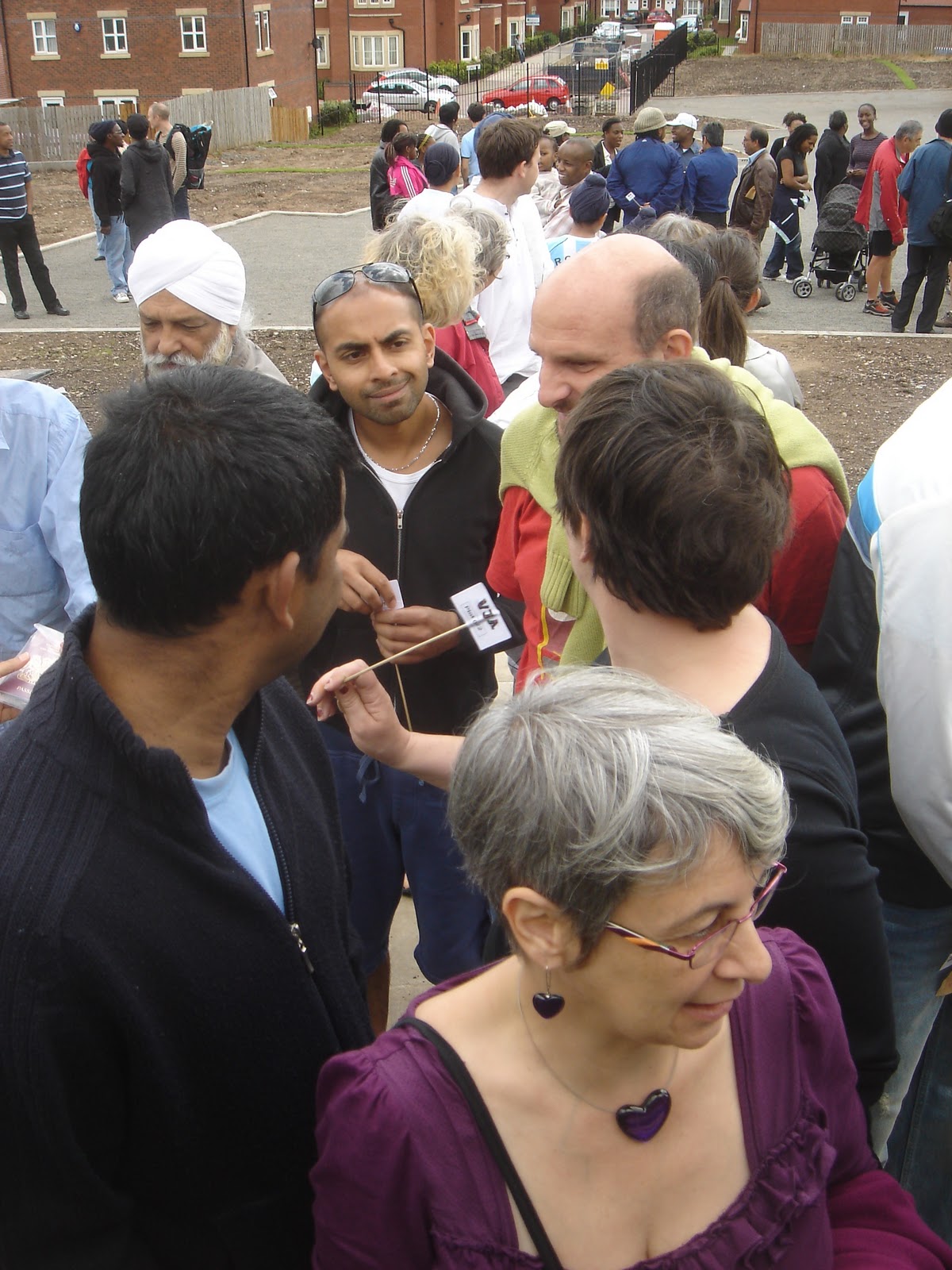
10 June 2010: queueing for plots on the restored VJA (ph: Richard Baddeley)
Other activity has involved work on restoring the churchyard of St Mary's Handsworth and the successful campaign to get Sandwell Council to alter the local plan for the area that includes Black Patch Park so that it is no longer available for industrial development. That's a continuing story amid as funds dry up for maintaining let alone restoring an urban park.

 What's been unique about this is the connection with the descendants of the Gypsies who were originally evicted from the Black Patch long ago. Some of them are shown in the YouTube of Bryn Phillips' song about Queen Henty's curse.
** * ** * **
 1400 Tuesday: Ah here's a reaction from Inlogov, from Philip Whiteman
....there remain a number of elephants in the room that Government has failed to fully answer.
Local authorities are being encouraged or subjected to the ideology of mergers and shared services are arguably good ideas in terms of economics but goes against the very concept of local control. In essence councils are becoming ever more distant from those they seek to serve. This is counter to the idea of connecting government to communities.
The move to de-ring fence funding is to be welcomed as it will allow greater local discretion over funding priority services. However, if Government is sincere in terms of allowing greater local autonomy in terms of funding, the balance of funding between central grants and local taxation needs to be addressed. Instead of central funding accounting for 75% to 25% local funding, this ratio should be reversed. Central government should only provide funding to ensure equalisation of funding between the richest and poorest communities.
The Big Society proposals could inevitably be depicted as little more than a mask for local authority spending reductions also announced yesterday. This means that funding community groups, the third sector and others to provide the Big Society capital will be difficult to achieve. The big hope comes from these groups being able to provide quick and cost effective alternative solutions.
The Localism Bill needs to ensure that principal councils can let go of services and hand them over to the parish and town level. Equally, local and parish councils need to build their own capacity and ensure that they are advocates for the Big Society. However, this tier of councils is very rural centric and greater thought will need to be given towards building the Big Society in urban conurbations.
The move towards increasing the number of mayors is journalistically and politically popular. However, government should not assume that all of the twelve cities will jump at the opportunity. Evidence in favour is patchy.
The role of councillors has largely been ignored. At a time of the Big Society, greater effort could be given towards the role in supporting and enhancing community influence and provision of local services.
INLOGOV will be researching, evaluating and monitoring how the Bill is enacted into reality. We will also be engaging our postgraduate students on the impact of Localism and the Big Society with their communities and employers. We welcome discussions with local authorities or any other organisation on how they seek to address the implications of new and current thinking within this arena. In the New Year, INLOGOV will publish a full and detail response to the Bill drawing upon expert opinion within the field.
** **
Καλά Χριστούγεννα και Ευτυχισμένος ο Νέος Χρόνος
I've posted quite a few Christmas cards this year including one to our neighbours - which might just make sense despite my Greek writing. We're always putting snow into our Christmas cards despite its rarity in English December. This year our local weather richly matches the theme. There was a prediction of snow in Ano Korakiana the other day - για έναρξη χιονόπτωσης στο χωριό. A celebration and vigil in the church of Savvani Arkoudena - εκκλησία των Σαββανήδων στην Αρκούδενα - ended early as a result. I see a photo of our neighbour - the Papas - Κωνσταντίνος Φαϊτάς - second from left - in Alice Stergiou-Savvani's dining room.
This year her family provides the traditional dinner of fish and wine for a vigil which, if I understand rightly, takes note of an ancient dispute that was to sever Eastern and Western christians. In the local church of Savvani Arkoudena there's a picture of St.Arius at the great Council of Nicea - first ecumenical council - Α’ Οικουμενική Σύνοδο - in the year 325AD. He is arguing his belief that Christ, though the most perfect of creations, is a creation of God the Father, in opposition to the belief of St.Alexander who held that Christ is of the same substance as the Father and co-eternal with him (my italics). This debate became so heated that Nicholas of Myra - one day to be known as 'Santa Claus' - slapped Bishop Arius for, as he saw it, belittling Christ.
The slap: 'Behold, how great a matter a little fire kindleth!' James 3:5-6
The insertion of Alexander's argument - the filioque (and from the soninto the Western creed 260 years after the arguments at Nicea (words on this in Democracy Street some years ago, and again in Feb 2008),
Aghios Panteleimonas attended by the President of Greece and the Archbishop of Athens - reported by Malcolm Brabant - to advance conciliation in the present...

** ** **
The other day I dropped into our local GP to get my flu jab - which covers swine flu - and have a routine blood test. I like this process of trying to stop people getting ill, rather than waiting until they do. That of course is the trouble with a lot of what government does - stops bad things happening via road safety, food and drug testing, with building regulations - inside and out - with child protection; all kinds of risk assessment - things that can make government look like party poopers, do-gooders and interferers - and with the additional problem that it's so tricky to measure performance in stopping things happening. You can measure how many people you've arrested. How do you measure how many crimes you've prevented; how many fires didn't have to be put out because of the work you've done to ensure they never started? As a recipient of the flu jab over six years I've no scientific proof it works just because I've not had flue more than once in that time.
Preventive medicine: old gits at the docs
** ** **
I'm flattered at seeing my face on the front page of the Ano Korakiana website - with a fair précis in Greek of what I wrote in 2007 about Ano Korakiana avoiding becoming a 'non-community'
I find my rough re-translation rather pleasing, so leave it as is, since the meaning's all there (go to the village website and click on my face to read it in Greek) - Ο  Simon Baddeley είναι λέκτορας στο Ινστιτούτο Τοπικής Διακυβέρνησης του Πανεπιστημίου του Birmingham στην Αγγλία, μα πάνω από όλα λάτρης της Ελλάδας. Εδώ και αρκετούς μήνες έχει αποκτήσει μαζί με τη σύζυγό του μια άμεση σχέση με το χωριό μας, αφού εδώ περνάει αρκετό διάστημα του χρόνου, στο σπίτι που αγόρασε  στην περιοχή που είναι το πηγάδι της «Γραμματινής», κοντά στην εκκλησία του Εσταυρωμένου. Μέσω δε της ιστοσελίδας μας προσπαθεί να έχει μιαν εικόνα για τη ζωή του χωριού μας και αρκετές φορές γράφει σχετικά στο δικό του χώρο στο διαδίκτυο, ανταλλάσσοντας μάλιστα απόψεις και με άλλους συμπατριώτες του που έχουν κάνει την ίδια επιλογή με τον ίδιο, να αποκτήσουν δηλαδή ένα «καταφύγιο», μια δεύτερη κατοικία στο χωριό μας...
Do not make Korakiana "non-community"
Written by Kvk
13.12.07
Simon Baddeley is a lecturer at the Institute for Local Government at the University of Birmingham in England, but above all a lover of Greece. He's acquired with his wife, a direct link to our village, after passing some time here last year, buying the house by the well of Grammatinis near the church of the Crucified. Through our website he strives to gain an idea about the life of our village and sometimes writes on his own site on the Internet, exchanging views with other compatriots who have chosen like him to have a second home in our village ... He indicates a developing problem in a recent memo to the village about our future, in response to some reports on our website, a small part of which has already been translated into English and French. 
"What I'm trying to figure out is why the village (Ano Korakiana) has such a great style of architecture. It resembles a village that might have benefited from one or two large public buildings gifted by a rich Greek Diaspora. It seems there are so many elegantly crafted buildings, lovingly prepared with the additions to the lintels and doors and arches and other decorative features, suggesting a prosperous time ...
Referring to comments on the site  - korakiana.gr - hat today, a reduction in the population of the village is evident, despite the installation of either temporary or permanent foreign families. Many years ago in my childhood, my parents bought and converted an old house in the village of Bagnor near Newbury in Berkshire. When we went there in 1949 we were re the first among some 20 houses in the village to install interior plumbing. Others went to a small stream - the Winterbourne - running at one point under the village street, bringing water home in buckets. When we left there in 1962, the village had changed a lot. The villagers had mostly moved to the municipal housing on the edge of Newbury, and more professionals from the city had moved into the village . Of course we now know this phenomenon well. It happens in villages throughout Europe - and no doubt elsewhere.
I remember my father said that although we loved the place we'd come to live we were also part of what some saw as the destruction of the rural economy. In the 90s I re-visited Bagnor. I could hardly recognize it. We were there to protest along with thousands of others against the highway that would pass through the meadows of my childhood. My father wrote in his old age, that the invasion against which we were protesting so vigorously (but peacefully), was part of a change that affected all of us and for which we were partly responsible.
Do you think that some of us are putting at risk what might be called the 'integrity' of Ano Korakiana? Can any of us (trying to avoid the term 'we' because you and I and our relatives are unique and I don't want to characterize us all together as 'foreigners') be criticized for our choices in life? Will Ano Korakiana become as much a non-community as Barbati, with newly built houses and wonderful views of the sea, but inhabited exclusively by seasonal visitors. I hope that young Greeks born in Ano Korakiana will be able to stay, or leave, and return to contribute to village life. There are villages in England which despite having been transformed have gained a new equilibrium, with significant involvement of relative newcomers, who've found harmony with the remaining former residents,  pressed for the building of 'affordable housing' so younger people can remain in the village.
It is truly a touching reflection of Simon Baddeley, thinking that might not have been experienced by many of us locals, a reflection of a 'foreigner' who seems to feel as 'native' as many of us. We believe that such examples are useful and beneficial for our region, now and for the future in an ever-changing world. Moreover, the history of Korakiana for centuries, has been largely written by family relocation ...
In a Greek nutshell I guess!
** ** **
At a suburban BBQ, a  man slaps a child who's not his own
My current reading. The Slap* by Christos Tsiolkas.  I read earlier work by him while in Australia. Tsiolkas' writes of the lives of successfully settled emigrants from the Balkans, especially Greeks, living in Australia. He reports the dire existences of a materially comfortable, social and psychological diaspora. This is the Balkans transferred to the suburbs of Melbourne; eastern Europeans escaped, or dislocated by globalisation, from the hold of blue-collar solidarity, faith and ritual, tight family, close neighbours, organic community. Tsiolkas is an enragé on the arid rewards of embourgeoisement. A third generation emigrant, he looks back at a prosperous dystopia in the way a young 'gentleman' sent to private school by his nouveau riche parents might be ashamed of them, looking upon talk of self-made success with ignorant disdain. I'm over 150 years away from that process worked out in the mills of Oldham and Bolton, distanced from its feelings and dynamic, but I've been lucky with my friends, relatives and reading.

*The link here is to The Omnivore, a website developed by my niece, Anna Baddeley
***
Oral evidence on Localism from John Stewart and George Jones, [George to the committee: "John and I are old men in a hurry. After all, we’ve been doing this for 40 years. We want to see it now."] taken before the Communities and Local Government Committee chaired by Clive Betts on 15 November 2010. Both have given a professional lifetime's academic attention to local government.

Q49 Chair : Good, we can make a start on our second evidence session of our inquiry into localism. Welcome, George and John; it almost seems like yesterday when you were before us on our previous inquiry into the balance of power, so welcome once again. Henry Peterson, welcome as well; it’s the first time you’ve come before the Committee. Somebody asked me the other day at a talk I was doing, after I’d finished, whether you could really prove that localism was going to make services more efficient, whether in the current climate it was actually going to be more cost effective and, if it wasn’t, whether there was any point in doing it. What would your response be if you were asked that question?
Professor George Jones: Yes, certainly localism will make services more effective, more efficient and more economical, because decisions will be taken close to the communities that are being dealt with. If we, for example, build on the work of the participatory budgeting experiments and exercises, we saw there, in an era of growth, that local citizens could take decisions sensibly and effectively about how to spend local money. Now we move into the era of cuts, and I’d have thought localism is even more significant, because, after all, it’s local people who will know where the cuts really bite, and they will know where to make sensible cuts far better than any central Government Department or regional office, and they will be able to be sensitive to any of the big problems that will arise-the social consequences, for instance, of cuts. Yes, it’ll be more economical, more efficient and more effective, because one hopes that they will be able to take an overview of all public service spending in the locality, building on the total budget experiments, so that it won’t just be local government expenditure that’s within their remit; it will be all public service expenditure. I’m a great champion of localism. You have yet to get me to define what I mean by that, but we’ll leave that to one side. My answer is wholeheartedly yes.
Professor John Stewart: I would also say wholeheartedly yes. You can fit expenditure more closely to two things: you can fit it more closely to local circumstances, which will vary from area to area; and you can also fit it more closely to what local people want. National Government tends inevitably to seek uniformity, because it hasn’t the machinery and the means to discriminate between the circumstances in one area and the circumstances in another, or to take full account of local wishes. That is why we actually have local councils; they can take account of local circumstances. The argument for localism is that maybe we are not giving the local councillors enough power.
In late November the Institute for Public Policy Research North - ippr north - sets out ‘five foundations’ upon which localism must be built:


  • A framework for decision-making which is efficient and effective – with powers being devolved down to the appropriate level of government.
  • Arrangements which give powers for much greater local financial autonomy. The target should be that local councils raise 50% of funds locally through a reformed local taxation system which combines local income and property taxes.
  • A set of national minimum outcomes which mean that every citizen is guaranteed a level of service within a system of greater de-centralization and local flexibility.
  • An increase in the transparency and accountability of local decision-making through more powerful and democratic local government.
  • A formal constitutional settlement between central and local government enshrining the key principles of central-local relations for years to come.

Monday, 8 November 2010

Aotearoa

South Island, New Zealand
Sunday: From Base Brisbane - a backpackers' hotel opposite Central Station in Brisbane costing A$70 for a double with baths (note: hot water is a problem on the second floor) and WC down the corridor and a steak and beer supper the night before for A$10 each, we caught the efficient Airtrain to the International Airport - under A$30 each return, and without fuss were on a flight over the Tasman Sea - what locals call 'the Ditch' - over South Island, New Zealand, to Dunedin, Les at the Pacific Blue check-in kindly getting us seats by an exit for the extra legroom we cherish. The flight was easy, no frills, pay for your snacks - then after three and a bit hours we were over the mountains of Otago descending to Dunedin, where Val awaited us under a grey sky.
It was chilly, as though we'd flown into the Highlands in June, with similar landscape. So here we were in New Zealand - a place I'd never thought I'd actually see, let alone where I'd find myself - 11000 miles from England - invited to lead a one day seminar in a few days. Once home in Dunedin - 23 kilometres from the airport - Val took us into her warm home at the end of a cul de sac above the city. A log stove was burning merrily. She'd given us her bedroom. We'd enough light to stroll around a garden that mixed familiar British plants with more exotic. Amid the colour and greenery, even the weeds were familiar - couch grass, the tenacious invader and the beautiful nomad dandelion - envy of respectable flowers for its irredeemable wildness.
Some British gardeners struggle to achieve this ambience of timeless relaxed inattention and I've never seen it on a TV gardening programme. Cobwebs are allowed, moss approved, lichen welcome. In the back was a dry stone wall, random bluebells, small fragrant roses, a mossy edged lawn sprinkled with daisies, a little pond, a big old garden shed, a greenhouse with untidy shelves and a kitchen garden needing a few more vegetables, a hedge with an archway leading to a small jumbled patch for compost with a wooden gate that might or might not open onto another tree lined street - a rich patch of England on the other side of the world, and our washing hung out in the sun. Across the horizon, above the low buildings of Dunedin, lay the hazy South Pacific and, to the north west, steep green pastures edged by the bright yellow of gorse in spring, topped by a roll of white cloud beneath the blue. We could hear Blackbirds, "but" said Val "if you hear snuffling late at night that's Possums." In the same house is Val's son Laurence, who helped get my laptop working on the WiFi and on our first morning was coaxing the garden. Steak and sauté potatoes and Greek salad for supper, then early to bed with "no hurry in the morning," so read myself to drowsiness with The Bridge over the Drina - a book about a real bridge in Bosnia Herzgovina that I don't want to end I'm enjoying it so much. In his introduction William McNeill writes
no better introduction to the study of Balkan and Ottoman history exists...with humour and compassion Andrić chronicles the lives of Catholics, Moslems and Orthodox Christians unable to reconcile their disparate loyalties.
Monday morning the wind was still chill but the sky clear but for the long white cloud on the high ground above. The house sits in a slight dip, shielded from the chilly breeze so we could enjoy the warmth of Val's front garden.
"The Maori call this place Aotearoa - The Land of the Long White Cloud" said Val. Later she said with a wry smile "Some call it the land of Wrong White Crowd." I suspect that's an old one - but important for me to strive to understand.
** ** **
From Chris on the plot next to ours on the Victoria Jubilee Allotments:
Hi Simon. Sounds like you need to be heading nearer to the equator! I will try and have a look at lifting a couple of your plants and give you a report on how they have grown. I got some very small "salad" potatoes (very expensive in supermarkets) but the bigger ones seemed to have started to rot; of course my crop was not from seed potatoes but just left overs, so was a bonus realy. I have very much slowed down with the work on trees and hedge pruning before spring; and finally putting the roof properly on the shed. All this and a general tidy up and putting weed control sheets in the strawberry beds will have to be done in the next few weeks as I will be off for my 3 mouth winter escape in Jan. The weather here has been good but turning to rain and colder this week Hopefully arrange a get together for a morning or afternoon tidy and sorting out world politics after your return in Dec. Happy traveling till then. Yours Chris
From Scylla Parkyn, our Hon.Sec.:
Hello Simon, thank-you for your email. I have spoken to one of the park rangers and he said that we are still in line for some leaves, although we haven't quite established where the Allotments they could drop them off ( I did suggest that maybe they could put them on their own plot in the corner for the time being, which they agreed might be an idea, as nothing is being done on it at present, and that they would look into it. The next Allotment meeting will be on 20th November at 11.00am in the Meeting Room. If you can make it perhaps you would like to raise the issue about the bee keeping, especially as you are also allergic to bee stings yet would not object to a beehive on the allotment. I'm sure your offer of giving a talk on how to use a scythe would be welcomed  (in any case,  there's been no sign of a communal rotavator or strimmer appearing). Delith at no 10 had a little 'shed warming' tea party the other day (a few pictures were taken, if you would like one to add to your documentation), while we have managed to find a rather palatial recycled summerhouse/shed affair which is also now up opposite. With best wishes, Scylla 
Dear Scylla. Thanks for your reply. I won't be home until 6 December, but if you think it appropriate do mention this email exchange and say that I fully appreciate the apprehensions of anyone who has a fear that something as apparently minor as a bee-sting (they don't hurt even a quarter as much as a stubbed toe!) could end up causing an allergic reaction so severe as to be fatal. When younger I was stung by both bees and wasps - no where near a hive in the case of the bees, though I was by a nest in the case of the wasps. I had a strong and quite alarming reaction that was cured - luckily - at a nearby medical centre (of which we have several in Handsworth). The nurse saw me about half an hour after the stings and gave me an adrenaline jab for anaphylactic shock and said "It's lucky you got to us when you did." Since then I carry the kit that at the time only a nurse or doctor could provide. These remedies are easily obtainable and for the last thirty years I've had no worries. I was stung by a wasp a month ago. Quite painful but actually no need for treatment because I had no reaction beyond the smart of the sting. I regard my allergy as my responsibility and have equipped myself accordingly (check with local GP!). Bees are essential for the pollination and reproduction of the things we grow on our allotments and gardens and I would be very keen to see beehives in the hands of qualified apiarists on the Victoria Jubilee Allotments - if need be on a plot next to ours or anywhere fellow plotholders consider them welcome. Bees are having a hard time at the moment from various diseases and we need to encourage their husbandry, apart from valuing their role in helping us with growing things. There's an immense amount of advice on the web about beekeeping on urban allotments which includes guidance on how to avoid causing harm to other plotholders or their families. Avoiding apprehension is another thing requiring education, reassurance and respect for safety measures recommended by professional beekeepers. I hope very much that common-sense will prevail on this matter, or we'll end up cutting off our noses to spite our faces, which is a bit silly. Bees and wasps can sting you anywhere and at any time whether on allotment, or at home, in your garden or indoors even or in a car - supposedly safe from all insects. (Some advice on stings including allergic reactions). Part of our problem on the VJA is that shortly after our site was opened in June this year, one of the allotment liaison officers seems to have settled an issue between a beekeeper and another plot-holder, fearful of allergic reaction to stings, in favour of the latter. This has set a local precedent that needs to be debated and I very much hope reconsidered. (My abject apologies to the parties involved if I've over-simplified this incident or just got the wrong end of the stick.) BTW I look forward very much to following Delith's example and having a 'shed-warming' party later in the year or New Year. But first we must get the shed put up. Best  Simon
** **
George Papandreou feels sufficiently pleased with the support shown for his party PASOK in the Hellenic regional and local elections held on Sunday to delay calling a General Election to test support for his government's economic policies. It's typical that a central government uses local elections as a litmus test of its own popularity - especially now - but of course what we're c,urious about are the actual local results of elections to the new councils created by the Kallicrates Plan for the re-organisation of local and regional government across Greece, especially those for the new Municipality of Corfu - Δήμος Κερκυραίων - an amalgamation of the island's thirteen previous local councils. (see my earlier note on local government re-organisation in Corfu in a May 2010 blog). A more pessimistic take on the local polls comes from Costas Douzinas and Petros Papaconstantinou:
...In a country where the turnout is usually up to 80%, some 45% of the electorate abstained and another 10% spoilt their ballots. Pasok received approximately 34% of the vote, the opposition New Democracy 32% and the Communists 11%. The three radical left parties that had not managed to field common candidates polled about 12%. If the wider left had created a united front against the measures, it would have emerged as the hegemonic bloc confronting the neoliberal logic of the ruling elites. In view of these results, Papandreou, looking gaunt and exhausted, announced that he will not call an election but continue with the implementation of these measures...
** ***
Our dear friend Danica in Belgrade who I last saw in Oxford in the northern hemisphere summer has just lost everything from her hard drive - 'tabula rasa' as she writes on Facebook and on her blog - Digital Seredipities.
simon, i am in huge shock and grief.
i lost application im preparing for Harvard to send in 4 days
i have to write mission statement agaain
and research proposal
and to translate one of my works from Serbian to English
all in 4 days.
im installing programs now.
money doesn't matter
i paid for new hard disc
what matters is data
i will write now post on digital serendipities about this experience
and even more about support of humans and friendships
this seems good test to know who are really my friends and who not.
thank you for being my friend.
much love to lin and you
x
I know the feeling. These 'little' crises are sent to test us - remember Newton's thesis, eaten by a dog or did the maid use it to light a fire or was that someone else who lost all their work in the same grievous way? (What actually may have happened) I keep three external hard drives, one left at home, and two which travel in separate cases, plus I've a flash drive for ID stuff hung round my neck, and documents, images, film and sound left in the 'cloud' - e.g. Google-docs, Flickr, Soundcloud,Vimeo and Youtube - with links via this blog. Loss of a hard disk is still vexing but think of the 24/7 work we ask of these things! In a vain attempt at consolation I sent D this page from Dog with the Blog
** ** **
In a connected world I'm interested in any perspective on the incomprehensible world of economics. This piece in the Otago Daily Times (8 Nov '10) by Peter Lyons, an economist at St.Peter's College in Epsom, NZ I found quite helpful - if for nothing else than that he admits there are no easy answers:
...The United States, Japan and the United Kingdom are abandoning monetarist orthodoxy. Their central banks are pumping money into their economies with the aim of stimulating demand and driving down their exchange rates. This aims to increase the competitiveness of their exports. As the New Zealand dollar increases in value against these currencies it makes our exports less competitive on world markets.  Export-led growth was meant to be our saviour but this may be denied to us by the beggar-thy-neighbour polices of other countries. Further decrease in effective demand in New Zealand will lead to rising unemployment which could spill over into the housing market. If significant declines in house prices occur, this could create a negative wealth effect. As people feel less wealthy they cut back spending, leading to a nasty deflationary spiral. This is what other countries are desperately trying to avoid. There are no easy answers but we need to look seriously at our use of monetarist policy through the Reserve Bank. It is a debate that is long overdue. Our economy is not out of the woods by a long shot. These are strange times as countries seek to extricate themselves from the debt quagmire left by decades of monetarism....
*** ***
Andrew Coulson shared some thoughts by email about our Prime Minister's vision of the Big Society from which I extracted this::
...The idea of the Big Society is to recreate civil society, to turn back the clock to a life when we lived a few miles from the rest of our families, worked in the same place, shopped in the same place, went to pub or church in the same place, etc – i.e. a pre-motor car society. But it is also presented as a way of having a reduced state – i.e. civil society structures take over from what the welfare state does now. Politically this is very clever, as it means it can appeal to the right (smaller state) and to the left (mutualism and communitarianism), not only within the Conservative Party but more widely. But as a piece of political ideology the BS is in danger of complete meltdown. Cameron could not get a cheer for it at the Conservative Party Conference. I think that is because most Conservatives know that if the voluntary sector bodies they are involved in are to prosper they need constructive relationships, and often resources, from the state. They also know that they will be unequal – easy in villages and among retired people, much harder in cities and 30-somethings with young families trying to hold down jobs. So they neither believe that a top-down initiative can add much to what they are already doing, nor that it can replace the state in (say) crime fighting or care for the elderly...
My reply (extract):
As one involved in local community activity most of my adult life the impulse comes from advice given me ages and ages ago by my step-father who said two things of especial importance about political involvement and engagement to me when I was about 16. They must have been important or I wouldn’t recall them so clearly. The first was “You can get almost anything done if you don’t mind not taking credit for it.” (My Dad added to this also with a remark about how rewarding it was to have planted an idea and see other’s claiming ownership of it and pursuing it with enthusiasm.) I am sure JDS has ever approached the world in this spirit. The second observation was that trying to make anything happen in a democracy is like wading through thick treacle. ‘There are so many others trying to influence the same decision-making bodies that you will only achieve your goals by wading faster and more persistently and occasionly joining up with others who’s hopes and desires you share. The result of this is that I've never had any doubts about the role of perseverance and the patient courage demanded by political engagement. Few of the projects that have mattered to me (parks, allotments, green spaces in cities, transport transformation) have involved under 20 years and many of these continue messy and fragile and incomplete (e.g. The ending of autodependency (:)))  I have always consoled myself without using it as an excuse to be less resolved that none of my political heroes ever lived to see their dreams realised. Wilberforce never saw the ending of slavery, only our declaration of its illegality. Many of the most stalwart campaigners for women’s suffrage never themselves lived to gain the vote. Martin Luther King’s dream...and so on. I’m sure this applies to those who campaign against the predatory lobbying of big pharma that you mention. David and Goliath has always been an appealing image learned in childhood classes. The summarising maxim for me is not ‘don’t let the bastards grind you down’ (tho’ I like that phrase) but ‘you are always losing until you win.’ Until people can be persuaded to take on games that they seem to be losing over most of their adult lives I don’t see how government can hope to rely on dreams of ‘civic engagement’. Being poor is just such a losing game, so asking such people whose achievements revolve around daily and weekly survival to do yet more is bizarre. Best, Simon (in Dunedin, NZ) (See Stuart Weir on 'sham' localism)
Linda looks over the Pacific 

Back numbers

Simon Baddeley