Total Pageviews

Showing posts with label Dhiaa. Show all posts

Sunday, 24 June 2012

Weather

I flew back from Inverness. The jet went up and up and never quite broke out of the clouds. It's like having an animated conversation. Something in the background that's gone unnoticed distracts me momentarily is easily ignored but - continuing - begins to become irritating, until I'm forced to break off conversation and notice - the weather in June. There was a mild blue day or two in between relentless wind, rain, deep cloud that has run through the month. We need rain of course to fill aquifers and reservoirs across England. At the same time there are floods up and down the land, rained celebrations - the Diamond Jubilee weeks. Its the size and scale of these swings that suggest imbalance and the more our species in its fecklessness causes the climate to warm, the more uncertainty there is about how much warming there will be - a gift to those who'd rather believe there's no problem, that these variations are normal, that it's only the wettest June for a century. What an impossible task for a young science to send out warnings - like writing history on the basis of half a morning's conversation.
**** ****
The morning ferry to Igoumenitsa on the Sea of Corfu
Jim Potts on the blog Corfu Blues provides links to blogs by foreigners promoting Greece, including Democracy Street:
'From Corfu, Democracy Street, Simon Baddeley's blog (and its rich archives) is a treasure trove of  balanced Philhellenism, analysis and intelligent comment.
This pleasing flattery might be misleading since loving a place doesn't always promote it. Greece is infinitely more important to me than I could ever be to her yet I row with her as I do with my wife, and isn't it always her who starts the argument. The cartoonist Pont (1908-1940) would understand my views on tourists...
Love of Travelling Alone by Pont (p.88 in my collected edition)
...and tourism - which Greece needs. This is a nice account of a short summer holiday on Corfu from the Buxton Advertiser - 'The Greeks are working hard to make your Euros work for you':
...Corfu may no longer be the completely undisturbed paradise which turned the young Gerald Durrell into a leading naturalist, but it is still one of the most beautiful places in the Mediterranean....
...where the sea is so still and clear that sometimes the water looks golden
*** *** ***
Lin, Denise and I went, as reps of our voluntary group, to a rather daunting event in town...later i wrote to the MP Chris White who has successfully and against odds brought in legislation that may help us.
'Meet the Buyer' - Lin and Denise at Midland Heart, 20 Bath Row, Birmingham
Chris White MP
Dear Mr White
Handsworth Helping Hands is a small voluntary group based in central Birmingham which runs a transit van and holds a rich variety of power and manual tools and a lot of enthusiasm and a healthy control of transparent accounts.
We offer a free of charge, or reduced rate, small garden and maintenance service for vulnerable or limited means residents, moving furniture, cutting grass or branches, installing door chains and other security devices in homes and site clearances. We get referrals directly or from Councillors, Neighbourhood Forums, resident groups and local Police, and are known by word-of-mouth. We do street clean-ups and green space litter picks, having a refuse disposal concession at our local tip. We check eligibility for a free service but funding from grants or larger contractors like Housing Associations are required to help with costs incurred such as fuel, wear and tear and labour charges.
On Friday three of our group, attended a 'Meet the Buyer’ session organised by Midland Heart. An impressive programme of presentations led up to an overview of the EU Pre-Qualification Questionnaire (PPQ) and the Invitation to Trade* (ITT) procedures by the Housing Association’s Procurement Manager, John Crisp. We were ready to leave the event at this stage as it was worrying clear that there was absolutely no way we could meet the starting criteria to do paid work for Midland Heart and I suspect other agencies of this kind. We lack the capital, the equipment and the documentation required to go through a 6-9 month process. 
We fully respect the Housing Association’s need to set tough standards for those who work for it, and we believe that in our own way we have met good local standards on a mostly voluntary non-profit basis, using any funds received to pay for HHH’s running expenses - insurance, road tax, maintenance of tools and van etc.
John Crisp suggested we remain to hear from the next speaker Melanie Mills, CEO of Social Enterprise West Midlands. Melanie suggested that there was a tension between the requirements of the OJEU and the government’s wish to encourage organisations like ours. She then gave a brief explanation of your Social & Public Services Bill. We found this encouraging.
I am contacting you to try to get some idea of whether the Public Services (Social Value) Act 2010-12 offers offers modifications in current  procurement conditions that will allow an organisation like ours - with appropriate liability, appropriate H & S procedures and record of transparency (audited accounts etc)  will be able to bid for paid work with realistic opportunities of getting contracts that will help support our unpaid voluntary work? 
Your response and further briefing on the implications of the Public Services (Social Value) Act 2010-12 for Handsworth Helping Hands would be much appreciated.
Very best wishes, Simon Baddeley (Secretary)
Voluntary Advisory Group for
Handsworth Helping Hands. Members of the group: Simon & Linda Baddeley, Charles Bates, Denise Forsyth, Leslie Pinder, Rajinder Rattu, John Rose, Michael Tye, Nigel Smith MBE

*or Invitation to Tender 
*** *** ***
Dhiaa has communicated from Baghdad. My friend left Birmingham in December 2010 to serve for 8 months as a Minister of State in the Iraqi Cabinet. A devout Muslim he has never once questioned or challenged my lack of faith, and has often joined me in theological debates that matter within Christianity - especially the filioque schism between the Latin and Orthodox Churches. He managed - with gentle circumspection - to give me an explanation of the Christian conception of the Trinity. We looked at paintings in the Barber Institute and The Adoration of the Child Jesus by Rosselli which attempts to depict this enduring conundrum of three divine persons in one - ὑποστάσεις.
I have also begun- slowly - to understand the history of long differences between Shia and Sunni in Islam. From November last year Dhiaa's been Secretary General of the Al-­Ahrar political bloc - the biggest single political grouping in the Iraqi government. This account is from Niqash - a web newsheet covering all Iraq (Arabic). I doubt Dhiaa would use a word like 'oust'. His continuing doctoral dissertation, interrupted by the summons home - Shiísm, Politics and Development in post Saddam Iraq: A Study of the impact of Sadr’s socio-political ideas on the formation, roles and development of governance. I learned more in his first chapters than from anything else I've read on contemporary Iraq - and there's a lot. The complexity can be daunting, but his detailed draft left me breathless with the pleasure of at last beginning to see a way in which this might be understood, and more important, might offer opportunities for peace and stability...
(a tiny sample from a draft since revised)...Figures 1, 2 and 3 below show, the main faith groups possessing that possess power and resources in modern Iraq are religious Muslim Shiíte groups. These groups not only conflict with other non-religious, non-Muslim, or non-Shiíte groups, but themselves are subject for to various conflicts. These conflicts pose an insurmountable obstacle in the face of to the development and the rebuilding of the country. The main conflict is generated by, and around, different world views expressed though (?) by a diversity of discourses. These discourses have a common frame of reference and a common set of goals....
Dhiaa Najm Al-Asadi
...The head of the Ahrar bloc in Iraq’s Parliament, Dhiaa al-Asadi, spoke to NIQASH about why he and his fellow MPS are standing behind a move to withdraw confidence from current Iraqi Prime Minister Nouri al-Maliki. The Ahrar bloc has 40 seats in Iraq’s Parliament and is particularly important because it is basically the political wing of the Sadrist movement, a multi-million-member group that follows crusading Shiite Muslim cleric Muqtada al-Sadr.
The Sadrist movement also incorporates the former Mahdi Army, a militia held responsible for much of the violence against American troops as well as the conflicts that nearly plunged Iraq into a sectarian, civil war following the 2003 US-led invasion of the country. Over the years, the Sadrist movement has disarmed and, as a political force in the form of the Ahrar bloc, has become a crucial part of al-Maliki’s current coalition government; it has also been engaged in community work and seems to be becoming popular with Iraqis that did not previously support it.
But now the Sadrists seem to be turning against the man who leads the coalition they are part of. In terms of current affairs, many have been interested to see the Ahrar bloc side with former political opponents to attempt to oust al-Maliki, a fellow Shiite Muslim. In doing so, the Ahrar bloc is on the same team as Iraqi Kurdish politicians and politicians from the Iraqiya bloc, a mostly Sunni Muslim bloc from the other side of the secular tracks...
'...there is a lot of politics going on in Iraq these days. Best regards, Dhiaa'  Sent from my iPad

Saturday, 7 January 2012

Mothercare

Mum and I went to buy baby things for my daughter's and her grand-daughter's expected son. It's the first time this coming wonder became real. We had a lovely hour together looking at various useful and slightly indulgent products and bought some clothes for Amy and for the baby as well as a bouncer, which Amy can collect from her local Mothercare in Birmingham. Sandi looked after us as we shopped. She seems about 13 years old compared to us, and was fulsome with enthusiastic advice. Outside the shop we ran into Isla, shopping with her husband Bruce, held together - he said - by so many metal implants, he can't pass security to fly, who lives way down the eastern edge of Loch Duntelchaig.
"Will you take our picture, Isla?"
*** ***
My dear friend Dhiaa-al-Asadi spoke last year of a day when we might visit the site of the City of Ur of the Chaldees, near Nasiriyah, that I learned of at school, to stand together by the great Mesopotamian ziggurat raised in the 21st century BC, a place where some say our civilisation has its roots:
I replied with joy; affirmatively. I'm missing Dhiaa - the great gift that came to me from the ill-judged invasion of Iraq. He has taught me, faithless - and bereft for it - much about faith, though in matters go government he is secular. I have learned as much about Christianity from Dhiaa as about Islam. When after much complex work we were able to get Dhiaa over to  Birmingham for the start of a brilliant Phd several years ago, our first long conversation occurred as he, still I'm sure, tired from his journey from Iraq via Jordan and Heathrow, wandered at my invitation around the Barber Art Gallery on campus. We stood in shared pleasure before Jan de Beer's Nativity.
"I've not seen so much wonder - held in - in suspension. The angel on the right whose hair's blown back by unseen force is supposed to be Satan at birth of his undoing." We stopped opposite a painting The Adoration of the Child Jesus by Cosimo Rosselli.
"I have always been puzzled" I began
Dhiaa and I went closer to the picture, as you can at the Barber, a public place you can have almost to yourself. We gazed at the sky and the Virgin's dress of blue egg tempura painted 500 years ago
"Who are these?" I asked pointing at the lucent sky, my finger millimetres from the paint "God? The Father and - and - then The Holy Ghost. It's unclear to me."
Dhiaa without a trace of the didactic, pondered his own interest in one of the foundational ideas of another religion.
"Is it meant to be a mystery? Your puzzling. Is it  how it can be understood?" We talked more about the rest of the picture, as though it were on a wall in our homes. Later when we revisited the Barber we would explore - I the student - the enduring differences between Sunnis and Shi'a, and then we came to the filioque, the difference that men have debated, argued and quarrelled over since the First Council of Constantinople in 381...(blog ref, blog ref)
Orthodox Creed: Καὶ εἰς τὸ Πνεῦμα τὸ Ἅγιον, τὸ κύριον, τὸ ζωοποιόν, τὸ ἐκ τοῦ Πατρὸς ἐκπορευόμενον...And in the Holy Spirit, the Lord, the giver of life, from the Father proceeding. 
Latin Creed with the filioque "from the Father and the Son". Et in Spiritum Sanctum, Dominum, et vivificantem: qui ex Patre Filioque procedit...And in the Holy Spirit, the Lord, and giver of life, who from the Father and the Son proceeds.
....and another thing, the idea that as so many struggle to release ourselves from the bonds of religion we come to see how they may also be anchors. Religion both releases and controls actions based on instinctive desires. Secularism, especially atheism, tends to scorn repression, relying on good governance separate from church, temple or mosque. Yet it may be that the worst imaginable actions - and we have seen much of them this last 100 years - may require a degree of repression that is beyond secular regulation; suppression of our worst instincts that can only come from impulses that transcend the rule of law; from that which is sacred, rooted in myth; beyond the utilitarian in its understanding of evil, and what we can explore through evidence-based policies on crime and punishment. I shared with him the arguments I'd developed about substitutes for repression and guilt, the idea of an internal polity (the paper I wrote back in 1995)...
*** ***
The Farnack
I've again taken long walks about the Strath. The river's full. Rain and snow melt. I think I managed to tire at least one of the dogs but only because she indulged in a mile's fruitless circular chase of a red deer twenty times her size.
*** ***
I shall translate this - or try to - later; from Ano Korakiana, a celebration of Epiphany, when John Baptist dipped the Christ in the Jordan, came a beam of light with the words <Ούτος εστίν ο Υιός μου ο αγαπητός εν ω ευδόκισα> ~ "This is my beloved son, in whom I am well pleased".
theofaneia2012.jpg
Των Θεοφανίων, Άη-Γιώργη
Με πολλά μποφόρ και ψιλοβρόχι εορτάστηκε στο χωριό η Ημέρα των Θεοφανίων. Στην εκκλησία του Άη-Γιώργη, το Συμβούλιο των Επιτρόπων είχε επιμεληθεί τον εορταστικό διάκοσμο, με την αναπαράσταση του περιβάλλοντος της Βαπτίσεως. Όμως, με το «εν Ιορδάνη…», το περιστέρι (συμβολισμός Αγίου Πνεύματος) κτυπημένο από το δενδρολίβανο του ιερέως «πέταξε και πήγε στις βρυσούλες…». Οι πιστοί θα αναμείνουν στη σειρά για την προμήθεια αγιάσματος στα γυάλινα φιαλίδια τους, ενώ οι Επίτροποι θα τους προσφέρουν γλυκό και ένα μικρό ημερολόγιο με την εικόνα του ναού. Την ίδια ώρα, η Φιλαρμονική μας βρισκόταν στην εκκλησία του Ποταμού για την εκεί τελετή της Βαπτίσεως, ενώ μόλις που θα προλάβει την κατάδυση του Τιμίου Σταυρού στον Ύψο.

Amid strong winds and drizzle the village celebrated the Day of Epiphany. In the church of St. George, the Board of Commissioners had arranged the festive decorations, symbolising the sacred Baptism. But with ...
I shall have to give up and ask Aleko or Nikos for help with the rest, but I do know that a lot of the men are going to strip off down by the shore at Ypsos and dive into the chilly sea after a gold cross.

Letter from Aleko:

Dear Simon and Linda. First of all A VERY HAPPY NEW YEAR and may the drachma stay where it is!!! Your attempt with the language is excellent and please carry on. You are miles ahead of any English person living here! It is ΧΡΟΝΙΑ ΠΟΛΛΑ and not ΠΟΛΛΑ ΧΡΟΝΙΑ!! Although the meaning is the same you say this at every celebration except at funerals. Last week I put my foot in it at a funeral at the Nisaki church when I said Χρόνια Πολλά!!!! The other point is : ΘΕΟΦΑΝΕΙΑ (Theofania)-never in singular!!! (τα Θεοφάνεια και οχι το Θεοφανειο). Theofanio does not exist as a word!! Now - the translation of your entire text :
With high winds and drizzle we celebrated the day of Epiphany. At the church of St. George the council of churchwardens took care of festive decorations re-enacting the Baptism. However with the hymn "In Jordan the dove (symbolising Holy Trinity)" was reborn with the priest's rosemary and "flew away to the wellspring." The faithful queued with small bottles for their Holy water, while the churchwardens offered them home-made sweets and a little calendar with a picture of the church. At the same time our Philharmonic brass band was at the church at Potamos (12 kilometres away) for the ceremony of the Baptism, and if they make a great effort, will be in time for the 'cross-casting' ceremony at Ipsos.
I would suggest we need Friday 27th January at my kafeneion just before 1pm, when the bus gets there, and then after a beer we'll go down to my house for lunch and later you can catch the the bus back to Ipsos. We will speak nearer the time. With love, Aleko
***  ***
Wanting to see the sea I borrowed the car and drove to the shore and walked in the late afternoon and into the evening around Fort George, strolling with the dogs on rough salted turf, gravel laced with boulders, and sand, firm, smooth and wet, reflecting the sky...
...over the Moray Firth towards Inverness, the Black Isle on the northern shore of the firth across the horizon, Fort Rose hardly visible and the rampart stars of the garrison fort the English built to hold the Highlands after the '45.

Saturday, 29 January 2011

My kingdom for a loose footed sail

The news is all from Egypt. From all Arabia.
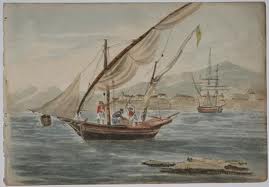
Greek fishing boat off Corfu
The puzzling mix of dead calm, mercurial zephyrs and sudden downward blasts of katabatic wind hurling downhill like invisible avalanches - often out of a clear sky - and tidelessness, make this kind of vessel, prior to the regretted internal combustion engine, ideally adapted to Mediterranean weather, in my case the vexing Sea of Kerkyra, a deceptive lake-like space between mainland Albania and Epirus and sickle shaped Corfu, with a narrow channel between Pantokrator's slopes and Butrint on the Albanian shore. This wooden vessel is relatively easy to row, ideally to scull with a long oar off the overhanging stern; her hull being streamlined underwater gives her ease of passage in smooth water - rowing or sailing, but being flared as it rises to the strakes gives buoyancy in the typical short steep seas thrown up by squalls or longer blasts of strong wind - especially if running before or hove to, perhaps with a small foresail aback and no mainsail; and here's the greatest advantage, the loose footed lateen sail which can be dropped in an instant when that strip of ruffled water is seen hurrying towards the boat that a moment before had been coasting or becalmed on amid the lightest of airs.
Boat race off Corfu
In addition the gaff can be set at various angles - dhows and feluccas - invention of the Arabs long long ago to passage the coasts of the Arabian Peninsula, Pakistan, India and East Africa, to sail up and down the mighty Nile, voyaging across the deep ocean with and against prevailing winds - so that the large light sail can be hauled almost vertical to present a leading edge to the wind that almost matches a modern Bermudan rig, or certainly a windward driver with a much longer leading edge than on a normal gaffer; or it can be strung almost horizontal to run downwind, and all the angles in-between. Finally, the sail being loose footed is easy to reef and also has a generous belly which gives these boats just the lift they need on a reach or closer to short seas to allow them to make way where a tighter less bellied sail tends to drive a boat this small into the waves, stopping a vessel dead, catching it in stays. 
English rigs 
The Bermudan rig, particularly the modern sail of high aspect ratio, is a very powerful sail and a very pressing one indeed. It is a sail without 'life' and 'lift.' driving the boat through the seas rather than helping her to fly over them. Those of us who, before the motor-boat became ubiquitous, were privileged to sail in the big open boats of the Navy, remember the enormous lifting power of the big loose-footed lugsails. Ch 4, p.34 Denys Rayner Small Boat Sailing. Collins 1962
I haven't even got onto the extra virtuosity that comes with the second mast. This delightful Greek fishing boat is both a yawl and a cutter - see the halliards for two head sails, and the second mast at the back - both incidentally quite stubby; easily shipped compared to the far taller mast required to carry a Bermudan sail. A great combination of canvas can be adjusted to respond to and challenge the pesky weather of the wondrous land. Sprits for and aft add to the versatility - adjustments to clews, pulling the sail foot in or out, can allow the boat to sail itself, reducing or increasing weather helm. Square-rigged Odysseus could have done with such technology, even if Penelope had many oars and men to pull on them. I detest fossil fuel engines but acknowledge the difficulty of relying on sail and oar alone in most modern sailing boats. Oh that someone would sell me a boat like this, or even that I might find one still exists in the Ionian Sea.


** ** **
On Friday I cycled along the canal - my favourite route to campus to meet Dhiaa who's leaving for Baghdad. He's already made one short visit to be seen by the Prime Minister, take the oath, prepare his office and meet his staff. In a very short while he takes up his job as a Cabinet member without Portfolio in the government of Iraq. He's offered me his bicycle which he can't risk using in his own country. We met under the Muirhead tower and cycled to University station and took our cycles into town for a last coffee and snack and conversation.
Coffee with Dhiaa in Birmingham - 28 Jan.  Dear friend, How are you doing? I have started my work two hours after my arrival in Baghdad on the 30th of January. Everything is going well but slowly. Please, give my best regards to family. Warm regards, Dhiaa - 30 Jan
We spoke of the astounding principle of indeterminacy - an idea I'd encountered in conversation long ago with my friend Tony Scoville after I'd sailed to America -  Dhiaa's theme, how Shia Islam has been historically accustomed to protest and opposition rather than governance, of the growing acceptance that Islam need not be compromised by the separation of church and state, of lessons from Islam about deficit economics and other ways to think about loans and credit and of course of events across the Arab world, especially in Tunisia and Egypt, across Europe especially in Greece and about what seems to me the daunting challenges of his role in government. "The problems are wicked" he said using the mathematical meaning of that term to describe an issue that presents almost intractable challenges; demands persevering courage and wisdom as much as technical and managerial know-how. "A wicked problem is one that changes
My kind boss - Russ Ackoff - when I was at the University of Pennsylvania in my first job as a lowly researcher for him at Wharton School:  'Every problem interacts with other problems and is therefore part of a set of interrelated problems, a system of problems…. I choose to call such a system a mess.' Ackoff, R, Systems, Messes, and Interactive Planning in Chaps 1 & 2 in  Redesigning the Future, New York/London 1974
 "So how can you...will you work?" "It will be with humility, working in one place and seeking to address the challenges there, always learning and recognising that every place is as unique as the people in it." I spoke of regularity frameworks, of audits. "There's a tradition of governance in Iraq that has in other times risen above family and tribe, while respecting both." It was Dhiaa, who via conversation and the opportunity to read chapters of his continuing Phd. work who introduced me to the scope and depth of the scholarship of Mohammad Baqir al-Sadr, murdered by Saddam in 1980:
Islamic theory rejects monarchy as well as the various forms of dictatorial government; it also rejects the aristocratic regimes and proposes a form of government, which contains all the positive aspects of the democratic system...Lastly, I demand, in the name of all of you and in the name of the values you uphold, to allow the people the opportunity truly to exercise their right in running the affairs of the country by holding elections in which a council representing the ummah (people) could truly emerge. Mohammed Baqir Al-Sadr, Principles of Islamic Jurisprudence, London: ICAS, 2003, p.15
Dhiaa gives me his folding bicycle
I spoke of my hope of seeing with him the site of Ur on the bank of the wide Euphrates, to walk beside the great Ziggurat, where some say Abraham was born. "I would like to do that very much. We will." We embraced and parted, two bikes squeezed in the back of my taxi to Handsworth. I asked Dhiaa soon after we first met what gave him most joy about his country - so devastated by tyranny; how he felt when he returned. He replied "Seeing the countenance of my countrymen"
** ** **
From The Corfu Blog 28 January '11:
The blood bank at the Corfu General Hospital is in desperate need of donors. The donation department is open every day at the new hospital at Kontokali from 8.00am to 2.00pm and again from 4.00pm to 8.00pm. The whole procedure, including a quick blood test takes around 20 minutes, and is on the lower ground floor of the hospital. 
** ** ** **
I have met, via the Kantounista thread on Facebook, Peter Papageorgiou who manages a chandlery I've visited between Kontokali and Gouvia. He saw this photo I took 49 years ago:
Xύτρα 1962
Mag Magmag and Peter Papageorgiou like this.
Hi Peter. On the voyage back to England, sailing from Athens to Italy in August 1962 - long time ago - we were becalmed off the southern Peloponnese, out of sight of land for many hours over many days. On a hot morning somewhere between the Aegean and the Ionian seas, south of the Gulf of Messinia, we saw this island rising from the dissolving mist. I've always thought it was Antikythera, which has one main island - Galaniana - but now I'm uncertain. It may be the largest of the rocky islets north west of Galaniana - Thumb Island. The island stayed in sight most of the day before fading into the haze. I so hope to see your wooden boat. No you are not crazy for taking on one, or only as crazy as someone who finds the time to grow their own fruit and vegetables or make their own wine. My dream would be to have a boat like one of the old lateen rigged loose-footed sail boats
Peter Papageorgiou Wow!What a wonderful story behind what appears to be a simple snapshot... And I think I may have an answer for your mystery island! I am almost certain it is CHYTRA (XYTPA) island off the southern tip of Kythera, so called because of its shape. You were actually very close to Kythera at the time!
Simon My lexicon and dictionary are unhelpful. Does Χυτρά mean 'pot'? Ι am embarrassed by the sheer scale of the Greek vocabulary, struggling to learn. Enjoyable but also painful.
Peter ha ha! yes Χύτρα means pot. Xύτρα ταχύτητος means pressure cooker for example. I didn't realise you had Greek on your PC! As for the Greek vocabulary...a large part of is part of the English one too, especially the scientific one... Although i suspect you already know that...:-)
Simon What is your wooden boat? I sent a picture of my dream. The puzzling mix of dead calm, mercurial zephyrs and sudden downward blasts of katabatic wind hurling downhill like invisible avalanches - often out of a clear sky - and tidelessness, ...See more (above)
Peter I can tell you are in love with the idea!! Yes classic boats are wonderful, so much more to them than a just means of enjoying the sea... My wooden boat is a King's Cruiser 28, designed by Tord Sunden (co-designer of the folkboat) and built in 1965 in Sweden out of mahogany planks on oak frames. Fractional rig, TROLL as it is called, had only two owners before me... both German. The daughter of the last owner, brought the boat to Corfu some years ago, however they have since moved to the BVIs so they needed to sell the boat to someone who would look after it and keep it going...and that's where I came in! I'm in the process of a restoration of sorts, as the boat has been out of the water for more than 4 years. Considering the time, the hull is in great condition! And I am enjoying the work as much as I am sure I will enjoy the sailing...It is a Zen thing. Ha ha!! When are you coming back out to Corfu, you must come have a look, and we must meet anyway... Regarding getting a traditional Greek boat, I think the best opportunity might be to pick up an old kaiki and converting back to the traditional rig. I'll ask around. By the way, boats are my business too, I own a chandlery...
Simon Wow! What good fortune I have in my meetings! We are in Corfu from 9 Feb through to 13 May and then again from September on until late Oct. Our boat's at Ipsos - Summer Song. 27 foot Snapdragon (be nice to her, Simon). We live next the church of the Archangel Michael on Democracy Street, Ano Korakiana, neighbours Leftheris and Vasiliki and family. More on my blog
Peter I've seen the boat! You bought it from Norman! I've known him ever since he was first here... I used to work with him for a winter in the boatyard...i thought the name of the boat sounded familiar...
Simon We came to Corfu and changed our lives after my daughter sat at the kitchen table in Birmingham said Mum 'look at this' and Lin said 'Simon look at this' and I clicked buy now! So how dare I be a bit rude about Summer Song, who bought us Kerkyra and much joy. S

Peter Yes Corfu has that life changing quality about it... regardless of the problems, there is something about the place... I grew up here of course. But I see it all the time. Here is a favorite saying of mine, from the Vikings: "Bound is a boatless man".
Simon Vikings - good on quotes. I'll steal that...Where's the chandlery? Gouvia. I've probably been there. In fact of course I have - watch this (at 1.49 for a few seconds)! Well well well. S [Boatman's World]
Angela Papageorgiou I love this photo - something very Homeric about it - the small wooden boat, a wine-dark sea, a glimpse of a mirage-like island tempting Odysseus to make a landfall there.
Peter Well, well, well indeed. Not only we have met but you have filmed me at work too... Well I never... That's so funny...
Simon Small island. Why I prefer to arrive by ferry rather than plane. If you become friends with Lin and me you'll have to help us learning Greek. That could be torture for you so beware (:)) S
Peter No problem!!
Simon Can you give me a Greek translation for 'Bound is a boatless man'
Peter I can try... "Δέσμιος είναι, ο άνθρωπος χωρίς βάρκα" would be a pretty exact one. can't think of something better right now. 
Simon Thanks so much. Now I wonder (I did mention torture) if you could introduce alliteration as in 'bound' 'boatless' - could you bring in a phrase like "δεμένος στο βρακί της μάνας του ...ο άνθρωπος χωρίς βάρκα" I know that must sound ridiculous but I wondered about combining βρακί and βάρκα without sounding sexist (:))

Peter What about: "Βράχων δέσμιος, ο άνθρωπος χωρίς βάρκα..." ‎:-) am i standing up to the challenge?

Simon I am loving this. I'm still too ignorant about Greek to judge but delighted you're working on that great Viking phrase! Oh and I just read on your twitter there's ice on the sea near you at Gouvia. 
Peter That was few days ago! Quite amazing really I could not believe it until I saw it. "Βράχων is the plural genitive form of βραχος (rock) so i think it is quite fitting. By the way i must warn you I have no formal english schooling so I am not familiar with some grammatical terms. for example i was not sure about alliteration but understood from the example. :-) 
S: Ha! Alliteration - you got it at once - is (checking my dictionary of English etymology) from Latin 'alliteratio', but via 'agnominatio' to the Greek 'paronomasia' which partly connects to 'λογοπαίγνιο' - I mean - 'παρονομασία'
<Βράχων δέσμιος, ο άνθρωπος χωρίς βάρκα>
S: I meant παρονομασία. I hope yopu don't mind I'm transcribing our conversation to my blog
P: not at all! I find the whole situation, amazing, amusing, enjoyable, educational and a great example of how the internet has the capacity to enrich our lives and allow people to "connect" on a previously unknown level...
S: The moment you used that word 'rock' I thought of locking into the mountains and guess where that went...God my Master Builder, You built me into the mountains
‎P: :-) A song which is part of Greece and Greeks. 
S: You could have said that in Greek and made me do some work! 
Ενα το χελιδόνι κι η άνοιξη ακριβή
για να γυρίσει ο ήλιος θέλει δουλειά πολλή
Θέλει νεκροί χιλιάδες να 'ναι στους τροχούς
Θέλει κι οι ζωντανοί να δίνουν το αίμα τους.

Θε μου Πρωτομάστορα μ' έχτισες μέσα στα βουνά
Θε μου Πρωτομάστορα μ' έκλεισες μες στη θάλασσα!

Πάρθηκεν από μάγους το σώμα του Μαγιού
Το 'χουνε θάψει σ' ένα μνήμα του πέλαγου
σ' ένα βαθύ πηγάδι το 'χουνε κλειστό
μύρισε το σκοτάδι κι όλη η άβυσσος

Θε μου Πρωτομάστορα μέσα στις πασχαλιές και Συ
Θε μου Πρωτομάστορα μύρισες την Ανάσταση


Lone is the swallow and costly (precious) the spring,
For the sun to turn it takes a lot of work,
It takes a thousand dead sweating at the wheels,
It takes the living also shedding their blood.

God my Master Builder, You built me into the mountains,
God my Master Builder, You enclosed me in the sea!

Magicians carried off the body of May,
They buried the body in a tomb of the sea,
They sealed it up in a deep well,
Its scent fills the darkness and all the Abyss.

God my Master Builder, You built me into the mountains,
God my Master Builder, You enclosed me in the sea!

*** *** *** ***
Life in Cairo as it comes:

** ** ** **
Linda and I have at last removed and replaced several square feet of kitchen counter - chip board which after thirty years had rotted and separated from its formica surface, leaking washing up water into the cupboards below. As the damp spread we prevaricated, not liking DIY, until Lin found a 'new' stainless steel sink with a double drainer on eBay for £11. A favourite plumber did the pipework, after I failed to budge the joints on the old sink taps. We jigsawed a sheet of MDF to fit the odd shapes either end of the sink, bought tiles to cover it - cutting them with the diamond disk on my angle grinder, fixing and filling gaps with grout;  finishing with varnished quadrant and D-moulding on back and front edges.
Lin continues making needle-felt bears, for family, friends and to sell on commission - also making cats, seagulls. rabbits and chicks.
**** ****
An interesting piece in Feb-March '11 Cycling, magazine of the Cyclists' Touring Club, (pp.46-48) reporting a study by the Transport and Health Study Group, strongly pro-cycling but not pro-helmet. It's called Health on the Move 2011 (HotM); authors Steve Watkins, Director of Public Health for Stockport,  Prof.Linda Jones, School of Health and Social Welfare, Open University and Dr. Jenny Mindell, Clinical Senior Lecturer, Dept of Epidemiology and Public Health, University College, London. The authors argue that one of the key difficulties of encouraging more people top cycle is the perception of its hazards, and a key driver of such opinion is the endless focus on head injury and cycle helmets. HotM examines risk and helmet effectiveness. The study concludes that the health benefits of cycling are so large that the issue of risk is 'in effect, a non-issue'. This is why the authors do not support promotion of helmets, though those who just counted head injuries or hospital admissions held that helmets and laws compelling people to wear them were effective. By increasing the public perception of cycling as dangerous continuing dispute over whether or not cyclists should be compelled to wear helmets has ended up as a threat to public health by deterring cycling. HotM's research showed that in no cases did an increase in cycling lead to an increase in serious injuries, in fact reduced risk - safety in  numbers -  was a consistent result.
Cycling gets safer as more people do it. The better health from regular cycling is such a powerful benefit that arguments over risk are simply wasted time. It is very disappointing that the DfT, rather than building on these advantages, instead scares youngsters from cycling by portraying it as unsafe and needing helmets. 
HotM don't support helmets for cyclists any more than for pedestrians, indeed if risk was assessed correctly the first candidates for helmets would be young males when driving cars. We have a long way to go to get a cycling culture. The public opinion changes that would support more cycling and walking. Safer roads and better health will not happen with more helmets, but with more people riding bicycles more frequently on roads where drivers behave more responsibly (see in an earlier blog - public cowardice).
31 Jan '11: Northern Ireland Assembly on compulsory helmets for cyclists
***** ******
E-mail from my friend in New England whose opinion on Egypt and beyond I sought:
What about Egypt???  My sense is that the old order goeth.  Each new demonstration in one country feeds the realization that others can do it too!  It goes like wildfire. Probably a damn good thing but it will make for VERY dangerous times--especially if a Khan like figure (in Pakistan) decides to open a black market in nuclear weapons.
Meantime he has gently corrected me:
Actually...what I was interested in is called the (Heisenberg) Uncertainty Principle not the Indeterminacy Principle.  However, it implies indeterminacy in the sense that nothing has simultaneously an infinitely precise momentum and position or energy and location in time. All this is a consequence of the fact that everything comes in units (even though the units are very small).  Alternatively one can say that information always comes in bits.  There is no ½ bit!  As a consequence, between the expression of one bit and the next one cannot say whether the value of the next observed  presence of an object will  express x or y bits of information. Actually, as I learned much later when I read the work of cosmologist/ mathematician John Barrow (Cambridge) the Uncertainty Principle is a misnomer. (He is superb.) It should be called the Certainty Principle because only the uncertainty of position and momentum gives rise to the stable orbits of electrons around atomic nuclei etc.  Without which no stable chemical atoms and hence life would be possible. Will explain on Corfu suspended under a sunset to the  accompaniment of many a glass of retsina with you and Lin!
It was via the writing of Richard Feynman that Tony S introduced me to the unfathomable and wonderful mystery of Quantum Theory. As well as being musically illiterate (to play rather than to listen) I am innumerate. I could do enough astral navigation to use a noon sight to get me across the Atlantic and I got my required A grade on Statistics 101 on a second try. Mathematics seems to penetrate - is that too strong a word?... Maths seems to map the enduring mystery I encountered as a toddler - that the universe, the full starred heavens, are no roof above but go on for ever without the beginning or end that circumscribed my little existence on a veranda with my atheist great grandmother still observing wartime black-out. Little does Tony know that proper retsina is now, so far as I know, impossible to find. It's become a nostalgia-drink of which the Greeks are slightly ashamed, as the Spaniards became of that fish and chip accompaniment once called 'Spanish plonk'. But we can rely instead on Leftheris' wine, made next door.

Wednesday, 19 January 2011

Reviving Jack's TV films

Took the train down to London with Richard to have lunch at Seafresh fish and chips near Victoria Station with Charles Webster to explore ways we might make and distribute more of Jack Hargreaves' original Out of Town and Old Country episodes. Back in Birmingham I wrote to Charles:
With Charles Webster at Seafresh
Dear Charles. Thank you for lunch. I think the JH project has taken a move forward after a hiatus when all of us involved were willing, but unsure how to proceed. As a result of our meeting today we’ve agreed to see if you, with the resources of Delta, can assemble a satisfactory pilot episode of Out of Town or Old Country, using a 16mm film and 1/4in sound tape from SWFTA – appropriately paired, plus the studio extracts (my stepfather speaking from his 'shed') that may exist in the collection of off-air recordings I hold that were originally recorded on VHS by a generous fan as they watched them 20+ years ago.
I'm going through my list of these, comparing them with Roger’s excellent list of what is held at SWFTA, with a view to finding a matching set of studio clips.
We’ve agreed the quality of these latter clips leaves much to be desired, but they seem to be all we have, and in one way or another, may help us create an entertaining reproduction of episodes not seen for over twenty years. The alternative is to do something like this – the exploding bait box episode - where the shed sessions are replaced by stills and explanatory text.
I’ve already phoned Jennie about this and she understands and will discuss with colleagues the possibility of digging out the single reel of film and tape that you can try to turn into a feasible pilot episode with the addition of my clips.
If this proves acceptable, all parties can seek agreement of the best way to proceed with creating and retailing a larger number of episodes by next Christmas 2011 (to set a conditional target). This requires me, in the first instance, to draw up a list from my tapes (one of which you saw during our meeting today) that can help SWFTA to select an ideal matched film and tape.
I’ll have a go at this on Wednesday and let you know how I’m doing. To give a quick example, just running a finger down Roger’s latest list and mine, I came up with these: (Roger’s titles differ in places from mine but the reel numbers are ones he’s noted):
Bantams JH752, Brassey Searle Circus JH616, Cape Cart JH660, Cider-making JH564, Coopering JH626A, Breeds of cattle JH631, Cutting up a pig JH636, Duncliffe Hill JH651
If I can do that in 5 minutes, an hour should produce an even more promising list of potential episodes for reconstruction. I must also allow for the fact that in some cases the ‘shed’ intro isn’t complete as the person recording off air didn’t get their video recorder switched on in time. On other occasions they stopped the video recorder too early. Take this for example (not all of these match Roger’s films) – 'breeds of cattle'. This shows quite a long session (08.48') of JH in the shed but no opening titles, though there are some at the end, or this 'butcher' or 'cutting up a pig', showing shed, OB film, shed again, with titles each end, or this – on the history of fishing rods – first half all in the shed, second half OB of fishing on a gravel pit pool with a finale in the shed which ends mid-sentence, but might be edited to serve our purpose, or this one of Brassy Searle’s Circus with no shed to start but one to finish, or this one of the Blagdon Horse which starts in the shed and ends without a shed going straight into the commercial break, and finally this, which has no starting titles but goes straight to shed, then OB with shed again, and titles. I hope this is helpful. I hope to be able to contact you again tomorrow evening. Best wishes, Simon
*** ***
After lunch Richard and I took the underground to Embankment, walked over the river towards Waterloo and along the south bank to Tate Modern to enjoy gazing at Ai Weiwei's grand project Sunflower Seeds - 100 million ceramic hand-painted sunflower seeds strewn across the floor of the Turbine Hall. Wow! We so wanted to steal a few of these but were scared off by a mix of respect for the place the artist wanted his work and fear of the amiable security guard overseeing the work.
Information is that 1600 artisans from Jingdezhen, in south east China, famous for ceramics and porcelain created these 'seeds', which Richard, using his iPhone found were already being sold on eBay which explains the security, despite the public reason being health and safety.
The sculptural installation is made up of what appear to be millions of sunflower seed husks, apparently identical but actually unique. Although they look realistic, each seed is made out of porcelain. And far from being industrially produced, 'readymade' or found objects, they have been intricately hand-crafted by hundreds of skilled artisans. Poured into the interior of the Turbine Hall's vast industrial space, the seeds form a seemingly infinite landscape. The precious nature of the material, the effort of production and the narrative and personal content make this work a powerful commentary on the human condition .... 'From a very young age I started to sense that an individual has to set an example in society', he has said. 'Your own acts and behaviour tell the world who you are and at the same time what kind of society you think it should be.' 
Q: Hello Simon, Thank you for your message. Firstly, I have to tell you the seeds I'm selling were not stolen. I purchased them from the original workshops in Jingdezhen Town who made all those Ai Weiwei's porcelain sunflower seeds in Tate Morden. So they are all legal :). How much seeds do you want to buy? Except the items I'm listing on Ebay, I do have quite a few of seeds for single selling, coz there are some people don't like my packages and just want the rough seeds. Regards...
** ** **
Last night I was phoning my friend Dhiaa "There's programme on BBC2 about the marshes...that is making me cry with joy. It reminds me of that picture you sent me last year of the school teacher in the marshes before they were destroyed." "We shall go there together" he said.

Recovery of the Mesopotamian Marshes from Simon Baddeley on Vimeo.
I picked up my little video camera to capture at third hand a heart-stopping moment during the documentary when thousands of teal wheel back and forth over the slowly recovering marshes of Iraq, drained by Saddam Hussein in the 1980s in order to remove the threat of insurgency from their inhabitants - the Marsh Arabs. Two hunters appear hunting the teal. A metropolitan reaction might be one of apprehension, but this restoration project is led by Azzam Alwash, the CEO of Nature Iraq. He observes that these marshes are where these hunters and their families are returning to live. The duck they want are for the pot. They are a part of the ecosystem, unlike armies and men seeking to drill for oil. The greatest threat to the environment is seldom hunting (though it can be of course) but destruction and blighting of habitat, first by British administrators who saw the marshes only as breeding grounds for mosquitoes ideal for agricultural land, and more recently by Saddam and now by Turkish policies involving the damming of feeder rivers reducing water supply, and consequent salinisation amplified by a long drought. Security remains the greatest risk to human visitors; solutions waiting on the restoration of government with the power to restore stability to Iraq. Despite these challenges the endeavour of Nature Iraq is enormously heartening. If the birds return, the people will and if their peace can be restored so can Iraq's.
Iraq in peaceful times - an old picture sent me by my friend Dhiaa
21 Jan '11: Mark who knows the Kalamos Marshes opposite Corfu sent me this link to a US 60 minutes film (lasts about 15 minutes) which starts after the ad at 0103. Good maps and background on Azzam Alwash on the terrible destruction of the Madān - معدان - and their inhabitants, their reed homes and the wildlife of the Iraq marshes. Azzam says this is not about the inhabitants loving the birds or the reeds but about their livelihood. Despite the Turkish dams and oil exploration in the area, Azzam would like to see the marshes made into an area for eco-tourism. This is the familiar challenge of the contemporary, that one can destroy, rediscover but never remake exactly because humans can't be captured in amber except in films or fantasy. The challenge then is what values - what shared values - can be negotiated about the future of this incredible place.

Thursday, 23 December 2010

Christmas in a village

In Rama was there a voice heard, lamentation, and weeping, and great mourning, Rachel weeping for her children, and would not be comforted, because they are not. Matthew 2:18
The picture's owned by the Queen. An earlier owner - Rudolf II -  found certain details so unacceptable he had them altered, so it looked as if the soldiers were poking over sacks of plundered goods instead of swaddled babies. Little faces were painted over, replaced by snow, sacks, poultry, animals and cheese. Massacre of the Innocents was renamed Sack of a Village. Even now, if you didn't know the painting's proper title, it seems like a lively village scene, sibling to that favourite Hunters in the Snow. Isn't the daily life of villagers a theme of the elder Breughel's? But something's happening, and even after the original was restored some of the worst things remain left to the imagination, in this masterpiece of evil's detailed banality (Ruben's treatment is quite the opposite).

Lully, lullay, Thou little tiny Child,
Bye, bye, lully, lullay.
Lullay, thou little tiny Child,
Bye, bye, lully, lullay.

O sisters too, how may we do,
For to preserve this day
This poor youngling for whom we do sing
Bye, bye, lully, lullay.

Herod, the king, in his raging,
Charged he hath this day
His men of might, in his own sight,
All children young to slay.

That woe is me, poor Child for Thee!
And ever mourn and sigh,
For thy parting neither say nor sing,
Bye, bye, lully, lullay.

This genius of the extraordinary in the ordinary painted The Fall of Icarus in which the tragic hero's leg sticks, almost comically, from a sea shading from mazarine to spinach green, as the world gets on with its business.
Knowing the picture would stand as a fine landscape, I could imagine a powerful patron, for different reasons, but with similar duplicity, ordering redaction of the leg;  re-naming the picture The Golden Age or some such,  treating a momentous accident as a blemish.
** ** **
Dave and Trish and family on Corfu have arranged by phone and email to have their Christmas lunch at our house on Democracy Street. Trish shared the news that G. in Ipsos is very ill and has returned to hospital in England; that CJ's Bar is closing and re-opening as Sally's, and that between them they've pumped out rainwater that rose above Summer Song's cabin sole (an idea of how it rains in Corfu). Here I've put up and decorated the Christmas tree, hung mistletoe over the porch; a wreath on our front door.
Παραμονή Χριστουγέννων στολίζαμε το δέντρο
We will be nine for Christmas lunch this Saturday - Lin and I, her parents Dot and Arthur, Richard our son, Amy our daughter and Guy our son-in-law, and our friends Liz and Matt....and news of a Christmas celebration - η χριστουγεννιάτικη γιορτή - for parents and children from the primary school and the kindergarten - του Δημοτικού Σχολείου και του Νηπιαγωγείου - in the Agricultural Co-operative building in Ano Korakiana.
** ** **
A great gift that came to me from the ill-judged invasion of Iraq has been my friendship with Dhiaa (see: in the Forest of Dean with my Japanese students), who having come here as a refugee with the help of CARA, has been studying matters that have become increasingly fascinating  - the post-invasion politics of his country and, looking further back to the political thought and practice of Mohammed Baquir al-Sadr executed by Saddam in 1980, founder of the Dawa Party, and the Sadrists, who are now, conditionally willing to participate in government though regarding US presence in their country as an 'occupation'.
Ph.D. candidate; intellectual involved in the redefinition of Shi’i practice and political thought through reading and work with Muhammad Sadiq al-Sadr - murdered by Saddam - Dhiaa explores the socio-activism of the Sadrist movement; argues it constituted a paradigm shift in modern political Shi’ism.
Dhiaa's theme is Shiísm, Politics and Development in post Saddam Iraq, the impact of Sadr’s socio­political ideas on the formation, roles and development of governance.
A few days ago Dhiaa told me in confidence - now unnecessary - that he'd accepted an invitation to become a minister of state without portfolio in the new Cabinet (see also) of his country. We met for coffee in town to say our farewells. He was leaving for Baghdad to meet the Prime Minister and take the oath of office. I imagine him hearing the sounds of helicopters heading to and from the green zone, the sound of electricity generators, small arms in the night and the company of his security. We talked between phone calls from Iraq, congratulating him. I pondered the possibility that one day I may be able to visit Iraq and see its beautiful ancient places - so devastated by war. Dhiaa, a devout Muslim, has given me - faithless - insight into the beauty of my birth religion, helping explain the mystery of the Trinity, the bizarre differences over the filioque clause in the Latin Creed and the contrast between knowing via scientific enquiry and faith that comes through revelation.  We've been amused by that; recognising how scientific breakthroughs are - in the biographies of their progenitors - experienced as revelations - εὕρηκα -  and so much that has been arrived at through science is a matter of faith. How many can actually argue the case for heliocentrism verus geocentrism, evolution versus special creation, or anthropogenic climate change? I gave Dhiaa my copy of The Bridge over the Drina. "Ivo Andrić did a Phd. on The development of spiritual life in Bosnia under the influence of Turkish rule before he wrote his greatest novel. Perhaps one day you can write a book based on your experiences here and in Iraq with the material in your thesis providing background and understanding."
** **
In the Ano Korakiana Kafenion on Christmas eve - Παραμονή Χριστουγένων:
Στο καφενείο του χωριού, παρά το τέλος του χαρτοπαίγνιου, η κουβέντα δε λέει να σταματήσει, αφού οι αφηγήσεις των παλαιοτέρων γυρνούν πολλές δεκαετίες πίσω, ξεσκονίζοντας παλιές ιστορίες του χωριού… «Καλά Χριστούγεννα» θα είναι η τελευταία τους φράση πριν την αναχώρηση για τα σπίτια…
** **
In Birmingham's Corporation Street I saw a member of the Police Firearms Unit getting Christmas presents. I was reminded that we are at war, albeit some version of what's called assymetric, while there are others having a go at each other with guns and knives amid the shopping.
This image posted on Flickr began a discussion on the police that moved from observations on firearm technology to the matter of their bearing arms:
  1. ....Policing in UK seems to carry lower risks than mining, oil or gas rigging, deep water fishing or roofing, but when an officer is killed 'in the line of duty' the public tends to know about it. Fatalities are often perceived as a more general attack on the principle of law and order or the wider community as well as on an individual.
    In 1995 a survey of more than 73,000 officers up to the rank of chief inspector in England and Wales revealed that officers want greater protection, including access to body armour, while facing increasing threats on their lives, but 79% of rank-and-file officers said they were opposed to being routinely armed.
  2. That's the thing, people tend to have an image of British police as unarmed policing with the assistance and consent of the public, truthfully that's all a carefully stage managed image dating back to Peel
    the idea of an unarmed consent based police service, who were no threat to the public, unlike the much feared French model of agents provocateurs and “spys”
    the reality is that from day one British police have been armed, and in fact there was something of a struggle to get officers to give up the cutlasses they carried along side single shot pistols
    even until relatively modern times (WW2) officers on night duties could request to carry a pistol, WW2 brought about proto-ARVs roving patrols with officers carrying rifles to stop spy's and saboteurs
    going into the 50's plans were made that in the event of the cold war turning hot, mobile fighting columns of officers with rifles and sub-machine guns were planned, then of course with the terrorist threat from the 70's onward you had ARVs
    so whilst that a somewhat shortened history of the subject it does go to show how the police have always had access to arms
    As for the 1995 survey well if memory serves that was carried out by ACPO so well not to be unkind but they got the results they paid for
  3. 'they'd have a job thats a safariland (I suspect the 6004 SLS) which has a locking system for the sidearm'
    But if he's 'out of service' and there's no-one watching his back...
    Your absolutely right about the stage management, I shot with MET officers in the 80's who did normal beat work whilst being armed with a revolver in a high-ride under their woolypully (Brixton so not so surprising). The ACPO LTD and Federation are effectively both organs of the Home Office anyway.
  4. Yes but, no but....the underlying principles of institutions from marriage to democracy are stage-managed. Someone - Oscar Wilde? - described marriage as a very public confession of a strictly private intention. Churchill - and others - said democracy is the worst form of government except for all the others. A lot of people including me and a lot of police (my daughter is one) approve and even cherish the principle of unarmed police. I don't deny the experiences and insights above, but I recall that at university we were supposed to be in by midnight or be locked out, but it was made known early in undergrad life that a convenient space between the spikes on one of the college walls was in disrepair...to repeat Churchill 'the English seldom draw a line without blurring it." The line between hypocrisy (rightly exposed) and the convenient ambiguity surrounding the principle of an unarmed police force fighting crime with the support of the community, tapers to the thinnest yarn. But it's a thread I'd choose to hang by.
    My first wife, American, replied, when long ago I commented patronisingly on gun wearing US police "Yeah! That's because our bad guys are a lot worse than your bad guys." Hm. What do you think?
    The 'code red' cross-examination in 'A Few Good Men' captures, encapsulates and dramatises the issue on a larger stage.

Back numbers

Simon Baddeley