Total Pageviews

Showing posts with label blood donation. Show all posts

Tuesday, 2 February 2016

Work

Hannah and Oliver at our house


We have recovered wood turned out by householders when Handsworth Helping Hands (HHH) were doing a Skip-it Don't Tip-it day in Putney Avenue.

It was full of staples, bolts and nails but once cut up, and stacked, burned well. On eBay Lin discovered a palette manufacturer not far from us who regularly give away kiln dried off-cuts. A few days ago, a neighbour messaged me 'I'm having a dead tree removed. Collect?' Contractors loaded parts of her felled tree into the borrowed HHH van. I stacked them in front of the house.
This afternoon, just back from Gloucestershire, I began cutting up the lesser girths with an electric chain-saw.

This timber, though from a poplar already dead, is too young to split. In a year it may be ready.
Earlier in the - around 8.00 this morning - Lin and I were in bed in Rock Cottage, in Lydbrook. The phone rang. Dot, her mum, was calling from her kitchen floor in Cannock.
"I've fallen in the kitchen, and I can't wake Arthur"
Lin dialled 999
"I'm 100 miles away in Gloucestershire" she told the operator.
"Is your mother bleeding?"
"I don't know I'm a hundred miles..."
"How does she look?"
The ambulance was on its way to Cannock in 15 minutes. Lin rang Wilf, next door, to unlock the front door, so the crew wouldn't have to break in. Then Arthur was awake. Lin was patched to the ambulance dispatcher.
Lin on the phone to her mum, waiting at her home for an ambulance

"Mum may have broken her wrist or her arm. It's badly bruised. I'm going to collect dad and take him to the hospital. Mum doesn't half pick her times. I'll bring them home."
We'd been working on tidying up Rock Cottage. Enjoying seeing Lydbrook again. Making the place ready for the family to enjoy again after Martin and Sandra and their son Adam have done so much restoration since August 2014.
Traveller's Joy on the path up to Rock Cottage - looking over towards Courtfield


In an hour we were packed up, tidying and heading back to the Midlands, Oscar in the back, We ate a picnic in the car, mackerel pâté sandwiches from a brown bloomer; wedges of pork pie.
*** *** ***
Handsworth Helping Hands has slightly changed direction.  Gaelle Finley included my thoughts on the futility of doing the same thing over and over....


RUBBISH? A BIG LOCAL ISSUE
What’s abandoned and not abandoned tells much about local and global economies. Once upon a time it was worth it for sellers of bottled drinks to pay people (often children) to return empty bottles. It meant fewer soft drinks containers littering the streets. One of the things that strikes anyone collecting street waste is the sheer amount of alcohol being consumed in the area – not beer but liquors of every kind.
Right now far less discarded metal is collected from the street. Why all these fridges? Disposing of them is no longer free to householders. The manufacturers encourage consumers to change fridges more frequently. There’s money to be made from the metal innards of fridges, especially the copper coil in the motor. Now, that’s less likely to be the case, and though people are still dumping fridges, we find fewer ‘gutted’ ones. Why do we see far fewer discarded ovens or washing machines? Because suppliers at point of sale are throwing in disposal-of-your-old-model in return for delivery and installation, which entails plumbing for washers and wiring in direct for all but very small stoves. Fridges and freezers are just plugged in.
Why so many clothes and other soft materials left lying around clothes recycling bins? There’s a market for old clothes often discarded in good condition, and people just want free clothes for themselves and their families. Going through discarded clothes, people select what they want and leave the rest on the pavement.
In our area, not many people want wood. I have delivered wood cut by Railtrack maintenance workers to a wood-stove owner in Handsworth. I use such wood for our wood stove, but there are not many wood stoves around – getting ones efficient enough for accreditation in a smokeless zone tend to make gas cheaper.
We wonder at how much expensive baby equipment is either dumped or given to Handsworth Helping Hands (HHH) as donations. This stuff is not cheap, but even less well-off people like to pay for new things for a baby. We got second hand push chairs for our children but we met friends who are shocked we did this.
Birmingham City Council Fleet and Waste managers attribute the volume of dumped furniture – sofas, armchairs, beds, shelves, sideboards, wardrobes and other items made of chipboard and MDF – to the high turnover of tenancies and the tendency to buy furniture that doesn’t last long. When a new tenant arrives they also want to clear out everything in close contact with previous tenants. A lot of that ends up on pavements. We know that more of this should be paid for by landlords, but it’s an extra too many seek to avoid.
Rarer items thrown in the street, which HHH has encountered, are the big polystyrene blocks that cannabis growers have used to insulate their growing spaces, serving also to hide their activities from the heat sensor in the police helicopter.
Very large accumulations of black bags – a familiar sight in the whole inner ring of the city – suggest the waste disposal methods of tenants a landlord doesn’t wish to be recorded for tax, so that their premises get no, or far too few, wheelie bins.
Add to these issues the vast messiness of trade waste and the low attention given to regulating trade waste licences in our area and you have another major source of rubbish.
We can no longer expect to leave out metal to be collected by the scrap men who roam around HHH street cleaning events – quote from an article in the Guardian last November ‘the bottom dropped out of the recyclable materials market. The global economic downturn means that the global response to “any old UK iron?” is a big fat “no” as scrap metal reputedly plummets from £175 a tonne to a mere £25, plastic prices falling by a reputed £100 a tonne and copper by a huge £1,500 a tonne’. 
Nick, Mike (Chair), Flea (cat) and Lin (Treasurer) ~ HHH committee (photo: Simon, Secretary)

Members of our voluntary group – Handsworth Helping Hands – enjoy what they do. We live in Handsworth. We care about Handsworth. We work hard and we work as a team. We are even used to thinking that we, our partners and residents, are having a real impact in the area. But more and more we’ve had to recognise that we find ourselves doing the same street clean-ups over and over. We are vexed at how many people seem impervious to change; at how our neighbourhood seems stuck in a rut, remaining an obstinate and notorious mess.  For example, HHH carries out one of its regular ‘Skip-it Don’t Tip-it Daysin one road, with partners and residents. Afterwards things looks great – for a while. We’re all very pleased – for a while. A job well done – for a while. A few days later, we find the same street that looked briefly as a street ought to look, is again as bad as before people got stuck in cleaning it up.
Picking up Bogan's 12m³ skip - hire charge £240 paid for by Neighbourhood Funds 

The same fly-tipping and littering has occurred again, in the same places we picked it up a few days before. We are a small group – 7 of us. We take pride in our local reputation, but we aren’t regulators. We have no authority. We see the same rubbish reappearing and we collect some if it. We resort to the repetitive and often futile labour of reporting it to an overloaded local council.  Knowing all this, experiencing it over three years, the HHH committee decided a few weeks ago to experiment with a shift in approach. We won a grant of £2140 from Birmingham Community Safety Partnership ‘Mobilising Communities Small Grants Fund’.  We selected four avenues – Putney, Brackley, Poplar and Crompton, each with fewer than 20 households, and have named it the ‘4 Avenues Project’. We will strive to engage people in these small places.
We continue to involve our Neighbourhood Office, Birchfield Residents’ Action Group, Midland Heart and Fleet & Waste, .....
Fleet & Waste bring sweeper and compactor truck to Putney Avenue


...but want to do things WITH rather than TO or FOR people. We are learning. So are residents. So, maybe, is everyone involved; learning together about the same intractable challenges that exist in longer streets, in larger areas, but with – just perhaps – a greater chance of doing something about them.
We would really like to balance the disproportionate emphasis on blaming feckless neighbours. There are such people, but just as with crime and health there is more to it. We need to continue to be hard on littering but harder on its causes.
Fish and chips break in Putney Avenue - Nick, Ruth, Oscar, Lin, John and Jimoh 
*** *** *** ***
Last week I donated blood for the 119th time. As a long term donor I'm allowed to continue after age 70, and as a volunteer for the Intervals Study, I'm giving blood more frequently. This time my appointment was 8 in the morning, dawn breaking ...
Cycling down Constitution Hill into Birmingham city centre


65 New Street - Blood donor centre is on the second floor

..On the way home on Constitution Hill I passed a clothes mannequins shop, including a dog mannequin - Tradelines. These give me an idea for a scarecrow on the allotment, especially as the shop has second hand models

** ** ** ** **
I offered to child-mind Oliver, instead of waiting for Amy to ask us as a favour. Oliver is just at the stage that ought to go on forever, where he's always asking "Why?" about things and I just love inventing the answers I don't know. We were strolling with Oscar down Gibson Road. The old car has been slowly bio-degrading for as long as we've lived nearby.
Gibson Road ~ Oscar and Oliver walking in Handsworth
Looking at this venerable Vauxhall Cresta Oscar asked "Why?"
"It is owned by the man in that house. Fifty years ago when he was a young man, about your age, he was given that car by his mum who had bought it second hand from the Queen. He was so excited he decided to drive it round the world via America, Russia, South America, China, across Greece to England where the engine exploded, so he bought a house and parked his beloved car in the drive..." "Why?"
"Because he'd driven so far and the car had looked after him he loved it. He could not even think of getting rid of it. So there it's stood for near 60 years!"
"Why?"
We walk on. Later I met up with Amy and Liz and Henry James and Hannah at One Stop. We had a meal at Wetherspoons.
Oliver, Liz with Henry James, Amy and Hannah at The Arthur Robertson (JD Wetherspoon), Perry Barr

...after which Oliver and I took a train from Perry Barr into New Street where I had a coffee and Oliver a choc ice-cream cone...
Oliver in Grand Central, Birmingham
...after which I cycled and walked  - Oliver sat on my cycle rack, Oscar in the handlebar basket - down to Fazeley Street where we slipped down an alleyway onto the Grand Union Canal...
 ...we headed through dark tunnels, under bridges and up locks to the junction at Aston Top Lock with the Birmingham & Fazeley. We followed that all the way to Spaghetti Junction where the canal turned east towards Minworth and Amy's home
Just east of Spaghetti Junction on the Birmingham & Fazeley Canal


...Oliver rode, walked and sometimes ran up and down the slopes of locks and hump bridges where a siding canal joins the main, keeping up a running conversation. We stopped at the KFC on Kingsbury Road backing onto the towpath - orange juice and a chicken leg for Oliver and corn-on-the-cob for me - then on in the gathering dusk to where after Minworth locks the towpath deteriorates and we were picking our way through puddles and mud until we came to Minworth Green Bridge hardly a 100 yards from Oliver's home on Summer Lane.
"You realise we've covered nearly 8 miles. All the way from the city centre to your house!"
We were hardly a minute waiting outside the house when Liz turned up, and soon after that Guy and Amy and, a good bit later. Linda. We had an Indian take-away.

****** ******
Dora Metallinos, on the Ano Korakiana website, praises the city of Corfu, το Πόλη - which seems so far away at the moment....

Πόλη, Κέρκυρα 
Γράφει ο/η Δώρα Μεταλληνού   01.02.16
Κάτω απ' αυτό το κομμάτι ουρανού είδα το πρώτο φως!Μέσα σε χρώματα,ευωδιέςκαι μνήμες!Τύχη μεγάλη το θεωρώ! Ευωδιάζει η ομορφιά εδώ και καθρεφτίζαται παντού. Μέσα στα σοκάκια περπάτησα τους πρώτους εφηβικούς έρωτες, Με μπλε ποδιά και άσπρο γιακαδάκι αγνάντευα κομμάτια σύννεφου...Οσο μου επέτρεπε το κενό ανάμεσα στα στενά σοκάκια. Πάνω στους υγρούς τοίχους,μουσκεμένα αποτυπώματαοι ολοφυρμοί ανθρώπων που γνώρισαν τη βία των κατακτητών. Κι ήταν πολλόι....Σε κάθε γωνιά οι σφραγίδες τους πάνω στα μνημεία. Αναμφίβολα υψιλής αισθητικής.
corfutown2016.jpg

 Ρούχα να κρέμονται σαν σε ικρίωμα, από τη μια μεριά στην άλλη στα καντούνια ,να περιμένουν να στεγνώσουν κάτω από όσες αχτίδες μπορούσαν να τρυπωσουν. Και εμείς να γελάμε με τα κρεμασμένα εσώρουχα των κυράδων. Σκάλες ξύλινες ατέλειωτες να οδηγούν μέσα στα σύννεφα! Ετριζαν καθώς τις ανεβοκατεβαίναμε κι έκαναν τη φαντασία μου να οργιάζει. Κυράδες με κρινολίνα και ομπρελίνα, κύριοι με ''μπαουλίνα'' και καπέλο ,να κοσμούν τους δρόμους.Κι εκεί σε κάποια τραπεζάκια του "Λιστόν"  η διανόηση να συσκέπτεται με αγωνία για τη γλώσσα και την ελευθερία.

Και οι χωριάτες στη λαική ,εικόνα κι αυτή ,στου νου μου τα κιτάπια, να κάνει εμφανή την κοινωνική διαφορά. Να φαντάζομαι πάντα την αδικία του να μη μπορούν να σεριανίσουν στο δρόμο των ''ευγενών''.

Και οι δυο κορφές της πόλης να αγκαλιάζουν σα δυο μεγάλες φτερούγες τους κατοίκους και τα σπίτια. Αιώνες ζωής πέρασαν από πάνω της...Η υγρασία, η αδιαφορία, η έκπτωση των αξιών,η αλλάγή προτεραιοτήτων, μόνιμο επίχρεισμα, έφερε τη φθορά στους τοίχους, στα μνημεία, στους ανθρώπους...

 Οξειδώθηκαν όλα....Μόνο μια παρηκμασμένη αρχοντιά έμεινε..Μια εκπνοή μεγαλείου.... Η περηφάνεια των κτηρίων μόνο,που στέκουν περήφανα,ευθυτενή.....μα τραυματισμένα.... 
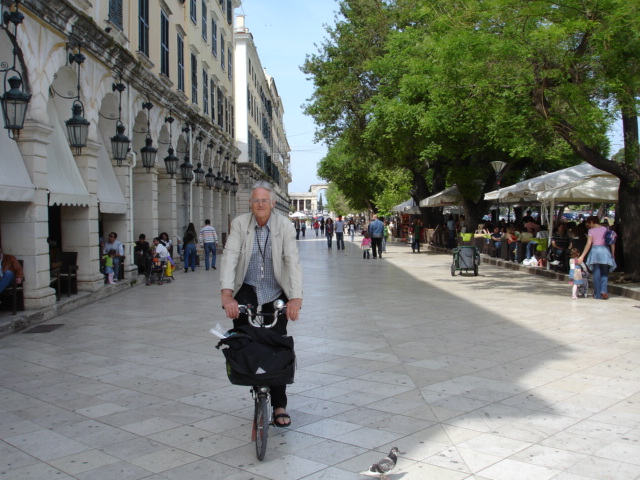
On the Liston on my Brompton (photo: Linda Baddeley)


Wednesday, 9 January 2013

A New Year

So let's start new in 2013. The sun was bursting over the Victoria Jubilee. I tidied; removing old cabbage stems and slug ridden leaves, pulling weeds from the path, putting dead stalks on the compost. Janet caught me, and as she'd promised, gave me a bag of Jerusalem artichokes; a little note of hand written instructions.
"I slipped" she said "on some wet leaves the other day. My back still aches"
"Thank you so much, Janet. Just be careful"
"Put them in any time from now. Don't leave them in the bag or they'll get mildew"
Vanley was working on his plot - a model of a kitchen garden. I stopped to talk and grumbled about what a bad year it'd been.
"That was last year, Simon"
"I know I know. What can I plant now?"
"Try garlic"
I found a few cloves and planted them with the help of a dibber, but I'll get some fresher ones tomorrow.
My confidence has taken a step back. I'm ready to be surprised if anything springs from this rich damp earth - except weeds.
"None of your weeds are a problem" said Vanley "You got the deeper rooted one's out last year. Bother the others with your hoe. Dig them back in. Think of this as your food."
He makes it seem easy.
I found a clear patch; raked it and dibber planted the dry earthy tubers about six inches down.
"I saw you the other day picking up litter"
"Oh yes. Quarter of a ton of it. I get angry with the people who drop it, the council that doesn't pick it up and the manufacturers who produce so much packaging"
Vanley isn't much interested in mutual grumbling, so I didn't go on. Later when I was working on the plot he stopped by to have a look.
"Not too bad. Keep at it."
My friend Ziggi rang from London too ask how I was and we agreed to meet up in March. She has an allotment.
"Unlike bringing up a child"she said "you can make up in the next year for the mistakes you made the year before. There's always the prospect of renewal. I've come to enjoy the winter for the time spent in preparation; ordering my potatoes and other plants. I'm going to grow my onions from seeds this year. I'll be planting chard in March. In fact that's really when I'll start."
*** ***
Yesterday I was at the blood donor centre in Corporation Street.
"Well well well. It's your hundredth donation" said the nurse.
"Can you take my picture?"
"Yes" said the nurse
"What;s your name?"
"Lauren"
"You're good at this. I hardly felt the jab"
"When you've finished you can hold the blood"
She pulled out the needle, put a plaster over the little bruise in the crook of my arm, and handed me the pack with a pint of blood. I've never held that before. I didn't really feel anything very much but I sported a smile and I do feel quite proud like getting a Scout badge - not that I was in the Scouts.
*** ***
Richard Pine has written another 'Corfu Letter' in the Irish Times ~ 'Raw figures conceal richness of life behind Greek economic collapse':
A recent study, Understanding the Crisis in Greece, by two Greek economists, Michael Mitsopoulos and Theodore Pelagidis (both of whom have been advisers to the Greek government) tells us the Greek economy is dysfunctional.
We do not need an academic treatise to tell us that. Greece’s relations with the EU have made that clear over the past three years at least. The 114 bar charts, pie charts and graphs in the book are unnecessary: we can observe all of them by looking around us.
Anton Chekhov used to say that he got the ideas for his searing dramas by looking out of the window and seeing all human life going by. Brian Friel showed us much the same in his essay on his mother’s home town, A Fine Day at Glenties.
I sit on the esplanade of Corfu town, absorbing the last of the autumn sunshine, and I look across the straits at an Albania already going into winter: a country consisting almost entirely of unhelpful snow-clad mountains.
We live in a world of microclimates, each of which disobeys the laws of economics, meteorology and citizenship.
What I see in town (really a small city rather than a large town) or in the village where I live, is living proof of this book’s thesis: that the political parties are undemocratic in nature and “everyone participates, more or less willingly, in the shadow economy”.
I see poverty, tax evasion, ostentatious wealth, despair and joy. Hope and helplessness. I see widows collecting wild greens (horta) on which they live almost exclusively because they cannot afford meat (although they buy chicken carcases to make stock). But I am also told that one of the poorest-looking widows owns five houses and has thousands of euro stashed away. A microclimate indeed.
One of the strongest indicators of Greece as a divided society is the contrast between town and village: the mutual suspicion of the people. The townies look down on the peasants (not too strong a word for subsistence farmers), who in turn regard the townies as crooks – and have done so since at least the 18th century.
A new dimension to political life has been the rise of the neo-fascist Golden Dawn, which in Corfu polled much higher than its national average in the last elections, and which is suspected of having organised an arson attack on its last synagogue.
It’s a country where women use the genitive of their husband’s or father’s name (the singer Vicky Leandros is known as Vicky Leandrou - Βασιλική Παπαθανασίου - here) and still adopt an all-black wardrobe as widows.
It’s also a country of immense beauty: Corfu town has been declared a Unesco world heritage site because its arcaded streets, built mostly during the 400-year Venetian occupation, and the evident signs of building during the British administration (1815-1864), make it a city of appealing uniqueness.
Sitting on the esplanade, I look at the miracle of the two arcaded blocks that form a replica of Paris’s rue de Rivoli - they were built by the father of the man who constructed the Suez Canal. Miraculous because when the French were routed from Corfu the British finished the job. It’s the social centre of 'le tout Corfou'
But the simplicity of village life and architecture complements and adds to that beauty – even though the inhabitants of village and town are as different as chalk and cheese. How can I reconcile the beauty of the environment – and the added value that inheres in the tourist industry – when Mitsopoulos and Pelagidis document so thoroughly that Greece is so resistant to the sort of reforms demanded by the EU?
I see the kaleidoscope from the opposite end, simply because the economists cannot look at the everyday lives of ordinary people. It’s possible that they may never have seen villagers dunking their local bread into their own olive oil – or seen the sacks of olives going to the oilery where the growers pay 80 cent per litre for production, or spit-roasted lambs at the local panegiri (saint’s day).
It is the celebration of life at the most basic level, even if it does involve bribery and corruption, that the economists can’t see: they may hold the view that Greek people are inured to the grey economy and to dealing with the problem of balancing responsibility to the state with the demands of family, but in a country which last year lost 1,000 jobs a day, and where young people look to emigration as their only hope of survival, the claims of the individual are bound to trump those of the state.
And if, as is rumoured, the local taverna decides to open for only three days each week, due to declining spending power, we will all have to learn more than just dunking bread in oil.
Dear Richard. As I ‘struggle' with The Diviner having downgraded my reading and probably my intelligence this last decade I just saw your latest in the Irish Times. You’ve excelled. It was so good to see you pairing Chekhov and Friel - two artists who’ve managed so brilliantly and magically to blur the ancient and over-revered distinction between tragedy and comedy. See you soon we hope. We come via Naples to Corfu...it was another writer who while ‘looking out of the window’ also placed his feet in a bowl of water (not so much to warm or cool) but to remind himself of his subjectivity when describing what he saw between his curtains.  Best Simon

Jan Manessi in Corfu wrote...fine article, but don't assume that everyone out collecting wild vegetables does so because they cannot afford to buy them - horta gathering has been a popular task for years - at weekends hillsides round Athens were full of people out with plastic bags and a small knife. They are a delicacy, and those with knowledge of the many varieties are greatly respected. The eastern way of changing a name's end depending on sex is just the way things have been done from Greece to Russia- and few of the younger widows, both in town and village, wear black any longer, certainly not after the 40 days mourning has ended. In old times a widow would not even go to church, as this was considered enjoyment, her visits outside the house were only expected to be to and from the graveyard- thank goodness times have changed in some respects.
*** *** ***
One of my half-sisters - Miranda - tells me of a new grandchild. ....
Hi Lin and Simon. Here is Otis (born three weeks early on 14th December - a birth compadre of your Amy!)
Otis Oscar 
Meanwhile Oscar came round to visit with Amy and Guy, Richard and Emma...
*** *** ***
Dusk in Ano Korakiana...

Σερί από λιακάδες το τελευταίο διάστημα, που σε συνδυασμό με το άπλωμα της μέρας, προδιαθέτουν για το τέλος του χειμώνα, παρότι είμαστε λίγο μετά την αρχή του. Στα χωράφια, όπου το μάζεμα της ελιάς συνεχίζεται με τη βιασύνη να προλάβουμε μιαν αλλαγή του καιρού, ο χρόνος κυλάει γαντζωμένος στο άρμα του ήλιου. Με ξεχωριστούς ήχους και χρώματα. Από το μοναχικό κελάδημα του πουλιού, ως το μοναδικό χρώμα του δειλινού, που βάφει κόκκινα τα πρώτα σπίτια του χωριού, κατά την επιστροφή.

A final streak of sunshine, comes with the end of the day, suggesting winter is delayed even as it's begun. The olive harvest continues apace in expectation of a change in the weather. Time is linked to the sun's passage. There's the song of a lone bird as the sinking sun paints the houses red.
*** *** ***
A lovely and fascinating present from Alan Moir who knows my interest in Albania - a book -  Kanuni I Lekë DukagjiniThe Code of Leke Dukagjini, in Albanian and English.
Albanian text is by the priest Shtjefën Gjeçovi, translated by Leonard Fox, published by Gjonlekaj Publishing Company, New York  in 1989. Alan and his wife Christine were friends of my mother's. He worked for a period under an EU-UK Home Office scheme by which senior police officers were seconded to Albania to assist in the reform of their police following the end of the regime of Enver Hoxha. Alan maintained connection with the country and has many friends there. At mum's memorial service in December I met up again with him and he promised to send me a copy of the Leke Dukagjini code: 
The entire essence of the legal code of the Albanians is an unparalleled rigorous respect for this basic principle: non-violation of the dignity of a man- his honour, home and life.”
(Ismail Kadare) 
“The ‘Kanun' or Code of Lekë Dukagjini is an extraordinary monument of 

Albanian culture, essential for the understanding of all the northern Albanian lands. This magnificent edition, with its authoritative translation of the text, is an indispensable work for anyone who wishes to explore the history and traditions of the Albanian people”
(Noel Malcolm, author of Kosovo: A short History, 1998) 
“Certainly the Kanun is an unique document, a codification of practices amounting to law of great historical significance. In addition, it provides the bedrock for the rule of law in Albania even today.”  (Robert W. Sweet, United States District Judge)
For all their habits, law and customs, the people, as a rule, have but on explanation: ‘It is in the Canon of Lek…' as for the laws ascribed to him, the greater part are obviously far earlier than the 15 th century, when he is said to have lived. They probably were obeyed by the unknown warriors of the bronze weapons in the prehistoric graves.” (Edith Durham, High Albania (1909)

*** ***
As well as the Jerusalem artichokes, I planted more garlic on Thursday morning, and a double row of potatoes...

Sunday, 28 October 2012

A tear

In the pre-checks for my last blood donation on Friday morning - my 99th - I thought I got a whiff of the impact of the crisis in Greece. The nurse, who knows me well, sees from my questionnaire, that I'm recently returned from Corfu. She looks in her 'book'.
"Hm. Yes. I think it's OK"
"Corfu isn't included in the West Nile Virus. It's just the mainland isn't it?"
"No longer"
Well maybe it's nothing to do with the malaria creeping back into Greece.
After a 40-year hiatus, malaria is returning to Greece. Some 70 cases have been reported there this year, and at least 12 people appear to have been infected in the country. (The others picked up the disease elsewhere.) That's a concern for health workers because it means malaria may now be endemic to Greece — and not just hitching a ride with travelers. Plus, the parasite is showing up in regions where it has never been reported, the U.S. Centers of Disease and Prevention said in a statement last week...
Celebrating my 75th donation - six years ago
I'm rather looking forward, in a Boy Scout way, to making my 100th donation next March. We'll have been back to Corfu before then. Might there be a problem?
*** *** ***
I'd heard that Patrick Leigh Fermor suffered from writer's block but only recently turned up what is probably the original reference to this condition. On 29 Sept'11 Colin Thubron wrote in the New York Review of Books:
Fifteen years ago, swimming in the Ionian Sea beneath his home, where nobody could overhear us, Paddy (as friends and fans called him) suddenly confessed to me the writer’s block that would plague the rest of his life. The expectations of a now-avid public, and his own obsessive perfectionism, were taking their toll, and he could not overleap this cruel impediment...
Forging his prose must have been an effort. I imagine him walking or travelling on sea and land, his broad intellect at work on sentences which would capture with precision an understanding - as rough stone takes form under the chisel and rasp – of the ancient divergence of Eastern and Western Christianity, something that's long intrigued and eluded my capacities for understanding history and theology. It was not perhaps accurately a writer's block; it was a thinker's block.
I have lots of facts. I understand almost nothing of why such differences divided whole populations for centuries. Why should the words 'and the Son' - filioque - matter so much?
Greek creed: Καὶ εἰς τὸ Πνεῦμα τὸ Ἅγιον, τὸ κύριον, τὸ ζῳοποιόν, τὸ ἐκ τοῦ Πατρὸς ἐκπορευόμενον And in the Holy Spirit, the Lord, the giver of life, from the Father proceeding.
Latin Creed: Et in Spiritum Sanctum, Dominum, et vivificantem: qui ex Patre Filioque procedit And in the Holy Spirit, the Lord, and giver of life, who from the Father and the Son proceeds.
And why should it matter as much to a secular student? That's my problem. Leigh Fermor has an agenda - a lover's search for the continuity of Hellenism. The things that happened in between.
Between when and when?
Well, say, the surrender of Athens in April 404 BC after the Battle of Aegospotami which ended the Peloponnesian War and Byron's death at  Mesolongi 19 April 1824- about 2228 years - give or take a few weeks.
No, no, no....from the death of Alexander in 323 BC and the break-up of his empire.
No! Again no.
What of the Hellenistic Period and the Seleucid Empire that ended with the triumph of Rome at the battle of Actium in 31 BC, making that ridiculously vague interval just 1855 years? And why the date of the death of Byron?
I wasn't taught about these dates, these chronologies and sequences. It was more simply 'Ancient Greece';  wonderful pre-historic tales ill-placed in times - about Theseus, Jason and the Argonauts, Perseus, Andromeda, the Olympian Gods and, later, in my spotted learning, Homer, the Iliad and the Odyssey and even later the Aeneid which only then, in Latin not Greek, tells the appalling prevenient account - horresco referens - as Sinon opens the Wooden Horse and through the night the merciless sacking of Troy begins - no finer account was ever written of such a calamity.
I didn't hear of the Seleucid Empire until now and I looked upon the history of Byzantium as a different part of the curriculum; a mess of marble fragments.
As with ideas that express a convincing truth, there is so much missing evidence; so much rebuttal. If Leigh Fermor, deeply self-educated in Hellenistic and Byzantine history, claims a stark contrast between the iconography of the Orthodox and the Latin churches, there will be, especially for someone as well travelled as he, be much contrary evidence.
On the grey rainy windy days when I've wandered alone and with Lin and my mother in this chilly church, I've gazed up and not noticed it, but plenty of others have seen the tear that lies on the face of the Virgin Mary amid the gold mosaic of the central apse of the Cathedral of Santa Maria Assunta on Torcello.
My mother in Santa Maria Assunta 
This is a Venetian-Byzantine Church; the image created in the 13th century, over two hundred years before the Fall of Constantinople. The tear seems an oddity, if Leigh Fermor's distinction between western and easter religious painting is correct.  Recall that Islam and Judaism eschew imagery, deplore it, in some cases with fatal and murderous intensity...
...in the foredoomed task of indicating the unfathomable mystery of Godhead in visible terms, the Greek ikon painters chose the hardest way. They sought ingress to the spirit, not through the easy channels of passion, but through the intellect. Religion and philosophy were as inextricably plaited as they had been in pre-Christian times and this was due to the same philosophical temper which has saved Judaic Christianity(a brief and local thing) and made it Greek, then universal....Mani, c.15
Basilica di Santa Maria Assunta on the island of Torcello - where Venice was founded


I imagine phrases forming in Leigh Fermor's head which when he sat to write resisted the journey from mind to paper. It must have been made trickier by his knowledge of Greek words and grammatical forms that could capture ideas and emotions that cannot be expressed in English -   ἀρετή, εἴδωλον, φιλότιμο, κέφι, μεράκι, απορία, θυμός, θάμβος...I'd like to see the original manuscript for chapter 15 of Mani.
I've read it over and over; at least, in part because it seems to help me; I say 'seems' to help me arrive at a real rather than a purely memorised mechanical grasp of the filioque difference. Leigh Fermor argues that the Orthodox theology of the Transfiguration - an astounding moment for which θάμβος is apt -    καὶ μετεμορφώθη έμπροσθεν αυτών καὶ ἔλαμψεν τὸ πρόσωπον αὐτοῦ ὡς ὁ ἥλιος, τὰ δὲ ἱμάτια αὐτοῦ ἐγένετο λευκὰ ὡς τὸ φῶς (Κατά Ματθαίον 17.2) ...and He was transfigured before them. His face shone like the sun, and His clothes became as white as the light - is a more or less direct product of Greek Philosophy.
For extent and influence in the world the dual message of Greek philosophy and the Greek interpretation of the Christian revelation stand alone.
He lists pagan sages - Apollonius of Tyana, Solon, Plato, Aristotle, Plutarch, Thucydides, Sophocles - without haloes but in robes 'as honourable as those that adorn the Christian saints' painted with them on the walls of a small church on the edge of Layia in the Mani.
Where but in the ancient schools (these figures imply), were developed the intellectual thews which enabled the great Doctors to hammer the raw material of the Gospels into the intricate and indestructible apparatus of Christian dogma? Without the dialectical and philosophic skill of these rain-swept sages, who would have heard of the Three Hierarchs indoors...(he lists Basil of Caesarea, Gregory of Nazianzus and John Chrysostom)...who would have unravelled the perplexing skein of the Trinity or confuted the subtle-tongued heresiarchs or championed the Homoousion and the Double Nature? The Greeks do well to honour these ancient mentors...The evolution of Christianity into a logical system which could weather the shocks of millenia, was a Greek thing. The Christian Church was the last great creative achievement of classical Greek culture....
'...when two or three are gathered together in thy Name...'
For many generations, writes Stephen Greenblatt in chapter four of The Swerve, learned Christians remained steeped...in a culture whose values had been shaped by the pagan classics. Platonism contributed to Christianity its model of the soul; Aristotelianism its prime mover; Stoicism its model of providence...
Raphael: The School of Athens
This is Cavafy’s territory - eloquent, gnomic, exciting surmise and reflection on Hellenic continuity. It does not greatly surprise me - since our interests so often ran in parallel - to learn that the last - latest – book my mum ordered (and which Bay bought for her in New York) is Robin Lane Fox’s Pagans and Christians in the Mediterranean world from the second century to the conversion of Constantine (a hundred years before the murder of Hypatia in 415AD).
The transition from pagan to Christian is the point at which the ancient world still touches ours directly. We are heirs to its conclusion: on either side,  participants shared an education which, until recently, we widely maintained. Like most transitions, it was a slow process, marked by unforeseen moments of sudden significance...
To me, whose school days were accompanied by rituals, bells, hymns, sermons and lessons from the King James Bible, whose parish church was Westminster Abbey, the customs, procedures and etiquettes of the Greek Church - whether observed in the quiet of an empty narthex or as a nervous but respecting participant, are more exotic, almost more foreign, than the services I've attended in Birmingham - in synagogues, gurdwaras and mosques. I delight in Greek Orthodox churches - sat alone, gazing around and upward, lighting candles, quietly praying...
"To?"
No preposition. Just praying.
Why 'to'?
Well just perhaps to a mystery; which is why I like Leigh Fermor's suggestion that the image of the Panayia is more mathematical than anthropomorphic, that in these ikons, he sees 'gilded and cube roots of the Logos' and, seeing the Virgin at the foot of the cross, he reads the message 'Do not worship me...but what I represent' - a reaction that contrasts with the feelings evoked by a Latin pieta - the seering image of a mother weeping over her betrayed, abused, tortured and murdered son.
Someone said the tear on the face of Mary in the church on Torcello is for mankind, not for her son. I remain puzzled and confused, but perhaps I'm also seeing that in the differences Leigh Fermor explores. Torcello is in the west, in the Veneto, and yet's it's cathedral is Byzantine, it's image of Mary - an in-between.
The two hour funeral service for my stepmother Maria at St Sophia's Cathedral in Bayswater was almost an ordeal. It wasn't until afterwards at the Makaria supper when a Greek opera singer with piano accompaniment sang Hadjidakis that I wept - not for grief but for joy at the pleasures of all Greece I'd enjoyed with her and my dad and their friends - and one of my my dry-eyed Greek half-sisters looked on concerned and slightly embarrassed.
On Mani see this from a blog about Leigh Fermor
*** *** ***
I'm not sure there could be a more beautiful and poignant or joyful train journey in all the world. The climax, whichever way I travel is Drumochter Pass, and the passage of the watershed into and from the Highlands, where one moment the river runs toward Dalwhinnie, and when descending from the Pass towards Blair Atholl the other way.

In the bright low light of Autumn the one track railway winds through valleys, through moorlands,  by emerald pastures striped with long shadows of tall trees, and now and then sparkling streams with water so clear I see sunlight and shadows on the stones beneath the water. Hamlets and lone farm houses rush by and always the glimpses of water - sometimes lochs with such windless surfaces they turn the landscape upside down. In wet weather torrents jump and splash towards culverts beneath the line. Aviemore, Kingussie, Dalwhinnie...
Dalwhinnie
...Blair Atholl, Pitlochry, Dunkeld and Birnham where I lose my sense of place along a Lowland list of stations on the way to Edinburgh whose names I can't remember.
The Lowlands


And then suddenely here's the bright sea of the Firth of Forth with islands and in the distance, glimpsed before a long bend, the hazy outline of the Forth Bridge over which we'll pass in minutes.
The Firth of Forth

*** ***
We've had regular minor problems with battery drain on the Handsworth Helping Hands LGV. We've got over it by jumplead-starting. Allan Broad in the Handsworth Park compound has been especially helpful - hence our present to him and fellow workers of a supply of biscuits, coffee and tea last August. To get to the bottom of this I took the van down to - Cedric Fernandes - Ceds Car Alarms in Hockley and paid £20 for him to check for battery leakage.
"All you've got" he said "is standard drain from three systems"
"Explain"
"You've got the dashboard, the locking and the electric window and mirror controls - they all leak enough milliamps to drain your battery in a fortnight"
"If I take off one lead" which is what we've been doing recently after parking "will that stop that"
"Yes"
"What's the condition of the battery?"
"It's a bit stale and you could do with one that's more heavy duty"
Ced suggested Bannings - a company on the Lichfield Road. I phoned them. It'd be £95 plus VAT.
"I never knew all this about battery drain as just normal" I said
Ced pointed to a smart looking Mercedes in his workshop, bonnet and boot lids raised, wires sticking out all over like a patient in intensive care.
"He's got round 25 electrical systems in there. He hardly ever drives it. We found one system that was draining more than it should. Took a while to find it. You're diesel and need a heavier push. Why I'm saying get a stronger battery."
I drove back to the park compound, disconnected a battery lead and cycled home through the leaf strewn park.
"I guess learning that was worth £20" 

Back numbers

Simon Baddeley