Total Pageviews

Showing posts with label Oliver. Show all posts

Monday, 18 February 2019

Age

Lydbrook Valley, Gloucestershire looking north towards Courtfield
I left Lin asleep upstairs. With old Oscar I walked out of Rock Cottage, along the familiar path by the small iron gate of Plum House, which has a new resident. With my hazel stick and walking boots I clambered, sharp left, up the random stepping stones of a ladder-length gully to a familiar path that runs through the woods to a lych-gate opening onto a sheep mown pasture filling the foreground of the Lydbrook valley, coated on either slope with trees in wintry brown, yellow and fading green. At the head of the sloping meadow there’s a break between hanger woods leading via a steepening track to an edge. Along this runs a staked barbed wire fence with large mesh chicken wire, to keep in lambs. There's a stile. 

It’s a boundary that recurs in the paintings of our friend Steven Outram, who works in an old church hall on the opposite side of the valley. 
'It seems like forever' Steven Outram
Oscar and I climb slowly, pacing ourselves, towards the stile. Beyond it, the landscape opens to a panorama; nearly twenty miles away I can often see the grey outline of the Brecon Beacons; in the middle ground, the tower of English Bicknor church, amid fields of cattle and sheep. Earlier clouds had thinned. We had sun for our walk. Over the wet turf of Lydbrook’s small airfield, there are two runways mown flatter, surfaces fancied by Oscar who not so long ago would scout through deep tangled bracken and bramble. 
A family was walking the same field.  I heard the chatter of happy children. Oscar and I strolled slightly askance towards the same field gate, letting the band of ramblers and their dog advance and disappear. 
Herefordshire towards the Brecon Beacons

We descend from the larger landscape to the combe, edged by the road past Eastbach Court. I enjoy this Queen Anne house, slightly grudging the investment apparent in its excellent maintenance, walled garden, out-lying barns, stables, Dower House and steward’s cottage - each address indicated by push-bells next to a bright red post box with the initials VR - with the time of daily collection - embedded in the stonework of the modest gates. But here’s no local farming squire embroidered into the landscape and lives of an ageless community. We’ve walked Bell Hill over thirty years and seen this house change owners three times. 

The morning is beautiful. Occasional cars slow for us, as I walk upwards; Oscar on a lead until we’ve ascended to the forest’s plateau. What may have been Eastbach Court’s home farm marches beside a rough track back into the woods above Lydbrook. I follow it into the trees, bright sun beams sliced by tall spruce, signs of leaf mould turfed over by foraging wild boar. 

Passing Nigel Aston’s old car yard – hulks of many models rusting on a bulldozed track just above our path, we arrive on the steep path down Bell Hill between the beech wood above Rock Cottage, at one point sliding on my bottom over leaves, mast and twigs. 
The slope down Bell Hill through the slender beech

At home again. Lin has fed the wood stove more of our well seasoned ash, cut four years ago, sawn and split in the summer.


A day later the rest of the family arrived. Linda and I become 'Nan' and 'Grandpa', 'Mum' and 'Dad'. The cottage becomes turbulent. To let grown-ups stay in bed, I'm steward - for drinks, cereals, toast, getting dressed and resisting the spreading disorder of objects that accompanies the activities of children. 
"Right everyone, A walk! Coats and boots"
With the two dogs, Oscar and Cookie, and three children we set off up Bell Hill inventing the ten foot rabbit that lives here. 
"Keep your eyes peeled. Listen carefully. Be not afeard. Bell Hill and the woods are full of noises, 
They know we're making things up. The sky is cloudless. 
Hannah, Oliver and Sophia on the way to Eastbach

"You know that on the other side of this hill there's an enormous bison"
We retrace the walk I made, walking along a sloping track beside heifers and a placid Black Angus bull, the dogs on leads. 
"There's the bison!" I show them a construction placed on a rise across a field.

"Do you want to see it close?"
"No, no, no!" in chorus. I knew we'd be trespassing.
Along the Eastbach road we troop north along Probert's Barn Lane, the narrow road - in places grass along its centre - that crosses back into the Lydbrook Valley.
Probert's Barn Lane
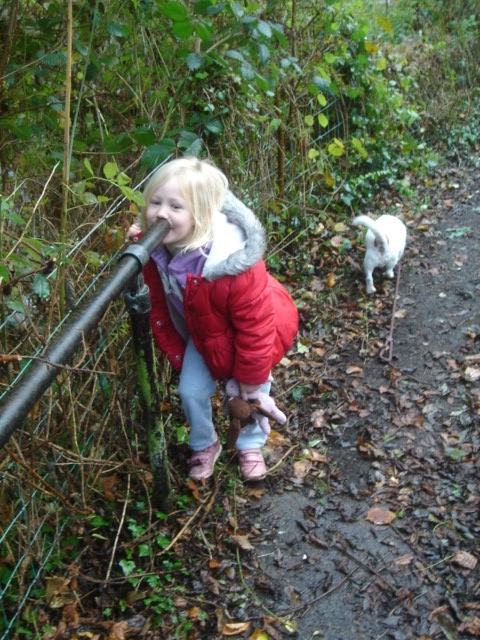
I'm trudging, glad of my stick. The children's energy is boundless. We've further to go. Back briefly to the cottage across a long sloping meadow, then down the path to the main road. Hannah and Oliver talk to one another through 100 feet of plumbing of the galvanised hand rail - mouth and ear; childish teasing back and forth along the pipe.
We stop to post a card the children have written to Sophia's dad...

... cross the dangerous road through the village, with tremendous care, and ascend the opposite hill on a narrow path to where the railway ran in and out of the Forest of Dean.
"There's a ghost train runs along here! Can you hear a train?"
Waiting for the ghost train that runs through the Lydbrook Valley


"What about the ten foot rabbit?"
"It's scared of the train. It lives over the way where we walked before"
"It's coming" shouts Oliver "Get on the train. Quick"
Safe on the train, we head toward the river. We descend by many steps to the Wye, collecting interesting fruit and seeds and leaves.

Beside the river there are ducks and a pair of swans scavenging, neck dipping for seconds at a time, by the opposite bank.
So home on the pavement up to the centre of the village, up the Bell Hill path.
"Have you seen the mess the wild boar have made of our lawn"
"It's the ten foot rabbit"
"No! Wild boar rooting"
Indoors the grown ups are about, well fuelled wood fire warming the room.


"Where are we going today?"
Making decisions about this will go on a while. I sit back with a mug of tea. The children lay out their samples, examining what they've collected.


*** *** ***
Εορτή Αγίου Ισιδώρου 
Παρά το δυνατό νοτιά, ο κόσμος γέμισε απόψε το εκκλησάκι του Αγίου Ισιδώρου πάνω από τη Βενετιά, για να παρακολουθήσει το Μεγάλο Εσπερινό, παραμονή της εορτής του Αγίου. Το ψαλτήρι, όπως πάντα πλήρες, με ανάμικτο «τοπικό» και «βυζαντινό» ιδίωμα, με τον Γεώργιο Κένταρχο και το Σπύρο Τσιριγώτη στο Ανάγνωσμα της «Σοφίας Σολομώντος».
agisidoros022019a.jpg
agiosisidoros022012.jpgΑύριο, Δευτέρα 4 Φεβρουαρίου 2019, ανήμερα της εορτής του Αγίου Ισιδώρου του Πηλουσιώτου, στις 8.00 το πρωί θα ξεκινήσει η ακολουθία του Όρθρου και στην συνέχεια, κατά τις 9.00 η Πανηγυρική Θεία Λειτουργία, μετ’ αρτοκλασίας. Στις δε 5.30 το απόγευμα θα ψαλθεί η Ιερά Παράκλησις προς τον Άγιο.
Above Ano Korakiana tonight, in spite of the strong south wind, people filled the little church of St. Isidoros of Pelousios above Venetià, in order to attend the Great Vespers service, on the eve, of the celebration of the Day of the Saint. As always, the list of  hymns and chants, was full of mixed local and Byzantine pieces. George Kentarhos and Spyros Tsirigotis read from the Wisdom of Solomon. (Part translation: Thanks to Maria Strani-Potts)

*** *** ***
Memo to myself re Birmingham City Council's plans to decommission Walsall Road Allotments - a petition. It was started by my friend Betty Farrugia, Secretary, for many years, of WRA - probably the best allotment site in the West Midlands. She it was who persuaded me to have an allotment myself, after we'd saved the Victoria Jubilee Allotments near my home in Birmingham. [By 21.00 on Tue 19th Feb 6.700 signatures had been attached to the petition: 8006 by 01.00 22/2/19]; 10274 signatures by 15.30 on 28th Feb 2019.

Walsall Road Allotments threatened by plans for Birmingham's 2022 Commonwealth Games

Thursday, 14 December 2017

Snow

I’d almost forgotten about snow; proper snow with sledging, snowballing, and inconvenience for people who want to go to work. The children rejoice. So far as I know, so does Oscar dog, even when, in the Highlands, there was little to be seen but his tail and a nose, surfacing now and then to check position. 

Birmingham, with the rest of the country south of the borders, gets taken by surprise. Snow comes so infrequently, the airwaves disperse hyperbole about 'weather', it can't be nostalgia that I recall such conditions as normal, to be taken in our stride. This weekend on to Monday, buses didn't run. Schools closed. No trains or trams for 48 hours, No gritting. When salting came, as befits services under 'austerity', only arterial roads got the treatment. 
Oliver was staying with us on Sunday. We ventured out on foot to the allotments. 
At the iron gates I brushed frosted snow off the lock's push buttons.
"We're the only ones to visit" 
"How do you know, grandpa?" 
"What do you notice about the snow, Oliver?"
To my surprise he couldn't work it out. 
We trudged through boot-depth snow to the plot. 

Pristine. From the parks came shouts and laughter. In the distance I could see the smudgy shapes of many Canada geese standing by the pond among the naked trees, oblivious to the stick people cantering about, snowballing, making snowmen, sledging.
"Help me, Oliver"
He'd already made sure to bring a carrot. The snow packed up sticky to make good lumps to pile up for our snowman's body. When he was nearly as high as me I used  a trowel to shape neck and shoulders. Oliver collected chunks with his gloved hands to fill in gaps in the body. 
"Charcoal for eyes! Veg nets for a scarf. Give us the carrot" 
I carved holes for nose and eyes.
"His mouth!"
I went in the greenhouse and found a dried runner bean pod, curved. Perfect. 
Amy rang "come home, Dad. We're all here now. Pasties and mince pies and...
"We'll go sledging in the park?"
"Of course"
I tarried to put out nuts, seeds, water and fat-balls for birds, Garlic stems were poking out through the snow in two beds; winter onions too. But for disturbance around our snowman, the plot lies under the snow, its soil teeming with dormant life. The burgeoning of summer is hardly imaginable. The bees are silent, clustered in winter around the queen; living off honey. The scene is black and white, but for Oliver's warm red coat and flags on the fruit cage.

** ** **
Our park has a special glamour under snow. Amy, Guy, Hannah, Oliver, Oscar dog and I walk over the rail bridge to the other side of the park with its bandstand, and steeper contours, good for sledging. 

We all have a go on our plastic sledges. I slide on my front, the better to steer with my toes. The children are fearless, sitting upright, veering into trees, tipping over. Up we stumble and down we go again - together and in turns dodging trees, the metal fence near the foot of the run, whooping, shouting, laughing with others sharing the slope,...
... until the sky tunes itself to dusk. We head home dragging the children on sledges. 
"I love seeing the street lights through the trees" I said to Amy. We're in a lovely city park remote from feral winter.
Dusk in Handsworth Park


** ** ** **
With many others, we've been helping Jan Kimber campaign against building houses over most of the Lea Hall Allotments. Jan and I evoked Handsworth Allotments Information Group (HAIG) - the small group that I'd set up to campaign against building houses over all the old Victoria Jubilee Allotments, where I now have my plot.
Lea Hall Allotments on Google Maps 

The plan to build on Lea Hall Allotments

Planning application 2017/08883/PA was submitted, on 25th October 2017, by Countryside Properties to build 110 new homes at the Lea Hall allotments site on Wood Lane, in Handsworth Wood. 'A mixture of detached, semi-detached and terraced, 79 of these 3+4 bed homes will be for sale and the other 31 will be for private rent.' My objection sent, with others, to Birmingham City Council Planning Department:
I wish to express my objection to planning application 2017/08883/PA to build on Lea Hall Allotments.
Allotments have legal protection under the the Small Holdings and Allotments Act 1908, unless it can be shown there is no demand for plots.
To suppress demand, Lea Hall Allotments Committee have been engaged in a ‘managed’ retreat from responsibility to look after these allotments, turning a statutorily protected green space into a profitable windfall site for housing.
This strategy, to empty allotment sites and suppress demand for plots,  in order to sell them, was criticised in the report of the Select Committee on Environment, Transport and Regional Affairs Fifth Report ‘The Future For Allotments’ 11 June 1998, which described what’s been happening at Lea Hall Allotments as ‘constructive non-maintenance’.
Members of Lea Hall Allotments Committee have colluded with Countryside Properties (the second developer with whom they have had recent dealings), in ‘constructive non-maintenance’, by:
- not advertising plots and rejecting applications for them
- abandoning all but minimal maintenance, and failing to invest in site infrastructure,
- unnecessarily cutting down some of the site’s mature trees,
- repeatedly telling plot holders that plans to build on the site have already been agreed,
- excluding the contribution of women plot-holders to promoting the site by prohibiting them from committee deliberations, 
The applicant claims suitable substitute plots are available on other allotment sites. This is not a case that has been easy for them to make, as the Lea Hall Allotments site is, or would be if properly managed, uniquely attractive, facing open green space to the north (across a railway line which assists security), with woodlands on its edge, good drainage and an exceptionally well equipped clubhouse with bar, toilets, a bowling green and facilities for meetings and entertainment.
This application by Countryside Properties threatens to remove yet more green space from one of  our city’s finest Victorian suburbs, contrary to guidance in Birmingham City Council’s ‘Mature suburbs: Guidelines to control residential intensification - Feb 2008.
Properly managed  and advertised, Lea Hall Allotments, left as allotments and conservation area, open to the public, would be a most valuable community asset.
There is a significant deficit of open space in Lozells & East Handsworth Ward. The proximity of the application site to Perry Hall playing field, quoted by the applicant as an example of green space availability, is compromised by the railway line between New Street and Walsall that runs along the northern boundary of the neighbourhood.
The new allotments in the applicant’s proposal cover only 24% of the existing site and they are far smaller than the normal average of 200 square metres in other city allotments..
The woodland in the north east corner of the site provides screening and noise protection for residents of Lea Hall Road, serves as a visual amenity for users of Perry Hall Playing Fields, is a habitat for a rich variety of flora and fauna, and contributes to the area’s drainage.
It seems especially unwise to allow this development on greenfield land given the forthcoming analysis by West Midlands Combined Authority on the remediation and development of brownfield land (West Midlands Land Commission - Final Report to the West Midlands Combined Authority Board. 9th February 2017)
A tour around Lea Hall Allotments on 22nd November


Jan Kimber describes Countryside Properties' plans for Lea Hall Allotments at Birchfield Neighbourhood Forum - 30 Nov 2017

Wednesday, 27 September 2017

'...co-operation between the gardener and the cook...'

The top of Soho Hill, three miles north west of Birmingham city centre, is concealed by the terraced streets that run north-south across Handsworth to Soho Road, where the gentle topography of the old rural landscape is blurred, depicted in old pictures, difficult to match with present observation.
The topography of Handsworth. Plot 14 on the Victoria Jubilee Allotments is 420 feet above sea level

I didn’t notice the hill’s slow ascent from the Hockley flyover, two miles to Junction 2 M5 and Smethwick, until, 15 years ago, I took to cycling, sensing the artery’s steady north-westward incline in my pedaling. In places, green spaces remain, once pastures, or heathland, the area’s boulder clay unsuitable for cultivating crops.
Where buildings and streets stop, there lie, near us, precious green spaces, landscaped to oblige the town – St Mary’s Churchyard where the dead lie in their classes from family vaults to paupers' unmarked indentations, Handsworth Park, whose history I’ve written, and the Victoria Jubilee Allotments on the north side of Soho Hill, on a gentle slope that continues, beyond sturdy iron palings, to the Handsworth Park pond and St Mary’s Church, whose bells, hushed by trees, ring familiar changes.
In June 2010, when the new Victoria Jubilee allotments were at last opened, Lin and I chose a plot at the far end of a site for which I and others had campaigned over ten years helping the city to negotiate a S106 agreement that delivered eighty municipal allotments, gravel paths, drains and a portakabin club house. The allotment is 200 square metres. Plot 14. A new part of my life.
“I shall not join the site committee. I’ve done enough paper work and talking to win conditional rights to this ground. £30 annual rent for over 60s. I shall concentrate on cultivating my allotment!”
I began to break up the surface tufts of well rooted couch grass the day I signed the lease. So I started to learn just what we'd squeezed from a developer who’d planned to build over the whole site, but been allowed a third of what had once been private allotments.
Plot 14 June 2010 (photo: Linda Baddeley)
The ground the developer left, after all the grading and digging they’d done to build houses, was not what it had been. The precious old tilth, product of a century's gardening, had disappeared, skimmed and dispersed all over the site, the ground graded and compressed over several years of construction by heavy machinery. The area’s unforgiving boulder clay, pushed into the Midlands by ancient glaciers, never arable, had resurfaced. The developer, pressured by the city, and Handsworth Allotments Information Group (HAIG), had hastily strewn a miserly carpet of second rate topsoil, before handing over the site under the terms of their 2004 S106 Agreement with the Council.

In the first phase, Lin and I got a shed via freecycle. We levelled the plot’s slope, edging a square with tanalised timber on which, under a bed of sand and pummelled earth, we laid levelled slabs recovered from a Handsworth front-garden. I re-roofed the shed, adding a veranda.
January 2011. '...It makes a nice comforting sound when the rain is beating down it and one is dry and warm inside'

For the next three years of phase one, I learned about soil. There came a stage where I was close to giving up, not looking forward to the short journey - walking (12 minutes), cycling or driving - to our plot. The spur was a formal letter.
A wake-up call! I react well to notices like this

I also learned that, but for the darkest months, you cannot leave an allotment alone; that couch grass can only be reduced by persevering work that never ceases; that more or less all that's edible is food for slugs and snails, with different vegetables prone to the attention of specialist insects – onion fly, potato worms, carrot fly - as well as being prone to infestation by disease, and ailments arising from missing elements in the soil. Then there are the birds, pigeons especially, who focus on fruit. That another pest is people, who break into allotments to steal; that my plot needed investment in manure...

...topsoil and compost, delivered by tipping trucks and in builder's bags...
Black gold arrives

...that I could make my own compost, use mulch and weed suppressant fabric and netting; that I could grow from seed in a green house – bought second hand...

...and, with a fruit cage, grow strawberries and raspberries and more, and working with our neighbour Gill, an apiarist, and with site committee permission, have Buckfast bees on site, giving honey and pollination; that cultivable soil should be laid out in beds that can be reached from a network of paths to ensure not having to walk on them; that earth is rich, sensitive, structured - an environment for billions of micro-organisms; that when growing things you should be more inclined to feed the soil than the plants that you grow in it.
Published in 1945, no book on gardening has taught me so much
The second phase – from the start of 2015 - has to do with rejoicing. It would have been impossible without my discovery of, and friendship with Winnie Hall,  who’s growing skill and confidence have made Plot 14 work. ‘Our’ plot now yields crops – potatoes, tomatoes, peppers, runner beans, broad beans, onions, garlic, marrow, butternut squash, pumpkin, courgette, aubergine, peas, cucumber, apples, cherries, plums, strawberries, raspberries, pears, gooseberries, tayberries, artichoke, Jerusalem artichoke, parsnip, rhubarb, grapes, rosemary, chives.
Plot 14 on the VJA. The two flags are for my two most loved countries. They serve too as bird-scarers.

Some things planted have not thrived; cabbage, cauliflower and Brussels sprouts have more or less failed. But my feeling is of triumph made sweeter by seeing so many others who’ve fallen by the wayside as they’ve grasped the work, time and cost involved in growing food on the Victoria Jubilee’s testing ground. Almost shameless triumph is made joy by the visits of my grandson Oliver and now his sister Hannah, learning like me, ...
Winnie harvesting with Ollie and Hannah
...starting to grow things in the sunrise of their lives.

I’ve commissioned a painting from Jan Bowman to capture this delight – a portrait of Hannah, Oliver, Lin and I on the plot in July, celebrating our grand-daughter’s third birthday.
Winnie Hall, Jan Bowman, Oliver, Hannah and her mum, Amy on the rocking horse for Hannah's birthday

The third and present phase has to do with illusions; with something I’d not anticipated when focused on preparing the ground and getting it to yield harvests – a problem of bounty becoming glut.
Over a year ago I was talking to a friend, who has an allotment in London, about growing vegetables. Supper in a restaurant near Russell Square.
“…human beings’ relationship with the earth. How it’s broken. Severed over generations by the transition from rural to urban…estrangement from the land. Loss of craft in cultivation…How can I, whose ancestors abandoned the land with Industrial Revolution, getting rich as iron-masters, mill-owners, bourgeois progeny, urban aspirants earning wealth from the surpluses of mechanisation…Leas of Oldham whose business profited from the sweat of mill girls. Jacksons of Rochdale, a mansion home burned down by mill workers?”
I spoke of first generation immigrants, from lands where farming is still in the blood – as in Greece, in the Caribbean, Gujarat, Africa.
“How can I hope to acquire that feel for growing stuff?”
I glimpse a glaze, my friend, with all her grace, cannot quite withhold.
I struggle on “My paternal great grandmother, born in Oldham, married in London, left the city to live in a cottage by the Itchen. She cultivated, with help from Mr New, her gardener. My sister and I had the run of surrounding water meadows. My maternal grandmother abandoned a metropolitan social life to start the dairy farm where I was born…my stepfather, born in London, made a career in broadcasting…in his last thirty years making a successful TV programme called ‘Out of Town’ about disappearing country life, the fall-out from mechanized agriculture. He once called my grandmother’s adventure a ‘hobby farm’ … she was devastated…anyway…what I’m saying is, on my allotment, I’m getting back some of that long lost…”
My friend - at last – intervened; agreed that the relationship between humans and the land was "perhaps broken"
“Yes, yes” I said “accelerating distortions in relations between the city and the countryside…”
“But, Simon, what also matters, perhaps even more is the relationship between the grower and the cook.”

By email she referred me to a paragraph in The Vegetable Grower's Handbook (1948) by Arthur J. Simons:
Time and again I have seen kitchen gardens and allotments which have been assiduously sown and planted by the head of the family without any regard of the actual requirements of the kitchen...The golden rule is to grow what you most like to eat in sufficient quantities to ensure that you have enough of it but not on such a scale as to involve wastage. This demands close co-operation between the gardener and the cook or housewife.
“The real problem is whether you and Lin like cooking and eating what you’re growing on your plot”
'So proud' (photo: Winnie Hall)

Leaving aside the author's archaism about 'head of the family', I hadn’t thought of this. I had just assumed that cooking and eating would follow the successful harvesting of which I was so proud.
Linda asks "So what am I supposed to do with this lot?"


So... now I..we have to learn  and far more important, agree, about succession planting, about storing, about deep freezing, about preservation, about bottling, making jam, jelly, chutney, about dehydrating, - every craft and trick from the ancient books about how to even out harvests; cooking and eating what's grown at home. There's the satisfying option too, of giving stuff to neighbours, and on occasion bringing a basket of surplus from the plot to offer for collection, when we do street work with Handsworth Helping Hands.
Denise and her niece Winnie preparing harvests from Plot 14 for freezing


Back numbers

Simon Baddeley