Total Pageviews

Showing posts with label Maria Strani. Show all posts

Sunday, 12 January 2014

Greece in winter - "Start with the shoe"

Angeliki and Irini met at the museum this Saturday
Last November I had an exchange of emails with Jim Potts, husband of the Corfiot writer Maria Strani, about Ano Korakiana’s self-taught sculptor, Arestides Metallinos Αριστείδης Μεταλληνός. I had sent him a DVD of some 300 photos of the works in the ‘Museum’ that Lin and I had been able to enjoy visiting.
Dear Simon. Just watched the DVD again, this time on the TV screen, with Maria. We both think they are brilliant. Maria did not find them at all ‘naughty’ or controversial (it's in the eyes of the beholder)…He could eventually become recognised as a major figure…At some point professional photos would need to be taken of individual works, with top quality studio lighting. But it's wonderful to see all the works, the DVD does the job remarkably well. Thanks again. Jim
Saturday morning Lin and I were having cake and - for me, a skirto, Lin, a glass of pomegranate juice - as we again visited Andrea and Anna Metallinos and their daughter Angeliki at the ‘Museum’.
Anna, Linda, Angeliki and Irini at the Museum

Also with us was Irini Savvani.
I resign with reluctance to the idea that not everything that happens is a matter of chance or personal intention.  I met her on Wednesday passing in Democracy Street. She was with her daughter, Alexandra, coming from the bakery.
I said "Kalimera"
She said “Are you Simon Baddeley?”
“Yes”
“I read your blog”
After some pleasantries, I asked Irini if she knew of the village sculptor, Arestides Metallinos.
“Of course. But I have not been in the museum”
“You’ve not seen his work?”
“I met him at his house with my parents when I was a small girl”
I said that Lin and I had had the good fortune, after several years, to be able to see the collection – last November.
“I would like” I said “to see a catalogue made. Also a British friend to whom I showed the DVD that Metallinos' granddaughter entrusted me with, advised that a Greek art historian or critic should write a piece about the sculptor to accompany such a catalogue”
“I am an art historian” said Irini, with a smile.
We continued chatting. I remembered how vexing it could be to a child in hand looking upwards at grown-ups talking on and on about things important to them. Alexandra tugged, politely, at her mum's sleeve. (Is this what we mean when we say their conversation 'went over my head')
"Would you be able to meet with Angeliki and her parents, Irini?"
She nodded. The very moment I got home, after sharing this meeting with Lin, I phoned Angeliki and made an appointment that suited all of us at the museum on Saturday morning. I emailed Irini by way of briefing
Dear Irini. Thank you for agreeing to meet at the ‘Museum’ at 10.00am this Saturday morning. I will be there with Linda and we will be meeting Angeliki Metallinou and her parents Anna and Andrea to have another look inside the museum and have a brief look at Aristedes Metallinos’ work. Our meeting shouldn’t be more than 45 minutes.
I first saw inside the museum when we were in Ano Korakiana last November, having been curious about it since we came to the village in 2006.
Angeliki has convinced me that the work of her grandfather, a self-taught sculptor who didn’t start carving stone and marble until he was 67 years old, has for a variety of reasons remained almost unknown to the village and to the rest of the island. After she and her mother invited Linda and I to visit the museum we said we would see if we could help make this work better known. Angeliki gave me a DVD with photos of her grandfather’s work which I have shown to three friends in Corfu. In different ways they advise making a proper catalogue and having a Greek art historian help with this by writing an expert description. That you met the sculptor as a young girl growing up in the village and are now an art historian is why I believe our meeting last Tuesday on Democracy Street is ‘serendipitous’. Angeliki agrees and looks forward to meeting you on Saturday morning.
I wonder what you think of some of the illustrations of Metallinos' work on my blog:
Example 1, example 2 (especially!), example 3, example 4...
And this 'recrucifixion'
and this chimaera - the EEC
Aristedes Metallinos had many themes and seems a most fascinating man. Kindest regards. Simon
In my mind the place to start with any catalogue is Arestides' finely crafted stone shoe, made long before he began carving in earnest. Andrea could not unlock the show case so I took a couple of photo's through the glass. I would have liked to hold the thing in my hands and pass it round. Although Ano Korakiana was a rich village, Aristedes Metallinos' family were poor. In other circumstances a young man or woman who carved such an object in local stone - harder than marble - might well have been guided towards an artist's education.

Παπούτσι - Shoe, carved in 1928 by Aristedes Metallinos Αριστείδης Μεταλληνός

Thursday, 9 February 2012

Rouvas

Wind from the east
Mark stirred the wide tub of rain and isobars between Ukraine, Ireland and North Africa with his mouse so that over several days a revolving pattern emerged into which he could zoom, focusing on the Adriatic, then the coasts of Corfu and the mainland...
...to see the weather forecast for the sea of Kerkyra.
“It’ll be rain on Friday. Look here”
A screen-full of arrows in lines across the area
“Some 9 winds from the east.”
I was again enjoying Bianco at Mark’s and Sally’s, with tasty spinach, and a green salad beautifully dressed. Mark and his brother Paul are coming down to Ipsos on Sunday to have a look at Summersong – see what, if anything, might be done about replacing her engine.
"It’s always going to be too expensive" Mark warned me, but the alternative, I said, is to leave her unused. I told Mark and Sally about my meal at Rouvas in town with Jim and Maria. Among her books including a novel, Maria’s penned a diatribe against the greed fuelled mess of place-prostitution (some call it mass tourism) Πωλείται ~ Το πούλημα της Πανωραίας, The Pimping of Panorea. Last year Jim published The Ionian Islands and Epirus, του Ιονίου και η Ήπειρος: Τοπία της φαντασίας, a copy I took with me for a signature.
I was looking forward to Rouvas, cosy from the drizzle on a side street off G.Theotoki, just before San Rocco Square. Friends had told me this taverna was a favourite place for lunch. Not expensive, though most things are dearer here than in England.
I’d prepared two ‘exam’ questions, which we plunged into after the arrival of crusty bread and wine.
1. Is the architectural, environmental and spiritual desecration of Corfu offset by the alleviation of the material and mental poverty of its population? 
2. What cultural objects could you present – texts, sculpture, music – as evidence of the continuity of classical and modern Greece.
“For the second one” said Jim “see Constantine Trypanis’ Penguin Book of Greek Verse.”
“Thanks for this.”
We were both aware that there have been a number of 19th century early 20th century European historical theorists – Fallmerayer foremost - who employed ideas about art, language, Balkan and central Asian migration over two millennia to spread a myth of discontinuity. I find it unconvincing; discreditable too, for its use of racial stereotyping though that was a great preoccupation of the times. Bernal’s African Genesis developed similar arguments in reverse. It’s not always the data that’s wrong, it’s the patterns these theorists made from it.
Jim says more on Corfu Blues, mentioning the 'objects' I asked for in Q.2 of my exam:
1. Of course Trypanis' anthology has omissions (no Ritsos, for example), and it stops with Elytis, but it is still invaluable for the inclusion of so many Greek poems from different periods, beginning with Homer. It prints all the original Greek texts and provides a helpful literal translation in English at the bottom of each page. 'Poetry written in Greek constitutes the longest uninterrupted tradition in the Western world' Trypanis' intro.
2. Another object I would choose to answer the question, at least in part, would be a threshing-floor (aloni, τ' αλώνι), both as an objective, physical structure and space, but also as a potent literary, cultural and folkloric symbol throughout Greek history, literature and folk-song, from ancient times, until the present day. It's sad to see many threshing floors abandoned nowadays, their surrounding walls crumbling, their beauty and function almost forgotten. As people start to go back to the land, maybe some, at least, will be restored. Will the circle be unbroken?
Τ' αλώνι
3. My third object would have been a bottle of retsina, resinated wine, but I couldn't remember exactly where I'd read (was it in Homer?) that the Ancient Greeks used to seal their wine-jugs with tree-resin, or used the resin as a preservative.
We agreed that question one depended what you meant by 'desecration', and by 'poverty'. No-one railing against the concreting of Corfu should be unaware of the historical record of poverty and injustice on the island. Lawrence Durrell gave passing reference to the fate of peasants - especially girls, and I mean 'girls' rather than 'women' - when they married. He did not celebrate picturesque poverty, but had another artistic agenda. He was not political until forced by war. Gerald, who eventually and admirably was, who cared for and learned so much about the flora and fauna of Corfu as a child – enchantingly described – reserves for most humans the role of serpent in Eden.
Maria, of an old Corfiot family, speaks of her own land and fellow citizens, angered at the way they so abandoned themselves to the gold rush, like a farmer who overworks his fields, draining them of nutrients, making them sterile, facing just retribution.
The Pimping of Panorea
It need not have been like that. It wasn’t poverty versus ill-gotten gains. They could, with more love and attention and respect, have been well-gotten. We spoke of how the Scandinavian countries through good governance had remedied the deep poverty of their people in the early part of the 20th century; how they had planned the terms on which they would adapt to the tectonic changes of modernism and mechanization. But we also recognized all was no longer cosy in the Scandinavian welfare system. People yearn for a personal right to dispose of the income they pay in taxes for collective goods like health, education and care of children and the old. The juxtaposition in question one was worn out. There was another question to be framed, about how you manage social transition.
Jim was worried about me cycling home to Ano Korakiana in the rain. He offered to put my bicycle in his car.
 “I’m so grateful, Jim, but I like cycling in the rain, really.”
I went to the British Cemetery. Lifted my bicycle over the two steps through the little gate. George Psailas came out with the bell.
I said I was fine and he went indoors. I had the place as I usually do, to myself, wet underfoot, green, quiet - within a 150 yards of the city centre. I saw the new dug grave of Chris Holmes’ mother, just laid beside her husband, who’d died in 1981- his epitaph, being in polytonic Greek, for which I'll need help translating.

ΣΚΙΑΣ ΟΝΑΡ ΑΝΘΡΩΠΟΣ, ΑΛΛ'ΟΤΑΝ ΑΙΓΛΑ
ΔΙΟΣΔΟΤΟΣ ΕΛΘΗ ΛΑΜΠΡΟΝ ΦΕΓΓΟΣ ΕΠΕΣΤΙΝ
 ΑΝΔΡΩΝ ΚΑΙ ΜΕΙΛΙΧΟΣ ΑΙΩΝ

Then back via George Gkavardinas', Γ. Γκαβαρδινας, Cycle shop on Ioulias Andreadi near the old hospital, for me as pleasing as toyshop to a child. Had he toe clips? Yes, tho’ most now use pedal clips.
“I don’t trust them. I forget about them and fall off at the lights” I said.
Could he fit the toe clips for me?
As he did this fiddly job a man wandered in between the rows of displayed bicycles with a small girl holding his hand and clearly without holding out his hand or wheedling sought alms. George said something politely and was answered in kind and the man and the girl went back to the street. I don’t know who of all of three and a half of us was more discomfited. I left delighted with my toe clips...
...to cycle 22 kilometres back up to Ano Korakiana. Earlier while at Netoikos where I do email the owner had remarked on my bicycle and I’d been singing its praises. I have used the word ‘divorce’ and ‘loveless’ marriage describing the ending of my feeling for cars. With bicycles it’s a lively love affair. I explained this because I think he, like Jim, felt slightly sorry for me as though I was forced to cycle in rain and cold. Going up the hill from Ipsos to Ag.Markos is hard work but I marked my ascent by two separate kandylakia where I’d rest for a while to recover my breath and strength. He told me of a recent incident near Lefkimmi where a cyclist had died, falling off and striking his head on a roadside shrine.
"It was concrete," he said "many of them are."
"That would have raised a chuckle on Olympus"
At Doctor’s Bridge, the turn to Sidari and Ano K, off the Paleo road, I rested and had a pleasant smoke. Mark drove by and waved. Later he said
“I should have stopped. You might have had a puncture.”
“I’d expect nothing else, but honestly I have no right to take lifts in cars after choosing to cycle. I’d have sat in the rain and mended the puncture or walked the last 5 kilometres.”
Where I stopped was a pair of rusty padlocked gates surrounded by litter; an unused lane disappearing into scrub. I asked about it
“That’s where someone murdered a relative. It’s supposed to be haunted”
“Na” I said “I’ll spend a night there” – no I won't.
Coming into the village I saw Thanassis, now Vice-Chair of the Agricultural Syndicate standing at the door of the building.
“Could I see the factory?”
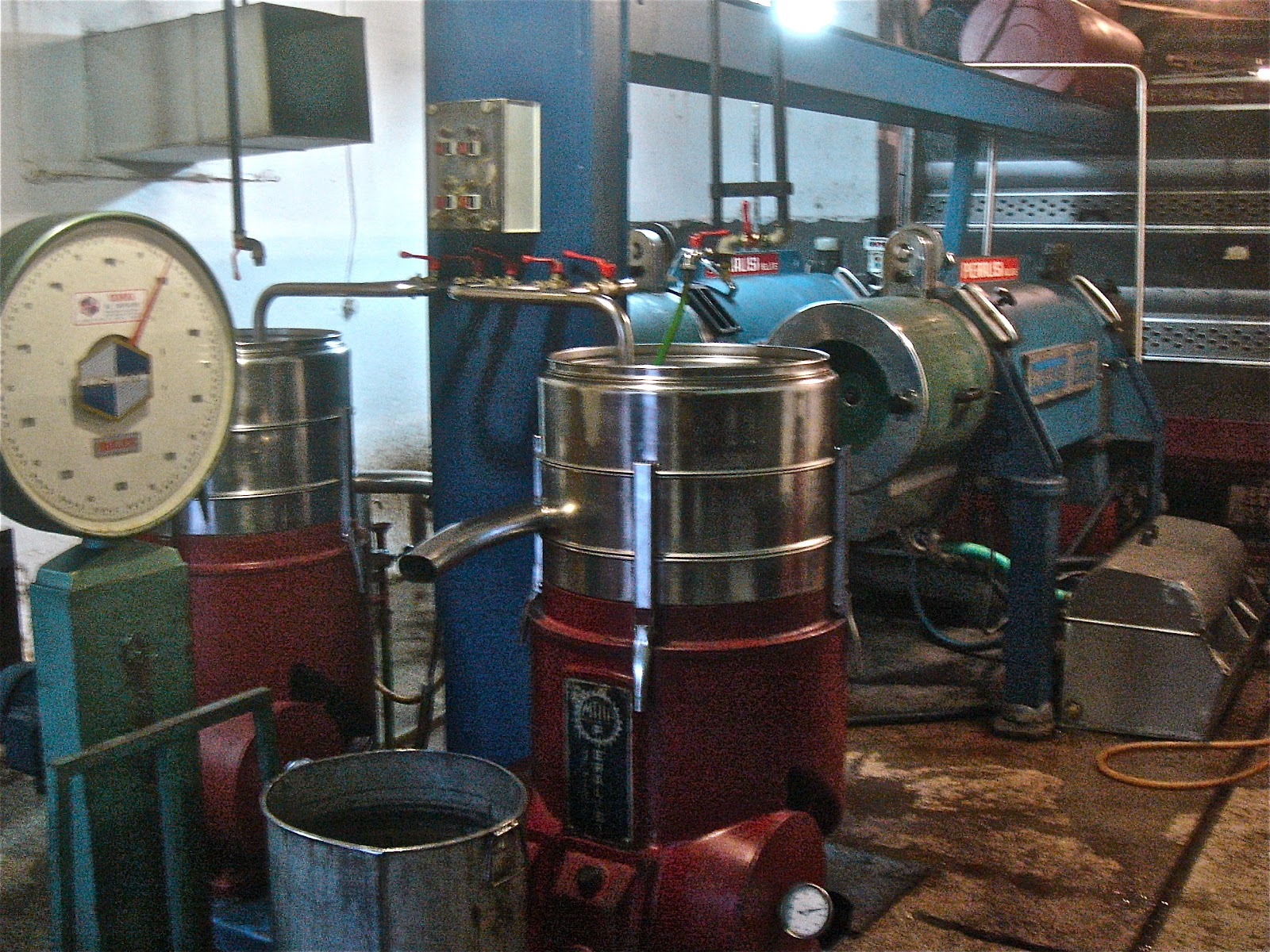
He introduced me to Sevastianos Metallinos - Σεβαστιανός Μεταλληνός, the Chairman - Ο Πρόεδρος του ΑΣΑΚ, who showed me round the equipment, explaining the process from the arrival of the olives, their filtering and washing, separation of oil from solids by crushing and slow and faster centrifuges, and the by-products in mush – to create olive spread – and skins and twigs which they sell as compost, cattle feed and soon as domestic fuel when it’s pressed into cakes.
He showed me around the space where the original mechanized olive presses, four great stones turned by belts driven by a petrol engine, had been installed before the first world war – the first in Greece. He made me a skirto as I asked questions. He explained the forthcoming impact of the November 2011 judgement by the highest court in France that the EU ban on GM crops is illegal. This judgement could force all but the most well-prepared food growers into buying GM seeds. There would be a meeting about this in the village - in particular about the setting up of a local seedbank and the conditions for the exchange of seeds - at the weekend in the Co-op building at 4.00pm on Saturday 11 February 2012.
I realised, I said, that I was behind the news on this, that I though GM had been largely rejected in Europe "Not so".
Μια σημαντική εκδήλωση θα πραγματοποιηθεί το ερχόμενο Σάββατο 11 Φεβρουαρίου 2012 στις 4 το απόγευμα, στην αίθουσα του Συνεταιρισμού του χωριού μας.  Ο Σύλλογος Προστασίας Περιβάλλοντος Κέρκυρας σε συνεργασία με τον Αγροτικό Συνεταιρισμό Άνω Κορακιάνας θα διοργανώσουν από κοινού την πρώτη «πρώιμη» Ανταλλαγή Σπόρων Ντόπιων Ποικιλιών, μια εκδήλωσε πανκερκυραϊκού ενδιαφέροντος και σημασίας. Με απλά λόγια, κερκυραίοι καλλιεργητές θα ανταλλάξουν και θα δωρίσουν σπόρους από ντόπιες ποικιλίες φυτών, που τείνουν να εκλείψουν. Απώτερος σκοπός είναι η λειτουργία μιας «ζωντανής» Τράπεζας Σπόρων που θα διασώσει και θα προστατέψει την τοπική βιοποικιλότητα.Η εκδήλωση αυτή διοργανώνεται για 5η συνεχή χρονιά, αλλά για πρώτη φορά έξω από την πόλη της Κέρκυρας και μάλιστα με τη συμμετοχή ενός Αγροτικού Συνεταιρισμού. Ας την τιμήσουμε λοιπόν με την παρουσία μας…
**** ****
Creatures of a day! What is a man?
What is he not?
A dream of a shadow
Is our mortal being.
But when there comes to men
A gleam of splendour given of heaven,
Then brilliant is the light that rests on them
And sweet their life.*
Πίνδαρος, Pindaros 522–443 BC
*The lines carved on the stone begin 'A dream...' Thanks to inspired Pindar, and to dear Chris Holmes and my friend Aleko Damaskinos for letting me know this poem - in two languages.
***
Corfu Blues is using links to maintain a commentary στήν μεγάλη κρίση...

Tuesday, 13 April 2010

'...στὴν κώχη τούτη τὴν μικρή...'

We watched the film of Cormac McCarthy’s book The Road. Brilliant and grim; another of the many anticipations of Armageddon that entertain us – eloquent warnings to be watched over popcorn, or in our case, via VLC media player over a pleasant supper. “People ate one another in those times”; successive dark ages, constant war, famished gangs of desperadoes, barbarians at the gate, circumstances in which the living envy the dead. We associate the ‘end of the world’ as we know it with plague, nuclear war and, now, with climate change – the latest horsemen. It’s even fun to watch, especially when the author's inserted a feel-good ending. Millenialism always present among us mortals, is especially popular these days - in secular as much as religious form. On Corfu its early apprehension is intensified by Maria Strani's cautionary fable - The Pimping of Panorea. Maria's a Corfiot, speaking of her own people and place, but foreign visitors’ and ex-pat vexation at the despoiling of their ‘little corner’ looks like displaced guilt; half conscious awareness that what’s happened to Panorea is happening everywhere. “Didn’t we come here to get away from all that?” Tosh on stilts. Blaming Corfiots, or Greeks as a whole, is a diversion; a disingenuous denial of the collective mess to which most of us contribute across the world. The problem in cameo: follow a romantic gravel track past multi-flowered verges, hollyoak and myrtle hedges intertwined with wild asparagus amid crags whose rocky grandeur surfaces above pine covered hills between which are enticing glimpses of azure sea skirting hazy mountains until on entering the cool shade of the woods we come, beneath the oak branches and overhanging cypress, amid ivy covered ground, a typical flytip
Regular flytipping on a gravel track between Ano Korakiana and Ipsos
– detritus, old and new, strewn along the way - building rubble, canisters of toxic liquid, mattresses, car body parts, carpets, fibre glass mouldings, polystyrene coving, cookers, washers, spin dryers, a baby-buggy and a baby-walker, square olive oil tins, shop blinds, a shattered mirror, off-cuts of roof insulation in geometric shapes, hardened bags of cement, old clothes, odd shoes, an umbrella, a bag of bar glasses, sodden books, a complete WC pan, ripped luggage, black plastic bags of unidentified debris, lathes, cardboard product boxes with more chunks of moulded polystyrene, broken bathroom tlles, legless tables and shattered plastic chairs, tattered bamboo screening, plastic bottles and popcans, fitted kitchen tops, sheets of cracked glass, rusting blackened stove pipe, off-cuts from pipes of various gauges, bags of sharded glass, semi-hardened crumbling plaster past its use-by date, palettes, a sack of bottles, electric cable, cracked plastic flowerpots, garden cuttings, a child’s plastic boat ‘The Titanic’ “and a cuddly toy!” – as competitors would say on one of Bruce Forsyth’s myriad TV game shows over the last sixty years. Recycling is a complicated and expensive process for glass and iron, especially alloys; even more so for plastic and polystyrene, not to mention the cans of chemicals. All but the garden waste could stay where it’s been tipped for decades, encouraging further nocturnal visits for dumping by people who are almost undoubtedly aware that what they’re doing is wrong. This is not the tedious moan "we're all guilty." As in The Road - there are good guys and bad guys. (Note: I heard the Demos brought a bulldozer to hide this site but were – rightly - stopped by an environmentalist in our village who insisted they must remove and dispose the rubbish, not just cover it up with local earth.)
This isn’t just Greece, nor is it the midden of impoverished people. Similar flytipping could be recognised at the end of a rural cul-de-sac in Staffordshire, on the edge of the Yorkshire Moors, strewn beside two miles of the Drumossie Road between Inverness and Inverarnie, almost anywhere, across a thousand isolated and lovely locations in reach of car, van and trailer – the same conveyance that could travel to an official refuse disposal site and pay for the service. Where Corfu suffers is that its official sites – Temploni and Lefkimmi - are overwhelmed, even illegal, suffering the worst problems of unprecedently feckless onsumption, and, in the case of beloved Kerkyra, packed ‘στην κώχη τούτη την μικρή’ – ‘into this little corner’.
I’ve been collecting images of our species’ ways of fouling its nest – woodlands, meadows, rivers, oceans - across the world (slides from my Flickr Group 'international flytipping').
The other day I was kindy offered, as something of a bargain, at least €60 reduced to €25 – “it fell off a lorry” - a shiny coffee table book with many professional photos of Corfu, a selective portrait of its resilient beauty, artfully posed, omitting reference to its leprous plight, as selective as glamour photography; as duplicitous as pornography. And a smooth article in a web journal Odyssey (Jan/Feb 2010) applies slap to the island's tattered complexion:
Corfu is, in a word, the most elegant of all the Greek islands. Its voluptuous natural beauty perfectly showcases the architecture of the island, an incredible blend of Continental European grandeur and Mediterranean simplicity. Peering over the rooftops of Corfu Town, with its narrow balconies and wrought-iron railings, you feel your gaze transported in time yet the island is firmly rooted in the present. There’s a reason why Corfu consistently ranks among the world’s top tourist destinations: it’s sophisticated yet totally unpretentious. One reason for Corfu’s lasting appeal is its adherence to tradition, both in its buildings and in the fabric of life. Tradition is a part of daily life, not just in the layout of such settlements as the tranquil Kalami, on the coast, or Pelekas, perched amphitheatrically on a verdant slope, or Argyrades, near the Korissia lagoon, but also in the traditional celebrations of holidays such as Easter, which is observed with particular ceremony. And if the island seems at times like something out of a novel or a memoir, it may be because in very many cases it is–just read the works of the Durrells, and others, to get the feel for places like Barbati.
If some of this weren't the case I wouldn't enjoy the place so much, but Barbati, pleeeze - a bloated centreless sprawl of cloned villas, oily sea, riven by the noise of internal combustion engines, mechanical diggers (part silenced by recession), riven olives, semi-finished, half-begun concrete foundations spouting pipes, wires and iron rods, piled litter blowing in the wind below the burned slopes of Pantokrator. Put a camera in the right place and you can make Barbati look romantic and happy people can enjoy just about anywhere - so the duplicity's sustained..."I thought she really liked me" as the tyro-John murmurs on leaving the service of a professional tart.
From the flytip off the sylvan track amid the greenery, Lin and I recovered wooden shop shutters in fine condition for fencing, drinks glasses, a bucket, several flower pots, and a small round table-top to which, once it’s cleaned up, we shall add a central support, along with two big sheets of cardboard we can use as templates for shelves in the dresser we’re fitting in downstair’s dining room. We also picked up the plastic ‘Titanic’ so that one of the children in the village can play at being the king or queen of the world or running it into an iceberg.
* * *
The construction of a dresser with doors and shelves inside the ever uneven tilted alcove of our dining room presents Linda with especial problems. Being inclined to precision, more mathematical than I, she prefers the objectivity of the set square and the spirit level to the subjectivity involved in creating an illusion of symmetry and straightness through a willing committment to the uneven. What squabbles this engenders! How invaluable the breaks for gardening, cups of tea, coffee and sweet cakes - brought round by an amused, and slightly bemused, Leftheris observing "Problema?" [Back to the future 22 April '10 - cupboard completed]

Saturday, 6 March 2010

A hard wind blowing

Am I to be self-employed or remain with the university? The latter gives me colleagues, admin support, access via Shibboleth to the libraries of the world. I earn money we share. In October one of those periodic reviews recommended honorary lectureships end this July. Should I cut loose first? I emailed JR the other evening about various things. Before I went to bed he'd replied:
Dear Simon, Thank you very much for your email and for all the thoughtful comments therein. I will reread it carefully and think about the Japan connection and protocol issues you raise. As regards your relationship with INLOGOV, I too would be hugely disappointed (and surprised) if the arrangement were to end on 31st July. It would certainly be my intention to recommend your Hon Lectureship (probably better described from now on as a Part-Time Visiting Lectureship - PTVL) to be renewed for as long as possible. And although I might predict that the College Leadership will only accept extensions for one year at a time, I am sure we will be able to continue the arrangement year by year until such time as you wish to stop. So please do not think your relation with INLOGOV is over! As long as INLOGOV survives, I am sure there will be work and a place for you - and most certainly while I am Director! Very best wishes - and see you next week! John
The mention of Japan refers to the decision by the Japan local Government Centre in January to end their three month training programme in UK for young Japanese civil servants. Politics at home; economic pressures. For 20 years we've been responsible for two weeks on this programme concentrating on British local government. Next week the Director of the JLGC will meet us in Birmingham so we can say farewell to a long collaboration and ponder ways of staying in touch. Later in the month I'm chairing a meeting with academics from Meiji University to discuss 'trust, research methods and the Japanese group’s new research project'. Meantime I've had work with Staffordshire on scrutiny and with Croydon and with Hampshire on Managing with Political Awareness, and before we return to Corfu, a day with Dumfries and Galloway on scrutiny. Yesterday I had to turn down an invite to talk to a conference on the effect of cuts and the likely policies of whoever's governing after the General Election:
Dear X. So sorry I'm already committed on the day you had in mind. ... I was very flattered you thought of me, ...If I can assist in any way in the future please don’t hesitate to get in touch again. Your questions are...absolutely on track. I take it you saw Cameron’s speech today at the Tory Party Spring Conference...confusing and inconsistent but seductive and in line with views among some of our colleagues that what when trying to read the future, don’t look at what some of the key people (like Cameron) say. We are in the run up to elections. Rhetoric gets polarised; focused on the ... marginals ... we can assume very little, beyond the likelihood that the recession is not only far from over but that we’ve not yet even seen the worst of it. This is a crisis that goes far beyond the UK, ... marked by generations rather than the decade length waves of boom and bust; a shift that makes parents anxious for their children’s future ... after a long period of prosperity and social peace. There’s hard wind blowing. The optimistic dimension - relevant to regulatory services like yours - is that faith in privatisation and the superiority of the market has received a blow from which it won’t recover. This makes for interesting and polarised times as some with leadership roles in local government struggle to continue functioning with what – since the days of Mrs T – has become orthodoxy, while others flounder alarmingly between two stools (the politics of Obama’s America) and a few others – very few - start to play around with original ideas that will one day make sense in theory and practice. Watch out for these. They’ll be as unobvious as the early signs of ‘Thatcherism’ e.g. being experimented with, long before they clustered and acquired enough coherence to be given a name as a dominant trend). In these circumstances real leaders in local government – whether politicians or professionals – will be those who don’t allow themselves to get morose... don’t get led by magic bullets and promises about the ‘right’ direction, and ride the uncertainty and unpredictability calmly, intelligently and pragmatically and cut some slack to slightly loony seeming ideas. Tall order! Best S
* * *
On 4th March I was up to catch an early train south to visit Richard and Wendy Hill in Havant. Pleasant cycling from Euston through the traffic, across the Thames to Waterloo, with time to do emails over coffee before catching my train to Havant. Richard is going to mend the carved wooden roach I inherited from my step-father. Richard made it nearly forty years ago from the mahogany railing of an old paddlesteamer, presenting it to Jack after making an Out of Town episode angling for sea bass out of Littlehampton in Richard's boat. Jack had also been given another carved fish - a crucian carp. I brought it with me. Richard thinks the carp might have been carved a lot longer ago than the roach, possibly by a craftsman in another country; India or Africa. "It's a beautiful piece of work."
For lunch Wendy had made the most delicious pie, rich with pieces of fresh seafish caught by Richard, followed by apple crumble with custard. Delectable. She packed up a dish for me to take home for Lin. We chatted and chatted; hours that passed so swiftly I could hardly believe my watch but it was time to head home. Before I left I saw
other examples of Richard's remarkable craftsmanship. in particular a large scale model of a fishing boat and, in the back garden, a wonderfully crafted carvel built rowing boat - The Green Man - his head in relief carved on the inside of her transom. I can look forward to visiting again when the fish is restored.
"I shall first make a plaster cast of the side of the fish already carved. I can lay it in that to use my wood carving chisels on the other side."
** ** **
On our last Sunday in Ano Korakiana Katya Spingos phoned to ask us for tea. We walked up to their house beyond the village traffic light on Odos Zogothoo Pigees (I think that's its name). Over tea, cake and biscuits and hazelnut liqueur we downloaded films we'd made of carnival, discussed the songs sung and plans to make a DVD of the event. Carnival was cancelled in 2009 to respect the memory of a young woman lawyer from the village killed on a road in Sarrocco Square in the city. We said how much we'd enjoyed ourselves this year and got into a discussion with her and Thanassis about how the event was organised and all the work involved, especially clearing, cleaning and decorating the Farmers' Co-op building for the dance. We spoke of the village and its sustainability. Would I ponder this? I asked John M, whether he could apply his knowledge of sustainability to us:
I am about to fly to Syd then on to Narrabri, Wee Waa and Dalby for our Sustainable Farm Family research so I am taking your email as hard copy and will reply later. I am very interested in the sustainability question re Ano Korakiana. It fits so well not just with the sustainability question but also with the work I have been doing on second homes and how these owners impact local communities. Be in touch, John
* * * Energy 95.7 Corfu is a radio station on Corfu. Its managing director is George Artinopoulos. Energy transmits a mix of Greek and foreign music with occasional op-eds. The one I've embedded takes a swipe at the illegal condition of landfill sites at Lefkimmi and Temploni, but focuses on problems with the new hospital under construction at Kontokali -'Η αθλιότητα στο νοσοκομείο Κέρκυρασ'. We see an attempt by local people, protesting at the state of the landfill sites, to draw their condition to the attention of European Commissioner Danuta Hübner, on an official visit to the Ionian Islands in February 2009. This is sad, and so depressing. How tempting to try, amid the wonders of the island, to sweep these messes out of sight and avoid the imputation of seeking to bring Corfu and Greece into disrepute.
Contact: nrgcorfu@otenet.gr - info@energycorfu.gr ΤΗΛ & ΦΑΧ: 0030 26610 24604 – 26617 71704 ΚΙΝ: 0030 6932 839 601 - 0030 69 847 11 847
[See this local blog about the new hospital in November 2008 - v. roughly translated]
* * *
Our daughter dropped round this morning. Linda's helping her with a community safety session with children and parents at the Main Library this afternoon. Amy showed me a letter from WM Police HQ saying she has a provisional start date for intake training into the Force at last. If things go to plan she could be having her passing out to become a full-time police officer by the end of October.
We had a good bicker about how we're all going to get up to the Highlands for Amy and Guy's wedding in mid-May. Who's going by car; who by train; whose staying at the hotel and who's staying with Poppet at Brin Croft....and for how long and on what days exactly. Phew.
** ** **
On Thursday evening I took Lin to the Birmingham Rep Production of Brian Friel's famous Dancing at Lughnasa (Loonaza). I could not get outside the feeling I was watching actors at work - talented and full of energy - but whether it was me, us, the audience, the direction - or whatever - the evening did not draw me in. Have I been spoiled by film? The troupe seemed too young for the Mundy sisters; too prosperous; no sense of the poverty of 1930s Ireland. Despite scripted reference to the fragility and hazardousness of a dissolving community - its clear and present danger seemed unreachable by those entertaining us. The tickets cost £25 each. I kept seeing the players chatting in their dressing room, going on to a meal in town, making more of a drama of their actual lives. We drove to Witton; to a place we'd not been for five years but had once enjoyed - Khanum Balti. The owner, glimpsed on the phone through a hatch at the back of an empty restaurant, seemed to have given up, after installing a job-lot of ugly new chairs round black wood-grained formica tables. There was a small radiant heater near Lin's knees. She switched it from rotating to ease the chill. We kept our coats on; ate from our basins with parathas - figures in a Brummie Edward Hopper, neon lit from above. "It's not Donegal, but isn't this the ambience we needed at the Rep?" I tried in a desultory way to compare fictional Ballybeg and Ano Korakiana - proxy music, the seduction of foreign rituals, the 'vexed reality' of fragmenting social and economic pressures - local and international, the poignant failures of which Maria Strani writes. It didn't work. I sounded as if I was trying too hard. I'd so hoped we'd be swept off my feet as we were at the carnival dance in the village. What am I to say to Richard, to whom I've promised to bring our evening's programme, when we return to Corfu?

Back numbers

Simon Baddeley