On the whole Linda and I don’t go walking in Handsworth and other parts of Birmingham. I do. I also cycle in and out and around most of the city within a radius of about three miles, sometimes further when cycling along the canal towpath to Amy’s house on the edge of the city. Lin does not cycle. In the Highlands my walks, at least in the last few years, have been solitary but for the dogs as Linda doesn’t share my feelings for that landscape – “too bare” she said, preferring the pastures and woods and river banks of Herefordshire and Gloucestershire around our Rock Cottage in the Forest of Dean. It’s in Corfu starting with Ano Korakiana itself that we have recovered the pleasure of shared walks. We set out with our long olive sticks – gifts from Mark; mine he topped with a deer’s cloven foot for my thumb, Lin’s more crooked with a fork for hers. Leaving the house so equipped our neighbours nod
“Βόλτα; a walk?”
“Ναι, βόλτα”
Walking in and around Ano Korakiana is one of our pleasures. It’s thus we see its agriculture
 |
| Grazings below Ano Korakiana |
Richard Pine reminded me over Tuesday lunch at Bellissimo – a place Lin and I like, in Lemonia Square, off Nicholas Theotoki, just across, as I’ve been told, from an old brothel and its annexe. It was unlikely that the troika would be anything but unhappy about progress on the – how many was it? – ninety-one – perhaps - reforms attached to the third bail-out
“Of which” said Richard “they’ve done part of about three...I'm writing another op-ed at once on the basis the excrement's about to hit the air-conditioning"
Our conversation - over a shared Greek salad, omelets, sausages and bread with house white wine - drifted through the events that would follow a refusal of more money for Greece from Europe; a national bankruptcy, civil servants unpaid; leaving their desks to find other ways to support their families; national stoppages, direct and indirect…we can’t add much; what’s it feel like to leave the road on a high bend? A moment, almost of relief, of a decision made for you, silence, floating in the peace, soaring into the unknown, then – gravity applies – and “the film cuts to the view of a spectator; a cacophony of things plunging."
Earlier in the morning I’d remembered that on the previous evening’s walk, as Lin and I came down the zigzag at the western end of the village, below Mougades, we noticed, inside one of the hairpin bends, opposite wheely bins and the last bus-stop, a broad concreted circle, ever so slightly convex, a parking space under branches, between shrubs and flowers.

Lin looked at it having seen my photos of them – of an alon, ἅλων, signature of a pastoral economy.
“Maybe”
“No no. It’s a large well, covered over. A cistern perhaps. Convenient beside the road”
Our conversation in Lemonia had drifted to discussing agriculture. I’d liked Richard’s reference to the ‘idea of terroir… rootedness of people…intimate relationship between land and people…vines and their olives.’
 |
| Ο Παύλος - Ήταν στο πάρτι γενεθλίων μας |
Katerina wandered over and leaned on the railing on Democracy Street looking down
I repeated my question, doubting I was making myself intelligible
They discussed this and Natasha spoke to them from her upper window above us, from where she often has conversations with neighbours in the street. It’s why I was so glad we recovered our balcony - to be able to have conversations between the house and the street. I held up a crude drawing I’d made of a circle with two stick figures holding threshing poles, looking as if they were fighting
“To make corn” I said in English which she understands “From wheat”
“Yes I know. Alon”
There was a spirited discussion between the three women.
“Would Lefteris know?” I asked Natasha
“He makes wine”
Gradually my lack of observational skills sunk in. Of course, Ano Korakiana doesn’t make flour nor thresh out corn. It’s a village of vines and olives; of sheep, goats, chickens, turkeys, guinea fowl, rabbits and geese and some pigs and donkeys. Natasha was already running down a long list, tapping the fingers of each hand as she leaned on her balcony
“Spinach.Tomatoes. Marrows. Squash. Melons. Peppers. Cabbages. Lettuce….”
“Of course" I tried to catch up "and oranges and lemons and…and bees…and nuts” I tried to recover.
“But there is no alon”
Later in town Richard, who I was telling about this, asked
“How much does it cost to process a kilo of olives?”
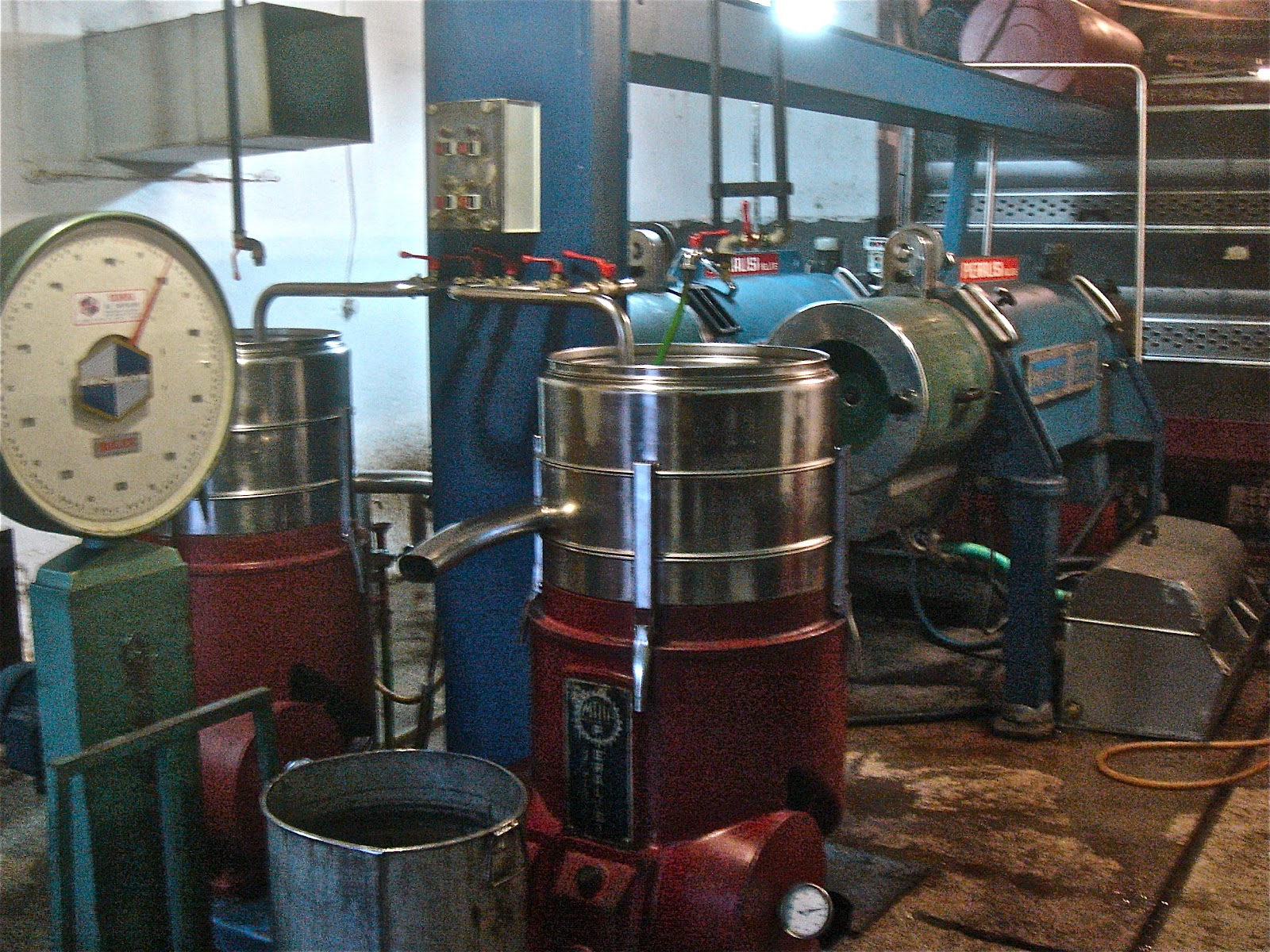
I prevaricated, describing the organisation of the machinery for extracting oil from olives as shown me by Sebastiano Metallinos last February at the Co-op. The farmer delivers his olives – say 50 kilos; they go into a hopper and are washed of leaves and twigs; washed twice, I think; the pomace piles up to be used later for compost and, in some cases, to be made into blocks for stove fuel. Did the olive stones go into the masher or were they removed into the pomace? I didn’t know. There’s no longer a circular grindstone. The mash goes through two centrifuges. This is kept for what? Olive paste. At the other end of the sequence a slightly turgid flow of green gold oil pours from a horizontal pipe into waiting containers.
“There’s not an olive press in Corfu that makes any money. I thought there was one up by you in Peritihia that I was told was a working business, but I’ve since heard it's a rich man’s hobby”
“So how much does it cost to get oil from a kilo of olives, say?” repeated Richard
“I forgot to ask about prices. I don’t know. How does any village make a business of agriculture now? Everything has to be vast, intensive, mechanised and regulated with the means of export to places across the world. We know all that. Ano Korakinia’s agriculture was always more or less local, sustaining the village. Now it looks as if we are surrounded by vegetable gardens, allotments, at best, orchards, small holdings – half an acre of olives here, a few rows of vegetable there, a small vineyard, a patchwork of roughly defined spaces, fenced, gated, with an apothiki."

“Good evening, Sebastiano. I have a question”
“Go ahead”
“How much does it cost to process a consignment of olives?”
"Ahah, you only want to know the cost of something that is a matter of the heart”
He peers at me with a broad ironic grin holding a hand to the centre of his chest.
“Of course of course, Sebastiano. I have a curious friend. As you know I care only about matter of the heart”
“Of course, Of course. The price is in litres not kilos. Early in the season…”
“You mean now?”
“From now until next June even. The olives produce less oil at the start – only about 12% of the original weight becomes oil, and that costs 80 cents a litre. Later in the season the olives produce more like 35%-40% oil and then the oil costs 30 cents a litre.”
Lin remarked “They don’t half mark it up by the time it’s in the shops...but going back to what Sebastiano's telling you, “I still think the price is in kilos….which would work out at 10 cents a kilo year round."
"How do you mean? You know I failed 'O' level maths"
"At the start of the season when you’re getting 12% - about one eighth - it takes 8 kilos of olives to make one litre of oil. Later in he season - the best part - it only takes about 3 kilos of olives to make one litre of oil. 8 kilos at 10c makes 80c at the start of the season; 3 kilos at 10c makes 30c later in the season."
"Oh right. Yes. Hm?"
I pointed to the rusting machinery beside the Co-op that I’d noticed earlier in the year.
“That was the first machinery for processing olives?”
“Some of it, yes, but some of it was for grinding corn” said Sebastiano
I suddenly remembered when he’d been showing me round the co-op earlier in the year that Sebastiano had mentioned bread-making as well as a shop. He’d also shown me the space where the belt had run to the engine that had once generated Ano Korakiana’s electricity – in the 1920s, or earlier, the first village in the island, in the the country possibly, to have its own electrical power.
“So where did the corn come from?” asked Lin
“From hereabouts” He pointed downhill
So perhaps there has been a threshing floor in Ano Korakiana, an alon, and wheat harvested from flatter ground below the village was brought up to have the corn beaten from it.

 |
| Flatter land below the village |
I had a salutary lesson from Mark about knots. It was supper in his and Sally’s house last night. along with her brothers Tim and Henry and R, an octogenarian mariner with a yacht at Benitses. We’ve been planning the arrangements for slipping Summer Song and replacing her engine. Discussing with R why a new engine was needed I confessed the stupid thing that I’d allowed to happen on the boat in a prolonged katabatic squall off Barbati three summers ago when we were motor-sailing back towards Ipsos through short steep seas, leaning over and getting wet. The jib sheet had slipped its figure of eight stop knot, pulled free of its deck eyelet, dragged overboard and wrapped round the prop-shaft. I’d glimpsed it over the windward side running taut under the water and knew at once what had happened. We reversed the engine and pulled it free.
Not good, eh? Worse to come. On the other tack the same thing happened; this time stalling the engine. We re-started in neutral, went into reverse and recovered a well ripped sheet end. I freed the rest in the harbour next day, diving beneath the hull with goggles.
“So what” I asked “is the normal knot to secure the end of a jib sheet?”
“Figure of eight” said someone.
I looked meaningfully at Lin who’d been on my court martial for this event - repeatedly.
“No. No” said the others, including Mark.
He fetched a length of rope; tied a figure of eight in it and banged it on the table a few times - just what a brisk breeze will do. His knot came loose in seconds.
“Give it here” I said, skeptical, and tied an eight knot tighter, banging it on my end of the table
“There, that’s holding”
Meantime Henry had tied a kind of three ring blood knot in the other end of the rope. I was looking at this doubtfully, continuing to bang my tight figure of eight on the table, when of a sudden I was looking at a clean end of rope. It had taken just seconds longer than Mark’s to unravel. I didn’t see it happen. One instant the knot was there, the next - gone.
“Jeez! Thanks Mark”
I was chastened. Lin looked vindicated. Seldom have I had such a salutary demonstration of the frailty of a device I’ve relied on since I learned to sail. I studied Henry's knot; Lin memorized it.


*** *** ***
Syed Ahmed’s report dated 3 October - summarized - to our ward committee, followed a request for news about what progress on laying out sports fields, a sports pavilion and children’s playground next to the Victoria Jubilee Allotments (VJA).
REFERENCE: VICTORIA JUBILEE ALLOTMENTS S106 Agreement (2003/01514/LA) – Persimmon Homes
Purpose 1.1 To update the Ward Committee on the delivery of the obligations arising from the S106 Agreement, (the Agreement) since the last briefing (18/07/2012).
Background 2.1 On 23rd August 2004, the City Council secured an Agreement for part redevelopment of the former Victoria Jubilee Allotments. The Agreement contained obligations for the developer, Westbury Homes (now Persimmon Homes) to deliver the following:
2.2 In May 2011, the City Council (Legal Services) wrote to Persimmon Homes, reminding them of the S106 obligations and advised that legal action would be taken, unless there was a new commitment to the satisfactory and timely completion of the S106 projects.
3 Progress / Action Outstanding 3.1 Affordable Housing Provision by Persimmon Homes. City project officer overseeing: Simon McDonald. Completed - 24 affordable housing units have been built and are occupied through partnership arrangements with Midland Heart and Family Housing Associations.
3.2 New allotments: Overseeing city council service and project officer - Parks & Nature Conservation, Bob Churn. These were transferred to the Council on 11th August 2010 and £21,620 commuted maintenance was paid in September 2011. 3.3 Handsworth Park and Play Area Improvement: Overseeing city council service and project officer - Parks & Nature Conservation, Bob Churn. A contribution was received and work has been carried out as part of the Park’s major Heritage Restoration project. £25,000 was received for Play Equipment to enhance the Park’s play area.
3.4 Sports Pitches. Overseeing city council service and project officer - Children, Young People & Families (CYPF), Gillian Dovey. These have been laid out but have not been transferred to the CYPF portfolio, as there were defects. The Project Officer is in ongoing discussions with Persimmon Homes to rectify the outstanding defects. The Project Officer carried out a site visit on 28/09/2012 and confirms that work is underway on the cricket square and it appeared that the ground has been levelled. The Project Officer is now organising an inspection to finalise the completion of this project.
3.5 New Public Open Space, incorporating a children’s play area. Overseeing service and project officer - Parks & Nature Conservation, Bob Churn. Project Officer has now received outline specifications of the scheme. The Public Open Space has not been laid out within the development, but Persimmon Homes have submitted draft design proposals, including an informal children’s play area. The Project Officer is now seeking detailed schemes specifications from Persimmon Homes. Upon completion the City Council will receive a commuted maintenance sum of £27,350 for this scheme.
3.6 Sports Pavilion. Overseeing city council service and project officer - Children, Young People & Families, Gillian Dovey. Construction is outstanding. The Project Officer has requested a formal update from Persimmon Housing with timescale form implementation of its project.
Recommendations 4.1 That the Ward Committee note the progress made since the last briefing and that further progress is reported to the Ward Committee in the future.
Contact Officer: Syed Ahmed, North West Planning & Regeneration Team (0121) 464 9839 syed.ahmed@birmingham.gov.uk
 |
| Plan of the VJA site showing the allotments next to the projected sports areas |
I wrote back to our ward councillors on 8 Oct’12:
Dear Ward Councillors. I appreciate the latest news following the meeting between Ghaz Hussein and the Project Officers responsible for following up on the implementation of the 2004 S106A on the Victoria Jubilee. Para’s 3.4, 3.5, and 3.6 in the 3/10/12 report to Lozells and East Handsworth Ward Committee describe a situation unchanged since you drew this matter to the relevant officers' attention in June this year.
I’m not clear why para 4.1 states 'That the Ward Committee note the progress made since the last briefing and that further progress is reported to the Ward Committee in the future’.
What progress?
We knew that the S106A payments described between para 3.1 and 3.3 had been made and their provision implemented. The issue raised in June 2012 (and indeed in 2011 on several occasions) related to the lack of discernible progress on the playing fields, play area and sports pavilion. We heard over 18 months ago why these delays were occurring - state of the sports pitches (3.4), objections by a tiny minority of new residents on the Victoriana estate to the positioning of the children’s play area (3.5) and differences regarding quality standards for the projected sports pavilion (3.6).
These problems have been well rehearsed. Unless I’m missing something, Syed Ahmed’s report repeats what was already known - certainly to councillors and other interested parties. Naturally we all hope that your representations on this matter will end the extended delay in the full implementation of the 2004 VJA S106A.
It may be that positive things are happening that are not referred to in the report copied to me, but nothing in it suggests there has been progress since this time last year or even before that. Is it possible to elicit a date when the playing fields might be available to the community? Are we going to miss out yet another sports season in 2013 before these start to be used?
The attached report makes no mention of the matter of access to the sports area. It would seem that there are bound to be issues arising in making it convenient for schools and other users to get into the site via Crick Lane, especially in coaches and minibuses. Will the children’s play area be accessible from the Victoriana Estate or will parents from there have to leave the estate and walk or even drive from their homes onto Hamstead Road and back up Holly Road and Crick Lane? Has this matter even been considered yet, or does it lie in wait as a further excuse for delay? Yours sincerely, Simon Baddeley, Handsworth Allotments Information Group (HAIG) s.j.baddeley@bham.ac.uk


.jpg)