Total Pageviews

Showing posts with label sustainability. Show all posts

Friday, 10 August 2012

Out of Town

'Here, long after I'd left home, is my stepfather on set, relaxed in the 'shed' he invented for the programme, a yoke of studio lights reflected in his glasses...
Jack Hargreaves ~ Out of Town 
...Growing up with Jack I spent a lot of the time we weren't out of doors, in a shed - watching him, sometimes helping him, always listening. It was a comfortable space suffused with the aroma of Gallaghers Honeydew and a bench rather than a desk next to tool racks and an accumulating plethora of useful odds and ends that would have cluttered a studio.'
I've just prepared this paragraph as a comment on a Southern Television studio photo in family files taken, I suspect, in 1980 when Jack must have been touching 70, about to leave the company, knowing it was almost certain to lose its franchise in the latest round of ITV bidding. I'm working with Ian Gilcrist at Delta who are preparing some images and texts to go with their release of 34 original Out of Town broadcasts.
These are as far as we know the only complete episodes of Jack's Out of Town programme that survive. The set that Charles Webster of Delta, who I've been working with over the last three years, plans to release later in the year. His 'box' will include an account from me of the search for this material and one from Simon Winter of Kaleidoscope of the extraordinary mix of luck and wisdom that unearthed them, with a short accompanying website, in which my stepfather's portrait will feature.
1951 ~ Gallagher's Golden Honeydew
I probably know as well as anyone how accurately Out of Town transferred my childhood to the tele’. In that posed studio photo he sits at a desk with the Falcon pipe he’d draw on through count-down - a concession to indoor smoking that even as early as 1980 had to be negotiated. He’d rest the pipe gently on the desk as he went on air, relighting it with the credits.  There was in the end surprisingly little difference between Jack’s carefully devised set and the shed next to our house; little difference between Jack Hargreaves as a natural on TV and Jack in a real shed being a dad to die for. He chatted as he worked. I was endlessly entertained, understanding, years later, why he sub-titled his book - Out of Town - ‘a life relived on television’. I'm sure that was because of, rather than despite, the artifice. Never am I so reminded of the fancy that we invent our lives, or at least our biographies.
*** ***
I don't wish recession on anyone but this is nectar:
ATHENS, Aug 8 (Reuters) - Greece's dire economic plight has forced thousands of businesses to close, thrown one in five out of work and eroded the living standards of millions. But for bicycle-maker Giorgos Vogiatzis, it's not all bad news. The crisis has put cash-strapped Greeks on their bikes - once snubbed as a sign of poverty or just plain risky - and Greek manufacturers are shifting into fast gear. The high cost of road tax, fuel and repairs is forcing Greeks to ditch their cars in huge numbers. According to the government's statistics office, the number of cars on Greek roads declined by more than 40 percent in each of the last two years. Meanwhile, more than 200,000 bikes were sold in 2011, up about a quarter from the previous year. Shops selling bicycles, and equipment ranging from helmets to knee pads, are spreading fast across the capital, popping up even between souvenir shops on the cobbled pedestrian streets of the touristy Plaka district. "They're sprouting up like mushrooms," said Vogiatzis, who designs and builds tailor-made bicycles in his workshop on the Aegean island of Rhodes....

*** *** ***
To my delight the chickens have arrived. Four healthy looking two year old hens. Two Suffolk Lights and two Rhode Island Reds. They were delivered to their run and coop on one side of Brin Croft at 7.45 Wednesday morning...

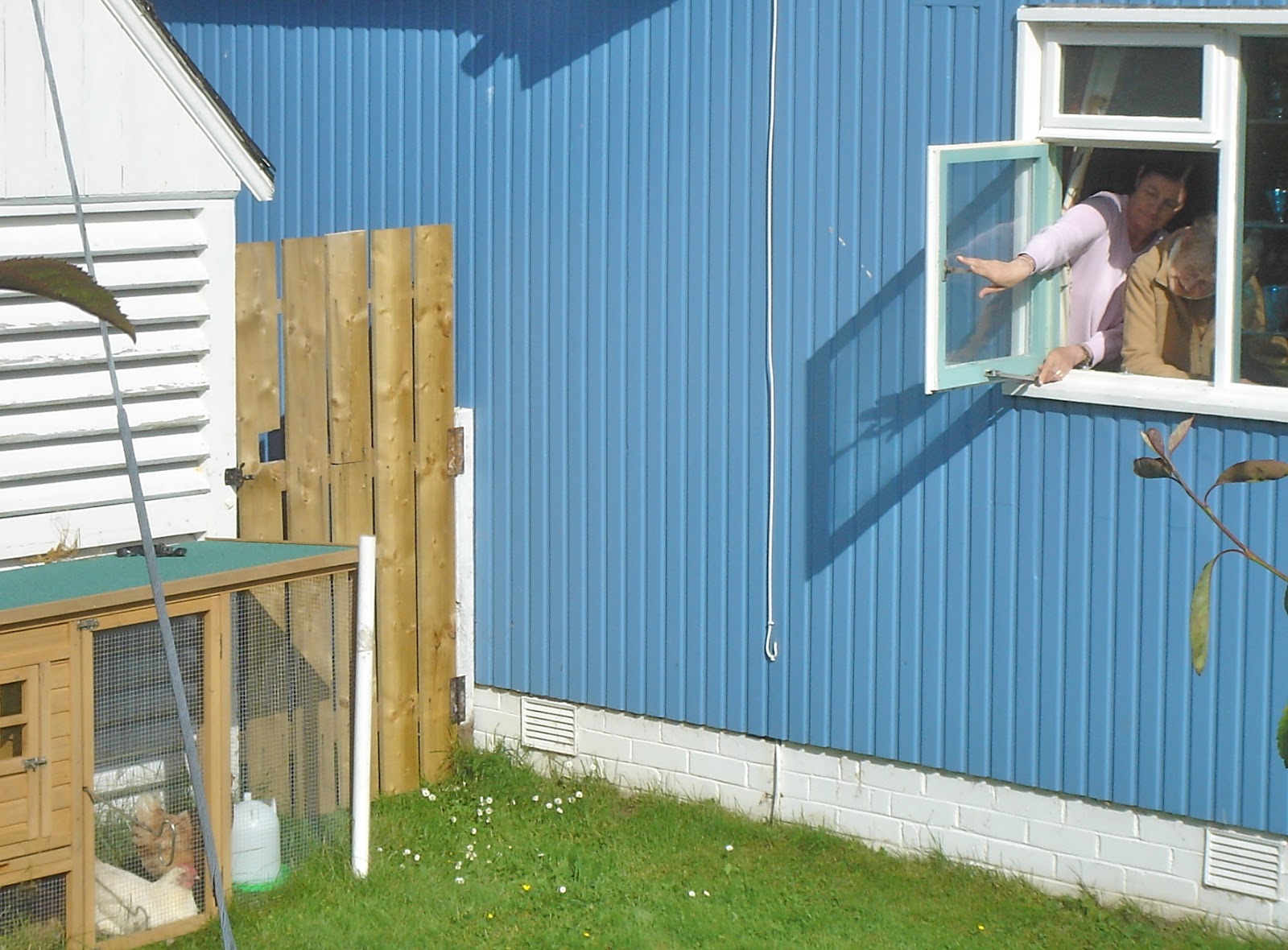
...kept in there for 24 hours. Friday afternoon three are out on the grass basking in  unaccustomed sun, wings outstretched, and Blanche seems to be broody in the laying box. "I doubt we'll have any eggs for a while. They need to settle in" said my mother, who sees them first on my computer...
...and names them, Blanche, Edith, Rhoda and Gladys - Edith the Suffolk with black speckles on her cape, and Rhoda, the Rhode Island with darker feathers on her back. I bought back a large bag of laying pellets and a water feeder from Harbros on Harbour Road in Inverness.The doctor and nurses have been dropping in, courtesy of the NHS to check on Mum who's not feeling so good. The arrival of hens and relatives cheering her up a little. Her grandson, my sister Bay's son, Antony, has taken a house in Tomatin for a week and is there with that side of the family. I've been ferrying Bay over the 14 miles to Inverarnie to check on our mum and confer with Sharon, her wonderful carer, and calm collected Doctor Sweeney who's mother's also in her 90s. Bay got our mother to a window to have a first gaze at her new chckens...
...and  my great niece came round with her mum keen to try feeding them...
Sydney with her grandma and the chickens
** ** ** **
I've been taking walks in jocund grazings playground for hundreds of small butterflies - Scotch Argus - myriad small insects, bees large and small, tiny moths fluttering between storks amid the rich greenery along the silvery Farnack...
The Farnack
...heading above this pleasant Highland bocage, on above the forestry line to scan the Strath in all its beauty - a panorama on these clear days to Ben Wyvis in Easter Ross beyond the Moray Firth winding away to Cromarty until it disappears beyond my middle ground, eastern slopes of serried pine, leading south to my point of reference - Brin Rock.


Time travel, like riding a bicycle the first time or skipping, is a mix of chance and craft. My daily biography runs to random slides amid the sounds of the moment; no track for smell. Dipping my nose into a flower, a patch of greenest sphagnum, rotting leaves, an errant pine branch, a handful of long wet grass to hold a living fish going back where it came, broken earth; I flick through a worm hole - momentarily effulgent with joy; sometimes its opposite stench, equally evocative. Possession is immeasurably brief, far outside conscious attention, an elusive sense animating the images and sounds, even the tastes, of lost times - του χαμένου χρόνου. How we mock noses, the part that resists all but teasing poetry. Yet the terriers, all dogs, share an environment of smells and taste. With their wet noses and little lolling tongues they survey and map the walks we take.

*** *** ***
À la recherche ... in Ano Korakiana
A swimming expedition of Korakianers to Dassia - before the they built the big road along the shore

"Η μυρωδιά της τηγανητής μελιτζάνας και πιπεριάς καθώς και η φρέσκια σάλτσα ντομάτας μου θυμίζουν έντονα τα καλοκαιρινά μας μπάνια όταν ήμασταν παιδιά! Από τα χαράματα με ξύπναγαν οι μυρωδιές που προανέφερα. Ήταν η μέρα που θα οδεύαμε προς Δασιά μεριά. Αρκετή η απόσταση όταν την κάνεις πεζή. Όσοι είχαν γαϊδουράκι ήταν τυχεροί. Εμείς δεν είχαμε! Ξεκίναγε η συντροφιά με τα φαγώσιμα κρεμασμένα στα ''σκαρβέκια ''του γαϊδάρου...
The smell of fried aubergines and peppers as well as the smell of fresh tomato sauce reminds me intensely of our summer bathing when we were children. These smells awoke us from daybreak. It was the day we were going to travel to the seashore at Dasia - a considerable distance on foot. Those who had a donkey were lucky. We didn't. Our group set off with the picnic food hanging from the wooden parts - σκαρβέκια - of the Jenny's saddle..."
*** ***
I thought this interesting - from John and Alistair cycling across Canada right now. Looking at what makes a community work -
John and Alistair in Tatamagouche
Sustainability and the Entrepreneurial Spirit: It is the most obvious thing that is missing in communities that are stagnant or in decline. In these places no one is able to refer to any one individual or a group of passionate and committed citizens who are taking action....Business entrepreneurs are the cornerstone of successful small communities. It may not take many, just a handful working on their own business. Together they recognise the efforts of others who also take this risk and they form an important cohort in the community around which others will follow to build a sense of place...
...and another cycle odyssey with a purpose - described in The Carbon Cycle. In 2006 Kate Rawles cycled 4500 miles from Texas to Alaska, following the spine of the Rocky Mountains conversing with people she met about climate change – from truck drivers to the Mayor of Albuquerque – to find out what they knew about it, whether they cared, and if they did, what they thought they could do. I've bought the book...and extract from Kate's blog. I like the fine grain, the small things, the ubiquity of unique individuals, talents I'll never encounter, the amount I miss in the wider world:
25th june '06...wonderful couple of days. great evening at neighbours' yesterday. when we arrived at john and anne's, just us and them. i was imagining a sit-down formal dinner. then another couple arrived, then a car-load, then another. cars kept arriving. soon the house was full of three generations, wandering inside and out, drinking beers, cokes and margheritas. i spoke with a geologist specialising in hazardous waste retraining as a nurse specialising in anaesthesia. (an anaesthetist with a geological time-frame, what a thought! let me put you to sleep for a hundred thousand years....).   his view on global warming was a) climates have always been in flux and this is just another flux and b) in any case talking about global warming isn't a good way to get people to act differently. it's too big and distant. focussing on the geo-political situation and the desirability of energy independance would be much more effective. i spoke with a solar astrophysicist who'd been studying the sun's output since 1970. we can't blame the sun's output for global warming anymore, he said. it's now certain that the output has been constant for the last 30 odd years. and yes, i certainly believe global warming is happening. i spoke with anne who showed me her little black and white cat panda's two kittens and told me a bear had eaten all their chickens bar one last night - and had a go at the hummingbird feeder. (bears? already? goodness!). best of all i spoke with heidi. small and slender, skin tight jeans, beautiful boots, pink and white shirt and white cowboy hat over a long pale plait, large blue eyes with a calm, grounded sort of look. heidi has a very large ranch in utah. in the summer she rides the ranch checking on cattle and fences, sleeping out for five or six nights at a time and then coming back for an occasional bath before setting out again. a real cowgirl (cowperson?!) - and a grandma! what an inspiration. (being a cowgirl is a long-standing fantasy of mine, tho its never sat entirely easily with being a vegetarian). we talked about arabs versus quarter horses (she uses quarter horses), how travelling in an rv cuts you off from so much of what you are travelling through, and how useful dogs are. "they make for lazy cowboys but take the pressure off the horses. they're about 5% useful: most of the time the cattle are chasing the dogs rather than the other way around." tom and rosalind told me later how heidi on form was an extraordinary dancer, known, amongst other things, for tap-dancing on tables and throwing truly wild parties which people would cross states to get to. and she invited me to come and visit! oh my. somehow i must find a way to make that happen.
****** ** ******
I've only just read Richard Pine's latest Letter from Greece in the Irish Times of 3 August 'Living with bribery and tax evasion as normal as the azure sky'...
I plead guilty. Last month I colluded in tax evasion and paid a bribe. I was buying stationery costing €105. The shopkeeper asked if I wanted a receipt. No thanks. “Then that will be €90 – cash, of course.” Of course. I saved €15 and he avoided paying VAT. Collusion. Everyone does it...Meanwhile, the coalition government in place since late June appears to be doing nothing except mouthing empty rhetoric about the need for reform and renegotiation of the bailout. There are reportedly 110 bailout conditions on which no progress has been made, thus imperilling payment of the next tranche of the loan. Government prevarication has registered with the voters: a recent opinion poll indicated that 50 per cent of voters are dissatisfied with the inaction of people who have the power – but not the motivation – to effect change. This is the same percentage that voted for the anti-austerity, anti-bailout parties on June 17th. A house divided, indeed. A visitor, looking at an aquamarine sky, asked: “Where else would you see a sky like that?” To which the answer is: Portugal, Spain, Italy – all the “bad boys” of southern Europe. It isn’t simply a matter of doing business in these countries in a quite different way to those of the north, but a cultural difference. A country in which clingfilm is called “diaphanous membrane”, and where boys are still named Aristotle, Hercules and Perikles, and girls Aphrodite, Urania (sky) and Agape (love), isn’t quite the same as one in which children are called Nigel and Ingrid, and where clingfilm is, well, clingfilm.
The other evening I asked my nephew, who's senior enough in knowledge of economics and finance, to have an opinion I value, about Greece
"You know how I feel. What of the future?"
"Greece will leave - will have to leave the Euro" he said very quietly; a little reluctantly.
"And Spain, and Italy and Portugal and...?" I asked amid a crowd of chatting relatives in my mother's sitting room. He looked at me eyebrows raised knowing I was seeking reassurance.
"Well?"
"They'll pull through"
Olympic debt race - Sophia Mamalinga 2 Aug'12

"What's the difference?" He shrugged and made a small spread of his arms. It was like pulling small teeth.
"Is it corruption?"
"Hm"
"Why Greece? Why not the others? You know how bad things are in Athens" I ran through my present list of harm and spreading misery.
"There's no capital left" He paused and looked away then back at me "Nothing there" Another pause "A dreadful mess."
He wanted to talk and think about something else. I didn't pursue, just felt a small ache in the pit of my stomach. (Telegraph 7 Aug'12: Greek exit from euro is 'manageable’ says Jean-Claude Juncker)
The family came to say 'Goodbye"

Monday, 4 October 2010

Sustainability


Mass production is inseparable from mass purchasing – a process maintained by the marketing of desire, complemented by the credit that subtracts deferment, lest we cease to play our essential part in the process by claiming – subversively – to be replete.
Thus until now has our world revolved. Many have been the diagnoses. The unintended consequences of industrialization were recognised even as it sprung from the inspiration of its inventors. It was in England, including Birmingham - cradle of industrialization - that the arts and crafts movement emerged at the turn of the 19th and 20th centuries. Many have been the nostrums that would allow us to keep the benefits of our inventive genius without the aloes of dispiriting wage labour on production line, call centre, warehouse, depot or in the field - agriculture, aided by enclosure, being one of the earliest sectors to be mechanised. Initially the making and selling of material commodities had been the focus of this process - the all enveloping process by which humans would make even dreams into commodities. Was there ever such a conundrum as the mass marketing of ‘individuality’? How do you attach the flavour of uniqueness to a product that’s made in millions by machines; persuade the world to buy something that makes them feel exclusive, though never, in their making, touched by craftsmen - except to make the original jigs? How do you lie without being untruthful?
I recall being fascinated with the ingenious way advertisers' wordsmiths and image smelters invented ways to square this circle – so it that it seemed to make sense. One device was the oxymoron. “Free gift”. The other thing was to use long words which impressed people who didn’t understand them at first, like ‘synthetic’ for ‘fake’ - the strangeness of the word, not the euphemism, was what counted; or saying things in the customer’s face - 'added sud-booster!' in detergents because, although quite unnecessary, consumers didn’t trust a liquid that didn’t behave like soap; or ‘home-cooked’ to describe cake-mix bought off the shelf, with the reassuring slogan 'you add the sugar!'; or the seductive juxtaposition of a slogan and an image –a couple in soft focus beside an azure sea – to sell a holiday. 'Enjoy paradise together'. No lies told about the serried loungers of those similarly persuaded; indeed a kind of truth. The consumer does the rest, selecting the dream from the reality, taking home snaps and memories that omit and select. My step-father spoke of the sale of dreams many years ago, before he entered television, and was working first for Coleman Prentice and Varley, where he met my mother, and was head-hunted to Hobson Bates, giants of the advertising industry in the 1950s. He was impressed by the Esso campaign - which over-50s will still remember so effective was it - to 'Put a tiger in your tank'. Accompanying that slogan were a number of 'giveaways' at petrol stations; stickers for drivers to display in their cars – 'I’ve got a tiger in my tank' - as well as wiggly tiger tails to tie on their aerials. “It’s a breakthrough” he told me “the first time the industry's got the punter to do their advertising for them!”
Years later when our children would balk at us buying them clothing without logos, usually trainers, T-shirts - not least because they were far cheaper - I’d say
“Look. How about asking the shopkeeper to pay you for displaying all that advertising”. By then Naomi Klein, and many others, Vance Packard most famously, had explained how this worked, but knowing makes no difference. We are all, even when we understand how it works, caught up in the process. Some people’s dreams – their room 101 of desire – takes a little longer to figure; requires a shrewder hustle.
When change comes – irresistible and inevitable change – those who can exploit it are those who have thought through, or sense intuitively, what they want despite the great persuasion that drives consumerism. These may be individuals, they may be families, villages, communities and indeed populations who might somehow escape the galloping crescendo.
What do you want from your life, your job, your community? What aspects of these things do you really want to maintain through the changes that are coming, are indeed happening now? Because so many of us live so unself-consciously, consumerism intervenes on the back of a sales campaign to seduce us, hustling our desires, telling us what we want, tapping into motives salesfolk understand better than most of us know ourselves.
The greatest obstacle to unending consumerism is self-knowledge separate from those inserted in us by the promoters of our hopes and fears. The spectre of sustainability is anathema to consumer society, since it's a philosophy, even a faith, able, unargued, to pervade our every action and thought - the idea that humans only need so much, that there can be sufficiency, satiation. That may sound simple. It isn’t. Sustainability is still a frail idea, assailed from every quarter by those who perceive it as impossible, impractical, subversive, sentimental, idealistic, toxic to all they hold dear. Yet sustainability, because so many people do find it a sound and desirable idea, is the prime target of the agents of consumerism. Everything that is unsustainable – carbon based energy, mass tourism, urban expansion planned obsolescence, population growth for a start – can be sold as sustainable when it is not.
[10 Nov 2010 - Ed Gillespie, Co-founder of Futerra, develops the argument on sustainability]
** ** **

A 1998 review: This study looks at the problem of collectively managing shared resources. Because of the book's unassuming nature and rather formal scholarly tone, it's easy to pass it over as just another academic work. But together with such books as Herman Daly and John Cobb's For the Common Good, Paul Hawken's The Ecology of Commerce and Vandana Shiva's work on restoring the commons, I consider it one of the more far-sighted and genuinely significant works to emerge in recent years on environmental resource management.
Ostrom uses the term "common pool resources" to denote natural resources used by many individuals in common, such as fisheries, groundwater basins, and irrigation systems. Such resources have long been subject to overexploitation and misuse by individuals acting in their own best interests. Conventional solutions typically involve either centralized governmental regulation or privatization of the resource. But, according to Ostrom, there is a third approach to resolving the problem of the commons: the design of durable cooperative institutions that are organized and governed by the resource users themselves.
"The central question in this study," she writes, "is how a group of principals who are in an interdependent situation can organize and govern themselves to obtain continuing joint benefits when all face temptations to free-ride, shirk, or otherwise act opportunistically."....
Back to the future: February 2011: Changing the way we eat conference in Manhattan

Saturday, 6 March 2010

A hard wind blowing

Am I to be self-employed or remain with the university? The latter gives me colleagues, admin support, access via Shibboleth to the libraries of the world. I earn money we share. In October one of those periodic reviews recommended honorary lectureships end this July. Should I cut loose first? I emailed JR the other evening about various things. Before I went to bed he'd replied:
Dear Simon, Thank you very much for your email and for all the thoughtful comments therein. I will reread it carefully and think about the Japan connection and protocol issues you raise. As regards your relationship with INLOGOV, I too would be hugely disappointed (and surprised) if the arrangement were to end on 31st July. It would certainly be my intention to recommend your Hon Lectureship (probably better described from now on as a Part-Time Visiting Lectureship - PTVL) to be renewed for as long as possible. And although I might predict that the College Leadership will only accept extensions for one year at a time, I am sure we will be able to continue the arrangement year by year until such time as you wish to stop. So please do not think your relation with INLOGOV is over! As long as INLOGOV survives, I am sure there will be work and a place for you - and most certainly while I am Director! Very best wishes - and see you next week! John
The mention of Japan refers to the decision by the Japan local Government Centre in January to end their three month training programme in UK for young Japanese civil servants. Politics at home; economic pressures. For 20 years we've been responsible for two weeks on this programme concentrating on British local government. Next week the Director of the JLGC will meet us in Birmingham so we can say farewell to a long collaboration and ponder ways of staying in touch. Later in the month I'm chairing a meeting with academics from Meiji University to discuss 'trust, research methods and the Japanese group’s new research project'. Meantime I've had work with Staffordshire on scrutiny and with Croydon and with Hampshire on Managing with Political Awareness, and before we return to Corfu, a day with Dumfries and Galloway on scrutiny. Yesterday I had to turn down an invite to talk to a conference on the effect of cuts and the likely policies of whoever's governing after the General Election:
Dear X. So sorry I'm already committed on the day you had in mind. ... I was very flattered you thought of me, ...If I can assist in any way in the future please don’t hesitate to get in touch again. Your questions are...absolutely on track. I take it you saw Cameron’s speech today at the Tory Party Spring Conference...confusing and inconsistent but seductive and in line with views among some of our colleagues that what when trying to read the future, don’t look at what some of the key people (like Cameron) say. We are in the run up to elections. Rhetoric gets polarised; focused on the ... marginals ... we can assume very little, beyond the likelihood that the recession is not only far from over but that we’ve not yet even seen the worst of it. This is a crisis that goes far beyond the UK, ... marked by generations rather than the decade length waves of boom and bust; a shift that makes parents anxious for their children’s future ... after a long period of prosperity and social peace. There’s hard wind blowing. The optimistic dimension - relevant to regulatory services like yours - is that faith in privatisation and the superiority of the market has received a blow from which it won’t recover. This makes for interesting and polarised times as some with leadership roles in local government struggle to continue functioning with what – since the days of Mrs T – has become orthodoxy, while others flounder alarmingly between two stools (the politics of Obama’s America) and a few others – very few - start to play around with original ideas that will one day make sense in theory and practice. Watch out for these. They’ll be as unobvious as the early signs of ‘Thatcherism’ e.g. being experimented with, long before they clustered and acquired enough coherence to be given a name as a dominant trend). In these circumstances real leaders in local government – whether politicians or professionals – will be those who don’t allow themselves to get morose... don’t get led by magic bullets and promises about the ‘right’ direction, and ride the uncertainty and unpredictability calmly, intelligently and pragmatically and cut some slack to slightly loony seeming ideas. Tall order! Best S
* * *
On 4th March I was up to catch an early train south to visit Richard and Wendy Hill in Havant. Pleasant cycling from Euston through the traffic, across the Thames to Waterloo, with time to do emails over coffee before catching my train to Havant. Richard is going to mend the carved wooden roach I inherited from my step-father. Richard made it nearly forty years ago from the mahogany railing of an old paddlesteamer, presenting it to Jack after making an Out of Town episode angling for sea bass out of Littlehampton in Richard's boat. Jack had also been given another carved fish - a crucian carp. I brought it with me. Richard thinks the carp might have been carved a lot longer ago than the roach, possibly by a craftsman in another country; India or Africa. "It's a beautiful piece of work."
For lunch Wendy had made the most delicious pie, rich with pieces of fresh seafish caught by Richard, followed by apple crumble with custard. Delectable. She packed up a dish for me to take home for Lin. We chatted and chatted; hours that passed so swiftly I could hardly believe my watch but it was time to head home. Before I left I saw
other examples of Richard's remarkable craftsmanship. in particular a large scale model of a fishing boat and, in the back garden, a wonderfully crafted carvel built rowing boat - The Green Man - his head in relief carved on the inside of her transom. I can look forward to visiting again when the fish is restored.
"I shall first make a plaster cast of the side of the fish already carved. I can lay it in that to use my wood carving chisels on the other side."
** ** **
On our last Sunday in Ano Korakiana Katya Spingos phoned to ask us for tea. We walked up to their house beyond the village traffic light on Odos Zogothoo Pigees (I think that's its name). Over tea, cake and biscuits and hazelnut liqueur we downloaded films we'd made of carnival, discussed the songs sung and plans to make a DVD of the event. Carnival was cancelled in 2009 to respect the memory of a young woman lawyer from the village killed on a road in Sarrocco Square in the city. We said how much we'd enjoyed ourselves this year and got into a discussion with her and Thanassis about how the event was organised and all the work involved, especially clearing, cleaning and decorating the Farmers' Co-op building for the dance. We spoke of the village and its sustainability. Would I ponder this? I asked John M, whether he could apply his knowledge of sustainability to us:
I am about to fly to Syd then on to Narrabri, Wee Waa and Dalby for our Sustainable Farm Family research so I am taking your email as hard copy and will reply later. I am very interested in the sustainability question re Ano Korakiana. It fits so well not just with the sustainability question but also with the work I have been doing on second homes and how these owners impact local communities. Be in touch, John
* * * Energy 95.7 Corfu is a radio station on Corfu. Its managing director is George Artinopoulos. Energy transmits a mix of Greek and foreign music with occasional op-eds. The one I've embedded takes a swipe at the illegal condition of landfill sites at Lefkimmi and Temploni, but focuses on problems with the new hospital under construction at Kontokali -'Η αθλιότητα στο νοσοκομείο Κέρκυρασ'. We see an attempt by local people, protesting at the state of the landfill sites, to draw their condition to the attention of European Commissioner Danuta Hübner, on an official visit to the Ionian Islands in February 2009. This is sad, and so depressing. How tempting to try, amid the wonders of the island, to sweep these messes out of sight and avoid the imputation of seeking to bring Corfu and Greece into disrepute.
Contact: nrgcorfu@otenet.gr - info@energycorfu.gr ΤΗΛ & ΦΑΧ: 0030 26610 24604 – 26617 71704 ΚΙΝ: 0030 6932 839 601 - 0030 69 847 11 847
[See this local blog about the new hospital in November 2008 - v. roughly translated]
* * *
Our daughter dropped round this morning. Linda's helping her with a community safety session with children and parents at the Main Library this afternoon. Amy showed me a letter from WM Police HQ saying she has a provisional start date for intake training into the Force at last. If things go to plan she could be having her passing out to become a full-time police officer by the end of October.
We had a good bicker about how we're all going to get up to the Highlands for Amy and Guy's wedding in mid-May. Who's going by car; who by train; whose staying at the hotel and who's staying with Poppet at Brin Croft....and for how long and on what days exactly. Phew.
** ** **
On Thursday evening I took Lin to the Birmingham Rep Production of Brian Friel's famous Dancing at Lughnasa (Loonaza). I could not get outside the feeling I was watching actors at work - talented and full of energy - but whether it was me, us, the audience, the direction - or whatever - the evening did not draw me in. Have I been spoiled by film? The troupe seemed too young for the Mundy sisters; too prosperous; no sense of the poverty of 1930s Ireland. Despite scripted reference to the fragility and hazardousness of a dissolving community - its clear and present danger seemed unreachable by those entertaining us. The tickets cost £25 each. I kept seeing the players chatting in their dressing room, going on to a meal in town, making more of a drama of their actual lives. We drove to Witton; to a place we'd not been for five years but had once enjoyed - Khanum Balti. The owner, glimpsed on the phone through a hatch at the back of an empty restaurant, seemed to have given up, after installing a job-lot of ugly new chairs round black wood-grained formica tables. There was a small radiant heater near Lin's knees. She switched it from rotating to ease the chill. We kept our coats on; ate from our basins with parathas - figures in a Brummie Edward Hopper, neon lit from above. "It's not Donegal, but isn't this the ambience we needed at the Rep?" I tried in a desultory way to compare fictional Ballybeg and Ano Korakiana - proxy music, the seduction of foreign rituals, the 'vexed reality' of fragmenting social and economic pressures - local and international, the poignant failures of which Maria Strani writes. It didn't work. I sounded as if I was trying too hard. I'd so hoped we'd be swept off my feet as we were at the carnival dance in the village. What am I to say to Richard, to whom I've promised to bring our evening's programme, when we return to Corfu?

Back numbers

Simon Baddeley