Total Pageviews

Showing posts with label Aristides Metallinos. Show all posts

Saturday, 17 May 2014

Λαός

Καραγκιόζης και Μπάρμπα Γιώργος
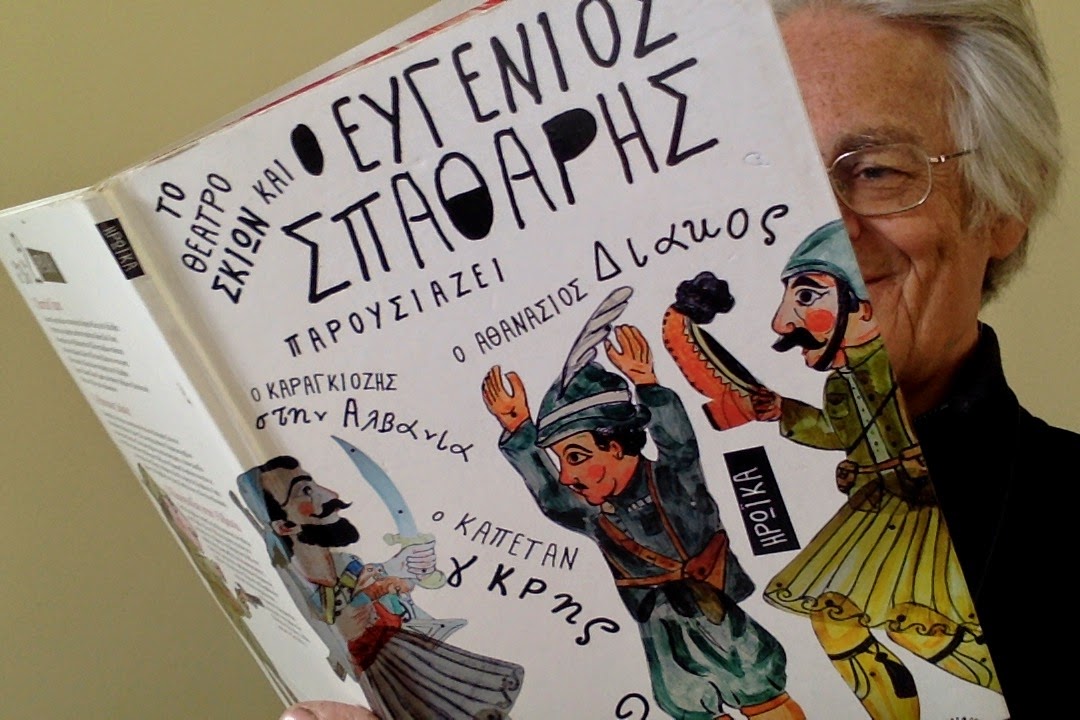
Chapter 4 of Lawrence Durrell's Prospero's Cell - 'Karaghiozis, a Laic Hero' - was when I came across this. Α good six years ago. I shall now try to learn more. We have a poster for a local performance of the shadow puppets in Corfu Town, which Lin framed to hang on the wall of Oliver's room. Karaghiozis Καραγκιόζης faces Barba Yorgos Μπάρμπα Γιώργος - both descendants of entertainment that began in the Ottoman domain as Karagöz and Hacivat. This will be like parsing Punch and Judy for a Greek friend.

'Laic' is a word I've been struggling with, translating the references I was given the other day to articles about the 'Laic' sculptor Aristides Metallinos. It comes from the Greek λαός meaning 'the common people' but without the disparagement attached where class and caste are familiar dynamics.  Lin and I were at Emeral being treated by Angeliki, and her cousin Tasos, to coffee and cake...
Coffee and cakes at Emeral
...and a sheaf of twenty year old photographs of the laic artist lent by Angeliki's parents - son and daughter-in-law, Andrea and Anna. The pictures are totally absorbing; some of them copied for me by Tasos.
Του λαἲκού λιθογλύπτη Αριστείδη Μεταλληνού
Angeliki had set up the meeting. We had no car so she drove us to and from Emeral, letting us shop for groceries at the nearby cash and carry that's replaced Sconto at Tzavros. She is gently familiarising us with the history of her grandfather. Until now we'd had just one slightly fuzzy face but now I see him closer.  There he sits working with his familiar hat - rather like the shepherd's beanie worn by the island's patron saint. The marble rests on tyres to absorb the blows of the chisel...


...other tools to hand on an upturned cardboard milk box. The references are ones I value even if I must wait to read the articles...and indeed have the wording of my references corrected:
Dear Tasos. Can you have a look at the way I have written out - in Greek and English - the references to the work of Aristidis Metallinos that we talked about when we met at Emeral last Tuesday?  Send me corrections, please. 
1. Γιάννη Μ Μαρή (1978) Βιογραφικό - Αριστείδης Ζαχ. Μεταλληνός, Απάνθισμα Γραμμάτων και Τεχνών, Επιμέλεια Εκδόσεως, Αθήναι, σελ. 611-617
1. Yianni M Mari (1978) Biography - Aristidis Zach. Metallinos, Anthology of Literature and Art, Epimelia Publications, Athens, pp. 611-617

2. Ευρυδίκης Αντζουλάτου-Ρετσίλα (1985) ‘Θέματα Κέρκυραἲκής λαογραφίας στο έργο του λαἲκού λιθογλύπτη Αριστείδη Μεταλληνού’, Δημοσιεύφθηκε στο Περιοδικό Μυριόβιβλος, τεύχος 7, σελ. 37-47
2. Eurydice Antzoulatou-Retsila (1985) ‘The folklore of Corfu in the art of the laic stone-sculptor Aristidi Metallinou’, article in Miriovivlos Periodical, issue 7, pp. 37-47

3. Ευρυδίκη Αντζουλάτου-Ρετσίλα (2005) ‘Θέματα Κέρκυρα ι κής λαογραφίας στο έργο του λαἲκού λιθογλύπτη Αριστείδη Μεταλληνού’ στο Πολιτιστικά και Μουσειολογικά Σύμμεικτα, Εκδόσεις Παπαζήση, Αθήναι, σελ.47-70 [ISBN: 960-02-1860-9]
3. Eurydice Antzοulatοu-Retsila (2005) ‘The folklore of Corfu in the art of the traditional stone-sculptor Aristidi Metallinou’, in Eurydice Antzοulatοu-Retsila (editor), Culture and Heritage Combined, Papazisi Publications, Athens, pp. 47-70 [ISBN: 960-02-1860-9] 
If you see any accents in the wrong place, or can edit my translations, do let me know, Tassos. I have the impression that articles 2 and 3 are perhaps the same, with the first one in the periodical Miriovivlos being re-published in the 2005 collection, edited by the author of the article in the periodical. Are the two articles the same, or is the second that appears 20 years later, re-written? Best wishes, Simon, Σάïμον και Λίντα Μπάντλεϊ
Tasos reminded us that thirty years before the result of the 2014 Eurovision Song Contest, his grandfather had carved a similar persona, titled 'Ο Κάτερος'...
...which tends to challenge the perspective on Aristides Metallinos as primarily a 'laic' artist. But we will come to that in time.
**** ****
My latest restoration...

...the legs and frame of an orphan table from beside the wheelie bins below the village, part legless, topless, speckled with wood-worm holes, covered in flaking paint, with no drawer handle.  I found part of another old table - blackened by sun, a castaway in the woods...

...from which I salvaged three beveled planks. Removing rusty nails, I tied them firmly to my bicycle with my leather belt, and cycled homeward realising that my jeans, wide-girthed, had become precarious. To prevent their falling I cut a length of cable hanging from the fence of an abandoned garden as a make-shift belt. The planks fitted perfectly. Where an edge and one corner were missing I cut out the right shapes from the third plank and scarfed them in with glue and screws. Leg-ends were replaced and the table levelled; joints pulled apart, glued and screwed; paint scraped off and the whole well sanded. Lin dug out an attractive handle for the drawer.


While working I was visited by a Jewel beetle


The clouds that come with this wet, chilly weather, continue to afford us incomparable cloudscapes; a view seldom seen in summer when heat haze obscures the spectacle of our delectable Ionian 'lake' and the undulating mainland of Albania and mother Greece.
One evening in the middle of May

Sunday, 12 January 2014

Greece in winter - "Start with the shoe"

Angeliki and Irini met at the museum this Saturday
Last November I had an exchange of emails with Jim Potts, husband of the Corfiot writer Maria Strani, about Ano Korakiana’s self-taught sculptor, Arestides Metallinos Αριστείδης Μεταλληνός. I had sent him a DVD of some 300 photos of the works in the ‘Museum’ that Lin and I had been able to enjoy visiting.
Dear Simon. Just watched the DVD again, this time on the TV screen, with Maria. We both think they are brilliant. Maria did not find them at all ‘naughty’ or controversial (it's in the eyes of the beholder)…He could eventually become recognised as a major figure…At some point professional photos would need to be taken of individual works, with top quality studio lighting. But it's wonderful to see all the works, the DVD does the job remarkably well. Thanks again. Jim
Saturday morning Lin and I were having cake and - for me, a skirto, Lin, a glass of pomegranate juice - as we again visited Andrea and Anna Metallinos and their daughter Angeliki at the ‘Museum’.
Anna, Linda, Angeliki and Irini at the Museum

Also with us was Irini Savvani.
I resign with reluctance to the idea that not everything that happens is a matter of chance or personal intention.  I met her on Wednesday passing in Democracy Street. She was with her daughter, Alexandra, coming from the bakery.
I said "Kalimera"
She said “Are you Simon Baddeley?”
“Yes”
“I read your blog”
After some pleasantries, I asked Irini if she knew of the village sculptor, Arestides Metallinos.
“Of course. But I have not been in the museum”
“You’ve not seen his work?”
“I met him at his house with my parents when I was a small girl”
I said that Lin and I had had the good fortune, after several years, to be able to see the collection – last November.
“I would like” I said “to see a catalogue made. Also a British friend to whom I showed the DVD that Metallinos' granddaughter entrusted me with, advised that a Greek art historian or critic should write a piece about the sculptor to accompany such a catalogue”
“I am an art historian” said Irini, with a smile.
We continued chatting. I remembered how vexing it could be to a child in hand looking upwards at grown-ups talking on and on about things important to them. Alexandra tugged, politely, at her mum's sleeve. (Is this what we mean when we say their conversation 'went over my head')
"Would you be able to meet with Angeliki and her parents, Irini?"
She nodded. The very moment I got home, after sharing this meeting with Lin, I phoned Angeliki and made an appointment that suited all of us at the museum on Saturday morning. I emailed Irini by way of briefing
Dear Irini. Thank you for agreeing to meet at the ‘Museum’ at 10.00am this Saturday morning. I will be there with Linda and we will be meeting Angeliki Metallinou and her parents Anna and Andrea to have another look inside the museum and have a brief look at Aristedes Metallinos’ work. Our meeting shouldn’t be more than 45 minutes.
I first saw inside the museum when we were in Ano Korakiana last November, having been curious about it since we came to the village in 2006.
Angeliki has convinced me that the work of her grandfather, a self-taught sculptor who didn’t start carving stone and marble until he was 67 years old, has for a variety of reasons remained almost unknown to the village and to the rest of the island. After she and her mother invited Linda and I to visit the museum we said we would see if we could help make this work better known. Angeliki gave me a DVD with photos of her grandfather’s work which I have shown to three friends in Corfu. In different ways they advise making a proper catalogue and having a Greek art historian help with this by writing an expert description. That you met the sculptor as a young girl growing up in the village and are now an art historian is why I believe our meeting last Tuesday on Democracy Street is ‘serendipitous’. Angeliki agrees and looks forward to meeting you on Saturday morning.
I wonder what you think of some of the illustrations of Metallinos' work on my blog:
Example 1, example 2 (especially!), example 3, example 4...
And this 'recrucifixion'
and this chimaera - the EEC
Aristedes Metallinos had many themes and seems a most fascinating man. Kindest regards. Simon
In my mind the place to start with any catalogue is Arestides' finely crafted stone shoe, made long before he began carving in earnest. Andrea could not unlock the show case so I took a couple of photo's through the glass. I would have liked to hold the thing in my hands and pass it round. Although Ano Korakiana was a rich village, Aristedes Metallinos' family were poor. In other circumstances a young man or woman who carved such an object in local stone - harder than marble - might well have been guided towards an artist's education.

Παπούτσι - Shoe, carved in 1928 by Aristedes Metallinos Αριστείδης Μεταλληνός

Back numbers

Simon Baddeley