Total Pageviews

Showing posts sorted by date for query markides. Sort by relevance Show all posts

Tuesday, 31 January 2012

In town for the day

I was in a room on the south bank of the Thames at some meeting of people in the same business – I’m almost certain it was a conference on analysing and debunking conspiracy theory - when gazing over towards the Houses of Parliament I saw the top floor of Portcullis House, the office accommodation for MPs over the road from the Commons, explode, freezing all in the room but me. No need to conform in dreams, I threw myself to the floor for cover. I knew exactly where this came from. It was a flashback to London’s especially brilliant New Year fireworks display with widely published stills of flames shooting from the upper turrets of Big Ben. Except they confirm prescience I give dreams no credence as prophecy. It was to do with my state of mind, sitting on my own the evening before watching a film of Susan Hill’s The Woman in Black - one of the scariest ghost stories (next to The Turn of the Screw), in which at one point, after a preamble of gathering dread and the illusion of escape to a cosy bedroom; a child’s playful giggle wakes the haunted man, Arthur Kidd. He sits up in his bed in the Gifford Arms half awake in a sweat but curious, when with dreadful abruptness the face of the woman in black, stoops on him screeching through gritting teeth. “She…came for me”.
I’d seen this before but was still on the edge of dread as I went downstairs to the cold and dark to wash, do my teeth, before bed, knowing imagination’s inventiveness; no-one else in the house.  The was the dream sorting things out, plus Parmesan.
Morning ferry to Igoumenitsa

I think I’ll go to town today. I’ve errands. It’s going to be sunny. From the village I cycle down a winding back road to the main Sidari Road, then two kilometres to its T-junction with the Corfu Town-Paleokastritsa Road, then four to the Tzavros T-junction.
My route from Ano Korakiana to town
Here’s the post office. I pay my electricity bill – 20% for electricity the rest, property tax. Then on, cycling in the sun, to join the dual carriageway for eight kilometres to the edge of town – able along most of that large busy stretch to cycle on quieter parallel side roads. I’ve done this journey in winter, at night in pouring rain, in the bright heat of a summer day. I like the feeling of approaching and arriving in the city – especially one as classy as Corfu’s capital.
It’s been hinted that those who live all the time in the Corfu Town look askance at the rest of the island, as some in Chelsea might regard Romford. Boarding a bus to town at a stop in the country as you proffer your fare you say simply “Πόλη” “Poli”. I entered via the main road Ioulias Andreadi towards the old hospital soon hurrying through the traffic that jams up here to visit the good cycle shop just opposite the Ipoliti T-junction to get a decent lock, a slight adjustment to my handlebars and thicker handgrips, which the owner fitted for me in two minutes using a detergent spray to loosen the old ones
“WD40’s no good for this” he said.
On down back streets to The Stove Shop in Solomou Street to ask about replacing cracked fireproof mica in the door and a new inside guard, showing pictures of what I needed on my camera. Stammatis described removing my stove door.
“We have the parts. Bring your old ones in in. It will be done while you wait.”
I went to buy my ferry ticket home, to be sure of the February schedule and headed for the Superfast ticket office by the new port gates. On the way I came to another travel agent and walked in to see Kostas and his son Anthony. Lin and I hired cars from him for two years until we got a better deal from Yiannis in Sidari. He’s always been welcoming, ready with coffee and cakes in his office so we felt embarrassed. Now on my bicycle I was invited in, sat down
“How are you?” We got talking.
I said I’d just paid my tax
“Ah” said Anthony who’s English is excellent “You paid your tax. You are a Greek now.”
We got onto the penalties Richard Pine had warned me of when we had lunch a few days ago.
“Get your floor area wrong for the tax and you can’t even sell your house and your surveyor – your μηχανικός – goes to jail for three years”
“Yes, yes” said Anthony “we have been trying to get our house measured during the amnesty. We had one man gave us 98 square metres, another 102 and one more 100”
“So they will all go to prison?” I suggested
“Yes. Everyone is going to prison”
“I will meet you there” I said. We were laughing. Kostas brought me a skirto and some of his wife’s cake and we chatted more, then Antony took me next door to get my ferry ticket with a 10% reduction for early booking.
So now I cycled back into town for writing paper – having rather taken to writing letters instead of just typing them into cyberspace. There’s no W.H.Smith here. Instead there’s Mastoras, Σπ.Αρβανιτακη 12, [Mastoras Bookshop, Sp. Arvanitaki 12, Corfu 49100] in the city’s central maze. A white haired gentleman of great courtesy realising I couldn’t manage asking for “writing paper and envelopes” “χαρτί αλληλογραφίας και φάκελος”, discreetly found me just what I wanted. Half of me had begun to think no-one would know about such things any more.
From there it was a short ride through marble streets to Zisimos, the most civilised of coffee shops, with no music nor young people in sight, in fact ‘nowt to be vexed at all’, and there I ordered a deep chocolate slice, a double Greek coffee without sugar and a Metaxa - “3 or 5 star?” “3…er…no…5” I replied thinking silently “I’m saving every day, not hiring a car”
 and started writing home until the sun shining down the Liston moved me into shade and I left for the city's main post office in Alexandras Street to be sure my letter to Lin would go at once. No post box gets collections in the winter.
With plenty of light I started home from San Rocco Square via my ‘secret’ route up Avrami Hill above the villas of Mandouki, a road along which, in a car, I can park close to the centre when the town’s busy. I met the main north road to Paleo and from there was home in an hour – going steadily but gently upwards, stopping at Sconto at Tzavros to get wine, pepper salami and prosciutto at the well-stocked concession butcher inside the store. The 1-1 gear on my 21 gear road bicycle elates me. I can pedal steadily all the way up the early slope of Democracy Street below Mougathes – the steepest section until, after Venetia at the top of the village, it becomes the zig-zag climb to high Sokraki.
*** ***
On the few nights I’ve been at home I’ve watched films. The other night, for perhaps the fourth time in 60 years, I watched The Third Man, filmed in 1949, shown to me first at my prep-school by a headmaster who clearly recognized its quality and, because I remember finding it incomprehensible, as I’m pretty sure did most of my 10 or 11 year old companions in the audience that particular ‘film-night’, I assume it was a shown as a spy is inserted into another country as a sleeper to be activated years later when the time is ripe, especially as the film was passed as suitable for Adult audiences, a category that allowed us to view it so long as we were in the company of a grown-up. Well indeed because the next spare evening I watched, for the first time, that equally black and white film of Ayn Rand’s (rather good name for a breed of potato – “Twenty pound of King Edward, hundred weight of Ayn Rand, please”) The Fountainhead. Sixty years later, the sleeper is alerted and inserted. Both films came out in 1949. In one the eventually triumphant hero, Gary Cooper, is the epitome of individualism versus the demoralizing collective, in the other there’s no hero, no obvious collective – rather a shaky alliance, “good fellows on the whole, did their best you know” -
 but the anti-hero, Harry Lime - Orson Welles, who might have approved Ayn Rand – especially given the ‘cuckoo clock’ story Welles added to the screenplay - is a black-marketeer with an engaging smile who profits from smuggling fatally diluted penicillin.
**** ****
On Saturday my neighbour, Effie, said “Simon, come tonight we’re having friends and fish – salt cod”. I turned up at half eight. In no time after lots of greetings of people I recognized from our party last year for Tony and Helen we were round a table enjoying village wine – especially good this year – and παστός μπακαλιάρος, with boiled potatoes and fresh crusty bread for the sauce. The conversation was Greek with English thrown in to help me keep up. I got the gist of about 40% and 100% of the good cheer. Then came sweet things and Effie turned on her tape recorder as we sat around talking ceaselessly.
"I'll sit this out"

I’m not good at ‘fun’. Before I dress up as a woman I make sure Lin’s out of the house with the doors locked, but this evening the men are soon in wigs, grotesque Royal Ascot hats, necklaces, hair bands, headbands, skirts, and after a while – when I wasn’t quite looking – my lips are red with lipstick and I’m not even thinking how to explain this when I skype to England next day.
Dancing of course with clicking, clapping and plates shattering on the floor. In the revels I lose my glasses and fear they’ll go the way of the plates but they’ve just got tangled in my tresses as I throw my head about in Effie’s and Adoni’s kitchen.
Σὰ βγεῖς στὸν πηγαιμὸ γιὰ τὴν 'Ιθάκη - τὴν Κέρκυρα!,
νὰ εὔχεσαι νἆναι μακρὺς ὀ δρόμος,
γεμάτος περιπέτειες, γεμάτος γνώσεις….
Next morning – 8.30 – I was down at Sally’s stables with Mark to help, as promised, with a small job clearing a trail of acacia, he going ahead with a small chainsaw, I - well gloved - clearing cut branches and putting them aside, accompanied by black dogs, Teal and young Drake.
“It’s horrid stuff” said Mark
“Isn’t it useful for something – like Hazel or Spindle or Rosewood?”
“Yes, making a crown of thorns” - Ο Ακάνθινος Στέφανος.
And I saw; removing my glove, touching one strand
“Imagine those woven together and pressed down on your head. You get a small scratch from those, it goes septic.”
Later he told me that he’d seen Acacia used as Shrike’s larders, something I’d read, with illustration, as a child but never seen.
“It’s not only small birds hung there, but mice, insects, pieces of fruit, bits of apple.”
How if you were walking with a child in the country and you came upon such a thing would you explain a 'larder'. Few modern houses have them, as they don’t have dusty attics for family history. How could you explain something which to an older generation would seem ingenious, including the hanging of meat, without lowering their opinion of the shrike?
“It’s because they don’t have fridges”.
*** ***
In early afternoon Mark and Sally picked me up outside my house to go for one of those long Sunday lunches with friends I so like – as last year, we drove up into the mountains, to Palia Taverna in Strinilas – with hugs and kisses on arrival at 2.00 and the same on leaving in the dark, getting back to Ano Korakiana by seven.
Strinilas in the mountains for Sunday lunch

I had hesitant fun explaining the party on Saturday evening at which I’d “only watched” (oh yes?) of course while “others” did a domestic enactment of Carnival (“so what’s that on your lips?”), but I was unconditionally proud to share the information that after attending a meeting of volunteers invited to help plan the village Carnival on Sunday 26 Feb. I didn’t understand much of what was being said in a group of 24, with others arriving as the meeting proceeded.

We sat in a circle, chilly, in the unheated meeting room of the Agricultural Co-op. There was nothing as commonplace as a chairman, secretary or an agenda with minutes and the like, but I knew people there and nodded with the rhythm of a lively debate. I didn’t notice just when I was recruited, but Foti told me at Effie’s party “For Karnivali, we are a team, Simon.”
Ένας καινούργιος καρναβαλιστής προστέθηκε στην Κορακιανίτικη καρναβαλική παρέα...Πρόκειται για το φίλο μας Simon Badelley, που με υπομονή παρακολούθησε όλη τη συζήτηση...who with patience watched the whole debate.
Team Carnival 2012
*** ***
Chatting to Adoni, Effie’s husband on Saturday, he was naming different parts of the country for me. In Corfu ‘we’ are the Ionian, over the sea directly is mainland Epirus, further east and north is Macedonia which contains the city of Thessaloniki, south of that Thessaly. “Then is it Attica?” I asked but he told me Attica is treated as just one part of ‘Central Greece’ which stretches from Euboia on the Aegean, east of great Athens to the west coast next to Ionian Levkas. “Then there’s the Peloponnese, then Aegea, which covers all the islands of the Aegean Sea. I wanted to check which of those many Greek islands he would name. And and then Crete - Kriti. East of Macedonia, is Thrace, we use a soft ‘c’ but Greeks call it Thraki – Θράκη. This assemblage is still young compared to the United Kingdom, made by the Act of Union at the start of the 18th century. We have one great challenged border, that between Eire and Northern Ireland – a cause and source of internal war since partition early last century.
 Map: Robert F. Holland, Diana Weston Markides (2006)
Greece, except for the front-line Ionian Islands defended by Venice for four centuries was a part of the Ottoman Empire until the founding of the original Greek Kingdom in 1843 – the Peloponnese, Aegean islands within about 100 miles of Athens and what is now Central Greece from south of Prevesa in the west to the tip of Euboea to the east. Twenty years later the British Protectorate – not colony – of the Ionian Islands became part of Greece. Thessaly was joined in 1881. In 1913, after another 30 years, as a result of the Balkan Wars, Macedonia, Crete and the islands of the north eastern Aegean became Greek – Samos, Chios, Lesvos, Mitylene, and Lemnos. In 1920 under the leadership of Eleutherios Venizelos the hold of the ‘big idea’, in his words, of a “greater Greece of two continents and five seas”, encompassing those parts of Turkey with strong Greek Orthodox populations, the International powers promoted but never ratified the Treaty of Sèvres, ceding to Greece parts of Asia Minor, Smyrna and its hinterlands with North Western Turkey up to Constantinople, giving Greece back its Byzantine capital, a part of the Black Sea coast and all the northern shores of the Sea of Marmora and of the Bosphorus. Turkey’s Grey Wolf, Kemal Atatürk, put a bloody end to that dream in 1922 as allied powers turned their back on Greece, treating Turkey as a preferred ally in the eastern Mediterranean while European leaders fearing the irredentist insurgency and violent repression associated with such bloodily settled borders promoted the Treaty of Lausanne and the great exchange of populations (2 millions forced to give up their ancient homes - Christians in Turkey to Greece, Muslims in Greece to Turkey). This heartbreaking sequence is denoted in the mural dated 1928 that I saw in the Taverna in Igoumentsa the other day – grief for all involved (who knows what further heartbreak it avoided). But via Lausanne in 1923 Greece was ceded Thrace, between Macedonia and a new Turkish border 100 miles west of Istanbul. Then 24 years later after the end of WW2 Italy in 1947 ceded Greece the islands of the south east Aegean – the Dodecanese – tiny Castelorizo, Rhodes, Kos and other island south of Samos, east of Crete. Cyprus, both Greek and Turkish, partakes in the history of contested borders, never became part of the Hellenic Kingdom or Republic but marks the last struggle over the latter’s present boundaries. This briefest of outlines explains the greater prevalence, compared to Britain, of frozen conflict around the edges of modern Greece, some as in the case of Kosovo, Cyprus, islands within throwing distance of Turkey, the former Yugoslav country now called the Republic of Macedonia, threatening to thaw, reviving ancient feuds, for the moment festering as chants in the stands at football matches and abuse exchanged in cyberspace.
**** ****
I was asking Richard P at Harry’s Taverna in Perithia, how one could honour accuracy in speaking in any public medium - a biography, even a novel or essays about past friends - in other than anodyne ways. He’d wondered when we last met how you wrote about the bastards in the place where you lived. I’m not long enough in this village to know them so have no need to censor myself, but - to continue this tremulous meander, do ponder how to speak or write of people who were more than friends. I know at least one person and possibly two who while having no fear of truth or anxiety about esteem would say “Be silent. There’s no problem unless you have one and why should that be?” J’y reste.
I still wonder though how I might…say something that could offend no-one including myself, because these were but also are relationships that are consigned to the past only in the sense that a funeral disposes of a body rather than my present recollection of its possessor. I recall someone in another context far from mine saying revenge against the depredations of an ancient monster – some abusing mentor or relative – was to forget them. Not easy to inter the past. But what of the constant company of worthy wonderful memories and their author? No need to resurrect what’s already eternal. Δεν δίνω συνέχεια. I thought of a souvenir of sorts, an image of self as an old (to be playful with time, spelled ‘olde’) hostelry that enhances it’s living by mentioning in guidebooks, on its website, the possibility that guests may glance in passing, a small brass plaque of uncertain age – it could have been the 1960s but carefully aged, what the dealers call ‘distressed’ - declaring that Good Bess Tudor or the Queen of Scots stayed here on the way to the rest of their lives, even a four poster bed, of insufficient quality to be genuine, stands in for the one in which they just might have slept.

Wednesday, 20 January 2010

Protectorate or possession?

I was delighted to accept Richard Pine’s invitation, to give a chat at the Durrell School in Philhellene Street in a few weeks - Wednesday 3 February. In Richard's words "7.30 glass of wine, 8pm talk, finish by 9pm".
I'm delving into the varying characteristics of different Lord High Commissioners of the Ionian Islands between 1815 and 1864, relying on sorties in the National Archives at Kew, on the early chapters of Diana Markides and Robert Holland The British and the Hellenes and, of course, on Eleni Calligas’s brilliant 1992 thesis – unpublished - that has brought together rich information about personalities in the Ionian political classes during the British Protectorate.
I have a portrait of Thomas Maitland, the graceless aristocrat, who in 1817 wrote a constitution for the Ionian Islands that made them more an English possession than the Protectorate, intended and agreed, in 1815.
There’s one of his successor Frederick Adam, whose statue stands outside the Protectorate's seat of government - The Palace of St Michael and St George at the head of the Liston - a man more congenial to Ionians, married to a Greek, he oversaw the building, for her, of a delightful neo-classical house, Mon Repos, in lovely grounds a mile south of the Commissioner's Palace.
I’m missing a picture of Alexander Woodford, acting Lord High Commissioner for part of 1832. I have found one of the whig intellectual Lord Nugent, keen to implement the liberal principles of his party, who became vexed when the Ionian politicians to whom he’d granted greater freedoms failed to observe his wishes.
Andrea Mustoxidi
I’ve also found one of his successor Sir Howard Douglas who sparred with a new class of Ionian parliamentarian in Andrea Mustoxidi - Ανδρέας Μουστοξύδης - intellectual, scholarly, politically astute, back from Italy enthused by republican ideas of liberty and equality brewing across the rest of Europe, by the outcome of the Greek War of Independence, the founding of the Hellenic nation and the idea of Ionian autonomy - these last two being visions that became contentiously separate in the following decades.
I’ve also a sketchy portrait of James Stewart-Mackenzie, and far better painting of his notable successor - an older portrait - of the exceptional John Colborne, Lord Seaton, a radically inclined Tory who at last dissolved Maitland’s colonial constitution and replaced it with ‘the Seatonian’, acting on the principle that power should be linked to the wishes of the electorate rather than of the Palace of St.Michael and St.George. For Seaton, Maitland’s style of government, far from being justified by Ionian venality and incompetence, was in large degree its cause. He was unique among commissioners in seeing economic problems at the heart of social discontent in the islands - exploited by many years of Venetian mono-cropping (olives in Corfu, currants in Zakinthos and Cephalonia).
Giuseppi Momferrato
The Tory in Seaton saw that by opening government to the parliamentarian liberali, he strengthened the Protectorate and undermined the campaigning zeal of the emerging radicals, the rizospastai, pressing for the departure of the British and the creation of a sovereign Ionian Republic – a political movement driven from Cephalonia – one of its leaders, the zealous and principled Elias Zervo in alliance and friendship with Giorgio Lunzo and Giuseppe Momferrato and others whose names and character I have yet to learn.
Elias Zervo
Seaton’s policies were harmed by the personality of his inherited resident, kept on instructions from London, on Cephalonia – Selwyn D’Everton - whose views on the readiness of Ionians for self-government were out of harmony with Seaton’s.
The irony of Seaton’s tenure as Commissioner was that his efforts to strengthen the hand of the liberali added to the momentum of the rizospasti who were not as distinct from the liberali as he might have hoped. The first outbreak of violence on Cephalonia in 1848 was, as Seaton recognized, a reaction against oppression and poverty imposed by local landowners, but it was used by the radicals to argue a philosophical case against the British. By enforcing the law on behalf of the signorini the British pushed Ionians enfranchised by Seaton’s reforms into the camp of the radicals.
The Rizopastai
I’m missing a picture Sir Henry George Ward, successor to Seaton, keen to continue reforms that favoured the wishes of the liberali, but faced with the murder by peasants of two landowners' employees on Cephalonia, Ward ordered military intervention resented to this day as a violent overreaction – a reminder of the fist in the glove that could be wielded by the British on behalf of the Ionian ruling class in whom they often recognized their strongest allies. There were hangings and floggings on Cephalonia – the latter penalty unfamiliar to Ionians and therefore additionally a focus of horror and widespread contempt and loathing for the Lord High Commissioner across the islands. There were good newspapers; many radical. News spread far more quickly along the islands than between London and Corfu.
Nonetheless Ward’s repression may have been a winning card for those British politicians and diplomats preoccupied with maintaining strategic power in the Eastern Mediterranean via influence on Greece. The dominant voice of the rizospasti, Elias Zervos, was silenced first by banishment to Orthoni, just off the north west coast of Corfu, but then by far more distant exile to Kythera, the southernmost of the Ionian islands, below Methoni in the Peloponnese.
Constantinos Lombardo
A way was cleared for the rise of Constantinos Lombardos from Zakinthos, a more opportunist politician who focused the energies of the rizopasti not on republican principles like Zervos, but on enosis - the transfer of the islands to the young kingdom of Greece.
I’ve a portrait of Ward’s successor Sir John Young. He was perhaps the most direct victim of the fact that Ionians were not restricting their political energies to the region. Islanders had come in delegations to London complaining directly to British ministers and MPs about the conduct of the Lord High Commissioner and his agents, cultivating support in London, and indeed the rest of Europe. There was a long tradition of Greek and British political intermingling, distinguished exemplars being Ioannis Kapodistria and later Giorgos Theotokis, who were able to navigate shrewdly amid the differences of opinion on Greece in the British political classes.
Thus, amid the accelerating trajectory of his career as one of England’s most distinguished statesman, William Gladstone, came on an extraordinary mission to Greece and the Ionian islands, convinced that most of the problems of the Protectorate lay with British policies that had blocked the emergence of a mature democracy there.
This didn't mean he came with the intention of abandoning the British Protectorate. To understand why the British government held so keenly to the Ionian islands I must recognise the motives of every power that has relied on Corfu as a military base.
Stand, on a clear day, on the summit of Angelocastra, (see this in another blog) above Paleokastritsa, from where Linda and I have gazed across fifty miles, maybe more, of the southern Adriatic – defended for three centuries by Venice, coveted in the mid-19th century by the Austro-Hungarian empire, linked in a conflux of Balkan contracts that policy-makers in Whitehall and the clubs off Pall Mall referred to as ‘The Eastern Question’, calculating whether to guard our interest in the Eastern Mediterranean via fledgling Christian states or a declining Ottoman Empire, whether, part quoting John Delane, influential editor of The Times, ‘to protect a cradle’ or ‘watch over a tomb’. Look eastward and you see a hundred miles of the mainland coast of Greece stretching south to Levkas - once Santa Maura - and Ithaka and the long contested sea marches between the Turkish Empire and Christian Europe.
Gladstone favoured the cradle. A fervent Philhellene, steeped in English classical scholarship, he came to tell the Ionians he supported reform of their constitution but not the ending of the Protectorate. Like Seaton, Gladstone doubted the quality of their government under the Protectorate, not the quality of the Ionians. He fell half in love with the Orthodox Church, famously banging heads with the Archbishop of Corfu as they bowed to one another simultaneously.
Had events taken a different turn; had Ilias Zervos and his followers from Cephalonia not been rendered ineffectual by exile, unable to present a serious challenge to the fervent politics of enosis pressed by Constantinos Lombardos and his Zantian followers, there might just have been a sovereign Septinsular Democracy along the western shores of Greece – an Ionian polity treated by the great powers as separate from their preoccupations with the Eastern Question, less subject to the machinations of hi-politics that dog Greece to this day (Would heads at the ECB ponder excluding Greece on the grounds of her weakening influence on the €? Possibly. Would France and Germany exclude Greece, or any of the PIIGS from the EU on mere economic grounds? Inconceivable – except among journalists ill-briefed by marginal politicians). Gladstone’s new constitution, improving even on Seaton’s, was rejected by the Ionian Parliament as soon as he’d left for England, leaving the last Lord High Commissioner, Henry George Storks, to apply all his political talent to ensuring that Whitehall’s decision to surrender the Protectorate to enosis looked like a grand gift to mother Greece from Queen Victoria, so that our people could depart amid guns fired in salute, much bunting, flag waving, kisses, embraces - even tears - on both sides.
To those cynical enough to believe in Albion perfidy two things would be apparent. Britain reserved a robust military foothold in Malta, and more important, as Ilias Zervos realized, greater influence at Athens than would be tolerated henceforth in the Ionian Parliament, having ceded the Ionian Islands as a quid pro quo for for the Greek Assembly's unanimous election of the young King George of the Hellenes. The Hellenic governing classes could rejoice, with some reservations, at this further enlargement of their kingdom; continuing to nurture that ill-fated dream of recovering Constantinople – the name for Istanbul displayed on the concourse of Thessaloniki Railway Station to this day. From Corfu History Forum:
THE UNION WITH THE EYES OF A MONK (translated)
Archives of the monastery of Myrtidiotissa, Catastico 1, p. 168r
During the year 1814, the English conquered Corfu, and their occupation lasted until 1864, when the Union with the rest of Greece took place. It would be better if the earth were torn apart and swallowed us all alive. Three times damn, according to the Triode*, to Bishop Athanasios who made (sic) the Union and doomed the Ionians. In the times of England everything was good, and when the Greek nation came, God’s rage came with them, and all the expensiveness and all the great blasphemy. I remember, when I was a little schoolboy, in 1888, that my father – God rest his soul - used to tell me that at the time that the English were in Corfu, in the village of Synarades only two men used to utter profane oaths, a Stathes P. and another Petros, son of A, and no one else. And the Greek nation brought all the sins to the Ionian Islands.**
* Certain feasts of the Lord in the Orthodox Church will have a canon composed of three odes, called a Triode, chanted at Compline on each day of the Afterfeast.
**Extract from the book of Spyros Karydes Αμβροσίου Μοναχού Χρονικά Σημειώματα, η Κέρκυρα των αρχών του 20ου αιώνα μέσα από τα μάτια ενός μοναχού, 2004, p. 107
** ** **
Yesterday and today we have sun. We did gardening, washing and sawing firewood and going about in the village visiting, observing at close hand work proceeding on older houses - flooring, roofing, repairing down to conscientious details.
In Nico and Sophia's house where ambitious restoration is nearing completion, I had the honour to be introduced to George Poplis a Greek craftsman from Albania who has taught himself - from the internet - the art of wood graining adding to many other fine touches in one of the finest houses in the village.
Across the road, Mark's brother, Paul has a few months more work to do on the house he and Jacinta have moved to from Bermuda (having lived over 15 years ago on Vido). Next door an old house, long up for sale, has been bought by a Dutchman and is being properly re-roofed and set up for residence. We heard of another restoration further down that has not gone so well -woeful workmanship paid for in advance; the half-completed house now up for sale. Up steps above Nico's place is Sally and Mark's house coming along fine with much of the work done by Ian, who was laying a magnificent oak floor yesterday morning. Sally told us that there's a new carpenter's shop opened at the bottom of Ano Korakiana. I couldn't have felt more satisfied at these signs of renewal, enjoying the muffled noise of drills, sanders and angle grinders carried on the breeze drying people's washing, including ours.

Friday, 12 June 2009

Ένoσις - 'so perilous an experiment'


I'd been told by a British friend, some years ago, in one of those generalisations filed under 'conjecture - revisit', that Corfiots were fiercely proud to be Greek but sustained a certain sense of superiority over other Greeks. Our dear young Hellene friend Nancy, from Patras, did mention, when we were happily debating politics at table this January, that some Corfiots (and presumably some inhabitants of the rest of the Septinsular) felt that in abandoning the Protectorate in 1864, the British had delivered what could have been an independent Ionian Republic into the hands of the Greek Monarchy, embroiling them in the machinations of Athens.
I suspect that it will necessary first to understand the machinations of Britain and her agents. I expect this to bring uncomfortable revelations about what went on in the Ionian Islands under our 'amical protection' - notwithstanding roads, education, cricket and sin tsin birra (echoes of Life of Brian on "what have the Romans ever done for us?"). Original sources offer direct insight but, subliminally, they draw a student through time, so that one finds oneself wandering in another dimension. A reader invents the voices of fiction in their head. Film-makers pre-empt such imagining. I've travelled thus before when pursuing research. As ever it depends who writes the history and what interpretations most credibly explain the motives and actions of individuals.

From Warlike England as seen by herself (1915) by Ferdinand Tönnies - insight into British foreign rule from a great sociologist
I will ever revert to Anglo-Hellenic relations because my necessarily sober study of texts is driven by inchoate emotions. At times what I thought was Greece turns out to be my reflection in a foxed mirror. I'm neither detached nor disinterested. I'm mindful of Kevin Andrew's passion for Greece, in whose seas his life ended, undimmed by a rare fury at 'uncritical, unquestioning adherence to the revolting shame of lesser people’s stupidity, cynicism and cheapness' and Byron, his heart buried in the Hiera Polis, writing, in a burst of vexation, that 'there never was such an incapacity for veracity shown since Eve lived in Paradise.'

In the National Archives reading room at Kew: British Colonial Office records for the Protectorate of the Ionian Islands
On only my second visit to the National Archives, last Thursday, I focused on the months between November 1858 and late Spring 1859, getting the hang of ordering documents on-line, remembering to put pens in my bag in the downstairs locker chained by my folded bicycle, requesting a desk, swiping my reader's card at security, collecting documents - one file at a time - from the glass-doored locker with the same number as my computer allocated desk space, collecting the polystyrene forms to support thick heavy volumes, donning white cotton gloves to turn pages...

Sir Thomas Wyse, author of Impressions of Greece, was British Minister (or ambassador) to Greece, sending reports on local affairs back from Athens to the Foreign Office in London since his posting in 1849. On 2 December 1858, in a dispatch to the Earl of Malmesbury, Foreign Secretary in the government of Lord Derby, Wyse describes how, on the evening of 24 November, he'd just left a party given by Ozeroff, the Russian Minister to Greece, when a young employee from the Hellenic Foreign Office called Typaldos arrived with the news 'that the Ionian Islands had been ceded to Greece'.
..the dance ceased…groups were to be seen in every direction congratulating each other, especially amongst the younger portion of the company on so unexpected and auspicious an event.

This news may have come attached to reports of William Gladstone's extraordinary mission to the islands (journeying from England by train through Dresden, Prague and Vienna to Trieste where he took the paddle steamer HMS Terrible down the Adriatic, arriving in Corfu on 24 November [see p.367 in this ref] reporting the magnificent Albanian landfall we've several times enjoyed - the Karaburan Peninsular then called the Acroceraunian mountains). The day after news broke of unification, people in Athens had started ...
... to hesitate as to the advantages of the change. The more sedate and experienced did not see that either party could gain much by the proposed union. Others went so far as to express apprehension of immediate danger to the monarchy and dynasty, from annexing their turbulent neighbour little used to the restrictions of genuine Hellenic liberty...(The Ionians) couple with the hope of such annexation, the means of establishing by their audacity or preponderance, a new state of things in Greece, involving in some of the theories, a radical alteration, not in the constitution only, but in the dynasty and Monarchy of the State...The time is not yet ripe, it is added, for so perilous an experiment. It would be not so much an annexation of the Ionian Islands to Greece, as of Greece to the Ionian Islands...(FO32/263 ~ p.165)

Letter from Sir Thomas Wyse to the Earl of Malmesbury ~ 2 Dec 1858
Background: The news that broke at Ozeroff's party was of course a rumour, since union with Greece did not actually occur for another five and a half years on 21 May 1864. Gladstone, over three months in late '58, early 59 had sought to convey to Ionians - in ways and for motives I'm trying to understand - that union with Greece was, for the time being, unrealistic. Inclined towards self-rule, he became convinced that a catalogue of complaints against the Protectorate could be attributed, in part, to the style of the previous Commissioner Sir John Young who had recommended an Ionian partition converting Corfu and Paxos to British colonies, ceding the remaining islands to Greece, in part to inbuilt flaws in the Maitland Constitution of 1817 that corrupted prospects of evolution towards self-government, making the Ionian Protectorate, a Colony in all but name, and unready for the 'home-rule' he perhaps hoped to seed (echoes of Gladstone's later preoccupation with Ireland) or union with Greece which he came to doubt was really what local people or the Greek government really desired. Having ensured the departure of Sir John Young, Gladstone sailed away from the islands on HMS Terrible, leaving a reform package for approval by the Ionian Senators that would strengthen Ionian conservatives, weakening radical pressure for enosis. But his successor Sir Henry Storks was left to face almost immediate rejection by the Ionian Assembly of Gladstone's proposals as well as continued demands and petitions for union with Greece. Thus we enter the last five years of the Protectorate.
Gladstone, during his twelve week Ionian mission had visited Athens to sound the Greek government and court on the idea of union. On 13 December 1858 he wrote to Edward Bulwer-Lytton, Secretary of State for the Colonies under Lord Derby, noting ‘divided sentiment’ about union in the Greek Kingdom - something ‘feared as well as desired’. It is exciting to see the signature and writing of Gladstone dotted about the records, but although it’s referred to in Holland and Markides as being in CO136/165 I couldn’t find it. That file starts in January 1859 where I did find a letter marked 'most secret' from Sir Henry Storks to Bulwer-Lytton, a few months after Gladstone's departure for England on 19 February. Sir Henry matched Gladstone and Wyse in conveying Athenian ambivalence about extending the Hellenic Kingdom to the Ionian Islands:


Sir Henry Storks at the Palace, Corfu, to Sir Edward Bulwer-Lytton
Downing Street, London ~ 9 April 1859
'No doubt the King of Greece would find the inhabitants of these islands very difficult to rule, and in many respects superior in attainments, and less docile than his own subjects, but still territorial aggrandizement, and the commanding strategical and maritime position of these islands, are objects of ambition which the Court of Athens is not likely to underrate...'
...adding a full measure of jaundice towards King Otto, Queen Amalia and their court.
'It is my duty to acquaint you that I have heard from sources in which I have confidence that little reliance is to be placed in anything the King or Queen of Greece, or the Ministers may say on the subject of the annexation of these States to the Kingdom of Greece. I believe there is an undercurrent of intrigue fanning the flame here, and that the chief movers are Greek agents. (CO136/165 ~ p.645-646)
***
Dropping in on the Scrutiny offices at Southwark Council in mid-afternoon I mentioned my visit to the National Archives. As I left, Rachel one of Shelley's colleagues, explained how security at the NA had, through its focus on preventing documents being stolen, overlooked the possibility of them being introduced. Some rogue had sneaked in fake correspondence to prove that Himmler, rather than committing suicide, had been murdered by British agents. The fake letters intended as evidence (scroll down this URL to see) were printed on a 'high resolution laser printer', written by someone risibly incapable of imitating official circumspection, a bit like those ridiculous, but at least technically clever, Meegeren imitations of Vermeer. But then Trevor-Roper was initially deceived by The Hitler Diaries, to which Richard, knowing his le Carré, adds "unless it was double bluff."
* * *
  Email from Ayios Markos:
I forgot to comment on your learning Greek. It can be hard, or it can be fun, depending on the teacher and the teaching methods. I found it more fun and learned more when I taught myself. There are some advantages to having the teacher though, such as pronunciation and grammar. When I took classes I found it too frustrating. There were a couple of times I had to grab the teacher by the throat. She kept me sitting across the table so I wouldn't grab her. Ha! She is my very dear Greek friend here.
There was a rather comical incident up here in Agios Markos. They are working on the road, cutting a trench for water pipes. This, of course creates more problems for the already narrow street. Consequently, there was major frustration by the bus driver who was having a problem getting through. He called and complained to the mayor, who then called the police and they came up and wrote tickets on 30 cars! Each costing €80. Everyone was up in arms. They have been parking there for nearly 20 years without ever being told it wasn't legal. They all embarked on the police department in a rage. The mayor was red faced and admitted he might have made a mistake. Last I heard they were told not to worry about it, and today I noticed they were all, once again, back in their old parking places. Don't you love Corfu? The Greeks are as much fun as the italians. Love, X
* * *
Organization for Security and Co-operation in Europe (OSCE) meeting in Corfu under the auspices of Dora Bakoyannis near Gouvia.
Forwarded email: I see there’s a big summity event at the end of the month in Corfu. Everyone get ready to be hustled off the road by large cars with flags, and off the sidewalk by burly gentlemen with ear pieces. Here comes the cavalry...
Reply from H: Yes. I heard from the neighbor. Hillary Clinton is coming! [she cancelled] Actually, as much as I would love to see her, I would rather not be around with all the police lining the streets. I've experienced it before when a dignitary came to town. We've been amused at the things they've been doing to the main roads. You would not believe all the painted white lines! You will laugh when you see them. And also cats eyes, which are already popping off. Ha!
And a call via Indymedia to protest at the implication of Fortress Europe
 * * *
Back to the future ~ 16 June 2009 re the Iranian Election result: I think I and many others may, at last, take Twitter seriously seeing its use along with mobile phone photos to evade attempts to silence those challenging the poll. See this witty lass on YouTube where she speaks of things in Iran and of Twitter ' the so-called "death of attention span" medium (2.26).
See also Iran: Nation of Bloggers plus accompanying comments. It reminds me of the way the mobile phone circumvented attempts by leaders of the 1991 August Putsch in Russia to control the media and the telephone network.
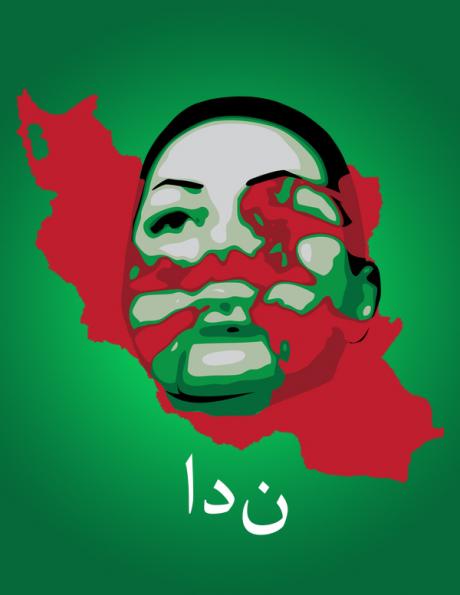
Back to the immediate future - 23 June 09: I was informed on Facebook across the globe by my student Takanori Ogasawara in Aomori Prefecture: 'The movie of the moment of Neda's (ندا آقا سلطان) death are so shocked. We receive the full benefit of peace here in Japan. On the other hand, on the another side of the Earth, a lot of people are dying.' The face of a woman, Neda Agha-Soltan, a philosophy student shot by a Basij militia sniper, on 20 November, dying in the street, was sent by an attending doctor's mobile to a contact in the Netherlands who put it on

the web from where it was picked up and relayed on live-blogs, flickr, facebook, mainstream media, wikipedia to be printed on placards in Iran. I'm just hearing a BBC R4 report in our kitchen at 13.26 23 June 09.
...and one of the most informed of commentators Iason Athanasiadis who spends a lot of time in Iran in The Spectator on 17 June 09 - cautious.
...and from Eric Margolis a sage warning about the higher-politics: 'In viewing the Muslim world, Westerners keep listening to those who tell them what they want to hear, rather than the facts. We are at it again in Iran...President Obama sincerely wants to enter into talks with Iran over its nuclear program and try to convince Tehran to give up enrichment. But hardliners in his cabinet and Congress are urging Obama to seize the opportunity to further destabilize Iran. Bad idea. A stable Iran is essential to a stable Mideast....US and British efforts to subvert Iran’s government could yet blow up in our faces.
...this on internet interception and this from Greek bloggers
[Back to the future -  22 June 2011: A More 4 programme For Neda]
[Back to the future - 14 November 2012: BBC News magazine 'Neda Soltani: 'The media mix-up that ruined my life'

Thursday, 28 May 2009

Reading through the Ionian Protectorate archives

The Ottoman Empire, Rumelia and the Septinsular Republic
The human geography is confusing. Rumelia, Djezair, Wallachia, Anatolia, Cyrenaica? Names of places keep shifting, appearing in different versions, different languages. From secondary sources - mainly the web - I know that over four centuries the Venetians ruled Corfu and the six other Ionian islands - Corfu especially on the front-line between Imperial Ottoman Islam and Christian Europe - then for two years at the end of the 18th century, the islands, taken from Venice as part of Napoleon's rearrangement of Europe, became the French Departements Mer-Égée, Ithaque et Corcyre. Revolutionary jubilation suffused the population as the privileges of the island's Venetian aristocracy were abolished, but taxation of Corfiots and ill-discipline among the French soldiery soured relations.
Just before Christmas 1798 Admiral Ushakov with a joint Russian-Ottoman fleet besieged the garrison at Corfu. Despite extra fortifications, the French surrendered in March 1799. In 1800 the seven islands were declared the Septinsular Republic, a tributary state of Sultan Mahmud II - the closest the Turks ever got to ruling Corfu, though the new Republic was in effect a Russian Protectorate, supported by a population of fellow Orthodox Christians - the period during which the Corfiot noble, Count Ioannis Kapodistrias, who, twenty five years later, would become president of the new republic of Greece, gained his first experience of government.
In 1807, under the Treaty of Tilsit, the French re-annexed the Ionian Islands placing them under the governorate of General Cæsar Berthier. A year later the wider European conflict brought the British soldier John Oswald to the Mediterranean, in charge of a brigade harrying the coast of French-occupied Italy and, then, in 1809 leading a force to invade the Ionian Islands capturing Zante, Ithaka, Cerigo and Cephalonia, where Oswald announced:
We present ourselves to you, Inhabitants of Cephalonia, not as Invaders, with views of conquest, but as Allies who hold forth to you the advantages of British protection.
In 1810 Oswald and Richard Church, an Anglo-Irish career soldier, invaded Santa Maura (modern Lefkada or Levkas) with a force of 2000 British and Greek soldiers, many of the latter to become fighters in the Greek War of Independence. They captured Levkas after heavy fighting. For this Oswald was made governor of the Ionian Islands, based in Zante, maintaining a British strategic presence, forming diplomatic relations with the Ottoman governors of mainland Greece. When Oswald left for England in 1811, Richard Church (later to become a General in the Greek War of Independence) succeeded. After less than a year, Church, slowly recovering from an arm wound incurred in the battle for Levkas, gave up the the governorship to George Airey, to tour through Ottoman occupied Greece as far as Constantinople.
After Napoleon's first abdication but before his return from exile in Elba and the battle of Waterloo on 18 June 1815, came the Congress of Vienna at which, over eight months between November 1814 and June 1815, allied ambassadors negotiated a map of post-Napoleonic Europe. Richard Church presented a report to Congress arguing that the Ionian Islands should stay under the British flag, recommending its extension to Parga and other Greek mainland towns in the possession of Ali Pasha of Yanina.
Corfu, defended by a French garrison under General Donzelot, was ordered by Louis XVIII to surrender to Sir James Campbell. After Napoleon's final defeat and second abdication, Great Britain, Russia, Austria and Prussia under the Treaty of Paris - 9th November 1815 - agreed to place the United States of the Ionian Islands under the 'amical protection' of Great Britain, and to give Austria the right of equal commercial advantage with the protecting country, a plan strongly approved by Count Kapodistria. This arrangement reinforced by the 'Maitland constitution' of 26 August 1817, creating a federation of the seven islands, with Sir Thomas Maitland its first High Commissioner [of Maitland's rule I've more to learn, but see p.174 of this reference: 'a colossal statue' in Cephalonia, a bust by Canova in Zante, a monument in Ithaka and a 'second triumphal arch' in Santa Maura! Chap. VI of the 1821 Edinburgh Annual Register, Sir Walter Scott's ambitious and eventually failed encyclopedic project for which I'm grateful and - 16/6/09 - a comment from Paxos on my flickr posting of Maitland's signature]

Thomas Maitland, second High Commissioner
explains "the advantages of British Protection" 1819
The United States of the Ionian Islands 1817 ~ National Archives
This arrangement lasted until 1864, three decades after the land across the narrow Ionian Sea, had, over eight years of gory insurrection against Ottoman rule, become the independent Kingdom of the Hellenes.
How the islands became united with Greece to be ruled from Athens is a complicated story - one which which surfaces in different versions even today, focusing on whether the British Protectorate was good or bad for Ionians, whether, when we did leave, we jumped or were pushed, and the advantages and disadvantages of union with mother Greece
Coach 420 on the M1 to London and the National Archives
To get more than second-hand insights I need to visit primary sources; see and carefully touch original papers, scan the gestures of official handwriting. So, I'm up at 5.30 for a day in London; cycling to Digbeth for a coach to Victoria (£9.40 return, and my folding bike in its bag accepted as luggage) then catching a District Line Underground to Kew, with a packed lunch from Lin.
I've already learned that the British Protectorate of the Ionian Islands, including Corfu, was headed by thirteen governors or rather a 'Commissioner' changed to 'Lord High Commissioners' - Sir James Campbell in 1814; half a century and twelve commissioners later, Sir Henry Storks, and overseeing the transition to union - enosis, Ένωσις - in 1864 with the Hellenic monarchy, the Greek Count Dimitrios Nikolaou Karousos [scroll down to the Ionian Islands on this link listing lead politicians and officials over the years ].
Primary sources at The National Archives
But now to the formal and informal writings, official reports, petitions, newspaper extracts, copies of letters sent and received (those in French, Greek and Italian translated, to my relief, into English) along with marginal comments. These are bound in heavy volumes bearing the impress of the Colonial Office. They can be studied in the Reading Room of The National Archives at Kew, which I visited for the first time yesterday, in pursuit of unsatisfied curiosity about what Robert Holland and Diana Markides call The Abandonment of the Ionian Protectorate 1859-1864 in their fascinating history - The British and the Hellenes.
I'm also on a long delayed errand following the letter I got from Thanassis Spingos and Kostas Apergis in Ano Korakiana in December 2007:
Dear Simon. It is said that before the Union of the Ionian Islands with Greece (1864), inhabitants of Ano Korakiana signed a 'paper' asking the British Government to keep the islands under Britain...We have been looking for this paper for years at the Greek archives without result. We wonder if you can help us by searching this paper in British archives (Parliament, Colonies archives, Foreign Office etc). We are sure that one of the names that signed the paper is Panos, Panayiotis or Panagiotis Metallinos (Μετταλινος). He was the 'leader'. A similar paper has been signed by inhabitants of Kinopiastes (another village in Corfu) and one village in Zakynthos island...
When I see Kostas or Thannassis I feel embarrassed at my delay. I think I've feared not finding the document they asked me about - through lack of diligence; through not being able to read the language in which it may be couched. After five hours hefting requested books from the locker allocated me in the Reading Room to my allocated desk I'd had a fascinating dip into original sources, gaining confidence as I went along, especially as all documents in Greek or Italian have an English translation attached. Only some of the handwriting is hard to follow.
I'd arrived as an ingénue. The staff at the National Archives are pros - bright, unpatronising. The place teems with people who know their way - veteran researchers - and others, like me, there for the first time.
First step was leaving my folding bicycle and bag in a cloakroom chained 'keep your key...put your laptop and pencils - no pens - in a transparent plastic bag.' Then came the daily briefing for newbies on how to get started - 20 minutes helpful guidance; then to 'The Learning Zone', a few yards away on the same floor where a bank of helpers, screens on-line to the archives, gave hints on catalogue searching. To see Ionian Protectorate documents I'd need a reader's card. That involved five minutes being photographed and showing ID - driving licence and a utility bill. I haven't done original text research for so long, it was like going back to school, with the excitement but not the trepidation. Finally I strolled through a polite security check, swiped my new card and came to the Reading Room.
Here you check in at an enquiry counter and are allocated a triangular space on one of many circular desks. Grey polystyrene blocks for large volumes to protect book spines, little weights like necklaces, so you don't have to press pages down with your fingers, and stands for taking photos with your own or a provided camera are to hand. I was also allocated a locker with the same number as my desk space - 20C - in one of two bays of about a hundred tiered lockers; all with glass doors on the reader's side, open at the bac. As we were told at the briefing talk, you order up to three items from the catalogue, with a note over the desk and, after a bit, by sitting at a computer screen by the counter, entering your reader's number from your card and searching and ordering; the computer keeping a tally of what you've requested already. After a maximum of 40 minutes - time for a coffee downstairs - the first three volumes had been placed in my locker. I could take them, one at a time, to study at my desk space, having ordered the next three items. By the time I'd looked through the first three, the next batch were in my locker. I could take them back to a 'returns' counter or leave everything I'd requested in my locker. (For future visits the first set of documents can be ordered from my kitchen table or wherever I have access to the web, ready for my arrival. Indeed a large part of the National Archives are catalogued for on-line search).
I asked for the documents suggested by Eleni Calligas, the young scholar who knows her way around these sources as well as anyone, an expert in Ionian politics and Hellenic nationalism:
I would suggest that the best place to look is the High Commissioner's Correspondence at the Colonial Office archive of the Protection, housed in the Public Record Office, now re-named National Archives but still held at the Kew. I would look at the last couple of years, from 1862 onwards - probably starting from CO136/177 to /184. If such a petition does exist and is signed by inhabitants of the village, it would be interesting to identify the local figure of importance, as the initiative probably emanated from there.

Five months before the British Protectorate ended
So, on my first visit to the National Archives I've found no petition from Ano Korakiana nor mention of any of the senior names of the village - Savvanis, Vradis, Mandilas, Ionas, Markos, Metallinos, Laskaris, Kaloudis, Linosporis, Reggis, Balatsinos, Kendarchos or Kefallonitis - nor from Kinopiastes - about 6 miles south of Corfu Town - nor, indeed, from any other village on the island.
This does not really surprise me. I understand from Kostas and Thannassis that the two villages on Corfu, and another whose name I don't know, on Zakinthos, were opposed to enosis, and even today - so I read in May's edition of The Corfiot Magazine - of the island's eighteen bands, the philharmonic orchestras of Korakiana and Kinopiastes do not play at the celebrations of Unification Day held in Corfu each 21 May.
[A check on the Ano Korakiana website shows the Samaras Philharmonia Band was a definite presence in Corfu Town on 21 May, along with the three bands from Corfu Town - a reminder, as ever, to check sources! "Η Φιλαρμονική της Κορακιάνας που συμμετέχει κάθε χρόνο στην εκδήλωση αυτή, μαζί με τις τρεις Φιλαρμονικές της πόλης της Κέρκυρας, είχε μια πολύ καλή, ισορροπημένη και «δεμένη» μουσικά, παρουσία, κερδίζοντας τις εντυπώσεις, σύμφωνα με τα σχόλια που μπορούσε κανείς να ακούσει."]
It's possible the petition, if it was a petition on paper rather than a representation delivered orally to Sir Henry Knight Storks, has disappeared from the record, or was never allowed to appear on it. Given the profile of enthusiasm displayed for enosis and the denigration of pro-English sentiments reported by Sir Henry, it's possible that opposition was expressed more privately than support.
I shall search the Storks files again, and look also at Foreign Office files, but it may be that I need to go back to the extraordinary tenure at the High Commissioner's Palace of William Gladstone, over seven weeks between the 24 November 1858 and the 19 February 1859.** Perhaps it was during those weeks, before enosis seemed given, that the elders of Ano Korakiana and others delivered petitions against the ending of the Protectorate.
Such opinions may be unrealistic; they're still expressed, thus Harry Tsoukalas, a business man on the island, planning to stand in the 2009 EU elections in a week:
These things are anathema to say but the truth is that unification with Greece was the darkest day in our history. It was a huge mistake that we have regretted ever since.
In Chapter 2 of their book, Holland and Markides, report Gladstone visiting Athens as part of his Ionian mission. While there he sounded out Ionian and Greek politician on unification:
This analysis stressed 'a divided sentiment' in Greek thinking on the matter, so that union was 'feared as well as desired'. The desire sprang from a natural inclination to cohabit with fellow Hellenes; the fear from the prospect of incorporating a branch of their race whose competitive abilities and education were so finely honed. In sum, the Greeks of the kingdom were fearful that union would turn out to be 'an annexation of Greece to the Islands, not of the Island's to Greece. (p.32)
In a letter to the Duke of Newcastle, (scroll down on the link to '23.12.1862') Colonial Office Minister, in London, Sir Henry Storks includes a translation of an unsigned note in Greek found in Corfu Town:
May the curses of St Spixidion(?)* light on him, who cries long live union with Greece.
Signature of Sir Henry Knight Storks, Lord High Commissioner of the Ionian Islands 1859-1863
*Note: Almost certainly St.Spyridon - Ἃγιος Σπυρίδων - Corfu's protective patron saint.
**Note: Harold Temperley (1937) in 'Documents Illustrating the Cession of the Ionian Islands to Greece, 1848-70', The Journal of Modern History, Vol. 9, No. 1, Mar., pp. 48-55, on p.49 describes three phases - covering at least 22 years - of the question of the ending of the British Protectorate:
A. Period of abortive proposals, 1848-65
I. Lord John Russell on possible cession to Austria, May 1, 1848 11. Palmerston on possible retention, December 21, 1850 111. Gladstone against annexation to England, February 2, 1855
B. Gladstone's attempt at settlement as high commissioner extraordinary and its aftermath, 1858-61
IV. His views on prevalent misconceptions, March 22, 1861
C. Period of cession and its aftermath, 1862-
V. Gladstone on the cabinet decision, December 8, 1862 VI. The queen's assent, December 9, 1862 VII. Clarendon in retrospect, March 15, 1870
* * *
'...not as Invaders, with views of conquest, but as Allies...'
The way the British and the Ionians parted company in 1864 is an exercise in the refined political delicacy with which a lose-lose, or at best a win-lose, situation can be turned into one that goes down in history, often to the bewilderment of those looking for a fight, as one in which almost all feel they've won, though quite a few, as Eleni Calligas observed of the Corfiot radicals, may be left bewildered. Such developments cannot be arrived at by one party to the potential conflict. The work of both, behind closed doors, is vital to the legerdemain of peaceful resolution. Apart from my particular interest in the mysterious petition from Ano Korakiana, this is why the peaceful and dignified conclusion of the Ionian Protectorate is of such enduring interest. In the records I was scanning on Wednesday I saw a translated slip passed to the Commissioner's desk in the last year of the Protectorate; 'If I my wife were pregnant with a child that I knew to be harbouring pro-English sentiments, I would rip it from her womb.' Storks notes receipt and makes no written comment.
How did two parties, both of proven historical capacity for immeasurable blood-letting, end up on 21 May 1864 at the Port of Corfu, participating, against a background of jovial band music, in a joint ceremony, with bunting, flag waving, roaring salutes, bowing, hand shaking and smiles? It was the happy culmination of an exercise in political wisdom that benefits the English in Corfu to this day.
I conjecture that at the opening of the new Acropolis Museum in Athens on 20 June 2009 we shall witness - or, rather, not witness, because their machinations will be circumspect, circuitous and opaque - the prefatory manoeuvering of two politically cunning nations, as they finesse a way of speaking about the contentious issue of 'the marbles' that will eventually allow both parties to claim victory in conserving, maintaining, and restoring that ancient marmoreal commentary on the contest between Athena and Poseidon. Nationalists, kriegsliebers, keyboard warriors, from both sides, will grind their teeth in bewildered vexation, as the British and Greek flags unite, amid fireworks and mingled anthems, at a ceremony of many embraces and a thousand kisses, on a date to be agreed.
* * *
Από: Simon Baddeley Θέμα: Researching the National Archives at Kew in London Προς: korakiana_com@yahoo.gr Ημερομηνία: Παρασκευή, 29 Μάιος 2009, 10:44
Dear Thanasis and Kostas. At last I got myself to the National Archives at Kew in London to search for any clues on that 'petition' from the village. It's been v.interesting but so far I have not found any document from Ano Korakiana or Kinopiastes. I have found many references though to the mixed feelings of people from the Ionian Islands - especially Corfu - about enosis in 1864. I plan to go back next week. If you have any further clues or advice do please pass this to me. Here is my diary with some images of my visit to to the Archives on Wednesday. Kindest regards. Xerete and wish me luck! Simon, Beaudesert Road, B20 3TG, UK
From: Κβκ Κορακιανα Date: Sun 31 May 2009 To: Simon Baddeley
Dear Simon. We are so glad to hear from you. Unfortunately we haven't had any clues so far but it's been very interesting for us to bring some references especially from Corfu. Thank you very much. We are looking forward to seeing you. Thanasis-Costas
Ionian Islands electoral lists ~ 1861 (Sta.Maura = Lefkadas)
* * *Having written to Corfiot News querying the report in the May edition about Ano Korakiana's band absenting itself from the annual celebration on 21 May of enosis with Greece in 1864, I got a reply on 2 June from Hilary Paipeti with permission to repeat it referencing the source - The Corfiot Magazine
Hi, thanks for that. It was always a tradition that Kinopiastes and Korakiana didn't go, but maybe that's changed. I'll amend it for next time! Hilary. PS Here is an archive article...
'Celebrating Union with Greece' Corfu News, Saturday, 15 May 1965:
In 1814 Great Britain, after a decision with the Great Powers of that time - Austria, Russia and France - established herself in the Ionian Islands as a ‘Protecting Power’. It was after the Napoleonic wars and the fall of the great Corsican, when the oppressive violence of the Holy Alliance was clouding the aged continent. A few years later liberating movements started in the whole of Europe. The revolution of 1821 gave the Greeks a conscience of their national rights and awakened into the souls of the enslaved the desire of freedom. The liberated Greek kingdom exercised an irresistible attraction to the people of the Ionian Islands. The French revolution of 1848 - which history considers as a starting point of the people’s spring - urged the Ionians to more vigorous claims. The first demands for a more liberal self-government formed, with the passing years, a strong national and social character. So, when in 1859 Gladstone was sent by the British government to the Ionian Islands to find a conciliatory solution, which would secure the continuation of the established regime of the Protectorate, the only voice he heard was ‘Union and only Union’. Four years later Great Britain was compelled to yield to the liberating struggle of the Ionians to accept the Union of the Septinsular State with Greece. On May 21 1864, the Greek flag was hoisted over the Citadel. Corfu and the six other Ionian Islands became an inseparable part of the independent Greek state.
To this Hilary added, from Corfiot News archives, this contemporary report on events on the island on 21 May 1864 - source not mentioned:
On the day of Union with Greece, British soldiers were exchanging military salutes with the Greek soldiers who had arrived to take over. When the Greek officer gave the order ‘Present Arms!’, one of the Corfiot spectators laughed and commented: ‘You hear that? These miserable Greeks have only just arrived, and already they’re begging!’ The Greek army was represented by some soldiers from the 10th Regiment, headed by General Pisa, who had been commanded to take over the island and its fortresses. As the British troops embarked into their warship and left, the general, together with the military and political leadership of the island, made his way to the Church of Saint Spiridon for a thanksgiving mass. Meanwhile, the common people were not so thankful. Under foreign rule for centuries, they now felt the time for revenge against the elite had come, and they lusted to pillage and burn the mansions of the landlords. And new authority was not yet in place. The people of Potamos, led by their political leader, Heimarios, set off for Town, advancing and shouting curses. Heimarios tried at first to calm them as he feared a confrontation with the army. But finding that impossible, he tried to persuade them to head for the countryside. ‘That’s where the big fight will be!’ he promised. But the most hot-blooded would not listen. They reached Platytera, where the Maltese community lived, and attacked the gardens and fields and smallholdings of the workers of that poor area. Heimarios could not stop them. But then he shrugged and said to himself: ‘Well, let them get on with it. Let them work off their anger on the Maltese, who have no mansions. The worst they can do is beat up a few locals, and steal a goat or two, and they’ll be happy. When we get back to the village, they’ll have calmed down and we can give the animals back.’ The Maltese men were absent, and only old people and children were at home. The Potamites did not harm them. They untied the sheep and cows, herded the grazing sheep, set fire to some thatches, and returned with their grand spoils to Potamos. They entered the village singing in celebration. But at the outskirts, they were brought up short by screams coming from their own houses. While they had themselves been looting, the men of Kontokali, returning in a gang from Town, had put into action a long-held plan to attack Potamos as soon as the British left. They entered the village from the east, causing the women and children to flee. Then they beat up a few remaining men, barged into the houses, and looted everything they could lay their hands on. After the initial shock at finding them there, the men of Potamos struck back, and the gang from Kontokali, caught in the surprise attack, fled down the hill. It was a remarkable sight - the Kontokalites fleeing with their booty, chased by the furious Potamites. But the runaways were weighed down with their loot, so as they ran they were the shedding clothes, tools and household goods they had stolen. The men of Potamos chased them as far as the outskirts of Kontokali. Spiros Peroulakis, a shoemaker from Potamos, was an eye-witness to the mayhem. It was a spectacle that rendered him speechless. The whole scene was a seething battleground, a mass of bodies - men, women and children - struggling against each other with scythes and spades. Meanwhile, two villagers from Korakiana appeared, running with sweat and panting fit to burst. They entered the kafenion where Peroulakis had taken refuge. ‘Give us water!’ they demanded. ‘We’re dying of thirst!’ ‘What are you running for?’ asked Peroulakis. They told him that they were on their way to Town to report to the army that Korakiana was being attacked by a group of about two hundred men from Skripero. At first, Peroulakis was under the impression that they were pillaging the houses of the landlords, but the men told him that they were looting the common houses, stealing oil and wine, and breaking into dowry chests. ‘Why don’t you call on your own men to protect their houses?’ asked Peroulakis. ‘We tried,’ was the reply, ‘but they were too busy looting in Skripero!’ And that is how the Union of the Ionian Islands was celebrated in Corfu’s villages.

Back numbers

Simon Baddeley