Total Pageviews

Showing posts with label Strinilas. Show all posts

Tuesday, 31 January 2012

In town for the day

I was in a room on the south bank of the Thames at some meeting of people in the same business – I’m almost certain it was a conference on analysing and debunking conspiracy theory - when gazing over towards the Houses of Parliament I saw the top floor of Portcullis House, the office accommodation for MPs over the road from the Commons, explode, freezing all in the room but me. No need to conform in dreams, I threw myself to the floor for cover. I knew exactly where this came from. It was a flashback to London’s especially brilliant New Year fireworks display with widely published stills of flames shooting from the upper turrets of Big Ben. Except they confirm prescience I give dreams no credence as prophecy. It was to do with my state of mind, sitting on my own the evening before watching a film of Susan Hill’s The Woman in Black - one of the scariest ghost stories (next to The Turn of the Screw), in which at one point, after a preamble of gathering dread and the illusion of escape to a cosy bedroom; a child’s playful giggle wakes the haunted man, Arthur Kidd. He sits up in his bed in the Gifford Arms half awake in a sweat but curious, when with dreadful abruptness the face of the woman in black, stoops on him screeching through gritting teeth. “She…came for me”.
I’d seen this before but was still on the edge of dread as I went downstairs to the cold and dark to wash, do my teeth, before bed, knowing imagination’s inventiveness; no-one else in the house.  The was the dream sorting things out, plus Parmesan.
Morning ferry to Igoumenitsa

I think I’ll go to town today. I’ve errands. It’s going to be sunny. From the village I cycle down a winding back road to the main Sidari Road, then two kilometres to its T-junction with the Corfu Town-Paleokastritsa Road, then four to the Tzavros T-junction.
My route from Ano Korakiana to town
Here’s the post office. I pay my electricity bill – 20% for electricity the rest, property tax. Then on, cycling in the sun, to join the dual carriageway for eight kilometres to the edge of town – able along most of that large busy stretch to cycle on quieter parallel side roads. I’ve done this journey in winter, at night in pouring rain, in the bright heat of a summer day. I like the feeling of approaching and arriving in the city – especially one as classy as Corfu’s capital.
It’s been hinted that those who live all the time in the Corfu Town look askance at the rest of the island, as some in Chelsea might regard Romford. Boarding a bus to town at a stop in the country as you proffer your fare you say simply “Πόλη” “Poli”. I entered via the main road Ioulias Andreadi towards the old hospital soon hurrying through the traffic that jams up here to visit the good cycle shop just opposite the Ipoliti T-junction to get a decent lock, a slight adjustment to my handlebars and thicker handgrips, which the owner fitted for me in two minutes using a detergent spray to loosen the old ones
“WD40’s no good for this” he said.
On down back streets to The Stove Shop in Solomou Street to ask about replacing cracked fireproof mica in the door and a new inside guard, showing pictures of what I needed on my camera. Stammatis described removing my stove door.
“We have the parts. Bring your old ones in in. It will be done while you wait.”
I went to buy my ferry ticket home, to be sure of the February schedule and headed for the Superfast ticket office by the new port gates. On the way I came to another travel agent and walked in to see Kostas and his son Anthony. Lin and I hired cars from him for two years until we got a better deal from Yiannis in Sidari. He’s always been welcoming, ready with coffee and cakes in his office so we felt embarrassed. Now on my bicycle I was invited in, sat down
“How are you?” We got talking.
I said I’d just paid my tax
“Ah” said Anthony who’s English is excellent “You paid your tax. You are a Greek now.”
We got onto the penalties Richard Pine had warned me of when we had lunch a few days ago.
“Get your floor area wrong for the tax and you can’t even sell your house and your surveyor – your μηχανικός – goes to jail for three years”
“Yes, yes” said Anthony “we have been trying to get our house measured during the amnesty. We had one man gave us 98 square metres, another 102 and one more 100”
“So they will all go to prison?” I suggested
“Yes. Everyone is going to prison”
“I will meet you there” I said. We were laughing. Kostas brought me a skirto and some of his wife’s cake and we chatted more, then Antony took me next door to get my ferry ticket with a 10% reduction for early booking.
So now I cycled back into town for writing paper – having rather taken to writing letters instead of just typing them into cyberspace. There’s no W.H.Smith here. Instead there’s Mastoras, Σπ.Αρβανιτακη 12, [Mastoras Bookshop, Sp. Arvanitaki 12, Corfu 49100] in the city’s central maze. A white haired gentleman of great courtesy realising I couldn’t manage asking for “writing paper and envelopes” “χαρτί αλληλογραφίας και φάκελος”, discreetly found me just what I wanted. Half of me had begun to think no-one would know about such things any more.
From there it was a short ride through marble streets to Zisimos, the most civilised of coffee shops, with no music nor young people in sight, in fact ‘nowt to be vexed at all’, and there I ordered a deep chocolate slice, a double Greek coffee without sugar and a Metaxa - “3 or 5 star?” “3…er…no…5” I replied thinking silently “I’m saving every day, not hiring a car”
 and started writing home until the sun shining down the Liston moved me into shade and I left for the city's main post office in Alexandras Street to be sure my letter to Lin would go at once. No post box gets collections in the winter.
With plenty of light I started home from San Rocco Square via my ‘secret’ route up Avrami Hill above the villas of Mandouki, a road along which, in a car, I can park close to the centre when the town’s busy. I met the main north road to Paleo and from there was home in an hour – going steadily but gently upwards, stopping at Sconto at Tzavros to get wine, pepper salami and prosciutto at the well-stocked concession butcher inside the store. The 1-1 gear on my 21 gear road bicycle elates me. I can pedal steadily all the way up the early slope of Democracy Street below Mougathes – the steepest section until, after Venetia at the top of the village, it becomes the zig-zag climb to high Sokraki.
*** ***
On the few nights I’ve been at home I’ve watched films. The other night, for perhaps the fourth time in 60 years, I watched The Third Man, filmed in 1949, shown to me first at my prep-school by a headmaster who clearly recognized its quality and, because I remember finding it incomprehensible, as I’m pretty sure did most of my 10 or 11 year old companions in the audience that particular ‘film-night’, I assume it was a shown as a spy is inserted into another country as a sleeper to be activated years later when the time is ripe, especially as the film was passed as suitable for Adult audiences, a category that allowed us to view it so long as we were in the company of a grown-up. Well indeed because the next spare evening I watched, for the first time, that equally black and white film of Ayn Rand’s (rather good name for a breed of potato – “Twenty pound of King Edward, hundred weight of Ayn Rand, please”) The Fountainhead. Sixty years later, the sleeper is alerted and inserted. Both films came out in 1949. In one the eventually triumphant hero, Gary Cooper, is the epitome of individualism versus the demoralizing collective, in the other there’s no hero, no obvious collective – rather a shaky alliance, “good fellows on the whole, did their best you know” -
 but the anti-hero, Harry Lime - Orson Welles, who might have approved Ayn Rand – especially given the ‘cuckoo clock’ story Welles added to the screenplay - is a black-marketeer with an engaging smile who profits from smuggling fatally diluted penicillin.
**** ****
On Saturday my neighbour, Effie, said “Simon, come tonight we’re having friends and fish – salt cod”. I turned up at half eight. In no time after lots of greetings of people I recognized from our party last year for Tony and Helen we were round a table enjoying village wine – especially good this year – and παστός μπακαλιάρος, with boiled potatoes and fresh crusty bread for the sauce. The conversation was Greek with English thrown in to help me keep up. I got the gist of about 40% and 100% of the good cheer. Then came sweet things and Effie turned on her tape recorder as we sat around talking ceaselessly.
"I'll sit this out"

I’m not good at ‘fun’. Before I dress up as a woman I make sure Lin’s out of the house with the doors locked, but this evening the men are soon in wigs, grotesque Royal Ascot hats, necklaces, hair bands, headbands, skirts, and after a while – when I wasn’t quite looking – my lips are red with lipstick and I’m not even thinking how to explain this when I skype to England next day.
Dancing of course with clicking, clapping and plates shattering on the floor. In the revels I lose my glasses and fear they’ll go the way of the plates but they’ve just got tangled in my tresses as I throw my head about in Effie’s and Adoni’s kitchen.
Σὰ βγεῖς στὸν πηγαιμὸ γιὰ τὴν 'Ιθάκη - τὴν Κέρκυρα!,
νὰ εὔχεσαι νἆναι μακρὺς ὀ δρόμος,
γεμάτος περιπέτειες, γεμάτος γνώσεις….
Next morning – 8.30 – I was down at Sally’s stables with Mark to help, as promised, with a small job clearing a trail of acacia, he going ahead with a small chainsaw, I - well gloved - clearing cut branches and putting them aside, accompanied by black dogs, Teal and young Drake.
“It’s horrid stuff” said Mark
“Isn’t it useful for something – like Hazel or Spindle or Rosewood?”
“Yes, making a crown of thorns” - Ο Ακάνθινος Στέφανος.
And I saw; removing my glove, touching one strand
“Imagine those woven together and pressed down on your head. You get a small scratch from those, it goes septic.”
Later he told me that he’d seen Acacia used as Shrike’s larders, something I’d read, with illustration, as a child but never seen.
“It’s not only small birds hung there, but mice, insects, pieces of fruit, bits of apple.”
How if you were walking with a child in the country and you came upon such a thing would you explain a 'larder'. Few modern houses have them, as they don’t have dusty attics for family history. How could you explain something which to an older generation would seem ingenious, including the hanging of meat, without lowering their opinion of the shrike?
“It’s because they don’t have fridges”.
*** ***
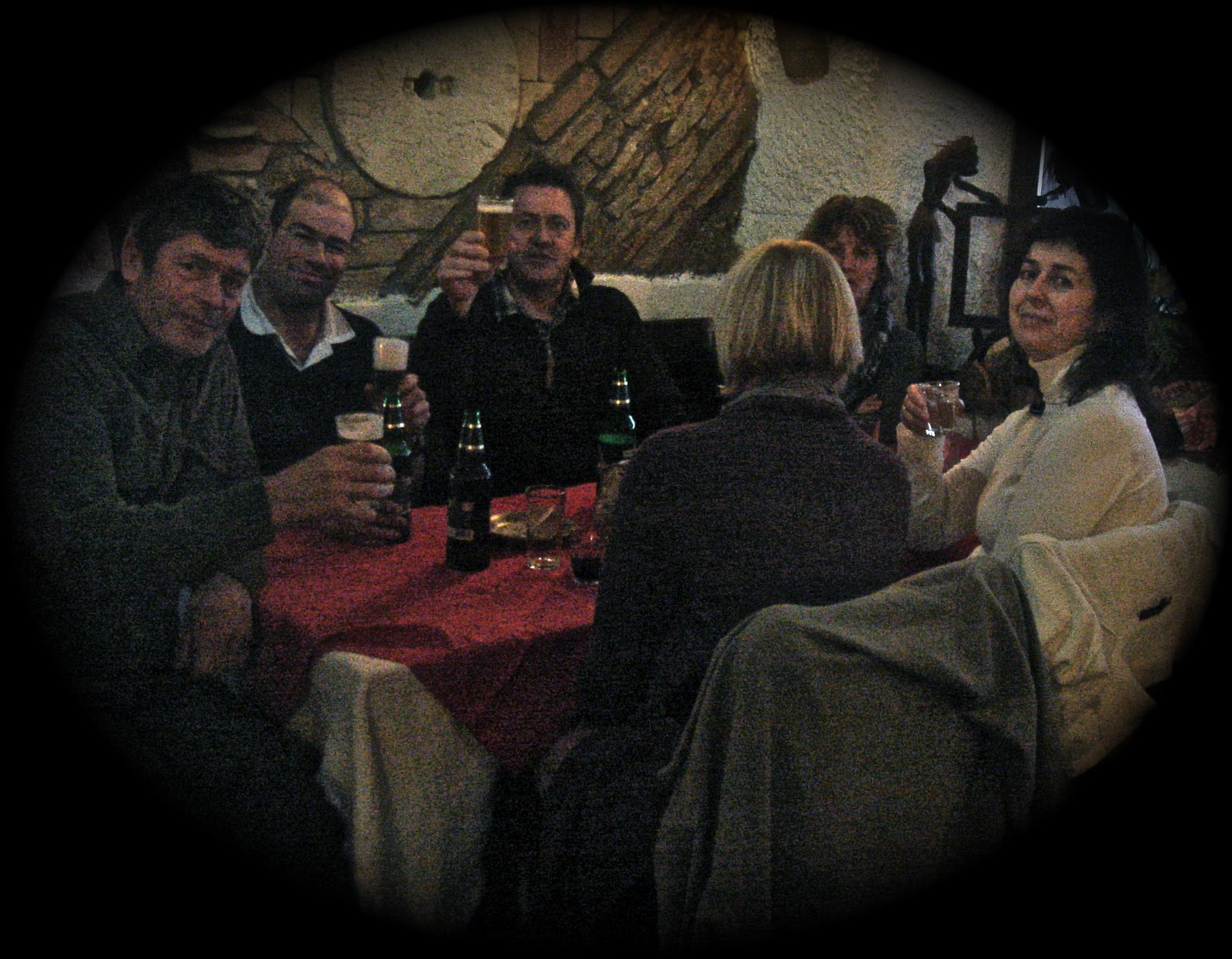
In early afternoon Mark and Sally picked me up outside my house to go for one of those long Sunday lunches with friends I so like – as last year, we drove up into the mountains, to Palia Taverna in Strinilas – with hugs and kisses on arrival at 2.00 and the same on leaving in the dark, getting back to Ano Korakiana by seven.
Strinilas in the mountains for Sunday lunch

I had hesitant fun explaining the party on Saturday evening at which I’d “only watched” (oh yes?) of course while “others” did a domestic enactment of Carnival (“so what’s that on your lips?”), but I was unconditionally proud to share the information that after attending a meeting of volunteers invited to help plan the village Carnival on Sunday 26 Feb. I didn’t understand much of what was being said in a group of 24, with others arriving as the meeting proceeded.

We sat in a circle, chilly, in the unheated meeting room of the Agricultural Co-op. There was nothing as commonplace as a chairman, secretary or an agenda with minutes and the like, but I knew people there and nodded with the rhythm of a lively debate. I didn’t notice just when I was recruited, but Foti told me at Effie’s party “For Karnivali, we are a team, Simon.”
Ένας καινούργιος καρναβαλιστής προστέθηκε στην Κορακιανίτικη καρναβαλική παρέα...Πρόκειται για το φίλο μας Simon Badelley, που με υπομονή παρακολούθησε όλη τη συζήτηση...who with patience watched the whole debate.
Team Carnival 2012
*** ***
Chatting to Adoni, Effie’s husband on Saturday, he was naming different parts of the country for me. In Corfu ‘we’ are the Ionian, over the sea directly is mainland Epirus, further east and north is Macedonia which contains the city of Thessaloniki, south of that Thessaly. “Then is it Attica?” I asked but he told me Attica is treated as just one part of ‘Central Greece’ which stretches from Euboia on the Aegean, east of great Athens to the west coast next to Ionian Levkas. “Then there’s the Peloponnese, then Aegea, which covers all the islands of the Aegean Sea. I wanted to check which of those many Greek islands he would name. And and then Crete - Kriti. East of Macedonia, is Thrace, we use a soft ‘c’ but Greeks call it Thraki – Θράκη. This assemblage is still young compared to the United Kingdom, made by the Act of Union at the start of the 18th century. We have one great challenged border, that between Eire and Northern Ireland – a cause and source of internal war since partition early last century.
 Map: Robert F. Holland, Diana Weston Markides (2006)
Greece, except for the front-line Ionian Islands defended by Venice for four centuries was a part of the Ottoman Empire until the founding of the original Greek Kingdom in 1843 – the Peloponnese, Aegean islands within about 100 miles of Athens and what is now Central Greece from south of Prevesa in the west to the tip of Euboea to the east. Twenty years later the British Protectorate – not colony – of the Ionian Islands became part of Greece. Thessaly was joined in 1881. In 1913, after another 30 years, as a result of the Balkan Wars, Macedonia, Crete and the islands of the north eastern Aegean became Greek – Samos, Chios, Lesvos, Mitylene, and Lemnos. In 1920 under the leadership of Eleutherios Venizelos the hold of the ‘big idea’, in his words, of a “greater Greece of two continents and five seas”, encompassing those parts of Turkey with strong Greek Orthodox populations, the International powers promoted but never ratified the Treaty of Sèvres, ceding to Greece parts of Asia Minor, Smyrna and its hinterlands with North Western Turkey up to Constantinople, giving Greece back its Byzantine capital, a part of the Black Sea coast and all the northern shores of the Sea of Marmora and of the Bosphorus. Turkey’s Grey Wolf, Kemal Atatürk, put a bloody end to that dream in 1922 as allied powers turned their back on Greece, treating Turkey as a preferred ally in the eastern Mediterranean while European leaders fearing the irredentist insurgency and violent repression associated with such bloodily settled borders promoted the Treaty of Lausanne and the great exchange of populations (2 millions forced to give up their ancient homes - Christians in Turkey to Greece, Muslims in Greece to Turkey). This heartbreaking sequence is denoted in the mural dated 1928 that I saw in the Taverna in Igoumentsa the other day – grief for all involved (who knows what further heartbreak it avoided). But via Lausanne in 1923 Greece was ceded Thrace, between Macedonia and a new Turkish border 100 miles west of Istanbul. Then 24 years later after the end of WW2 Italy in 1947 ceded Greece the islands of the south east Aegean – the Dodecanese – tiny Castelorizo, Rhodes, Kos and other island south of Samos, east of Crete. Cyprus, both Greek and Turkish, partakes in the history of contested borders, never became part of the Hellenic Kingdom or Republic but marks the last struggle over the latter’s present boundaries. This briefest of outlines explains the greater prevalence, compared to Britain, of frozen conflict around the edges of modern Greece, some as in the case of Kosovo, Cyprus, islands within throwing distance of Turkey, the former Yugoslav country now called the Republic of Macedonia, threatening to thaw, reviving ancient feuds, for the moment festering as chants in the stands at football matches and abuse exchanged in cyberspace.
**** ****
I was asking Richard P at Harry’s Taverna in Perithia, how one could honour accuracy in speaking in any public medium - a biography, even a novel or essays about past friends - in other than anodyne ways. He’d wondered when we last met how you wrote about the bastards in the place where you lived. I’m not long enough in this village to know them so have no need to censor myself, but - to continue this tremulous meander, do ponder how to speak or write of people who were more than friends. I know at least one person and possibly two who while having no fear of truth or anxiety about esteem would say “Be silent. There’s no problem unless you have one and why should that be?” J’y reste.
I still wonder though how I might…say something that could offend no-one including myself, because these were but also are relationships that are consigned to the past only in the sense that a funeral disposes of a body rather than my present recollection of its possessor. I recall someone in another context far from mine saying revenge against the depredations of an ancient monster – some abusing mentor or relative – was to forget them. Not easy to inter the past. But what of the constant company of worthy wonderful memories and their author? No need to resurrect what’s already eternal. Δεν δίνω συνέχεια. I thought of a souvenir of sorts, an image of self as an old (to be playful with time, spelled ‘olde’) hostelry that enhances it’s living by mentioning in guidebooks, on its website, the possibility that guests may glance in passing, a small brass plaque of uncertain age – it could have been the 1960s but carefully aged, what the dealers call ‘distressed’ - declaring that Good Bess Tudor or the Queen of Scots stayed here on the way to the rest of their lives, even a four poster bed, of insufficient quality to be genuine, stands in for the one in which they just might have slept.

Wednesday, 16 March 2011

Sunday lunch <α λα παλαιά>

Mark said “we were thinking of Sunday lunch together…in the mountains” which rise behind Ano Korakiana with the three crags, almost overhanging the village, their ascent by car or cycle via an old military road with twenty nine hairpin bends, each stretch revealing an ever-larger landscape until you get to Sokraki astride the watershed and can see over the north coast of the island, the high snowed peaks of Albania above Girokaster where our island still runs close to the Balkan mainland. Verged with wild flowers – banks of violet honesty some turning silver dollar, yellow and white daisies, a few spring cyclamen below overhanging olives their spreading roots covered in moss - the road winds briefly down to an upland valley.
Honesty
The weather’s mild beginning to be languorous even in March. Stopping for a pee Mark, strolling off the road, finds a blackbird’s nest full of skyblue eggs. Four kilometres on round a hairpin in the middle of Zigos, a climb to Sgourades, the village with the shop house on several storeys buttressed by grandiose curlicued horizontal corbels that might have been salvaged from a signorini’s mansion, then a turn south west, still ascending, but on the middle slopes of Pantokrator, until coming to a sharp exit left, where the bus parks that connects passengers on the Corfu town-Spartillas-Acharavi service travelling towards Sokraki. We climb steadily meeting no traffic until Mark and Sally stop by two cyclists going the same direction – workmates - pedalling to the summit. With panoramic views south and north, we begin to descend to the north side of the ridge we’ve been following to Strinilas. We park outside ‘a la palaia’ - α λα παλαιά - Yianni and Maria waiting; a kitchen full of cooking. By good chance, Tim and Nikki who’ve come from the north east, were there too. Swiftly our booked table for six is pulled out to sit eight of us. It’s just before two, the journey having taken about half an hour, and there’s a flaming fire and a smell of Sunday lunch. “Forget the menus, Yianni” says Paul “Show us what what you’ve got.” We straggle into the kitchen peering over each others’ shoulders, at casseroles, prawns, roasting meat, rice and vegetables in big pots and all sorts of starter dishes. I’ve already decided on the big squid in its own ink and leave it to Sally and Cinta, both cooks and speaking excellent Greek, to set us all up with a selection of pies – spinach, aubergine and cheese – garlic potatoes, thin sliced chips, big garlic mushrooms with lemon, snails in oil and butter and green salads with goat’s cheese – served with jugs of village white and red wine and beer, garlic and olive butter and a basket of new soft crusted bread; all before our main course – squid, local lamb, big prawns, pork chop - not arriving until we’d had plenty of time to clear the starters. Eating was good; "not much meat on the lamb perhaps", and the seafood was “probably from a freezer in town, shipped from far away…these are the times” someone remarked.
After the main meal had been enjoyed Mark took a photo. After a well judged interval, came custard coated honey baklava, a variety of coffees and a shared dish of apple slices sprinkled with cinammon. <Είμαι ευχαριστημένος> I said. The night surrounded us filled with stars as we descended down the same narrow roads, the lowlands far below sprinkled to the north with the lights of Roda, Karousades and Sidari and villages in between, while, prominent in the southern landscape, the bright cluster of the city at the end of a line of white lights reflected in the sea winding along the coast from Dassia through Gouvia, Kontokali and Potomas to the floodlit Old Fort on the tip of Cape Sidero. On the edge of Ano Korakiana we were stopped by an ambulance in the road by the high sided buildings before the narrow platea opposite the kafeneion, blue lights flashing, men in white coats clambering in, glimpses of starched sheets on a stretcher in a bright interior of shiny equipment and in the dimmer street lights people clustered in the flickering shadows. “I think it’s at M’s house” said Cinta out of their car just ahead of us. In a minute the ambulance was away, the street emptied. At home we watched a happy film – an episode of ‘The Darling Buds of May’ - needing no supper before bed.
****
Dear dear Sachiko. I'm in Greece at the moment where of course we have been getting the terrible news from Japan. I've been in touch with Takanori but not with any other friends from Japan. He mentioned being used to earthquakes but that this was "something special" and indeed it is. He is OK but do you have news of others I may know? I send my deepest condolences at this tragic time for Japan, and to you and your family who must be tremendously concerned both for the country as a whole and in some cases for relatives and friends. Much love and the kindest regards, Simon (and Linda) 
From Sachiko Imai 15 March at 16:21 Report. Dear Simon. Thank you for your concern. I and my family are OK so far. But I'm very sorry that now is not time to contact with my friends and people who you may know. My prefecture Ibaraki is one of the worst disaster areas. In my case, water supply still cut off. Big quakes are continuing every one hour or so. And we have acute shortages of electricity, foods, and gasoline. In addition, my prefecture is bordered by the south of Fukushima prefecture where the nuclear explosion occurred. We must support them with great care. On the other hand, we are also taking care of our own nuclear facilities. The disaster scale is so huge. There is no end in sight. Of course, I would like to think the situation is getting better day by day. Now, as a member of the Ibaraki disaster countermeasures office, I am doing my best. I'd like to thank you for your concern again.  Sachiko
Dear Sachiko. We are thinking of you, with much of the rest of the world. I know that you will do more than your best and am proud to know you. I heard from my university from Caroline Rance PA to our Director who wrote 'We have heard from Irmelind that no one at JLGC has anyone injured in their personal families and that the group of students on their JET programme from the UK are all ok, John, Ian and Catherine are dining today with Ira and three others from JLGC and will be passing on INLOGOV's thoughts and good wishes.' Dearest Sachiko take care of yourself. XXX Love and best wishes from Simon and family. 
** ** **
Messages from England reflecting economic circumstances have included a tough decision not to renew four research posts at the institute, an email from a tenant at one of Lin's properties in the centre of Birmingham saying he's had to leave at short notice as work planned in town is cancelled, and another saying the venue in Staffordshire of our friends' wedding has gone bankrupt. Matt and Liz are nothing if not spirited and while still recovering cash invested in the event over three years - they had taken out insurance - have found another place: Rowton Castle. Halfway House, Shrewsbury.
wedding breakfast menu: starter - salmon and prawn mousse wrapped with salmon and dill. main - boneless leg of lamb cooked in rosemary and garlic, with vegetables and shrewsbury sauce. dessert - lemon curd tart with blackberry coulis and a finger biscuit. we will be marrying at 2pm
guests are expected to arrive at 1pm.....
****
Meltdown and dependence on unwise and untested technologies - op-ed in Huffington Post by Randall Amster. Could there, as events develop at Fukushima, be a re-think of our re-committment in the UK to nuclear technology? See how The Guardian wavers. If only the issue could be seen as a no-brainer. All technologies carry negatives, both in their  application and in consequence of not applying them, but only nuclear energy barring unforeseen inventiveness, promises in the case of high level nuclear waste a legacy of toxic menace that can outlast the duration of man's recorded history on earth:
...The splitting of relatively heavy uranium atoms during reactor operation creates radioactive isotopes of several lighter elements, such as cesium-137 and strontium-90, called “fission products,” that account for most of the heat and penetrating radiation in high-level waste. Some uranium atoms also capture neutrons from fissioning uranium atoms nearby to form heavier elements like plutonium. These heavier-than-uranium, or “transuranic,” elements do not produce nearly the amount of heat or penetrating radiation that fission products do, but they take much longer to decay. Transuranic wastes, also called “TRU,” therefore account for most of the radioactive hazard remaining in high-level waste after a thousand years. Radioactive isotopes will eventually decay, or disintegrate, to harmless materials. However, while they are decaying, they emit radiation. Some isotopes decay in hours or even minutes, but others decay very slowly. Strontium-90 and cesium-137 have half-lives of about 30 years (that means that half the radioactivity of a given quantity of strontium-90, for example, will decay in 30 years). Plutonium-239 has a half-life of 24,000 years. (US Nuclear Regulatory Commission)
The matter of nuclear fusion is sufficiently complex for the stark facts to disappear amid obfuscation, which will clearly include the clear and present danger presented by continued reliance on fossil fuels and the current inadequacy in terms of human energy demand of renewables. As definitive as the  half-life of Plutonium-239, is the fact that in a world of wind, sun, waves. tides and geothermal energy we in the 21st century have not already turned our undivided attention, devotion and capacity for enduring austerity into tapping the energy of these natural renewables. There's a tale of an old man on his death bed complaining to God. "Why didn't you warn me I would die, Lord?" "But my dear child I made your hair whiter, your joints weaker, your skin more wrinkled, your teeth looser, your lungs more feeble. I did this very gradually and very gently so as not to frighten you. What more could I do by way of warning?"
17 March: Dear Simon. I really appreciate your heartwarming message. I hope the all disaster areas in Japan will be restored soon. Thank you very much. Best regards, Sachiko
A most rare public appearance, in measured classical language - an address by His Majesty The Emperor - 天皇 - on what, in Japan, was the 16 March:
I am deeply saddened by the devastating situation in the areas hit by the Tohoku-Pacific Ocean Earthquake, an unprecedented 9.0-magnitude earthquake, which struck Japan on March 11th. The number of casualties claimed by the quake and the ensuing tsunami continues to rise by the day, and we do not yet know how many people have lost their lives. I am praying that the safety of as many people as possible will be confirmed. My other grave concern now is the serious and unpredictable condition of the affected nuclear power plant. I earnestly hope that through the all-out efforts of all those concerned, further deterioration of the situation will be averted. Relief operations are now under way with the government mobilizing all its capabilities, but, in the bitter cold, many people who were forced to evacuate are facing extremely difficult living conditions due to shortages of food, drinking water and fuel. I can only hope that by making every effort to promptly implement relief for evacuees, their conditions will improve, even if only gradually, and that their hope for eventual reconstruction will be rekindled. I would like to let you know how deeply touched I am by the courage of those victims who have survived this catastrophe and who, by bracing themselves, are demonstrating their determination to live on. I wish to express my appreciation to the members of the Self-Defense Forces, the police, the fire department, the Japan Coast Guard and other central and local governments and related institutions, as well as people who have come from overseas for relief operations and the members of various domestic relief organizations, for engaging in relief activity round the clock, defying the danger of recurring aftershocks. I wish to express my deepest gratitude to them. I have been receiving, by cable, messages of sympathy from the heads of state of countries around the world, and it was mentioned in many of those messages that the thoughts of the peoples of those countries are with the victims of the disaster. These messages I would like to convey to the people in the afflicted regions. I have been told that many overseas media are reporting that, in the midst of deep sorrow, the Japanese people are responding to the situation in a remarkably orderly manner, and helping each other without losing composure. It is my heartfelt hope that the people will continue to work hand in hand, treating each other with compassion, in order to overcome these trying times. I believe it extremely important for us all to share with the victims as much as possible, in whatever way we can, their hardship in the coming days. It is my sincere hope that those who have been affected by the disaster will never give up hope and take good care of themselves as they live through the days ahead, and that each and every Japanese will continue to care for the afflicted areas and the people for years to come and, together with the afflicted, watch over and support their path to recovery.." 

Saturday, 5 March 2011

A bump in the night

Mark's Royal Roast
Earlier in the week – a roast at Sally and Mark’s in company with his brother Paul and Cinta – and what a roast! Lin photographed Mark's painstaking collation of goose, pheasant, duck, partridge and chikla cooked by Sally before it went on the table with her small roast potatoes, roast carrots and parsnips with crispy cloves of garlic and a rich gravy passed round in a steaming jug. Oh my! What a meal, and then the cheesecake Cinta’s made for pudding - all with village wine, then cheeses and – made of what was not included in the roast - one of Mark’s patés topped with clarified butter and bay leaves. When we went home he gave us a piece to take for picnics.
Chatting with Paul, Mark's brother, we made sketchy inventories of the wildlife we’d encountered on Corfu. “There are more than 3000 species at least“ he said. Lin and I have seen the short-toed-eagles, kestrel, skops owls, swallows, jays, sparrows, a blue looking thrush. "Ah a Blue Rock Thrush" said Paul. We've also seen at least one hoopoe, and…”
Paul reeled off more mentioning the number found by a twitcher friend who, even as they spoke of the wryneck, had seen one perch on a branch yards away.
"Hundreds and hundreds of seagulls"
"Heading for the tip at Temploni"
“Then there are the lizards, geckos, tortoises, turtles, snakes – several kinds – and pine martens, hedgehogs, weasels, stoats, foxes, rats and…”
We enjoyed lists down to shrews, before getting on to insects and arachnids. He’d had an entomologist friend who’d found, looking in just one place on the island, five species of butterfly he’d not seen before.
“So many species are here for those who know how to watch and look.”
“I remember the first time Lin and I saw fireflies on the edge of the village, and the rose beetles bumping around the house. But” I said “the worst harm, the most blighted environment, for all the concrete on shore, is the marine. Isn’t that where pollution and over fishing have really taken a toll?”
“Probably but I suspect, and I’ve heard it said that there are many species around which have so adapted themselves to our predation, that they’ve found niches where most don’t find them any more.”
“I wouldn’t rely on it.”
“Friends have told me they’ve seen fish they thought could no longer exist around here.”
I’d been speaking of Gerald Durrell, whose biography by Douglas Botting had been lent us from the Durrell School Library by Richard Pine; read at one sitting, into the early hours.
“I’m embarrassed at how little I knew about him. My mind had always been on Lawrence and his novels. I’d not properly grasped the work his brother had done and which continues across the world; his thinking about breeding endangered species in a zoo, quite different from other zoos at the time, until such a sanctuary would no longer be needed, over years of inertia, even active resistance, from the zoological establishment. Now he's among the leading founders of a new orthodoxy, with momentum given to ideas and practices that were once anything but common-sense. I’d started to grasp this when visiting London Zoo last year with my dear friend Ziggi. I'd not been there for decades. The Zoological Society had been critics of the younger Durrell. This time there were no self-harming stir crazy beasts - worst the lions, tigers and bears - rubbing bare patches on themselves pacing back and forth against the tall iron bars of their cages in front of gawping customers - a younger me among them. In those days they were the dangerous animals; we their victims; far far to go as we humans teem upon the planet, but a significant reversal in less than a lifetime, and the seed for Durrell was planted over a few innocent childhood years in Corfu not eighty years ago.
The Garden of the Gods
GD...even today the majority of people do not realize the extent to which we are destroying the world we live in. We are like a set of idiot children, let loose with poison, saw, sickle, shotgun and rifle, in a complex and beautiful garden that we are slowly but surely turning into a barren and infertile desert. It is quite possible that in the last few weeks or so, one mammal, one bird, one reptile, and one plant or tree, have become extinct. I hope not but I know for certain that in the same time one mammal, bird, reptile, and plant or tree, have been driven just that much nearer to oblivion.
The world is as delicate and as complicated as a spider's web, and like a spider's web, if you touch one thread, you send shudders running through all the other threads that make up the web. But we're not just touching the web, we're tearing great holes in it; we're waging a sort of biological war on the world around us. We are felling forests quite unnecessarily and creating dust bowls, and thereby even altering the climate. We are clogging our rivers with industrial filth, and we are now polluting the sea and the air.
*** ***
On Friday night we drove over to the Kafenion beside the church on a tight corner in the middle of Nissaki to have a drink with our Greek teacher, Aleko. He was ensconced at one of several sturdy wooden tables. We were introduced to the owner Yianni, his son Mitsou and another friend, Kosta.
“Two beers for Simon and me, a wine for Linda”.
The place was without a TV. Dim, with a bar and behind us stacks of dexion shelves, and a dappled conglomerate stone floor – 1950s; congenial, with no background sound of half-glanced TV – the dead music and second hand voices to be endured in so much public space, a furnishing so ubiquitous that its absence has to be remarked.
I glanced at jars of honey for sale. “Blimey Lin” I muttered  “€13 a kilo! Who can pay that for honey?”
“Aleko” I said “It’s not just inside. This bloody infotainment. In Birmingham, they’ve allowed - no - encouraged, the installation of a permanent television screen – big as a double decker bus - one side of Victoria Square in front of our grand Council House where the sound and sight of sport and newsak are forced on all. The Birmingham screen's tuned to BBC, though, if they could get away with it, we’d have commercials there alongside the posters.”
“Well they’re converging anyway. Haven’t you seen how the posters are becoming animated. Some clever-clogs are pondering how, once we’ve all got retinal ID, they can circulate eye-spam that knows our name.”
“It’s such a pleasure when you meet a young person who dislikes this as much as we, but they’ve been brought up to it from birth so tend not to notice; even drink it up. Disconcerted by its rare absence.”
We talked about Corfu, and Scotland – which Aleko knows well, as a mathematics teacher at Edinburgh and a mountain climber in the Highlands. We got to naming villages we’d visited on the island. “Sokraki, Zygos on the way to the road over the mountains between Spartillas and Acharavi. Remember that hail storm last time we were passing Strinilas?” I said to Lin
“The car was skidding on hail the size of marbles on a slope below the spreading tree in front of the taverna in the middle of the village."
Another day thirty years ago, Aleko had been on a tour of villages, writing about them. He's stopped to explore...
“The man in the Taverna asked me ‘why are you asking all these questions? Are you from the tax office, the police?’ I explained I was writing a book. He was helpful then…As we talked into the evening there came on such a storm.”
“Hail?”
“No rain rain rain. You know they have no WC there?”
“You have to go up steps, round a corner to a public loo.”
“Then, there was one of those with a hole and two size 70 footprints to stand in. The rain went on and on. You could hear water streaming down the hill. I was on a motorcycle, up a mountain with miles back to town, in the dark. You know those roads?” He gestured their winding turns. We nodded.
“‘You must stay in my house tonight’ the man said. It was up an alley just round the corner. There were no electrics. He lit a candle. We were in the sitting room. It had two doors off the back. ‘I sleep through that one. You sleep in that one. First we’ll have another brandy.’ We talked more, then he said ‘goodnight. Don’t forget to blow out the candle before you go to bed.’ In total darkness I crept into the other bedroom. I got ready to sleep and reached around until I found the bed but it was all bumps. As I tried to smooth them down in the pitch black the bumps moved. I was frightened. What is this? I crept out of the room feeling my way to the sofa in the sitting room. In the morning my host woke me. ‘Why are you sleeping here?’ I gestured to the bedroom. ‘You didn’t like my daughter?’ I went away from there in haste, and ever after would dash quickly through Strinilas. If I’d stayed in that room I’d have been married next day. Passing through the village if I see a woman who looks in her 50s, I still wonder if she was the bump in the night...The old man’s dead now.”
Before we left I shared my yearning for a wooden boat – despite the work it involves – not only that but with something other than a “bloody Bermudan rig”. That got us onto sextants vs sat-navs, a subject on which Aleko shares my views on lost skills, not to mention “modern charts that omit nearly all the land features you could use to take bearings. There’s GPS for you.” Then I got onto my thing about a loose footed sail on a spar that could be lowered and raised” “Like the Arabs, a felucca” “Yes but those were normal here, Aleko. Perfectly adapted over many decades, centuries even, for the fickle weather here, especially is you don’t want an engine other than an oar. Me I’d like to scull.” “Ah sculling” he replied with enthusiasm “I taught myself to do that even though I’m no sailor, preferring mountains, but my brother has a boat, a very nice one with all the kit. I wonder if he knows how to scull”
We made figure of eight sculling motions, holding an oar in the hand, toasting one another with the other.
“I know an old man in his eighties who knows the old boats. I’ll find him for you next time we meet.”
****
Now and then looking over to the sea, I realise how much I'd like to sail on it - not motor, but sail and row and scull. At Ipsos Harbour we’ve enjoyed free mooring for our boat Summer Song since we came to Corfu. The harbour, being constructed with an EU grant ring-fenced to encourage the local fishing economy, doesn’t offer the power, mooring rings, water or security to pleasure boats that would allow charging the few privateers who’ve taken up a space and laid their own informal moorings.
The fishing boats - fibre glass motorboats and graceful small wooden caiques – nestle deeper into the little harbour with access to power and water and a smooth concrete jetty. How much longer can this indulgence last for us, moored on the rougher rubble made projection that protects the harbour from the strong easterlies that now and then drive across the narrow sea from mainland Greece? Word about this rare opportunity has spread among local boat owners. Now and then someone will arrive from the sea, take a temporarily empty space even though most of the twenty or so regular users have put names on their mooring buoys and small landing stages, arrayed them with ropes and bumpers. exhibiting shared resistance to interlopers by reminding them a particular space is ‘taken’.
While we’ve been doing work at 208 Democracy Street we’ve spent less time with Summer Song. Dave who keeps an eye on her when he can spare the time, has twice had to bail out rainwater that's leaked into the cabin. For nearly a year I’ve not been covering the cockpit with a secure awning. The heat of summer and wet and wind of winter having made it unusable. Today I drove down to pagrati bros – ‘number one for awnings systems’ – on the airport edge of town, 38 Lefkimis National Road, carrying the old cover sewn by Pauline, Summer Song’s previous so-owner. I’m not sure how these things go but I guessed that the price would be less than if I’d gone to a marine supplier. The first price mentioned was €320. I looked as pained as I could. The boss suggested an alternative to canvas at a third less. I accepted, knowing Lin would blow her top at the way boats drain money.
I drove homeward via Dave’s patch on the Kato Korakiana road; parked by his camper and swapped gossip. He, Trish and their family and friends had spent Christmas at our house.
“It was great!” He told me there’s an office of some kind near the west edge of Ipsos Harbour. “They’re collecting €40 a month from the yacht owners.”
“Haven’t approached me yet.”
“They don’t know you. But you’ll come across them if you spend time on the boat. They don’t say you must pay, just ask if you’d like to pay. I guess they keep a sort of an eye on the place.”
It was George Gedling, back in September 2006 when Lin and I first arrived in Corfu and were living for a fortnight on Summer Song which we’d just bought on ebay, who told me about the way things worked for yachts in Ipsos Harbour. He lived on the roomy catamaran Symphony moored on the road side of the harbour, running local day cruises out of Ipsos, doing landscape gardening and other odd jobs around the island, including tracking down a woodyard near Calafationis that would supply the tongue and groove cypress we needed to repair our upper floor, and latterly leading a local rock group – that we enjoyed last spring in Gouvia, the last time we saw him.
George as Dave had told us by phone this Christmas, had just gone into the Queen Alexandra in Portsmouth. He died on Sunday. For the last few days there’s been a glass on the counter at Sally’s to collect a wreath. He and his wife had divorced only recently.
Dave told me “She and her new husband and family have taken Symphony to a mooring down Benitses way.  All very quick. There’s another catamaran next to George’s. He’d been looking after it for years after he owner died. There’s been nothing from relatives in UK. The harbourmaster’s posted notice it’s been so long abandoned it must be lifted out and moved. There are two Yanmars I put in that. They’ve been wet a few times but almost new otherwise.”
Lin and I think Summer Song’s present engine is on its last legs. Unwilling to spend the money needed to install a new engine we’ve been prevaricating.
“Let me know about one of those engines, Dave?"
"Will do and I’ll get that broken pump mended or replaced.”
“What about the little old inflatable dinghy?”
“That went” Dave shrugged.
This is the sort of mush I’ve got into, half hoping someone will find me a small day boat with a lateen rig, a lug sailed cutter, something loose footed and shaped like a boat.
Shaped like a boat
I’d so like to distance myself from a yachting universe that's more or less glass fibre and Bermudan sails, and sail a rig - lateen, lugger, gunter, gaff - which might actually function on the mercurial sea of Kerkyra.  I don't really like the internal combustion engine. I so want to just sail or row...or scull. I want to recover the duration and waywardness of wind and oar, not forcing upon myself the scheduling made possible by engines and the miasma of fossil fuel.
Traditional Greek sailboat
So why am I concerned about an engine for Summer Song? She’s a slow old boat better suited for the gustier regularity of English Seas than the wiry treacherous weather of the Mediterranean with its long languorous calms and zephyrs that can hardly move her, or the bang-crash squalls that jump down from hot mountains stirring short steep wavelets that catch her in stays, turgid on her twin keels. In the tideless Mediterranean, her shallow bilge keels that would be useful in tidal waters for cleaning and painting between high waters make her even slower here. If I can't get my loose footed lateen boat of wood then I must have an engine we can trust in Summer Song.
*** ***
I've just read, again almost in one, Mary Henderson's book Xenia - A Memoir, beautifully written, of someone both English and Greek, loving both countries, able to be critical of both, with powerful accounts of life in Nazi-occupied Athens and then of the Greek Civil War. It is another of the books generously loaned me by Yolanda who we met on the ferry from Venice a month ago.
*** ***
Carnival tomorrow! Procession starting Sunday afternoon at 4.00pm, and a party after (see: last year's). Get out the fancy dress and prepare some food to share at the old olive press.
***
Back to the future - 19 March '11 - on local boats with a loose footed sail. I should seek out a vessel called the falkusa, built in the village of Komiza on the island of Vis in Croatia (see also and this). And here's a forum discussion with links to which I'd like to be able to refer including - Traditional Greek Shipbuilding by Kostas A. Damianidis (Athens 1996 ISBN 960-244-038-4)
Croatian Falkuša

Thursday, 18 February 2010

Καρναβάλι 2010 ~ let's face the music and dance


Ian knocked at our door around 10.30 on Friday morning.
“Hold on, hold on!” said Lin disappearing into the bedroom to dress. Outside Ian and his 'concrete man' Andreas were waiting to discuss plan to rebuild the balcony beside the house and the steps up to it. Natasha came home with some shopping and I asked her help.
 “Leftheri!” she called. Soon she, her parents, me, Andreas, Ian, who speaks Greek well, and then Lin, were in conference at the side of the house assessing angles, supports, ways of getting concrete down the 13 steps from Democracy Street and the neighbours' memory of how it had looked before its ill-judged demolition by the previous owners’ builder. It was as exciting as Christmas. No we didn’t want Andreas to start while we were away. It wasn’t a question of trust. Just that problems arise requiring decisions where it’s foolish not to be there to discuss things. So we’ll get an estimate next week and if that’s OK proceed at Easter. (Forward a few months. Not Andreas but Alan eventually made our new balcony)
** ** **
Last Saturday we decided the weather looked good enough to do a guided walk starting from Kalfi to Strinilas and so, well clothed, we ascended high over the silvered coast to Sokraki and drove on via Zygos across a stretch of the Acharavi road until the Strinilas turn high above Spartillas where clouds began. The winds joust over Ano Korakiana on the marches between two kinds of weather. I often see the shift from south wind to north wind, from grey, wet and mild to cold and clear. Blue sky edging southward over the three crags behind us will disappear behind ascending clouds driving north. Gaze from the balcony in the morning and try to guess whether to hang out washing. I misjudged which wind would prevail. On the high ridge below Pantocrator we entered grey mist. Hail rattled the car roof turning the road white with ice. On the short sharp slope to Strinilas Platea our wheels span on ice, a few yards from The Oasis Taverna. “Coffee?” “No electricity” We sat in chill but coffee was made on the gas. I recall the last time I noticed the Oasis full of guests enjoying food and drink shaded from burning sun by a great oak now leafless in mist.
“A Metaxa too?” When the sky lightened and the hail melted, we descended towards Acharavi on the north coast, having abandoned the walk, giving an old lady a lift to the shops. The clouds lifted stretching our landscape. High Albania stretched across the north eastern horizon, mountains bathed in sunlight skirted by broad patches of azure turning to deep blue flecked into white caps by a northerly that, within an hour, had cleared the sky over all Corfu, drying puddles.

Linda and I were trying to understand how a loan to government gets hidden as a currency exchange. The last two or three years have been an opportunity to try to make sense of those ‘financial instruments’ that have been used to erode faith in credit, a concept derived from credo - I believe. I now understand the way sub-prime house loans were sold on in inviting packages to people, institutions and whole countries that ought to have known better.
The case of the Hellenic Republic, now in the news, seems to have entailed venture capitalists offering to pay in dollars for Greek airport tax, national lottery receipts and other assets, that would be repaid in Euros – a currency exchange, not a loan.
[Back to the future 2 March 2010: 'Recent revelations about the extent to which Goldman sold toxic mortgage-backed securities to its clients while betting against those securities in the market prompted Phil Angelides, chair of the Financial Crisis Inquiry Commission, to suggest that this business model was “like selling a car with bad brakes and then taking out an insurance policy on the driver.” Mary Bottari in The Cap Times]
Lin and I played at duping each other
“But the euros will be repaid in the future, so it must be a loan!”
“No we don’t want that money yet as we're confident we'll get a far better return on the investment we’ve agreed to make in those assets in a few years.”
“Er, but we were in debt and now we aren’t, so how come you haven’t give me a loan?”
“Is it a loan if I buy the right at some future date to apply for planning permission to build a house at the end of your garden? Come off it. You're selling me a valuable opportunity. If it was a loan where’s the interest you’d be paying me?”
“Er.”
“We're investing in Greek futures. Paying in dollars. Not only that we'll be taking our profits in Euros. That’s how confident we are in the future of the Eurozone. It’s a patriotic speculation in which we’re proud to be involved.”
“Er. Right. But won’t the accountants in Brussels insist we’ve received a loan to pay off our debts.”
“They never did. Why should they now?”
“Whatever you say, I think it’s a loan.”
“Look. In the UK they’ve been doing this for years. The public argument shouldn't be about loans and debts, unless it's to play up the efficiency of the private sector over the public. Since Mrs Thatcher a large majority of voters have come to believe - or convinced enough not to argue against - that business is better at running things than government. What was part true, part untrue depending on purpose and context is now an article of faith. Do you agree.”
"Until government bailed out the banks.”
“Yes well. Let's go back twenty years. Grab the political agenda that claims private is good, public is bad. This lets government realise vast profits by shifting public goods like hospitals, railways, roads, schools, electricity and water supply systems to the private sector. Business takes over what, for government, has been a political liability. Sovereign risk? Troublesome unions? Vote losing taxes? Floods? Acts of God? Let the private sector take that off your hands. We apply more efficient management and we profit financially, and you, if you've done the political job of selling the argument to the voters, will profit politically. In the UK it's called the Public Private Finance Initiative. No even better, a public-private partnership - a catchy title that shows that government is still there able to regulate the unacceptable face of capitalism. Oh, and while you’re about privatising those assets, announce the issue of shares at a tempting discount to the public, so that instead of belonging to government, all those private hospitals, railways and schools genuinely belong to the public and ... I can't do this any more. It's four-o-clock, let's go to Carnival"
Carnival in Ano Korakiana from Simon Baddeley on Vimeo. Carnivali in Ano Korakiana brightened the greyest chilliest and wettest day of the year. brightened the greyest chilliest and wettest day of the year. Part of the band in motley, military, priest and police, made 'oompa oompa' with drum and fife. The king enthroned, priapic with crown on his heart-covered float, accompanied by courtiers, male as female and other reversals of carnival, paraded upwards preceded and trailed by bouncing umbrellas, a phalanx of pink parasols, women in silvery wigs dancing up to the start of Democracy Street, twirling round a ribboned pole amid whistles, bangers and music.

Stopping and starting the procession gathered more people – some in masks, a long nosed Pinocchio, some as they were; streamers and confetti thrown from windows, hugging and greeting, planned and spontaneous, impossible not to smile and laugh in the chill wet. Up we went to the bandstand, round the carpark and back down the street in rain that poured from low cloud obscuring views to the sea. Nico and Sophia, standing by their front door, invited us in from the cold and wet for coffee and rich chocolates to meet their family.
“All the news is bad”
“Indeed it is” we smiled.
At 7.00 two hundred or so were gathered in the upper room of the Farmers' Co-op on the lower road to watch a demonstrably hilarious dialogue between two women we didn’t understand but clapped with everyone else. Then a formal reading by a top hatted master of ceremonies naming people in the village to theirs and everyone else’s amusement and applause. karnav2010_8.jpg
Then a more disposable carnival king was carried out to the road and burned, with a bit of diesel to overcome the rain. Everyone began moving through a small door down short steps to the lower room to sit at long tables under a beamed roof. We were ushered to Leftheris’ family where dishes had been brought to pass with village wine in jugs, water and cola – lamb, pork, salad, cheese pies, olives, bread in chunks. As we tucked in along with every age, the dancing started with a band that created the mood of the evening, responded to people as they danced and sang – dances for couples became threesomes, foursomes until chains of us were stepping forward six steps one way, two back in that way that can’t help look elegant because the clumpers like me are carried hands held in the ring, six right, left two, unpausing until well after midnight the band made up of two guitarists, lead singer, keyboard and lighting mixer – played unceasingly. The dancing space was seldom empty. If not filled with pairs and chains, it was taken by men and women dancing solo amid clapping support, nimble and beautiful. I danced with Lin and in the circles – like Scottish reels.
“We all drank a lot of wine” said Katya when I saw her at the shop a couple of days later. As at a family wedding, wine added to the enjoyment; none crass. There was a break in the music around one in the morning. I thought we were going home, but after a few minutes, the room filled with lively chatter, the band came back with renewed energy. It wasn’t only the young on tables, though one couple danced with especial virtuosity, the young man - minutes previously in ballet skirt, tights and pigtails now entwined with a young woman who’d begun alone shivering her hips in the Arabian style. This duet had others joining in. The whole room floated on the music and swayed with the singing, happiness making us all even more good looking, and some especially handsome and beautiful. As the band said its goodbyes, an older lady led the Ano Korakiana song singing two line verses, unaccompanied, the chorus picked up by the moving circle. We walked home just before three-o-clock. “I’ve so enjoyed myself” I said “Me too” said Lin. Today I got a thankyou from a villager in Athens who loved seeing all their friends on our YouTube film of the celebration.
Note: The song to the dance is a paeon to Corfu "Kerkyra, overflowing with greenery and beauty...into each and every corner and the seashore..." No sentences, a recital of the island's attributes
* * *

We've nearly finished creating a wall between the stairway and what's now the downstairs bedroom and laying out the old bedroom as a downstairs dining room. Hardest has been knocking headroom from reinforced concrete beam at the foot of the now boxed-in stairs, cutting through the steel rods, but it's near done now and the mess cleared up so we can stand back relieved the house hasn't collapsed and the stairs creak less. Now it's a matter of tidying up the house ready to go back to England for four weeks.
Before the fiddlers have fled
Before they ask us to pay the bill
And while we still
Have the chance
Let's face the music and dance
** ** **
We've enclosed our staircase to make a new downstairs bedroom. We'll cut and mitre wood trim under each tread at Easter. Then we can start work on what's now the downstairs dining room - a better arrangement now we've cut and chipped away headroom in the opening between hallway and stairs and I don't have to risk falling sideways while descending with a tray.
All this has been done for under €100. It's minor joinery, tidied with architrave, trim, sanding, painting and filling with advice from Alan by phone. It'd be peanuts for an experienced craftsman, but we're pleased with ourselves.

Back numbers

Simon Baddeley