Total Pageviews

Showing posts with label enosis. Eleni Calligas. Show all posts

Friday, 21 May 2010

Briefing

The City in May
I've got mail - about the coalition:

Simon...Whatever else might be said about our sainted Coalition, it's certainly transformed the political landscape. Already, a coupla weeks down the line, New Labour are the oldest news. Scarcely a day (or a joint press conference) goes by without the ober-Tories going a deeper shade of scarlet. The Rage on the Right is a joy to behold and the smart money has to settle on the short-odds bet that Dave and Nick probably mean it...never thought I'd wake up to sniff a bonfire of Tory manifesto pledges - Inheritance Tax, Capital Gains Tax, and constitutional reform to name but three. Neither would I ever have associated St Vince with yet another assault on the Post Office* (sugared with a helping of shares for the workforce). These guys are serious and a full five years begins to sound less than fanciful.

Dave is clearly the King of Political Opportunity, out-ballsing even Blair in his C4 moment (parking his tanks on the 1922's turf was a delicious piece of Sudenten-kraft). So where do the ubers go now? And - much more importantly - WTF happens to the metropolitani of New Labour?

In the annals of Blind Robbery, Dave is an extremely gifted operator. In broad daylight, with Lib Dem connivance, he's stealing NuLab's clobber and leaving the poor bunnies to their fate. The only real direction to head is leftwards, towards (brace yourself) some kind of socialism... but a journey like that would tear the party apart. No wonder Cruddas, wise man, said no thank you.

And here's the best quote from this morning's press...an aside from a comparison with the giddy days of '97. These guys, says whomever, are moving at breakneck speed and bolting down promise after promise. Much of this stuff will necessarily have to wait a while, not least because - as smiler Liam confirmed - we're skint. But the sheer velocity of what's happening takes your breath away. And Blair's boys? Back in '97? They hit the ground reviewing.

Nice.G.

** ** **
Took the train to London, cycled through the city to the river, via Holborn and Fleet Street, King William Street; crossed the river on Waterloo Bridge, commuters coming the other way; east on to Tooley Street. When I ride at rush hour in the city I think lines in the heads of thousands since they were composed, since I heard them at school - recorded by Eliot in Mr Lushington's English class at Westminster. He encouraged listening, slipping in analysis when you weren't looking. Redemption and commuting elide unhindered by reasoning:
A crowd flowed over London Bridge, so many,
I had not thought ... And each man fixed his eyes before his feet.
... Flowed up the hill and down King William Street,
To where Saint Mary Woolnoth kept the hours...
But London wasn't like this. Nor I. Lushington also explained the objective-correlative in a way I could understand; which still makes sense. Unvoiced words - phrases - assemble in my head - the river glideth...mighty heart...all bright and glittering in the smokeless air...and with the heart of May doth every beast keep holiday - correlating artlessly with my surroundings connecting them timelessly to all I've known and been taught since birth - sublime and banal, agreeably jostling.
The crowd, like me, did feel sprightly, flowing indeed but more like a parade than a procession. Brown fogs gone.
I'm working with a new council executive next week. This morning I met with with a senior officer and the new council leader to talk through my draft:
GOVERNANCE IN XXX: GETTING THE BEST FROM OFFICERS
Seminar for a new Executive
AIMS
To understand political and managerial roles, responsibilities and structures and how they are changing,
To demonstrate ways in which member-officer collaboration gives direction and purpose to local government,
To learn more about working effectively with and through officers.
This event for senior members aims to strengthen the purpose, creativity and direction of the Council in difficult times. It will focus on better understanding of how new policies emerge, about negotiating the respective roles of members and officers, about clarifying the role of cabinet in the decision-making, modernising corporate governance, reviewing individual skills and information needs, and enhancing organisational capacity.
STYLE: Simon Baddeley with xxxx will use short talks, films, and exercises to stimulate analysis, reflection and shared discussion of these issues.
PROGRAMME (As the programme is participative, timing of specific sessions between start at 1000 and finish at 1500 may vary. Short breaks to be agreed)
Welcome. Introductions. Purpose of the day - Leader and CEO
'The Improvement Journey': working with councillors and officers – invited elected Mayor from an exceptional council
BREAK
Briefing on Xxx Council’s organisational structure – xxxx
A performance framework for the new Cabinet? – Simon Baddeley/Cllr xxxx, Leader of the Council
LUNCH
Constructing trust between members and officers – short talk and discussion introduced and illustrated by SB
Summary: What we take from the day; implications for our work as a Cabinet – Leader of the Council
CLOSE
* * * My colleague Philip Whiteman has helpfully extracted local government relevant policies from ‘The Coalition: our programme for Government’ published by the Cabinet Office yesterday, putting in bold what will be of most interest to us at Inlogov: 4. COMMUNITIES AND LOCAL GOVERNMENT The Government believes that it is time for a fundamental shift of power from Westminster to people. We will promote decentralisation and democratic engagement, and we will end the era of top-down government by giving new powers to local councils, communities, neighbourhoods and individuals.
• We will promote the radical devolution of power and greater financial autonomy to local government and community groups. This will include a review of local government finance.
• We will rapidly abolish Regional Spatial Strategies and return decision-making powers on housing and planning to local councils, including giving councils new powers to stop ‘garden grabbing’.
• In the longer term, we will radically reform the planning system to give neighbourhoods far more ability to determine the shape of the places in which their inhabitants live, based on the principles set out in the Conservative Party publication Open Source Planning.
• We will abolish the unelected Infrastructure Planning Commission and replace it with an efficient and democratically accountable system that provides a fast-track process for major infrastructure projects.
•We will publish and present to Parliament a simple and consolidated national planning framework covering all forms of development and setting out national economic, environmental and social priorities.
•We will maintain the Green Belt, Sites of Special Scientific Interest (SSSIs) and other environmental protections, and create a new designation – similar to SSSIs – to protect green areas of particular importance to local communities.
•We will abolish the Government Office for London and consider the case for abolishing the remaining Government Offices.
• We will provide more protection against aggressive bailiffs and unreasonable charging orders, ensure that courts have the power to insist that repossession is always a last resort, and ban orders for sale on unsecured debts of less than £25,000.
•We will explore a range of measures to bring empty homes into use.
• We will promote shared ownership schemes and help social tenants and others to own or part-own their home.
• We will promote ‘Home on the Farm’ schemes that encourage farmers to convert existing buildings into affordable housing.
•We will create new trusts that will make it simpler for communities to provide homes for local people.
• We will phase out the ring-fencing of grants to local government and review the unfair Housing Revenue Account.
•We will freeze Council Tax in England for at least one year, and seek to freeze it for a further year, in partnership with local authorities.
We will create directly elected mayors in the 12 largest English cities, subject to confirmatory referendums and full scrutiny by elected councillors.
•We will give councils a general power of competence (SB note: what about 'general competence'?)
•We will ban the use of powers in the Regulation of Investigatory Powers Act (RIPA) by councils, unless they are signed off by a magistrate and required for stopping serious crime.
•We will allow councils to return to the committee system, should they wish to.
•We will abolish the Standards Board regime.
•We will stop the restructuring of councils in Norfolk, Suffolk and Devon, and stop plans to force the regionalisation of the fire service.
•We will impose tougher rules to stop unfair competition by local authority newspapers.
•We will introduce new powers to help communities save local facilities and services threatened with closure, and give communities the right to bid to take over local state-run services.
•We will implement the Sustainable Communities Act, so that citizens know how taxpayers’ money is spent in their area and have a greater say over how it is spent.
•We will cut local government inspection and abolish the Comprehensive Area Assessment.
•We will require continuous improvements to the energy efficiency of new housing.
•We will provide incentives for local authorities to deliver sustainable development, including for new homes and businesses.
•We will review the effectiveness of the raising of the stamp duty threshold for first-time buyers.
We will give councillors the power to vote on large salary packages for unelected council officials.
Coming home on the London to Birmingham Pendolino
* * * And from the Ano Korakiana website a reminder, dated 19 May, that the current local council - Demos Faiakon (Δήμος Φαιάκων) - will very soon cease to exist under the Hellenic Government's Kallicrates Plan for reforming Greek local government, and hoping that attention will be given to the collapsing edges of the road just below Venetia by the ravine, and just below the bridge on the same ravine where rain is threatening more damage as well as the need to re-tender the work for the long uncompleted football ground below the village which I understand to be the property of the great Thessaloniki football club PAOK:
Όπως είναι γνωστό, σε μερικούς μήνες, Δήμος Φαιάκων και Νομαρχία Κέρκυρας δεν θα υπάρχουν, σύμφωνα με το σχέδιο «Καλλικράτης». Στη θέση τους θα δημιουργηθεί και θα λειτουργεί μάλλον ένας Δήμος…για όλη την Κέρκυρα. Όσο είναι λοιπόν ακόμη καιρός, η Δημοτική μας Αρχή ας φροντίσει να κλείσει κάποιες εκκρεμότητες και να προωθήσει κάποιες άλλες προς τη Νομαρχία. Ενδεικτικά αναφέρουμε: 1.Την αποκατάσταση από το Δήμο του δρόμου, που από την Επαρχιακή οδό οδηγεί στην είσοδο του χωριού στις Μουργάδες, μέσω Λαμπράδων. Κυρίως εξαιτίας του έργου της γεώτρησης, ο δρόμος έχει καταστραφεί από τη διέλευση βαρέων οχημάτων. Εδώ και μήνες έχει αναγγελθεί η αποκατάστασή του, ενώ έχουν γίνει και οι απαραίτητες τοπογραφικές μετρήσεις. Ενώ όμως το έργο ήταν να δημοπρατηθεί το περασμένο Φθινόπωρο, ακόμη δεν έχει γίνει κάτι και ο κόσμος που τον χρησιμοποιεί καθημερινά ανησυχεί… 2. Την ανάγκη αποκατάστασης από τη Νομαρχία δύο σημείων του επαρχιακού δικτύου εντός του οικισμού όπου το πλευρικό τοίχωμα του κεντρικού δρόμου έχει υποχωρήσει, από τις βροχοπτώσεις του Χειμώνα. Το ένα σημείο βρίσκεται στην είσοδο της Βενετιάς, όπου έχει υποχωρήσει το έδαφος στον τράφο μαζί με τα παρακείμενα δένδρα και το άλλο πριν από το γεφύρι στον μεσαίο δρόμο…όπου πέρα από το χωρίς οπλισμό τοιχίο που «έφυγε» με τις βροχές, έχει αρχίσει και ο δρόμος να «γέρνει». 3.Υπάρχει επίσης η σημαντική εκκρεμότητα του γηπέδου του ΠΑΟΚ, για το οποίο έχει δοθεί για άλλη μια φορά υπόσχεση στη Διοίκηση του Συλλόγου, ότι είναι προς υπογραφή νέα δημοπρασία για την ολοκλήρωση του έργου…Για να δούμε !
* * * Today is of course a day of celebration in Corfu and the other Ionian Islands. 21 May 1864 is the date of the formal ending of the British Protectorate of the Ionian Islands and their union - enosis - with the Hellenic Kingdom. How could any Ionian, unless they were paid servants of the British profiting from the continuance of our military and administrative presence, oppose the lowering of the British flag and the raising of the Γαλανόλευκη over the Septinsular? There were those whose material interests were linked to the spending of the British. There's a fine house near us in the centre of Ano Korakiana that Kostas Apergis - village historian - told me was built from the profits of providing bread to the Protectorate garrison. But I do not mean these people. I refer to that faction within the rizospastai led by Ilias Zervos of Cephalonia
who bitterly resented the calculative way - as they saw it - the British seemed to have deferred to the populist arguments of Constantinos Lombardos of Zakinthos
for enosis, abandoning their Protectorate to the Greek Kingdom before it had been possible to negotiate Zervos' vision of an autonomous Septinsular Republic.
The remnants of this resentment seem to have faded now that Ano Korakiana's band no longer, as they did for many years, absent themselves from the celebration of the anniversary of union along with the band of Kinopiastes
*** ***
Alan and Honey, as promised yesterday, sent pictures of the double doors at the top of the new stairs and the support column at the end of the balcony.
Today Greece received the first tranche of the EU bail-out loan. My Greek Odyssey posts Elytis' prophecy from Axion Esti - a recording.
***
*It's going to anger many, especially Liberal Democrats, seeing Vince Cable pushing further privatisation of Royal Mail. I fact the LibDems raised this at an annual conference 5 years ago. It's about risk and who'll pay for it, given the demise of paper correspondence, even for legal documents, and growing consumer resistance to junk mail, one of the main items now carried by postal workers. I've scanned the response from businesses that use the post office - the Mail Users Association; also the Postal Services Commission's response to the Independent Review of the UK Postal Services Market. Believing instinctively in the contribution of village and 'corner shop' post offices to social cohesion, this is sad reading. Two years ago I imagined trying to explain to intrigued great grandchildren the process of writing and posting letters. It may be that my sense of place can no longer be confirmed by objects and actions to do with the post as we've known it for two centuries. Perhaps I have to brace myself and unpack, empty and refill a bundle of cherished things I associate with a sense of place and community; fill it with other objects and activities. It's chicken and egg. As conventional paper mail declines so the cost of providing it to those who still use it increases. People, as have we, turn to other ways of doing what was previously done by post. Post boxes are threatened with the same future as phone boxes, even though removing them has taken away traditional place markers - objects older people and their ancestors knew as part of the unnoticed noticed. For the young these things have less resonance. This isn't just a public-private issue, though that debate will dominate the politics of the matter. It's about human invention - socio-technical change. Where do I look for other ways to maintain and recreate what matters? Closer settlement patterns versus sprawl; villages instead of suburbs; access via proximity (walking, cycling, urban transit) replacing access by mobility (motoring, flying); carfree and car-lite rather than autodependent; local rather than global food chains - allotments, city farms and home produce versus big box food retailing. Further invention. Smart growth. Sustainability. In Ano Korakiana we don't have much to do with post, collecting electric and water plus rate bills from the last shop in the village.

Wednesday, 20 January 2010

Protectorate or possession?

I was delighted to accept Richard Pine’s invitation, to give a chat at the Durrell School in Philhellene Street in a few weeks - Wednesday 3 February. In Richard's words "7.30 glass of wine, 8pm talk, finish by 9pm".
I'm delving into the varying characteristics of different Lord High Commissioners of the Ionian Islands between 1815 and 1864, relying on sorties in the National Archives at Kew, on the early chapters of Diana Markides and Robert Holland The British and the Hellenes and, of course, on Eleni Calligas’s brilliant 1992 thesis – unpublished - that has brought together rich information about personalities in the Ionian political classes during the British Protectorate.
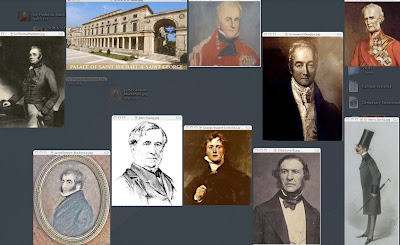
I have a portrait of Thomas Maitland, the graceless aristocrat, who in 1817 wrote a constitution for the Ionian Islands that made them more an English possession than the Protectorate, intended and agreed, in 1815.
There’s one of his successor Frederick Adam, whose statue stands outside the Protectorate's seat of government - The Palace of St Michael and St George at the head of the Liston - a man more congenial to Ionians, married to a Greek, he oversaw the building, for her, of a delightful neo-classical house, Mon Repos, in lovely grounds a mile south of the Commissioner's Palace.
I’m missing a picture of Alexander Woodford, acting Lord High Commissioner for part of 1832. I have found one of the whig intellectual Lord Nugent, keen to implement the liberal principles of his party, who became vexed when the Ionian politicians to whom he’d granted greater freedoms failed to observe his wishes.
Andrea Mustoxidi
I’ve also found one of his successor Sir Howard Douglas who sparred with a new class of Ionian parliamentarian in Andrea Mustoxidi - Ανδρέας Μουστοξύδης - intellectual, scholarly, politically astute, back from Italy enthused by republican ideas of liberty and equality brewing across the rest of Europe, by the outcome of the Greek War of Independence, the founding of the Hellenic nation and the idea of Ionian autonomy - these last two being visions that became contentiously separate in the following decades.
I’ve also a sketchy portrait of James Stewart-Mackenzie, and far better painting of his notable successor - an older portrait - of the exceptional John Colborne, Lord Seaton, a radically inclined Tory who at last dissolved Maitland’s colonial constitution and replaced it with ‘the Seatonian’, acting on the principle that power should be linked to the wishes of the electorate rather than of the Palace of St.Michael and St.George. For Seaton, Maitland’s style of government, far from being justified by Ionian venality and incompetence, was in large degree its cause. He was unique among commissioners in seeing economic problems at the heart of social discontent in the islands - exploited by many years of Venetian mono-cropping (olives in Corfu, currants in Zakinthos and Cephalonia).
Giuseppi Momferrato
The Tory in Seaton saw that by opening government to the parliamentarian liberali, he strengthened the Protectorate and undermined the campaigning zeal of the emerging radicals, the rizospastai, pressing for the departure of the British and the creation of a sovereign Ionian Republic – a political movement driven from Cephalonia – one of its leaders, the zealous and principled Elias Zervo in alliance and friendship with Giorgio Lunzo and Giuseppe Momferrato and others whose names and character I have yet to learn.
Elias Zervo
Seaton’s policies were harmed by the personality of his inherited resident, kept on instructions from London, on Cephalonia – Selwyn D’Everton - whose views on the readiness of Ionians for self-government were out of harmony with Seaton’s.
The irony of Seaton’s tenure as Commissioner was that his efforts to strengthen the hand of the liberali added to the momentum of the rizospasti who were not as distinct from the liberali as he might have hoped. The first outbreak of violence on Cephalonia in 1848 was, as Seaton recognized, a reaction against oppression and poverty imposed by local landowners, but it was used by the radicals to argue a philosophical case against the British. By enforcing the law on behalf of the signorini the British pushed Ionians enfranchised by Seaton’s reforms into the camp of the radicals.
The Rizopastai
I’m missing a picture Sir Henry George Ward, successor to Seaton, keen to continue reforms that favoured the wishes of the liberali, but faced with the murder by peasants of two landowners' employees on Cephalonia, Ward ordered military intervention resented to this day as a violent overreaction – a reminder of the fist in the glove that could be wielded by the British on behalf of the Ionian ruling class in whom they often recognized their strongest allies. There were hangings and floggings on Cephalonia – the latter penalty unfamiliar to Ionians and therefore additionally a focus of horror and widespread contempt and loathing for the Lord High Commissioner across the islands. There were good newspapers; many radical. News spread far more quickly along the islands than between London and Corfu.
Nonetheless Ward’s repression may have been a winning card for those British politicians and diplomats preoccupied with maintaining strategic power in the Eastern Mediterranean via influence on Greece. The dominant voice of the rizospasti, Elias Zervos, was silenced first by banishment to Orthoni, just off the north west coast of Corfu, but then by far more distant exile to Kythera, the southernmost of the Ionian islands, below Methoni in the Peloponnese.
Constantinos Lombardo
A way was cleared for the rise of Constantinos Lombardos from Zakinthos, a more opportunist politician who focused the energies of the rizopasti not on republican principles like Zervos, but on enosis - the transfer of the islands to the young kingdom of Greece.
I’ve a portrait of Ward’s successor Sir John Young. He was perhaps the most direct victim of the fact that Ionians were not restricting their political energies to the region. Islanders had come in delegations to London complaining directly to British ministers and MPs about the conduct of the Lord High Commissioner and his agents, cultivating support in London, and indeed the rest of Europe. There was a long tradition of Greek and British political intermingling, distinguished exemplars being Ioannis Kapodistria and later Giorgos Theotokis, who were able to navigate shrewdly amid the differences of opinion on Greece in the British political classes.
Thus, amid the accelerating trajectory of his career as one of England’s most distinguished statesman, William Gladstone, came on an extraordinary mission to Greece and the Ionian islands, convinced that most of the problems of the Protectorate lay with British policies that had blocked the emergence of a mature democracy there.
This didn't mean he came with the intention of abandoning the British Protectorate. To understand why the British government held so keenly to the Ionian islands I must recognise the motives of every power that has relied on Corfu as a military base.
Stand, on a clear day, on the summit of Angelocastra, (see this in another blog) above Paleokastritsa, from where Linda and I have gazed across fifty miles, maybe more, of the southern Adriatic – defended for three centuries by Venice, coveted in the mid-19th century by the Austro-Hungarian empire, linked in a conflux of Balkan contracts that policy-makers in Whitehall and the clubs off Pall Mall referred to as ‘The Eastern Question’, calculating whether to guard our interest in the Eastern Mediterranean via fledgling Christian states or a declining Ottoman Empire, whether, part quoting John Delane, influential editor of The Times, ‘to protect a cradle’ or ‘watch over a tomb’. Look eastward and you see a hundred miles of the mainland coast of Greece stretching south to Levkas - once Santa Maura - and Ithaka and the long contested sea marches between the Turkish Empire and Christian Europe.
Gladstone favoured the cradle. A fervent Philhellene, steeped in English classical scholarship, he came to tell the Ionians he supported reform of their constitution but not the ending of the Protectorate. Like Seaton, Gladstone doubted the quality of their government under the Protectorate, not the quality of the Ionians. He fell half in love with the Orthodox Church, famously banging heads with the Archbishop of Corfu as they bowed to one another simultaneously.
Had events taken a different turn; had Ilias Zervos and his followers from Cephalonia not been rendered ineffectual by exile, unable to present a serious challenge to the fervent politics of enosis pressed by Constantinos Lombardos and his Zantian followers, there might just have been a sovereign Septinsular Democracy along the western shores of Greece – an Ionian polity treated by the great powers as separate from their preoccupations with the Eastern Question, less subject to the machinations of hi-politics that dog Greece to this day (Would heads at the ECB ponder excluding Greece on the grounds of her weakening influence on the €? Possibly. Would France and Germany exclude Greece, or any of the PIIGS from the EU on mere economic grounds? Inconceivable – except among journalists ill-briefed by marginal politicians). Gladstone’s new constitution, improving even on Seaton’s, was rejected by the Ionian Parliament as soon as he’d left for England, leaving the last Lord High Commissioner, Henry George Storks, to apply all his political talent to ensuring that Whitehall’s decision to surrender the Protectorate to enosis looked like a grand gift to mother Greece from Queen Victoria, so that our people could depart amid guns fired in salute, much bunting, flag waving, kisses, embraces - even tears - on both sides.
To those cynical enough to believe in Albion perfidy two things would be apparent. Britain reserved a robust military foothold in Malta, and more important, as Ilias Zervos realized, greater influence at Athens than would be tolerated henceforth in the Ionian Parliament, having ceded the Ionian Islands as a quid pro quo for for the Greek Assembly's unanimous election of the young King George of the Hellenes. The Hellenic governing classes could rejoice, with some reservations, at this further enlargement of their kingdom; continuing to nurture that ill-fated dream of recovering Constantinople – the name for Istanbul displayed on the concourse of Thessaloniki Railway Station to this day. From Corfu History Forum:
THE UNION WITH THE EYES OF A MONK (translated)
Archives of the monastery of Myrtidiotissa, Catastico 1, p. 168r
During the year 1814, the English conquered Corfu, and their occupation lasted until 1864, when the Union with the rest of Greece took place. It would be better if the earth were torn apart and swallowed us all alive. Three times damn, according to the Triode*, to Bishop Athanasios who made (sic) the Union and doomed the Ionians. In the times of England everything was good, and when the Greek nation came, God’s rage came with them, and all the expensiveness and all the great blasphemy. I remember, when I was a little schoolboy, in 1888, that my father – God rest his soul - used to tell me that at the time that the English were in Corfu, in the village of Synarades only two men used to utter profane oaths, a Stathes P. and another Petros, son of A, and no one else. And the Greek nation brought all the sins to the Ionian Islands.**
* Certain feasts of the Lord in the Orthodox Church will have a canon composed of three odes, called a Triode, chanted at Compline on each day of the Afterfeast.
**Extract from the book of Spyros Karydes Αμβροσίου Μοναχού Χρονικά Σημειώματα, η Κέρκυρα των αρχών του 20ου αιώνα μέσα από τα μάτια ενός μοναχού, 2004, p. 107
** ** **
Yesterday and today we have sun. We did gardening, washing and sawing firewood and going about in the village visiting, observing at close hand work proceeding on older houses - flooring, roofing, repairing down to conscientious details.
In Nico and Sophia's house where ambitious restoration is nearing completion, I had the honour to be introduced to George Poplis a Greek craftsman from Albania who has taught himself - from the internet - the art of wood graining adding to many other fine touches in one of the finest houses in the village.
Across the road, Mark's brother, Paul has a few months more work to do on the house he and Jacinta have moved to from Bermuda (having lived over 15 years ago on Vido). Next door an old house, long up for sale, has been bought by a Dutchman and is being properly re-roofed and set up for residence. We heard of another restoration further down that has not gone so well -woeful workmanship paid for in advance; the half-completed house now up for sale. Up steps above Nico's place is Sally and Mark's house coming along fine with much of the work done by Ian, who was laying a magnificent oak floor yesterday morning. Sally told us that there's a new carpenter's shop opened at the bottom of Ano Korakiana. I couldn't have felt more satisfied at these signs of renewal, enjoying the muffled noise of drills, sanders and angle grinders carried on the breeze drying people's washing, including ours.

Back numbers

Simon Baddeley