Total Pageviews

Showing posts with label Handsworth. Show all posts

Saturday, 26 October 2019

Context


Before first light the parched island is soaked by a drenching downpour, a timely damping down of hectares of tinder. We lie in bed surrounded by unaccustomed gloom, lightning flashing through the curtains, crashes of thunder, constant rumbling. Mountains and sea are obscured; our forested foreground, now grey-green under a drifting overcast. The trees beside the house are wrung by the wind. Pouring rain spatters our windows, its fall muffled on the roof tiles, echoing in the downpipes. Water spills over the gutters splashing on the common path. Where I left a small gap in the kitchen windows, the counter’s wet. Water glosses the plaka under the veranda, the decking and concrete of our balconies, dribbling from the  yellowing leaves of the wisteria, soaking the green and red of the bougainvillea, bowing its branches. Abruptly a quilt is welcome on the bed and I switch to shirts with long sleeves and socks. I wear underpants again; even a jumper in the evening.
From this day of rain a fortnight follows of clear blue skies. The mountains in the east – rising in Epirus and the southern tip of Albania – return, during these unexpected days of early autumn , to their Wedgwood blue haze. The strip of sea between Corfu and the mainland could be mistaken for a placid lake, our green hills along its western shore, barer land over the strait.  
After weeks of washing clothes by hand – no great problem - we’ve bought a washer to replace the old one Lin couldn’t mend. Mark took it away for scrap after I’d unbolted its concrete steadying weights. I've carried them down to the garden where they stand as modernist shapes. From the same store on the road to Lefkimmi we’ve also bought a new wood stove – exact match of the one that came with the house 12 years ago. Age and misuse had warped the old stove's lid; its body leaked smoke from cracks at each corner. I manhandled three hundred weight of cast iron down the balcony steps, through the apothiki, to the garden where, filled with soil from the compost heap, the old stove sprouts a young bougainvillea we’ve bought.   
In search of context I’ve been reading a school text describing British economic and  social history from 1700. It ends in 1975 when I was 33 - just starting to live in a grown up way so it seemed; helping me to try understanding the next 44 years – my small life's window that included marrying Linda, her having our two children, getting our own house, the job I’ve had until I left the university a few years ago; my bicycles and my travels on them, the advent of Mrs Thatcher, the routing of the public sector, privatisation, the ending of the narratives and ideologies of modernism with its vision in many dimensions of 'one society'. About ten years ago I was strolling, with my folding bicycle, along the slab pavement of the Thames South Bank in London. Under my feet I found a commemorative plaque celebrating the Festival of Britain - marking its centre. For a millisecond I caught a full-body memory of a 9 year-old holding mum's hand in just that spot pausing amid many people - an enthusiastic crowded space - in 1951. "I have no wish to return to that time. I'd rather be in the now and the future" I thought. But I liked the thought of having been there long ago. 

So...the changing fabric, population and demography of our city, Birmingham, and other cities, the implosion of empire, the blatantly diverging fortunes of rich and poor, automation, artificial intelligence and the spreading role of decisions by algorithms indecipherable by their authors, the vast harvesting of personal data, the end - almost - of posting letters in mailboxes, the ubiquity of screens and roving phones, the hours spent dealing - over the phone - with energy service companies, the world wide web which I entered only in 1995, personal data harvesting, the dilution of place as a product of vast increases in the ease of transience "I'm both somewhere and anywhere",  identity politics "I'm a type on a bureaucratic check list which is useful to know, and I'm not at all which is also a lesson"; the tsunami of superficial distraction, but also my allotment, my continuing work with family, on getting the work of my stepfather  - Jack Hargreaves - restored and published, and also our project with his descendant family ("such a privilege") to give a a wider profile to the laic sculptor of Ano Korakiana, Aristeidis Metallinos (1908-1987), my involvement with local campaigns especially Handsworth Park, the Victoria Jubilee Allotments...
With our grandson, Oliver, on Plot 14 of the Victoria Jubilee Allotments (photo: Tim Hamilton)


... Black Patch Park and our small charity Handsworth Helping Hands,
Handsworth Helping Hands committee meeting

...our encounters with the law, my membership of 1000Elders and participation, as a subject, in research into healthy ageing, the growing up of our children, the arrival of our grandchildren, our homes in Handsworth, the Forest of Dean and Corfu, the boat Summersong, and, the long association with the Highlands from a childhood Christmas at Fasnakyle through the time my mother married again and went to live near Inverness for forty years, to go back to the 35 years before 1977, my childhood, my abrupt encounter aged 12, on a desk in the study of a schoolfriend's father of black and white photo's, in a hard backed book, of thin bodies bodies piled on trucks and being pushed by a bulldozer into a pit, and youth, my old travels on land and sea, sailing the Channel...
Sailing to France in Two Pearls in 1963 (photo: Barbara Hargreaves)
... the coast of Brittany, the Mediterranean from France to Greece, across the Atlantic in Young Tiger from the Canaries to the Caribbean, my time in America, the faces of those who loved me and taught me, long dead but ever in my mind, the panoply of art, literature, poetry, film, music, sculpture, design, architecture that educates me, and enriches my understanding, my ever-present confusions, vexations and perplexities…
I’m also re-reading – much more closely than in earlier years - Out of Town: A Life Relived on Television by Jack Hargreaves. Published in 1987
‘...this book, like my programmes – is concerned with those times, with the feeling of the old, small-farming life and the know-how of it’. The story my stepfather tells is of the time when his mother and father met in 1889 to 1929 when Jack would have been 18 - ‘until I left the farm to go to London University and read Veterinary Science’  
*** *** ***
There can hardly be a citrus tree on the whole island of Corfu that is not now infested and blighted by citrus scale insects, which over the last two years have settled in numberless scores on the underside of every young leaf, sucking its sap to access its sugar, bringing black mould to the leaves' upper surfaces. We are almost entirely bereft of once plentiful oranges and lemons. We see no end in sight for this grievous blight.
Our orange tree struggling against citrus scale insect infestation, beside three more similarly affected lemon trees

Some cut down their citrus trees. Others pollard them severely. Many paint the tree trunks with asvesti (white wash) but these insects do not travel up the trees from the ground. They move through the air on broad vectors across large areas. The insects, sometimes in a symbiotic relationship with ants, return as soon as new leaf shoots appear. Some spray with insecticide, which works temporarily but is not good for the fruit. We try regular spraying of non-toxic olive oil soap solution under the leaves. It works a little. So far we have avoided the blackened waste that has afflicted some trees we see in passing. We've heard that Bayer have a systemic insecticide applied to the soil around the roots which kills to insects leaving the fruit 'safe' after 3 weeks, and lasting a year. We are considering this option. Meantime we maintain the soap solution spraying with a pump action garden spray. Naturalist friends say there may be a chance of the trees learning to resist the harm caused to the vital photo-synthesis of leaves by insects and mould. They also say that a predator on scale insects may emerge. This is a low visibility catastrophe affecting tens of thousands of lemon and orange trees on Corfu and surely elsewhere. I'm always pleased when travelling on the island I see, now and then, a citrus tree bearing fruit, it's leaves unaffected and healthy. I saw a tree full of oranges in a garden on high ground in a village west of Agros a few days ago. Is it are resistant species? Have the pest insects not yet arrived? Waiting like a evil character in the wings is the olive tree plague Xylella Fastidiosa.


Wednesday, 18 May 2016

The public domain? Our '4 Avenues Project'

'Before'
MOBILISING COMMUNITIES, SMALL GRANTS FUND 2015-16
Handsworth Helping Hands (HHH) -  ‘Four Avenues Project’

INTERIM REPORT ~ May 2016

Overview and interim conclusion
The most significant finding that has emerged from HHH’s work on its ‘4 Avenues Project’ has been the transience of residency in the clusters of houses on which HHH has focused. Handsworth, with other inner suburbs of Birmingham, has a reputation as the home of communities of interest. In the avenues where HHH has worked, four small geographical, rather than social clusters, of no more than 16 houses, we have encountered marked absence of community – or to be precise - absence of local communities of place.
A place? The new street sign put up by Council street services has just replaced one defaced with a blow torch

Individual residents and families may belong to faith groups, ethnic and interest groups, distributed in and around the city, but these do not amount to street life, or any of the things that might be associated with the social life of a village. When encouraged by a temporary HHH initiative in a specific street, a small number of individuals have turned out to help clear rubbish, load it on skips, sweep streets and alleyways, and express views on ‘what needs doing’. This transience, predominantly short term tenancies, poses a problem as to how to bring about continuity of commitment to looking after the spaces outside people’s homes. HHH members have been in meetings with social landlords.
'during'

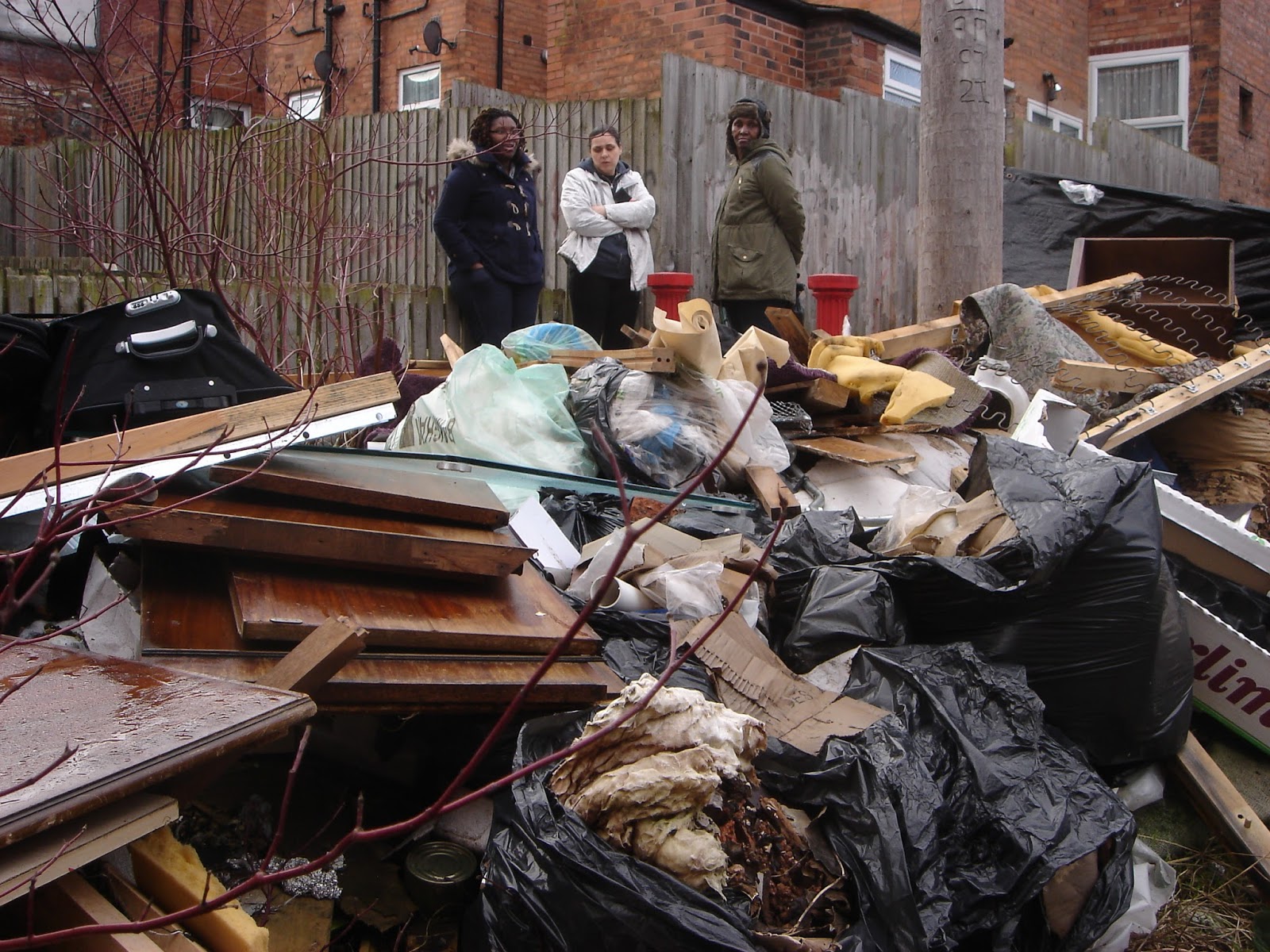
They claim that current economic conditions, preclude them maintaining public spaces surrounding their properties, especially when the street is ‘unadopted’. This retreat, by responsible social landlords, from public space stewardship, is exacerbated by the prevalence of private buy-to-let residencies owned by landlords with no commitment to the space outside their properties, and little for the private space inside them. The frailty of communities of place means there’s no educating process about recycling, removal of heavy object like sofas and waste disposal; no culture of shame to inhibit littering and flytipping in public spaces and shared alleyways, nor involvement in caring about the lives of neighbours; nor is there much evidence of a will, or ability, by the local authority or social landlords, to implement sanctions that might support those residents and local groups who do care about the state of their neighbourhood. Our interim conclusion, given what previous experience and this project has taught us so far, is that no amount of financial capital, even were it available, or social capital in the form of voluntary activity carried out by HHH and similar bodies, is going to have more than a transient impact, without the financial and social revenue that might help create communities of place. The ‘4 Avenues Project’ attempts, through concentrated focus on very small areas, to see if it is possible, through a variety of personal and collective engagements, and a variety of small improvements, with residents and partners, to make a difference. HHH is working with the small proportion of residents who have shown willing to evolve care and attention to that sense of place, whose absence, has become so evident. How we will know whether this possibility has been realised we are uncertain. It is difficult to know if a place has got better. Finding that out, even being able to measure it, is part of the year’s learning. (continued)

'during' - a fish and chip break for volunteers and residents


'after' - but how can this space be looked after now?


*** ***
Gill has emailed me:
I now have a nucleus colony which can go to your allotment. They are Buckfast bees, specially bred to be both docile and prolific.

Dear Gill. Wonderful news! Buckfast bees come up so well on Google (:))
I’ve emailed Winnie who’s on my plot most days and she and I have just spoken by phone.
She’s looking forward to seeing the bees return, which is pleasing given the stings she got only a year ago, along with Dennis.
I have checked with others on nearby plots and they are also happy to see the bees return, especially Danny - two plots away - who, with her  family, had to ‘evacuate’ last year.
I so want this to work!! But nature also plays a part.
Winnie is tidying up the beehive ‘cage’ this afternoon. Her mobile is xxxx. A new number I think. x S
Winnie texted the bees had been delivered Monday evening. [Last year's bee crisis when our plot colony went feral - my letter to the allotment committee - June 2015):
Dear VJA Committee. Re bees. As you know we had a problem on the allotment last Sunday 7th June. For reasons still unclear but experts suspect was a missing queen following a swarm, the bees which for 3 years have been fine and so welcome, went 'feral', stung two people and frightened away several families from their plot that afternoon. In under 30 minutes I was on my plot with my apiarist friend – Gill Rose - who had come more immediately to the 'rescue’ after a phone call from me. Arriving at my plot I experienced a threat - even on the path while well away from the hive - from a dozen angry bees, and had to back off slowly. Another experienced apiarist – Nigel Fleming (Birmingham Beekeepers Association) - joined us and it was very regretfully decided by him and Gill to apply apicide to the colony. I support their judgement. So now for the first time since June 2010 we have no colony of bees on the VJA, tho' there are still some wild bees roaming the site. I have met and spoken to people affected including the people stung and the people with young children who'd been threatened and had to leave the site. All understood the dilemma. We are preparing the case for reintroducing bees on the allotments and want to make sure we've covered every angle on top of the hazards we had anticipated when the bees first arrived – liability insurance, accreditation of the apiarist, risk assessment, netting around hive, first aid kit to hand, approval by committee after consultation with plot-holders. Everyone I've spoken to seems keen to see the bees back and is sad that such drastic action was needed. Any advice? What is the view of the VJA Committee on re-introducing a bee colony to the site? Did the people directly responsible respond the ‘bee crisis’ swiftly and responsibly; call to Simon from Danny W at 15.37 on Sunday? - attendance at the hive by 16.10; - decision to apply apicide when all bees had returned to hive; - 18.15 Simon notified by Gill that colony has been destroyed; - from 16.00 Simon on site talking to people affected, with follow up on subsequent days and via Facebook and email to VJA committee members Kindest regards, Simon, Plot 14, VJA


Tuesday, 29 September 2015

'The cold outside'

"Welcome home" said Mark over my phone "A beer at Piatsa?"

It was long before the film of Zorba the Greek, a few weeks before Easter 1957 - ours had been on April 8th (I checked on Google). Greeks held theirs on April 21 that year. I was 16. By the time my train got to Larissa, it was hours after midnight. I was half-asleep; a compartment to myself – the seventh day of a rail journey from London via Paris and Venice where I’d spent two days in an elated stupor breathing the smell of damp paving.
Abruptly the door of the compartment was slid open. A wedding guest party surrounded me, chatting, gesturing, drinking. Vexed by their thoughtless invasion of my space I signalled them to quieten down “pleease!”.
Used to exercising weight, tutored to being in authority, I probably missed an initial hint of displeasure across the carriage of this Greek train on Greek soil. I do recall their amusement. There was the offer of a drink (tsiporo?) and gestured encouragement to join in. Surrounded  by happy laughter, not mockery, I turned, irritated, towards the darkness beyond the steamed window of the train rumbling down to Athens.  There, at dawn, on a low platform, the Greek side of my family awaited with joyous greetings, and many disturbing hugs and kisses. Through a tiny window from the loo of yia-yia's flat in Kolonaki I saw the Parthenon - no longer the familiar schoolbook illustration, the real place!
Five years later I was with a friend. We’d sailed on a small boat from England drifting ahead through August heat for landfall. After a swift reach from Sicily. sunrise on the third day, the good wind abandoned our small vessel on a limpid mirror. Fifty years later the moment remains as dreamlike as at the time; glimpsing the forms of land melded to white sky and coppery sea - a way to the mainland of Greece between Cephalonia and Zakinthos into the Gulf of Patras, 170 miles from Piraeus and the city to which I’d determined to return.
I spent my first twenty five years in a fog of schooled and inherited insensibility, almost impervious to the wisdom of generous parents – English and Greek - who probably knew that, as perhaps for them, only time would tell me.
In 1968 I was with one side of my family again. They’d flown on to Greece. My dad wanted a car while we were there. Over four days I drove his small Hillman through Belgium, Germany, Austria, Italy and by ferry to Greece (Patras? Igoumenitsa?) sleeping one night in a field above the sea, a few yards from a narrow road. From Piraeus I took another ferry to join the Greek side of my family in Aegina. We returned to Athens for a day, where, with my diplomatic family, I attended a house party somewhere near Vouliagmeni, hosted by a man whose bald head I glimpsed for a few seconds, Colonel Stylianos Pattakos
It was only in Detroit, married a year later, meeting American Greeks - and Greek exiles from the Junta - that I grasped the discomforting notion of ‘sides’, of Greece as a polity, of animosities and moral positions, words and facts and opinions that left the paper-fragranced sentences of my superlative education – in one ear as others' thoughts, out of my mouth as words for conversation and essays, and out of the other ear unedited.
Though it seems so in memory, I could not have been quite that one-dimensional, except perhaps at my mother’s breast. My CV, by the time I was thirty, was enough to ease me into academia where, mostly fuddled, time did begin at last to tell and I began to listen.
It was 25 years before I came to Greece again.
Flying to Greece - Amy, Linda, Richard

Standing in the cockpit of our Airbus (full of screens and no joystick) where passengers could – pre-9/11 – still be invited for a pilot’s glimpse of the world ahead, I stood behind my family (now my second marriage), as with Linda, Richard and Amy, we flew high over the border of Greece; able to see to port the glow of Thessaloniki; ahead the greater glow of Athens; to starboard a moonlit Ionian Sea and far below, in inky blackness, clusters of tiny glittering diamonds - villages in the foothills of the Pindos.
“Children! There’s Greece”
In the dim cabin tears welled from my eyes with the delight – and the idea – of sharing ‘my’ Greece with my wife and children. I could not speak for a moment.
Met by our relative’s driver we were swept into Athens towards Kifissia. My half-Greek half-brother and his family were with us. He too hadn't been back to Greece for a long time. Shopping malls flashed by; showrooms with glistening new cars behind picture windows, furniture shops displaying stainless steel and leather, fashion boutiques, a bright neon frieze.
“Amazing!” said George “It’s a modern European city”
I was presented with a Greece that was without the strange and magical difference that had struck me and fixed itself in my memory decades earlier. Air travel had taken away distance. All seemed lit by the familiar light of common day, modern, grown-up, no longer enchantable, respecting routine, far less dumb, a man who’d returned to meet the boy who several times had left Greece seduced by something that had been other and exotic.
I noticed blemishes – ugly architecture, urban rubbish. We enjoyed our holiday immensely. I was delighted and relieved my family liked this familiar Greece as much as I - even if not as I had first seen the place - climbing up to the Acropolis together tho’ by then the inside was fenced off to tourists, strolling in the Agora, taking the train about the city, driving through great mountain ranges of the Peloponnese via Sparta and Kalamata to Pylos, picking our way through the ruined fort of Methoni crumbling battlements and sudden chasms unhindered by health and safety warnings, sipping from the Pierian spring by the Roman temple of Corinth, where we plucked fresh figs, visiting islands in the Aegean.
Life went on. My dad died long ago. My mum, who’d divorced him years before then (hence his second marriage to an Athenian and my Greek family), remained the bridge to yet another country – the past, in which I’d not lived, an unknowable land of fantasy and invention, and the landscapes of the Highlands and its clear peat waters.
River Farnack in Strathnairn with Oscar
Σα βγεις στον πηγαιμό για την Κέρκυρα να εύχεσαι νάναι μακρύς ο δρόμος...


We could talk about our separate experiences, my adventures as novel to her and hers to me.
My Greek stepmother Maria had, like this modern Greece, become part of an ordinary present, older, almost British, no longer part of the wondrous seduction of that distant land where I’d arrived by rail, sea and road so long ago.
Coming back to Greece - painted in 1970. Hung until she died above my mother's bed. Now I'm unsure where to put it.

I come aged 66 to the morning around our kitchen table in Handsworth. My beloved daughter, Amy, tells her mum she’s seen a yacht on a free mooring for sale in Corfu on ebay. I bought it, on an unwise impulse that brought Linda and I to Greece to buy a small house in the village of Ano Korakiana.
Beforehand, our very first evening in Corfu, hire car from the airport, having seen the boat and been disappointed but resigned to our purchase; considering the possibility of ‘making a list’ of things to be done, we went to an English bar on the cluttered strip-front of Ipsos, looking over the Corfu Sea to the bare mountains of Albania and Epirus. Our fellow customers were British. Notices, including our menu, were in English. In amiable company we had our first meal in Corfu – fish and chips with mushy peas; vinegar beside HP sauce. Above the bar a flat screen played desultorily watched news of the world delivered with loud familiar voices by familiar faces interspersed with pop and football. On shelves in a corner were popular paperbacks to be exchanged; below them a week-old British newspaper, headlining an event in the public life of a celebrity. We inhabited ‘modern times’.
No longer do I leave ‘here’ to arrive ‘there’, separated by poste restante mail and, in emergency, complicated phone calls by appointment. Here and there is now everywhere.
I can sample the 'other'; what is different, exotic, foreign but welcoming – what I experienced and enjoyed in Greece at 16 – I can take a cycle ride in Handsworth in my England and see and greet men and boys in djellabas leaving their mosques, women in black wearing veils over all but part of their face, Sikhs in turbans from their Gurdwaras, woolly hats in the national colours of Jamaica, dreadlocks, weave, ....

Soho Road, Handsworth

....Somalians, Eritreans, Kurds, Iraqis, Syrians escaping war and poverty in the Horn of Africa and the Middle East, and, since EU enlargement, Poles, Roma from Rumania, Lithuanians, Bulgarians, Ukrainians, Turks, even Moldovans, also Christians from Vietnam, and, on our allotments, a Chinese family. On the Soho Road, a short walk from home, the few small supermarkets are outnumbered by the high street shops serving Handsworth’s bouillabaisse. Near home I overhear myriad languages and dialects, beginner’s English, Brummie accented.
Birmingham New Street


But since no-one would yet – or ever - consider Handsworth or its sibling inner suburbs encircling our city’s centre, a touristic, or even a gentrified destination unlike London's Brick Lane, here’s no threat to personal autonomy and human dignity as a result of visitors’ objectifications of local cultures; no more risk of having our encounters ‘commodified’ than in Anatolian Smyrna or 19th century Alexandria; no likelihood our place will be ‘spoiled’.
Here among my good neighbours...
On our street

...is crime, ill-health, mental illness, deprivation, disappointment, sadness and loss. Part of the population is transient, waiting, amid the wealth of successful immigrants planning to leave for new homes far from the centre. Here is village life in the city - a littered place of ill-repute where some strangers fear to visit - more so after dark - and indentured sociologists write semi-scanned policy papers for government. Where we’ve lived for forty years.
"Welcome home" said Mark over the phone to me in the village the afternoon of our arrival in Ano Korakiana.
I don’t think of Greece as a place where I have a second home, as might families of a certain prosperity and provenance. All over Handsworth are families of our imploded empire who make return visits to their natal villages – in Pakistan, Kashmir, the Punjab, the Caribbean, as also the villages and towns of Eastern Europe. We are nearer to them in our transhumance – returning home now and then.
Time to return to the pages of fairy stories? 'Once upon a time….there was a town, a little house, a great dark forest'
….I first met him in Piraeus. I wanted to take the boat for Crete and had gone down to the port. It was almost daybreak and raining. A strong sirocco was blowing the spray from the waves as far as the little café, whose glass doors were shut. The café reeked of brewing sage and human beings whose breath steamed the windows because of the cold outside....
Warsan Shire ~ 'Home'
no one leaves home unlesshome is the mouth of a shark
you only run for the border
when you see the whole city running as well
your neighbors running faster than you
breath bloody in their throats
the boy you went to school with
who kissed you dizzy behind the old tin factory
is holding a gun bigger than his body
you only leave home
when home won’t let you stay.
no one leaves home unless home chases you
fire under feet
hot blood in your belly
it’s not something you ever thought of doing
until the blade burnt threats into
your neck
and even then you carried the anthem under
your breath
only tearing up your passport in an airport toilets
sobbing as each mouthful of paper
made it clear that you wouldn’t be going back.
you have to understand,
that no one puts their children in a boat
unless the water is safer than the land
no one burns their palms
under trains
beneath carriages
no one spends days and nights in the stomach of a truck
feeding on newspaper unless the miles travelled
means something more than journey.
no one crawls under fences
no one wants to be beaten
pitied
no one chooses refugee camps
or strip searches where your
body is left aching
or prison,
because prison is safer
than a city of fire
and one prison guard
in the night
is better than a truckload
of men who look like your father
no one could take it
no one could stomach it
no one skin would be tough enough
the
go home blacks
refugees
dirty immigrants
asylum seekers
sucking our country dry
niggers with their hands out
they smell strange
savage
messed up their country and now they want
to mess ours up
how do the words
the dirty looks
roll off your backs
maybe because the blow is softer
than a limb torn off
or the words are more tender
than fourteen men between
your legs
or the insults are easier
to swallow
than rubble
than bone
than your child body
in pieces.
i want to go home,
but home is the mouth of a shark
home is the barrel of the gun
and no one would leave home
unless home chased you to the shore
unless home told you
to quicken your legs
leave your clothes behind
crawl through the desert
wade through the oceans
drown
save
be hunger
beg
forget pride
your survival is more important
no one leaves home until home is a sweaty voice in your ear
saying-
leave,
run away from me now
i dont know what i’ve become
but i know that anywhere
is safer than here

Friday, 1 July 2011

Our shed

Lin came along with me to help lay the foundation slabs for the shed, itself obtained free via freegle on our allotment. We got some slabs through freecycle, some we lifted from street skips (with permission) and from a householder re-paving his front garden with red brick. He helped me lift them into the back of Lin's car. Once unloaded and stacked beside our plot I borrowed the allotment association's trolly to get them down to the raised area prepared for the shed. There are still four more slabs to position so we have a large enough paved area for a 6' x 8' shed. Lin and I took turns holding up the door-end, to place the shed where it'd do least harm to our view of the Park. I look forward to sitting inside the shed on a rainy winter day dunking biscuits in a mug of tea made from water I've boiled on a small propane stove. Having sawn through some panels to get them into the van we hired to collect them from Walsall before Christmas, I've got to join them up with splints. We need to refelt the roof and put glass in the window frames - perhaps transparent plastic sheet. And before assembly each panel needs weather-proofing. We also need guttering, downpipe and a waterbutt and I've a mind to lay some industrial carpet tiles we've been storing for a touch of extra comfort.
And from Corfu Richard Pine sends an email drawing my attention to one of many tents in Syntagma Square...
Οδός Δημοκρατίας, Πλατεία Συντάγματος, Αθήνα, Ελλάδα
*** ***
Yesterday evening we finally got enough members of the 'old committee' of the Central Handsworth Practical Care Project together at a community meeting room in Carlyle Road for the 'voluntary advisory group'  to be voted the delegated powers needed to make progress in getting the organisation into better repair.
Mike, Leslie, Linda, Edmund, Daphne and Charles in Carlyle Road
Many uncertainties remain but with good will and not too much bad luck we could be up and running, though we're not yet out of the woods, which is why Lin and I were up late enough again to see the sky lighten and, as the light grew, catch people in Canada and Australia for chats - one in our 'yesterday' and another in our 'tomorrow'. John Martin our good friend in Bendigo had turned the strongest green. Wonderful technology skype but we're still in its early days.
John asked about our allotment and I clicked on the screen share option which only works at present from me to him as his version of skype doesn't seem to have that option. I shared pictures - still and moving - of me scything, using an azada and being snide about strimmers. Meantime the sun rises over the roof tops of Handsworth.
Dawn in Birmingham (Photo: Richard Baddeley)
** ** **
Συζήτηση για το Νερό...
It seems to me that enough wise men and women in Ano Korakiana have got together to have had an encouragingly productive discussion yesterday about the water supply problem in the village and the surrounding area down to the coast. (for background see last para here...The areas nearer to the sea and of course more populated do not have 'good' water.They call it 'sea-water'. Our area Ano Korakiana has very good drinking water since they opened the bore-holes at Humouli and Damari - στη Χούμουλη και στο Νταμάρι. These two bore-holes cover all the needs for drinking and general use water for Ano Korakiana, Lower Korakiana and Agios Markos. In order to satisfy all, they draw more water than what is available.... ) 

Saturday, 19 March 2011

Found in translation

Linda went to see her parents in Cannock on Saturday, taking oranges and lemons from our garden in Corfu. Dorothy, my mother-in-law, eats lemons as I eat oranges. I've been working on my diary for our fortnight here - see the dentist, the doctor, do two pieces of work for the university, visit Darlington to borrow Mark Taylor's VHS tape of my stepfather's programmes and get it digitised, possibly by Tony Herbert, one of the members of the informal 'Jack Hargreaves Committee' I've convened - over the internet; visit Richard and Wendy Hill in Havant, do work on our allotment and on our garden, lead another history walk through Handsworth Park this Sunday (last year's walk).
This afternoon I cycled into town to run through a list of errands, after a morning of on-line work on my correspondence. How I sympathise with the hard bitten hero in those cop procedurals who has to do routine paperwork to fend off station bean-counters. Lin spent yesterday and last night doing the same - insurance, tax files, bills that come by post, and a phone call or two, one to tell us a neighbour of thirty years had dropped dead of a stroke a week ago. In the midst of the routine our lives are leavened by visits from our daughter, while our son and girlfriend make us a supper of bangers, from Bowketts of Oldbury, and mash with fried onions, fresh leeks and some red wine.
A baked potato with lots of butter and a cup of tea in the Rag Market
In town I went to the market to have a baked potato, buy bird food, a new pair of cheap shoes, then to busy New Street Station to get pre-booked rail tickets to London, Darlington and Havant and finally to Illingworth's in the Western Arcade to get my Tor Oriental cigarettes - dearer than my new shoes. But before that I dropped into the Apple shop to see if there was news of Niko, our Greek teacher. I asked an assistant who pointed behind me and there  he was - "my first day back at work" - after just returning from caring for his stricken mother in Athens. He gave me hurried news, said he'd be in touch tomorrow. we embraced.
****
There was a public meeting in the village council on the 19 March to discuss the proposed windfarm - αιολικού πάρκου - on Trompetta and its repercussions for the village and its surroundings. In a packed room discussion began after a briefing from President Nikos Metallinos, followed by the Chairman of the Council Spyros Thymis:
Σε «ανοικτή» συνεδρίαση του Τοπικού Συμβουλίου Άνω Κορακιάνας συζητήθηκε απόψε το θέμα του αιολικού πάρκου Παντοκράτορα και οι επιπτώσεις του στο χωριό μας.  Στην κατάμεστη αίθουσα του ισογείου (αφού το θέμα βρίσκεται στο επίκεντρο του ενδιαφέροντος των κατοίκων) η συζήτηση ξεκίνησε με ενημέρωση από τον χωριανό μας Νίκο Μεταλληνό και ακολούθως ο Πρόεδρος του Συμβουλίου Σπύρος Θύμης διάβασε το ομόφωνο ψήφισμα στο οποίο είχαν καταλήξει λίγο πριν τα μέλη του Τοπικού Συμβουλίου. Το ψήφισμα, αφού εκφράζει την αντίθεση του χωριού στην επικείμενη εγκατάσταση ανεμογεννητριών, καλωδίων και υποσταθμών, ζητάει την πολιτική, νομική και οικονομική συμπαράσταση του Δήμου Κέρκυρας στην αναγκαία πλέον προσφυγή στο Συμβούλιο Επικρατείας, καθώς επίσης και την ανάκληση της απόφασης του Γ.Γ. της Περιφέρειας. Η συνέχεια θα δοθεί την επόμενη Πέμπτη το βράδυ στη συνεδρίαση του Δημοτικού Συμβουλίου Κέρκυρας, όπου θα συζητηθεί το θέμα. Το πλήρες κείμενο του ψηφίσματος ακολουθεί...
A unanimous resolution was passed expressing Ano Korakiana's opposition (widely shared on the island, though not so much by me) to the imminent installation of wind generators, cables and substations, regretting the support given the project by the Municipality Corfu and the Regional Authority. I don't want to oppose renewable energy technologies despite recognising the immensity of the project and the enormous amount of road activity that will go with building the farm. We both assume that traffic will not try to pass through Ano Korakiana via Venetia and Sokraki but will ascend the mountains via the Trompetta road beyond Skripero off the main road to Acharavi and Roda - but who knows.
***
Though the whole is not to be missed, the second verse in the poem To live - Ikiteiru - 生きる - by Shuntaro Tanikawa contains the gem...meeting all kinds of beautiful things, and rejecting carefully the hidden evil...kakusareta aku wo chuuibukaku kobamu koto - to ferret out whatever evil may be hiding deep withing us

生きているということ
いま生きているということ
それはミニスカート
それはプラネタリウム
それはヨハン・シュトラウス
それはピカソ
それはアルプス
すべての美しいものに出会うということ
そして
かくされた悪を注意深くこばむこと

I can't read the Japanese. That's where the web is so helpful, allowing me to tease out different versions and interpretations. How this couples with Cavafy in Ithaka:

Τοὺς Λαιστρυγόνας καὶ τοὺς Κύκλωπας,
τὸν ἂγριο Ποσειδῶνα δὲν θὰ συναντήσεις,
ἄν δὲν τοὺς κουβανεῖς μὲς στὴν ψυχή σου,
ἄν ὴ ψυχή σου δὲν τοὺς στήνει ἐμπρός σου

Toὺs Laistrygonas kaὶ toὺs Kiklopas,
tὸn agrio Poseidona dὲn thὰ sinandeesis,
ἄn dὲn toὺs koovanees mὲs stin psiki soo,
ἄn i psixi soo thὲn toὺs steenee ἐmbros soo.

The Lestrygonians and the Cyclops, 
the fierce Poseidon you will never encounter, 
if you do not carry them within your soul, 
if your soul does not set them up before you.

From a Japanese comment on Tanikawa's poem:
被災地以外の方々は何をすべきなのか。
いつも通り生活し仕事をし生きる。
ことと思います。
方向性は行政が決め、そこで手伝えることをやればいいと思う。
まずは、自らの生活が基本。
「出来る人が、出来ることを、出来るだけ」

'What should those who aren't in the afflicted areas do now?
I think they should keep living their life and work as usual.
The administrations will decide the policy and we just need to help following what they say.
First of all, our daily life is our priority.'

Found in translation...
Eriko at Dores
Our dear friend Eriko, my student for a few weeks, brief guest in the Highlands, writes from Japan: 
I really appreciate your warm message, Simon and Linda. It reminds me of peaceful and tranquil landscape in Inverness as well as your hometown in Birmingham. How are you, your mother and your children? Thank you very much for your consideration to us. As to me, my family and relatives, they are all safe and sound. So is Hitomi. When the quake hit, I felt the quake my office room on the sixth floor. It was a long and lateral shake. It did not damage or slant anything but my  colleagues and I were a little upset. The office building is said to be one of the most earthquake-resistant buildings in Nara prefecture so I was quite certain about safety and stability. Later I looked through the window on Todaiji temple and surrounding houses in order to make sure nothing was torn down. Finally it turned out there was no destruction within the prefecture. The news of a female local govt employee in Eastern Japan in charge of disaster prevention kept warning local citizens to evacuate before tsunami came. As a result she sacrificed herself, was washed away and has not been found yet. This news made us - me and my colleagues - extremely sad. At this time, There is a mixture of peace and unordinariness in Kansai region. I hear, in my flat, high school students practise club activities as if no dreadful incident had happened. Public transportation is smoothly working without any delay or absence. Consumption of water, gas and electricity is not restrained. However, in shops of daily necessities, torches and batteries have been sold out and bottles of water and towels are scarce. This is because people in Kansai who have relatives and friends in Eastern part of Japan bought and delivered the stuff.  Not to change the subject over two days I have attended a seminar for a licensed English guide. Did I tell you that I had passed the exam? It does not mean I will change my jobs in the near future. It will require another several years or more till I make a decision so I will only broaden my experience and try to absorb as much as possible for the time being. The seminar took place in Kyoto and attendants went around major tourist destinations and learned fundamental things for good guiding. Tourists are comparatively fewer than normal years but they looked unworried and fairly comforted. Some were from Tokyo Metropolitan Distrct and they said they felt very relaxed after several days of unusual tension. It is like two different countries existing on the same island. What I can do at the moment is to keep following the news and update me with the latest need so that I can be of any help. Besides, I am currently commited to the charity music concert held in McDonald in April. I will let you know how it works out. Once again thank you so much for sending us your condolences. I am deeply grateful for it. Please give my warm regards to your beloved. Eriko.
Dearest Eriko. We are so pleased to hear from you. I read a poem 'To Live' and a comment after it by someone in Japan 'What should those who aren't in the afflicted areas do now? I think they should keep living their life and work as usual'....My mother is fine and so pleased to hear from you. (I phoned her when your email arrived). She sends you love - as do we. 'There is a mixture of peace and unordinariness' 'two different countries existing on the same island.' This is so strong a description of how it must be. I'm going to the dentist on my bicycle and then I shall do some work in our garden. But I cannot write more as I am so happy to hear from you crying with a mixture of happiness (at hearing from you and of Hitomi) and sadness for Japan. I have also heard from Sachiko Imai and from Taka and they have given me news of others being OK. XXX Simon & Linda 
***
Hello Simon. Sorry for delay. I haven't kept in touch with other Japan programme members much. But they might be all right because they were not from these prefectures which suffered terribly by this disaster. I think medias in foreign countries now are focussing on nuclear problems much. I'm not sure how it will be going but it looks like getting better. This occurred mainly because of power supply's cut off. This caused cooling pumps and water circulation system stopped. But TEPCO (Tokyo Electric Power Company) looks like making progress successfully to revive power supply. Cooling pumps may work soon hopefully. When they can start cooling nuclear fuels, it will become safer again (but it takes over 10 years to stop and cool nuclear power plants completely and we are in danger until that). Still tens of thousands of people are missing and over 300 thousand people are finding shelter. It may take over a decade for these areas to be reconstructed. Also, around Kanto area, we got planned blackout and this may make our economy deteriorate. As a result of this accident, lots of Japanese people are changing their  minds and thinking nuclear power plants are really dangerous. But it's very difficult to stop all of them. They generates almost 40% of electricity we need in this country. TEPCO may restart disengaged heat power plants. But they can't generate enough electricity and it takes years to build enough solar or wind power plants instead of nuclear power plants. We stand at a crossroad now. Best wishes Taka 
****** *******
The relentless process of clearing soil, turf, flowers, shrubs and trees from front gardens in our road continues - this time two doors down from us, our neighbour, with his growing family needs more parking space for his work van - he's a central heating engineer - and yet more cars; a growing three, even four car family.
While our garden has a driveway for one car, with room for a visitor (I divorced my car three years ago), absorbs gallons of rain and is showing all the signs of spring growth, this garden - no longer a garden but a frontage - adds to the accumulation in the city of sterile hard surfaces - crazy paving. There had been talk until recently of planning rules to discourage this but under the Coalition government this becomes an imposition on the individual; an interference in private space. The idea that  reducing the risk of flooding might be a public good has exit-ed left. I've noticed there are loads of grass-paving options available which allow 'green parking' (not to be confused with parking sites which give concessions to 'greener' cars or an excuse to lay temporary mat on meadows) for cars and even heavier vehicles. Just try web-searching for 'grass driveways'. green driveways', 'turf reinforcement', 'porous grass paving grids'.

Sunday, 20 February 2011

Edmund and Chris in Handsworth

I’ve edited down the film I made of Edmund Branch and Chris Hryniuk at work, over a day, for the Central Handsworth Practical Care Project in the last week of January to what I hope is a handy six and a half minutes. I think I’ve conveyed something of the variety of the things the project’s been doing for people – especially the old – in Handsworth. I’ve got Edmund and Chris emptying a house after someone’s died, taking rubbish to the tip, other things for the Red Cross shop in Newtown to sell, and things kept back to pass on to people Edmund knows need them like a sewing basket, washer, books and an electric kettle; noting requests for further work; clearing items from the home of someone recently widowed; moving earth on an allotment – ours – to help create a base for a shed on the VJA; cutting back overhanging branches on a public footpath. Some of this work is done free which is where a challenge arises as the Project will need to find new sources of money to support this, and some like the house clearance and the allotment work paid for. The film is in part a small tribute to Glynis Foley, the project’s manager almost up the time of her death last year. I’ve known Edmund in passing for years and argued with Glynis at local public meetings for nearly two decades. (Many thanks to Mark and Sally for letting me spend hours on their WiFi downloading this film)

[16 August 2011: I have made this film private. The project is about to be wound up and a new one started. Until this happens I thought ti wiser to take this film off the web. More explanation later
July 2012 and it's public again with CHPCP replaced by Handsworth Helping Hands]
I’ve made the film for my own enjoyment but also as publicity to assist fund raising, now that neighbourhood funding from Birmingham City Council has more or less dried up under the Comprehensive Spending Review. Bills for running costs – road fund licence and insurance on the truck, insurance on the chipper and other tools, employee insurance and so forth – are due to be covered by paid work, and the more that becomes the case, the more difficult it will be to continue to carry out a host of small repair jobs and other errands for pensioners living on a pittance. There are a good number of white van businesses in our area doing a host of odd jobs, but very few if any doing a significant proportion of those for free, nor do those involved have anything like the first-name knowledge of people as Edmund who is known, liked and trusted by so many across Handsworth.
***** *****
At 208 Democracy Street the wood from the neighbours' building garnered in October is keeping us warm by night. The sun keeps us warm by day, jocund breezes blowing the damp from our washing.

Thursday, 27 January 2011

Cider and wine making

My enjoyable search for a suitable film to be put into a DVD continues. I realise that the greater part of my films of Jack are from Old Country not Out of Town, the preceding series. That already puts a limit on the use of Out of Town films at SWFTA that could be used. Barring finding further copies of OoT that contain shed scenes rather than just OB sequences, that limits us to Old Country. I have never gone through the films I have systematically, preferring to look at them when the mood took me. Many I've never seen before, being out of the country at University in America when this series was running, so I enjoy seeing them even twenty years or more after they were broadcast. I learn as I go along but for now I'm recognising that some films were the first of the standard two film episode around a half-time commercial break. Thus each film either shows the start of the programme, ending with 'Part One', or it starts after the commercials and ends with credits. The person recording these on to VHS off their TV at the time of the broadcast would often turn on the recorder after the titles started, turn it off before they'd quite ended. That needn't be a problem. What we seek is a 'shed' session that can be spliced at start and finish of a suitable 16mm film from SWFTA. Roger Charlesworth at Plymouth now has my copies - on 5 DVDs - of all the episodes and parts of episodes I have.
As I go through the films I have I stream a selection on Vimeo and YouTube. Thus I've just put one of two films about cider making on the internet.
This was a film I liked because in content it so reminded me of the process of making wine in Ano Korakiana. Neighbours share a machine for crushing the grapes. I got a chance to turn this while Leftheris and Fortis were working with a load of grapes they'd bought from trucks parked by the highway brought up from Zakinthos - after local grapes had shrivelled on the vine in the heat of July and August last year. The juice from the crushing is allowed to ferment without further pressing. Relatives came with extra flagons to collect some of Lefteris' wine. Juice from the lower quality grapes and the debris in the drained tank is pressed out with a screw press that also goes around the village. The pomace from the pressings is used by some to make Tsipouro  - Τσίπουρο - a party spoiler that no-one I know likes much. Leftheris, our neighbour, spreads the pomace on his garden. This  is a tiny clip of me being warned, while helping with grape crushing, to keep my hands out of the cogs. Some of this wine should be ready by Easter.

***** *****
I'm learning more about the work of Central Handsworth Practical Care Project. It was largely run by Glynis Foley, its project manager, who lived in St.Peter's Road. She died a few months ago. Disliking the oversight of a committee, for the last ten years at least, she'd held all the reins, keeping the project's minimal paperwork to herself - audited until the Coalition came to power by BVSC - while Edmund Branch who I've known, to greet, for years, does a range of jobs around the neighbourhood - small repairs, garden maintenance, security works, house clearance and furniture recycling for local pensioners. I suggested I might be a candidate for work, for which we'd pay, to get the foundations made up for a shed on our allotment. "Yes we could do that" said Ed. He's worked three years with Chris, a younger man. I sat beside him as Edmund drove us in the project's truck to do various jobs. I said I'd take pictures for a short film about the project; hoping to give it higher profile now that funds are getting so scarce. The first job involved emptying things from a house after a death, taking some to the dump, other to the Red Cross Shop in Newtown and some specific items - an electric kettle, a sewing basket - to other pensioners Edmund knew wanted them.
Clearance
Later they removed a few boxes from the house of a new widow and discussed arrangements for her transport to her husband's funeral in a few days. Then they came to our allotment to prepare an estimate for a few hours' work there. Next came an hour's work with a chainsaw clearing foliage and overhanging baskets from a public footpath near Romilly Avenue. "This is a slow time of year" said Edmund. I didn't like the idea of all those photos just going to the tip, so took the portrait of the young woman with her bouquet in the small avenue to put in my study.
*** *** ***
Thursday evening in the Agricultural Co-operative in Ano Korakiana: The first meeting was held to plan for this year's village Carnival. I assume the event will be on a Sunday in mid-February (13th?). Old and new volunteers turned up on an exceptionally chilly evening - for Greece - to discuss organisation and ways to make the event even more successful than last year's.
Το φωτογραφικό φακό ήταν η Αγγελική Άνθη
...and in Corfu city centre, news via Facebook, of active citizens - Κantounistas - Καντουνίστας - demonstrating in a humorous and light hearted way about people parking their cars on the city's new cycle lanes and joining together to bag and dispose of litter [See Living in lala land]:
Kantonistas
To Maria*:
Dear Maria. What exactly does kantounista mean? X Simon
From Maria:
Kantounia are the many little alleys in the Old Town of Corfu. Kantouni is a Corfiot word not used anywhere else in Greece...there are ATENISTAS (Athens) and many other analagous words in other Greek towns. It is a new idea and term that our young people have invented. Just when I had lost hope I see our young Corfiots are becoming more active. Let's pray that it will last and bring results. Maria
*Maria is a a Corfiot - Maria Strani - a writer married to a writer Jim Potts (see Corfu Blues). A few years ago Maria wrote a passionate cry of anger and grief at what had happened to Corfu in the last two generations through the greed and fecklessness of her fellow citizens - The Pimping of Panorea. I argue with her that this is not just a Corfiot problem. Being a small island amplifies the effects of human habits that are endangering the planet.
** ** **
Peter Papageorgiou wrote me a CV for Kantounistas:
Ο Simon εκτός από ακαδημαικός είναι 2ης γενιάς φιλέλληνας, περνάει αρκετούς μήνες το χρόνο στην Κέρκυρα, (μένει στην Κορακιάνα) και είναι λάτρης του ποδήλατου, περπατήματος, των μέσων μαζιής μεταφοράς, του αρέσει να μαζεύει σκουπίδια και η εθελοντική εργασία γενικότερα. Επίσης έχει αντιτεθεί, με νόμιμα πάντα μέσα, σε ζητήματα "κακής" ανάπτυξης, έχει διαδηλώσει υπέρ της προστασίας του περιβάλλοντος και έχει λάβει μέρος σε critical mass (ένα τέτοιο θέλω να οργανώσουμε κι εμείς μια μέρα...

Back numbers

Simon Baddeley