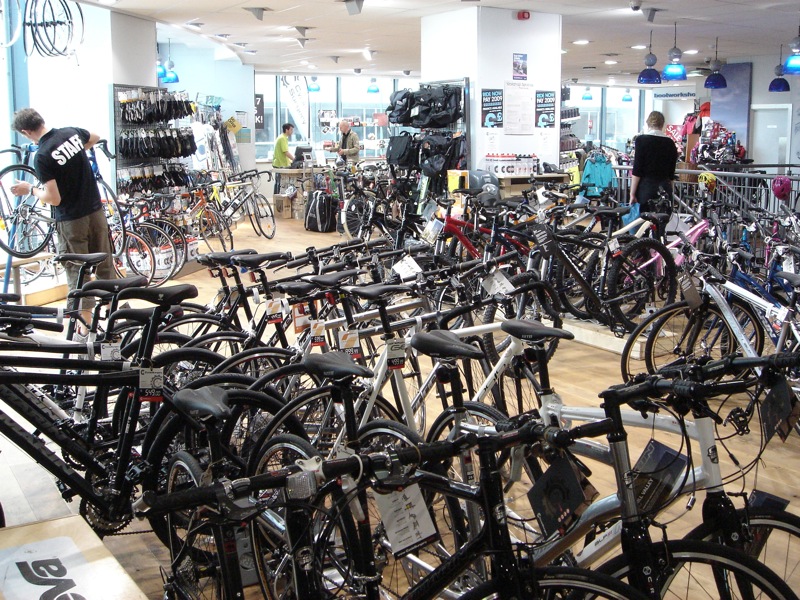
We're back below the grey skies of Birmingham in July. Light showers, gentle breezes and occasional touches of blue and the garden thriving with greenery. Guy collected us from Gatwick on Thursday afternoon (effortless flight from Corfu in what looked like a brand new EasyJet Airbus) so we didn't have to wait ages for the cheap train journey we'd spent so long booking. (What is happening to me!). Richard and I went into town by taxi on Saturday and bumped into Amy at work and spoke to her Sergeant Pietrafesa. Once she was off work - having started at 7.00am - we got donuts in Selfridges and visited the new city centre Cycle Surgery that's now part of Snow & Rock. I was impressed - not least because they stocked 'proper bicycles', with baskets, bells, mud and chain guards and sit-up and beg handlebars as well as a selection of folders including Bromptons, but also because they offered a serious repair service in a city that, despite once being the city of a 1000 trades has had little of this sort in the centre for ages. Maybe things are changing for the better (link to image and commentary on bicycles in Birmingham) - not least because Amy's boss rides a bicycle.
On Friday I was on campus with Andrew on the last day of the accredited Oversight and Scrutiny module on which we work together. He told me of some of the changes afoot in our part of the University - especially the new Centre for Public Service partnerships (CPSP). Tonight I head south to Brighton for a workshop on Monday with new chairs of scrutiny, then I'm in Haringey for some consultation on political-management leadership on Tuesday, using the time to drop in on Phoenix Cycles to get a front wheel-bearing fixed by Mike at Battersea (tho' this is something I could now get done in Brum), then on Thursday and Friday I'm at Telford running an event on member-officer relations for middle range professionals from Midlands councils. I do enjoy being a tourist in my own country.
I took pictures for Andrew at Priorsfield on Friday - in particular one of Roger Patrick, retired police officer, discussing his Phd thesis on the challenges of relating performance figures to policing policies. We've e-mailed friends in Ano Korakiana. H's daughter will stay with her husband at 208 in August and we'll be back there after they leave. With the internet and webcams and more friends I feel close to Democracy Street, able to inspect every change in the surface of the road past our house and able to gaze over Ano Korakiana and even hear its wonderful band in their blue and yellow as they march on the Liston and above the village "the floor of heaven...thick inlaid with patines of bright gold" MoV: 5, 1
Past midnight and I'm opening my saved up birthday cards - from over twenty colleagues at work...
...from family, in New York `and Switzerland, from good friends, from The Friends of Black Patch Park, on Facebook and by email:
many many happy returns of the day Simon, may you have a wonderful time and may the day and every day in your life be filled with all that your heart desire love from Minoti
Lin drove home alone this evening from a third visit to Stafford Hospital to see her dad who's had two MRI scans for unexplained pains in back and stomach.
"So where's Dot?"
"She's home. So's dad."
"I bet they're glad. What did they say - at the hospital?"
"Osteoparosis"
Rang Amy. knowing she'd been to clinic for a check. Nothing yet.
"I'm having contractions. I can't feel them. Could go on for ages"
From Corfu: Hi Simon, the Haggis was delicious. Did it just like you said with chips and gravy. Yummy... cheers for now Mark
From England: I meant ’neeps’ (e.g. turnips) but I bet the chips were good too and Sally’s superlative gravy. No grandson news yet. X S
Amy came with Liz to see the allotment; helping me water the plot after these weeks of unseasonably warm rainless weather .
*** ***
And now a trying letter from South West Film and Television Archive:
Dear Simon. Some time ago you asked me to send you a copy of our standard Acquisition Agreement. I sent this in November 2011 and although I’ve received your generic updates about your ongoing investigations of Jack’s films, I haven’t had a specific response to my email.
SWFTA is now in a position where an agreement needs to be reached as a matter of urgency. We are about to start on a major project to refurbish and upgrade our storage vault and we no longer have the luxury of being able to allow ‘unofficial’ collections – those which are, so to speak ‘in limbo’ – to take up valuable storage space.
We understand that the Jack Hargreaves material presents specific and complex problems which, through no lack of effort from the various parties involved, it has not yet been possible to solve. For SWFTA’s part, the material has been kept in good faith for many years while waiting for the rights holder to be found, and weeks if not months of staff and volunteer time have been diverted from other projects to work on the films. I hope you would agree that SWFTA’s efforts have provided you with a great deal of information that you would not otherwise have had.
We appreciate that a significant investment would probably be needed in order to extract any economic value from the material, but SWFTA is not now, and is not likely to be in the future, able to offer such an investment. We recognise the historic importance of the material, but if it is to be kept at SWFTA on this basis it needs to be under the terms of a defined agreement, particularly as the material does not fall within our formal regional role as a South West archive.
The films have been under discussion for more than two years now, and no clear solution has been found. SWFTA’s current circumstances are such that we simply cannot continue to wait, and must urge you to make a decision before Thursday 12 April 2012 when the vault has to be emptied for construction work to begin.
We have identified five possible options you may wish to consider:
1. Remove the material from our premises.
2. Pay for it to be stored at SWFTA.
3. Donate the material formally to SWFTA and sign the Agreement accordingly (hard copy to be provided).
4. If it is of no further interest, leave the material to be dealt with at SWFTA’s discretion.
5. Request SWFTA to dispose of the material on your behalf and at your expense.
I look forward to hearing from you at your earliest convenience. May I ask you to be sure to copy Bob in on your response as I will be on leave over Easter. Yours sincerely, Jennie...Administrator, SWFTA
*** ***
I'm getting greetings - hard copy, soft copy - writing, text and song via landmail, the phone and web and someone's at the door and Sophia and Niko in Corfu just sent me this. ΧΡΟΝΙΑ ΠΟΛΛΑ !!!!!!!!!!!! ΠΑΙΔΙΚΑ ΤΡΑΓΟΥΔΙΑ: ΓΕΝΕΘΛΙΑ
And from our Greek teacher's fiancee Hi Simon, hope you and Linda are well? Χρόνια Πολλά και πάντα άξιος, φυλάκια από Νίκος και Χριστίνα xxx and from dear friends Paul and Lula in Ag Ioannis, who, in passing, mention they reckon to have fixed the roof leak at 208 Democracy Street.
The social web - nice when it's nice
*** ***
Much of the afternoon I've been trying to sort the problem of what to do about the films and tapes at South West Films and Television Archive - a phone call to Jennie, emails to Endemol, Nick Wright, Fred Dinenage, the British Film Institute (BFI) and Paul Heiney among others, as well as soaking in advice from friends on the Out of Town page on Facebook. Lin's spent the same time working out the correct way to submit a tax return for Handsworth Helping Hands; long phone calls to different tax offices. And in the evening we went to Amy and Guy for a BBQ where my birthday cake was a shed! Amy said she'd felt one small contraction.
*** ***
In Ano Korakiana today, the Rural Co-operative filed an application in the Corfu District Court to amend the Constitution agreed at its recent AGM.
Application to change the Constitution of the Co-op
The hearing is set for 25/5/12. Meanwhile, enrollment of new members continues in order to meet the conditions of the new law as these relate to our Association's drive to maintain its autonomy.
2. Yesterday morning, we were audited by the German contractor as a condition of our certification in the 'traceability, protection and certification of olive oil" programme. The audit covered the first phase of the programme dealing with the electronic recording and tracking of oil from production to consumption. Since 2010, as agreed by the AGM, the Cooperative has taken part in this programme along with Lafkos and Nymphes - a core activity of the Corfu Union of Agricultural Cooperatives...
1. Κατατέθηκε σήμερα το μεσημέρι στο Ειρηνοδικείο Κέρκυρας η αίτηση του Αγροτικού Συνεταιρισμού Άνω Κορακιάνας για την τροποποίηση του Καταστατικού που ψήφισε πρόσφατα η Γενική του Συνέλευση. Η δικάσιμος ορίστηκε για τις 25/5/2012.
Στο μεταξύ, συνεχίζεται η εγγραφή νέων μελών, προκειμένου να καλυφθούν οι απαιτήσεις του νέου νόμου, για την αυτόνομη πορεία του Συνεταιρισμού μας.
2. Πραγματοποιήθηκε χθες το πρωί από την ανάδοχο γερμανική εταιρεία, ο έλεγχος του Συνεταιρισμού μας στο πλαίσιο της συμμετοχής του στο πρόγραμμα «Ιχνηλασιμότητα, προστασία και πιστοποίηση της ποιότητας του ελαιολάδου», προκειμένου να λάβει σχετική πιστοποίηση. Ο έλεγχος αυτός αφορούσε την α’ φάση του προγράμματος και αναφερόταν στην ηλεκτρονική καταγραφή (μέσω του Ηλεκτρονικού Υπολογιστή) και παρακολούθηση της πορείας του ελαιολάδου από την παραγωγή έως την κατανάλωση. Ο Συνεταιρισμός είχε ενταχθεί στο πρόγραμμα αυτό από το 2010, με απόφαση της Γενικής του Συνέλευσης, μαζί με τους Συνεταιρισμούς Λαυκίου και Νυμφών, στο πλαίσιο σχετικών δράσεων της Ένωσης Αγροτικών Συνεταιρισμών Κέρκυρας...
**** ****
And my sister Bay in New York has sent me a wonderful map of Greece and the Balkans printed in 1854 and actually made in 1832 showing The Greek Kingdom shortly after she became independent. In fact the map shows a number of dates so I've copied it to a friend in Italy - Olimpia Gargano in Ventimiglia near Nice, who knows about old maps, especially of Albania and the Balkan Peninsular to see what she can tell me about it.
I can see the Ionian Protectorate (unter Britischem Schutz) and the borders of Greece, agreed at Independence in 1832 - no Epirus, Thessaly, Macedonia; no Thrace nor the islands bordering Turkey; no Crete...no railways, tracks not roads and swiftest travel by lake, river and sea. What a land for the free traveller to explore the exotic with the protection of dragomen and bodyguards unencumbered by modern inhibitions about orientalism and risk of condescension.
*** ***
And wine from the Greek side:
...and from my daughter, a really good watering can...
...with which to water my baby cabbages, laced with twigs to keep away the ravening pigeons
Jack Hargreaves 1911-1994 with his stepson Simon Baddeley born 1942 (photo: Barbara Hargreaves)
My stepfather delighted in reading Charles Dickens. He could recite first lines of the novels
It was the best of times, it was the worst of times, it was the age of wisdom, it was the age of foolishness...
"Opening lines are fascinating. They contain all that’s to follow”. I like the phrase 'recalled to life' from the first chapter. Dickens, after setting the scene - France and England in 1775 - for A Tale of Two Cities, describesthe DoverCoachtoiling up Shooter’s Hill. The night is stormy. To ease the horses, passengers have been asked to get out and trudge through the mud. Here's a place perfect for ambush and robbery. A lone rider is heard galloping in pursuit. It's Gerry Cruncher, messenger from Telsons Bank. Rider and coach halt, Jerry facing a wary driver's blunderbuss. Jarvis Lorri, banker, stands beside the coach. Jerry hands him an envelope.
He opened it in the light of the coach-lamp on that side and read - first to himself and then aloud; “ ‘Wait at Dover for Mam’selle.’ It’s not long, you see, guard. Jerry, say that my answer was, Recalled to Life.”
Recalled to life. Old 16mm film smells of vinegar. The cans in which it's stored are brown with rust - many over forty years old, films made by Jack's cameraman Stan Bréhaut for the Southern TV series Out of Town. at risk of wasting in our garage.
But by Christmas 2019, my licensee, Network on Air, will be publishing 6 episodes selected from the archive of recovered Out of Town material, sitting in our garage for ages, recovered by Jack from a warehouse some unknown time after Southern TV lost its licence in 1981. There were 100s of cans of 16mm film with added library sound effects and a similar number of flat cardboard boxes containing ¼” reel-to-reel sound tapes of Jack’s commentaries, which, left to Southern TV’s successor Meridian, had sat in their library, cherry picked as background – without Jack - for country-themed programmes, becoming disordered. Jack had moved on, to do successful broadcasting on Channel 4 for three years, delivering sixty episodes of Old Country in the same style and format as OOT, using the same ‘shed’ – the set he’d used at Southern, set up in the Old Schoolhouse in Meonstoke. Jack Hargreaves - the invention of the camera from Simon Baddeley on Vimeo.
The recovered OOT material was stored on racks in his workshop beside Raven Cottage. When domestic DVD players proliferated, Jack selected 28 reels of film from this archive. The film had magnetic sound strips containing the sound effects – fish splashing, hammering, wind, atmos, and so on - added post-production. See Dave Knowles, Jack's sound technician, on the next clip between 00.47 and 1.46 explaining the characteristics of the film in the archive.
Although an executor of my stepfather's estate, I knew nothing of the ‘archive’ until 2009. Well before he died Jack had entrusted the unwieldy collection of film and tape to his friend Nick Wright, a media academic. Thank goodness! In 1994, when Jack died, such a collection would have burdened me. I might have discarded it and surrendered all rights – a condition for gifts - to the BFI.
I remained unaware, until Richard Hill, filmed for an OOT episode on sea angling in the early 70s, wrote and asked if he could have a copy of the episode in which he and his friends appeared.
His computer literate neighbour, with a touch of OCD, had traced the archive to Plymouth, then to Jack’s stepson, Simon Baddeley, as the likely owner of rights.
Some time after Jack died Nick Wright had moved house. Lacking storage in his new home, he’d passed Jack’s gift to the South West Film and TV Archive, where it had stayed over 10 years. Via Paul Peacock, who was writing Jack's biography, Paul and I met Nick in Leeds. Over a meal and a pint, Nick explained the unwieldy nature of the JH archive.
“These are not complete episodes of Out of Town broadcasts, Simon. They’re Stan’s location footage with sound effects. You’d first have to match film with sound tapes of Jack’s commentaries. There are no titles, no theme tune, no credits. Footage where Jack spoke from his studio 'shed' have vanished”
I learned later that, until the end of the 1970s, the only way such footage would have been recorded was on v expensive swiftly re-used Quad tapes.
The mishmash nature of the OOT archive had one positive – it was generally perceived as useless. Nick said he’d looked through it and could do nothing with it. His gift to me was a signed letter he’d sought from a senior employee, Cathy Meacock, of Endemol International, declaring, in writing, that despite Endemol’s ownership of so much old Southern media (bought speculatively, overriding, so they claimed, Jack’s informal reclamation of OOT film), they had ‘no further interest in the material’. Nick was free to do with it as he - and therefore I - wished. Nick was clear the archive at SWFTA, passed to him by Jack, was mine.
I phoned Jenny at SWFTA and gave permission for Richard Hill’s episode to be assembled and sent to me to take to him on a DVD as an MPG file. By train and cycle I took a day trip to the edge of Southampton. Richard now grey-haired was over the moon. We enjoyed Wendy Hill’s cups of tea and fish pie.
“If it hadn’t been for you, Richard, I’d not have discovered my stepdad’s archive”.
I learned from Jenny the work her husband Roger Charlesworth had done to make Richard’s DVD out of the archive material available, finding the sound tape that went with the episode, digitising sound and picture, splicing them, inserting stills of Jack in the absence of studio ‘shed’ footage; pro bono.
I took a train from Birmingham and met Roger and Jenny in the old naval yard in Plymouth, viewed the ‘JH archive’ stacked on dexion, and met the manager of SWFTA. He put out feelers about rights in return for SWFTA making more episodes. I said I’d think about it, taking home his blank waiver.
Time passed.
What could be done with the archive if neither Nick nor the archive technicians could spin this treasured straw into an episode of Out of Town? Would still pictures or random footage run as background to Jack’s voice? A friend suggested, with a clever example, of how Jack’s voice could be added to his animated picture. Not quite recalled to life though.
Meantime I was supporting publication by Delta of those full episodes of Out of Town that Jack had made for VHS in 1987, speaking from his workshop at Raven Cottage – not even Southern TV broadcasts, though they contained the location footage Jack had recovered from the archive.
In 2010 SWFTA wrote to say that without my waiver giving them rights to any work they could not afford to store the JH archive. With my neighbour, John Rose and the borrowed use of a van, we drove to Plymouth and collected the films and tapes to store in our garage.
In 2012 Kaleidoscope’s David King unearthed 30 episodes of Out of Town broadcasts made in 1980-81. These were published by Delta as “The Lost Episodes”. Endemol had been about to throw them out. Once they realised my hopes for them, they claimed copyright, as for all the Southern TV media over which they claimed ownership. After several attempts to contact them, their CEO emailed me “Simon. You can have all OOT material we own for £10,000 ‘take it or leave it’”
I found the cash. I co-signed a novation agreement transferring their licence with Delta to me plus an addendum rights transfer for the OOT episodes saved by David. I went to Endemol's HQ in Shepherd's Bush and put the masters I'd bought on my bicycle rack
Collecting my OOT master tapes
After Jack’s death his solicitor with whom I shared the executorship along with Isobel of the will, said he had no doubt that Jack wanted this material to belong to me, that it almost certainly did, but “their lawyers have more time and money than you can afford”.
For about three years I was making train visits to London, cycling around the city to meetings. With advice from Charles Webster of Delta, now my licensee, I got a rights lawyer. James Greenslade of Simons Muirhead & Burton in Soho. £600 an hour! He cut me pro bono advice, going through Endemol’s contract with his platinum toothcomb.
I was about to recover my outlay in royalties from Delta’s sales of two OOT DVD box sets, when Charles texted me that Delta had gone into administration.
Charles and I had been working enthusiastically on ways of restoring the archive but seeing the way the wind was blowing he'd left Delta. He and I had meetings at a fish and chippie near Victoria Station to continue exploring ways to restore the archive. I hired Francis Niemczyk up Kilburn way to start restoring the films Lin and I had matched with their sound tapes, adding Frazer Ash, Digital Transfer Manager of British Universities Film & Video Council off Oxford Street.
Charles and I drifted apart, he, vexed that I’d made an agreement he’d cautioned against, with Chris Perry of newly formed Big Centre TV based in Walsall, to broadcast existing OOT episodes on a new local TV station, in return for getting the services of a reputable film restoration company in Wardour Street, Soho, restoring the archive. The long and short of that embarrassing episode, drawn out over a year of constant emails and excuses, was that the OOT episodes were broadcast in the West Midlands, but Perry failed to fulfil his side of our agreement, got summarily fired from the company he’d started, whose new director, after some wriggling, agreed to pay me a symbolic £1500 of compensation. So few people watched this local TV company little was lost. I was an irritated fool.
After turning down offers for Jack’s material from a couple of the companies circling Delta’s administrators, there came, a surprise approach from Talking Pictures that went nowhere, and another from Network on Air. I liked their CEO Tim Beddows.
I signed an Acquisition Agreement with his company in 2017. Tim Beddows was keen to republish all that Delta had published plus extras featuring Jack. Even more pleasing was Tim’s offer to restore and publish the whole archive if I would fill in for Jack where his introductions had gone missing. It wasn’t as if I hadn’t spent enough time humming and haa-ing over options for filling in where Jack was missing. With trepidation I agreed. Tim drove a first batch of old footage with sound tapes to be restored by his company in Canary Wharf where, after tapes and films had been matched and digitised, they were stored as HD – “better than when Jack saw them” said Tim. I relayed a link to the first batch of restorations to Ian Wegg, Southern TV’s amateur local historian. Ian dated them and alerted me to footage already published by Jack when he cherry-picked location film for his 1987 VHS issue of OOT. From this base selection, I picked 16 suitable 12 to 6 minute sequences which, put together, would give us 3 hours viewing in 6 half hour episodes, made up of 15 parts.
Tim assured me “That’ll be enough to start. This will be Network’s Out of Town Vol 3, ready for Christmas 2019”. But there were more slips twixt cup and lip, not least a Pandemic, which delayed the publication until the start of July 2020 by which time the new DVD, also on Blu-ray, had been renamed Further Out of Town.
Tim had contracted film-maker, director and producer, Paul Vanezis to make the film insets of me introducing each restored OOT episode. With the restored OOT footage, now digitised in HD, loaded to his hard drive, Paul and I met up on my allotment in Handsworth, where between my shed and fruit cage we spent two sunny July mornings filming introductions.
Paul Vanezis films inserts of me introducing Further Out of Town on the Victoria Jubilee Allotments in Handsworth
I’d spent two months rehearsing after digesting Jack’s recorded introductions without picture and the location footage to be used - trying not to imitate Jack but to find a suitable version of Jack's relaxed style in front of a camera.
I practised for a day with my friend Michael Livesley at his studio in Liverpool ...
and spoke on my own to Photobooth on my laptop...
So, over 11 years after I learned of the existence of the ‘JH Archive’ we are lined up to publish the following films introduced by me.
Episode 1. Garden Pests/Red Squirrels/Country Flowers
Episode 2: Planting a Vine/Sheep Fair
Episode 3: Southall Market/Fishing in the Hebrides/Peeler crabs
Episode 4: Andalusian Horses with Brassy Searle and son
Episode 5: Mr Cuckoo/Sea Bream/Stocking a lake
Episode 6: Butterflies/North wind fishing/John Bass lake
Before they are scanned, Paul Vanezis checks old opening titles of FurtherOut of Town
Hi Simon, Linda. I had an idea to cover the drain totally with plaka after we discovered the smell. I am sure the smell is from a broken pipe leaking into your garden down the wall into the drain. I do not think a reed pond could cope with sewage. This would make a nice step up to the garden area. At a later time I thought we could build the reed pool on top of the plaka, next to the steps. This would take the form of three pools, trickling into each other and finally any excess water would be channelled into the drain and go out with whatever smelly water comes into the drain.
No problem with the beam being covered with plaster. Monday sees the final part of the old wall come down. The new one has been bricked up, and M and B are making a jig for the arch. The curve has been measured as follows, try it on a bit of paper if you like. Measure downwards 38cm at 1cm intervals. Measure across the top 114cm at 3cm intervals. Number downwards 38-1, and across the top from left 1-38. Joint 1 to 1, 2 to 2 etc, and you will end up with a curve. Repeat on other side if you have space. Will show picture of jig as soon as it is built.
Have receipts for euros, and still have marble and varnish to purchase. Will get down to big paintshop near airport to see if they sell the required varnish.
Found mess of electric cable in thin wall when we took it down. Not connected to anything, may have been old mains supply into building.
Will be cutting floor and stairwell Monday or Tuesday, then replacing odd planks and sanding. Will follow instructions from web site re vacuum clean and white spirit etc. Best regards, G, M & B
Hi G. Thanks for the update. Sounds like everything's coming together. Re. money, I reckon the marble and varnish will cost about €150-€200. I can't buy this amount from the currency firm - they're not interested in less than €1000. Has anyone got a sterling account based in England that I could put the extra money into?
Not sure about the plaka ideas. They sound great, but we're a bit strapped for cash and will be for some time. I don't think we're going to be able to afford any extra work for a while.
Anyway, I think we should try to work out where the smell is coming from. We'll have to do some investigation when we come in September. We'll have a think about the plaka over the drain and I'll e-mail again to let you know what we think.
Really wish we could be there to see the work in progress. Can't wait. September seems ages away, but it's only about 15 or 16 weeks. Regards to all. Lin & Simon [The alternative to sending cash via an exchange company which is not interested in sums below £1000 is through an agency like Western Union who require a fee of nearly £50 to send someone a sum of say £250]
Thursday, April 12, 2007
Yesterday we started clearing the small garden, to see what lay beneath. I opened the gate onto the path to the lower road. Neighbours brought a house gift. Our builders arrived to measure up the roof for an estimate of complete repairs as well as removing the concrete rubble blocks that the previous owners had set up beside the house to stack rubble and which have brought damp into the lower rooms. A young woman from the house behind when asked said “It was very nice” leaving unfinished her view that improvements had been unsuccessful. We agreed. An outside staircase to a balcony had been removed. I cycled back to Ipsos and Lin came down in the car. Shared a lager and an altercation with itinerant topers whose game is to ask questions, top the answer until someone remonstrates and then say ‘sorry’. We were part rescued by a friend who’d winked across the space at the bar into which this couple had barged.
Tuesday, April 10, 2007 Summer Song lies near the end of the seaward arm. of Ipsos Harbour. The owner of the little yacht moored next to ‘Summer Song’ until February, sailed for Italy while we were away, but Magnus, her skipper, is now in hospital there after he became ill while crossing the Straits of Otranto. The Italian Coastguard came alongside his drifting boat but in trying to lift him from his boat he dropped into the sea from which they only finely rescued him after two hours in the water.
We went into town and drew money from our bank behind the Liston, bought bedding, shower curtain and paint in the Evraiki [Back to the future reference: Look out for a forthcoming book by Marcia Haddad to which I was referred on 27/7/07 by Stan Boardman-Jacobs' 'The Day My Heart Broke']
We drove to Democracy Street - the back way, turning off the Sidari Road along roads lined by the pink blossoms of Judas trees, to gaze from our balcony at the sea and the woods and the village above and below and discuss plans for the house. I checked the shop nearby could receive our mail. “Yes, two or three times a week it comes.” I said the bread was good there. The owner said he used to have a bakery there. The wood meant the bread lasted 5-6 days, “but I don’t want to talk about that.”
Monday, 9 April 2007 Ano Korakiana, Easter Monday
We visited 208 Democracy Street and met the builders. It may be necessary to redo the whole roof rather than just repair parts of it. Ano Korakiana’s Easter Monday procession gathered round the bend by Little Venice. We had a coffee – skirto and nescafe – at the kafenion and gingerly wandered up Democracy Street to the ravine bridge where we waited. The drums started. The procession moved off. A troop of cub scouts, cross bearers and then the Ano Korakiana band. Woodwind – clarinets and flutes – to spice the grander sound of the swaying trombones, trumpets and the drums. They were playing San Tomasso. Solemn but not sad. Then three ranks of dignified women in suits with purple ties – part of the choir. Then passed – St.Peter and St.Spiridon and St Michael on banners, then priests. One saw us and nodded and said “Christos Anesti, Where from?” “From England.” I should have replied "Anethos Anesti".
We waited a little and than strolled on, wary to follow, but not join the procession as it played down Democracy Street. We visited some friends at the bottom of the village. Later on the low road past olive trees, Lin stopped the car and we could hear bees not yet recruited to the killing labour of monocultivation, doing voluntary work among the wildflowers.
Edward Lear, Corfu, 1871, w/c & gouache. Indianapolis Museum of Art, USA
Saturday, April 7, 2007
The big ferry from Bari sailed hardly a 100 metres by the corner of north east Corfu in the dark and on to Igoumenitsa where we landed and trollied our luggage a kilometre along the seafront to the Pantokrator. We remembered how when we'd come this way the previous November a south wind had blown with such strength off the shore our ship had been unable to dock for two hours - a wait that had given us a new friend in Hy from Ayios Markos who'd ridden home with us once we'd made it to Corfu.
She was very full, convivial chat drowning the noise of unwatched TVs in the familiar saloon. One family, at least, had brought a whole lamb for Easter. It lay wrapped beside them but as the crowd increased was stowed below their seat. 'One vast realm of wonder' (Canto 88 Byron's 'Travels of Childe Harold') - words of a lover, blind to flytipped refuse, strip mall development, bleached menus selling 'pise and ships', UK redtops and eurotrash porn, dumb t-shirts, fuming traffic, wall-to-wall football on TV and shaven lads with rosy bellies. But Greece makes me blind. I get a lump in my throat as I see it twinklng below from a late night plane or rising from the sea from the deck of a ferry.
The air was crisp as the ship headed north west over a flat sea. At the Port of Corfu by mid-morning Kostas' boy met us with a car. We left it outside his office with our luggage and strolled towards the Liston until we were standing tightly surrounded by people of all ages below fine balconies packed with onlookers, some preparing to drop terracotta pots on the marble streets below. As even larger pots appeared in the windows above we "ooh'd" and "aah'd" in anticipation. At noon the cascade began. 'Crash" "huraaaaaa" "crash" "huraaaaa". The water in the pots, as well as holding the sins of the preceding year, ensures shards don't explode among the onlookers. The sun shone bright. the crowd was civil and happy. A few minutes later with bands playing we strolled through pottery strewn streets, eating roast lamb, onion and tomato on pita bread.
Friday, April 6, 2007
All seats to Bari from Rome were reserved. At Termini by 8.30am we walked through the bustle and boarded a Eurostar for Bari hoping for the best. Another passenger, a young teacher, Valerian, helped translate, asking the guard if sitting on our luggage would be OK. He nodded. A young woman ran to catch the train as it started and the guard opened the door so she could hop aboard with a broad and slightly out-of-breath smile of gratitude. In a spacious lobby at the end of the last carriage we could gaze through glass at the receding lines as our train sped south.
The snack trolly was a door away. We enjoyed hot chocolate and espresso. Later Lin made a picnic – bread and wine. Cassino, Caserta, Foggia and then some seats came free. We ate, chatted and read. The train was clean and roomy; the passengers civil without needing words. No-one sought our tickets or made announcements.
At Bari we left our luggage at the station and soon found ourselves in a Good Friday procession through the high sided streets following or being followed by a brass band in grieving sonour swaying amid a procession of saints carried on biers behind Jesus - ecce homo - bearing a cross to Golgotha by crowded pavements, shops (few shuttered) bars (none closed) a nunnery and commuters in their cars queueing to get out of town.
We are almost running out of things to do on a rainy day.
“It's raining in Athens” said Lefteris from the steps, which he negotiates more slowly these days, “It's raining in Italy. Raining everywhere”
“Every day? Κάθε μέρα;”
“Αύριο, και μεθαύριο και μεθαμεθαύριο...Tomorrow and tomorrow and tomorrow”
In Athens it's really bad.
Yet even so the blessed sun reminds us of its efforts to scatter the overcast and allow us one washing day a week, its sudden beams piercing the grey to cast patines of silver around Vido, its distant warmth making enticing gaps like the glimpses of sky and bright unfurling nimbus above the heads of the cherubs in the ceiling of a rich man’s chapel. “Enough blue to make a little boy’s trousers”
I leave our cosy bed, don woolly slippers. Shave. Go to the loo. Enjoy a shower – now the new boiler’s in place. Get dressed. Put away last night’s washing up, cutlery, pans, plates. Bring up logs from the apothiki; we’re running short. Clear the ashes, make up a fire – paper, twigs, and a few logs for the evening chill. Brush teeth. Make a cup of tea. Lin sleeps. All is quiet.
Through an opening in the spinach green shutters, above our balcony rail and the rich green leaves amid our oranges and lemons and the almond blossom, an olive landscape veiled in swathes of driven rain rolls south to the backs of the high cliffs between Capes Iliodoros and Plaka. The mountains behind the airport from where Lear would often paint his exquisite landscapes of Corfu – gazing over the tarbooshed heads of two or three languid muleteers, over the twin headed outcrop of the Old Citadel, across the broad bay beyond the city, towards Trompetta and high Pantokrator - are grey outlines almost hidden by rain and mist. A ferry heads for Igoumenitsa where we'll be Wednesday evening.
*** *** ***
The old boiler is leaking
It’s not that it was a complicated job - for anyone who knew what they were doing. All the same, removing our broken hot water boiler and replacing it caused arguments that wouldn’t happen if we did it again. Self-help in the home means forever doing things for the first and often only time. Wouldn’t it be more sensible to call in a reliable plumber? They’ll provide the boiler, install it, guarantee their work and have a cup of tea as you pay their annotated bill for parts and labour. It’s not as if by now we don't know where to find workmen we trust, but this wish to do things ourselves is like our shared dislike of taking taxis, learned in childhood from my great grandmother who could well afford them but preferred to persuade bus drivers to take her where she wanted to go. You learn more that way. It’s the same with many things, especially housework, cooking and childcare.
I visited a plumbing shop near Sgombou and got prices for various boilers; phoned a plumber we know to ensure the prices were reasonable (owe him a drink) and also a friend in the village.
“Do you have baths?”
“No. Showers only”
“Then go for a 60 litre instead of your present 80 litre tank”
“What about this compression bubble beside our tank?”
“Not needed”
I still don’t understood what that item actually does, but it was the first thing I unbolted from the wall.
He added “Use the plumbing supplier on the main road by Gouvia”
“I know it”
“Spiro there is from the village”
So we collected a new tank. €120 with 5 year guarantee. Of course I couldn’t see how the old tank was fixed to the wall behind it, but guessed it was a bracket on two bolts, that the old tank, once drained and disconnected, would lift off.
So the power supply is switched off at the panel in the utility room and the three wires – live, neutral and earth - disconnected and the tank drained – something we’ve done before and know how to do. The first time, to clean the boiler and change the element, I, thinking all water had emptied out via the tap, unbolted the round hatch containing element and thermostat housing. I and the floor were abruptly drenched in rusty water and limescale. This time we are dry and ready to lift the boiler out of its bracket.
“It’s heavy” says Lin “If we let it slip it’ll smash the tile floor and hurt one of us”
We ponder. I scuttle down to the apothiki where I stored an old sculling oar we found on the beach ages ago. I shove it right up inside the old boiler and wedge the oar end in a plastic bucket of gravel beside the end of the bath/
“It’ll just sink into that” says Lin
“No it won’t”
“Yes it will”
“No it will not”
I jerk the boiler upwards above my head. I’d already loosened one of the bolts with a few levering jerks of a jemmy.
“OK it’s free”
The boiler now sits on the oar, unbalanced but it's weight held.
“Gently, gently”
We gradually slope the oar, dodging the shower rail, until I can cradle the boiler in both arms.
“Now how do we get the oar out?”
“Down a bit more, bit more.”
“OK now bring it round and pull it towards you”
I back away towards the window of our small bathroom
“Now ease it out”
“As the actress said to the bishop”
I carry the old boiler away and we make a cup of tea.
“How are we going to get the new one up?”
“Wait until they come to supper on Tuesday night. I’ll ask Mark and Paul”
Next problem is that the bracket on the new boiler is lower than the old. Two more bolts are needed. I see the old ones were expansion bolts in a plastered wall made of insulating bricks. It’s dodgy getting a firm fixing with two lined up holes in that. I could see where the previous builder had made two other holes that had failed, filling them with mortar.
“We’ll use the other wall. We’ll need different length connecting pipes and a junction in the electric cable so it’ll reach”
I start drilling. The first hole is too easy. It’s old stone wall and I’ve hit a wider mortar seam between rough stone, but one of the recovered expansion bolts gets a sturdy grip in the gap. I insert a tough ring of hard epoxy glue around the wider hole near the surface. Lin then makes a careful measurement using one of the new brackets as a template and the next challenge is to get the second hole exactly level with the first. I begin drilling. Two inches in the lights start to flicker in the bathroom and the drill dies. The carbon brushes are shot and their dying sparking must have set off a sympathetic flicker in the light circuit.
“I’ve never seen that before. Have you?”
Of course my battery drill, good for wood drilling, is no way up to hammering into the rock I’ve encountered.
I phone a friend.
“Er! Any chance you could lend me a drill to finish one hole in our bathroom wall”
“Sure. Come round”
This was not do-it-yourself. Too many experts brought in to help. I was lent a very expensive craftsman’s battery powered drill. The sort of thing you don't see in shops for ordinary punters.
“Wow, thanks! You shouldn’t be lending something like this to an amateur”
“Simon. I’ve seen some of the things you’ve been doing in your house. You’re craftsmen!” I beamed inwardly and outwardly’
“Yeah yeah, But gosh thanks all the same”
Back in the house. This beautiful piece of kit drilled confidently into the rock, even so, taking me nearly 15 minutes. This time a big rawlplug went neatly into the hole followed by a coach bolt on which you could have hung a cathedral. Furthermore it was perfectly in line with the other. I returned the drill with profuse thanks.
For the next two days Lin began redecorating the bathroom and we washed in warm water from the kettle. We removed the fiddly wire shelf through which things fell into the bath and replaced it with a sturdy glass shelf.
“Amy bought this shelf on eBay, but she didn’t want it”
“Oh?”
“She’d bought babe clothes from the same address for a couple of quid and was told they had to be posted to her, just up the road, charge £6.00. Classic ebay seller trick to get profit on carriage”
“Then?”
“The same seller offered this shelf for 99p ‘buyer collect’. Amy didn’t want it but clicked ‘buy now’ and went to the address. Once there she said 'Oh and can I pick up those clothes I bought?'”
Ah, the cunning of thrift.
My battery drill served for the smaller holes needed.
Tuesday evening, friends for supper.
“Mark, Paul! Can you help?”
They went downstairs. Lifted the new boiler between them. Dropped it neatly on the bolts in three seconds, then back to the table.
Next day I bought two 50cm flexible pipes at Sgombou; removed the old pipes and after binding plumbers’ thread on the boiler and the hot and cold inlet-outlet pipes tightened everything up, turned on the water, filled the tank; then the electricity. On came the pilot light.
“We’ve got hot water again!”
Lin had a shower.
“Hm. Not sure 60 litres of hot water is enough for wash, rinse, conditioner and rinse.”
But later as she continued decorating, adding grout to a circling ribbon of small blue tiles, she said “Ohoh! There’s a leak”
I sighed and inspected. The no-return valve on the cold water inlet was dribbling steadily from the quite the wrong place.
“Shit”
I turned off the water, undid the connection. The bolt shot off under pressure from 60 litres of warm water, bruising my knuckle. It poured into bowls and buckets I emptied into the bath.
“Now what’s gone wrong?” I wondered “I’m taking this valve to the plumber at Kontokali”
Spiro checked it.
“You must not tighten the nut that connects to the valve so that it prevents it working. Just three or four turns will do” Now how could I have known that?
I bought another valve, a tap to go between tank and valve and a shorter length of flexible pipe. €11.50. Back home I wrapped plumbers waxy string carefully around each connection and gently tightened everything; turned on the water and watched.
“It’s OK!”
“Don’t say that where the boiler can hear you” said Lin
*** *** ***
On naftemporiki.gr - an intriguing interview with an academic who loves Greece, and knows the history of modern Greece in great depth, Professor Mark Mazower speaking in English with Greek sub-titles. Μαζάουερ: Ανάκτηση της αυτονομίας με σωστή οικονομία
I especially like his observations on the new generation of young Greek historians, but also his admission that so much of what is happening in and to Greece was not what he ever expected.
*** ***
Another good letter from my friend Jan D in England:
Hello Simon. I follow your escapades on your blog. Good to see that you are busy doing practical tasks. In the future (perhaps sooner than we think ) such skills will again be vital and in much demand, we may (re)discover that manual and technical skills are more important than the latest IT gizmo, after all we can’t eat the computer or mobile phone. Talking about food are you following events in Britain? These are depressing and worrying times. Quick on the heels of the Mid Staffordshire Hospital scandal we now have what is referred to as the ‘horsemeat’ scandal. This will not surprise you but it is yet another example, on top of all the others, of mismanagement. corruption and deceit in a key industry; this time the food chain and supermarket ready-made meals. The food chain has now become so long and uncontrollable we cannot be certain of what we are eating (despite the labels) or the safety of it. The Government is out of its depth and everybody is blaming everybody else (what’s new!). Yet another example of what happens when you deregulate. The Food Standards Agency has lost of half of its inspectors (through so called efficiency no doubt), so it’s not surprising that yet again we have an industry operating outside any meaningful control or accountability. If it wasn’t so serious you’d laugh at some of the finger pointing. Monty Python could not have done better. We are being told that it is all down to Romanian horse thieves! Well if everything else fails blame ‘Johnny Foreigner’, especially if there’s a gypsy angle as well. The hypocrisy is staggering. Some of the most diehard anti-European MPs are now calling for EU actions and seeking the co-operation of our European partners. I actually don’t mind eating horse; done it many times in France as long as I know that is what it is and that it is safe to do so. However there may be some benefits emerging from this, especially around a revival of locally produced food and local food outlets. Traditional butchers are doing a roaring trade at the moment and hopefully this will extend to local markets, greengrocers, artisan bakers etc., which can only be good for local communities and ‘localism’. I don’t think this is the demise of supermarkets, but they may well operate somewhat differently in the future.
There is also a growing acknowledgement and appreciation of the importance of a wide range of public functions. Whether this is just an immediate reaction or a longer term shift is yet to be seen. Regrettably I think the deregulators and unlimited free marketeers have the upper hand and wield enormous power and I still have a deep anxiety that we are moving toward a new type of feudalism. There was a very interesting article in the Guardian this week on the workings of so-called Think Tanks. They like to present themselves as independent and objective, but in reality they are well funded pressure groups working on behalf of some rather unpleasant, and in many cases American, corporate interests, (tobacco, climate deniers, chemicals, etc.). Frequently it’s impossible to know who funds these organisations, and to really rub salt into the wound many of them are registered charities and hence receive tax benefits. They also have considerable access to the political elite. I am not a natural conspiracy peddler but it is difficult to see how local democracy or any democracy can function properly in the economic and political environments now emerging. I would be interested to hear your views on this. I am convinced that some form of ‘bottom –up’ or ‘refocused’ consumerism is part of the answer, and in this context modern technology can be a powerful tool so I’m not a total Luddite.
I have read some more on the developments in Russia since the fall of Communism which is good case of Be Careful of What You Wish For. We spent decades trying to bring down the Soviet Union in the (naïve) belief that a western style democracy would make it free, open, fair and governed by the rule of law. But it hasn’t quite worked out like that. Whilst the Soviet Union was good riddance, what has replaced it, according to a book by Edward Lucas, is organised crime, big business corruption, illegality and bribery on a phenomenal scale, e.g. as much as $6 billion is paid in bribes every year and half of the country’s $140 billion public expenditure is siphoned off illegally. He calls it a ‘pirate’ state (others call it a mafia state) ruled by a criminal elite heavy populated by ex-Soviet spooks and ex- secret agents and the ‘nouveau riche’. (see also Luke Harding's Mafia State) I think this demonstrates what can happen when a vacuum is created during political upheavals and who might fill it. It makes you stop and think what could happen here as the state and public sector retreat on an unprecedented scale. The ‘intelligent’ criminal may well thrive and then local democracy or any democracy is going to struggle to survive in any meaningful way.
As more and more of society is removed from democratic accountability and transparency and power and wealth concentrated in a very small group we face a troublesome future and I can’t help feeling it has gone beyond the tipping point already. I struggle to envisage how an alternative may emerge or what it would look like. The offerings of the left are as cliché ridden, unrealistic and unpleasant as the offerings of the right or any other existing group. A new mind set is certainly required as well as different expectations and these things don’t come easy if at all. I agree with you that a recalibration of the relationships between the citizen, the state and the public domain is crucial to the way forward. The very notions of progress, growth, well-being etc., need to find a new narrative which appeals to people and which they can actually experience as something positive and fulfilling in meeting their aspirations.
I am conscious that this sounds idealistic and naïve and it may well be that we need to hit the buffers hard in order to make a paradigm change or we may simply just drift into a very different society to the one we have had for the last 60-70 years and adjust accordingly; although in the longer run people will not put up with a new form of feudalism.
I am struggling to find ways local involvement and actions can assist us in going in a more positive direction but as I said I am convinced that a bottom up approach is necessary. Despite all the scandals and increasing loss of faith and mistrust in many public and private institutions, it is interesting to note that with one or two exceptions local authorities have conducted themselves properly (with very little recognition) and actually coped better than most (so far) with challenges facing them which are greater than most; they are almost too competent for their own good; all they get in return is abuse from Eric Pickles a particularly odious minister. Happy days. Look forward to our conversation in March. Best Jan
*** *** ***
I wondered if there was a name for a lunch that lasts into the early evening. Olimpia said there was 'at least, there is in Northern Italy (mostly Piedmont area): they use to call it "merenda sinoira"'*. We were at Jan M’s home overlooking the Kerkyra Sea below Garitsa, a village south of the city.
Having driven south on the Lefkimmi Road, past that doleful ruin – Kaiser’s bridge – we turned onto a thin winding ascent, negotiating a minor landslip, realized we’d missed a turn, and crossed it again. A man, perched like a statue beside the road, pointed our way up a snaking gravel drive to a Venetian country house of courteous aspect.
If a house could be polite this one was; so too its owner who greeted us almost with diffidence, as though our visit honoured her. Through a modest front door into a room of perfect proportions, large and graceful without grandeur or pretension. If only all Corfu could have learned to know and respect such architecture, instead of crusting its lovely shores with vain construction. Even from the balcony of San Stephano nested so delicately inside the landscape...
... its almost invisible, the tiers of a monster shack stuck themselves through the skyline; one of Greece’s Lopachkin’s, before running out of money, had again wounded the island with the skeleton shelves of yet another Leggotel. From its guest rooms the world offers fine prospects; from outside, the world is blighted by the plans of a new signor.
We talked and ate and drank. Jan M made being our host look easy. Local wine, local food. Over coffee we looked at a photo album – black and white portraits, of people who’d enjoyed and lived in and visited the house. Some seemed almost ready to talk - so animated their gaze into the long open shutter from long ago.
In the guest book Aleko came across the delicate signatures of his parents, guests before they were married. I glimpsed in the same book, looming in my memory, a curling scrawl of fading black ink taking up all of a page, as one who suddenly encountering a venomous snake sees it bigger than it is - the signature of Kaiser Wilhelm, last German emperor, that Abraham who slew his son. instead of the offered ram of pride, and with him half the seed of Europe one-by-one.
*Antica tradizione contadina, di origine piemontese, la "Merenda sinoira" è un pasto pomeridiano che, per l'abbondanza, tende a sostituire la cena (per questo "sinoira" o «cenoira»). D'estate, dovendo lavorare i campi anche dopo il tramonto, i contadini organizzavano delle chiassose e ricche merende, sul tardo pomeriggio.
*** ***
Upstairs at 208 Democracy Street the wood of a disassembled and de-nailed palette is being made into skirting board to hide the ragged gap between the chipboard floor and our bedroom walls; walls, which, being in places curved, require a mix of wood bending and later filling. The palette wood was first sanded and double-coat varnished. On top of the wood we attach strips of moulded trim bought from Αποθήκη Ζύλειας The Wood Shed, a timber yard on the Lefkimmi Road in Kanalia, about a kilometre beyond the airport and Simonetti’s Yard. Rather too wide at the base each strip had to be sanded down several millimetres before varnishing.
This combination was glued to the wall, held by bricks while it dried, and varnished with old nail holes yet to be filled. The improvement is remarkable.
I don't know why it took us so long to find and start using a chimney brush with rods to clean our stove pipe.
What has so far involved the exercise of taking down and taking apart the stove pipe inside the house, with attendant soot, followed by resealing the pipe joints with heat proof silver tape, now entails the simpler task of climbing a ladder on the outside wall, removing the top of the chimney and shoving the brush on two rods into the pipe so that soot ends up dropping into the stove where it can be cleared away like the ash.
“We’ll have to do this more often…”
“As the actress…”
“…instead of putting off a messy job until the stove starts spouting smoke”
*** *** ***
The Rev William Mather has sent me a copy of his address at mum's Memorial Service
Barbara Burnett- Stuart, 1917-2012
Some personal reflections;
William Mather, 8th December 2012
My own personal memories of Barbara are linked with my parents, Bill and Eleanor who were friends with Barbara and Angus in Cheshire and Manchester when Angus was working with Thomson Newspapers.
There were wonderful social events and whenever Barbara and Angus were around there was lots of laughter and fun. These always seemed to be linked with tweeds and dogs and glorious days outside, in all weathers, sharing their love of shooting and fishing both in Cheshire and up here.
Libby and I once bumped into Barbara quite by chance on one of our rare visits to London. Feeling a bit like tourists we were exploring the Burlington Arcade and on going into a very respectable shoe-shop suddenly bumped into Barbara, trying on shoes!
When my late mother visited us here a couple of years ago we went to see Barbara at Brin Croft and I reminded her of the Burlington Arcade shoe-shop. She said with relish: “Ooh and were the shoes very expensive?!”
Barbara had a wonderful way of combining all aspects of life. Born in London she had a real feel for city life but she loved the country and all that went with it. Perhaps it was her early years escaping with her mother and sister Margot to Clavering, a totally unspoilt rural Essex village, that nurtured her love for the open air. There were bicycles and horses, paddling in the ford, developing a dairy farm and sharing in Girl Guide activities. They all loved it
During the war Clavering became a refuge from the nightly air-raids of the Blitz. During this period Barbara remembered her mother trying to keep everybody calm with matter-of-fact comments like: “We must remember to let the dogs out before the bombs come.”
When she married John Baddeley in 1940, Clavering became the obvious place for their home and it was there that Simon and Bay were born.
It is perhaps no surprise that following her privileged upbringing Barbara put her sharp mind and humour to good use by throwing herself into journalism, photography and publishing.
Sadly her first marriage ended shortly after the war and was followed by a long relationship with the Country Broadcaster Jack Hargreaves. Eventually in 1965 she married Angus, adding his two step-daughters, Fiona and Jennifer to the family.
Among the wonderful family films that Simon managed to do about Barbara – including memories of the Blitz, and of life at Clavering, there is one of Barbara reflecting on coming to live in the Highlands. In it she says: “I just bless the day when Angus said: ‘Would you settle if we went to Scotland?’ Because if he hadn’t said that, we never would.”
Settle she certainly did, settling in Strathnairn at Mains of Faillie near Daviot. This became a home for more and more grand-children and eventually great grand-children. For most of them, in Simon’s words: ‘The Highlands became a refuge of constant pleasure and happy memories, of winter snow, wind and rain, chilly summer swims, climbs and long walks with many dogs.’
She also became involved in much community activity, including the Samaritans and becoming a ‘Friend’ of Eden Court Theatre.
This service has been specially designed with hymns, readings, tributes and photographs to try and remind ourselves of some of Barbara’s interests and loves. Thomas Hardy’s poem ‘Afterwards’ hints at some of the enjoyments and awareness of life’s delights, eccentricities and quiet beauties – from hedgehogs ‘travelling furtively over the lawn’ to ‘watching the full-starred heavens.’ Barbara would have loved such imagery.
And her article ‘Peace of Mind’, with her personal reflections on looking at Leonardo da Vinci’s painting, ‘Madonna of the Rocks’ – written when she was women’s editor of Farmers’ Weekly – is particularly perceptive. She ponders on ‘peace of mind’ and how gazing at the painting and in particular the face of the Virgin, she writes: ‘one begins to know the meaning of that Peace which Passeth all Understanding.’
Earlier in the same article she remembers child-hood visits to her local church at Christmas, where in a Christmas crib-scene, she sees the figure of Jesus, ‘this tiny figure representing the Man who was to make men and women of us all.’
Barbara would not have called herself particularly religious but she was blessed with an open-heart towards life and people and with a spiritual awareness.
It is perhaps worth reminding ourselves that when she refers to the ‘Peace that passeth all understanding,’ she is quoting from the famous verse in Philippians 4-4-7. In the words of the Authorised Version of the Bible, which she loved, it is as follows:
4. Rejoice in the Lord alway: and Again I say, Rejoice 5. Let your moderation be known Unto all men. The Lord is at hand. 6. Be careful for nothing; but in Every thing by prayer and supplication With thanksgiving let your requests Be made known unto God. 7. And the peace of God, which Passeth all understanding, shall keep Your hearts and minds through Christ Jesus.
Mum on Democracy Street in 2010
*** *** ***
Lin and I visited Richard in the Corfu Private Clinic a few days ago. He's now flown to Dublin for further treatment...sends his regular circular 'Greek voters ponder the unthinkable - cutting ties with the EU':
Please follow the link to see my column in The Irish Times of Tuesday 19 February. Apologies for .the delay in circulating this which was due to medical complications. I hope to resume a regular column very shortly. Regards Richard Pine
(extract)....A 'Grexit', as it is called, is still an option. If the Voulí is a 'council of elders', it has shown itself to be incapable of knowing its own mind or of recognising and interpreting the will of the people. What people actually want, and what they are not getting, is a way out of the economic impasse, a means of creating wealth which will counteract the recession, and lead to job creation. This is not without precedent. In the 1920s Hungary, in the throes of reconstruction, offered the state railways to foreign buyers, and even went so far as to apply to the then League of Nations for a bailout. Parallels with Greece are obvious, where state assets are on offer, not very successfully, to foreign investors and buyers. The imperatives for any struggling country, especially a small one, to look for help elsewhere are compelling. It’s even within recent memory that the UK secured IMF funding to dig it out of an appalling financial crisis. In 1977, the then president of Greece, Konstantine Tsatsos, argued for Greece’s inclusion in Europe (it was admitted in 1981) on cultural and political as well as economic grounds. He linked Greece to other southern states – Portugal, Spain, Italy – all of which, it could be argued, would have to either catch up quickly or be left behind. Their inherent assets would not be enough to sustain them in an age of technological change and wealth creation. How right he proved to be.
*** ***
Aftermath: I still haven't got the boiler right. After a couple of days the non-return valve below its cold water inlet starts to drip. I replace it with another - €3.50. It works for a while then the dripping starts again.
Paul, up the road, asks me “What’s your water pressure?”
“You mean on the gauge outside the house?”
“Yes”
“Somewhere between 7 and 8”
“It should be more like 3”
“But we’ve only opened the mains tap a quarter turn”
“That’s flow not pressure”
“Er?”
“It’s like amps and volts” says Lin helpfully
“You will find a screw for adjusting the pressure just next to the dial”
“And don’t you touch it” says Lin “until we know exactly how it works”
“Hold on you were saying the boiler was jinxed. Thinking of calling in the priest to exorcise it”
“That may still be necessary”
*** ***
Down at Ipsos work continues on Summer Song and also, as promised by the Deputy Mayor of Corfu at the meeting on 8 Feb, on the revived police station.
Says Cinty "That's good. I hope they don't make it so comfortable the new policemen just stay indoors lounging"
 Richard and I went into town by taxi on Saturday and bumped into Amy at work and spoke to her Sergeant Pietrafesa.
  Once she was off work - having started at 7.00am - we got donuts in Selfridges and visited the new city centre Cycle Surgery that's now part of Snow & Rock. I was impressed - not least because they stocked 'proper bicycles', with baskets, bells, mud and chain guards and sit-up and beg handlebars as well as a selection of folders including Bromptons, but also because they offered a serious repair service in a city that, despite once being the city of a 1000 trades has had little of this sort in the centre for ages. Maybe things are changing for the better (link to image and commentary on bicycles in Birmingham) - not least because Amy's boss rides a bicycle.
 On Friday I was on campus with Andrew on the last day of the accredited Oversight and Scrutiny module on which we work together. He told me of some of the changes afoot in our part of the University - especially the new Centre for Public Service partnerships (CPSP). Tonight I head south to Brighton for a workshop on Monday with new chairs of scrutiny, then I'm in Haringey for some consultation on political-management leadership on Tuesday, using the time to drop in on Phoenix Cycles to get a front wheel-bearing fixed by Mike at Battersea (tho' this is something I could now get done in Brum), then on Thursday and Friday I'm at Telford running an event on member-officer relations for middle range professionals from Midlands councils. I do enjoy being a tourist in my own country.
I took pictures for Andrew at Priorsfield on Friday - in particular one of Roger Patrick, retired police officer, discussing his Phd thesis on the challenges of relating performance figures to policing policies.
On Friday I was on campus with Andrew on the last day of the accredited Oversight and Scrutiny module on which we work together. He told me of some of the changes afoot in our part of the University - especially the new Centre for Public Service partnerships (CPSP). Tonight I head south to Brighton for a workshop on Monday with new chairs of scrutiny, then I'm in Haringey for some consultation on political-management leadership on Tuesday, using the time to drop in on Phoenix Cycles to get a front wheel-bearing fixed by Mike at Battersea (tho' this is something I could now get done in Brum), then on Thursday and Friday I'm at Telford running an event on member-officer relations for middle range professionals from Midlands councils. I do enjoy being a tourist in my own country.
I took pictures for Andrew at Priorsfield on Friday - in particular one of Roger Patrick, retired police officer, discussing his Phd thesis on the challenges of relating performance figures to policing policies.
 We've e-mailed friends in Ano Korakiana. H's daughter will stay with her husband at 208 in August and we'll be back there after they leave. With the internet and webcams and more friends I feel close to Democracy Street, able to inspect every change in the surface of the road past our house and able to gaze over Ano Korakiana and even hear its wonderful band in their blue and yellow as they march on the Liston and above the village "the floor of heaven...thick inlaid with patines of bright gold" MoV: 5, 1