Total Pageviews

Showing posts sorted by relevance for query "harm in world politics". Sort by date Show all posts

Friday, 22 June 2007

Keronvel - pondering causes of harm

Thursday, June 21, 2007. Still raining. This place lends itself to strong light. Its absence flattens the broad acres of variegated granite and sand, removing perspective. Lacking contrasting shades giant boulders lose their striking scale. Wetness, which I like in a city - Corfu being a good example - especially when it goes with rain on canopies dripping off roofs into cascading gutters, and gloom, adding mystery to a Scottish glen, doesn’t suit Brittany. This is my subjectivity at work, but I like this coast edged by distant dangerous overfalls, while in-shore a gusting wind shifts shades of azure and darker blue across the rocky shallows, testing the hovering seabirds, driving cloud shadows which abruptly darken a foreground of rock and green shore while dazzling a strip of distant beach and as swiftly shading the horizon while flattering the place I’m standing with a surge of light and warmth.
We resorted to a supermarket to buy presents and wine. The rain drummed on the high roof above the busy aisles. Arthur’s even started to pack. Lin’s reading in the car parked outside the gîte. Dorothy’s listening to music through earphones. We phoned Amy at Glastonbury “Hullo mummee!” “Hullo mummee” echoed Liz, near Amy’s phone. “It’s wet here too but we’re in the tent.” “What do you want for presents?” “Danetta dark chocolate mousse and Mikado biscuits, pleeeeese”. For Richard it’ll be lager and saucisson sêche. Say’s Lin “I bet the weather will brighten as we leave France.” The forecasts say ‘No”.

* * * * * *

1230 pm Thursday The air is fresh with sea smell under a grey sky, the rain coming in gusts from the west - weather that seems to cover most of western Europe though an e-mail from Belgrade reports unprecedented heat. Now at 1230 in the afternoon Dot’s made up our picnic but we’re still in the gîte nattering and having cups of tea. At breakfast - Dot’s poached eggs on toasted baguette - I drew from Arthur more of his mining life before and during the war. He was 5 years down Hilton Main from 1934 and called up as a miner with threat of prison, disallowed from his attempts to join the army, to go down the same mine again for the duration. After that he worked at Goodyear making tractor tyres. The story continues. I hope Richard and Amy who have other things in their lives now will want to know about their grandparents early lives doing mining and factory work that has now dispersed to other parts of the world.

* * * * * *

I’ve been sent an essay about ‘harm in world politics’. It’s by one of the strategic managers from the Fire & Rescue Service who thought it might interest me. He suggests that de-civilising is ‘an almost complex form of barbarism coupled with the continual refinement of the civilizing process that aids rather than hinders the barbarism’. He suggests the sociologist Norbert Elias might see us as ‘late barbarians’. I replied:

Dear R. It is a privilege to be entrusted with your paper. I will now read it properly. Being on holiday is a good time to read in a relaxed and concentrated way. I have been intrigued, and some would say almost morbidly curious, about the subject that is the theme of your essay for almost as long as I can recall.

I started, this interest, when I was staying with the parents of a school friend when I was about 10 or 11 in 1952. His parents were the kindest hosts. I happened to wander in their house and saw on a desk a copy of Russell’s early commentary on the Holocaust ‘The Scourge of the Swastika’.

As you may know many English children were probably far more protected as a generation from knowledge of violence. No television and few images - nothing to compare with the exposure via film, TV, internet and magazine that today‘s children (and most parents) take for granted. Perhaps my parents immersed in a world war wanted us to be innocent for a while.

I leafed through this book. I’d never seen a corpse, not even a photo of one. The worst pictures I saw were pictures of the crucifixion, I found them pretty horrific but they were paintings. All of a sudden here were black and white photos of hundreds of deformed emaciated dead bodies being pushed into pits by men driving bull dozers with masks over their faces. I didn’t really understand what I was seeing. Then my friend’s dad came in and saw me with the book.

I realise now that he was horrified that I had been able to see it, that it had been there for me to view even though that was my fault for wandering into his study. My memory is not the shock of the photos but the shock and seeing this gentle man so emotional and disturbed. I took it for annoyance at me but it was more complicated than that, as I’ve said. The images had an effect that burned into my brain rather more slowly but I recall the moment, over 50 years ago, with clarity.

Many years later I was pondering not how to tell my son the facts of life. I reckon from looking at his text books that knew rather more than me so good was the primary school curriculum on sex education. My worry was how he should learn about the evil men do. When he was 9 I was delivering a paper in Vienna (on IT in local government) and took him with me for a treat – to enjoy the great wheel, the cakes and sweets, and the streets of a beautiful city. While there I had arranged to visit the Simon Wiesenthal Centre and, after the conference, while touring the city we arrived at the centre by appointment. It was an ordinary third floor flat with an Austrian policeman at the entrance. We were met by a sweet lady called Rosemary who greeted us, obviously well used to school visits. We saw no horror pictures but we did see many filing cabinets in a spacious office and on the wall in the reception area a vast and slightly faded map of Europe upon which were dotted the names of camps and railway routes between them and the various nations of Europe. I could hardly speak but we did get into conversation. I was told by Rosemary that Mr. Wiesenthal was away but sent his best wishes. She gave Richard something to drink and we chatted about the work of the centre. We were only there about 20 minutes but I thought that if and when my son became curious on this subject he would recall a visit to an address in Vienna and the attention of a kind lady.

She explained before we went that Wiesenthal was doing his work because of what happened to his mother. People asked if he could forgive to which his reply was that you can forgive something done to yourself but you cannot, and have no right to, forgive someone for what they did to someone else.

It’s a story about forgiveness that underlines the importance of your interest in the process of decivilising. I met an old man who lived near us about ten years ago who’s late wife was a Czech who’d survived the camps. An ex-marine, he’d met her in Europe in 1945. “She forgave them” he told me. “How was that possible?” He paused in his porch, where I was on one of my door-to-door campaigns for a local cause – Neighbourhood Watch, I think, if not the Park or allotments. “All the same people who got involved in those things live round here” he said. “How do you mean?” I asked anticipating for a second a fantasy of anonymous war criminals in Handsworth. “Our neighbours. Among them there are camp guards, people who’d join the underground, people who’d harbour you despite the danger, people who’d betray and collaborate, people who’d use the situation to settle old differences between neighbours. They’re all the same people.”

Mazower and his co-writers are doing fine work on events in Greece in the 1940s. I hope we may meet again and work further on current issues for the F&RS in xxx. A thought and a question (no need to answer): do you think people with a non-conformist tradition in their background are more alert to the sudden emergence of evil in their immediate surroundings, including in themselves, because of the message from the pulpit about the closeness of hell fire – the message that the devil goes round and about like a prowling lion searching for opportunity? My stepfather said that even though he was an atheist his Methodist upbringing had given him a life-long fear of hell even though he no longer believed in the religion that taught him about it. I recall that I didn’t really start to grasp what this was all about until I was forced to confront the possibility that it was I who could have been the perpetrator of genocide – not some other species of human. If I recall that insight came about 20 years after I’d seen that picture of the bulldozers at work at Belsen. Best wishes, Simon (in France until 24 June)
[Back to the future 19/07/07: Is it possible that Europeans in their dark century were the perpetrators and victims of greater racism than on any other continent (Nanjing and other atrocities notwithstanding) and so have learned a terrible lesson about the banality of evil - how it starts with quite small incivilities (hence our preoccupation with what some call 'political correctness' but which is also about assiduous politeness - verbal and non-verbal). We know how close to civilization lies its opposite - how easy it is to indicate lack of worth in another individual because they belong to another collective group (age, ethnicity, nation, gender, sexuality, faith, class, disability, the list is endless and always waiting reinvention). Because we fear our own potential for evil (a burdensome self-consciousness) we make jokes about all these things but they are seldom funny. What matters most is that we are human - or try to be. It is of course clear as day that by having such noble sentiments I am better than everyone else. Evil is as close and as lethal as current to the linesman on an electricity pylon and that to steer from it I must be as well insulated, well trained and consequently as alert about the energy of evil as he is about the energy of electricity - but I must never lose my sense of humour, since to be good requires wit as well as wisdom.]

* * * * * *

I got a letter from Alex in England for a fortnight before returning to the house in Nebias in SE France where she and Brian and daughter Zoë have part settled. They, like us, are working out how much to stay in UK and how much to make home in another very different place. I’d sent her some references as part of an upgrade of Compendium Learning’s website.

* * * * * *

The process of getting my Iraqi friend and his family to England to live and work is proceeding through different bureaucracies.
‘…Do you think that the seat may be offered in the next academic year? Or may be in September this year or later? Because, in case my travel will be delayed till sometime after the beginning of the new year, I may well need to register my sons in a Primary school before they are already filled. Registration has already started and only the private schools are accessible to Iraqis who have invalid residency in xxx. …’

The Middle East is overflowing with fugitives. My friend speaks of his good fortune at even having these circumscribed choices compared 'to most of my compatriots’.

* * * * * *

I am steadily filling my order book with paying work. I was 65 on 29 March, but I’ve delayed accepting my state pension for the next two years – preferring a lump sum around 2009 with interest. While I’m earning I don’t want to pay income tax on it either.

* * * * * *

This bloody chapter writhes in my head. It causes me more worry than anything. It’s a daily reminder of inadequacy - for all the pleasant displacement activities prompted by this familiar paralysis. It’s like making love in old age – the delightful ridiculous unreliable coincidence of presence, desire and potency.
There are various ways of looking at leadership ‘at the apex’. The intermingling of politics and management is granted - their separation a convenient myth practised by politicians and managers seeking to evade difficulties of government. Among the ways of commenting on the interconnection (or its avoidance) are Max Weber’s, Agneta Blom’s, John Stewart’s, Peter Self’s, Poul Mouritzen’s and James Svara’s and mine (drawing on these). I should describe each in brief and then expand on my three categories of relationship using examples, in the case of the last and most positive, from my film interviews of members and officer’s in conversation.
Where I can contribute is by discussing the fluidity and tension in the relationship between a politician and an officer. How it can shift from reciprocity to dependency. Though Self used the image of a bridge between politics and administration, he omitted Weber’s argument about a ‘profound source of tension’ between democracy and bureaucracy or, to stay with Self’s metaphor, the opposing pressures on the keystone – which are on the one hand the source of the bridge’s stability, but on the other a reminded of the violence of its collapse if the equilibrium of forces bearing on the keystone is disturbed, either by the crumbling of the keystone itself or the grounding of the bridge. An interdependent overlapping relationship - a tango - can become separate and co-dependent with a change of power and personality and external circumstances. The Jeeves-Wooster, and the Sir Humphrey-Jim Hacker relationships present themselves as attractive evasions of the tango. The challenge for a political leader and a senior manager recognising the possibilities that a relationship is ceasing or has ceased to be reciprocal, interdependent and overlapping, is how to recover the dance, how, jointly, to relearn its complex steps and rhythm. I have conversations that show the delicacy of this process of re-establishing, renegotiating and strengthening trust at the political-management interface.

* * * * * *

My interpreter friend is as ready as she is going to be facing complaints to which she is being required to answer to her profession’s disciplinary panel. I’m to be her ‘friend’ at a hearing in London in early July. It starts at 1600pm and I must catch a train from Paddington at 1803 for work in Devon next morning. She feels nervous. I’m thinking that by being there until 1715 I am helping as well as I can, on top of the arguments I’ve helped prepare with her. Neither of us is quite right.

* * * * * *

There are sunny windy intervals when the coast becomes lovely. Here Arthur, Dorothy and Lin gaze westward over the Anse de Guillec, about a kilometre NW of Kerblat, on one of the regular benches placed along the shores by the local council.

* * *

ATHENS, Greece, June 21
Sweltering weather blanketed much of southeastern Europe Thursday, bringing a deadly storm to Vienna and power problems in Greece.

Friday, 26 December 2008

Politics or therapy?

Some in the streets of Athens write or hold up banners saying 'Death to the police' spreading similar messages through the web. Are these views endorsed by many of those on the streets? Do demonstrators crying "Batsos" ("uniformed thug") want police officers to be done to death? Do those who disagree with these statements allege that they are made by agents provocateurs? International journalists are usually good at getting graphic image of injuries incurred in street riots - or passing on images gathered by others, on mobile phones for instance. I've seen more bloodshed at rugby games. My continued impression is that both police and demonstrators are being - so far - quite skilled at avoiding causing serious injury to one another - with the fatal exception of the death of Alexandros Grigoropulos - where the officers allegedly involved are in custody and the PM has expressed deep regret, personally and publicly. The other shooting, from an unknown source, a few days later seems to have caused minor injury to a student's hand. The language being used by demonstrators seems disproportionate. There have been dramatic pictures of smoke, tear gas and flames, but I'm wondering where politics - the mobilisation of power to bring or prevent change - enters this crisis. From here it looks more like therapy. Others have observed that the most dramatic and genuinely political event in the last few days has been the national strike and its offshoots across Greece - but I'm reading students being as polemical against these kinds of political expression, as they are against the police, and the media can't capture sufficiently dramatic images from peaceful industrial action. How do you film a walk-out, a slow-down, or even a peaceful march when there's noise and smoke round the corner? There is malaise across the economy. It parallels the impact of recession across the rest of Europe and the world. I look to see if new ideas will emerge from events in Greece, but I'm seeing nihilism, despair, 'rebellion against the drudgery of life', street theatre and widespread petty crime (not petty if it's your shop that's trashed). The 'uprising' may be understandable as a social phenomenon but it has, so far, little standing as an historical one. It makes no discernible contribution to political innovation - though it may be a seeding ground for the future.*
We hypothesize that the rioting in Greece is not simply an inevitable result of economic recession, but a proactive radical initiative that speaks to the general public. CrimethInc.Workers' Collective 20 December 08
Social upheavals of the past have been associated with striving for equity - in confrontations with the state involving extended and fatal brutality. Such campaigns are happening even now in other parts of the world, characterised by lengthy imprisonment, torture, suppression and pervasive state cruelty. Greece has its own history - of courage and brutality - in this respect but I can't quite see if the events of the past week have anything very much to do with that past. It's more akin to football violence. I want to be wrong in this. It is clear there is a need for social and political reform in the Hellenic Republic and beyond. Why else have I spent much of life pursuing environmental issues, joining in campaigns to press for sustainable policies and 'divorced my car'. I'm familiar with the role of 'situationism' in protest. It was part of student rebellion in the 60s in the USA where students and their supporters faced far more lethal forces than those deployed in the streets of Athens and Thessaloniki and a few other cities in recent weeks. Those student campaigns against 'Amerika' (a slurred view of misused US power that has endured), pale beside the dangers incurred in the Civil Rights movement of the same era. Some Greek students have been digesting post-modernist texts about breaking out of the matrix of a virtual society in which rebellion - or any kind of political dialectic - is absorbed, but it looks from here as if they are failing; even reproducing the processes against which they rail. With ugly undisciplined exceptions - the Greek police have digested contemporary manuals on managing urban disorder - among other things to avoid returning violence with stronger violence and to ensure escape routes from confrontation. In Greece such escapes, apart from those the police allow, are provided in the colleges where they are forbidden to go. Panos Livadas, General secretary of information at the Greek Embassy in America wrote this to the Washington Times on Boxing Day:
...The fact that a huge number of the demonstrators were teenagers expressing - peacefully - their frustration over the killing of their fellow student compelled the police to adopt defensive tactics in order not to risk further loss of life. No one would want a repetition of the tragic experience of the 1992 Los Angeles riots, with 53 deaths and more than 2,500 injuries. It is certain that the Greek government is determined to protect law and order (375 arrests have taken place), and it guarantees safety, as it did during the Athens 2004 Olympic Games. It should be noted that the police tactics will be re-evaluated when the dust settles. Since last week, tension has been de-escalating, and we are returning to complete normality. In the past five years, we have worked hard to strengthen our economy (our growth rate has been double that of the Eurozone's average, while the International Monetary Fund forecasts a 2 percent growth rate in 2009) and to implement bold reforms in order to provide answers to young people's uncertainties. These are understandable uncertainties, I might add, especially in the light of the deep global economic crisis. Finally, we will work even harder to address young people's needs, to create more opportunities for the young, and to restore our young people's trust in us.
I keep hoping that lively debates are being held in these safe houses and that, from a population skilled in using the social web, novel ideas will spread. If there's a more positive way of understanding what is happening I long to know it. For me the lesson is to spend more time seeking out those figures in Greek society who are campaigning and, in a variety of ways that don't hit the headlines, working for change. I know these people exist and that they have been working for many years to develop new ideas, to spread them and to influence reformation of the Greek polity. My relative ignorance of such people is a reproach to me and, since my ideas are of minimal significance, a much more serious reproach to those in the media who follow only smoke and the flames. BTF - From Kathimerini's 29 December 2008 Editorial:
...There are many police officers, judges, academics and politicians who are quietly doing their jobs, honoring the institutions they are meant to serve. We have an obligation to discover these low-key figures and appoint them to key posts. There is no need for sweeping changes. We just have to be more eclectic and make sure we pick the right people for the right jobs.
*I remain intrigued with the possibilities that I am observing this crisis through the distorting lens of the present. Throughout my career the ideas of Fred Emery, my boss at the Tavistock Institute, for a few years after I left university, have periodically recurred - especially his thoughts on understanding future possibilities in a paper he wrote for the ESRC in 1967:
From Section III Methodologies for predicting the future: …It is not simply foolhardy to think that we may enable ourselves more readily to recognize the future in its embryonic form. There are almost certain regularities about these emergent phases. Social processes which, in their maturity, are going to consume significant portions of men’s energies most likely have a lusty growth. They do not, by definition, command human resources at this stage , and hence their energy requirements must be met parasitically, i.e. they must in this phase appear to be something else (my italics). This is the major reason, we think, why the key emergents are typically unrecognized for what they are while other less demanding novel processes are quickly seen. A social process which passes for what it is not should theoretically be distinguishable both in its energy and informational aspects. Because it is a growing process, its energy requirements will be substantially greater (relative to what it appears to do) than the energy requirements of the maturer process which it apes. Because it is not what it appears to be, the process will stretch or distort the meanings and usage of the vocabulary which it has appropriated. F. E. Emery (1967) 'The Next Thirty Years: Concepts, Methods and Anticipations' (excluding FEM’s 1997 postscript – in the year of his death), Human Relations, 1967, 20, 199-237. p.15
This suggests we should assume that what is really happening lacks, for the moment, the characteristics of a whole or a gestalt, that can be named and analysed. What may be emerging may have a 'lusty growth' - but currently exists as a diversity of disconnected trends and events - unjoined dots - which may, with the benefit of hindsight, be seen as converging. Though this is the result of human actions, inevitably imperfect awareness of these possibilities can induce the false causality of millenarianism, cargo cults and conspiracism - paranoia made confusing for occasionally being nearly correct, as with astrology. Fred would suggest looking out for the debilitation that caused by parasitic action on familiar institutions. From where is energy being sucked? Where is it going? Is language being stretched, distorted, 'appropriated'?
[John Psaropoulos of Athens News gives a quite detailed account of events in Athens in the immediate aftermath of the death of Alexandros Grigoropulos - one that captures the confusions and contradictions that befog my understanding of what's going on] [...and see this piece in the blog Diatribe called Phoenix by Dean Kalimniou in Melbourne, dated 22 December '08:
...The Greek revolution was underlain by an ideology of liberal enlightenment developed by profound thinkers and underwritten by powerful financiers. It was a co-operative effort of all sections of society aimed at re-building a viable, cohesive state in accordance with western values. Modern Greece is a member of NATO and the European Union. As such, it purports to espouse the values guiding these entities and aspires to take its place among the great nations of the world. Yet it cannot hold itself out to be a proponent of the rule of law and democracy when it allows its citizens to run amok and cause harm to each other. For this reason, and in the face of the howls and curses of the ashen lunatic fringe, the perpetrators of these disgusting crimes against Greek citizens must be brought to account and be punished. A properly functioning democracy has no need of a violent steam valve. In that way, citizens will all be made to feel responsible towards each other and can set upon the task of making themselves and the State more accountable. Abigail van Buren may have quipped that: "People who fight with fire usually end up with ashes," but I prefer this, by Miguel Cervantes, if only the Greeks could take a good, long, hard look at themselves: "The phoenix hope, can wing her way through the desert skies and still defying fortune's spite, revive from the ashes and rise." It is time we reject ashes for good, and embrace the regenerative qualities of our immortal bird.]
[Back to the future 5 January 2009: Dimanadis Matzounis, a 21 year old police officer on duty outside the Culture Ministry, was shot and wounded in Exarchia by two men with Kalashnikov automatic weapons] * * * * Harold Pinter died. Ann Wright is a US Army veteran who retired as a Colonel. A former US diplomat, she resigned in March 2003 in opposition to the invasion of Iraq. She served in Nicaragua, Grenada, Somalia, Uzbekistan, Kyrgyzstan, Sierra Leone, Micronesia and Mongolia. In December, 2001 she was on the small team that reopened the US Embassy in Kabul, Afghanistan. She is the co-author of the book "Dissent: Voices of Conscience. Her tribute to Pinter speaks of her pleasure that he had chosen, on being awarded the Nobel prize, to make a speech excoriating George Bush for his failure as a self-declared leader of the free-world, and Tony Blair for sullying us with his support for US foreign policy, for suspending the rule of law at Guantanamo, for legalising torture, for their suave moral incompetence. I envy him for the eloquence with which he could express his rage at US foreign policy. These gangsters and their followers - claiming to put my safety and my family's safety - ahead of the principles in which I'd been brought up, put those principles in harm's way. Principles for which one should be prepared to face injury and death. In my name these ghastly people with their pally ways found legal justifications, playing on artfully sustained ignorance and terror, for unravelling Lincoln's resounding proposition. That their governments have made the world more dangerous rather than less is beside the point (since our danger is nothing to that faced by the wretched of the earth), though it compounds the shame that will mark their place in history. Ann Wright's words about Pinter console me, especially as she's a citizen of that Manichean world where the devil has learned not to waste good working time in the company of those already his own. Back to the future 1 January 2009 - Harold Pinter's funeral on 30 December 2008 at Kensal Green Cemetery where Dad and Maria are interred:
Michael Gambon at Pinter's request read this from Pinter's No Man's Land (1.11.42-1.12.36)
I might even show you my photograph album. You might even see a face in it that might remind you of your own of what you once were. You might see faces of others in shadow or cheeks of others turning or jaws or backs of necks or eyes, dark under hat, which might remind you of others whom you once knew, whom you thought long dead but from whom you will still receive a sidelong glance if you can face the good ghost. Allow the love of the good ghost. They possess all that emotion trapped. Bow to it. It will assuredly never release them but who knows what relief it may give to them
[Back to the future 23 March 09: I found these words of Pinter, when he was accepting the 2005 Nobel Prize, below the profile of an exceptional photostream on Flickr:
When we look into a mirror we think the image that confronts us is accurate. But move a millimetre and the image changes. We are actually looking at a never-ending range of reflections. But sometimes a writer has to smash the mirror – for it is on the other side of that mirror that the truth stares at us. I believe that despite the enormous odds which exist, unflinching, unswerving, fierce intellectual determination, as citizens, to define the real truth of our lives and our societies is a crucial obligation which devolves upon us all. It is in fact mandatory. If such a determination is not embodied in our political vision we have no hope of restoring what is so nearly lost to us – the dignity of man.
* * * * Obama and Biden will travel south by rail from Philadelphia's 30th Street (where I arrived for my first job from New York) via Wilmington to Washington Union for the Inauguration on 20 January - a fillip for America's long blighted railways and a celebration of good architecture. [Back to the future 16/01/09: NY Times photo album of Obama's government] * * * My family bought me some well judged presents - deep dark chocolate, the first Swedish police procedural (even before Mankell), a Richard Wilson thriller, some pudding wine, a Macallan single malt, a wind up LED torch, a monocular and DVDs of BBC dramatised versions of Vanity Fair and North and South. Richard also told me about using Handbrake to convert films I made into DVDs some years ago to MP4 so's I can edit them - a present in itself.

Monday, 8 November 2010

Aotearoa

South Island, New Zealand
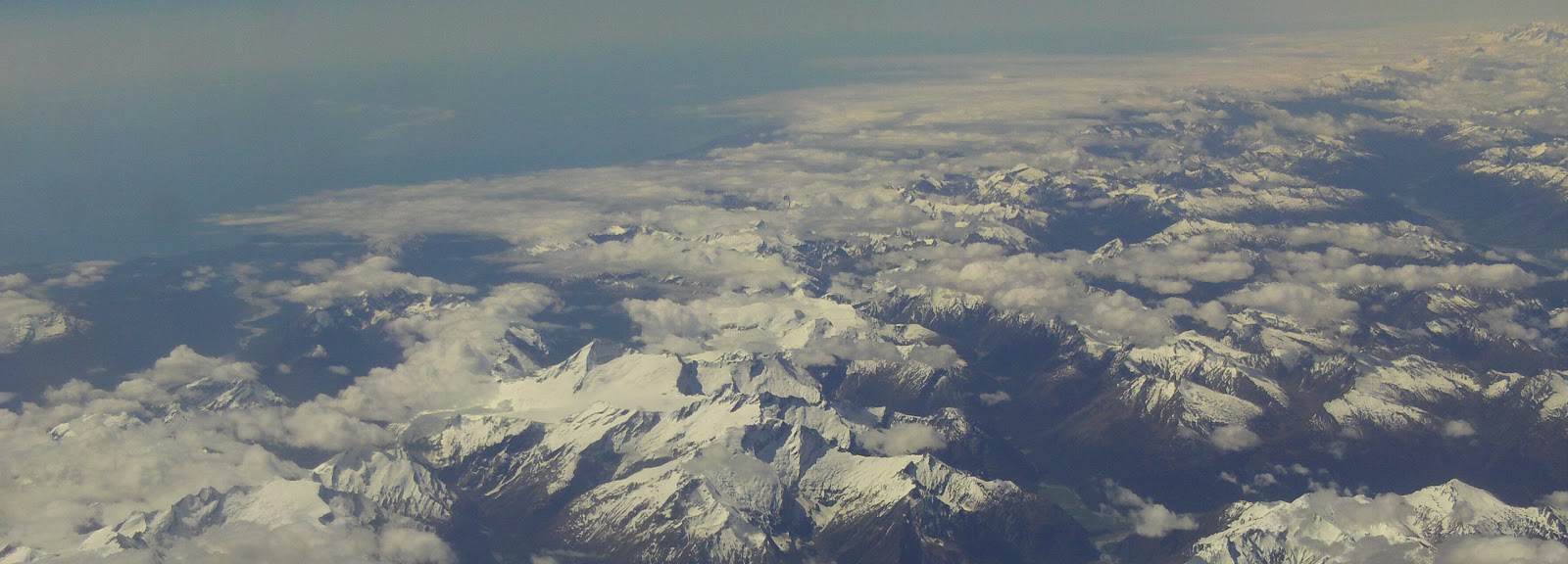
Sunday: From Base Brisbane - a backpackers' hotel opposite Central Station in Brisbane costing A$70 for a double with baths (note: hot water is a problem on the second floor) and WC down the corridor and a steak and beer supper the night before for A$10 each, we caught the efficient Airtrain to the International Airport - under A$30 each return, and without fuss were on a flight over the Tasman Sea - what locals call 'the Ditch' - over South Island, New Zealand, to Dunedin, Les at the Pacific Blue check-in kindly getting us seats by an exit for the extra legroom we cherish. The flight was easy, no frills, pay for your snacks - then after three and a bit hours we were over the mountains of Otago descending to Dunedin, where Val awaited us under a grey sky.
It was chilly, as though we'd flown into the Highlands in June, with similar landscape. So here we were in New Zealand - a place I'd never thought I'd actually see, let alone where I'd find myself - 11000 miles from England - invited to lead a one day seminar in a few days. Once home in Dunedin - 23 kilometres from the airport - Val took us into her warm home at the end of a cul de sac above the city. A log stove was burning merrily. She'd given us her bedroom. We'd enough light to stroll around a garden that mixed familiar British plants with more exotic. Amid the colour and greenery, even the weeds were familiar - couch grass, the tenacious invader and the beautiful nomad dandelion - envy of respectable flowers for its irredeemable wildness.
Some British gardeners struggle to achieve this ambience of timeless relaxed inattention and I've never seen it on a TV gardening programme. Cobwebs are allowed, moss approved, lichen welcome. In the back was a dry stone wall, random bluebells, small fragrant roses, a mossy edged lawn sprinkled with daisies, a little pond, a big old garden shed, a greenhouse with untidy shelves and a kitchen garden needing a few more vegetables, a hedge with an archway leading to a small jumbled patch for compost with a wooden gate that might or might not open onto another tree lined street - a rich patch of England on the other side of the world, and our washing hung out in the sun. Across the horizon, above the low buildings of Dunedin, lay the hazy South Pacific and, to the north west, steep green pastures edged by the bright yellow of gorse in spring, topped by a roll of white cloud beneath the blue. We could hear Blackbirds, "but" said Val "if you hear snuffling late at night that's Possums." In the same house is Val's son Laurence, who helped get my laptop working on the WiFi and on our first morning was coaxing the garden. Steak and sauté potatoes and Greek salad for supper, then early to bed with "no hurry in the morning," so read myself to drowsiness with The Bridge over the Drina - a book about a real bridge in Bosnia Herzgovina that I don't want to end I'm enjoying it so much. In his introduction William McNeill writes
no better introduction to the study of Balkan and Ottoman history exists...with humour and compassion Andrić chronicles the lives of Catholics, Moslems and Orthodox Christians unable to reconcile their disparate loyalties.
Monday morning the wind was still chill but the sky clear but for the long white cloud on the high ground above. The house sits in a slight dip, shielded from the chilly breeze so we could enjoy the warmth of Val's front garden.
"The Maori call this place Aotearoa - The Land of the Long White Cloud" said Val. Later she said with a wry smile "Some call it the land of Wrong White Crowd." I suspect that's an old one - but important for me to strive to understand.
** ** **
From Chris on the plot next to ours on the Victoria Jubilee Allotments:
Hi Simon. Sounds like you need to be heading nearer to the equator! I will try and have a look at lifting a couple of your plants and give you a report on how they have grown. I got some very small "salad" potatoes (very expensive in supermarkets) but the bigger ones seemed to have started to rot; of course my crop was not from seed potatoes but just left overs, so was a bonus realy. I have very much slowed down with the work on trees and hedge pruning before spring; and finally putting the roof properly on the shed. All this and a general tidy up and putting weed control sheets in the strawberry beds will have to be done in the next few weeks as I will be off for my 3 mouth winter escape in Jan. The weather here has been good but turning to rain and colder this week Hopefully arrange a get together for a morning or afternoon tidy and sorting out world politics after your return in Dec. Happy traveling till then. Yours Chris
From Scylla Parkyn, our Hon.Sec.:
Hello Simon, thank-you for your email. I have spoken to one of the park rangers and he said that we are still in line for some leaves, although we haven't quite established where the Allotments they could drop them off ( I did suggest that maybe they could put them on their own plot in the corner for the time being, which they agreed might be an idea, as nothing is being done on it at present, and that they would look into it. The next Allotment meeting will be on 20th November at 11.00am in the Meeting Room. If you can make it perhaps you would like to raise the issue about the bee keeping, especially as you are also allergic to bee stings yet would not object to a beehive on the allotment. I'm sure your offer of giving a talk on how to use a scythe would be welcomed  (in any case,  there's been no sign of a communal rotavator or strimmer appearing). Delith at no 10 had a little 'shed warming' tea party the other day (a few pictures were taken, if you would like one to add to your documentation), while we have managed to find a rather palatial recycled summerhouse/shed affair which is also now up opposite. With best wishes, Scylla 
Dear Scylla. Thanks for your reply. I won't be home until 6 December, but if you think it appropriate do mention this email exchange and say that I fully appreciate the apprehensions of anyone who has a fear that something as apparently minor as a bee-sting (they don't hurt even a quarter as much as a stubbed toe!) could end up causing an allergic reaction so severe as to be fatal. When younger I was stung by both bees and wasps - no where near a hive in the case of the bees, though I was by a nest in the case of the wasps. I had a strong and quite alarming reaction that was cured - luckily - at a nearby medical centre (of which we have several in Handsworth). The nurse saw me about half an hour after the stings and gave me an adrenaline jab for anaphylactic shock and said "It's lucky you got to us when you did." Since then I carry the kit that at the time only a nurse or doctor could provide. These remedies are easily obtainable and for the last thirty years I've had no worries. I was stung by a wasp a month ago. Quite painful but actually no need for treatment because I had no reaction beyond the smart of the sting. I regard my allergy as my responsibility and have equipped myself accordingly (check with local GP!). Bees are essential for the pollination and reproduction of the things we grow on our allotments and gardens and I would be very keen to see beehives in the hands of qualified apiarists on the Victoria Jubilee Allotments - if need be on a plot next to ours or anywhere fellow plotholders consider them welcome. Bees are having a hard time at the moment from various diseases and we need to encourage their husbandry, apart from valuing their role in helping us with growing things. There's an immense amount of advice on the web about beekeeping on urban allotments which includes guidance on how to avoid causing harm to other plotholders or their families. Avoiding apprehension is another thing requiring education, reassurance and respect for safety measures recommended by professional beekeepers. I hope very much that common-sense will prevail on this matter, or we'll end up cutting off our noses to spite our faces, which is a bit silly. Bees and wasps can sting you anywhere and at any time whether on allotment, or at home, in your garden or indoors even or in a car - supposedly safe from all insects. (Some advice on stings including allergic reactions). Part of our problem on the VJA is that shortly after our site was opened in June this year, one of the allotment liaison officers seems to have settled an issue between a beekeeper and another plot-holder, fearful of allergic reaction to stings, in favour of the latter. This has set a local precedent that needs to be debated and I very much hope reconsidered. (My abject apologies to the parties involved if I've over-simplified this incident or just got the wrong end of the stick.) BTW I look forward very much to following Delith's example and having a 'shed-warming' party later in the year or New Year. But first we must get the shed put up. Best  Simon
** **
George Papandreou feels sufficiently pleased with the support shown for his party PASOK in the Hellenic regional and local elections held on Sunday to delay calling a General Election to test support for his government's economic policies. It's typical that a central government uses local elections as a litmus test of its own popularity - especially now - but of course what we're c,urious about are the actual local results of elections to the new councils created by the Kallicrates Plan for the re-organisation of local and regional government across Greece, especially those for the new Municipality of Corfu - Δήμος Κερκυραίων - an amalgamation of the island's thirteen previous local councils. (see my earlier note on local government re-organisation in Corfu in a May 2010 blog). A more pessimistic take on the local polls comes from Costas Douzinas and Petros Papaconstantinou:
...In a country where the turnout is usually up to 80%, some 45% of the electorate abstained and another 10% spoilt their ballots. Pasok received approximately 34% of the vote, the opposition New Democracy 32% and the Communists 11%. The three radical left parties that had not managed to field common candidates polled about 12%. If the wider left had created a united front against the measures, it would have emerged as the hegemonic bloc confronting the neoliberal logic of the ruling elites. In view of these results, Papandreou, looking gaunt and exhausted, announced that he will not call an election but continue with the implementation of these measures...
** ***
Our dear friend Danica in Belgrade who I last saw in Oxford in the northern hemisphere summer has just lost everything from her hard drive - 'tabula rasa' as she writes on Facebook and on her blog - Digital Seredipities.
simon, i am in huge shock and grief.
i lost application im preparing for Harvard to send in 4 days
i have to write mission statement agaain
and research proposal
and to translate one of my works from Serbian to English
all in 4 days.
im installing programs now.
money doesn't matter
i paid for new hard disc
what matters is data
i will write now post on digital serendipities about this experience
and even more about support of humans and friendships
this seems good test to know who are really my friends and who not.
thank you for being my friend.
much love to lin and you
x
I know the feeling. These 'little' crises are sent to test us - remember Newton's thesis, eaten by a dog or did the maid use it to light a fire or was that someone else who lost all their work in the same grievous way? (What actually may have happened) I keep three external hard drives, one left at home, and two which travel in separate cases, plus I've a flash drive for ID stuff hung round my neck, and documents, images, film and sound left in the 'cloud' - e.g. Google-docs, Flickr, Soundcloud,Vimeo and Youtube - with links via this blog. Loss of a hard disk is still vexing but think of the 24/7 work we ask of these things! In a vain attempt at consolation I sent D this page from Dog with the Blog
** ** **
In a connected world I'm interested in any perspective on the incomprehensible world of economics. This piece in the Otago Daily Times (8 Nov '10) by Peter Lyons, an economist at St.Peter's College in Epsom, NZ I found quite helpful - if for nothing else than that he admits there are no easy answers:
...The United States, Japan and the United Kingdom are abandoning monetarist orthodoxy. Their central banks are pumping money into their economies with the aim of stimulating demand and driving down their exchange rates. This aims to increase the competitiveness of their exports. As the New Zealand dollar increases in value against these currencies it makes our exports less competitive on world markets.  Export-led growth was meant to be our saviour but this may be denied to us by the beggar-thy-neighbour polices of other countries. Further decrease in effective demand in New Zealand will lead to rising unemployment which could spill over into the housing market. If significant declines in house prices occur, this could create a negative wealth effect. As people feel less wealthy they cut back spending, leading to a nasty deflationary spiral. This is what other countries are desperately trying to avoid. There are no easy answers but we need to look seriously at our use of monetarist policy through the Reserve Bank. It is a debate that is long overdue. Our economy is not out of the woods by a long shot. These are strange times as countries seek to extricate themselves from the debt quagmire left by decades of monetarism....
*** ***
Andrew Coulson shared some thoughts by email about our Prime Minister's vision of the Big Society from which I extracted this::
...The idea of the Big Society is to recreate civil society, to turn back the clock to a life when we lived a few miles from the rest of our families, worked in the same place, shopped in the same place, went to pub or church in the same place, etc – i.e. a pre-motor car society. But it is also presented as a way of having a reduced state – i.e. civil society structures take over from what the welfare state does now. Politically this is very clever, as it means it can appeal to the right (smaller state) and to the left (mutualism and communitarianism), not only within the Conservative Party but more widely. But as a piece of political ideology the BS is in danger of complete meltdown. Cameron could not get a cheer for it at the Conservative Party Conference. I think that is because most Conservatives know that if the voluntary sector bodies they are involved in are to prosper they need constructive relationships, and often resources, from the state. They also know that they will be unequal – easy in villages and among retired people, much harder in cities and 30-somethings with young families trying to hold down jobs. So they neither believe that a top-down initiative can add much to what they are already doing, nor that it can replace the state in (say) crime fighting or care for the elderly...
My reply (extract):
As one involved in local community activity most of my adult life the impulse comes from advice given me ages and ages ago by my step-father who said two things of especial importance about political involvement and engagement to me when I was about 16. They must have been important or I wouldn’t recall them so clearly. The first was “You can get almost anything done if you don’t mind not taking credit for it.” (My Dad added to this also with a remark about how rewarding it was to have planted an idea and see other’s claiming ownership of it and pursuing it with enthusiasm.) I am sure JDS has ever approached the world in this spirit. The second observation was that trying to make anything happen in a democracy is like wading through thick treacle. ‘There are so many others trying to influence the same decision-making bodies that you will only achieve your goals by wading faster and more persistently and occasionly joining up with others who’s hopes and desires you share. The result of this is that I've never had any doubts about the role of perseverance and the patient courage demanded by political engagement. Few of the projects that have mattered to me (parks, allotments, green spaces in cities, transport transformation) have involved under 20 years and many of these continue messy and fragile and incomplete (e.g. The ending of autodependency (:)))  I have always consoled myself without using it as an excuse to be less resolved that none of my political heroes ever lived to see their dreams realised. Wilberforce never saw the ending of slavery, only our declaration of its illegality. Many of the most stalwart campaigners for women’s suffrage never themselves lived to gain the vote. Martin Luther King’s dream...and so on. I’m sure this applies to those who campaign against the predatory lobbying of big pharma that you mention. David and Goliath has always been an appealing image learned in childhood classes. The summarising maxim for me is not ‘don’t let the bastards grind you down’ (tho’ I like that phrase) but ‘you are always losing until you win.’ Until people can be persuaded to take on games that they seem to be losing over most of their adult lives I don’t see how government can hope to rely on dreams of ‘civic engagement’. Being poor is just such a losing game, so asking such people whose achievements revolve around daily and weekly survival to do yet more is bizarre. Best, Simon (in Dunedin, NZ) (See Stuart Weir on 'sham' localism)
Linda looks over the Pacific 

Saturday, 17 November 2007

It's not that I don't care

I met Rebecca in Coffee Republic, Newhall Street, for a second conversation, recorded on a machine hardly the aize of a thumb. She prompted me to think where and to whom my blood went. I'd been wondering, since our first conversation, why I cared so little. It comes down to the difference between donating and selling. Unless I could see no other way to feed my family - an improbable necessity - I wouldn't sell my blood. Seeing it as a gift, not a commodity, I've no wish to know the receiver of my blood, or to impose knowledge of my identity on them. My blood goes not to individuals but to a commonwealth with which I have a gift relationship. 'It is we who are under threat' On 16 November 2007 there was a conference at the National and Kapodistrian University of Athens on 'environmental management through research and teaching'. This was a multidisciplinary event which would surely have drawn the attention of policy-makers - indeed some of those who spoke are very much part of the policy process already. The knowledge, the evidence and the research skills exist. How do these ideas connect more strongly to political action - at every level, street, village, town, continents and sea? Professor Dimitrios Mavrakis, Director of Energy Policy and Development Centre (KEPA) at the university:
They talk about threats to the environment, but it is we who are under threat...However many forests we burn, the mountains will stay in place, the forests will regenerate but we will have lost a great deal. I have also heard that Greece will face problems in the future due to its lack of environmental protection. Well, I’m sorry, but Greece is already facing problems. If you don’t believe it, the next time you have a salad, think about what water was used to irrigate the lettuce and how many agricultural chemicals are in it. Cancer is rife in the provinces because of those substances.
Professors reported on environment-related research. 'You need a mask to get around downtown at midday,' commented one academic. Anna Karakatsani, associate professor of pneumonology, whose image I can't find but whose research record in her subject is impressive, noted, that the slightest increase in airborne particles is reflected in increased hospital admissions:
Research shows an increase of 10mg/m3 in PM10 leads to a daily mortality increase of 0.6%, and 1% in hospital admissions for respiratory problems.
Associate Professor Polyxeni Nikopoulou-Stamati, head of the health and environment postgraduate programme, with a research record of learning how cancer is caused by the environment:
Water is also subject to pollution. In the past 50 years, we have been deluged with tons of chemical substances.
Mavrakis' point that it's we who are at risk is well made. Whether or not you believe in Gaia, the earth has only to shrug 'its' shoulders to precipitate an extinction spasm [video from the National Center for Conservation Science and Policy, Oregon, on feeding science into politics]. A few million years - a geological blink - should allow recovery from the human era, so that in the Neozoic Era, we'll be no more than a stratum of carbon-plastic to be analysed and used for jewellery by intelligences evolved from rats, rabbits and cockroaches. Academic evidence in our 19th century cities showed even the most unaltruistic entrepreneurs that the water born diseases of the urban poor placed them in harm's way unless they promoted ambitious investment in clean water supply and sewerage. Having bought my return flight to Corfu next week, I've been watching United Nations General Secretary Ban Ki-Moon's keynote speech introducing a presentation, by Rajendra Pachauri, Chair of the Intergovernmental Panel on Climate Change, of the panel's latest report, their fourth assessment - Climate change:the physical science basis - in Valencia this morning. Pachauri used terms I need to understand - 'meridional overturning circulation', 'macro-economic costs of mitigation', 'dangerous anthropogenic interference with the climate system' - but his question was clear 'What changes in lifestyles, behaviour patterns and management practices are needed, and by when?' as was the implication of his concluding quote from Mahatma Gandhi.
Be the change you want to see in the world [Note: American in Athens blog wrap-up on the environment in Greece dated 5 Nov 2007 and CORDIS - the Gaias sphere] [Back to the future 12 March 2009: Climate Change Conference in Copenhagen ]
Med threat from 'concrete coasts' ~ BBC June 2005 'About 150 million people also live within 20km of the Mediterranean, and each summer that population almost doubles as swarms of sun-seeking tourists pack the region's hotel rooms. But what they come to enjoy is slowly being destroyed...'
World Wildlife Fund ~ Key Threats to the Mediterranean Region. Brief Report 2005: 
...projected tourism activity in the most ecologically important areas in the region will further degrade already developed areas and cause drastic transformations of the coastal and marine ecosystems in untouched areas. Furthermore, by 2020, approximately 350 million tourist arrivals will visit the Mediterranean, representing about 22% of all tourists world-wide. The ten Balkan countries are forecast to receive 79 million tourist in the year 2020 (4.6 % growth rate over period 1995-2020). The leading tourist destinations will be Greece, Turkey, and Croatia. Under the current tourism development patterns, these trends likely imply the degradation and even the outright destruction of most of the still valuable natural and cultural areas of the region.

Tuesday, 24 November 2009

Melbourne


John's old friend Jeff Floyd lent me his fine bicycle which I collected this morning from a floor high over central Melbourne, heading south along the Yarra to the shore at St Kilda, still far from the swells of real ocean but sandy and blue and built-up, just kilometers from the vertiginous architecture of this great city. The great interior and the vast uninhabited ocean shores remain remote, but for glimpses through a plane window and the genius of the indigenous genii who’s art seen this afternoon, when I cycled back to the city, has imparted something of what I’ve yet to learn; something which D.H.Lawrence in his genius seem to miss - 'this speechless country'. No longer and I don't mean just the Mabo Case or Paul Keating's Redfern Address, or Kevin Rudd's magnificent speech on 13 February 2008, or the Aboriginal Tent Embassy which I saw when John cycled me around central Canberra, but an epic - known and yet to be known - that will flow into future understanding of Australia and the world.

The recovery of Terra Nullius
I've been gazing entranced at the work of H.J.Wedge, Samantha Hobson, Julie Dowling, Gordon Hoskey, Treahna Hamme and, respect to Geoffrey Bardon, at the great mural Napperby Death Spirit Dreaming by Tim Leura Tjapaltjarri and Clifford Possum Tjapaltjarri.
But why turn my experience of a few weeks in Australia into painting by numbers? What might be fun would be to see how my judgements shift; what changes these swift weeks have made in my character.
There's the sense of understanding more about the negotiated space between politics and management, through the thinking of John Martin, now friend and colleague, studying the relationship in Australia; from John’s and Annie’s film – especially – of the conversation between the Mayor and CEO of Marion. This demonstrated the way a role-determined tension between political aspiration and managerially stewarded limits - legal, technical, financial - is resolved – over and over, by unique individuals who get better and better at it.
That demonstration of the personal workings of government also shone a light on the position and role of professionals in that mix whose grammar we’re striving to make more intelligible. Here there’s a professional who cares so much about the difference between almonds and jacarandas as part of the landscape of a street - a place - fretting about root-falls on understreet services – invisible to most. We’re still parsing this conversation. John’s used it on his own with one set of managers and councillors. I will use it in England – an exploration of how managers broker the relationship between the professionals and the politicians in government – made real In animated conversation between leaders - politicians and managers - at the apex, negotiating overlapping spheres of activity and interest.
As my train on Monday morning hurried south to Melbourne, through Castlemain, Malmesbury, Kyneton, Macedon, I drank up the landscape washed by a weekend of steady rain, still insufficient to fill the creeks and lakes so thirsty is the land itself, our speed at moments blending iron bark, grass, corrugated iron, yellow red stone, and clouds that reach beyond horizons I've glimpsed over a wing.
From my comfortable and inexpensive seat on the train I see stretches of the road on which I’ve been driven several times to Melbourne Airport to catch airplanes to the edges of the continent – Perth, Darwin (via Alice Springs), Brisbane, Canberra, Sydney, Adelaide and Launceston. We calculated, John and I, that by the time I’m home I’ll have travelled 47000 kilometres, over 29000 miles. I asked an environmental campaigner about this at the conference at Bendigo on Energy Futures, after he’d shown us a clever clip of flight movements across the world. He had no imperative. He mentioned George Monbiot pondering the same. Could you give up friends made across the world through the benefits of flight? “He calls them love miles"
*** *** *** I sent Paul in Agios Ioannis some pieces from the blog that might interest him for the December Newsletter, having failed so far to put together thoughts on the reciprocity between Ionians and successive Lords High Commissioners during the Protectorate - the theme of my chat this February at the Durrell School. 'Paul, would any of these do?':
Some of the most beautiful in Northern Greece - Koliopoulos on 'plundered loyalties' in Macedonia
Yearning Burning Earning and again - the commodification of Greek land, the 2009 fires in Athens and the Hellenic Cadastre
The missing commentary - The Parthenon Marbles
"Which side then has committed more crimes - right or left?" - ο Eμφύλιος.
Bad building on Corfu
Long ago in Aegina - Yannis Moralis and my Greek stepmother, Maria Roussen
Shades of grey. Corfu in winter
Consumerism - upon which most of us depend...
* * * *
Greece and Melbourne mingle in my current reading - Christos Tsiolkas' Loaded - an excellent introduction to the city - East, North, South and West - for the average tourist with guidance on places to visit. I'm jesting. This is a Melbourne Sorrows of Young Werthe written in 1995, made into the film Head on, driven by the manic confusions of voluntary transportation to Australia, Greek parents with peasant roots who require land to feel secure, who 'migrated to escape the chaos of history' who 'know fundamentally, property is war' that:
Possession of land, of more and more land, is the means by which an uneducated, diasporic community enables itself to rise in the New World and kick their brothers and sisters in the face, in the balls, in the cunt. p.143
This Australian sturm und drang is unremittingly ugly - sexual and substance self-harm dancing to music that hurts and endless arguments of the kind that makes troubled youth so bloody irritating to the forgetful old - who've got their own problems. Wimpishly, I felt like hiding the book's well-lit pages from neighbours on the plane lest they think I'm reading porn, albeit funded by the Australian Council for the Arts. Ari, Tsiolkas' loaded antihero, loathes cars and suburbs and a lot of other things including the 'weakness' of his Greek parents. He was already 30 when Loaded was published. The book's unconsoling vigour brought to mind E.M.Forster in Passage to India, which I mined for A-Level 40 years ago:
Most of life is so dull that there is nothing to be said about it, and the books and talks that would describe it as interesting are obliged to exaggerate, in the hope of justifying their own existence. Inside its cocoon of work or social obligation, the human spirit slumbers for the most part, registering the distinction between pleasure and pain, but not nearly as alert as we pretend. There are periods in the most thrilling day during which nothing happens, and though we continue to exclaim, “I do enjoy myself,, or , “I am horrified,” we are insincere.
As an Englishman with mainly Scots roots, linked through my dad to a Greek stepmother and half Greek family set of sisters and half-bro, and parents who divorced in 1949, brought up by my mother and stepfather now living in inner-city Birmingham and the most congenially beautiful village in Corfu and re-visiting Australia, Tsiolkas' rich writing speaks of a misery in being young that I only half recall if at all, being largely distracted from self-harm by the ocean and all the possibilities of a life privileged by the imagination and talent of those closest to me, and located by English private boarding schools from the age of six - an indoctrination so robust I didn't start to peel it away until I was into my 30s, largely impervious until then that a peel even existed, and wasn't something that I could being to write about until I was well into my 50s, when I'd assembled some experience. I'll read more of Tsiolkas, as also Tim Winton, and thank the Brisbane bookshop owner who pitched me at just two consummate artists to be going on with, narrating the history of Australia as surely as its great physical explorers, matching the new cartography of its emerging indigenous artists.
[Back to the future 17 December 09: A finely written diatribe by the Sydney columnist Elizabeth Farralley, against suburbs and MacMansions and Australia's love affair with ugliness - see the comments too]
*A very different take on the Greek diaspora, comes from Stavros, author of My Greek Odyssey:
* * *
The image that will remain in my head is the Tjapaltjarris' night sky inside Napperby Death Spirit Dreaming and Lorenzo's words in The Merchant of Venice

Look how the floor of heaven Is thick inlaid with patines of bright gold: There's not the smallest orb which thou behold'st But in his motion like an angel sings, Still quiring to the young-eyed cherubins; Such harmony is in immortal souls; But whilst this muddy vesture of decay Doth grossly close it in, we cannot hear it.
It reminded me of Richard's picture last year when he stayed with us in Ano Korakiana.
and...
HR 5171 (back to the future March 2014)

Back numbers

Simon Baddeley