Total Pageviews

Showing posts sorted by relevance for query "car driven away". Sort by date Show all posts

Monday, 29 October 2007

An amicable divorce

I have just seen my car driven away by a friend who's got it for free. I've been 'deciding' for 5 years - maybe longer. But the final decision to be rid of it came a week ago, since when it's sat in our drive, insurance cancelled. It helped that the cost of repairing its transmission was assessed as more than its worth. I have not been without a car since the 1960s. This evening is a moment long anticipated, regularly postponed. My family seem to have had cars since they were toys. I recovered an old photo of Barbara Maine, my maternal grandmother Bar, in her Peugeot smoking a cheroot. I recall having some of my happiest childhood times in cars, with my family. What I best remember (something written about and filmed at the time) is the accessibility to places all over Britain we got from having a car in the 1950s. I realise we drove - 50 years ago - on roads that most people now see in absurd advertisements - filmed on locations in Croatia or Albania. My mother and step-father were writers and journalists through the late 1940s and '50s. Cars were part of their salaries. We had the means to drive. We would arrive at places where there would be no cars for miles - or very few. We could park next to beaches, cliff tops, and high ridges with mighty views (see what I mean about advertising?). We reconnoitred long, lightly-paved rural lanes ending in cul-de-sacs where, after a word with a the farmer, we set up tent and fished in clear trout streams. We ate our catch fried in butter. I was often very happy - innocent of being in a vanguard of social change. My step-father remarked once, when I was going on once about the 'beauties of the countryside' (I was a literary youth) that this sort of thing wouldn't last. 'We're doing things the very rich could do. Now we are doing it. Soon everyone will be doing it! We're part of the rot.' In later years he observed that the central dilemma of socialism (quoting Bertrand Russell) was that 'you can ruin anything by making it available to everybody.' From the mid '60s, life on the open road, new motorways notwithstanding, became increasingly closed. The freeway became unfree as more and more people, understandably, sought access to a possession we'd enjoyed more exclusively. The freedoms promised by the advertisers of cars became more and more conditional. Friends of friends were killed in them and by them. I started travelling abroad to get away from the crowds in my own country - often walking and relying on trains and buses when going to lonelier places that were still places. Travelling with my wife, we seldom returned more than twice because we could always see material prosperity spreading - as it rightly should - but in the process blighting the quietness and slowness of more self-sufficient economies we'd visited as guests rather than an important part of the new local economy. We saw fishing boats laid up and replaced by marinas and yachts. We saw heritage signage spreading, as places became consumer items and we became harvest. We too had been consuming but we'd usually enjoyed the only table in the house.
In old age, my father said
'The only places left to live will be the cracks between the concrete. I advise you to to live in places already ruined. Maybe you will find the wisdom to make them better in some new way none of us understand."
Photo from Richard Risemberg's 'Bicycle Fixation'
I did not revisit my childhood experiences of motor touring until 1995, when with my young children we toured the Peloponnese in a hired car. We had had help from the Greek half of my family identifying still isolated areas of the peninsula. The motorway southwest from Athens was under construction. We drove en famille from Athens via Corinth and Leonidi, Sparta, Kalamata and Messini to Pylos on almost empty roads, stopping when we wanted and having picnics, strolling together through ancient ruins. Stopping high in the Taygetos mountains in Lakonia (the point from where this summer's conflagration spread) one Sunday evening and hearing silence under a black sky pierced by a million stars (normally hidden above the yellowing pall of light polluted England), with no sound except the cooling cracking of the car, hot from ascending a narrow zigzag road where we encountered no other vehicle for half-hours at a time. I took joy seeing my little daughter and wife who, unlike me, had never been to Greece, walking among the remains of a civilisation I associate with my roots as well as my present family. The car took us to the edge of beaches and right up to tavernas where we could park and walk to a table. Only once an ill-judged detour 'to see the sea' at Koroni jammed us into the narrow walking streets of an ex-fishing village grid-locked by visiting motorists - foreign, and the new expanding Greek middle classes, and us. Back in England I saw this holiday as an anachronistic replay of my motoring childhood and realised I could not keep trying to stay ahead of people with the same aspirations as myself but slightly further back in the rat race. I had to start thinking about my step-father's old age advice. I kept my car but reduced my annual mileage below 3000. My favoured way of getting about became my feet, my bicycle, train or bus, while car ownership just went on increasing. I have indeed found contentment and interest in the cracks in the concrete. I have watched wild fowl, inland seagulls, herons, urban rats, and foxes along canal towpaths, passing beneath the pillars of raised motorway junctions as I've cycled and walked the city, threading its congested roads and alleys free of worries about gridlock and parking. I have enjoyed picnics in the shadow of dilapidated industrial ruins. I've campaigned for more urban green space, for education for sustainable living. I've chatted across the rich world in cyberspace to like-minded people about ways to solve that central dilemma of making the riches of the world available to everyone without destroying it.
I've tried to imagine cities where more people will want to stay and make them into real places again instead of dismal, narrow economies where they can earn enough 'to get away.' I have found the roots of such cities in my own home town, as I walk and cycle about. Anyone hearing moralising in these reflections, should know that we fly to places still, that there's still a car in the drive (my wife's). My daughter has just bought her own. We are profligate with energy. This is more about about ending my long taken-for-granted relationship with the car - my auto-dependency. It's been a gentle separation, then an amicable divorce from a long and increasingly jaded marriage of convenience.
[A piece I wrote 7 years ago about 'cutting my car use']

[Back to the future 14/01/08 Alex Taylor, Fortune senior editor: DETROIT (2008 Detroit Motor Show number) -- If you are looking for some insight into what the automobile of the future will look like you could do worse than talk with Tom Lane. An American, he runs all of Nissan's Product Strategy and Product Planning from his office in Tokyo. Unlike most executives, he welcomes the imposition of new U.S. fuel regulations that mandate 35 miles per gallon by 2020. "It is not an issue" for Nissan (NSANY) he says. He expects the new regs to drive more small cars, improved technology, and a broader variety of shapes and sizes, as designers try to get more variety out of similarly-sized vehicles. But he points to some discouraging global trends that don't bode well for the industry. He notes that consumers in Japan are losing their mojo when it comes to cars. The population is aging, and younger drivers would rather spend their money on new cellphones and Internet access." Japan is increasingly not interested in new cars," he says. The population in Europe is aging too, and Lane sees similar ennui spreading there. As car ownership becomes more expensive and cities increasingly impose congestion pricing on car usage in center cities, he sees car owners switching to mass transit for their daily commute, and then renting cars for longer trips. "The U.S. is headed that way," he says. "The challenge for us, going forward, is a more interesting offer. Doing a better Sentra or an Altima isn't going to do it." [Review article 'Reducing our dependence on the car', Local Government Studies (2000) 20:1, pp.101-110]
['Cutting car use' Bicycle Fixation 2000]
[Back to the future. AlterNet piece on driving cars in July 2008]
[Back to the future 11 Oct 2009: The auto industry frets over young people's lack of interest in driving]
[Back to the future 14 Oct 2009: Oil ~ From extraction to consumption: an exhibition by Edward Burtynsky]
[Back to the future: 14/06/10 Lament for today's cars]
[Back to the future: 28/03/12: Edward Burtynsky ~ Automotive detritus, Oil ]

Tuesday, 15 July 2008

On Democracy Street with Richard and Amy

It's good having Richard and Amy here, walking the same places and meeting the same people - in the village and the town. Low, compared to Iraq, we're still unused to this heat. It can catch late risers, like my family, unawares. Having got ‘Summer Song’ ready, I’ve thought of sailing but realised I’d need to desert the house, cycle down to Ipsos, and set out before dawn to enjoy six hours between about 4.00 and 10.00, mooring or anchoring in a north facing cove in the heat of the day. . “Why do so many people here sit outside all evening?” asked Amy yesterday. Summer in the Mediterranean in a village with inhabitants who find personal climate control expensive – or even unnecessary - is unfamiliar. Richard relies on a fan; recalls coping with humid heat in Thailand. This morning, up at 7.30, I opened windows and shutters to get a steady morning breeze through our lower rooms. Upstairs Lin sleeps by a fan. Amy, on a mattress in the upstairs sitting room, has A/C, with windows shut. I did a little washing up, put away cutlery and plates, took in the washing and listened to the neighbours chatting from their doors and looked over my e-mail news. * * * Joel Crawford has circulated a Paul Harris op-ed about the people and the ideas affected by rising oil costs:
‘The worst hit parts of the US are…the small towns that dot the Great Plains, Appalachia and the rural Deep South…people in these isolated and poor areas are reliant on cheap petrol…Stories abound of agricultural workers unable to afford to get to the fields and of rural businesses going bust. Even farmers are not immune. They might not need a car to get to their fields but their fertilisers use oil-based products whose prices have gone through the roof. A handful have started using horses again for some tasks, saving petrol on farm vehicles...’ Harris ends by noting the visit of Chinese government officials, one of many delegations from the Far East and South America, to an Arizona suburb near Phoenix. surveying with approval ‘the luxurious car-driven suburban lifestyle on display…Even as America is sobering up from its excess of cheap oil, other parts of the world…want homes far from dirty city centres, huge open roads and fast cars…a beguiling vision of freedom, mobility and bountiful riches’. Meanwhile American suburbs begin to display problems long associated with their inner cities, and once-abandoned downtowns enjoy ‘a remarkable renaissance’.
And in the NEAL PEIRCE COLUMN Sunday, July 6, some thoughts on ‘metropolitics’:
So Americans bedeviled by $4-plus-a-gallon gas want more transportation choices? They have no idea of what real choices are. For a taste of our necessary future - driven by rapid energy cost inflation and climate emergencies - check the streets of Amsterdam. Sure, cars still function here. But by our standards, their numbers are remarkably modest. Especially on center city streets, another king reigns: the bicycle. Bikes, indeed, swarm around by the thousands…Bikes, overall, account for 37 percent of Amsterdam transport. Public transit accounts for 22 percent of trips. On top of regular and high-speed rail, there's a massive light rail network - 50 miles of tram lines, with many stops, dense in center city, radiating out to neighborhoods and suburbs with cross-connecting lines too. Recently freight tram cars began running through the city, cutting truck use (and pollution). And Amsterdam has added three new subway lines since its first in 1976. So what's the Amsterdam game plan? For decades it's been to nurture the ‘compact city’, slowing a middle-class exodus and preserving the open landscape by dense development, recycling old industrial areas and intermingling uses. Reducing auto use -- now just 41 percent of trips compared to 90 percent-plus in most US cities -- is the heart of the plan.
* * * Down at Ipsos harbour it was gusting F6 from the west. I cycled down from Ano Korakiana - a pleasant ride - and began taking off sails and packing up the boat again since we have to be away to England Thursday morning. Richard scootered down to help with the main. The foresail must wait until the wind lessens as it must be unfurled before lowering and I don't fancy wrestling with a sail that big in this wind - whistling over a blue blue sea churning up wavelets. Well reefed we'd enjoy sailing in this but I still lack confidence in myself and 'Summer Song'. I hope we - Richard and me - can go sailing in September and perhaps go further afield than Lin and I have been so far. * * * Riding tomorrow. Out with Alex K all yesterday - enjoying calamares at Benitses and talk and insights on local history and the challenge of implementing a Greek Land Registry - via the Hellenic National Cadastre - to set up a legal framework for adjudicating state and municipal property, define forest and coastal zones, and resist encroachment and unauthorized development of land.

Kathimerini 18 July 08: The long process of entering millions of properties on Greece’s first comprehensive land register started with a mad rush yesterday as some 30,000 people are estimated to have visited 75 offices where the necessary paperwork can be submitted. It is estimated that some 3 million Greeks will have to register their properties over the coming months and years. However, the process is beginning with the owners of properties in 107 areas around the country. The scheme has been highly publicized in recent weeks and this led to thousands of people gathering at the main office in Syntagma to either submit documents or find out more. “We estimate that a total of 400-500 applications, related to about 1,000 title deeds, were submitted,” said the head of the Syntagma office, Alexandros Velissarios. “The number of people who congregated here was at least 10 times as many as the number of applications. And they were not just from Athens but from all over Greece.” A total of 4,800 applications were submitted at land registry offices yesterday. Another 3,700 were submitted to www.ktimatologio.gr, a website which gives information in English as well as Greek about how the cadastre will work. The amount of people gathering at the offices yesterday caused frustration among the queuing public, as some people had to wait for up to three hours. There were complaints that people who had not completed their forms beforehand were allowed to do so while others waited. Others moaned that it was not clear what documents were needed. However, despite the fact that information sheets were readily available to anyone making general inquires, many of the people waited in line to speak to staff to learn more.

Monday, 27 September 2010

A bumble bee in the cockpit

Rain arrived in the early hours. I heard its patter before dawn and snoozed the better. By midday water was spouting in gouts from the gutter pipes, pouring down steps in the village like a burn in spate, running in rivulets down the street, gurgling into the cross street gutters. Heavy clouds streamed up from the south flowing up the sides of the mountains behind the village hiding the crags, blowing a loppy sea toward the strait. It rained all afternoon, into the evening. I was driving back alone from Tzavros after midnight, windscreen wipers at double speed. At the corner just beyond Marmara Trifona – stone factory – I skidded the car ending up in brambles and hollyoak facing back the way I’d come. In seconds I knew I was stuck there. But I was unhurt and so was the car. A Samaritan had already pulled up just ahead of me. Was I alright “Can I take you anywhere?” Andrioti on his way to Acharavi gave me a lift home to Ano Korakiana. Mark, who I texted, offered to help drag me out but said it was a very dangerous corner ‘better try your car hire company’. I cycled down to see the scene in the morning, sun shining again.
As I surveyed the scene several people stopped to check no-one had been hurt and offer assistance, but Yianni from ValuePlus cars in Sidari was sorting me out in no time. Early Sunday but Sophia, his wife - I think - answered the phone almost instantly. She contacted Yianni and a few minutes later said he’d be along with a tow truck in 45 minutes. Yianni’s first action on arriving was not to check his car but to express his relief I was safe and ask “Are you alright?”, later checking the new tires on the car in case they had been a problem, when I was well aware it was my fault for touching the brake too late on a steep corner in drenching rain. The two truck men, Spiros and another Yiannis, spoke for a few moments, then positioned the truck across the road, with one stopping northward traffic and me waving down southward. In less than five minutes the car was out of the verge, the road clear, and the car on the truck, taken to a layby a hundred yards away, and off loaded. Yianni drove it a kilometer back and forth and back and handed it back. “Everything’s fine. No worry. Pay the truck €40” Which I did gladly, with a tip, especially as I’d been offered an earlier tow for €90 by another passing truck while I was waiting for Yianni.
I’d not told Lin the night before what happened. Wanted it sorted first. Now I did, realizing how fortunate it was that I’d not had my skid at a lot of other places where I could have fallen off the road, toppled the car, injured or killed myself and worse done the same to another on the road. This is how everything goes pearshaped in life; how easily and ordinarily the man with the scythe can drop in for a chat. Now apart from the lesson about wet roads on Corfu – told me plenty of times – I hold the memory of people’s kindness and efficiency. That has so often been my experience here. ** ** ** Nice news from Handsworth. After lying dormant for three weeks rain has brought forth our potatoes, photographed by Richard in the rows I planted them at the end of August.
Chris on the neighbouring plot emailed:
Hi Simon. Good news from hobbit land your tatties are looking great and all seemed to have formed plants at least 15cm. They all seem to have sprouted. Only half of my last ones seem to have come up which is amazing. I have never grown potatoes before so will be interested in any ideas you have when they are ready to eat. We seem to have good soil. I have put my shed up only roof needs finishing. New leader for labour elected today as I find out my and Perdis and teams NHS jobs are now likely to end in April and all cycling work with BCC and Sandwell NHS seems to be slowing and payments have not been made this month. It will be good that the allotment will mean I will not get bored and there will be plenty of time to get good food next year. Hope you are enjoying your break. Yours Chris
** ** ** Earlier in the week: Lin, tidying, broke a favourite piece of strawberry glass; tiny fragments over the marble floor. Natasha, in a brown study, sat on her step was exclaiming about the high cost of the English language book her son needs for his first lessons. We’ve got more dictionaries than we need collected at table-top sales, so I could at least offer that. Apart from our good fortune in neighbours, we’ve already had infinitely more in generosity, food, coffees and wine, informal lessons and invitations to the family table, so it was a relief she accepted it as tiny quid pro quo, but we’re far from evens on gift exchange. **** Email from Val back in New Zealand:
Hi Lin. Sorry I didn’t email you as soon as I arrived, but I was too tired and too cold. Would you believe; freezing weather and snow? So I spent the evening in front of a hot fire. … I slept on all flights on the way home (even from Christchurch to Dunedin , which was very bumpy because of bad weather, and a small plane), and I slept for 10 hours last night! I bought some duty free perfume in Athens; no problem until I got to Bangkok, there a custom officer insisted I put the SEALED duty free bag in a snap lock plastic bag! No problems with the couple of things that I had bought in Dubai. In Sydney there were no problems with the couple of things that I had bought in Dubai , but the customs official - a woman - was concerned with the amount of perfume in the bottle which was still inside the sealed duty free bag from Athens , which was still inside the snap lock bag from Bangkok . Having assured herself that it was an OK amount, she informed me that she had to x ray it again!!! When I got to Christchurch there was no problem with the perfume but as I had come via Dubai and had bought duty free there, I was accosted by a male customs officer at the carousel while I was waiting for my case, wanting to know if I had bought any pipes (hookahs) in Dubai , or any other wooden things. By this time I was feeling very jaded and very belligerent, I just told him “Oh for God’s sake, I have enough bloody crap at home without importing any”. When he stopped laughing, he told me he had to ask because several times a week they had people trying to bring them into the country. The flight from Christchurch was delayed by nearly an hour because there was a bumble bee in the cockpit, and they had to search the airport for some fly spray! It would have been quicker if someone had driven to the nearest shop and bought some. (I have just glanced out of the window, it’s snowing again, so much for showing off my sun tan!) The insect bites are no worse, or better come to that. By the time I got home I had a thing the size and shape of a rugby ball at the end of each leg, but the swelling has gone down considerably overnight. Love Val Hi Val. Glad you arrived safely, in spite of your encounters with overenthusiastic customs officials, and managed to sleep the journey away. Hope I can do the same when we come over! Loved the bit about the bumble bee in the cockpit. Hope the bites will be better soon - I had a nasty one between my big toe and the next toe (the little buggers will find any bit that hasn't been doused in anti-mos stuff!), but good old Germolene has done the trick. Now that you're not here the mosquitoes have turned their attentions to me. Simon is obviously their last choice - not sure what that says about him. He did, however, trip up the steps today and managed to save himself by putting his hand on a wasp, which promptly managed to sting him before being crushed to death. Two Piriton tablets and Anthisan cream to the rescue! The weather has continued very hot since you left, but they've forecast rain tomorrow. We've managed to get some work done…Still plenty to do…Apparently it's freezing cold in the UK too, so I've got that to look forward to. Must go now. I''ll be in touch in a few days. Can't Skype, as it's too early for you. Love Lin
*** ***
Rain rain rain - and a good thing too. Cleaning the roads, washing the walls and paths, freshening the air, reducing humidity. It is almost impossible to imagine sun and brightness when the south wind arrives with its freight of mist and damp. Lin was fussing over a tiny leak in our roof in the back room upstairs and through a join in our flue pipe. For her its like a flaw in her plans for the house that even a drop of rain should find its way into her home. I scolded her for starting at a flea. She almost wept. In the village few people are about. The season is ending for tourism. Wood is being delivered and stored for the winter. Me. I like this weather, quite as much as when its sunny. It shows things in different light; cues different reflections.
A wet day in Ano Korakiana - Ισχυρό ΚΚΕ
**** In Scotland I have news, a few days ago, of the happy meeting of Minoti Chakravarti-Kaul and my mother, who Minto calls Theodora - which is one of my mum's names, but one I've never heard used. She has a way of giving special people she meets a choice of her names - Barbara, Poppet, Theo, Theodora.. A plot is unfolding - loose ends woven; nothing if not intriguing.
Email from Minto (mum says that's the diminutive they used) during their meeting at Brin Croft in the Highlands:
Dear Simon.Thank you so much for your emails and it is only just this moment that I have been able to sit down to my netbook in St Andrews - home of my daughter. I did not want to take up more than 2 hours with dear Theodora Sumner Maine - she will be just that for me for the rest of my life. Unknown to her we did not tell her that we would limit our time and so when we did get up to leave she was just in her natural mode of seeing us off. Contrary to what Sharon said she had no problems with my accent and I spoke up just a little and also went slowly but she is so very alert and it was amazing how she got on to the issue of common lands in the UK.
I left her the big volume on the tradition of commoning with her and we will post the latest copies to her from Langford soon. She wants to know everything about the movement. That is how we could not talk much about what I had planned to ask her and also I had to abandon the whole set of questions I had prepared to ask her. It does not matter as she asked me within a few minutes when I would come back and could I stay with her and I was amazed at how things turned around. She asked this several times so I told her that I would try and be back with her about February/March and if she had her grand children around her that I would rent a cottage somewhere and work on my book and bump it off her and she was delighted with the decision and said she would note it in her diary.
I was going to write chronologically about our visit but I will wait till I get back to Langford and write a more coherent account about our time with Theodora. But let me just say that when I first entered her home there she was like a Dresden china image of Lady Maine and the aura about her and the place was so beautiful and inviting that I almost did not remember all the formal circumstances. When we parted both of us had tears in our eyes as she said that Sir Henry would be pleased with us meeting and remembering him the way we did.
I did tell her a lot of things about Sir Henry and India and the aftermath of the mutiny etc....for the time please bear with me if I am not able to write anything which will capture the extraordinary spirit of our meeting - it was like linking to a hallowed past as if the time had not elapsed. Theodora is just amazing. God bless her. Thank you very much Simon for making all this possible. Regards, Minoti. Prof. Dr. Minoti Chakravarty-Kaul, C-59 Uttaranchal, 5 I.P. Extension, Delhi 110092 URL: http://commonlandsresearch.info
PS. The book shown in my hand there is the one with the paper cuttings of the time ... but the book itself will stay here till I come back next year and bring it back for the collection which may be we should index. What do you say? I have promised Theodora to organise the papers and books she says these are in the other house from where she had shifted to Brin Croft. She had no idea that her father, that is H.C.S. Maine, had several important groups of letters which he had made available to George Feaver! ...She is very interested in the issues of grazing lands in Scotland and shepherding.
And what Professor Chakravarti-Kaul added when I spoke to her on the phone while she was at Brin Croft, among other things, was "Your mother and I have been talking not about the past but about the future!"
Note: The photo of Minoti and my mother at Brin Croft is by Dr Peter Lane 
 ** ** **
 How lucky that now in my late 60s I encounter The Pickwick Papers. I could never have enjoyed these when younger. I wouldn't have understood or found it possible to engage with Dickens' first novel - though others of his I've enjoyed since youth. Leave reading Pickwick until later - like Cavafy. If it's taught in school play truant. Save for old age!
Sam Weller and Samuel Pickwick
*** *** Corfucius has pointed out that a 'spineless' news editor at the BBC has removed an account by the excellent freelancer Malcolm Brabant about the throwing of a shoe at George Papandreou during a recent protest in Thessaloniki. But see this from Teacherdude - citizen journalist - on 30 Sept '10.

Saturday, 24 January 2009

A place to keep silence

Last night we arrived in Ano Korakiana to find the house dry and sweet. Mr Leftheris greeted us with a fine five kilo marrow rescued from rotting in our garden. This morning the sky's grey. Rain's been falling in abundance, but not a drop in the house, warmed by our log stove, lit with one match. Having coached from Birmingham, we flew from Luton to Bulgaria, landing at Sofia after midnight. Until five-o-clock, we waited in the airport café for the first bus – 84 - at a stop by the terminal. Dobran, a student cameraman, finishing security duty, jotted down our bus connections, helped with fare paying and pointed out Hotel Pliska, where we changed buses for the central station. We were driven slowly through Sofia's outskirts on carriageways edged by dirty snow heaped against indefinite frontages lit by tall yellow lights. A fellow passenger - Emir Kusturica - seeing us gazing at this placeless streetscape nodded that he was going the same way as us. I like public transport for the likelihood of helpful locals who read the minds of strangers. Our bus route ended beside the neon-lit concrete of central station rising conspicuously from shiny streets, suckled by yellow cabs, a cavernous old modernist atrium where we were swiftly befriended by a man over keen to assist. Queuing behind five sets of passengers, we watched the clock marking our train time drawing closer as two women, having started the day with a smoke, opened a counter for the tiresome business of issuing tickets. One customer, ashen and elderly, abruptly taken by shakes, peeled away to steady her wrist with her other hand. I wished I could have made her well. One of the women behind glass stared interrogatively at her before getting on with writing dockets, printing tickets, stapling papers, receiving fare and explaining procedure. Realising plastic wasn’t currency, I scurried to a nearby money changer and bought levs with my euros getting notes in Bulgarian currency but small change in euro's. Three students - one called Goran Bregovic - pointed us towards our platform but our helper, bent on some return, picked up Lin’s bag, led us to a carriage and a compartment. I tipped him лв5 and he, seeing change, asked for more, but Lin restrained me.The train – a Greek one - slid away almost at once. For six hours we sped through a damp grey landscape on a single track to Thessaloniki - a comfortable compartment to ourselves. 1055 we were checked at Kulata, the Bulgarian side of the border. At Promachon, the Greek border station, a young Greek policeman inspecting our papers said “You’re in Hellas”. I smiled and punched the air. He responded with a gleeful grin. At Thessaloniki at one – about twenty-four hours since we’d left Birmingham – we were to take a bus to Meteora, but learned that a "sort of a strike" had cancelled it, so we caught a six-o-clock train to Kalambaka, chatting and snoozing and reading – Lin, a thriller, and me engrossed in Mark Mazower’s Dark Continent: Europe’s twentieth century – a whodunit with a cast of millions, many plots and measureless violence, and I still don't know who did it. Kalambaka was the end of the line. At nine thirty we strolled from the station up a narrow street to our guesthouse beneath dimly lit rocks soaring into darkness – Meteoro, ‘the wide rocks’. How could we ever ascend such dizzying heights? We rose Thursday morning and started upwards. The road from the guest house became a lane, then a well crafted path winding between mossy boulders, grassy spaces, small trees and shrubs. After an hour's walking we came to the monastery of Holy Trinity - closed Wednesdays and Thursdays - connected by a small cable car to the plateau behind Meteora, over which a road could bring visitors by car and coach. As we gazed at the great rock pillars, the town of Kalambaka and the winding river Pinious far below, a friendly man on a scooter called Kostas arrived and gave us free souvenir postcards, a cigarette lighter and a map, plus some handouts to pass on, encouraging us to stay at his guest house. For the climb we had the pleasant valley and the towering rocks to ourselves and the wheeling birds. Going down Lin went ahead. I walked down alone in quietness broken by the occasional rumble of jets. This place was defined by its holy inaccessibility, providing isolation and refuge for prayer in a dangerous world. Serving a secular economy Meteora's strengths might, but for modern engineering, have become a weakness. Patrick Leigh-Fermor, travelling in Roumeli over forty years ago, wrote of the recession of spirituality in Greece. His wonderful writing has the same touch of melancholy as Matthew Arnold's line on faith's long withdrawing roar - both writers understood and only part regretted. Modern guides celebrate what has been inherited, preserved and restored, courtesy of EU, UNESCO, the Greek government and the region’s Metropolitan - and much voluntary work by the few remaining inhabitants of the monasteries. How ever far we trek along what ever enticing route, a car park, landing strip or a marina will mark our destination and if they don’t they will. I shan’t forget our walk up and down that path between Kalambaka and the road to the Monastery of the Holy Trinity. We saw signs of goats beside our track. Once I slipped on my back missing a small pile of dung but was unhurt. We spied goats standing quietly in a clearing among the hollyoaks across the valley between the rocks. The ground about us was bursting with small plants and even early flowers. Later in the evening, my knees aching, we ate tasty lamb roasted on an open fire along with properly chopped chips and local red wine. From the bus station next morning we took a coach through a whitened landscape to Ioannina where we caught another to Igoumenitsa. From that now familiar jetty we sailed on the Saint Irene to Corfu Port, enjoying the company of two young Australians, Katherine and Roseanne, visiting Corfu to meet a sick relative, on their first visit to Greece.

Thursday, 29 September 2011

What I wanted them to see

Birmingham and the Black Country when they made widgets
These days it’s tricky, even in Birmingham, where for two centuries men and women sweated a living amid a vast stubble of chimneys belching smoke and steam over middens of soot and clinker beside turgid waterways through which horse drawn narrowboats edged night and day between workshops making widgets for the world, to find a part to solve a household problem, a gasket, a metal plate, catch, strapped hinge, a reverse pintle, bracket, fastening, matching handle, screws, nails and bolts of particular length and gauge and other needed devices lacking exact names. Things are made somewhere else, the sweat and dirt transferred to hungrier places.
This is nearly the same in Corfu though it does have small workshops dotted about. Here the difficulty of finding a widget is increased by the challenge of describing its specificity in Greek (Greece can surely accommodate its own version of that memorable ironmongery sketch by the Two Ronnies that starts with a request for “fork handles” or possibly “four candles”).
We’ve found a mix of gesture, sketching on a counter or scrap paper and pidgin Greek evokes a slow steady comprehension, interjected by checks in the direction of evolving agreement until we arrive at a pleasing glow of acknowledgment that our shakily communicated request has been understood. Relieved we wait for the shopkeeper to retreat into one of many multi-stacked aisles to bring what we want.
“Ah ha. Of course. I understand now what you need. No.”
His understanding smile plus hands and all his body transmutes, and we return to conjecture as to where in Corfu, across Greece or indeed the world, the desired item might be found. Like long waiting for a bus you can be glad to see one going in the opposite direction, for proof they even exist. A good ten days ago we needed small black plastic catches to secure the foot of one of the mosquito screens on one of our windows which kept shooting up on its rolled spring escaping originals wrongly footed. After fruitless diversions, questionings of regretfully unknowing friends, getting us nowhere, on the basis of a clue as opaque as a hint to Sam Spade, I was cycling and walking up and down streets on the south west edge of Corfu town, following a succession of contrary but accurate directions. I came at last to a shaded workshop on a narrow road that had crossed Margariti on the way to the airport where my gestures including the imitation of mosquitoes, the pulling down of a screen and two bent fingers as I crouched going “kik, kik”, quickly brought a box of black plastic mosquito net clips, a swift demonstration of how they worked, the handover of an opposing pair, and a complete refusal to accept payment, despite my obvious jubilation including the beginning of an un-English embrace – a touch on the other’s shoulder “I’ve been looking everywhere…ψάχνω παντού για... ευχαριστημένο!”
My stepfather enjoyed showing widgets used for pre-industrial farming, things either sent by viewers or which he'd encountered. Some were familiar, some unknown, so he'd show them on the tele' when broadcasting in the 1970s and 80s (this too).

** ** ** **
A few days ago we dispensed with our hire car. It's our largest outgoing when here - at around €20 a day in the season.
“Let’s see if we can do without it for a fortnight and save ourselves around €250” said Lin
"Great, we can walk, I can cycle and both of can take the bus."
Yesterday was a perfect example of the widget-seeking advantage of a bicycle over a car in the narrow traffic congested maze of Corfu; so easy to stop, park, drop into shops and ask directions. It was pleasurable too to cycle into town, down the steep narrow path from the house to the lower road, then, after a careful check of my tyres for thorns, two kilometers to the main Sidari road, two kilometres to its junction with the main road between town and Paleocastritsa, four more to the Tzavros junction then six kilometres along the dual carriageway to the Old Port turn at Potamos and another kilometer through Mantouki to the bottom of Nikiforou Theotoki Street where I can wend my way between walkers and a few more cyclists to Alpha Bank on Kapadistriou to pay our car hire fee into Yianni’s account, get a receipt and collect pink slips for other transactions made over the year. These slips are evidence our income is from UK; that we are not earning here. The tax office in Greece needs proof our income is external; enough to pay for the basics – electric and water with corresponding taxes – of running a house on the island. Tellers at the bank find it a chore to generate these. It always takes a wait of twenty minutes or so until they arrive. I relax and read and gaze around until I have my paperwork, then scoot off on other errands; searching for widgets, strolling my bike down Voulgareous Street amid the crowds enjoying a takeaway spinach pie, until I enter wider Georgios Theotoki and pedal amid cars and scooters to San Rocco Square, leaving it on this occasion via Polichroniou Konstanta which turns by the old hospital, now moved to the new one at Kontokali, into Ioulias Andreadi up Avrami Hill to where the narrow one-way airport road turns off to the south, where I started asking about window frame suppliers.
Later I returned to town emerging into San Rocco from Mitropoleous Methodiou, visited an internet café near St Spiridon’s cathedral, struggling I suspect, now there are so many places with free WiFi, looked up the news, awful as ever on the economy, found no service on the campus server so no email, threaded my way to the old port, along the front on Xenofondos Stratigou to catch the 4.15 bus, the last of the day, to Ano Korakiana, my bicycle folded and stowed in its luggage compartment – total fare €2. Just west of Agios Markos the steepest hill from Ipsos already climbed, with I its only passenger, the bus was stopped from preceding by a small fire. I unfolded and cycled past a police car, fire engine and a few watchers, two more kilometres on the narrow road through olive groves and was home by 5.30.
* * * *
What I wanted them to see
After five days as our most welcome guests, Tony and Helen Scoville have left for the mainland, heading for Zagori and the Vikos Gorge, then Meteora and the long drive south to Epidavros, then Athens - their first visit to Greece. We’d thought it impossible to do more than guide them to a few places on Corfu.
Monday the 26th, the day before they left, they drove me to the summit of Pantokrator then, on advice from Spiro in the shop, back to the Strinillas-Acharavi road, turning right to Petalia, Loustra, Eriva, Trimodi, Lafki, Kaniotiko, circling the western slopes of Mt. Krassato, on down to Riliatika where a thin road turned sharp right off a T-junction in Ag.Martinos, winding down and up a lonely sinuous route made by men, women, donkeys, sheep and goats from Krinias, Vassilika and Perouli, circling settlements within 30 minutes walk, toiling on foot and hoof for the Venetian empire over centuries, planting olives trees, unearthing rocks to build contoured dry-stone terraces to hold soil for saplings to root. Today, trees - centuries old - tall-coppiced every two years, have grown stout, gently twisted, full of natural cavities, venerably gnarled, now and then bearing plastic bottles in their branches to ward off insects, moss coated, cyclamen sprinkled in spring, harebells, myriad ungrazed wild flowers and grasses along sunlight verges. Now and then, though not this time of year, relieved of fiefdom, a waged family from far away, arrives by car, tending land they own, harvesting small black windfall olives gathered in spread nets. They’ll take these to one of the local modern olive presses to get a supply of their own oil, some offered for sale from roadside stalls in the tourist season. It’s not the best. Olives should be collected when they’re still on the tree; shaken down. Once these groves would have been dotted with labourers serving one of the northern estates, lean brown country people toiling for the signori – the lord of the manor. We’d see donkeys, sheep and goats and - around a makeshift apothiki - fowl grubbing from the undergrowth that today grows free in spring, drying in summer to make tinder for the arsonist or the feckless thrower of a smouldering cigarette. The landscape is confined, deep green, deep shaded, dappled with the bright sunlight that here and there shines through the olive leafed canopy, the ground brown with small outcrops of rock. There are few birds. In the quiet you hear insects and woodland sprites before a scooter or a car approaches, its engine varying as its driver negotiates the bends echoing unevenly so the listener is uncertain if it’s coming or going or, like us, has stopped to look and listen half-hoping for ghosts. At the hairpin turn in New Perithia we headed back up the Krassato’s burned eastern slopes via Margarika, Zervou, Loutses, Ipsila and Anapaftiria to lunch at Palia Perithia under the vine canopy of Foros where a sleepy dog adjusted its position on a margin between shade and the light of mid-afternoon sun. We enjoyed cold beers, local wine, horta, tsigarelli....
...grilled sausages, feta salad with green peppers sliced sweet onions and beef tomatoes, saganaki, fried vegetables and to finish a slice of sweet squashy cinnamon coated pie and Greek coffee attended by hovering wasps, interested cats. Distracting them with a wave becomes a reflex, punctuating conversation about the decades since Tony and I first met...
Before they were expected the previous Wednesday, Linda and I had done lots of tidying.
Downstairs bedroom
We waited their arrival late that afternoon.
My friend Antony sailing to Corfu
We would normally meet guests at the port or airport. Instead, being carless, I’d given elaborate directions so they, driving a hire car from Athens, after taking the ferry from Igoumenitsa, could find our house. Listening out, I could tell them coming up Democracy Street. A local would have driven faster, less tentatively. I’d written ‘we’re just past the church of the Archangel Michael’. They’d seen it and paused and I, waiting on our balcony for their arrival, saw them coming by and pausing again.
“Tony!” I called to the back of the car.
“Hullo!” said Helen.
“They’re here” I shouted to Lin indoors, as another car bringing Lefteris and Natasha, our neighbours home from a funeral in Agoria, pulled up behind. In a moment we were carting suitcases down the steps. Mark’s and Paul’s Dad Phil who was having a drink with us, guided Tony to drive on to a parking place and brought him back to us.
So having met and become friends as we set out on life’s journey – he 26, I two years younger – we met again – he 71, me 69. We shook hands in the street.
“So. We made it!” I said “…and as I was saying before we were interrupted …” Can we, I thought, get on with your thoughts on existence, infinity and indeterminacy – ideas we’d discussed with fervor all those years ago, Tony introducing me to Feynman, Gödel, Schrodinger and Heisenberg skirting, for me, ineffable mysteries of time and space. They brought presents, blue woven table mats, a set of white table napkins, a book about the wonderful house they’ve built in the wooded hills of Connecticut and a book by James Gleick The Information and a Schubert CD.
That evening I walked them around part of the village, up to Venetia, down the narrow path by Agios Jacobus, where the procession goes at Easter, and so back to our house via the lower road explaining the views as we came upon them – distant Albania, Epirus, the Old Fort that marks Corfu town to the south, and the story, as much as I knew it of our village.
From Angelokastro
On Thursday we picnicked below Angelokastro the fortress on a rock pinnacle commanding a view of the southern Adriatic and the high cliffs of western Corfu, descending to the tawdry shores of Paleokastritsa, on a tight bend of the descent we stopped at George’s souvenir shop, bought bottles of his village wine, and climbed again to the lovely monastery teeming with visitors.
On Friday Tony rose in the gloom, came upstairs and went out on our big balcony to see ‘rosy fingered dawn’ silhouetting the mainland mountains over the Kerkyra Sea.
We stayed home the rest of the day with plenty to do as they went exploring south towards lake Korission, saw the blighted eastern littoral, worked their way into the wooded hills along narrow roads where even with Stephen Jaskulowski’s excellent map, now a decade out of date, they missed an intended circuit that would take in both coasts where the island narrowed. I think they lunched in Ag Mattheos; swam from Ag Gordis before returning to Ano Korakiana for supper with us. Tony said they passed through one village in the south that looked desperately impoverished, and we've been sharing with them what we know of the crisis; how it strikes our neighbours here, Greece and the rest of the world.
On Saturday we went to town, strolled up N.Theotoki, up the Liston, around the Palace of St Michael and St George, through the Durrell Boschetto and into the Old Fort to gaze over the gentle blue to Vido, Pantocrator and the mainland, retraced to take a coffee, baklava and ouzo at Zissimos on the Liston...
Helen and Anthony at Zissimos, Corfu
...then a shopping amble down narrow Odos Ag. Spiridon, peering briefly into the cathedral, rejoining N.Theotoki and so home, to rest before supper at Strapunto, the taverna on the turn to Kato Korakiana.
On Sunday we sent our guests off to explore ‘Kensington’ – the cornice road from hideous Barbati circling the north east with its view over the Corfu Channel to Butrint and Saranda in Albania...

... taking a meal at a Toula's by the sea at Agni, thence the north coast as far as Roda from where they turned south through the Trompetta mountains to join the Sidari road west of Skripero bringing them home with a few hours before our party for them under the walnut tree in Effie’s and Adoni’s garden...from the Ano Korakiana website, by one of our guests, Thanassis Spingos:
Mark, Simon, Effie at our party for Tony and Helen
Η πρόσκληση σε ένα garden-party, που λάβαμε από τον φίλο Simon Baddeley, εξελίχτηκε τελικά σε μία ελληνο-αγγλική γαστρονομική συνάντηση, στον κήπο της Έφης και του Αντώνη, στην Πλάστιγγα. Κάτω από την τεράστια καρυδιά, το μακρύ τραπέζι που από νωρίς είχε στρωθεί, αποδείχτηκε τελικά μικρό για να χωρέσει τους πολλούς προσκεκλημένους του αγαπητού μας Simon και της συζύγου του Lyn. Το δείπνο ξεκίνησε με πρόποση και καλωσόρισμα του «οικοδεσπότη», που κατέληξαν με απαγγελία στοίχων του Καβάφη στα ελληνικά και το τραπέζι περιελάμβανε αρκετά νόστιμα πιάτα και σαλάτες, καθώς και ποτά για όλες τις προτιμήσεις. Οι ώρες κύλησαν ευχάριστα με συζητήσεις κατά παρέες, με τη συνοδεία μουσικής και χορού, αλλά και του εμφιαλωμένου κρασιού και των μελωμένων σύκων που προσφέρθηκαν για επιδόρπιο, παραγωγής της οικογένειας Λευτέρη Ιωνά. Ήταν μια θαυμάσια βραδιά συνάντησης και γνωριμίας…
Under the walnut tree with friends
** ** **
I'm again studying When Tomorrow Comesstruggling with it as I try to make sense of this report of an extended debate over recent months on the future of the public domain and the role of government, especially local government in England and Wales. It's not easy following the recorded conversations of people seeking new ways to understand public services, citizenship and community - always hazy concepts. A couple of times in the last month I've put the document down in a mixture of vexation and incomprehension, but I keep coming back to it, mining the text for things that make sense, underlining phrases, adding comments, getting a feel for the conversation behind this difficult text.

Friday, 27 April 2018

Respite

“I’m going to get a jug of cold custard and pour it down the front of those ridiculous trousers!”
Lin, who usually handles our travel documents, gave me my passport and boarding card at the departure gate in Birmingham Airport. She was embarrassed to be seen with me in my comfortable overlarge jeans, held up by braces, which nearly fell down, when security told me to check them separate through the metal detector.
“I’ve bought priority boarding”
“So you won’t have to be seen in my company?”
“Exactly” ... though I knew she wanted to ensure her hand luggage with our picnic for the journey stayed with her, rather than going with mine in the hold.
Once aboard, before heading for a seat rows away from me – she will not pay Ryanair to choose seats - Linda handed me the prosciutto and cream cheese sandwiches she’d made in the night. I’d enjoy them with a paper mug of coffee drunk through a mesh fed with plastic sachets of milk, ten miles over the Dolomites, peaks laced with snow.
Almost midday, our flight landed - oops - with a bang before swiftly settling. My guess - a Boeing pilot new to Kapodistria not wanting to use up its short runway. At Corfu, surrounded by hazy mountains, I placed my hand flat on the apron’s hot concrete. We collected the car from Yianni, drove over to shop at Lidl by the airport, parking under one of their shades. With essentials - milk, butter, fresh veg - we drove familiarly north.
“Easter’s early. The Kokykias are still coming into blossom. Last year it was near 1st May. They’d almost finished”
Lin dropped into Kaizanis supermart at Tzavros for feta. We stopped at Emeral to have ice creams in cones. Bitter choc for me. Pomegranate and melon for Lin.
In the village, mid-afternoon, none but the cats saw us descend the shallow steps from Democracy Street, bumping and carrying our luggage. Into the cool dry house. Switch on electricity, turn on water faucets – one behind the apothiki under a metal cover, the other under the veranda with a pressure gauge.
“Cup of coffee?”
“Yes” and a cup of tea for me.
Beds all made; all as we left things last year, but for a little more winter growth of weeds in the garden, and the lower path to the bus stop filled with greenery awaiting my sickle. Despite the rainy winter there was the tiniest amount of leak-water in the plastic tray we’d left in our bedroom.
A few days later. Easter Saturday. in the crowded forecourt of Ag Georgios for midnight rejoicing, Lin and I stood with candles lit from the altar’s candle held by Papa Evthokimos. Minutes later, fireworks and shots.
“Xristos Anesti” “Alethos Anesti!”
“Kronia Polla” “Kronia Polla”
Η Ανάσταση ~ Resurrection

Following the village band playing happy tunes, we strolled home down the steep slope from the church. I marked a new candle-flame cross above our other porch, the first one, after ten Easters, having no more room for them.
We sat together upstairs. Lin jumped up on hearing sounds outside
“That’s them!”
The family had stopped their car to off-load children and baggage at the top of the steps. Down came Oliver and Hannah holding their own small suitcases, descending slightly edgeways, one foot ahead of the other.
“Careful on the steps, you two” I call from the balcony.
Their beds are made up. The stair gate in place.  Pajamas, loo, wash, teeth...
“Just one story!” and so to bed
The Sea of Corfu from Ano Korakiana 

Two years ago - February 2016 - we were enjoying a weekend at Rock Cottage when, early in the morning, we still in bed, Linda got a phone call from her mum.
“I’ve fallen over in the kitchen. Think I’ve broken my wrist. I can’t wake Arthur”
From a 100 miles away Lin phoned Staffordshire ambulance service. Dot was taken to Staffordshire General. We returned to Birmingham. Lin visited her dad at home in Cannock, took him to see Dot and brought him home to live with us. Arthur has never owned nor driven a car so Lin, as she has whenever in recent years her parents have been ill - Dot with a cancer in her cheek and Arthur in his eye - both brilliantly cured by the NHS -  ensured her parent’s transport to and fro between hospitals in Staffordshire and South Yorkshire, consultations, shopping and home.
This time, with her bad wrist, Dot should have been out of hospital in under a week, but norovirus struck - not her, but many other patients. We could neither collect Dot nor visit her. She was, through this ill-chance, unnecessarily bed-ridden for 3 weeks, as the infection played cat-and-mouse in her ward, recurring over and over just as an imminent ‘all clear’ was reported by phone. Dot at 93, unexercised, became unable to walk. I now know, with hindsight and the experience as a subject for research into sarcopenia in humans over 65, the swiftness with which lack of exercise lessens muscle strength.
Lin got her mum to a care home not far from us in the Black Country ‘to get her back on her feet’. This brief rehab was working. Lin visiting every day with Arthur and sometimes the grandchildren. Then Dot came down with pneumonia - rife in institutions. She was moved by ambulance to Sandwell General. Arthur, stoic and mostly silent, would have a stilted phone conversations between chauffeured visits by Lin to see his partner of 70 years. One early morning, at our house, he fell over trying to get to the commode in his bedroom - having refused his daughter’s help; his wish for independence, and keenness not ‘to be a bother’ amplifying his dependency. I heard him groaning through his door. Commode tipped on the floor. An ambulance took him to the same hospital as Dot, where, in days, he had a hip replacement, but, after three more days, descended into an amnesiac mist, brought on in part by pain and perhaps anaesthetic, and came down with hospital pneumonia. A day later, Lin had an early morning phone call
“Come quick”
When we arrived at the hospital Arthur was dead. Lin and I saw him, kissed his brow where his body lay still on his bed curtains around, then, with the duty doctor, went to break the news to Dot on the same open ward corridor.
Throughout the time - 45 years I’ve known them – my in-laws have been inseparable; dependent on each other; proudly independent as a couple, grandparents to Richard and Amy. Dot, stoic as her husband, released two tears at the news. Still ill, she could not be at Arthur's funeral - short and truly sweet, just ten close relatives at a 15 minute ceremony in Perry Barr Crem followed by a lunch at Toby’s Inn; flowers from our garden, picked at the last minute, placed on Arthur’s simple coffin. He was 98.
Lin found a care home in the north of the city, smart and efficient at over £1000 a week, paid for by the NHS. Dot, from hospital, arrived at Aston Court the day after her husband’s cremation. After this second stay in a hospital bed, she was again unable to walk, though just able to stand.
She was visited daily by different members of her family, but despite Lin’s best efforts at pressing the care home, especially the visiting physio, her mum remained confined to her bed with, now and then, time in a wheelchair in the lounge or dining room. She’d forgotten how walking worked. Her mind intact - she read, sang, did puzzles, watched TV and chatted to her nurses and visitors, planning, she’d repeat, to get back home which she believed was just outside her bedroom window. The home allowed Oscar dog to visit. He would jump on her bed and lick Dot’s face. As well as Lin and Amy and Richard and the great grandchildren, Dot’s niece Barbara with daughter Janice were regular visitors. I less so. Climate controlled, expensive, spotlessly clean, salubrious, quiet even muffled, with lot-bought neo-impressionist French landscape prints – poppies, contoured fields of perfect blue – hung along tope carpeted corridors lined with uncontroversial wallpaper, the place wreaked of my civilised abandonment, oozed rebuke for my selfishness.
At Sandwell General Dorothy had been catheterised - probably more to ease the work of her carers, than essential. Walking patients are at risk and hospitals fear litigation. At Lin’s request the catheter was removed, but Dot remained incontinent, her carers tending to her needs in bed. It was now that Dot began to speak of wanting not to have to wake up every morning. Prescribed antibiotics for a chest infection, she would appear to swallow her pills. Lin would find tablets secreted among her mum’s sheets.
“I don’t need them” Dot would repeat.
Lin and I brought her to our daughter’s home over Christmas. Asked after lunch what she wanted for a present Dot muttered, with a wan smile, “Knock me off”.
Dot and her great grand-daughter out for a meal

In November 2017, after she had been there 17 months, a meeting was held at the care home. Linda and I were in Ano Korakiana. As anticipated, the review was to decide whether Staffordshire NHS Trust could continue to pay for care, or whether this should be handled by Staffordshire County Council’s Social Services, who would seek funding from the family. Our daughter, was at the meeting, attended by an NHS manager and nurses who looked after Dot. Later Amy phoned her mum. The NHS, as Lin expected, would no longer pay for Dot’s care. The decision would be rubber-stamped in January 2018. Dot’s future care could be paid out of her inheritance, such as it is, or Lin, on her mum’s behalf, must make ‘alternative arrangements’.
“I can build ramps” I said
“Yes” said Lin “and we can clear the sitting room at our house, put in a bed and all that’s needed, and have a visiting and occasional llve-in carer service.”
Dot can hardly stand, let alone get about, but she could at first be gently moved from bed to wheelchair and from wheelchair to car and back.

She could feed herself but her care must involve washing and therapy to deal with the risk of sores from spending so much time lying down, as well as 'going to the loo and all that'.
“But we would be handling the finance not a local authority”
Now should be payback for all the National Insurance Dot has paid through her long life, but what’s been paid out so far for her care in old age and disability, can no longer be paid, and the state wants to draw on her savings.
Dot seemed to be on the edge of a twilight zone; coming and going, rallying into occasional cheerfulness, collapsing into waxen grief. Arthur had now been gone over a year and a half. At the time she first went there, staff had her down in the admission paperwork for ‘End of Life Care’. Lin pointed out that that was not the case, that her mum might yet recover mobility and we could bring her to our house.
“I knew the NHS wouldn’t continue funding” said Lin, “Mum’s situation didn’t meet their criteria”
On 17th January our drawing room had become a bedroom for Dot with extra heating, a commode, TV and remote, a patient turner – a gadget that helps the bedridden to stand and transfer from bed to wheelchair and back, books. bedside light and over-bed table and a button that rings a buzzer in the kitchen next door. I had made a wooden porch ramp, enhanced by a short aluminium extension bought on eBay. I hung a ribbon notice over the front door ‘Welcome home, Dot'
Then Lin collected her mum, the care home nurses helping Dot from bed to car. Once home I helped lift her from the car, Dot reaching up to grip the top rim of the car door, then turning ever so carefully – "I’m worried I’ll take a tumble” -  until she could sit again in her unfolded wheelchair. The ramp was imperfect, but after testing with help from children, seemed good enough to wheel Dot into our house and up to our kitchen table.
“Cup of tea?”
"Yes please"

Over several weeks we formed a routine of movement between kitchen table – where we always eat and talk and work – and the sitting room made into a bedroom. Dot made small sighs, mumbling unconsciously and repeatedly to herself, which, when she dozed, became an iteration of the phrase “Help me, mummy. Help me, mummy. Help me, mummy...”
We would chat with her. I sat beside her recalling times around family photos in a pile of albums and from the computer.
“That was when we were on the beach in Brittany. Remember that time we lost Amy? She wasn’t lost, it was us losing her. There’s you and Arthur on a bench on a sunny day. Who’s that?”
Anse de Guillet, Brittany - June 2007

Dot was forgetting names, even mine. Later we got to joke about her absent mindedness.
“She’s always been daft” says Lin
“Who’s that Dot. That’s me! What’s my name?”
“Charlie” she says with a cheeky grin
“Who’s that then?” I ask, pointing at Richard who was visiting as he often does
“Don’t be silly, I know who that is. He’s my favourite”
“So what’s his name?”
“I know who he is”
“Tell us his name or I get out the electric cattle prod”
“Not telling you”
Later in the albums and on the computer I name people and places, hoping to help her fading memory. I think she knows, but she can’t always summon a name.
I read avidly 'Our Island Story' when I was 10. Now Dot enjoys reading it at our kitchen table

Irritated with her daughter for insisting she go out of the house to spend a couple of hours on two or three days a week at community centres Lin had found at Oscott and Great Barr, Dot, truculent, said she would be reporting her daughter to her “doctor friend”… “He used to be an ombudsman”
“What are you talking about, Mum?”
“Yes. He’s my friend. I’ll tell him”
We were looking at ramps on the internet. Discussing different types.
“You don’t need to bother with them” says Dot “I’ll be out of here next week. I’m going home”
“How, mum?”
“I’ll be off”
Every morning when Lin tends to her, assisted once a week by a visiting carer for a bed wash Dot says sorry for “being such a bother”... “I wish I wouldn’t wake up in the morning”
Registered with our local GP, her doctor said to Lin not to force Dot’s medicines on her – prescriptions for another chest infection.
“If she won’t take them, she won’t”
I was thinking of the Hippocratic oath; the part where a doctor swears they will ‘not strive officiously’ to keep a patient alive. Lin solves the problem of Dot disappearing her tablets by getting liquid antibiotics. I get a sense that such subterfuge would not be approved by the doctor, though the law and current rules forbid thinking, let along practising this way. Lin and I discuss this.
“Mum said to me this  morning, ‘I want to die. I want to be with my Arthur’ ”
“It’s no surprise, Lin. They were together for 70 years.”
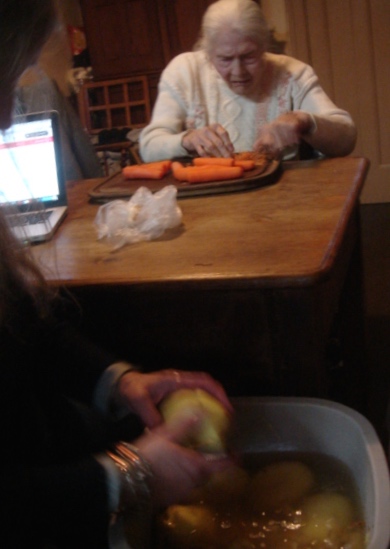
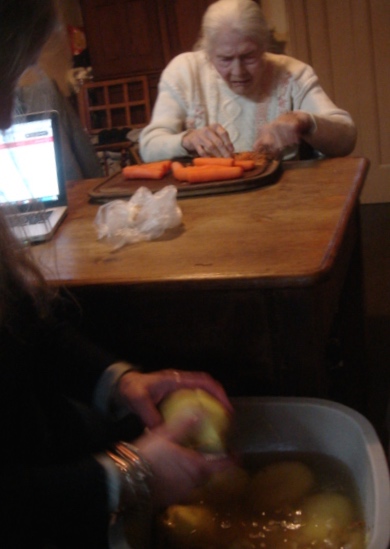
Dot helps prepare Sunday lunch
When we do get Dot, laboriously, to one of the day care centres – at St Mark’s Community Hall, Oscott Community Centre - she enjoys herself. Eating at a shared table, having cups of tea, with others of the same age also disabled, doing light exercises in a circle of chairs, playing games including Bingo. The people there are kind and outgoing, both the carers and other old people. The cost is minuscule.
But our hopes of getting Dot on her feet again, with just the scrap of independence that would allow her to make it on her own between bedroom and kitchen to, perhaps, make a cup of tea or a sandwich, have dwindled. As she’s brought, laboriously, from car to chair and back, her legs have a life of their own, just functioning, with her grip on the car door to stand for a second as she turns from one seat to the other”
“I’d never have believed she could be so heavy” I said to Lin
“I know”
“She’s a beloved sack of potatoes. God help me from becoming like this’”
 “Top me if I do” says Lin “Mum wants to die. Nothing we do to entertain her is sufficient consolation to raise the will to walk. We’ve been to the markets, to the Chinese New Year Festival, out for meals…she almost begrudges our care, as I probably would.”
Oliver shows Dot pictures on the computer

When we take her out she can enjoy herself

Lin had worked to surround us with other help, two neighbours, one himself a carer for his brother with progressive MS, said they’d be happy to drop in to do errands if we should be away. The caring group Helping Hands sends the pleasantest young woman, who lives near us, to wash Dot and help Lin turn her in her bed. The district nurses visit – briskly. Once a GP came, when Dot was coughing badly. Paramedics followed at his request and whisked Dot to hospital in their ambulance. The paperwork that came back with her the next day defined her as being ‘unwell’.
“I’m not sure what that was about” said Lin.
If we were to be away she and a colleague will come in the morning and evening to get Dot up and put her to bed, wash and handle her incontinence, changing nappies, emptying the commode if it were used. We explored having a two-way camera at Dot’s bedside to have talk and vision from anywhere in the world.
When Dot developed a more serious chest infection we could no longer get her out of bed. Almost continuous the quiet chanting of ‘help me, mummy…let me go” and groans, almost of irritation, as though we are interfering, when we turn her to change a bed pad or draw her helpless body back up to her pillows.
The children visit as do Barbara and Janice. Oliver, nearly 6, came on Dot’s 94th birthday to present his great grandmother with a card he’d written himself. He made Dot laugh aloud, playing with a silly monkey programmed to chatter and, now and then, emit a mechanical raspberry.
Oliver brings a card for his great grandmother's 94th birthday

“She looks now and then at the tele’” said Lin “but it’s no more than moving wallpaper. She’s not reading now or doing puzzles, yet every now and then she’ll sing a song like she used to with the children, and she can still recite the ‘Wreck of the Hesperus’"

It was the schooner Hesperus, 
      That sailed the wintry sea; 
And the skipper had taken his little daughtèr, 
      To bear him company. 

Blue were her eyes as the fairy-flax, 
      Her cheeks like the dawn of day, 
And her bosom white as the hawthorn buds, 
      That ope in the month of May....

With Lin and I she runs through the story of young what’s his name - Albert - and the lion at Blackpool zoo ...
They didn’t think much to the Ocean:
The waves, they was fiddlin’ and small,
There was no wrecks and nobody drownded,
Fact, nothing to laugh at at all.

 “the stick with the horse’s head handle…and poked it in Wallace’s ear…you could tell lion didn’t like it, cos giving kind of a roll he pulled ... dum de dum …. and swallowed the little lad whole!’”
“I’ve made up my mind” says Lin one morning, a few days before the flight still not cancelled “I’m putting mum back in the care home. They’ve got a room. Three weeks respite. We’ll be in Greece when the family’s there over Easter. I’ve got a flight back on Ryanair for £14. You can stay on.”

After three weeks Lin flew back to England; a flight from Corfu at six in the morning.  We were at the airport at 4.30am. I waited a moment to check the flight was on time, then drove to the hire car compound, unloaded my folding bike and pedalled via back lanes, lit by my torch, towards the city.
Email 24th April: Dear Lin. Heard your plane arriving and I think I heard you leaving. I guess you’ll be touching down any moment in Birmingham
After dropping you off I couldn’t resist a cycle tour of the empty city. I left the car at the deserted compound and headed for SaRocco Square via dark back lanes, dogs barking now and then. Then along the Liston, down Theotoki to the harbour where a ferry was disgorging trucks - still dark. Then back up Theotoki to the bus station for coffee and croissant and wait for my bus. Two people - me and another - all the way to the village.
The 08.30 bus from the Green Bus terminal stays on the Paleo Road instead of turning right at Tsavros. Then opposite the Casa Lucia turn at Sgombu, it turns right and heads up past many narrows and tight squeezes past vans and trucks, past the Strapunto turn, past Luna D’Argento, into the village on the lower road before coming to our stop from the west. At 9.00 (timetabled arrival in AK) my bus was just passing Technomart at Gouvia! I walked in the morning heat up the path to 208. Cup of tea and sending this from Piatsa then a list of things to do….spray trees, prepare shutters for touching up, plant your cuttings….XXXXXXXXXXXXX  S
Our emails crossed on the day Lin arrived in Birmingham:
Lots to do here too. Sorted the post. I've won £25 on the premium bonds. I opened one of yours marked 'Important', but it was just a Temple Bar dividend notice (£5.25), so I need it for your tax return. The only interesting mail you've got is a largish, gold envelope - maybe a late birthday card? Just washed and disinfected the cat litter tray and swept up the litter round it. Shan't do much more today, 'cause I'm shattered. And cold! L x
On my own in the village
I have a list of jobs, starting with painting the shutters on three windows...the first batch have been sanded, filled where the sun's dried cracks, treated with preservative primer, undercoated and finished with Corfu green gloss.

While the family were here Oliver and I walked up one of the rough tracks from the sea to Ano Korakiana
Thanks to neighbour Thanassis Spingos, who runs the village website, for a photo of Oliver, holding my hand, as we walk behind Mayor Fokion during the Easter Monday procession around Ano Korakiana.

*** *** ***
Back to the future - July 2018 As the weather grew warmer and the days longer it seemed that Dorothy rallied, became less morose, seemed to take more pleasure from life
Great granddaughter, born 2014, and great grandmother, born 1924 in our kitchen in Handsworth this July

How I hope it may be for me was captured in a lithograph by the Spanish artist Goya. He writes beside his self-portrait as an old man, rheumy-eyed, walking with the help of two sticks 'Always Learning'

'Aún aprendo' Francisco Goya aged 80 in 1826

Back numbers

Simon Baddeley