Total Pageviews

Showing posts with label Minoti Chakravarti-Kaul. Show all posts

Saturday, 18 August 2012

Progress

There is no question that the ground on my allotment is becoming easier to work. I'm becoming a little better at gardening. Last year's work removing larger weed roots and clearing debris in the top soil makes present digging a lot easier. I suspect too that I'm more adept with fork and spade. It's pleasing to hear Gill's bees working - following their rules not ours. Φάγε μέλι υἱέ ἀγαθὸν γὰρ κηρίον ἵνα γλυκανθῇ σου ὁ φάρυγξ...Proverbs 13 Son, eat honey, for the honeycomb is good, that thy throat may be sweetened. 14 So shall the knowledge of wisdom be unto thy soul: when thou hast found it, then there shall be a reward, and thy expectation shall not be cut off....οὕτως αἰσθήσῃ σοφίαν τῇ σῇ ψυχῇ· ἐὰν γὰρ εὕρῃς, ἔσται καλὴ ἡ τελευτή σου, καὶ ἐλπίς σε οὐκ ἐγκαταλείψει. .

I see them through their net screen surrounded by Buddleia and flowers.
The two rows of potatoes I planted a fortnight ago are doing better than previous crops...

I've also have a line of spinach....
I pulled up the remaining onions; cropped the last of the broad beans - some pods suffering from the damp weather, slug infested - and took the sound ones home after rolling back more black polythene and preparing more ground for planting tomorrow.
Around July 2012 hardly a month after the new Victoria Jubilee Allotments (VJA) were opened Gill had to remove her beehive and bees from the site after a complaint by the wife of someone who had a plot next door that her husband was allergic to bee stings - subject to anaphylaxis.
Gill and I needed to run a health and safety relay with risk assessment and review before a new colony could be re-introduced. Jeevan, our secretary told me today that she has had many positive responses from other plot-holders welcoming bees on the allotment. We feel the bees are more secure now Gill's met the conditions for their introduction set by the Council - a precedent which should make it easier for more plot-holders to keep bees. (List of the conditions half way down this blog entry)
This year the Birmingham Honey Show is on 8/9 September at Martineau Gardens... 'a chance to find out all about the fascinating craft of beekeeping, ...talk to local beekeepers, view observation hives, make candles from beeswax and buy locally produced honey direct from the beekeepers.'
**** ****
Amy came round with Oliver. We skyped Scotland and spent an hour's chat with mum and Liz at Brin Croft as Oliver ate and played. The think I like about this still very new way of carrying on a telephone conversation is the way everyone if they want can walk about the room doing other errands and chores while all taking part in the conversation. I like too how I can move the screen camera around to show different things, and how, because the call is free - barring the WiFi subscription - you can just leave the   line open and allow long pauses and use gesture as well as voice and show small objects - like the miniature wedding album (1" x 1") full of tiny photos Lin has made for Amy which she showed to mum and Liz holding it close to the camera as she paged through it.
"I'm still unused enough to this technology Liz" I said "to think for a moment that you're here not there"
"That's because you want me to make you a cup of tea!"


Oliver's was in a high chair which was my mother's in 1918, mine in the 1940s, our children's in the 1980s and now our grandson's.
*******
Now here's a precious book just arrived; a classic by Lord Eversley, a reference sent me the other day by Minoti Chakravati-Kaul, who's about to begin her book on Sir Henry Maine. Lord Eversley is George John Shaw-Lefevre, 1st Baron Eversley PC, DL (12 June 1831 – 19 April 1928) - Eton and Trinity. Co-founder of the Commons Preservation Society...
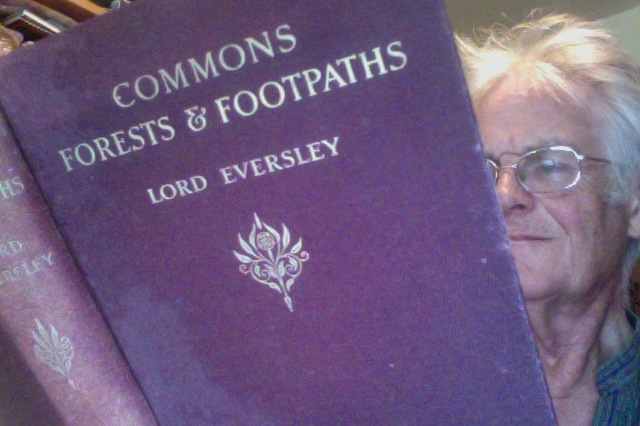
...The general assumption had been that common land was granted by ’superior lords’. On page 5 written in 1910, the author writes:
Owing, however, to the investigations of Professor Nasse, Von Maurer, Sir Henry Maine, Seebohm, and others, another theory has been advanced; namely' that common rights ‘are in most cases survivals of a system of collective ownership of land by the inhabitants of their several districts, the prevalence of which in the early stages of communitieshas been traced over the greater part of Europe. Under this system there was originally no individual ownership of land. It was owned in common by village communities.
Eversley ends with a quote from the poet Oliver Goldsmiths poem, The Deserted Village,
'Our fenceless fields the sons of wealth divide...'
Read of ecological depravity in the Amazon, but learn first how it began in our green and pleasant land. Minoti wrote:
Dear Simon. yes indeed that para will be in my book to be sure in the great debate. I was re-reading it to include in the chapter as I am likely to annotate all the correspondence of HSM around the whole issue of common lands instead of just a list of letters. So they will be organised in such a way as to throw light on his thinking about the topic and support from his overall insights on comparative historical analysis and jurisprudence.  Here is another book but it is to do with his major contribution to comparative historical analysis : his very useful way of filling gaps in history and historical analysis - if you do not get the book not to worry I have an old copy which I will bring to you if my Corfu trip does work next year. By that time I hope to get a rough draft on my Delhi book as well as this one and we can go through his letters together.
I am going to visit the Memorial bench for Eversley near New Forest and would like to have a copy of the photograph of the grave of Sir Henry if you have it somewhere. I would like to put that or a picture of the memorial in Westminster next to the Eversley one and see how it can then intersperse the letters of Sir Henry in communion with the future.
I will write more later I am about to leave for Tonbridge to visit a great environmental historian at a clinic and to also pay my respects to one of the greatest historians of GB and also of common lands Prof Joan Thirsk and her husband Jim* they are 90 and 100 years respectively. Love Minoti. PS You will be my major milestone on the way to HSM.  George Gomme : The Village Community : London, Walter Scott 1890. He is perhaps the most faithful follower of HSM. M
Prof. Dr. Minoti Chakravarty-Kaul, C-59 Uttaranchal, 5 I.P. Extension, Delhi
*Strange coincidence - that Joan's husband, James Thirsk, now 100, wrote Bletchley Park: an inmate's story and must have been there when my grandfather, Sir Henry Maine's grandson, was there, moving between work at Bletchley and his office at The Broadway by St James Park underground station, where he'd been involved since its inception in the Government Code and Cypher School. When I was about ten I learned Grandpa Henry - Henry Maine - had started doing hush-hush work around 1919. My mum had cautioned me about reticence and I've been reflexively incurious ever since - relaxing only with years, and far wider publicity for wartime intelligence, though even now my knowledge of what was involved is minimal.
"Did you go to grandpa's office ever?" I asked my mum last year
 "Oh yes. I used to drop him off there and pick him up when I started driving"
"What was it like?'
"An office. Very ordinary. You know my father also did ARP work during the blitz...night duty on a roof near St Paul's. It was a cover I suppose or maybe he just volunteered."
*** *** ***
Out of Town, I mentioned it a few days back; Charles Webster at Delta has drawn my attention to the pre-offer on Amazon of my stepfather's 9 DVD compilation made in 1986.

Delta are already displaying these DVDs at garden centres and other outlets across the UK with special offers in The Express and The Telegraph. These, with the exception of hitherto unpublished episodes on Stonehenge and Brickworking are the same films as have been available for a long time, though increasingly difficult to buy without looking for used copies on eBay. The previous licensee, Contender, lost interest in marketing 'Jack Hargreaves'. These films are titled Out of Town but they are not original broadcasts of a programme that ran for twenty plus years on Southern Television. Jack compiled them in 1986, five years after the company lost its franchise, using location film he'd bought from Southern for £1 - in lieu of pension. It will be later this year that Delta will be issuing copies of 34 original Out of Town broadcasts only discovered in 2011. The full set will include notes by me and Simon Winter, of Kaleidoscope, describing what was involved in this discovery (a sample sound track - about the ancient hybridity of the English and the land they encountered when they first arrived)

Sunday, 26 June 2011

Seeking Sir Henry in British Columbia

George Feaver, Canadian political scientist, born May 12, 1937 in Hamilton, Ontario, died on 12 May 2008 on his 71st birthday in Vancouver, British Columbia. In 1969 he published From Status to Contract: A Biography of Sir Henry Maine 1822-1888, London:Longmans.
George Feaver
I read Feaver's biography of my great great grandfather - far too cursorily - at the time it came out. It wasn't even my own book but a complimentary copy sent by George to my mother, Barbara or Theodora (to use Minoti's preferred name for her) after Grandpa Henry, Sir Henry's grandson, who'd died a year before publication, in 1968 had shared his sparse collection of Sir Henry's material with George.
I was aware Sir Henry James Sumner Maine was quite a well known ancestor, but his reputation and work passed me by. I got glimpses of others' opinions of his unique contribution to understanding the origins of law and the ancient traditions that underlay the government of rural communities - superlative but elusive opinions.
Jane Maine
At home we've an oil painting of his wife Jane, who on lived many years as his widow after his death in Cannes. In her childhood my mum knew Grannie Maine. I recall my tutor at Trinity Hall, Graham Storey, of which Maine was Master from 1877 until his death, apologising after the College had decided to remove a heavily varnished oil portrait from its dining room wall.
"It's not a good painting. In fact it's awful" he said.
I agreed, entirely unaffected. I recall reading later, in Feaver's biography, that Maine was an impatient sitter, not much interested in being portrayed.
Henry Sumner Maine
Henry James Sumner Maine
It's only in the last year that my interest in Maine has quickened, not so much in his distinctions, his title and a plaque (see p.31 in link) in Westminster Abbey, which I never saw all the years I was at Westminster School, but in his writing and ideas and their significance during his life, and after his death. Again it was the interest and knowledge of others that spurred my present interest - especially their interest in the governance of village communities and the origins of law.
Having already begun to make adjustments to Maine's Wikipedia article - almost entirely lifted from the 1911 Encyclopaedia Britannica - I was scanning the internet and came upon a publication by the young political scientist Karuna Mantena. She had just published Alibis of Empire: Henry Maine and the Ends of Liberal Imperialism (Princeton, 2010). I found her address on the faculty list at Yale, also on Facebook, and wrote to her. She replied almost by return:
Dear Simon Baddeley. Thank for very much for your kind and encouraging note. What a humbling and extraordinary thing to feel connected to Maine in this way! Please allow me to send you and/or your family a copy of the book. It has also appeared in a South Asia edition, which I can send since you may already have the UK/USA edition. If ever I can make a visit to Birmingham, I will be sure to be in touch. all my best, Karuna. Karuna Mantena, Assistant Professor of Political Science, Yale University
I replied with thanks and enthusiasm, hoping I'd said nothing tactless. I'd bought a copy of her book and was reading it. She wrote again:
Karuna Mantena
Dear Simon. It would be my pleasure to send a signed book for your mother. I do hope we can meet one day soon. And certainly if I make it up to the Highlands, I would so delighted to meet your mother. Yes, the book tracks a change from a more liberal-utilitarian moment of imperial civilizers to one more interested in cultural protection and integrity. Maine was at the cusp of that change, and incredible intelligent and perceptive in the debate (others in his camp were more strategically oriented). Indeed, he has had a long reputation in Indian as a friend and defender of Indian village communities. Gandhi was a great admirer of Maine's on this account. And since then a whole host of Indian legal historians have found Maine's work on the impact of English law in India to be especially illuminating. It is wonderful to hear from you, so there is nothing to apologize for. all my best, Karuna
Last September, I got another email - while we were in Corfu:
Dear Mr. Baddeley. A friend of mine, at the University of Hertfordshire  just successfully discovered your exchange with Karuna Mantena who had sent me her dissertation on Sir Henry Sumner Maine since I have written about him in my book on Common Lands and Customary Law: Institutional Change in North India Over the Past Two Centuries published by Oxford University Press, 1996. I knew George Feaver very well who as you know wrote Sir Henry's biography  ... and felt the lack of some of the known sources known to exist in the family's archives to which I had 'lost the trail' so to say. You cannot imagine my excitement, or perhaps you can for I have been living with the research on his papers since 1978. Is it possible for me to meet you sometime as I am in England right now and will be making a presentation at Hallam University on the 17th of this month? Best wishes and look forward to hearing from you. Prof. Minoti Chakravarty-Kaul
And so the view halloo. Since last September Minoti (one of her reviews) has visited my mother in Scotland - twice.
Minoti and Theodora
Her first visit was last September. George Feaver's book sits on the table in front of Minto and Mum. The second visit was earlier this month when I was staying at Brin Croft and Minoti stayed two nights with us there and talked to us both about Sir Henry. Before she left she wondered if I could approach the late George Feaver's family and possibly his university to see if by chance George's estate had any Maine material that might be shared. I quickly found and posted to a Facebook site commemorating Feaver asking if anyone could help and was almost immediately referred to his niece, Robin Peterson, who replied equally quickly to my email, saying she did have things of her uncle's that might interest me. She and her family live in Aldergrove, on the edge of Vancouver, under an hour from the Pacific, and a lot less from the US border hardly 10 miles to the south; about 4700 miles from Birmingham:
Hi Simon. I just received you message and would love to help. I have approx forty boxes to search thru. I know my Uncle had been collecting these books for years. I had tried to donate them to UBC, the University where he taught, but suffice to say they where more interested in me categorising the lot, than receiving it. I know these are quite valuable and want them to go to a good home, where they will be given their due respect. If you know of anyone who is a collector and interested in these, please let me know. Some are in disrepair and need a loving restoration, others are in good  to excellent condition for being over 130 years old.
Maine, Henry Sumner, Early History of Institutions, London, John Murray, Third edition 1880
Maine, Henry Sumner, Dissertations on Early Law and Custom, London, John Murray, 1883
Maine, Henry Sumner, Popular Government, London, John Murray 1885
Maine, Henry Sumner, Popular Government, London, John Murray, Third edition 1886
Maine, Henry Sumner, Village-communities in the East and West; six lectures delivered at Oxford, London, John Murray 1871 - 2 copies ( one in excellent condition )
Maine, Henry Sumner, Village-communities in the East and West; six lectures delivered at Oxford, London, John Murray Third edition 1876
Maine, Henry Sumner, The Whewell Lectures, International Law; a series of lectures delivered before the University of Cambridge, London John Murray, 1888

There may be more. I still have to go thru the boxes. I will try to find the information you wanted,  i.e. Uncle George's working papers, etc. Please let me know if there is anything else you are looking for, and by all means, please  forward this information to Dr.Minoti Chakravarti-Kaul. Cheers, Robin 
Last Friday we had a conversation on Skype - about 7.00am in the morning for me and around midnight for Robin and her family.
In the course of this conversation Robin told me that after his death George Feaver's home was cleared of most of his possession by his family - a perfectly normal process - but that forty boxes of papers, including the books listed above, had been left for disposal by auction. A friend of Robin's daughter (I think) who worked at the auctioneers sent a message to Robin about the sale. She dropped everything and dashed down to the auction, and rescued the boxes - selling at C$1 each - and has them stored in her garage. As we chatted - for over an hour - she showed me George's original bound dissertation on which his book on my great great grandfather had been based with illustrations not in the book, as well as first edition copies of Maine's books that had been in her uncles' library. On 25 June I got this email:
Hi Simon. The books are safely on their way to you Mum's place in Scotland! Darrell took them down to the Fed Ex office in Langley this afternoon. They were picked up for sorting and VIA (Vancouver International Airport), by 3:00PM PST. The tracking number is  **** **** ****, which you can track on the Fed Ex website. The clerk wrapped them with bubble wrap and commented - 'these look old'.  LOL. I feel so much better that they are going home...They should arrive in Inverness no later than July 1st., so your Mum can have a peak thru them before you get there.... I think you'll have fun looking thru these. I just wanted to tell you how much I enjoyed our conversation last night. I'll have to at least  get dressed for the next, lol.  Maybe a little more heads up before the camera starts rolling. Looking as glamorous as Olive from On the Buses takes time. Robin, Darrell, and Family 
*** *** ***
Yesterday afternoon I tried out my new azada on the plot and was delighted at its superiority over the fork and grubbing mattock when it came to clearing more of the untouched weed-riven soil, and I was joined by two spectators - Robin who I know and someone I often see on Victoria Jubilee Allotments - his name Tsitsan - but that's only the sound. I don't know the spelling.  He was curious about my azada and offered to have a go with it.  Verdict? I wish I'd discovered the azada when I started getting the plot ready for planting.
Who breaketh up, timely, his fallow or ley,
sets forward his husbandry many a way ~ Thomas Tusser 1524-80
The azada is a gem of a digging tool. Thanks to those gardeners who recommended I get one, and thanks to Simon at the web mail-order firm Getdigging for sending it so swiftly, and thanks to my friend Robin for another good argument  - about scientific creativity and strimmers.
Earlier I had taken my scythe over again and had a go at cutting the grass strips on either side of Scylla Parkyn's plot. She our Hon.Sec. I found that I could not cut the narrow strips as close as with the strimmer that making such a noise a few plots away. I reminded myself  I need to get better at sharpening my blade and choosing a time when the grass is wetter. All the same Scylla will now be able to use the allotment association's handmower on much shorter grass. I'll hone my scything skills.
Back to the future - a flattering email on 19 July from Simon at getdigging:
Hello Simon. Just a quick note to say I saw your piece on Youtube with your “new Azada” – I didn’t realise it was there until a customer said she had seen it. You look as though you were born with an Azada in your hand - and apparently not even out of breath when, after giving short shrift to a goodly area of sod, you casually strode off with the bell cap for a sip of water; very impressive! Almost as impressive was the deep philosophical discussion which you managed to have with your neighbour at the same time!  Anyway, many thanks for the kind mention; it’s always nice to have a helping hand – being a small one-man band my advertising budget of £5.00/year doesn’t stretch very far so every bit of publicity is always appreciated. All the best, Simon 

Sunday, 29 May 2011

Explaining Sir Henry

His work is phenomenal...and most relevant today
Minoti Chakravarti-Kaul, who's been studying Henry Maine's works the best part of her academic life, is our guest at Brin Croft, taking my mother, his great grand-daughter, through an extended but gentle tutorial on the work of Sir Henry Maine.
"Anything in Europe that has to do with law tends to go back to Greece. They had very famous philosophers to give guidance on governance, from which the Romans borrowed. Where under some circumstances Greek law determined Roman Law Sir Henry found their provenance in ancient law"
"But why did he go to India in the first place?"asked mum
"What Maine recognised was that what they developed - the Pax Romana - was a copy of the spirit within which law developed, as well as being borrowed....when Sir Henry was asked to go to India it was after the Indian Mutiny or what is called the first independence movement in India and a large part of the country was at a critical point...very critical juncture... a need for a reformulation of the rule of law, keeping in mind the ancient roots and Maine who had just published his Ancient Law, was seen as an expert to show the way self-consciously or otherwise to a form of law that to some extent might mimic an earlier imperial process of Pax Romana - that is to say Pax Britannica or a rule of law that could keep the peace.


"
This process was manifest in Greater Punjab that is a large part of northern India which includes Pakistan of today, and here Pax Britannica built on the foundations of custom and famously passed the Punjab Laws Act of 1872 in recognition of such roots. Maine thus helped to lay the foundations of a very important principle of governance - ruling people by their own laws, particularly in village communities which in northern India held 90% of the land. This was in recognition of the self-governaning capacities of village communities which organised land use patterns and joint tenures which resembled the two or three field system in pre-feudal Europe.
"Where do you begin this story? Where would the revenue of the Indian Government after the take-over from the East India come from? It would not be based on pillage and piracy, nor on trade, but on a positive new move to establish a new law, not an imported law from England. Yet it was recognised that law in England had roots in custom.
"
"So how did this work?" asked Mum
"Where did production come from? Land. Agriculture. Natural resources including forestry. One major insight into this...how can I prove what I'm telling you? The change would be like this. Each of the provinces of the Empire in India would have a Lieutenant-Governor who would be advised by a Council with a legislative section able to make laws. Each province's law-making was legalised by legislation - in the case of Punjab, the largest  province, which then included Pakistan, the largest part of British India, for instance - the Punjab Laws Act of 1872, which was based on recognising custom....Punjab had 31 Districts including Delhi right up to the Afghan border and south east to the river Jumna - the huge greater Punjab.""
"How did anyone determine the law?" I asked, fascinated
"In the case of Punjab it was the custom of the village community. Every village would negotiate a principle which became known as  that of Joint Revenue liability for calculating the tax for the entire village and paid jointly by them collectively."
"How did they do that?" Theodora asked
"It was a huge process"
Here we are getting to the core of how law was made by the people on the ground. I was at last beginning to understand something that had long roused my curiosity about my brilliant ancestor. Where did he find and how did he obtain his data; what were - apart from his own creative mind - his primary sources?

Henry Maine
"There was a statement taken from the people on the principles involved. The people who had the land who were to pay the taxes were known as the malikan-deh or those who was recognised long before the British had stepped into Delhi in 1803. The Afghan ruler in Delhi  Sher Shah Suri had taken over from the heir of the first Mogul ruler Babar and had established a method of realising land revenue which the British took over. The Afghans were very much evident in India as there were large caravans of traders and cattle herders who moved across northern India right up to Calcutta, travelling via the Grand Trunk Road from Kabul made famous by Rudyard Kipling in his novel Kim. Today this is called Sher Shah Suri Marg or National Highway 1.
"There was a statement taken from the people on the principles involved. The people who had the land who were to pay the taxes were known as the malikan-deh (proprietory body of the village). Sir Henry didn't create this.
The system of land revenue settlements with village-communities resulted in records of rules which were put down in the Village Administration Paper which was known as Wajib-ul-Arz ('this which is declared as right') - containing all the customs of the villagers as 'our' rules. These were originally written down by the Afghan ruler - Sher Shah Suri. He laid the foundations of this kind of revenue settlement which was later taken up  by the Mughals of whom the greatest was Akbar.  These rules were not foisted on the villagers. It was their declaration. The script used to record such declarations was Shikasta."
"This is wonderful, Minoti" I said "I learn, I learn!"
All of this has been described in detail in Minoti's Common Lands and Customary Law: Institutional Change in North India over the Past Two Centuries Oxford University Press, 1996, some of it plagiarised by other academics I suspect.
In a break, Mum mentioned that she was born in 1917 in Sir Henry's home, 27 Cornwall Gardens
"You know what happened?" said Minoti making a diversion "A lot of people who served in the government of India were coming and buying houses in the neighbourhood of Cornwall Gardens and so many such people came to live there, a man called Henry Thring, came to refer to this area of Kensington as 'Maine's Village Community.'"
"Simon. You are our Sutradhar... to continue, Theodora (this is my mother's first name; one I've never used, but which she and Minoti enjoy)...I'm giving proof of why these customs were not dated. These villagers were asked to recount their history as far back as they could remember. The settlement officers were recording the history of each village. They recorded these in Shikasta - a written language not a spoken language (shikasta, shekasta شکسته shekasteh). These histories are called Shajra Nasb, Shajra-e-Nasab (shajra - map, nasb - fate - the fate of the village) [see: Wajib-ul-Arz, Riwaj-i-ams]. We use the word 'history' to describe our past. They use the word 'mapping'. These are the stepping stones to understanding the work of Sir Henry. I have seen these records, heard them being read out by the patwari."
Minoti" I said "None of this was mentioned by George Feaver in his biography of Maine"
"I know he told me when we met that he'd missed out about common property resources in India and all that"
"So how did Maine encounter these things?"
"Because the settlement officers recorded their findings in reports that would have gone to the Lieutenant-Governor...proceedings which would certainly have got to Maine via the Viceroy and thence to the Secretary of State who would certainly have discussed them with Sir Henry as the Legal Member of the Viceroy's and later the Secretary of State's Council in London.."
Mum joined in "I remember as a little girl at Henmead Hall, my grandfather's wife, Fanny, seeing all these 'dry old books by some relative of ours' and getting rid of them. I was a little girl but I remember seeing all these books by Sir Henry with 'John Murray', his publisher's name, engraved on them."

Maine, Henry Sumner, Ancient Law: Its Connection With the Early History of Society, and Its Relation to Modern Ideas, London, John Murray, 1861
Maine, Henry Sumner, Village-communities in the East and West; six lectures delivered at Oxford, London, John Murray, 1871
Maine, Henry Sumner, Early History of Institutions, London, John Murray, 1875
Maine, Henry Sumner, Dissertations on Early Law and Custom, New York, John Holt, 1883
Maine, Henry Sumner, Popular Government, London, John Murray, 1886

"I'll give you a link. You know of Paul Vingradoff who occupied Sir Henry's Chair - Chair of Historical and Comparative Jurisprudence at Oxford. You know what Vinogradoff did? Paul went to India in, I think, 1923, and he looked at the village papers regarding tenancy to find out whether Sir Henry Maine had got his information from the grassroots. So he followed Sir Henry's track in India by going to seek out his sources, with regard especially to The Punjab Tenancy Papers."
Looking at Minoti's old map of Kanjhawala
Mum was having difficulty concentrating and Heather brought her in some lunch so we took a break.
I am increasingly aware of the originality of Minoti's research focus. So much scholarship in this area has been done by political scientists. They begin with an interest in the working of power and tend to see the gathering of village details - the recording of a Shajra Nasb, the fate map of the village, from the village accountant, the patwari, by an imperial settlement officer as a means of refining a process of subordination and oppression. Minoti who can 'dance' with vexation, as she delivers public lectures, at political injustice and human silliness, is coming from a different place. She is intrigued with the possibilities of discovering, as did Maine the scholar, the enduring complexity and effectiveness of the self-governing capacity of village communities with customary law, and from there, extending the possibilities of such very old systems to the modern enthusiasm for bottom-up governance and local autonomy, with its implications for creating ecologically sound and sustainable self-governing communities

.

Kanjhawala ...from a review of Minoti's book in English Historical Review
** ** **
With Minoti off the Garbole Road
In the afternoon Richard drove Minoti and I to the high moors south of Strathnairn to see Inverness-shire from that narrow road 1000 feet higher than Brin Croft. A mile and a half along the road he turned sharp left along a dirt road towards a line of turbines harvesting the wind that blow over the tops. The blade tips of the turbines trailed wisps of vapour - a thin vortex of spinning air - emanating power, embracing the wind in great gasping turns, shadows sweeping the ground. What a pleasure to learn that both the Swiss and the German governments, responding to an educated public dislike of nuclear power, are phasing it out over the next few decades. I'd like to think that there is a growing population prepared to be more frugal in its use of energy, to live more sustainably, to turn away from consuming, to think about new ways of living together on the earth, to question brilliantly and shrewdly the grim mantra of growth.
A reaction to posting this clip:
18th and 19th century follies were at least decorative....late 20th and early 21st century wind farms are just as much follies....only totally non decorative. The power they generate is a tiny fraction of our communal needs...
Me: Wind and sun alone, even without wave, tide and geothermal power, exist in renewable abundance. Our present problem is one of harvesting - a challenge we're only beginning to understand. Meeting our communal needs via fossil fuel is unsustainable. Public hostility and the precautionary principle have raised doubts among leading democracies - Switzerland and Germany for a start - about further nuclear investment.
** ***
Vexing news from the Ano Korakiana website - despite the cash being allocated and supposedly guaranteed for the restoration of the old Philharmonic building just south of Venetia at the top of the village, work has been stopped for the last two months, possibly longer as we noticed when strolling up that way in February through April this year...
Ο "Καλλικράτης" έχει τελικά επιπτώσεις ακόμη και στο εκτελούμενο έργο του κτιρίου της Φιλαρμονικής.Οι εργασίες έχουν εδώ και 2 μήνες σταματήσει, αφού οι υπηρεσίες αδυνατούν να πληρώσουν το εργολάβο, παρότι τα χρήματα είναι κατατεθιμένα στο λογαριασμό του έργου.
**** ****
Last September I got an email asking to use some of Jack's films for a documentary about how TV had treated the countryside:
Dear Mr Baddeley. I found your contacts via the web, and I hope you do not mind me contacting you? We are making a documentary for BBC4 which will be a celebratory look at the relationship between the countryside and television over the years, and across the genres - from drama and comedy to factual programmes in seminal British television. We have interview contributions from Kate Humble and Bill Oddie, John Craven and Bill Bryson to name a few. We would dearly love to include extracts from 'Out of Town' by your late step-father Jack Hargreaves, however, we are having trouble tracking down the owners of the material. We are particularly interested in the material he produced while at Southern TV, in black and white. I wondered if you had any knowledge of who might hold this material, or can point me in the correct direction? I have tried contacting one of the dvd distributors for the later series, however, they seemed unsure, and directed me to an Australian company. If you could offer me any advice, I would be most grateful, as we feel it would be an important addition to our programme. Please don't hesitate to contact me if you require further information. Many thanks in advance. very best wishes Dee Edmonds, Production Manager, Crocodile Media Ltd, Glasgow
I pointed Dee towards the South West Film and Television Archive and got thanks and a payment of £200 for using the material they chose, in discussion with Jennie at Plymouth, with rights over its specific use in Crocodile's programme for the next 5 years, then forgot about it. I got an email from Tony Herbert, member of the informal JH Committee, a few days ago:
Dear Simon. My apologies if you already know of this but before doing anything else I must mail you as I have noticed in Radio Times that a new series is starting on BBC4 on Sunday 29th May at 9pm entitled 'Welly Telly - The Countryside On Television', exploring how British TV's coverage of rural issues has changed over the years. According to the write up tributes are paid to Jack. The programme is repeated on following Thursday at 8pm. Best wishes Tony
I'm not keen on television about television. It reminds me of 'resurrection bolly' - a barrack room stew of the previous week's leftovers. Even so my heart took a little dip at the whimsical 'Welly Telly', even though briefed on the need for catchy titles as bait for commissioning editors - to quote from a diary entry:
You know I was listening to a podcast in which Aris Roussinos, who'd rather run an olive oil plantation on ancestral land in Corfu, makes his current crust as a TV development producer - a job my stepfather did as well as actually broadcasting. Aris was speaking about the 'massive crisis' in TV broadcasting (10.14 in the Word podcast 20 May '10 with a reference to Aris' article 'Why do they commission this rubbish' here, and the removed YouTube 'Monkey Tennis' episode here) and the struggle to invent programmes that would keep up viewing. "It starts with a catchy title", he'd said. You need that to catch a commissioning editor's short attention scanning hundreds of ideas ... I don't think Amy or Guy were listening to me. "Aris spoke about an idea for a film about gay Taliban - (from 16.50 in the podcast) "not that new so... "
This was an hour long programme on BBC4 with impressive credentials. Alex James narrated. John Moulson directed and produced. Academic film and television critic Matthew Sweet, Jack Kibble-White, a experienced follower of trends on television, advised. Dick Fiddy of the respected British Film Institute condescended to his childhood enthusiasm for Jack's "very amiable slow delivery" looking at "old time crafts like whittling" or going "for a ramble with his dog". Interviewed were mainstays of countryside programmes, well known commentators on contemporary culture, a few bright comedians with snatches from famous comedies like The Good Life and Last of the Summer Wine. We watched for 15 minutes on Sunday - Mum, me, Minoti and Richard - then turned it off. Wondering if I was making hasty judgement - easy to do - I picked it up later on-line hoping I'd been unfair. The programme remained unsatisfactory. This is little to do with the talents who appeared and everything to do with the capacity of finance-strapped television to take a complicated theme - the way television over fifty years has presented the countryside to a thoroughly metropolitan population. I'd find it impossible in these circumstances to give so intriguing subject a smidgen of justice. Welly telly didn't just fail to comprehend, it didn't even know there was something to be comprehended. That's the scale of the disjunction that Jack, with one foot in the city, the other in the country, was trying - entertainingly - to explain. I wanted to be pleased by Welly Telly but the programme was taking us all down 'So What Street'; encyclopaedic in its coverage of countryside broadcasting or commentaries on it, though - Dee did not use the really early black and white film of Jack's Out of Town* even though we know some of this is in the archive - sprinkled with opinion and sentiment but weak on narrative, unwilling to take a position - politics appeared briefly and superficially with crowd pictures in Whitehall - and seemingly unable to explain; missing, or sidestepping, seismic changes in agriculture, the dislocation of rural populations, the disappearance of a way of life, the deep disconnection of most of us from the land, the transformation of the country mentally, if not wholly in activity, into the city of Britain - a metropolitan population surrounded by parkland.
I sent my opinion of Welly Telly to members of the JH Committee and got this reply from Ian:
Hi Simon. Not much of a case for the defence I'm afraid, you have summed it up pretty well. I have seen some very good documentaries on BBC4 but sadly this wasn't one of them, the lightweight nature of it leads me to suspect that it was made with an eye to showing it on other channels.  A particular downside was the involvement of Dick Fiddy of the BFI, a person I have some respect for but I don't think did himself any favours.  I contacted the BFI some months ago about their Out of Town holdings but not had the courtesy of a reply. A wasted opportunity really, there is a good programme to be made but that wasn't it. A small plus, as a lover of archive television in general, was the clip of Ted Moult's Farmers' Quiz, which I hadn't seen before and was quite extraordinary. I hope you and Tony have a useful trip to Mrs Bréhaut. I plan next Thursday to visit the British Library newspaper depository at Collingdale to work on the definitive episode guide. They have a complete set of Southern edition TV Times so I expect to make some good progress. Kind regards, Ian
Ian's reference to the farmers' quiz Top of the Farm '69 - rang a bell. I realised something that had been troubling me about Welly Telly; something I'd missed about my stepfather's approach to television. Ian referred to a bizarre clip in B & W - 'bizarre' because Vic Phillips pauses over five seconds before answering - an easy laugh at a frequent longeur in the early days of the medium. Then there was the matter of Jack's approach to sound. David Knowles of Lacewing reminded me only the other day of Jack's seemingly casual attitude to his soundtrack. Once he had superlative images - as he did from Stan Bréhaut in 21 years of Out of Town and later Steve Wagstaff for Old Country, JH would talk over a location film after approving a few, mainly symbolic, background dubs from the sound library - a splash, a crowd sound, a whistle and a bang - letting viewers fill in wth their imagination. I can see why Dee Edmonds for Crocodile Media would have though she'd be trespassing if she tried to bring Jack's archive B & W film to life with some similar composite of soundless film, library sound dubs and a commentary - something impossible without Jack.
Thinking about Welly Telly a few days later I realised it's greatest weakness was only marginally to do with different takes on the countryside. What was missing was an intelligent discussion of the art and grammar of television. Jack was praised at the end of Welly Telly as a pioneer of countryside broadcasting, but his greatest achievement was to find a perfect vehicle for his subject and a style of broadcasting, almost invariably live - not on location but in the studio shed and the live voice-over on a sound dubbed silent film - which allowed an avuncular and - in Dick Fiddy's infant memory - 'amiable' front for a cunning sometimes scathing critique of contemporary social mores.

Did they think about the skylarks when they built Mayfair
on the grazings that ran down to the Shepherd’s Market?

Did they worry about the snipe when they drained the marshes
behind St.James’s Palace to build Belgravia?

Where did the kite go when they dug the London sewers?

Do the piles they drove down through the beaver’s dam hold
firm the supermarket in Newbury High Street?

Who cooked the big trout that lay under the village bridge
at Wandsworth?  Who feasted on the last salmon that was
netted at Tower Hamlets?

Now they come to put central heating in the ploughman’s hovel.

They claim the sun that used to bake the hay.  And breathe
the breeze in which the pointing dog caught a hundred scents.

They walk out in trainers and T-shirts that say “Save the
Rain Forest”.

“Stand back!” they say.  “We have a right to walk where we please!”

But we look where they trod before and shudder for what
follows in their footsteps.

I said I must write a warning.  But I was angry and - as the
Japanese say - to be angry is only to make yourself ridiculous.

So we will live out our days in the cracks between the
concrete.  And then they will pour cement on top of us.

J.H.
1993

** ** **
 In Greece's big cities - Thessaloniki and Athens - citizen-journalist Teacherdude - Craig Wherlock - reports on continuing but peaceful street demonstrations against the government's austerity measures.
** ** **
Extract from page 2 of the translation of Maung Tet Pyo's Customary Law of the Chin Tribe translated by Maung Shwe Eik, Assistant Government Translator, British Burma with a preface by John Jardine, Judicial Commissioner of British Burma, Rangoon 1884. This book was one of the few books left from what must have been Sir Henry Maine's library, having his book plate inside the front cover. It seeemd to me that this extract captured rather well the point that Minoti was making to me about Maine's emphasis on the unwritten laws of village communities.

*** ***
An ugly story appears in the Inverness Courier of 27 May '11.
A young trainee gamekeeper called James Rolfe was fined £1500 for being found in possession of a dead Red Kite during a police raid on the Moy estate last June, where the Highland Game Fair started by mum's husband Angus over 25 years ago, is held every August. Rolfe is a pawn in an emotive conflict reflecting changing times, the incursion into the highland moors of a political battle whose chief protagonists and antagonists are city dwellers. New monitoring technology has played an instrumental part in securing Rolfe's unprecedented conviction; CSI Highlands. Moy is the ancestral home of the Mackintosh Clan, a beautiful place we know well. Victor Beamish and Celia Mackintosh are among 250 Scottish Estate owners who last year - weeks before a police raid on the Moy Estate - signed a letter to the Scottish Government Minister for Environment, Roseanna Cunningham:
Roseanna Cunningham
It is for us a straightforward decision to underline our view of illegal poisoning. Frankly, we condemn it out of hand and it has to stop. The message must go out to the people who indulge in such criminal behaviour that what they do is totally unacceptable to the overwhelming majority who have the true interests of the countryside at heart. We will continue to do everything we can to ensure that message is conveyed across the land management sector. We do not presume guilt nor refer to any particular incident, but the apparent deliberate poisoning of protected species in recent years has left us utterly dismayed. We also support the full weight of the law being brought to bear on those who are involved in illegal poisoning and endorse the efforts of the Partnership for Action against Wildlife Crime, in which our representative organisations are active and enthusiastic participants.
The fining of James Rolfe is a tiny breakthrough - the slapping of a foot soldier. Grouse shooting, or wing-shooting covering a wider range of game birds, is a business in Scotland - fuelled by a rich urban population's willingness to pay high fees for an opportunity to shoot grouse, pheasant, deer and duck. There are implicit pressures on the staff responsible for maintaining hunting spaces across Scotland to ensure their international customers return home feeling they've had value for money. Other Highland denizens, especially raptors, which reduce the customer's bag by preying on eggs, chicks or adult game birds are targeted by some veteran keepers, whose trainees are liable to learn from their older mentors. Poisoned bait put out to kill hooded crows, kills raptors too, but fudges the issue making convictions incredibly complicated. The Scottish Parliament is proposing amendments to the Wildlife and Natural Environment Bill, trying to get at people higher up than gamekeepers, by introducing a law of vicarious liability that would target their employers.
The level of monitoring is increasing with growing political committment to stopping the illegal killing of protected species. The economics of grouse shooting is opposed to the economics of wildlife tourism and the growing experience and political strength of those concerned with protection of threatened species - especially birds of prey. Rolfe's red kite was fitted with a satellite-tag  monitored by RSPB Scotland staff and adopted - as are many - by pupils at a local primary school. Its disappearance from the monitor triggered an alarm and search. The  discovery of crudely hidden dismembered remains eventually led to the raid last June on the Moy Estate by police in a fleet of vehicles supported by  representatives from the RSPB, Scottish SPCA, Scottish Natural Heritage, the National Wildlife Crime Unit, and the Scottish Government Rural Payments and Inspectorate.
When I'm at the Moy Fair in early August - an event I've enjoyed for over twenty years - I shall keep my ear to the ground

Monday, 27 September 2010

A bumble bee in the cockpit

Rain arrived in the early hours. I heard its patter before dawn and snoozed the better. By midday water was spouting in gouts from the gutter pipes, pouring down steps in the village like a burn in spate, running in rivulets down the street, gurgling into the cross street gutters. Heavy clouds streamed up from the south flowing up the sides of the mountains behind the village hiding the crags, blowing a loppy sea toward the strait. It rained all afternoon, into the evening. I was driving back alone from Tzavros after midnight, windscreen wipers at double speed. At the corner just beyond Marmara Trifona – stone factory – I skidded the car ending up in brambles and hollyoak facing back the way I’d come. In seconds I knew I was stuck there. But I was unhurt and so was the car. A Samaritan had already pulled up just ahead of me. Was I alright “Can I take you anywhere?” Andrioti on his way to Acharavi gave me a lift home to Ano Korakiana. Mark, who I texted, offered to help drag me out but said it was a very dangerous corner ‘better try your car hire company’. I cycled down to see the scene in the morning, sun shining again.
As I surveyed the scene several people stopped to check no-one had been hurt and offer assistance, but Yianni from ValuePlus cars in Sidari was sorting me out in no time. Early Sunday but Sophia, his wife - I think - answered the phone almost instantly. She contacted Yianni and a few minutes later said he’d be along with a tow truck in 45 minutes. Yianni’s first action on arriving was not to check his car but to express his relief I was safe and ask “Are you alright?”, later checking the new tires on the car in case they had been a problem, when I was well aware it was my fault for touching the brake too late on a steep corner in drenching rain. The two truck men, Spiros and another Yiannis, spoke for a few moments, then positioned the truck across the road, with one stopping northward traffic and me waving down southward. In less than five minutes the car was out of the verge, the road clear, and the car on the truck, taken to a layby a hundred yards away, and off loaded. Yianni drove it a kilometer back and forth and back and handed it back. “Everything’s fine. No worry. Pay the truck €40” Which I did gladly, with a tip, especially as I’d been offered an earlier tow for €90 by another passing truck while I was waiting for Yianni.
I’d not told Lin the night before what happened. Wanted it sorted first. Now I did, realizing how fortunate it was that I’d not had my skid at a lot of other places where I could have fallen off the road, toppled the car, injured or killed myself and worse done the same to another on the road. This is how everything goes pearshaped in life; how easily and ordinarily the man with the scythe can drop in for a chat. Now apart from the lesson about wet roads on Corfu – told me plenty of times – I hold the memory of people’s kindness and efficiency. That has so often been my experience here. ** ** ** Nice news from Handsworth. After lying dormant for three weeks rain has brought forth our potatoes, photographed by Richard in the rows I planted them at the end of August.
Chris on the neighbouring plot emailed:
Hi Simon. Good news from hobbit land your tatties are looking great and all seemed to have formed plants at least 15cm. They all seem to have sprouted. Only half of my last ones seem to have come up which is amazing. I have never grown potatoes before so will be interested in any ideas you have when they are ready to eat. We seem to have good soil. I have put my shed up only roof needs finishing. New leader for labour elected today as I find out my and Perdis and teams NHS jobs are now likely to end in April and all cycling work with BCC and Sandwell NHS seems to be slowing and payments have not been made this month. It will be good that the allotment will mean I will not get bored and there will be plenty of time to get good food next year. Hope you are enjoying your break. Yours Chris
** ** ** Earlier in the week: Lin, tidying, broke a favourite piece of strawberry glass; tiny fragments over the marble floor. Natasha, in a brown study, sat on her step was exclaiming about the high cost of the English language book her son needs for his first lessons. We’ve got more dictionaries than we need collected at table-top sales, so I could at least offer that. Apart from our good fortune in neighbours, we’ve already had infinitely more in generosity, food, coffees and wine, informal lessons and invitations to the family table, so it was a relief she accepted it as tiny quid pro quo, but we’re far from evens on gift exchange. **** Email from Val back in New Zealand:
Hi Lin. Sorry I didn’t email you as soon as I arrived, but I was too tired and too cold. Would you believe; freezing weather and snow? So I spent the evening in front of a hot fire. … I slept on all flights on the way home (even from Christchurch to Dunedin , which was very bumpy because of bad weather, and a small plane), and I slept for 10 hours last night! I bought some duty free perfume in Athens; no problem until I got to Bangkok, there a custom officer insisted I put the SEALED duty free bag in a snap lock plastic bag! No problems with the couple of things that I had bought in Dubai. In Sydney there were no problems with the couple of things that I had bought in Dubai , but the customs official - a woman - was concerned with the amount of perfume in the bottle which was still inside the sealed duty free bag from Athens , which was still inside the snap lock bag from Bangkok . Having assured herself that it was an OK amount, she informed me that she had to x ray it again!!! When I got to Christchurch there was no problem with the perfume but as I had come via Dubai and had bought duty free there, I was accosted by a male customs officer at the carousel while I was waiting for my case, wanting to know if I had bought any pipes (hookahs) in Dubai , or any other wooden things. By this time I was feeling very jaded and very belligerent, I just told him “Oh for God’s sake, I have enough bloody crap at home without importing any”. When he stopped laughing, he told me he had to ask because several times a week they had people trying to bring them into the country. The flight from Christchurch was delayed by nearly an hour because there was a bumble bee in the cockpit, and they had to search the airport for some fly spray! It would have been quicker if someone had driven to the nearest shop and bought some. (I have just glanced out of the window, it’s snowing again, so much for showing off my sun tan!) The insect bites are no worse, or better come to that. By the time I got home I had a thing the size and shape of a rugby ball at the end of each leg, but the swelling has gone down considerably overnight. Love Val Hi Val. Glad you arrived safely, in spite of your encounters with overenthusiastic customs officials, and managed to sleep the journey away. Hope I can do the same when we come over! Loved the bit about the bumble bee in the cockpit. Hope the bites will be better soon - I had a nasty one between my big toe and the next toe (the little buggers will find any bit that hasn't been doused in anti-mos stuff!), but good old Germolene has done the trick. Now that you're not here the mosquitoes have turned their attentions to me. Simon is obviously their last choice - not sure what that says about him. He did, however, trip up the steps today and managed to save himself by putting his hand on a wasp, which promptly managed to sting him before being crushed to death. Two Piriton tablets and Anthisan cream to the rescue! The weather has continued very hot since you left, but they've forecast rain tomorrow. We've managed to get some work done…Still plenty to do…Apparently it's freezing cold in the UK too, so I've got that to look forward to. Must go now. I''ll be in touch in a few days. Can't Skype, as it's too early for you. Love Lin
*** ***
Rain rain rain - and a good thing too. Cleaning the roads, washing the walls and paths, freshening the air, reducing humidity. It is almost impossible to imagine sun and brightness when the south wind arrives with its freight of mist and damp. Lin was fussing over a tiny leak in our roof in the back room upstairs and through a join in our flue pipe. For her its like a flaw in her plans for the house that even a drop of rain should find its way into her home. I scolded her for starting at a flea. She almost wept. In the village few people are about. The season is ending for tourism. Wood is being delivered and stored for the winter. Me. I like this weather, quite as much as when its sunny. It shows things in different light; cues different reflections.
A wet day in Ano Korakiana - Ισχυρό ΚΚΕ
**** In Scotland I have news, a few days ago, of the happy meeting of Minoti Chakravarti-Kaul and my mother, who Minto calls Theodora - which is one of my mum's names, but one I've never heard used. She has a way of giving special people she meets a choice of her names - Barbara, Poppet, Theo, Theodora.. A plot is unfolding - loose ends woven; nothing if not intriguing.
Email from Minto (mum says that's the diminutive they used) during their meeting at Brin Croft in the Highlands:
Dear Simon.Thank you so much for your emails and it is only just this moment that I have been able to sit down to my netbook in St Andrews - home of my daughter. I did not want to take up more than 2 hours with dear Theodora Sumner Maine - she will be just that for me for the rest of my life. Unknown to her we did not tell her that we would limit our time and so when we did get up to leave she was just in her natural mode of seeing us off. Contrary to what Sharon said she had no problems with my accent and I spoke up just a little and also went slowly but she is so very alert and it was amazing how she got on to the issue of common lands in the UK.
I left her the big volume on the tradition of commoning with her and we will post the latest copies to her from Langford soon. She wants to know everything about the movement. That is how we could not talk much about what I had planned to ask her and also I had to abandon the whole set of questions I had prepared to ask her. It does not matter as she asked me within a few minutes when I would come back and could I stay with her and I was amazed at how things turned around. She asked this several times so I told her that I would try and be back with her about February/March and if she had her grand children around her that I would rent a cottage somewhere and work on my book and bump it off her and she was delighted with the decision and said she would note it in her diary.
I was going to write chronologically about our visit but I will wait till I get back to Langford and write a more coherent account about our time with Theodora. But let me just say that when I first entered her home there she was like a Dresden china image of Lady Maine and the aura about her and the place was so beautiful and inviting that I almost did not remember all the formal circumstances. When we parted both of us had tears in our eyes as she said that Sir Henry would be pleased with us meeting and remembering him the way we did.
I did tell her a lot of things about Sir Henry and India and the aftermath of the mutiny etc....for the time please bear with me if I am not able to write anything which will capture the extraordinary spirit of our meeting - it was like linking to a hallowed past as if the time had not elapsed. Theodora is just amazing. God bless her. Thank you very much Simon for making all this possible. Regards, Minoti. Prof. Dr. Minoti Chakravarty-Kaul, C-59 Uttaranchal, 5 I.P. Extension, Delhi 110092 URL: http://commonlandsresearch.info
PS. The book shown in my hand there is the one with the paper cuttings of the time ... but the book itself will stay here till I come back next year and bring it back for the collection which may be we should index. What do you say? I have promised Theodora to organise the papers and books she says these are in the other house from where she had shifted to Brin Croft. She had no idea that her father, that is H.C.S. Maine, had several important groups of letters which he had made available to George Feaver! ...She is very interested in the issues of grazing lands in Scotland and shepherding.
And what Professor Chakravarti-Kaul added when I spoke to her on the phone while she was at Brin Croft, among other things, was "Your mother and I have been talking not about the past but about the future!"
Note: The photo of Minoti and my mother at Brin Croft is by Dr Peter Lane 
 ** ** **
 How lucky that now in my late 60s I encounter The Pickwick Papers. I could never have enjoyed these when younger. I wouldn't have understood or found it possible to engage with Dickens' first novel - though others of his I've enjoyed since youth. Leave reading Pickwick until later - like Cavafy. If it's taught in school play truant. Save for old age!
Sam Weller and Samuel Pickwick
*** *** Corfucius has pointed out that a 'spineless' news editor at the BBC has removed an account by the excellent freelancer Malcolm Brabant about the throwing of a shoe at George Papandreou during a recent protest in Thessaloniki. But see this from Teacherdude - citizen journalist - on 30 Sept '10.

Back numbers

Simon Baddeley